서 론
어류들은 경쟁을 감소시키고 동일 서식지에서 공존하기 위 하여 시기, 공간, 먹이 등의 자원을 분할하여 공유한다(Platell and Potter, 2001; White et al., 2004). 군집 구조를 조절하는 자 원 중에서, 공존하는 어류 사이에서 다른 종류의 먹이 이용과 먹이 분할은 유사한 종들이 공존하기 위한 중요한 역할을 하 고(Ross, 1986), 종종 생태지위(niche) 분리의 기본적인 매커 니즘이 된다(Gerking, 1994; Duarte and Garcia, 1999). 그리 고 이에 관한 연구는 지속적인 생물다양성 보존을 위한 생태
계 관리의 관점에서 유용한 정보가 된다(Micheli and Halpern, 2005; Greenstreet and Rogers, 2006).
Amblychaeturichthys속 어류는 망둥어과(Gobiidae)에 속하 며, 우리나라에서 도화망둑(A. hexanema)과 수염문절(A. scii
stius) 2종이 출현하는 것으로 알려져 있다(Kim et al., 2005).
두 어종은 우리나라 전 연안에 출현하며, 조간대 지역보다 다 소 수심이 깊은 연안의 저서환경에 분포하는 것으로 알려져 있다(Kim et al., 2005). 도화망둑과 수염문절은 주로 저인망에 의해 부수어획물(bycatch)로 어획되며, 다른 어류에 비해 상 대적으로 현존량이 낮아 우리나라 저서 어류군집의 비우점종 으로 알려져 있다(e.g. Lee, 1996; Huh and Chung, 1999; Park, 2010). 비록 조사해역에서 두 어종은 저서 어류군집의 비우 점종에 속하지만(Park, 2010), 달고기(Zeus faber)와 황아귀
—79 — http://www.fishkorea.or.kr
동해 남부 연안에 출현하는 도화망둑 (Amblychaeturichthys
hexanema)과 수염문절(Amblychaeturichthys sciistius)의 먹이 분할
허성회·박주면1,
*·
백근욱2부경대학교 해양학과, 1맥쿼리대학교 생물학부, 2경상대학교 해양식품생명의학과
Diet Partitioning between Co-occurring Amblychaeturichthys hexanema and Amblychaeturichthys sciistius in the South eastern Korean Waters by Sung-Hoi Huh, Joo Myun Park1,* and Gun Wook Baeck2 (Department of Oceanography, Pukyong National University, Busan 48508, Korea; 1Department of Biological Sciences, Macquarie University, Sydney, NSW 2109, Australia; 2Department of Seafood and Aquaculture, Gyeongsang National University, Tongyeong 53064, Korea)
ABSTRACT Stomach contents of Amblychaeturichthys hexanema and A. sciistius(Perciformes:
Gobiidae) from southeastern waters off Korea were analyzed to determine dietary habits and the presence of any inter- and intra-specific partitioning of food resources. These two species were bottom-feeding carnivores that consumed mainly benthic crustaceans, and other demersal invertebrates and planktonic organisms were also important in their diets. Non-metric multidimensional scaling(nMDS) ordination and multivariate analyses based on gravimetric contributions of the different prey taxa to stomach contents revealed significant inter-specific dietary differences; i.e. partitioning of food resources between the two species. Size-related changes, however, were not significant for their diets. Differences in the types and range of prey ingested by the two species could often be related to differences in the feeding behaviors. Our results of stomach contents analyses provide clear evidence of niche segregation between co-occurring A. hexanema and A. sciistius in southeastern Korean waters, which would reduce the likelihood of inter-specific competition for food resources.
Key words: Stomach contents, Gobiidae, East Sea, resource partitioning, multivariate analysis
* Corresponding author: Joo Myun Park Tel: 82516296570, Fax: 82516296565, Email: [email protected] ISSN: 1225-8598(Print), 2288-3371(Online)
Accepted: June 27, 2016
(Lophius litulon) 같은 저서 생태계 상위포식자에게 포식되어 이들의 잠재적 먹이원으로써 중요한 역할을 한다(Huh et al., 2006; Park et al., 2014).
도화망둑과 수염문절은 현존량이 낮아 국내에서는 연안 해 역 어류 군집 연구에서 두 어종의 출현여부만을 보고하였다 (Lee, 1996; Huh and Chung, 1999; Park, 2010). 그러나 중국 동북부 Jiaozhou Bay 에 출현하는 어류 군집 연구에서 도화 망둑을 우점종으로 보고하였고(Mei et al., 2010), 도화망둑에 관한 섭식생태가 연구되었다(Han et al., 2013). 다른 망둥어 과 어류의 경우 국내에서는 조간대에 출현하는 망둥어과 어류 의 섭식생태에 관한 연구가 있었고, 대부분 망둥어류는 크기 가 작은 저서 무척추동물을 섭식하였다(e.g. Huh and Kwak, 1999; Kwak et al., 2010; Baeck et al., 2010, 2013b). 그리고 망 둥어과 어류 사이의 섭식관계 연구에서 공존하는 유사한 형 태의 망둥어과 어류들은 비슷한 먹이생물을 섭식하였지만, 어 느 정도 먹이자원 이용의 차이를 나타내었다(Salgado et al., 2004; Baeck et al., 2013b). 섭식생태에 관한 연구는 생태계 내 먹이망(food web)에서 포식자 또는 피식자로서 어류의 역 할을 이해하는데 중요한 연구 분야임에도 불구하고(Wootton, 1990; Brodeur and Pearcy, 1992), 연구해역 주변에서 망둥어과 어류를 대상으로 한 섭식생태 연구는 없었다.
본 연구는 동해 남부 연안에 출현하는 도화망둑과 수염문 절의 위 내용물 분석을 통하여 1) 두 어종의 위 내용물 조성을 파악하고, 2) 성장에 따른 위 내용물 조성의 변화가 있는지 분 석하고, 3) 두 어종 간 섭식된 먹이생물에서 차이가 있는지에 관하여 조사하였다. 본 연구의 결과는 저서 생태계 관리와 보 전을 위한 기초 자료가 되고 향후 연구 지역에서 어종 간 섭 식관계 및 먹이망 연구를 위한 중요한 자료가 될 것이다.
재료 및 방법
1. 연구지역 및 시료채집
본 연구에 사용된 시료는 동해 남부 연안에서 채집하였다 (35°15′N~35°18′N, 129°17′E~129°21′E). 도화망둑과 수염문 절 시료는 소형저인망(길이=20m, 폭=4m, 날개 그물의 망 목=3cm, 자루 그물의 망목=1cm)을 이용하여 수심 30~60 m에서 2006년 1월에서 12월까지 매월 채집하였다. 어류채집 은 소조기 낮 동안 수행하였다. 채집된 시료를 냉장 보관하여 실험실로 운반한 뒤, 위 내용물의 소화를 방지하기 위하여 5%
포르말린에 고정하여 보관하였다. 이후 실험실에서 각 개체의 표준체장(standard length, SL)과 체중을 각각 mm와 g 단위까 지 측정하였다. 측정된 개체는 위 부분을 분리한 뒤 위 내용물 분석 전까지 70% 에탄올에 보관하였다.
2. 위 내용물 분석
각 개체의 위 부분은 해부현미경 아래에서 핀셋을 이용하여 절개한 뒤, 먹이생물을 종류별로 구분하였다. 발견된 먹이생 물을 가능한 종(species) 수준까지 분류하였으며, 소화가 진행 되어 분류가 어려울 경우 과(family) 또는 목(order) 수준으로 나타내었다. 위 내용물에서 발견된 모든 먹이생물은 개체수를 세었고 이후 중량을 측정하였다. 위 내용물 분석 결과는 각 먹 이생물에 대하여 출현빈도(%F), 개체수비(%N), 중량비(%W) 로 나타내었다(Hyslop, 1980). 이후 각 먹이 분류군에 대하여 상대중요성지수(index of relative importance, IRI)를 계산하였 고(Pinkas et al., 1971; IRI=[%N+%W]×%F), 계산된 상대 중요성지수비는 백분율로 나타내었다(%IRI). 체장별 위 내용 물 조성의 변화를 분석하기 위하여 표준체장 20mm 간격으로 구분하여(30~49mm, 50~69mm, 70~89mm, 90~109mm, 110~129mm), 각 체장군에서 먹이 분류군의 조성을 분석하였 다.
3. 자료분석
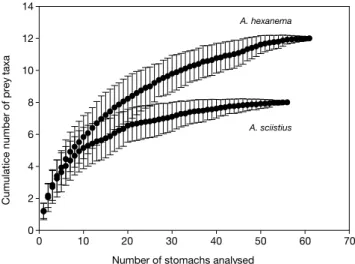
본 연구에서 분석한 어류의 개체수가 각 어종의 섭식생태를 설명하기 위한 충분한 표본인지 결정하기 위하여 먹이누적곡 선을 통하여 분석하였다(Ferry and Cailliet, 1996). 분석을 위 해 먹이생물을 12개의 분류군으로 구분한 뒤, 위 내용물이 발 견된 개체들의 순서를 100번 무작위하였다. 이후 각각의 무작 위한 순서에서 새로운 먹이 분류군에 대한 누적 먹이 분류군 수를 세었고, 100번 무작위한 값에 대하여 평균과 표준편차 를 도표상에 나타내었다. 먹이누적곡선이 점근선에 도달하였 을 때, 위 내용물 분석을 위한 적정 표본수로 간주하였다. 만 약 누적곡선에서 점근선에 근접한 값 이전 10개의 값이 총 먹 이 분류군 수에 대하여 ±0.5일 때 적정 표본수로 간주하였다 (Huveneers et al., 2007).
도화망둑과 수염문절의 전반적인 위 내용물 조성 또는 각 어종의 체장군 사이의 위 내용물 조성이 어떠한 차이가 있 는지 분석하기 위하여 nonmetric multidimensional scaling (nMDS), permutational multivariate analysis of variance (PERMANOVA), analysis of similarity(ANOSIM), similarity percentages(SIMPER)을 이용하여 분석하였다(Clarke and Gorley, 2006; Anderson et al., 2008).
분석을 위하여 각 어종의 체장군에 속하는 개체들을 무작 위로 5개체 또는 6개체의 소그룹으로 구분한 뒤, 각 소그룹에 서 먹이 분류군의 평균 중량 백분율을 계산하였다. 이러한 무 작위한 소그룹에서 먹이 분류군의 평균값 사용은 단일 개체 의 위 내용물 조성에서 ‘0’의 비율을 나타내는 먹이 분류군 수 를 감소시킬 수 있고, 따라서 다변량분석의 효율성을 증가시
킬 수 있다(White et al., 2004; Marshall et al., 2008). 또한 위 내용물 중 우점 먹이생물의 편향성을 감소시키기 위하여 평균 중량비 자료는 제곱근변환(square root transformation)을 실시 하였고 BrayCurtis similarity를 이용하여 유사도 매트릭스를 구축하였다(Platell and Potter, 2001).
도화망둑과 수염문절의 위 내용물 조성에서 종(species), 체장군(length class) 그리고 2요인(species×length class)의 상호효과가 위 내용물 조성 차이에 유의한 영향을 미치는 지 분석하기 위하여 twoway PERMANOVA를 실시하였다.
PERMANOVA에서 component of variation(COV)는 각 요 인의 영향을 나타내는 값으로, COV가 클수록 특정 요인 또 는 상호효과의 영향이 크다는 것을 의미한다. 종 간 또는 각 어종의 체장군 사이의 위 내용물 조성의 차이는 oneway ANOSIM 분석을 통하여 유의성을 검증하였다. ANOSIM 분 석에서 global R 통계량은 각 그룹의 유사성을 나타내는 값으 로 -1에서 +1의 범위는 나타내며, ‘0’에 가까울수록 그룹간 차이가 없음을 나타내고, -1 또는 +1에 가까울수록 각 그룹 은 유의하게 구분된다는 것을 의미한다. PERMANOVA 또는 ANOSIM 분석에서 유의한 차이가 나타났을 경우, SIMPER 를 통하여 어떤 먹이 분류군이 이러한 차이에 기여하였는지 를 분석하였다. SIMPER 분석 결과는 누적 기여도 90% 이 상인 먹이 분류군만을 나타내었다. 또한 종별 위 내용물 조 성을 차이는 nMDS 분석을 통하여 시각화하였다. 상기 분석 을 위하여 PRIMER v6 multivariate statistics package(www.
primere.com)와 PERMANOVA+ addon module을 사용하였 다(Anderson et al., 2008).
두 어종이 얼마나 다양하고 넓은 범위의 먹이생물을 섭식하 였는지 알아보기 위하여, diet diversity와 niche breadth를 각 각 ShannonWiener diversity index(H′)와 Levin’s standardized niche breadth(B)를 이용하여 구하였다(Krebs, 1989). 상기 분 석은 가장 낮은 분류군 수준에서 먹이생물의 개체수를 이용하 여 계산하였다.
결 과
1. 위 내용물 조성
본 연구에서 총 74개체의 도화망둑과 73개체의 수염문절 의 위내용물을 분석하였다. 채집된 어류의 체장은 도화망둑이 57~129mm SL(mean±SD=91±17mm), 수염문절이 34~75 mm SL(mean±SD=61±9mm)의 범위였다. 위 내용물 분석 결과, 도화망둑은 13개체, 수염문절은 17개체에서 위 내용물 이 발견되지 않아, 각각 17.6%와 23.3%의 공위율을 보였다.
두 어종의 누적 먹이곡선은 모두 점근선에 도달하였으며(Fig.
1), 최소 표본 크기는 도화망둑 59개체, 수염문절 51개체로 추 정되었다.
먹이생물이 발견된 도화망둑 61개체의 위 내용물에서 총 12개 분류군(taxa)의 먹이생물이 발견되었다(Table 1). 섭식 된 먹이생물 중, 새우류(Caridea)는 34.4%의 출현빈도, 개 체수비 11.4%, 중량비 74.7%, IRI 51.8%로 가장 우점한 먹 이생물이었다. 자주새우류(Crangon spp), 긴발딱총새우 (Alpheus japonicus), 분홍갯가꼬마새우(Eualus spathulirostris) 는 가장 많이 섭식된 새우류 종이었다. 그 다음으로 단각 류(Amphipoda)에 속하는 Gammaridea가 많이 섭식되었는 데, 54.1%의 출현빈도, 개체수비 33.5%, 중량비 5.8%, IRI는 37.1%였다. 갯지렁이류(Polychaeta)는 IRI 5.0%였고, 그 외 먹이 분류군은 IRI 2.0% 이하로 먹이생물로써 중요도가 낮았 다. 총 56개체의 수염문절 위 내용물에서는 총 8개 분류군의 먹이생물이 발견되었다(Table 1). 수염문절 또한 새우류를 가 장 많이 섭식하였는데, 50.0%의 출현빈도, 12.2%의 개체수 비, 71.8%의 중량비, IRI는 70.1%였다. 수염문절은 섭식된 새 우류 중 자주새우류와 분홍갯가꼬마새우를 주로 섭식하였다. 요각류(Copepoda)는 출현빈도 19.6%, 개체수비 31.0%, 중량 비 4.6%, IRI 11.7%로 두 번째 중요한 먹이생물이었다. 단각류 에 속하는 Gammaridea와 Hyperidea 또한 중요도가 높았는데, 각각 8.4%와 8.2%의 IRI를 나타내었다. 그 외 먹이 분류군은 IRI값이 1% 이하였다.
2. 종 간(inter-specific), 종 내(intra-specific) 위 내용물 조성의 차이
Twoway PERMANOVA 결과 두 어종의 위 내용물 조성
Number of stomachs analysed
0 10 20 30 40 50 60 70
Cumulatice number of prey taxa
0 2 4 6 8 10 12 14
A. hexanema
A. sciistius
Fig. 1. Cumulative prey curves(prey taxa per stomach) for each of Amblychaeturichthys hexanema and A. sciistius collected in the southeastern coastal waters of Korea. Vertical bars represent standard deviations.
은 어종 간 차이가 유의하였으나, 체장과 유의한 연관성이 없 었으며, 2 요인의 상호작용 효과 또한 유의성이 없었다(Table 2). COV값은 종 간 효과가 체장 효과에 비해 약 16배, 2요인 의 상호효과에 비해 약 6배 높은 값을 보였다. ANOSIM 분
석 결과 또한 두 어종의 위 내용물 조성이 차이가 유의하였다 (global R=0.127, P=0.028). SIMPER 분석 결과 두 어종 간 위 내용물 조성의 dissimilarity는 48.4%이었고, 총 9개 먹이 분류군이 위 내용물 조성 차이에 누적 90% 이상 기여하였다.
두 어종 간 이러한 dissimilarity에 높은 기여도를 보인 먹이 분류군은 Gammaridea, 새우류, 갯지렁이류, 요각류, Hyperidae 였고, 각각 10% 이상과 누적 70.6%의 기여도를 보였다(Table 3).
다른 분석들과 유사하게 nMDS ordination 또한 두 어종의 위 내용물 조성이 공간적으로 뚜렷이 구분됨을 알 수 있었다 (Fig. 2). nMDS ordination에서 도화망둑의 표시점들은 중앙에 서 왼쪽으로 널리 분포해 있는 반면, 수염문절은 중앙에서 오 른쪽까지 수평으로 분포해 있었다.
성장에 따른 위 내용물 조성의 변화를 살펴보기 위하여 각 Table 1. Percentage frequency of occurrence(%F), number(%N), weight(%W) and index of relative importance(%IRI) of prey species in the diets of Amblychaeturichthys hexanema and A. sciistius
Taxa Prey items Amblychaeturichthys hexanema A. sciistius
%F %N %W %IRI %F %N %W %IRI
Cumacea Unideitified 4.9 17.4 1.4 1.6
Copepoda Total 9.8 12.3 1.0 2.3 19.6 31.0 4.6 11.7
Calanus 9.8 12.3 1.0 10.7 22.7 3.3
Harpacticus 1.8 1.6 0.3
Unidentified 7.1 6.7 1.0
Euphausiacea Unideitified 3.3 1.7 1.1 0.2 3.6 3.9 1.4 0.3
Mysidacea Unideitified 1.6 0.4 0.0 <0.1
Amphipoda
Gammaridea Total 54.1 33.5 5.8 37.1 25.0 14.5 5.5 8.4
Amphithoe 3.6 4.3 0.7
Ampelica 11.5 12.7 2.0 8.9 4.7 0.9
Byblis 1.8 0.4 0.5
Liljebrogia 1.6 0.4 0.3 3.6 0.8 1.3
Monoculodes 14.8 4.2 1.1 1.8 0.4 0.3
Unidentified 34.4 16.1 2.3 8.9 3.9 1.8
Hyperiidea Total 1.6 0.4 0.5 <0.1 12.5 31.0 8.3 8.2
Parathemisto 8.9 18.0 6.4
Unidentified 1.6 0.4 0.5 5.4 12.9 1.9
Tanaidacea Unideitified 1.6 0.4 0.1 <0.1
Caridea Total 34.4 11.4 74.7 51.8 50.0 12.2 71.8 70.1
Alpheus japonicus 1.6 0.4 8.8
Crangon spp. 23.0 8.5 58.6 37.5 8.6 59.8
Eualus spathulirostris 5.4 1.2 6.7
Leptochela sydniensis 1.6 0.4 5.2
Unknown 8.2 2.1 2.1 8.9 2.4 5.4
Brachyura Total 4.9 1.7 2.6 0.4 1.8 0.4 0.4 <0.1
Charybdis bimaculata 1.6 0.8 0.8
Unknown 3.3 0.8 1.8 1.8 0.4 0.4
Chaetognatha Sagitta spp. 6.6 8.5 4.7 1.5 5.4 5.9 2.9 0.8
Polychaeta Total 14.8 11.4 7.8 5.0 5.4 1.2 5.1 0.6
Ampharete sp. 4.9 7.6 4.7
Prionospio sp. 3.3 1.7 0.5
Sternaspis scutata 1.6 0.4 1.0 1.8 0.4 4.3
Tharyx sp. 1.6 0.4 0.5
Unknown 4.9 1.3 1.1 3.6 0.8 0.8
Teleostei Unideitified 3.3 0.8 0.2 0.1
Table 2. Mean squares(MS), pseudoF ratios, components of varia
tion(COV) and significance levels(P) for a series of PERMANOVA tests, employing BrayCurtis similarity matrices derived from the mean percentage weight contributions of the various prey taxa to the stomach contents for Amblychaeturichthys hexanema and A. sciistius
Source d.f. MS PseudoF COV P
Species 1 4332.9 3.662 26.559 0.017
Length class 4 1175.4 0.993 1.690 0.483 Species×Length class 1 1223.6 1.034 4.246 0.409
Residual 15 1183.3 34.400
어종의 체장군별 위 내용물 조성을 비교했을 때, 두 어종 모 두 체장군별 위 내용물 조성에서 유의한 차이를 보이지 않았 다(ANOSIM, global R= -0.254, P=0.869 for A. hexanema, R=0.241, P=0.125 for A. sciistius).
도화망둑(H′ =2.46, B =0.364)과 수염문절(H′ =2.37, B=0.390)은 각각 2.46과 2.37의 먹이 다양도(H′), 0.364와 0.390의 dietary breadth(B)로, 두 지수 모두 종 간 큰 차이를 보이지 않았다.
고 찰
본 연구에서 출현한 도화망둑과 수염문절은 모두 새우 류, 단각류와 같은 저서 갑각류를 주로 섭식하는 갑각류식자 (crustacean feeder)였다(Table 1). 그러나 두 어종의 위 내용 물에서 섭식된 갑각류 종류의 비율을 달랐다. 중량비 기준으 로 새우류는 두 어종의 위 내용물 조성에서 유사한 비율을 보
였지만, Gammaridea와 게류(Brachyura)는 도화망둑의 위 내 용물에서 비율이 더 높았던 반면, 요각류와 Hyperidea는 수 염문절의 위 내용물에서 더 높았다. 갑각류 외에 모악동물 (Chaetognatha)과 갯지렁이류의 비율이 도화망둑의 위 내용물 에서 다소 높았다. 비록 두 어종은 유사한 먹이생물을 공통적 으로 섭식하였지만, 각 종의 위 내용물에서 먹이생물 기여도 의 차이는 두 어종의 먹이 자원 이용의 차이를 반영한다. 공존 하는 같은 속에 속하는 망둥어과 어류 사이에서 먹이 이용의 차이는 다른 연구들에서도 보고되었다. 예를 들어 우리나라 남해안 갯벌에 출현하는 말뚝망둑(Periophthalmus modestus) 과 큰볓말뚝망둑(P. magnuspinnatus)의 섭식생태 연구에서 말 뚝망둑은 갯지렁이류를 더 많이 섭식한 반면, 큰볓말뚝망둑 은 게류를 더 많이 섭식하였다(Baeck et al., 2013b). 또한 포루 투갈 Tagus 하구역에 출현하는 Pomatoschistus minutus와 P.
microps는 모두 갑각류를 주로 섭식하였지만, 본 연구와 유사 하게 갑각류 종류의 비율은 두 어종의 위 내용물에서 차이를 나타내었다(Salgado et al., 2004).
도화망둑과 수염문절의 먹이생물 중 가장 중요한 먹이생 물은 갑각류 중 새우류였고, 그 중 자주새우류가 각각 23.0%
와 37.5%의 출현빈도, 58.6%와 59.8%의 중량비를 나타내어 가장 선호하는 먹이 종류임을 알 수 있었다(Table 1). 자주새 우류는 온대해역의 사니질 저서환경에 주로 분포하며, 본 연 구해역의 십각류 군집에서도 우점하는 종류였다(Huh et al., 2010). 일반적으로 어류는 먹이를 찾기 위한 에너지 낭비를 줄이고 포획 가능성을 높이기 위하여 서식지 주변에 풍부하 게 서식하는 먹이생물을 주로 섭식한다(Persson and Diehl, 1990). 따라서 연구해역에서 다른 갑각류에 비해 풍부하게 분 포하는 자주새우류는 두 어종에 의해 쉽게 포획될 수 있었으 며, 자주새우류의 높은 섭식율은 먹이포획을 위한 에너지 소 비에 비해 에너지 획득을 최대화하기 위한 섭식전략으로 판단 된다. 또한 이러한 섭식전략을 나타낸 두 어종은 기회주의포 식자(opportunistic predator) 임을 나타낸다(Pihl, 1985). 본 연 구해역에서 출현하는 갑각류식자 중에서 홍감펭(Helicolenus hilgendorfii)도 이러한 섭식행동을 나타내었다(Baeck et al., Table 3. SIMPER analysis showing the species found in the stomach contents which contribute the most for differences between diets of Ambly
chaeturichthys hexanema and A. sciistius
Prey taxa Average dissimilarity Dissimilarity s.d. Contribution % Cumulative %
Gammaridea 8.21 1.25 16.97 16.97
Caridea 7.13 1.11 14.75 31.72
Polychaeta 6.63 1.04 13.71 45.44
Copepoda 6.53 1.42 13.50 58.94
Hyperiidea 5.64 0.86 11.67 70.60
Chaetognatha 4.25 0.86 8.79 79.40
Brachyura 3.2 0.63 6.62 86.02
Euphausiacea 1.83 0.56 3.79 89.81
Cumacea 1.79 0.50 3.69 93.51
Fig. 2. nMDS ordination of the dietary composition constructed from BrayCurtis similarity matrices that employed the weight contribu
tions on overall diet between the two studied species of Gobiidae in the southeastern coast of Korea(▲=Amblychaeturichthys hexanema,
▼=A. sciistius).
2D Stress: 0.2
2013a).
성장에 따른 먹이생물의 변화는 어류에서 나타나는 일반 적인 현상이고, 주로 섭식되는 먹이의 에너지 효율과 관련있 다(Gerking, 1994). 이러한 변화는 먹이 자원 또는 공간에 대 한 종 내 경쟁을 감소시키는 결과를 가져온다(Langton, 1982;
Chizinski et al., 2007; Barnes et al., 2011). 비록 두 어종은 어 느 정도 성장에 따른 변화의 경향성을 나타내었으나(data not shown), 성장에 따라 유의한 위 내용물 조성의 변화를 나타내 지 않았다. 이는 본 연구에서 충분히 넓은 체장 범위의 개체가 채집되지 않았거나 각 체장군에서 분석된 개체수가 충분하지 않았기 때문으로 판단된다. 따라서 향후 넓은 체장 범위에서 충분한 시료 확보 후 추가 연구가 필요할 것으로 생각된다.
본 연구에서 도화망둑과 수염문절의 위 내용물 분석 결과 두 어종의 먹이생물은 대부분 저서 무척추동물이었고, 두 어 종 모두 저질 가까이 서식하는 먹이를 섭식하는 섭식전략 을 나타내었다. 비록 두 어종은 유사한 범위의 먹이생물을 섭 식하였지만, 위 내용물 조성에서 유의한 차이를 나타내었다 (ANOSIM, P<0.05). 이러한 차이는 두 어종의 위 내용물 조 성에서 특정 먹이생물의 비율 차이 때문이고, 따라서 두 어종 은 먹이 자원을 분할하여 이용하는 결과를 가져왔다. 먹이 자 원의 분할은 공존하는 여러 어종의 서식지가 중복될 때 다른 먹이자원을 이용함으로써 경쟁을 피하고 공존할 수 있게 한다 (Platell and Potter, 2001; Krajewski et al., 2006). 공존하는 어 류 사이에서 먹이 이용의 차이는 어종 간 입 형태, 섭식전략, 서식지, 운동능력 등의 차이와 관련있을 수 있다. SIMPER 분 석 결과 섭식된 먹이생물 중 Gammaridea, 새우류, 갯지렁이 류, 요각류, Hyperidae는 두 어종의 위 내용물 dissimilarity에 가장 기여도가 높은 먹이생물이었다(Table 3). 그러나 도화망 둑의 경우 저질속 또는 저질 근처에 서식하는 갯지렁이류와 같은 먹이생물의 중요도가 다소 높았던 반면, 수염문절은 부 유성 갑각류의 요각류와 Hyperiidea의 중요도가 더 높았다. 이 러한 공존하는 어류 사이에서 저서성과 부유성 먹이 중요도 의 차이는 캐나다 동부 Newfoundland에 출현하는 두 종의 대 구류(Gadus morhua and G. ogac)에서도 발견되었다(Knickle and Rose, 2014). 몇몇 과거 연구들 또한 공존하는 망둑어류 사이에서 먹이 자원 분할에 관한 결과를 보여주었다(Salgado et al., 2004; Baeck et al., 2013b). 이러한 공존하는 어류 사이 에서 다른 섭식 행동 및 전략은 먹이 분할의 근거를 보여주는 중요한 특성 중 하나이다(Ross, 1986; Platell and Potter, 2001).
본 연구는 동해 남부 연안에서 출현하는 도화망둑과 수염문 절의 먹이생물과 먹이 분할에 대한 중요한 정보를 제공해 주 었다. 위 내용물 분석 결과 두 어종은 저서 갑각류를 주로 섭 식하는 갑각류 식자임을 나타내었다. 비록 두 어종은 유사한 먹이생물을 섭식하였지만, 각각 먹이생물의 기여도는 두 어 종의 위 내용물에서 다르게 나타났다. 어류의 섭식생태에 관
한 연구는 저서 생태계의 포식피식 관계를 이해하기 위한 중 요한 연구이고, 생태계 관리와 보전을 위한 기초 연구가 된다.
그럼에도 불구하고 본 연구는 성장과 계절에 따른 먹이 변화 를 나타내기 위한 충분한 개체수 분석의 부족으로 두 어종의 섭식생태를 완전히 밝히지 못하였다. 따라서 향후 이러한 관 점에서 연구를 위한 충분한 표본 확보 후 분석이 필요할 것 이다.
사 사
본 연구의 시료 채집과 분석에 도움을 준 부경대학교 해양 학과 유영생물학 연구실 학생들에게 감사 드립니다. 그리고 본 논문의 자료분석과 영문교정에 도움을 준 맥쿼리대학교 생 물학부 Associate Professor Jane Williamson에게 감사 드립 니다.
요 약
본 연구는 동해 남부 연안에서 출현하는 도화망둑(Ambly
chaeturichthys hexanema)과 수염문절(A. sciistius)의 위 내용 물을 분석하여 두 어종의 위 내용물 조성을 조사하고, 종 간 그리고 성장에 따른 먹이자원의 분할이 있는지 연구하였다. 도화망둑과 수염문절은 저서성 갑각류를 주로 섭식하는 저서 섭식 육식성어류였다. 저서성 무척추동물과 부유성 먹이 또 한 각각 도화망둑과 수염문절의 먹이로써 중요도가 다소 높았 다. 중량비 자료를 이용한 nonmetric multidimensional scaling (nMDS)와 다변량 분석(multivariate analyses)에서 두 어종의 위 내용물 조성은 그 차이가 유의하였다. 그러나 두 어종 모 두 성장에 따른 위 내용물 조성 변화에서 차이가 유의하지 않 았다. 두 어종이 섭식한 먹이생물의 차이는 섭식 행동의 차이 와 관련있다. 결론적으로, 본 연구해역에서 두 어종의 위 내용 물 분석 결과는 도화망둑과 수염문절 사이에 생태지위 분리의 증거와 먹이 자원에 대한 종 간 경쟁 감소의 가능성을 보여주 었다.
RefeReNceS
Anderson, M.J., R.N. Gorley and K.R. Clarke. 2008. PERMANO
VA+ for PRIMER: Guide to software and statistical meth
ods. PRIMERE, Plymouth Marine Laboratory, Plymouth, Baeck, G.W., C.I. Park, J.M. Jeong, M.C. Kim, S.H. Huh and J.M. UK.
Park. 2010. Feeding habits of Chaenogobius gulosus in the coastal waters of Tongyeong, Korea. Korean J. Ichthyol., 22: 4148.
Baeck, G.W., J.M. Park, H.C. Choi and S.H. Huh. 2013a. Diet com
position in summer of rosefish Helicolenus hilgendorfii on the southeastern coast of Korea. Ichthyol. Res., 60: 7579.
Baeck, G.W., Y.H. Yoon and J.M. Park. 2013b. Ontogenetic and diel changes in diets of two sympatric mudskippers Periophthal
mus modestus and Periophthalmus magnuspinnatus on the tidal flats of Suncheon Bay, Korea. Fish. Sci., 79: 629-637.
Barnes, L.M., M. Leclerc, C.A. Gray and J.E. Williamson. 2011.
Dietary niche differentiation of five sympatric species of Platycephalidae. Environ. Biol. Fish., 90: 429441.
Brodeur, R.D. and W.G. Pearcy. 1992. Effects of environmental var
iability on trophic interactions and food web structure in a pelagic upwelling ecosystem. Mar. Ecol. Prog. Ser., 84: 101
Chizinski, C.J., C.G. Huber, M. Longoria and K.L. Pope. 2007. In119.
traspecific resource partitioning by an opportunistic strate
gist, inland silverside Menidia beryllina. J. Appl. Ichthyol., 23: 147151.
Clarke, K.R. and R.N. Gorley. 2006. PRIMER v6 user manual/tuto
rial. PrimerE Limited, Plymouth, 192pp.
Duarte, L.O. and C.B. Garcia. 1999. Diet of the mutton snapper Lutjanus analis(Cuvier) from the gulf of Salamanca, Co
lombia, Caribbean Sea. Bull. Mar. Sci., 65: 453465.
Ferry, L.A. and G.M. Cailliet. 1996. Sample size and data analysis:
are we characterizing and comparing diet properly? In:
MacKinlay, D., K. Shearer(eds.), International congress on the biology of fishes, San Francisco, California, pp. 71-80.
Gerking, S.D. 1994. Feeding ecology of fish. Academic Press, San Diego, 416pp.
Greenstreet, S.P. and S.I. Rogers. 2006. Indicators of the health of the North Sea fish community: identifying reference levels for an ecosystem approach to management. ICES J. Mar.
Sci., 63: 573593.
Han, D.Y., Y. Xue, Y.P. Ji and Q.Y. Ma. 2013. Feeding ecology of Amblychaeturichthys hexanema in Jiaozhou Bay, China.
Chinese J. Appl. Ecol., 24: 14461452.
Huh, S.H. and S.G. Chung. 1999. Seasonal variations in species composition and abundance of fishes collected by an otter trawl in Nakdong River estuary. Bull. Korean Soc. Fish.
Tech., 35: 178195.
Huh, S.H. and S.N. Kwak. 1999. Feeding habits of Acanthogobius flavimanus in the eelgrass(Zostera marina) bed in Kwang
yang Bay. Korean J. Fish. Aquat. Sci., 32: 1017.
Huh, S.H., J.M. Park and G.W. Baeck. 2006. Feeding habits of john dory Zeus faber in the coastal waters off Gori, Korea. Korean J. Fish. Aquat. Sci., 39: 357362.
Huh, S.H., J.M. Park, D.S. Jeong and G.W. Baeck. 2010. Seasonal and interannual variation in species composition and abun
dance of decapod assemblages collected using pots in the coastal waters off Gori, Korea. Korean J. Fish. Aquat. Sci.,
43: 293297.
Huveneers, C., N.M. Otway, S.E. Gibbs and R.G. Harcourt. 2007.
Quantitative diet assessment of wobbegong sharks(genus Orectolobus) in New South Wales, Australia. ICES J. Mar.
Sci., 64: 12721281.
Hyslop, E.J. 1980. Stomach contents analysisa review of methods and their application. J. Fish Biol., 17: 411429.
Kim, I.S., Y. Choi, C.L. Lee, Y.J. Lee, B.J. Kim and J.H. Kim. 2005.
Illustrated book of Korean fishes. Kyo-hak Publ. Co, Seoul.
Knickle, D.C. and G.A. Rose. 2014. Dietary niche partitioning in sympatric gadid species in coastal Newfoundland: evidence from stomachs and CN isotopes. Environ. Biol. Fish., 97:
343355.
Krajewski, J.P., R.M. Bonaldo, C. Sazima and I. Sazima. 2006. For
aging activity and behaviour of two goatfish species(Perci
formes: Mullidae) at Fernando de Noronha Archipelago, tropical West Atlantic. Environ. Biol. Fish., 77: 18.
Krebs, C.J. 1989. Ecological methodology. Harper and Row, New York, 654pp.
Kwak, S.N., S.H. Huh and H.W. Kim. 2010. Feeding habits of Acen
trogobius pellidebilis in an eelgrass(Zostera marina) bed. J.
Korean Soc. Fish. Tech., 46: 358367.
Langton, R.W. 1982. Diet overlap between Atlantic cod, Gadus morhua, silver hake Merluccius bilinearis and fifteen other northwest Atlantic finfish. Fish. Bull., 80: 745-759.
Lee, T.W. 1996. Change in species composition of fish in Chonsu bay 1. Demersal fish. Korean J. Fish. Aquat. Sci., 29: 71-83.
Marshall, A.D., P.M. Kyne and M.B. Bennett. 2008. Comparing the diet of two sympatric urolophid elasmobranchs(Trygonop
tera testacea Müller & Henle and Urolophus kapalensis Yearsley & Last): evidence of ontogenetic shifts and possi
ble resource partitioning. J. Fish Biol., 72: 883898.
Mei, C., B.D. Xu, Y. Xue, Y.P. Ren and X.X. Zan. 2010. Fish com
munity structure and species diversity during autumn and winter in the central waters of Jiaozhou Bay. J. Fish. Sci.
China, 17: 110118.
Micheli, F. and B.S. Halpern. 2005. Low functional redundancy in coastal marine assemblages. Ecol. Lett., 8: 391400.
Park, J.M. 2010. Species composition and reproductive ecology of fishes in the coastal waters off Gori, Korea. PhD Thesis.
Pukyong National University, Busan, 236pp.
Park, J.M., S.H. Huh, J.M. Jeong and G.W. Baeck. 2014. Diet com
position and feeding strategy of yellow goosefish, Lophius litulon(Jordan, 1902), on the southeastern coast of Korea. J.
Appl. Ichthyol., 30: 151155.
Persson, L. and S. Diehl. 1990. Mechanistic individualbased ap
proaches in the population/community ecology of fish. In Annales Zoologici Fennici(pp. 165182). Finnish Zoolog
ical Publishing Board, formed by the Finnish Academy of Sciences, Societas Scientiarum Fennica, Societas Biologica Fennica Vanamo and Societas pro Fauna et Flora Fennica.
Pihl, L. 1985. Food selection and consumption of mobile epibenthic fauna in shallow marine areas. Mar. Ecol. Prog. Ser., 22:
169179.
Pinkas, L., M.S. Oliphant and I.L.K. Iverson. 1971. Food habits of albacore, bluefin tuna, and bonito in California waters. Fish.
Bull., 151: 1139.
Platell, M.E. and I.C. Potter. 2001. Partitioning of food resources amongst 18 abundant benthic carnivorous fish species in marine waters on the lower west coast of Australia. J. Exp.
Mar. Biol. Ecol., 261: 3154.
Ross, S.T. 1986. Resource partitioning in fish assemblages: a review of field studies. Copeia, 1986: 352-388.
Salgado, J.P., H. Nogueira Cabral and M.J. Costa. 2004. Feeding ecology of the gobies Pomatoschistus minutes(Pallas, 1770) and Pomatoschistus microps(Krøyer, 1838) in the upper Tagus estuary, Portugal. Scientia Marina, 68: 425434.
White, W.T., M.E. Platell and I.C. Potter. 2004. Comparisons be
tween the diets of four abundant species of elasmobranchs in a subtropical embayment: implications for resource parti
tioning. Mar. Biol., 144: 439448.
Wootton, R.J. 1990. Ecology of teleost fishes. Champman Holl, New York, USA, 404pp.