48(4) : 314∼ 319 (2017)
314
삼채 잎 추출물의 예쁜꼬마선충에 대한 수명연장 효과
기별희1 · 이은별2 · 김준형3 · 양재헌4 · 김대근3* · 김영수1*
1전북대학교 식품공학과, 2농촌진흥청 국립농업과학원 기능성식품과, 3우석대학교 약학대학,
4전북대학교 헬스케어기술개발사업단
Lifespan-extending Effects of Allium hookeri Leaves in Caenorhabditis elegans
Byeolhui Ki1, Eun Byeol Lee2, Jun Hyeong Kim3, Jae Heon Yang4, Dae Keun Kim3* and Young-Soo Kim1*
1Department of Food Science and Technology, Chonbuk National University, Jeonju 54896, Korea
2Functional Food & Nutrition Division, Department of Agro-food Resources, Rural Development Administration, Wanju 55365, Korea
3College of Pharmacy, Woosuk University, Jeonju 55338, Korea
4Center for Healthcare Technology Development, Chonbuk National University, Jeonju 54896, Korea
Abstract − To evaluate the longevity property of Allium hookeri (Liliaceae) leaves, this study was performed. Ethanol extract of A. hookeri was successively partitioned as methylene chloride, ethyl acetate, n-butanol and H2O soluble fractions, and lifes- pan-extending effects of the fractions were checked using Caenorhabditis elegans model system. The most active ethyl acetate- soluble fraction elevated heat stress tolerance, and increased expression of stress resistance protein. Further studies were per- formed to investigate several aging-related factors such as reproduction, food intake, growth and movement of C. elegans. The results revealed that there were no significant changes in aging-related factors including reproduction and food intake, however, ethyl acetate-soluble fraction treatment led to up-regulation of locomotory ability and growth of aged worms, suggesting ethyl acetate-soluble fraction affected healthspan as well as lifespan of nematode.
Keywords − Allium hookeri, Caenorhabditis elegans, Longevity
노화는 산소를 이용하여 에너지를 생산하는 모든 생물이 겪어야 하는 자연현상이다. 유전적, 환경적 요인들의 복합 적인 작용에 의해 생리적인 기능저하를 야기하고 결국에는 각종 질병을 일으켜 사망에 이르게 한다. 많은 논란이 거듭 되고 있으나 노화의 주요원인은 Herman에 의해 제안된 free radical 이론이 아직은 상당한 설득력을 가지고 있다.1) Free radical 이론은 세포 내 대사과정 중에 생성되는 free radical 이 세포 내의 DNA를 비롯한 탄수화물, 단백질, 지질 등과 반응하여 효소활성을 비롯한 산화적 손상 등에 영향을 주 어 세포의 기능저하, 조직손상 등을 야기하여 결과적으로 질병과 노화를 촉진한다는 이론이다.2,3) 이에 인체의 노화를 촉진하며 질병을 일으키는 것으로 알려진 free radical을 비 롯한 활성 산소종(ROS)의 생성을 억제할 수 있는 천연자원
의 발굴이 요구되고 있으며, 실제로 각종 스트레스를 억제 하고 노화를 지연시키며, 수명을 연장할 수 있을 가능성이 있는 quercetin, curcumin, resveratrol 등과 같은 천연물 유 래 화합물들이 보고되고 있다.4-8)
본 연구에서는 저자 등이 삼채 뿌리를 채취한 후에 폐기 되는 삼채 잎 추출물의 항산화능을 보고하고,9)이어 삼채 잎의 수명연장과 관련된 작용을 알아보기 위해 예쁜꼬마선 충(Caenorhabditis elegans)을 모델로 실험을 실시하였다. 삼 채 잎의 에탄올 추출물을 제조하고 이 추출물의 용매 분획 물을 확보하여 각 분획물의 수명연장 효능을 확인하였다.
또한, 수명연장의 기전연구로 열 스트레스에 대한 저항성과 이와 관련된 스트레스 저항능을 확인하는 기전연구의 일환 으로 형질 전환시킨 선충을 대상으로 열 스트레스 저항성 단백질 발현 여부를 측정하였다. 그 외에 노화 관련 인자로 생식능, 몸길이, 음식 섭취량 및 운동량 변화 등을 측정하 여 삼채 잎 ethyl acetate 분획물이 선충의 수명연장에 미치
*교신저자(E-mail):[email protected], [email protected] (Tel): +82-63-270-2569, +82-63-290-1574
는 효능을 확인하였다.
재료 및 방법
실험재료 − 삼채 잎은 2015년에 순창군에서 재배한 것을 김대근교수가 검증한 후에 60oC에서 건조하여 실험에 사용 하였으며, 표준품은 우석대학교 약학과 표본실에 보관하고 있다(WSU-15-005).
추출 및 분획 − 건조하여 분쇄한 삼채 잎 1 kg을 에탄올 5 L로 50oC에서 5시간씩 2회 추출하였다. 추출액을 수욕상 에서 감압농축하여 ethanol엑스 약 59 g을 얻었으며, ethanol 엑스를 증류수로 현탁시킨 후 상법에 따라 동량의 methylene chloride(0.6 g), ethyl acetate(1.3 g) 및 n-butanol(6.9 g)의 순 으로 용매 분획하여 분획물을 확보하였다.
Caenorhabditis elegans의 배양10)− 예쁜꼬마선충(C.
elegans, wild type)과 Escherichia coli OP50은 차동석교수 (우석대학교)로부터 제공받아 사용하였으며, Nematode Growth Medium(NGM) agar plate에서 배양하였다(20oC).
삼채 잎 분획물은 DMSO를 용매로 한 stock solution을 제 조하고 멸균시켜 일정량씩 NGM plate(50oC)에 첨가하였으 며, 최종 DMSO농도는 0.1%(v/v)를 유지하였다.
수명연장효능평가11)− 선충의 수명연장분석은 20oC에서 독립적으로 3회 실행하였으며, 성장단계를 일치시키기 위해 NGM plate로부터 알만을 따로 분리하여 삼채 잎 분획물을 첨가한 각각의 plate에 옮겨 배양하였고 매일 생존여부를 확 인하였다. 생존여부의 확인은 선충을 platinum wire의 끝으 로 자극했을 때 반응이 없는 경우를 사망상태로 간주하였 고 독립적으로 3회 실행하였다.
온도 스트레스 저항성 평가12)− 성장단계가 동일한 선충을 삼채 잎 ethyl acetate 분획물을 농도별(250, 500 µg/mL)로 처리한 NGM plate에서 배양하였다. 온도 스트레스에 의한 내성을 분석하기 위해 선충을 성체가 된 후 4일째에 신선 한 배지로 옮기고 36oC에서 배양하여 시간 별로 생존율을 24시간 동안 측정하였다.
형광 발현강도 정량 및 분석 − 형질 전환된 선충 HSP- 16.2::GFP를 포함한 CL2070를 삼채 잎 ethyl acetate 분획 물을 농도별(250, 500 µg/mL)로 처리한 배지에서 배양하였 다. 성체가 된 후 4일째에 사용하였으며, 현미경 관찰 전 CL2070는 2시간 동안 36oC에서 열 스트레스를 가하고 4시 간 동안 20oC에서 회복시켰다. 선충을 sodium azide(2%)로 마취시킨 후 형광 실체 현미경(Olympus, Japan)으로 GFP 발현을 관찰하였으며, 현미경으로 촬영한 사진을 ImageJ 소 프트웨어를 이용하여 발현강도를 정량, 분석하였다.
노화 관련인자 분석 − 삼채 잎 ethyl acetate 분획물을 처 리한 plate에서 성장 단계가 동일한 N2 선충을 배양하였다.
생식능 측정은 모체와 자손을 구별하기 위해 L4 유충을 개 별적으로 매일 새로운 plate에 옮겼으며, 자손은 L2 또는 L3 단계에서 측정하였다. 선충의 식이량 측정은 4일과 8일된 성충을 새로운 NGM plate로 옮겨 1분 동안 인두의 움직임을 관찰하였다. 선충의 몸길이는 4일째, 운동량은 성체 4일과 8일째에 측정하였다. 몸길이와 운동량은 Olympus software (Olympus, Japan)를 이용해 분석하였다(ethyl acetate분획 250, 500 µg/mL).
통계 분석 − 통계 자료의 값은 평균값±표준오차(mean ± S.E.M.)로 표시하였으며, 그룹 간의 통계적 유의성 검정은 Student’s t-test를 통해서 분석하였고, 선충의 연속적인 생존
Fig. 1. Effects of fractions from A. hookeri leaves on the lifespan of wild-type N2 nematodes. Worms were grown in the NGM agar plate at 20oC in the absence or presence of fractions. The number of worms used per each lifespan assay experiment was 44- 50 and three independent experiments were repeated (N=3). (A) The mortality of each group was determined by daily counting of surviving and dead animals. (B) The mean lifespan of the N2 worms was calculated from the survival curves. Statistical difference between the curves was analyzed by log-rank test. Error bars represent the standard error of mean (S.E.M.). Differences compared to the control were considered significant at *p<0.05 and ***p<0.001 by one-way ANOVA.
도는 Log-rank test 분석 방법을 이용하였다. p값은 *p<0.05,
**p<0.01, ***p<0.001일 때 유의성이 있는 것으로 간주하 였다.
결 과
C. elegans 수명 연장효능 − 야생형 N2 선충을 이용하 여 삼채 잎 ethyl acetate 분획물의 수명에 미치는 영향을 관 찰하였으며, Fig. 1에서 보는 바와 같이 삼채 잎 ethyl acetate 분획물은 C. elegans의 수명을 농도의존적으로 증가시켰다.
대조군의 평균 수명 시간은 13.1±0.5일이었고, ethyl acetate 분획물에서 선충의 평균 수명을 15.8±0.5일이었다(23.2%,
***p<0.001, Fig. 1, Table I).
열 스트레스 저항력 증가 효능 – 삼채 잎 ethyl acetate 분획물의 선충에 대한 열 스트레스 저항능에 미치는 영향 은 고온 스트레스 조건 하에서 선충을 배양하여 생존율을 확인하였다. 선충에게는 고온 조건인 36oC에서 생존율을 관 찰한 결과 대조군은 7시간 만에 죽기 시작하여 16시간에 모 두 사멸한 반면, 삼채 잎 ethyl acetate 분획물 처리군은 250, 500 µg/mL 농도에서 각각 20시간, 22시간으로 생존율이 향 상되었다. 대조군의 평균 생존시간이 16.0±0.5시간었으나, 500 µg/mL 농도 처리군은 17.3±0.5시간(***p<0.001)으로 29.9% 평균 생존 시간을 향상시켰다(Fig. 2, Table II).
형질 전환 선충 HSP-16.2의 발현 증가 − 삼채 잎 ethyl acetate 분획물의 선충에 대한 열 스트레스 조건 하에서 내 성 스트레스 반응 유전자의 증가 여부를 알아보기 위해, HSP-16.2를 포함한 형질 전환 선충 CL2070을 사용하였다.
CL2070 유전자를 포함한 선충을 2시간 동안 36oC에서 열
처리를 하고 2시간 동안 20oC에서 회복시킨 후 HSP- 16.2::GFP 형광 강도를 측정한 결과, ethyl acetate 분획물 250 µg/mL 투여군은 대조군에 비해 약 12.6%(***p<0.001), 500 µg/mL 투여군은 24.2%(***p<0.001)의 증가율을 나타 냈다(Fig. 3A, 3B).
노화 관련인자의 변화 − 삼채 잎 ethyl acetate 분획물 처 리가 선충의 수명 메커니즘에 미치는 영향을 확인하기 위 해 생식, 섭식, 몸길이 및 운동량을 측정하였다. 500 µg/mL 분획물 처리군은 대조군에 비하여 선충의 생식능력과, 4일 Table I. Effects of fractions from A. hookeri leaves on the lifespan of C. elegans
Fraction Mean Lifespan (day) Maximum lifespan (day) Change in mean lifespan (%) Log-rank test Control
Ethanol Methylene chloride
Ethyl acetate n-Butanol
13.1 ± 0.5 14.4 ± 0.5 14.0 ± 0.7 15.8 ± 0.5 13.9 ± 0.9
19 20 21 23 20
- 9.1 6.7 20.4
5.7
-
*p<0.05 -
***p<0.001 -
Mean lifespan presented as mean ± S.E.M data. Change in mean lifespan compared with control group (%). Statistical significance of the difference between survival curves was determined by log-rank test using the Kaplan-Meier survival analysis. Differences compared to the control were considered significant at *p<0.05 and ***p<0.001.
Table II. Effects of ethyl acetate-soluble fraction from A. hookeri leaves on the stress tolerance of wild-type N2 Stress condition Fraction Mean lifespan (h) Maximum lifespan (h) Change in mean lifespan (%) Log-rank test
36oC thermal tolerance
Control 250 µg/mL 500 µg/mL
13.3 ± 0.4 16.0 ± 0.5 17.3 ± 0.5
16 20 22
- 19.7 29.9
-
**p<0.01
***p<0.001
Mean lifespan presented as mean ± S.E.M data. Change in mean lifespan compared with control group (%). Statistical significance of the difference between survival curves was determined by log-rank test using the Kaplan-Meier survival analysis. Differences compared to the control were considered significant at ** p<0.01 and ***p<0.001.
Fig. 2. Effects of ethyl acetate-soluble fraction from A. hook- eri leaves on the thermal stress tolerance of wild-type N2 nematodes. To assess thermal tolerance, worms were incubated at 36oC and then their viability was scored. Statistical differ- ence between the curves was analyzed by log-rank test. All experiments were done in triplicates.
Fig. 3. Effects of ethyl acetate-soluble fraction from A. hookeri leaves on the expression of HSP-16.2 in C. elegans. (A) Mean GFP intensity of CL2070 mutant was represented as mean ± S.E.M. of values from 19 to 25 worms per each experiment. (B) Images of 16.2::GFP expressions of CL2070 worms in the presence or absence of ethyl acetate-soluble fraction. Data are expressed as the mean ± standard deviation of three independent experiments (N=3). Differences compared to the control were considered significant at ***p<0.01 by one-way ANOVA.
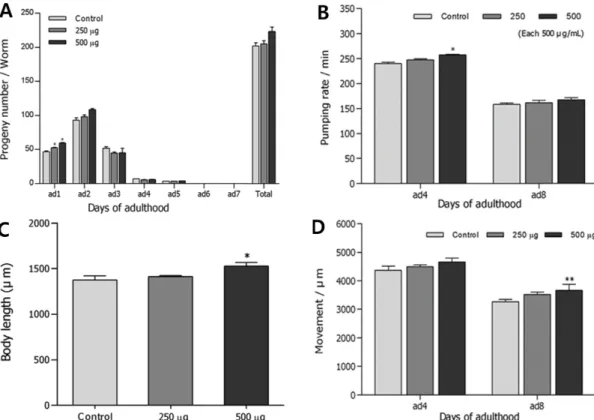
Fig. 4. Effects of ethyl acetate-soluble fraction from A. hookeri leaves on the various aging-related factors of wild-type N2 nematodes.
(A) Daily and total reproductive outputs were counted. The progeny was counted at the L2 or L3 stage. (B) On the 4th and 8th days of adulthood, the pharyngeal pumping rates were measured. (C) For the grown alteration assay, photographs were taken on 4th day of worms and the body length of each animal was analyzed. (D) The body movements were counted on 4th and 8th days of adulthood worms under a dissecting microscope for 10 seconds. Data are expressed as the mean±S.E.M. of three independent experiments (N=3). Differences compared to the control were considered significant at *p<0.05 and **p<0.01 by one-way ANOVA.
과 8일째의 먹이 섭취량의 변화는 미세한 증가는 있었으나 유의성이 없었다(Fig. 4A, 4B). 그러나 4일과 8일째 선충의 몸길이와 움직임을 측정한 결과 4일째에는 모두 대조군과 비교하여 유의성 있는 변화가 없었으나, 8일째에는 대조군 에 비해 몸길이(*p<0.05)와 운동량(*p<0.01)이 유의성있게 증가하는 것이 확인되었다(Fig. 4C, 4D).
고 찰
삼채 잎 에탄올 추출물을 methylene chloride, ethyl acetate 및 butanol을 이용하여 용매분획을 실시하고 각 분획에 대 하여 예쁜꼬마선충을 모델로 사용하여 수명에 미치는 영향 을 확인하였다. 예쁜꼬마선충은 토양 속에서 미생물과 박테 리아를 먹이로 하며, 약 1 mm 정도 크기로 20oC에서 20일 정도의 짧은 수명을 가지고 있다.13,14)단순한 생물임에도 불 구하고 선충의 발생단계나 세포사멸기전, 외부환경에 대한 반응 및 인간의 수명과 연관되는 노화 등 유전학적인 면에 서 인간과 많은 부분이 유사하여 최근 연구에 많이 이용되 고 있다.15-17) 삼채 분획물의 수명연장 실험을 위해서 일반 적인 배양환경에서의 야생형 N2 선충을 이용하였으며, 시 간에 따른 선충의 생존율을 확인하였다. 선충의 생존율을 측정한 결과 삼채 잎 ethyl acetate 분획물이 가장 높은 생 존율을 나타냈다. 선충의 생존과 수명은 스트레스와 밀접한 관련이 있으므로 열 스트레스 조건하에서 선충의 저항성을 측정 하였다.11)열 스트레스 조건에서 삼채 잎 ethyl acetate 분획물을 처리한 선충군이 대조군에 비해 높은 생존율을 보 였으며, 이는 이미 보고한 juglone으로 유발시킨 산화적 스 트레스 조건에서도 같은 결과를 보였다.12) 이 결과는 삼채 잎의 ethyl acetate 분획물의 선충에 대한 수명연장 효능이 열과 산화적 스트레스 저항능과 상당한 관련이 있음을 시 사한다. 한편, green fluorescent protein(GFP)은 자외선을 비 추면 녹색의 형광 빛을 띄는 단백질로 추적하고자 하는 유 전자에 GFP를 결합시켜 유전자의 발현 위치에서 형광빛을 띄어 선충의 체내에서 어떻게 작용하는지 관찰할 수 있다.19,20) 열 스트레스 조건하에서 heat shock protein-16.2(HSP-16.2)을 발현시키는 선충의 mutant를 이용하여 삼채 잎 ethyl acetate 분획물이 단백질 발현에 미치는 영향을 살펴 본 실험에서 는 열 스트레스에 저항성을 나타내는 HSP-16.2 단백질 발 현이 대조군과 비교하여 상당히 증가되는 것이 관찰되었다.
이는, GFP-fused transgenic strain CL2070을 이용하여 산화 적 스트레스 저항성 확인실험에서도 삼채 잎 ethyl acetate 분획물 처리군이 산화적 스트레스에도 저항성이 있음이 보 고된9) 내용과 더불어 열과 산화적 스트레스에 저항할 수 있 는 능력이 노화방지 및 수명연장과 상당한 관련이 있음을 추측할 수 있다. 또한, 삼채 잎 ethyl acetate 분획물의 선충 내 항산화 효소인 SOD, catalase의 활성 증가와 선충 내의
ROS 축적억제 효과등은12)선충의 수명을 연장시키는데 영 향을 줄 수 있을 것으로 사료된다.
삼채 잎 ethyl acetate 분획물을 노화와 관련된 선충의 구 조적, 기능적인 면에 미치는 영향을 확인하기 위해 선충의 생식, 먹이 섭취에 따른 인두의 움직임, 몸길이와 운동량 등을 측정한 실험에서 생식능과 섭식량의 변화는 유의성 있는 변 화를 나타내지 않았다. 다만, 몸길이와 운동량은 농도 의존 적으로 유의성 있는 변화를 나타내 신체성장 촉진능력과 운 동량의 향상이 선충의 건강한 수명연장에 영향을 줄 수 있 음을 시사한다.
결 론
삼채 잎의 ethyl acetate 분획물은 예쁜꼬마선충을 실험 모 델로 사용한 수명연장실험에서 대조군보다 유의성 있는 강 한 수명연장 효과를 보여 주었다. 열에 의한 스트레스 저항 성 평가에서 삼채 잎 ethyl acetate 분획물 처리군이 열 스 트레스 조건하에서 대조군과 비교하여 농도 의존적으로 생 존율이 증가하는 것이 확인되었다. 이와 관련하여 HSP-16.2 를 발현시키는 선충의 mutant를 이용한 삼채 잎 ethyl acetate 분획물의 영향을 확인한 결과, 이 분획물이 열 스트레스에 저항성을 나타내는 HSP-16.2 단백질 발현이 대조군과 비해 상당히 증가됨을 확인하였다. 또한, 수명에 미치는 노화 관 련 인자를 측정한 결과 삼채 잎 ethyl acetate 분획물 처리가 선충의 생식능력과 음식 섭취량에는 유의성 있는 영향을 미 치지 않는 것으로 나타났으나, 몸길이와 운동량을 유의성 있게 증가시켜는 것이 확인되어 선충의 수명연장에 어느 정 도 영향이 있음을 확인하였다.
인용문헌
1. Herman, D. (1956) Aging: a theory based on free radical and radiation chemistry. J. Gerontol. 11: 298-300.
2. Beckman, K. B. and Ames, B. N. (1998) The free radical the- ory of aging matures. Physiol. Rev. 78: 547-581.
3. Si, H. and Liu, D. (2014) Dietary antiaging phytochemicals and mechanisms associated with prolonged survival. J. Nutr.
Biochem. 25: 581-591.
4. Liao, V. H. C., Yu, C. W., Chu, Y. J., Li, W. H., Hsieh, Y. C.
and Wang, T. T. (2011) Curcumin-mediated lifespan extension in Caenorhabdits elegans. Mech. Ageing Dev. 132: 480-487.
5. Bass, T. M., Weinkove, D., Houthoodf, K., Gems, D. and Patridge, L. (2007) Effects of resveratrol on lifespan in Dro- sophila melanogaster and Caenorhabditis elegans. Mech. Age- ing Dev. 128: 546-552.
6. Grünz, G., Haas, K., Soukup, S., Klingenspor, M., Kulling, S.
E., Daniel, H. and Spanier, B. (2012) Structural features and bioavailability of four flavonoids and their implications for
lifespan-extending and antioxidant actions in C. elegans.
Mech. Ageing Dev. 133: 1-10.
7. Pandey, R., Gupta, S., Shukla, V., Tandon, S. and Shukla, V.
(2013) Antiaging, antistress and ROS scavenging activity of crude extract of Ocimum sanctum (L.) in Caenorhabditis ele- gans (Maupas, 1900). Indian J. Exp. Biol. 51: 515-521.
8. Tiwari, S., Singh, S., Pandey, P., Saikia, S. K., Negi, A. S., Gupta, S. K., Pandey, R. and Banerjee, S. (2014) Isolation, structure determination, and antiaging effects of 2,3-pen- tanediol from endophytic fungus of Curcuma amada and docking studies. Protoplasma 251: 1089-1098.
9. Ki, B., Lee, E. B., Kim, J. H., Yang, J. H., Kim, D. K. and Kim. Y.-S. (2017) Anti-oxidative effects of Allium hookeri leaves in Caenorhabditis elegans. Kor. J. Pharmacogn. 48:
141-147.
10. Brenner, S. (1974) The genetics of Caenorhabditis elegans.
Genetics 77: 71-94.
11. Lithgow, G. J., White, T. M., Melov, S. and Johnson, T. E.
(1995) Thermo tolerance and extended life-span conferred by single-gene mutations and induced by thermal stress. Proc.
Natl. Acad. Sci. 92: 7540-7544.
12. Lee, E.Y., Shim, Y. H., Chitwood, D. J., Hwang, S. B., Lee, J. and Paik, Y. K. (2005) Cholesterol-producing transgenic Caenorhabditis elegans lives longer due to newly acquired enhanced stress resistance. Biochem. Biophys. Res. Commun.
328: 929-936.
13. Guha, S., Natarajan, O., Murbach, C. G., Dinh, J., Wilson, E.
C., Cao, M., Zou, S. and Dong, Y. (2014) Supplement timing of cranberry extract plays a key role in promoting Caenor- habditis elegans healthspan. Nutrients 21: 911-921.
14. Hope, I. A. (1999) Background on Caenorhabditis elegans.
In C. elegans: A Practical Approach, 1-15. Oxford University Press, NY.
15. Kaletta, T. and Henartner, M. O. (2006) Finding function in novel targets: C. elegans as a model organism. Nat. Rev.
Drug Discov. 5: 387-399.
16. Kobet, R. A., Pan, X., Zhang, B., Pak, S. C., Asch, A. S. and Lee, M. H. (2014) Caenorhabditis elegans: A model system for anti-cancer drug discovery and therapeutic target iden- tification. Biomol. Ther. 22: 371-383.
17. van der Bliek, A. M., Sedensky, M. M. and Morgan, P. G.
(2017) Cell biology of the mitochondrion. Genetics 207: 843- 871.
18. Rieckher, M. and Tavernarakis, N. (2017) Caenorhabditis ele- gans microinjection. Bio. Protoc. 7: e2565.
19. Salim, C. and Rajini, P. S. (2016) Glucose-rich diet aggra- vates monocrotophos-induced dopaminergic neuronal dys- function in Caenorhabditis elegans. J. Appl. Toxicol. 37: 772- 780.
20. Hostettler, L., Grundy, L., Käser-Pébernard, S., Wicky, C., Scha- fer, W. R. and Glauser, D. A. (2017) The bright fluorescent protein mNeonGreen facilitates protein expression analysis in vivo. G3 (Bethesda) 7: 607-615.
(2017. 11. 6 접수; 2017. 12. 1 심사; 2017. 12. 6 게재확정)