*Corresponding author: Sung-chul Kim
Phone: +82-10-5035-0627; Fax: +82-42-821-6731;
E-mail: [email protected]
Korean J Environ Agric. 2015;34(3):155-160. Korean Online ISSN: 2233-4173
Published online 2015 August 20. http://dx.doi.org/10.5338/KJEA.2015.34.3.25 Print ISSN: 1225-3537
왕겨 바이오차의 암모늄태 질소(NH 4 -N) 흡착 특성
최용수1,2, 신중두1, 이선일1, 김성철2*
1국립농업과학원 농업환경부 기후변화생태과, 2충남대학교 농업생명과학대학 생물환경화학과
Adsorption Characteristics of Aqueous Ammonium Using Rice hull-Derived Biochar
Yong-Su Choi
1,2, Joung-Du Shin
1, Sun-Il Lee
1and Sung-Chul Kim
2* (
1Climate Change & Agroecology Division, Department of Agricultural Environment, National Academy of Agricultural Science, Wanju 55365, Korea,
2Bio Environmental Chemistry, College of Agriculture & Life sciences, Chungnam National University, Daejeon 34134, Korea)
Received: 8 June 2015 / Revised: 13 July 2015 / Accepted: 10 August 2015 Copyright ⓒ 2015 The Korean Society of Environmental Agriculture
This is an Open-Access article distributed under the terms of the Creative Commons Attribution Non-Commercial License (http://creativecommons.org/licenses/by-nc/3.0) which permits unrestricted non-commercial use, distribution, and reproduction in any medium, provided the original work is properly cited.
155
Abstract
BACKGROUND: Objective of this study was to investigate adsorption characteristics of NH
4-N to biochar produced from rice hull in respective to mitigation of greenhouse gases.
METHODS AND RESULTS: NH
4-N concentration was analyzed by UV spectrophotometer. For adsorption experiment of NH
4-N to biochar, input amount of biochar was varied from 0.4 to 10 g/L with 30 mg/L NH
4-N solution.
Its adsorption characteristic was investigated with application of Langmuir isotherm. Adsorption amount and removal rates of NH
4-N were decreased at 53.9% and increased at 20.2% with 10 g/L compared to 0.4 g/L, respectively. The sorption of NH
4-N to biochar produced from rice hull was fitted well by a Langmuir model. The largest adsorption amount of NH
4-N (
) and binding strength constant (
) were calculated as 0.4980 mg/g, and 0.0249 L/mg, respectively. It was observed that dimensionless constant (
) was 0.58.
CONCLUSION: It was indicated that biochar produced from rice hull is favorably absorbed NH
4-N, because this
value lie within 0<
<1.
Key words: Adsorption, Ammonium nitrogen, Biochar, Langmuir isotherm, Rice hull
서 론
석탄, 석유, 천연가스 등의 연료로부터 발생하는 온실 가스 (greenhouse gases, GHG)는 온실 효과(greenhouse effect)에 큰 영향을 미치는 것으로 나타났다(Lehmann, 2007). 농업 및 토지 이용에서 발생하는 온실 가스, 특히 이 산화탄소(CO
2)는 총 발생하는 온실 가스의 20% 정도 차지하 고 있다고 추정되고 있고 또한, 기후 변화에 따른 작물 생산 성에 대한 직・간접적인 효과에 관한 연구도 발표되었다 (Koocheki and Nassiri, 2008).
아산화질소(N
2O)는 지구온난화지수(global warming potential, GWP)가 이산화탄소보다 298배 더 크며(IPCC, 2007), 대기 중의 아산화질소 농도는 매년 0.8% 증가하고 있 다(IPCC, 1994). 지구 온난화에 큰 영향을 미치고 있는 아산 화질소는 질소 순환 과정 중 탈질화작용(denitrification) 과 정에서 생성되고(Davidson et al ., 1986), 탈질화작용은 pH (Law et al ., 2011), 토양 수분, 탄소와 질소의 기질에 의해 영향을 받는다(Beare et al ., 2009). 질소 비료(N fertilizer) 와 유기 토양 개량제(organic soil amendment)의 시용은 유기물의 분해를 촉진시켜(Wang et al . 2011) 분해되기 쉬
Research Article Open Access
Table 1. Characteristics of biochar from rice hull used in this study
pH EC1) TC2) TOC3) TIC4) TN5)
(1:20) (dS/m) --- % ---
10.74 13.31 44.32±2.44 38.90±0.97 5.42±2.77 0.065±0.06
1)EC; Electrical conductivity, 2)TC; Total carbon, 3)TOC; Total organic carbon,
4)TIC; Total inorganic carbon and 5)TN; Total nitrogen
운 탄소 화합물을 생성하여(Chatterjee et al ., 2008) 토양에 서 탈질화작용의 속도를 증가시켜 아산화질소의 배출을 촉진 시킨다고 보고하였다(Pérez et al ., 2010).
이러한 아산화질소의 배출을 억제하기 위한 방법으로 바 이오차(biochar)가 주목을 받고 있다. 바이오차는 열분해 (pyrolysis) 및 액화 공정(liquefaction technology)을 통하 여 바이오 오일을 만드는 과정에서 발생하는 부산물로써, 흡 착제로 사용되고 있다(Arami-Niya et al ., 2011). 바이오차 는 산소가 제한된 환경에서 바이오매스를 열분해하여 얻을 수 있는 탄소 함량이 높은 고체 물질로, 바이오차를 토양 개 량제로써 토양에 첨가하면 pH의 증가, 보수력 증가 및 이온 교환 능력이 증가하고 미생물의 주거지를 제공하는 등 다양 한 특성에 의해 농업 생산성을 향상 시킬 수 있다(Woo, 2013). 또한, 바이오차가 아산화질소 배출량 저감을 설명할 수 있는 mechanism을 규명하기 위해 2007년부터 2013년까 지 발행된 문헌을 이용하여 메타분석(meta-analysis)한 결과 바이오차를 토양에 첨가하였을 때, 아산화질소 배출량이 54%
까지 감소하였고, 바이오차의 소재, 열분해 조건 및 C/N ratio 등의 특성이 아산화질소 배출량 저감에 영향을 미치는 것으로 보고되었다(Cayuela et al ., 2014).
바이오차의 흡착 특성을 설명하기 위해 많은 실험이 수행 되었으며, 바이오차의 소재로 밀짚, 옥수수대, 땅콩 껍질을 온 도별로 제조하여 NH
4-N와 NO
3-N의 흡착 특성을 알아보는 연구 결과, NH
4-N 흡착량은 높은 온도(700℃)에서 생성된 바이오차보다 낮은 온도(400℃) 일 때 밀짚, 옥수수 대, 땅콩 껍질에서 각각 36%, 46%, 38% 정도 흡착량이 더 높게 나타 났지만, NO
3-N에 대해서는 오히려 용출되는 현상이 일어났 다고 보고한 바 있다(Gai et al ., 2014). 참깨 부산물로 제조 한 바이오차를 이용하여 중금속 흡착 실험을 한 결과, 제거 효율은 Pb>Cu>Cd>Zn 순으로 나타났고, Freundlich와 Langmuir 흡착등온식 모두 Pb의 흡착능력이 가장 우수하게 나타났다고 하였다(Choi et al ., 2013). 또한, 토양 산성도에 따른 바이오차의 인(phosphorus)의 흡착 실험 결과, 인(P) 에 대한 바이오차 적용 효과는 산성도에 의해서 큰 영향을 받 는다고 하였고, 인(P)의 흡착은 바이오차를 많이 첨가함에 따 라 산성 토양에서 50%-60% 증가하였으나, 알칼리 토양에서 는 7% 감소한다고 보고하였다(Xu et al ., 2014).
따라서 본 연구는 기후 변화에 영향을 미치는 온실가스인 아산화질소 배출을 감소시키기 위한 방법으로 왕겨를 소재로 하여 제조한 바이오차의 NH
4-N의 흡착 특성을 규명하는 것 이었다.
재료 및 방법
실험재료 및 분석방법
실험재료로 사용한 바이오차는 지역 단위 협동조합에서 왕겨를 소재로 하여 만든 제품을 구매하여 이용하였다. 바이 오차의 입자크기는 체(sieve)를 이용하여 0.5 mm 에서 2 mm 사이로 걸러 사용하였으며, 왕겨 바이오차의 화학적 특 성은 Table 1에 나타내었다.
pH와 EC(electrical conductivity)는 바이오차 5 g을 플라스틱 병에 넣은 후 증류수 100 mL(1:20)를 가하여 회 전식 진탕기(SJ-801S, Neuronfit, Seoul, Korea)에서 160 rpm으로 30분간 진탕한 후, pH/EC meter(Orion 4 star, Thermo scientific, Waltham, USA)로 측정하였다. TC (total carbon), TOC(total organic carbon) 및 TIC(total inorganic carbon)는 950℃에서 WO
3를 촉매로 사용하는 유기탄소분석기(Elementar Vario EL II, Hanau, Germany) 를 이용하여 분석하였다. TOC 분석은 2 M HCl을 이용하여 inorganic carbon을 완전히 제거하고 건조 시킨 후 유기탄소 분석기를 이용하여 측정하였다. NH
4-N 용액은 (NH
4)
2SO
4(Guaranteed Reagent, Junsei, Tokyo, Japan)로 제조하 였고, NH
4-N 분석은 EPA Method 350.2에 따라 UV spectrophotometer 측정용 키트(ST- Ammonium, C-Mac, Deajeon, Korea)로 655 nm에서 측정하였다.
왕겨 바이오차 투입량 변화에 따른 NH4-N의 흡착량 및 제 거율 산정
왕겨 바이오차의 NH
4-N의 흡착량과 제거율을 산정하기 위하여 NH
4-N 농도를 30 mg/L으로 고정시키고 바이오차 를 0.4-10 g/L의 범위로 변화시키는 조건으로 실험을 수행하 였다. 각각의 플라스틱 병에 바이오차 투입량을 넣고 30 mg/L NH
4-N 용액을 주입한 후 왕복식 항온 진탕기(JP/
NTS-3000, Eyela, Tokyo, Japan)를 이용하여 25℃에서 140 rpm으로 24시간 교반 후 여과하였다. 이때, 바이오차의 입자크기를 0.5 mm-2 mm로 하였기 때문에 Whatman No.2를 이용하여 여과하였다. 이 침출액의 NH
4-N 성분을 분석하여 왕겨 바이오차에 대한 NH
4-N의 흡착량 및 제거율 을 산정하였다.
NH
4-N의 흡착량과 제거율은 교반이 완료된 후 용액 중
에 잔류하는 NH
4-N의 농도를 측정하고 Eq. 1와 Eq. 2를 이
용하여 구했다.
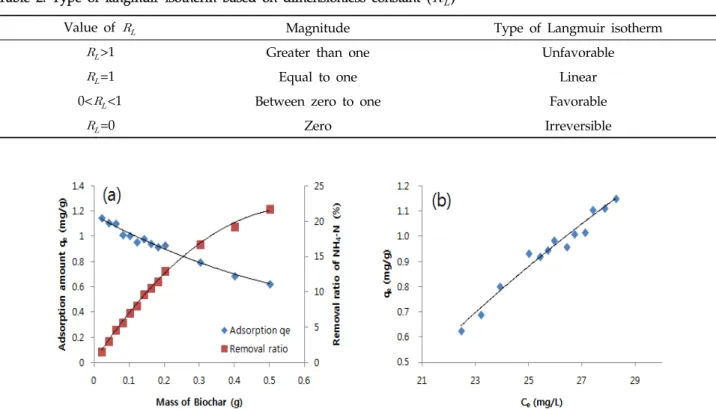
Table 2. Type of langmuir isotherm based on dimensionless constant (
)Value of Magnitude Type of Langmuir isotherm
>1 Greater than one Unfavorable
=1 Equal to one Linear
0<<1 Between zero to one Favorable
=0 Zero Irreversible
Fig. 1. Variation in adsorption amount and removal ratio of NH4-N (a) and plot of qe vs. Ce in NH4-N (b) adsorption on different mass of biochar (qe is amount of NH4-N adsorption to the biochar (mg/g), and Ce is concentration of NH4-N in solution at equilibrium (mg/L)).
(Eq. 1)
×
(Eq. 2)
Eq. 1와 Eq. 2에서
는 바이오차 무게(g) 당 흡착된 NH
4-N의 양(mg/g),
는 NH
4-N 용액의 초기 농도(mg/
L),
는 흡착 후 NH
4-N 용액의 평형 농도(mg/L), 는 용액의 부피(L),
는 바이오차 투입량(g)으로 나타내었다.
NH4-N의 Langmuir 흡착등온식 적용
Langmuir 흡착등온식은 Eq. 1을 이용하여 계산한 NH
4-N 흡착량(
)을 이용하여 Langmuir 흡착등온식에 적용하였다.
Langmuir 흡착등온식은 일반적으로 흡착제의 흡착사이트에 대해 용매와 흡착질간의 경쟁이 강하지 않고 흡착질이 흡착 제의 표면에 단층(monolayer)으로 흡착하는 경우에 나타나 는 것(Na et al ., 2012)으로, Eq. 3과 같이 표현된다.
(Eq. 3)
Eq. 3에서
는 NH
4-N 흡착량(mg/g),
은 바이오차의 최대 단분자층 흡착량(mg/g),
는 결합 세기(L/mg),
는 NH
4-N 용액에 잔류하는 NH
4-N 농도(mg/L)이다.
과
값을 산출하기 위하여 Eq. 3을 선형화하여 Eq. 4를 얻었다.
(Eq. 4)
Eq. 4에서
대
를 그래프에 도시하여 얻은 직선식 의 기울기와 절편을 이용해
과
값을 얻을 수 있다.
값은 값이 클수록 최대 단분자층 흡착량이 크다는 것을 나타내고,
값은 그 값이 클수록 흡착 친화도가 크다는 것을 나타낸다 (Choi et al ., 2005).
(Eq. 5)
Langmuir 흡착등온식의 특징은 Eq. 5로 정의되는 무차 원 상수
로, 분리계수 또는 평형계수라고 부른다(Lee, 2014). Table 2에서 요약된 바와 같이 무차원 상수
값에 따라 Langmuir 흡착등온식의 유형을 나눌 수 있다(Hamid et al ., 2014).
결과 및 고찰
NH4-N의 흡착량 및 제거율
왕겨 바이오차 투입량에 따른 NH
4-N의 흡착량 및 제거
율을 조사한 결과는 Fig. 1(A)로 나타냈다. NH
4-N 용액의
농도를 30 mg/L으로 고정시키고 바이오차를 0.4-10 g/L
수준으로 나누어 실험한 결과 NH
4-N 흡착량은 1.15-0.62
Fig. 2. Langmuir isotherm plot of 1/Ce vs. 1/qe on NH4-N (qe is amount of NH4-N adsorption to the biochar (mg/g), and Ce is concentration of NH4-N in solution at equilibrium (mg/L)).
Table 3. Parameters calculated from langmuir isotherm model
1) (mg/g) 2) (L/mg) 3)
0.4980 0.0249 0.9937** 0.58
1) : maximum adsorption capacities of NH4-N.
2) : binding strength constant of NH4-N.
3) : dimensionless constant of Langmuir isotherm.
(**denote significance at 1.0% levels.)
Fig. 3. Reaction of biochar carboxyl surface group reacting with ammonia, with ammonia acting as (A) Brownsted or (B) Lewis acid(Jansen and van Bekkum, 1994; Seredych and Bandosz, 2007).
mg/g 로 지수 함수적으로 감소하는 경향을 보였다.
반면에, NH
4-N 제거율은 1.6-21.8%로, 0.2 g까지는 직선 에 가까운 선형적 관계를 보였지만 0.3 g 이상부터는 바이오 차 투입량에 따른 흡착 제거율이 곡선의 형태를 보여줌으로 써 전체적으로 로그 함수적으로 증가하는 경향을 보였다. 이 는 바이오차 투입량이 증가함에 따라 흡착층의 중첩현상 때 문에 바이오차의 활성 사이트를 보호하는 현상이 일어나고 (Kizito et al ., 2015), NH
4-N 용액 중에 잔존하는 NH
4-N 의 농도가 감소하면서 바이오차의 흡착사이트에 대해 탈이온 교대 성분과 흡착질 사이의 경쟁이 급격히 증가하기 때문에 나타나는 현상이다(Na et al ., 2012). NH
4-N 제거율에 관한 연구는 바이오차뿐만 아니라 제올라이트(Huang et al ., 2010), 활성탄소(Halim et al ., 2013), 이온교환수지(Sica et al ., 2014) 등 다른 흡착제를 이용하여 진행한 실험에도 비슷 한 경향이 나타나고 있다. Fig. 1(B)는 흡착 후 NH
4-N의 평 형농도(
)에 대한 NH
4-N 흡착량(
)을 그래프를 나타낸 것 으로, Y=2.1976ln(x)-6.1939 식의 로그 곡선의 형태를 보였 으며, 바이오차를 적게 투여할수록 포화되는 형태의 곡선을 보였다.
NH4-N 흡착능력
왕겨 바이오차의 NH
4-N 흡착능력을 조사하기 위해
Langmuir 흡착등온식에 적용하였으며, Langmuir 흡착등온 식에서 도출된 직선식은 Fig. 2에 함께 표시하였다. 이 직선 식을 Eq. 4에 대입하여 기울기와 절편으로부터
과 값을 구하였으며 Table 3에
와 무차원상수
도 함께 표시하였 다. 최대 단분자층 흡착량을 나타내는
값은 0.4980 mg/g 으로 산출되었으며, 흡착 친화도를 나타내는 값은 0.0249 L/mg로 산출되었다.
값은 0.9937**로 고도의 유의성이 있는 것으로 나타났다.
무차원 상수
값은 0.58로 Table 2에서 나타낸 바와 같 이 0과 1 사이에 포함되므로 Langmuir 흡착등온식에 잘 맞 는 것으로 나타나 흡착에 용이함을 알 수 있었다(Table 3).
다른 소재를 이용하여 제조된 바이오차로 수행된 연구를 보면, 견목을 소재로 하여 300℃에서 8-12시간 열분해한 바 이오차를 NH
4-N 용액과 낙농 분뇨 폐수에 첨가한 후 최대 흡착량을 산출한 결과 NH
4-N 용액과 낙농 분뇨 폐수에서 각각 2.8 mg/g, 8.3 mg/g을 흡착하였으며(Sarkhot et al ., 2013), 목재와 왕겨를 소재로 하여 600℃에서 10시간 열분해 한 바이오차를 NH
4-N 용액과 돈분 혐기 소화 슬러리에 첨 가하여 최대 흡착량을 산출한 결과 목재와 왕겨 바이오차의 최대 흡착량은 NH
4-N 용액에서 각각 133.33, 71.94 mg/g, 돈분 혐기 소화 슬러리에서 최대 흡착량은 78.06, 59.56 mg/g으로 목재와 왕겨 바이오차 흡착량은 돈분 혐기 소화 슬러리보다 NH
4-N 용액에서 각각 70.8%, 20.8% 더 많이 흡착된다고 보고하였다(Kizito et al ., 2015).
바이오차의 흡착 mechanism을 보면 Fig. 3에서 보는 바
와 같이 바이오차에 흡착된 암모니아(Ammonia)는 다양한
형태로 존재하며(Boehm, 1994), 암모니아는 바이오차 표면
에 존재하는 산소 그룹과 반응하여 아민(Amines) 또는 아미
드(Amides)를 형성한다고 알려져 있다(Seredych and Bandosz, 2007). 암모니아는 Brownsted and/or Lewis acid로써 반응하여 바이오차 표면에 존재하는 카르복실기 (Carboxyl group)와 반응한 다음, 암모늄염(Ammonium salt) 또는 아미드(Amide)를 형성한다(Fig. 3).
본 연구의 결과는 앞서 선행된 연구와 비교하였을 때 보다 낮은 흡착량이 산출되었다. 이는 앞서 선행된 연구와 다른 바 이오차 소재를 사용하였고, 바이오차를 생성하기 위한 온도와 시간이 다르기 때문에 바이오차의 흡착 능력에 차이가 나는 것으로 판단된다. 또한, 교반 시 교반 조건으로 설정한 온도, 속도, 시간 역시 바이오차 흡착 능력에 영향을 미칠 것이라고 판단된다. 선행 연구에서는 바이오차의 투입량을 고정시키고 NH
4-N 용액의 농도를 변화시키는 조건에서 실행되었지만 본 연구는 농경지에 바이오차를 시용한다는 전제 조건하에 바이오차의 투입량을 변화시키고 NH
4-N 용액의 농도를 고 정시키는 조건에서 수행하였다. 따라서 앞서 선행된 연구 결 과와 본 연구의 연구 결과를 상호 비교하는 것은 바람직하지 않다고 판단된다.
요 약
왕겨 바이오차의 N
2O의 배출을 감소하기 위한 NH
4-N의 흡착제로서 가능성을 연구하기 위해 NH
4-N 용액을 이용하 여 왕겨 바이오차의 흡착 특성을 조사하였다. NH
4-N 제거율 은 왕겨 바이오차를 많이 첨가할수록 NH
4-N 제거율이 증가 하는 경향을 보이는 반면에, 바이오차 무게(g) 당 NH
4-N 흡 착량은 감소하는 경향을 보였다. 왕겨 바이오차를 이용한 흡착 실험 결과를 Langmuir 흡착등온식에 적용하여 최대 단분자층 흡착량(
), 흡착 친화도(
), 무차원 상수
를 산출하였다. 그 결과 무차원 상수
값이 0-1사이에 있어 Langmuir 흡착등 온식을 잘 표현하였다. 따라서 왕겨를 소재로 제조한 바이오 차는 흡착에 용이한 것으로 나타났다. 향후 이를 바탕으로 온 실가스를 제어하기 위해 왕겨를 소재로 한 바이오차를 토양 에 시용하였을 시 N
2O 배출 감소를 위한 NH
4-N 흡착 특성 에 대한 연구가 필요한 것으로 판단된다.
Acknowledgment
We thank National Academy of Agricultural Science, Rural Development Administration beyond Research Program of Agricultural Science & Technology Development for funding the study (Project No. PJ 010920).
References