• 검색 결과가 없습니다.

Adsorption Characteristics of Cd, Cu, Pb and Zn from Aqueous Solutions onto Reed Biochar

N/A
N/A
Protected

Academic year: 2021

Share "Adsorption Characteristics of Cd, Cu, Pb and Zn from Aqueous Solutions onto Reed Biochar"

Copied!
6
0
0

로드 중.... (전체 텍스트 보기)

전체 글

(1)

Adsorption Characteristics of Cd, Cu, Pb and Zn from Aqueous Solutions onto Reed Biochar

Ik-Won Choi, Jae-Hoon Kim, Soo-Hyung Lee, Jae-Kwan Lee, Dong-Cheol Seo

1

, and Ju-Sik Cho

2

* Water Environmental Engineering Research Division, National Institute of Environmental Research, Incheon 22689, Korea

1

Division of Applied Life Science (BK21 plus) & Institute of Agriculture and Life Science, Gyeongsang National

University, Jinju 52828, Korea

2

Department of Bio-Environmental Sciences, Sunchon National University, Suncheon 57922, Korea

(Received: August 16 2016, Revised: October 5 2016, Accepted: October 24 2016)

Carbon-based sorbents such as biochar and activated carbon have been proven to be cost-effective in removing pollutants containing heavy metals from wastewater. The aim of this study was using batch experiment to evaluate the adsorption characteristics of heavy metals in single-metal conditions onto reed biochar for treating wastewater containing heavy metals. The removal rates of heavy metals were in the order of Pb > Cu

≒ Cd ≒ Zn, showing the adsorption efficiency of Pb was higher than the other heavy metals. Freundlich and Langmuir adsorption isotherms were used to model the equilibrium adsorption data obtained from adsorption of Pb on reed biochar. For reed biochar, the Langmuir model provided a slightly better fit than the Freundlich model. Lead was observed on the biochar surface after adsorption by scanning electron microscopy (SEM) and energy dispersive X-ray spectroscopy (EDS). The main functional groups of reed biochar were aromatic carbons. Overall, the results suggested that reed biochar could be useful adsorbent for treating wastewater containing Pb.

Key words: Biochar, Reed, Heavy metals, Freundlich model, Langmuir model

Scanning electron microphotographs and X-ray energy dispersion spectra of Pb adsorption biochar (×500).

1)

*Corresponding author: Phone: +82617503297, Fax: +82617528011, E-mail: [email protected]

§

Acknowledgement: This study was supported by Post-Doctoral Fellowships Program of National Institute of Environmental Research, Republic of Korea. Also, this work was carried out with the support of “Cooperative Research Program for Agriculture Science &

Technology Development (Project No. PJ011227042016)” Rural Development Administration, Republic of Korea.

(2)

Table 1. Chemical characteristics of reed biochar used.

pH Elemental analysis Heavy metals

C H N Pb Cu Cd Zn

1:10 ---%--- ---mg kg

-1

---

10.01 72.4 2.1 0.2 nd nd nd nd

Introduction

우리나라 산업분야에 따라 염색공정, 도금공정, 가죽모피 가공공정에서 페놀, 시안, 중금속류 및 휘발성 유기화합물이 다수 검출되는 것으로 보고되고 있다 (Kim et al., 2012). 또 한 유럽연합 국가에서도 금속가공 산업과 펄프 및 제지산업 의 폐수 중에서 납, 구리, 아연, 수은, 크롬과 같은 중금속들 이 배출되고 있는 것으로 확인되었으며, 이들의 처리를 위해 침전 및 흡착 공정이 제안되었다 (Kim et al., 2012; Monte et al., 2009; Sthiannopkao and Seesai, 2009).

중금속 제거를 위한 침전공정은 비교적 간단한 처리공정 으로 안정적이면서 처리효율이 높아서 고농도의 폐수처리에 많이 이용되고 있다. 하지만 낮은 농도의 중금속 처리에는 처 리효율이 그다지 높지 않다 (Say et al., 2001). 그러므로 배 출허용기준을 만족시키기 위해서는 낮은 농도에서도 처리효 율이 우수한 흡착공정을 이용하여 미량의 물질까지 제거할 필요성이 있다. 흡착공정은 다른 처리공정과는 달리 흡착제 를 주기적으로 교체하여야 하기 때문에 비용부담을 줄이기 위해서 경제적인 흡착제 선택이 중요하다. 이렇게 경제적인 흡착제를 개발하기 위해서 여러 재료들이 사용되어지고 있 다. 그 중에 하나가 수계에서 제거되는 고사 전· 후의 수생식 물을 이용한 biochar 흡착제 개발이다. 일반적으로 인공 및 자연습지에서 수생식물은 수질을 정화하는데 유용한 것으로 알려져 있다. 하지만 겨울철에 고사된 후 분해되면 2차 오염 을 유발하기 때문에 수생식물을 절취하여 주변에 방치하거 나 소각하고 있다. 그 중에서 가장 대표적인 수생식물로 갈대 가 있다. 이러한 폐자원을 이용하여 흡착제를 제조하기도 한다.

최근 들어 탄소격리와 온실가스 저감효율이 뛰어난 biochar 의 흡착특성이 알려지면서 몇몇 연구자들에 의해 biochar의 중금속 흡착 연구가 진행되고 있다 (Jiang et al., 2012; Kim et al., 2013; Kolodynska et al., 2012). 특히, biochar가 함 유하고 있는 극성 관능기는 수중의 중금속 이온에 대한 흡착 능력이 뛰어난 것으로 보고된 바 있다 (Bae and Koh, 2011;

Lu et al., 2012; Regmi et al., 2012). 또한 폐기되는 자원을 이용하여 중금속 흡착능력이 뛰어난 biochar를 제조한다면 경제적인 측면뿐만 아니라 환경오염적인 측면에서도 도움이 될 것으로 판단된다.

따라서 본 연구는 중금속 오염폐수의 효과적인 처리를 위 하여 갈대로 제조한 biochar의 중금속 (Pb, Cu, Cd 및 Zn) 흡착 능력을 비교하였으며, 이 중 가장 흡착능력이 우수한 중금속을 선정한 후 등온흡착식에 적용하여 흡착특성을 알아보고, 갈 대 biochar의 중금속 흡착 전· 후의 표면 변화를 조사하였다.

Materials and Methods

공시재료 Biochar제조를 위한 원료는 순천만에서 채취

하여 상온에서 건조시킨 갈대를 이용하였고, biochar 제조장치 (STI, Korea)를 이용하여 혐기조건을 유지하며 600°C에서 1 시간 동안 가열하여 biochar를 제조하였으며, 제조된 biochar 를 1~2 mm 크기로 분쇄하여 공시재료로 사용하였다. 공시 재료의 화학적 특성은 Table 1에서 보는 바와 같다.

공시폐수는 Pb(NO

3

)

2

, CuSO

4,

CdSO

4

및 ZnSO

4

(Junsei, Japan)를 혼합하여 제조하였으며, 각각의 중금속 농도는 1,000 mg L

-1

되게 한 후 증류수로 희석 조제하여 사용하였다.

중금속 제거효율 조사 Biochar의 중금속 제거효율을 조사하기 위하여 각 중금속 (Pb, Cu, Cd 및 Zn)의 농도가 100 mg L

-1

인 용액 100 mL에 biochar 0.05 g을 첨가하여 실온에 서 24시간 160 rpm으로 교반 후 biochar의 중금속 제거효율 을 조사하였다.

중금속 등온흡착 실험 중금속 등온흡착식은 각각의

100 mg L

-1

중금속 용액 100 mL에 biochar의 양을 달리 첨가 한 후 24시간 160 rpm으로 교반시켜 흡착평형상태에서 중금 속 잔존농도를 분석하여 중금속 흡착량을 산출하였다. 각각 의 중금속 흡착량을 이용하여 Freundlich와 Langmuir 등온 흡착식에 적용하여 각각의 인자를 계산하였다. Freundlich 등온흡착식은 실험식으로 다음과 같이 표현 된다 (Freundlich, 1906).

  



(Eq. 1)

Eq. 1에서 q는 흡착제 무게당 흡착된 중금속 이온의 질량 (mg g

-1

), C

eq

는 잔류중금속 이온의 평형농도 (mg L

-1

), K는 흡착능력, 1/n은 흡착강도를 나타낸다. 상기의 Eq. 1의 양변 에 log를 취하여 선형화시키면

log  log log



(Eq. 2)

로 되며, Eq. 2에서 log q에 대하여 log C

eq

를 plot해서 얻은 기울기로부터 K, 그리고 1/n값을 얻을 수 있다. 결과로부터 얻은 K값은 흡착능력과 관련한 함수로서 값이 클수록 흡착제 의 흡착능력이 증가하는 것으로 알려져 있으며 (Choi, 2004;

Choi et al., 2005), 1/n 값은 입자와 오염물질간의 흡착강도

를 나타내며 일반적으로 그 값이 0.1~0.5의 범위에 존재할

(3)

Fig. 1. Removal rate of heavy metals by reed biochar.

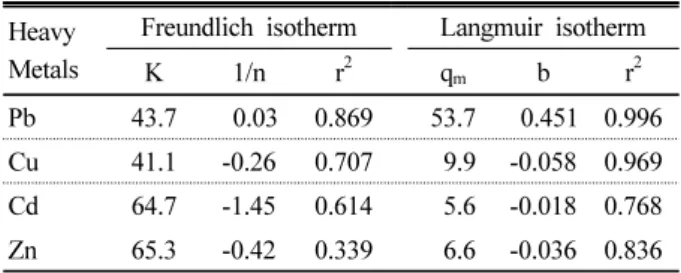
Table 2. Determination of the parameters for the Freundlich and Langmuir adsorption isotherm using reed biochar.

Heavy Metals

Freundlich isotherm Langmuir isotherm

K 1/n r

2

q

m

b r

2

Pb 43.7 0.03 0.869 53.7 0.451 0.996 Cu 41.1 -0.26 0.707 9.9 -0.058 0.969 Cd 64.7 -1.45 0.614 5.6 -0.018 0.768 Zn 65.3 -0.42 0.339 6.6 -0.036 0.836 때 피흡착제는 흡착이 용이하고, 2 이상이면 난흡착성 이라

고 알려져 있다. 또한 흡착강도 (1/n)값이 1보다 적을 경우 Langmuir형의 흡착등온특성을 갖는 것으로 알려져 있다 (Na et al., 2011; Weber and Miller, 1989). Langmuir 등온흡착 식은 다음과 같이 표현된다 (Langmuir, 1918).

   

  







(Eq. 3)

Eq. 3에서, q는 중금속흡착량 (mg g

-1

), q

m

은 단분자층을 형성하는 포화흡착량 (mg g

-1

), b는 결합세기, C

eq

는 잔류 중 금속 평형농도 (mg L

-1

)이다. 상기 Eq. 3을 선형화시키면

 



    

 



(Eq. 4)

로 되며, Eq. 4에서 C

eq

에 대하여 C/q를 plot해서 얻은 기울 기로부터 q

m

, 그리고 b값을 얻을 수 있다. 결과로부터 얻은 q

m

이 클수록 최대 흡착량이 크다는 것을 나타내고 b 값이 클 수록 흡착친화도가 크다는 것을 나타낸다 (Choi, 2004; Choi et al., 2005).

중금속 흡착 전 · 후의 biochar 표면 변화 Biochar 에 흡착된 중금속의 흡착형태를 관찰하기 위해서 전자현미 경 (SEM, Hitachi, Japan)으로 관찰하였으며, 흡착 전· 후의 biochar 표면의 무기원소 분석은 Energy Dispersive X-ray Spectrometer (EDS, Serial II, Noran, USA)로 분석하였다.

Biochar의 중금속 흡착 유무에 따른 biochar 표면의 작용 기 변화를 관찰하기 위하여 FT-IR (FTIR 8700, Shimadzu, Japan) 스펙트럼을 이용하여 KBr 가압정제법을 이용하였다.

분석방법 pH와 EC측정은 시료 5 g에 증류수 50 mL를 가하여 160 rpm에서 30분간 진탕 (JEIO TECH SK-760M)한 후 pH, EC meter (Seven Multi, METTLER TOLEDO)로 측정 하였다 (NIAST, 2000). 원소분석은 Elementary analysis (CHN 628, Leco, USA)로 측정하였다. Biochar의 중금속함량 (Pb, Cu, Cd 및 Zn) 분석은 일정량의 시료를 습식분해 (황산+과염 소산)한 후 일부를 취하여 ICP (ICPE-9000, Shimadzu)로 측 정하였다 (NIAST, 1996).

Results and Discussion

중금속 제거효율 갈대 biochar의 중금속 종류별 제거 효율을 조사한 결과는 Fig. 1과 같다. 각 중금속의 농도가 100 mg L

-1

인 용액 100 mL에 biochar 0.05 g을 첨가한 결과 전체적으로 중금속 제거효율은 Pb가 높았고 Cu, Cd 및 Zn은

비슷한 처리효율을 나타내었다. 특히 Pb의 제거효율이 50.1%

로 다른 중금속에 비해 높았다. Cu의 제거효율은 12.8%이었 고, Cd의 제거효율은 10.8%이었으며, Zn의 제거효율은 10.7%로 Pb의 제거효율에 비해서 낮았다. 이러한 결과는 참 깨 biochar (Choi et al., 2013) 배추 biochar (Bae and Koh, 2011), 천연제올라이트와 제강전로슬래그 (Kim and Yim, 2012), 미생물 (Kim et al., 2005) 및 해조류 (Choi et al., 2005) 등을 이용한 Pb, Cu, Cd 및 Zn 흡착제거 실험에서도 본 연구와 유 사한 경향이었다. 갈대 biochar의 중금속 제거특성을 이해하 기 위해 Freundlich와 Langmuir 등온흡착 실험을 수행하였다.

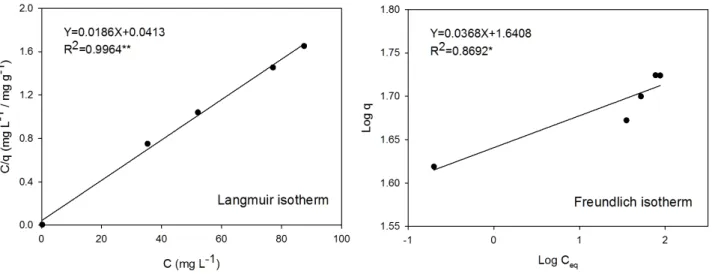
중금속 흡착능력 갈대 biochar의 중금속 흡착능력을 조사하기 위해 100 mg L

-1

농도의 중금속 (Pb, Cu, Cd 및 Zn) 용액 100 mL에 biochar의 주입량을 달리하여 흡착 후 Freundlich 와 Langmuir 등온흡착식에 적용하였다 (Table 2, Fig. 2). 각 각의 중금속별 Freundlich식 2에서 도출한 직선식으로 부터 구한 값을 Eq. 1을 이용하여 각각의 중금속의 K 값과 1/n 값 을 구하여 Table 2에 나타내었다. Pb, Cu, Cd 및 Zn의 흡착 강도 (1/n)는 각각 0.03, -0.26, -1.45 및 -0.42로 Pb에 대한 흡착강도 (1/n)만이 양의 값을 가지는 것을 보여주었으나 이 값이 1 이하로 Langmuir 형의 흡착등온특성을 가지고 있는 것을 알 수 있었다.

갈대 biochar를 이용한 중금속 흡착실험 결과를 이용하여

Langmuir식 4에서 도출한 직선식으로 부터 구한 값을 Eq. 3을

(4)

Fig. 2. Freundlich and Langmuir isotherm equations of Pb using reed biochar.

Fig. 3. Scanning electron microphotographs and X-ray energy dispersion spectra of biochar before and after Pb adsorption (×500).

이용하여 각각의 중금속의 최대흡착량 (q

m

)값과 흡착친화도 (b)값을 구하여 Table 2에 나타내었다. Langmuir 등온흡착식 에서 최대흡착량 (q

m

)을 보면 Pb를 흡착할 경우 53.7 mg g

-1

으로 Cu 9.9 mg g

-1

, Cd 5.6 mg g

-1

및 Zn 6.6 mg g

-1

에 비해 서 상당히 높은 것을 알 수 있었다. 본 연구에서 사용된 갈대 이외에 다른 물질로 제조된 biochar의 중금속 흡착능력을 보 면 하수슬러지 (sewage sludge) biochar를 이용한 Pb

2+

흡착 효율은 17~30 mg g

-1

로 보고된 바 있고 (Lu et al., 2012), 거 대억세 biochar를 이용한 Cd 흡착효율은 11.4~13.24 mg g

-1

로 보고된 바 있고 (Kim et al., 2013), 큰개기장 (switchgrass) biochar를 이용한 Cd 흡착효율은 15.7~34.0 mg g

-1

, Cu 흡착 효율은 19.4~31.0 mg g

-1

으로 보고된 바 있다 (Regmi et al., 2012). 이에 비해서 본 연구에서 사용된 갈대 biochar는 Cu,

Cd 및 Zn에 대한 중금속 흡착율은 높지 않은데 비해서 Pb에 대한 흡착효율은 상당히 높았다. 그리고 흡착친화도 (b) 또한 Pb가 상당히 높게 나타나서 갈대 biochar가 Pb에 대한 선택 적 흡착능력이 높은 것으로 판단된다. Pb 흡착은 전반적으로 Langmuir 등온흡착식이 Freundlich 등온흡착식에 비해서 잘 일치하였다. 일반적으로 Langmuir 등온흡착식은 균일한 흡착에너지를 갖는 흡착제와 비극성 흡착물질의 경우에 잘 적용되는 것으로 알려져 있다 (Choi et al., 2005; Ruthven, 1984; Yang, 1987).

중금속 흡착 전 · 후의 biochar의 변화 Biochar의 Pb

흡착 전· 후의 biochar를 전자현미경 (SEM)에 부착된 EDS로

분석한 결과는 Fig. 3과 같다. 중금속 흡착후 갈대 biochar에

(5)

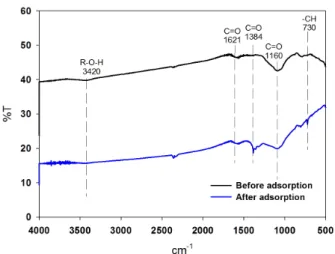
Fig. 4. FT-IR spectra of biochar before and after Pb adsorption.

형성된 electron dense particles의 구성성분들을 정확하게 확인하기 위해서 전자현미경에 부착된 EDS를 통해서 electron dense particles를 확인한 결과 Pb가 biochar에 결합되어 있 는 것을 알 수 있었다 (KaduKová and Komorová, 2002; Kim et al., 2005; Say et al., 2001).

Biochar의 Pb 흡착 작용기를 확인하기 위하여 중금속 흡 착 전후의 갈대 biochar의 FT-IR을 찍은 결과 (Fig. 4) 제조 된 갈대 biochar는 IR 스팩트럼상에서 중금속 이온과 치환될 수 있을 것으로 예상되는 functional group을 확인 할 수 있 었는데 730 cm

-1

에서의 -CH, 1160 cm

-1

1384 cm

-1

1621 cm

-1

에서의 C=O stretching (Bae and Koh, 2011; Lu et al., 2012;

Regmi et al., 2012), 3420 cm

-1

에서의 R-O-H stretching (Lu et al., 2012) 등의 peak를 가지고 있었다. 이러한 작용기들 중에서 1160 cm

-1

, 1384 cm

-1

, 1621 cm

-1

에서의 방향족 C=O ring stretching 등은 바이오차 제조시에 다량 생성되어 Pb 흡착에 관여할 것으로 판단된다 (Bae and Koh, 2011; Lehmann and Joseph, 2009).

Conclusion

갈대의 중금속 흡착제로서 가능성을 검토하기 위해 600°C 에서 1시간동안 열분해 한 갈대 biochar를 이용하여 수중의 중금속 흡착특성을 조사하였다. 갈대 biochar의 중금속 흡착 효율을 비교한 결과 Pb > Cu ≒ Cd ≒ Zn 순으로 Pb의 흡착 효율이 가장 높았다. 실험대상 중금속 중 Pb의 흡착효율이 가장 우수하여 본 논문에서는 갈대 biochar 표면에 Pb의 흡 착메커니즘을 구명하고자 하였다. 갈대 biochar를 이용한 Pb 흡착실험 결과 Langmuir와 Freundlich 등온흡착식 모두에 서 Pb의 흡착능력이 우수한 것으로 나타났으며, Langmuir 등온흡착식이 Freundlich 등온흡착식에 비해 적합하였다.

SEM을 통한 Pb 흡착 전· 후의 biochar관찰 및 EDS 분석결과 Pb가 biochar에 결합되어 있는 것을 알 수 있었다. FT-IR 분 석결과 제조된 biochar에 주로 화학적 흡착에 관여할 방향족

C=O ring stretching (1160 cm

-1

, 1384 cm

-1

, 1621 cm

-1

)이 확 인되었다. 이상의 결과를 미루어 볼 때 갈대로 제조한 biochar 는 Pb에 선택성을 가진 흡착제로서의 활용 가능성이 높을 것 으로 판단된다. 이들 결과는 향후 갈대 biochar를 중금속 흡 착제 활용하기 위한 기초자료로 활용될 수 있을 것으로 판단 된다.

References

Bae, S.Y. and E.S. Koh. 2011. Lead and zinc sorption on biochar of cabbage using hydrothermal carbonization. J. Kor. Soc.

Environ. Analys. 14:228-233.

Choi, I.W. 2004. Biosorption of heavy metals and development of biosorbent by using seaweeds. Master Science Thesis, Sunchon National University, Korea.

Choi, I.W., S.U. Kim, D.C. Seo, B.H. Kang, B.K. Sohn, Y.S.

Rim, J.S. Heo, and J.S. Cho. 2005. Biosoroption of heavy metals by biomass of seaweeds, Laminaria species, Ecklonia stolonifera, Gelidium amansii and Undaria pinnatifida, Korean J. Envirion. Agric. 24:370-378.

Choi, I.W., D.C. Seo, S.W. Kang, S.G. Lee, Y.J. Seo, B.J. Lim, J.S. Heo, and J.S. Cho. 2013. Adsorption Characteristics of Heavy Metals using Sesame Waste Biochar. Korean J. Soil Sci.

Fert. 46:8-15.

Freundlich, H.M.F. 1906. Over the adsorption in solution. J.

Phys. Chem. 57:385-470.

Jiang, T.Y., J. Jiang, R.K. Xu, and Z. Li. 2012. Adsorption of Pb(II) on variable charge soils amended with rice-straw derived biochar. Chemosphere 89:249-256.

KaduKova ́, J., and T. Komorová. 2002. Bopakumulácia a biocoppcia striebra riasou Chlorella kessleriz modelov ̀ych roztokov [Silcer bioaccumulation and biosorption by alga chlorella kessleri from model solutions]. Acta Metall. Slovaca.

8(2):117-123.

Kim, D.H. and S.B. Yim. 2012. Removal characteristics of heavy metals in acid wastewater by ceramics using natural zeolite and converter slag. J. KSEE. 34(4):239-246.

Kim, J.H., D.H. Jeong, J.S. Shin, C.G. Lee, J.P. Kim, J.Y. Lee, Y.S. Lee, M.Y. Kim, and Y.S. Kim. 2012. A Study on Discharge of Hazardous Water Pollutants in Industrial Wastewater.

National Institute of Environment Research. Korea.

Kim, S.U., I.W. Choi, D.C. Seo, M.H. Han, B.H. Kang, J.S. Heo, B.H. Sohn, and J.S. Cho. 2005. Biosorption of heavy metal in aqueous solution by heavy metal tolerant microorganism isolated from heavy metal contaminated soil. Korean J. Envirion. Agric.

24:379-385.

Kim, W.K., T. Shim, Y.S. Kim, S. Hyun, C. Ryu, Y.K. Park, J.

Jung. 2013. Characterization of Cadmium Removal from Aqueous solution by biochar produced from a giant Miscanthus at different pyrolytic temperatures. Bioresource Technol. 138: 266-270.

Kolodynska, D., R.Wnetrzak, J.J. Leahy, M.H.B. Hayes, W.

(6)

Kwapinski., and Z. Hubicki. 2012. Kinetic and adsoroptive characterization of biochar in metal ions removal. J. Chem.

Eng. 197:295-305.

Langmuir, I. 1918. The adsorption of gases on plane surface of glass, mica and platimum. J. Am. Chem. Soc. 40:1361-1403.

Lehmann, J. and S. Joseph. 2009. Biochar for environmental management: science and technology, Earth-scan, USA.

Lu, H., W. Zhang, Y. Yang, X. Huang, S. Wang, and R. Qiu. 2012.

Relative distribution of Pb

2+

sorption mechanisms by sludge- derived biochar. Water res. 46:854-862.

Monte, M.C., E. Fuents, A. Blanco, and C. Negro. 2009. Waste Management from Pulp and Paper Production in the European Union. Waste Manage. 29: 293-308.

Na, C.K., M.Y. Han, and H.J. Park. 2011. Applicability of theoretical adsorption models for studies on adsorption properties of adsorbents[I]. J. Kor. Soc. Environ. Eng. 33(8):606-616.

NIAST. 1996. The official test methods for the fertilizer quality and sampling guideline, National Institute of Agricultural Science and Technology, RDA, Suwon, Korea.

NIAST. 2000. Methods of soil and plant analysis. National Institute of Agricultural Science and Technology, RDA.

Regmi, P., J.L.G. Moscoso, S. Kumar, X. Cao, J. Mao, and G.

Schafran. 2012. Removal of copper and cadmium from aqueous solution using switchgrass biochar produced via hydrothermal carbonization process. J. Environ. Manage.

109:61-69.

Ruthven, D.W. 1984. Principles of Adsorption and Adsorption Process. John Wiley & Sons. U.S.A.

Say, R., A. Denizli, and M.Y. Arica. 2001. Biosorption of cadmium(II), lead(II), and copper(II) with the filamentous fungus Phanerochaete chrysosporium. Bioresour. Technol.

76:67-70.

Sthiannopkao, S. and S. Seesai. 2009. Utilization of Pulp and Paper Industrial Waste to Removalk Heavy Metals from Metal Finishing Wastewater. J. Environ. Manage. 90. 3283-3289.

Weber, J.B. and C.T. Miller. 1989. Organic chemical movement over and through soil. In B.L., Sawhney, and K. Brown. (ed.) American Society for agronomy, Madison, WI. p. 305-334.

Yang, R.T. 1987. Gas Separation by Adsorption Processes.

Butterworths Series in Chemical Engineering. Butterworth-

Heinemann. U.K.

수치

Table 1. Chemical characteristics of reed biochar used.
Table 2. Determination of the parameters for the Freundlich  and Langmuir adsorption isotherm using reed biochar.
Fig. 2. Freundlich and Langmuir isotherm equations of Pb using reed biochar.
Fig. 4. FT-IR spectra of biochar before and after Pb adsorption.

참조

관련 문서

This study the changes in structure and mechanical characteristics by the analysis on mechanical characteristics of the welding part and the post weld

In this study, the RESRAD-RECYCLE 3.10 computer code was used to evaluate individual and collective doses due to the recycling of radioactive metal waste

mould with rapid and uniform cooling characteristics using the deposition of the multi-materials based on the direct metal rapid tooling process.. In order

Therefore, the aim of this study was to investigate the morphologic characteristics of the interalveolar foramen and to analyze according to sex and age using cone

Objectives : The purpose of this study was to investigate the effects of general characteristics, health characteristics, mental health characteristics, suicidal

The purpose of this study is to establish and design the characteristics of summer resorts according to the design manual, develop cultural products using

Therefore this study is to examine various characteristics of Doseon, extract the truth of tale inherent in the tale and show the aspects of Doseon tale

The aim of this study was to evaluate the sealing ability in Type II root canal obturation by comparing the presence of voids between single cone technique using Endoseal MTA