Korean J ournal of S oil S cience and F ertilizer
Article https://doi.org/10.7745/KJSSF.2020.53.3.301
pISSN : 0367-6315 eISSN : 2288-2162
Phosphate Adsorption Characteristics of Activated Palm Biochar in Aqueous Solution
Hui Seon Kim1,4, Sangwon Park2, Seok-In Yun3, Hoon Choi3, and JoungDu Shin4*
1Graduate Student, Relating with National Institute of Agricultural Sciences & Wonkwang University Collaboration, Korea
2Agricultural Researcher, Chemical Safety Division, National Institute of Agricultural Sciences, Wanju Gun 55365, Korea
3Professor, Department of Bio-Environmental Chemistry, College of Agriculture and Food Sciences, Wonkwang University, Iksan 54538, Korea
4Principal Researcher, Climate Change & Agroecology Division, Department of Agricultural Environment, National Institute of Agricultural Sciences, Rural Development Administration, Wanju 55365, Korea
*Corresponding author: [email protected]
A B S T R A C T Received: August 4, 2020
Revised: August 20, 2020 Accepted: August 22, 2020
ORCID JoungDu Shin
https://orcid.org/0000-0002-5941-3438
Objective of this study was to investigate PO4-P adsorption characteristics of activated palm biochar with application of Langmuir isotherm. For the adsorption experiment of PO4-P to activated palm biochar, the loading amount of activated palm biochar varied from 0.4 to 6 g L-1 with 30 mg L-1 of PO4-P solution. The maximum adsorption amount and removal rates of PO4-P were 0.57 mg g-1 and 56.6%, respectively. The sorption of PO4-P of activated palm biochar was fitted well by a Langmuir model. For application of Langmuir isotherm, it appeared that the maximum adsorption amount of PO4-P and binding strength constant were estimated to be 9.36 mg g-1 and 0.005 L mg-1, respectively. Therefore, activated palm biochar can be used to control the release of PO4-P from supplemented biochar pellet fertilizer.
Keywords: Absorption capacity, Activated palm biochar, Isotherm model
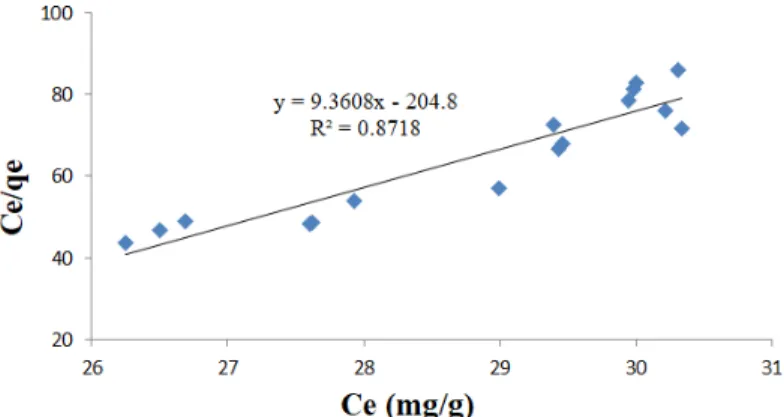
Langmuir isotherm plots of PO4-P by different mass of activated palm biochar. The values were average of three replications.
Ⓒ The Korean Society of Soil Science and Fertilizer. This is an Open Access article distributed under the terms of the Creative Commons Attribution Non- Commercial License (http://creativecommons.org/licenses/by-nc/4.0) which permits unrestricted non-commercial use, distribution, and reproduction in any medium, provided the original work is properly cited.
Introduction
우리나라의 기후조건이 여름철에 집중되는 호우로 비료 시용에 따른 양분 용출 등의 많은 연구가 이루어져 왔다.
인 (Phosphorus)은 식물 세포의 기본인 핵산과 세포막의 인지질을 구성하는 등 식물 성장에 있어 중요한 역할을 하며, 인산을 주성분으로 하는 비료는 오래전부터 이용되었다. 하지만 지속적인 인산질 비료의 시용은 토양 중의 인산 함량 을 높이고, 강우 시 유거수에 의해 생태계로 용출되어 수질의 부영양화 현상을 초래하게 된다 (Barber, 1979; Sutton et al., 1982). 고농도의 인은 물리, 화학 및 생물학적 변화에 크게 민감하게 반응하기 때문에 환경으로 배출되기 전에 토 양에 적절한 처리를 통해 인의 용출을 제어하는 것이 필요하다 (Lee et al., 2010). 최근에 인 처리를 위한 흡착제 개발 에 관해 활발하게 연구되고 있다. 흡착 등온식 (adsorption isotherm)을 이용하여 광그라프트 중합과 아민화 반응을 통해 제조한 흡착제의 PO4에 대한최대 흡착량이 111.4 mg g-1으로 나타났으며 (Lee et al., 2016), 황토의 혼합량과 접 촉 시간이 증가함에 따라 인의 제거율이 증가한다고 발표하였다 (Shin et al., 2011). 대체로 인의 제거는 비교적 높은 비용과 처리공정이 복잡하고 정교한 기술이 요구되기 때문에 적은 비용으로 효율이 높고, 유지 및 관리가 간편한 새로 운 인 제거 기술이 요구되고 있다 (Ryoo and Choi, 2012). 바이오차는 인을 제거 및 유지하고, 토양 개량제로서 이용 될 수 있다 (Bolton et al., 2019). 또한 바이오차를 이용함으로서 효율적이면서 효과적으로 오염 물질을 제거할 수 있 어 경제적인 방법으로 여겨지고 있다 (Woo, 2013). 바이오차를 이용한 PO4-P 제거의 기존 연구에서 왕겨, 야자수, 옥 수수, Coco pod 바이오차는 PO4-P를 흡착하며, 이중 야자수 바이오차가 11.63 mg g-1으로 가장 높은 흡착량이 나타 났다고 보고했다 (Eduah et al., 2020). 이외에도 수산 폐기물 바이오차의 투입량 증가에 따라 인의 제거율이 증가하지 만 (Lee et al., 1997), 참나무 바이오차의 경우 일정 수준 이상의 바이오차가 투입되면 감소한다고 발표했다 (Choi et al., 2015). 이에 따라 바이오차는 종류마다 투입량이 증가 할 수록 인의 제거율이 다르게 나타나는 것을 알 수 있다. 바 이오차를 이용한 PO4-P 제거에 관한 연구는 있지만, 야자수 활성 바이오차를 이용한 PO4-P 흡착 연구는 미흡한 실정 이다. 최근 야자수 바이오차는 Freundlich 흡착등온식을 통해 Basic Blue 3과 Brilliant Blue FCF (청색제 1호) 염료가 다분자 층으로 흡착하지만 (Lee, 2015; Park et al., 2018), 아닐린 염료는 Langmuir 흡착등온식에 잘 맞아 단분자층으 로 흡착한다고 보고하였으며 (Lee, 2019), 이러한 연구 결과에 따라, 흡착질 마다 흡착 특성이 다르다는 것을 알 수 있 다. 이외에도 야자수 바이오차는 Congo Red, acid Green 27등 흡착제로 폭넓게 활용되고 있다 (Lee, 2015; Lee, 2017). 바이오차가 다공성이면서 흡착능을 높이기 위해서는, 열분해 온도를 높이거나, 이화학적 처리를 한 활성 바이 오차를 만들어야 하지만, 연구자들은 소규모의 열분해 시스템을 가지고 유, 무기태 화합물에 대한 흡착능 시험을 하 는 단계이다. 따라서 바이오매스 전환 활성 바이오차의 가격이 상대적으로 높아, 대량 생산이 가능한 야자수 활성 바 이오차를 본 연구 소재로 이용하여, 야자수 활성 바이오차가 PO4-P를 흡착능을 구명하고자 하였다. 본 연구는 야자수 활성 바이오차를 이용한 PO4-P의 흡착 특성을 구명하기 위해 수행하였다.
Materials and Methods
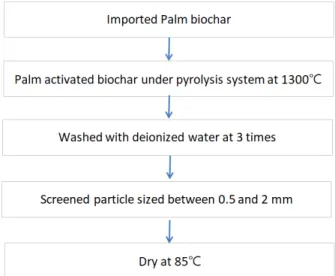
실험 재료 및 화학 성분 분석 야자수 바이오차를 1,300°C에서 활성화한 활성 야자수 바이오차를 본 실험에 사용하였다. 야자수 활성 바이오차를 증류수로 씻은 후 85°C에서 건조하여 아래 Fig. 1에 도식한 절차에 따라 준비하 여 사용하였다 (Fig. 1).
야자수 활성 바이오차에 대한 표면 주요 원소로서 C, H, O, N, S는 원소분석기 ( EA 2000, Thermo finnigan, Sane
Fig. 1. Paragraph of preparing the activated palm biochar used in this experiment.
Table 1. Characteristics of activated palm biochar.
C (%) H (%) O (%) N (%) S (%)
74.33 0.95 7.58 0.97 1.32
Table 2. XRF analysis results of activated palm biochar.
Chemical properties Activated palm biochar (%)
Calcium (Ca) 28.7
Potassium (K) 2.6
Iron (Fe) 35.9
Chlorine (Cl) ND
Silicon (Si) 15.7
Sulfur (S) 7.9
Phosphorus (P) ND
Manganese (Mn) 1.7
Others 2.9
*ND : Not Detected.
Jose, CA, USA)를 이용하여 정량 하였으며 (Table 1), 필수 및 미량 원소는 X선 형광분석기 (XRF) (S2 Ranger, Bruker AXS GmbH, Karlsruhe, Germany)을 이용하여 분석하였다 (Table 2). 질소 함량은 0.97 mg kg-1으로 다른 종 류의 바이오차와 비교하여 극히 낮은 것으로 나타났다 (Table 1).
야자수 활성 바이오차에 대한 필수 및 미량 원소 분석 결과는 Table 2에 나타냈다. 작물 생육의 필수 원소인 인은 분 석기기의 검출 한계 이하로 나타났으며, 가리의 함량은 2.6%이었으며, 특히 칼슘의 함량이 28.7%로 높게 분석되었 다. 또한 Fe, Cl, Mn과 같은 미량원소 성분은 대체로 낮게 검출되었다(Table 2).
PO4-P 흡착실험 및 분석 방법 PO4-P의 흡착량 실험을 위해, HDPE 광구병 (Az.BWH0250PN)에 (NH4)2HPO4
시약을 사용하여 각각 30 mg L-1 PO4-P 용액을 같은 양으로 넣고, 야자수 활성 바이오차를 0.4 -25 g L-1의 범위로 투
입량을 변화하여 사용하였다. 25°C에서 왕복식 항온 진탕기를 24시간 동안 140 rpm 속도로 진탕 하면서 흡착시켰다.
바이오차 입자를 여과지 (Whatman #2)를 통하여 여과한 후 용액 중에 잔류하는 PO4-P의 농도는 비색법 (Kitson and Mellon, 1944)을 보완한 자외/가시광선 분광광도계 측정용 키트 (ST- Ammonium, C-Mac, Korea)를 이용하여 자외/
가시광선 분광광도계로 측정 하였다. 야자수 활성 바이오차의 투입량에 따른 PO4-P의 흡착 특성을 알아보기 위하여 PO4-P의 흡착량과 제거율은 아래 Eq. (1)과 Eq. (2)를 이용하여 산정하였다.
(Ep. 1)
× (Ep. 2)
qe : 야자수 활성 바이오차의 단위 g당 흡착된 PO4-P의 양 (mg g-1) C0 : PO4-P의 초기 농도 (mg L-1)
Ce : (NH4)2HPO4 용액 중의 PO4-P 평형 농도 (mg L-1) V : (NH4)2HPO4 용액의 부피 (L)
W : 야자수 활성 바이오차 투여량 (g)
흡착등온식 적용 본 연구의 흡착 실험 결과를 Langmuir 흡착등온식에 적용했을 때 직선을 나타낸다면, 이는 Langmuir 흡착등온식을 따른다고 할 수 있으며, 흡착질이 흡착제의 표면에 단층으로 흡착한다고 가정하였다 (Na et al., 2011). 또한, Langmuir 흡착등온식은 흡착된 분자들 사이에 작용하지 않는다고 가정하였다 (Lee, 2019).
Langmuir 흡착등온식은 Eq. (3)으로 나타내었다. qm, b값은 Eq. (3)을 선형화하여 Eq. (4)를 이용하여 계산하였다.
(Eq. 3)
(Eq. 4)
qe : 야자수 활성 바이오차 단위 g당 흡착된 PO4-P의 양 (mg g-1) qm : 야자수 활성 바이오차의 PO4-P 최대 단분자층 흡착능 (mg g-1) b : 결합 세기 (L mg -1)
Ce : 용액 중의 잔류하는 PO4-P 평형 농도 (mg L-1)
Langmuir 흡착등온식의 적합성 여부는 분리계수 (RL)을 이용하여 흡착소재로써 이용 가능성을 판단할 수 있다. 무 차원 상수 (RL)값은 Eq. (5)를 이용하여 산출하였다 (Choi et al., 2015).
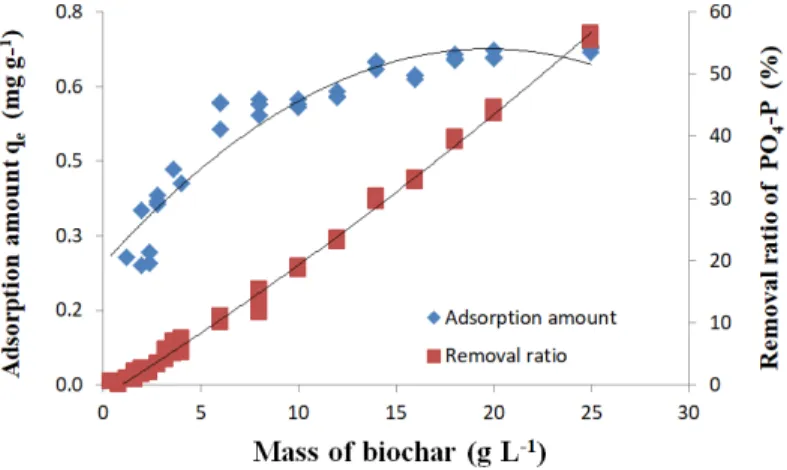
Fig. 2. Variation in adsorption amount and removal rate of PO4-P on activated palm biochar. The values were average of three replications.
(Eq. 5)
Results and Discussion
야자수 활성 바이오차의 PO4-P 흡착량 및 제거율 H/C 비율은 바이오차의 화학물질 구성 정도와 탄화 등급 에 대한 지표로서 사용하였다 (Hammeset et al., 2006; Schimmelpfennig and Glaser, 2012). H/C 비율이 ≤0.2이면 블랙카본 (Black carbon)으로 규정하는데 적당하다고 하였다 (Kuhlbusch and Crutzen, 1995). 따라서 H/C 비율은 0.01로서 바이오차 질을 판단하는 데 본 실험에 사용한 바이오차는 양질인것으로 나타났다 (Table 1). 야자수 활성 바 이오차 첨가량에 따른 PO4-P의 흡착 제거율 변화를 Fig. 2에 나타내었다. 야자수 활성 바이오차의 PO4-P 제거율은 야 자수 활성 바이오차의 투입량이 많아질수록 0.99%에서 56.5%으로 점차 증가하여 직선적 변화가 나타났으며, 야자 수 활성 바이오차의 투입량이 증가할수록 PO4-P는 효율적으로 제거되는 경향을 보였다. 이러한 현상은 일반적으로 흡착제의 비표면적은 흡착질에 대한 흡착 위치를 제공하는 것으로 알려져 있으며, 이는 입상 활성탄의 양이 많아질수 록 정의 상관관계로 비표면적이 증가하여 더 많이 흡착 지점이 만들어 진다는 연구 결과와 일치하는 경향이었다 (Lee, 2019). 하지만, 야자수 활성 바이오차의 투입량이 많아짐에 따라 제거율이 증가하였고, 또한 단위 질량 당 PO4-P 흡착 량은 0.4 - 6 g L-1 범위에서는 0.24 - 0.57 mg g-1로 증가하는 반면, 6 g L-1 이상부터는 더 이상 증가하지 않고 포화되는 형태를 보였다. 본 연구의 결과는 용액 내의 PO4-P가 야자수 활성 바이오차의 투입량에 따라 표면적이 증가하여, 야자 수 활성 바이오차에 대한 흡착율과 제거율이 증가하지만, 일정 수준 이상의 야자수 활성 바이오차가 투입되면 흡착 부 위의 겹침이나 집단화 현상이 발생하여 오히려 전체 표면적이 감소하는 원인에 기인한다는 연구결과와 일치하였다 (Kizito et al., 2014).
일정 농도의 PO4-P를 대상으로 야자수 활성 바이오차의 투여량을 변화할 때의 최대 흡착량 및 흡착 특성을 알아보 기 위해 흡착 등온식에 적용하였다.
흡착등온식 적용 야자수 활성 바이오차의 PO4-P 흡착능을 산정하기 위해, Langmuir 흡착등온식 Eq. (3)을 적 용했을 때 선형식 (Y = 9.36x - 204.8)으로 나타났으며, 흡착등온식의 적정 정도 (0 - 1)를 나타내는 결정 계수 R2 값이
Fig. 3. Langmuir iostherm plots of PO4-P by different mass of activated palm biochar. The values were average of three replications.
Table 3. Parameters calculated from application of Langmuir isothermal model with adsorption result of PO4-P.
qm
(mg g-1) b
(L mg-1) R2 RL
9.361 0.005 0.87 0.868
qm: maximum adsorption capacities of PO4-P, b: binding strength constant of PO4-P, R2: Significant at 1%, RL:
dimensionless constant of Langmuir isotherm.
0.87로 도출되어 Langmuir 흡착등온식에 잘 맞는 것으로 나타났다 (Fig. 3). 이는 야자수 활성 바이오차가 표면이 균 일하고 흡착이 단분자층에서 일어날 가능성이 더 크다는 것을 의미한다.
Langmuir 흡착등온식의 특징은 무차원 상수 RL의 사용이다. 분리계수 또는 평형계수라고 하며, 0 < RL < 1이면 흡 착 소재로서 적합하다는 것을 의미한다. 무차원상수 RL 값은 0.868로 Langmuir 흡착등온식에 잘 맞는 것으로 나타났 다 (Table 3). 최대 단분자층 (qm)과 결합세기 (b)는 각각 9.36 mg g-1과0.005 L mg-1로 산출되었다. qm과 b는 값이 클 수록 높은 흡착성을 보인다. 수산 폐기물을 이용한 바이오차의 최대 qm과 b 값은 각각 4.39 mg g-1, 19.56L mg-1이며, 참나무 바이오차의 PO4-P의 최대 qm과 b 값은 0.1 mg g-1, 0.06 L mg-1으로 보고했다 (Choi et al., 2015; Park et al., 2018). 선행 연구와 비교했을 때, 야자수 활성 바이오차의 qm값이 2.1 - 93.6 배 높게 나타남으로, 야자수 활성 바이오 차의 PO4-P흡착능이 더 뛰어남을 알 수 있다. 하지만 바이오차 이외의 흡착제 광그라프트 중합과 아민화 반응을 통해 제조한 흡착제의 PO4-P 최대 qm과 b값은 111.4 mg g-1, 0.126 L mg-1로 보고되었으며 (Lee et al., 2010), 야자수 활성 바이오차에 대한 흡착력 증진 방법에 관한 연구가 더 필요하다고 판단된다. 따라서, 야자수 활성 바이오차는 PO4-P를 흡착하므로 바이오차 펠렛 완효성 비료 제조 공정 시 왕겨 바이오차와 야자수 바이오차를 적절한 비율로 혼합한 바이 오차 팰렛 완효성 비료를 경작지에 시용할 때 PO4-P의 용출을 제어하기 때문에 유거수에 의한 PO4-P의 손실을 줄일 수 있기를 기대한다.
Conclusions
본 연구는 야자수 활성 바이오차의 PO4-P 흡착 특성을 구명하고자 수행하였다. PO4-P 제거율은 야자수 활성 바이 오차를 많이 투입할수록 PO4-P 제거율이 증가하는 경향을 보이지만, 야자수 활성 바이오차 무게 (g) 당 PO4-P 흡착량
은 감소하는 경향을 보였다. 야자수 활성 바이오차를 이용한 흡착실험 결과를 Langmuir 흡착 등온식에 적용하여 최 대 단분자층 흡착량 (qm), 흡착 친화도 (b), 무차원 상수 (RL)는 각각 9.36 mg g-1, 0.005 L mg-1, 0.87으로 산출되었다.
무차원 상수 (RL)값이 0 - 1사이에 있어 Langmuir 흡착등온식에 잘 맞는 것으로 나타났다.
Acknowledgment
This work was performed with the support of the “Cooperative Research Program for Agricultural Science &
Technology Development (Project No. PJ01381401)”, Rural Development Administration, Republic of Korea.
References
Barber, S.A. 1979. Soil phosphorus after 25 years of cropping with five rates of phosphorus application. Communications in Soil Science and Plant Analysis. 10(11):1459-1468.
Bolton, L., S. Joseph, M. Greenway, S. Donne, P. Munroe, and C.E. Marjo. 2019. Phosphorus adsorption onto an enriched biochar substrate in constructed wetlands treating wastewater. Ecological Engineering: X. 1:100005.
Choi, Y.S., J.D. Shin, S.I. Lee, and S.C. Kim. 2015. Adsortion Characteristics of Aqueous Ammonium Using Rice hull-Derived Biochar. Journal of Agricultural Chemistry and Environment. 34(3):155-160.
Choi, Y.S., S.G. Hong, S.C. Kim, and J.D. Sin. 2015. Adsorption Characteristics of Aqueous Phosphate Using Biochar Derived from Oak Tree. Jornal of Korea Organic Resource Recycling Association. 23(3):60-67.
Eduah, J.O., E.K. Nartey, M.K. Abekoe, S.W. Henriksen, and M.N. Andersen. 2020. Mechanism of orthophosphate (PO4-P) adsorption onto different biochars. Environmental Technology & Innovation. 17:100572.
Hammes, K., R.J. Smemik, J.O. Skjemstad, A. Herzog, U.F. Vogt, and M.W.L. Schmidt. 2006. Synthesis and characterization of laboratory charred grass straw (Oryza sativa) and chestnut (Castanea stavia) as reference materials for black carbon quantification. Organic Geochemistry. 37(11):1629-1633.
Kitson, R.E. and M.G. Mellon. 1944. Colorimetric determination of phosphorus as molybdivanadophosphoric acid.
Ind. Eng. Chem. Anal. 16(6):379-383.
Kizito, S., S. Wu, W.K. Kirui, M. Lei, Q. Lu, H. Bah, and R. Dong. 2014. Evaluation of slow pyrolyzed wood and rice husks biochar for adsorption of ammonium nitrogen from piggery manure anaerobic digestate slurry. The Science of the Total Environment. 505:102-112.
Kuhlbusch, T.A.J. and P.J. Crutzen. 1995. Toward a global estimate of black carbon in residues of vegetation fires representing a sink of atmospheric CO2 and a source of O2. Global Biogeochemistry. 9(4):491-502.
Lee, G.J. 2015. Adsorption Kinetics and Thermodynamics of Brilliant Blue FCF Dye onto Coconut Shell Based Activated Carbon. Korean Chemical Engineering Research. 53(3):309-314.
Lee, G.J. 2015. Isotherm, Kinetic and Thermodynamic Characteristics for Adsorption of Congo Red by Activated Carbon. Korean Chemical Engineering. 53(1):64-70.
Lee, G.J. 2017. Adsorption Equilibrium, Kinetic and Thermodynamic Parameter Studies of Acid Green 27 Using Activated Carbon. Korean Chemical Engineering. 55(4):514-519.
Lee, G.J. 2019. Analysis for Adsorption Equilibrium, Kinetic and Thermodynamic Parameters of Aniline Blue Using Activated Carbon. Korean Chemical Engineering Research. 57(5):679-686.
Lee, J.J. 2019. Analysis for Adsorption Equilibrium, Kinetic and Thermodynamic Parameters of Aniline Blue Using Activated Carbon. Korean Chemical Engineering Research. 57(5):679-686.
Lee, J.K., T.W. Ahn, and J.M. Oh. 2010. Study on the Influence of Water Quality on the Phosphorus Fraction Properties from Reservoir Sediments. Environmental Engineering Research. 32(9):840-850.
Lee, S.M., B.J. Choi, K.H. Kim, and E.S. Lee. 1997. Preparation of Adsorbent from Fisheries Wastes and Phosphorus Adsorption. Korea Society of Waste Management. 14(5):2093-2332.
Lee, Y.J., J.J. Song, and C.K. Na. 2016. Nitrate and Phosphate Adsorption Properties by Aminated Vinylbenzyl Chloride Grafted Polypropylene Fiber. Environmental Engineering Research. 38(10):543-550.
Na, C.K., M.Y. Han, and H.J. Park. 2011. Applicability of Theoretical Adsorption Models for Studies on Adsorption Properties of Adsorbents(1). Journal of Korean Society of Environmental Engineers. 33(8):606-616.
Park, H.N., H.A. Choi, and S.W. Won. 2018. Adsorption Characteristics of Coconut Shell-based Granular Activated Carbon on a Basic Dye Basic Blue 3. Korean Chemical Engineering Research. 56(1):96-102.
Ryoo, K.S. and J.H. Choi. 2012. A Comparative Study on Adsorption Characteristics of Total Nitrogen and Phosphorous in Water Using Various Adsorbents. Bulletin of the Korean Chemical Society. 56(6):700-705.
Schimmelpfennig, S. and B. Glaser. 2012. One step forward toward characterizations: some important material properties to distinguish biochars. Journal of Environmental Quality. 41(4):1001-1013.
Shin, G.W., Y.D. Choo, K.Y. Kim, H.D. Ryu, and S.I. Lee. 2011. Evaluation of Lanthanum(III)-Loess Composite as an Adsorbent for Phosphate Removal. Journal of Korean Society of Environmental Engineers. 33(2):143-148.
Sutton, A.L., D.W. Nelson, J.D. Hoff, and V.B. Mayrose. 1982. Effects of Injection and Surface Applications of Liquid Swine Manure on Corn Yield and Soil Composition. Journal of Environmental Quality. 11(3):468-472.
Woo, S.H. 2013. Biochar for Soil Carbon Sequestration. Clean Technology. 19(3):201-211.