Microtox 생물검정법을 이용한 은 이온과 은 나노입자의 수용액과 토양에서의 독성 비교 평가
위민아·오세진·김성철1·김록영·이상필·김원일2·양재의*
강원대학교 바이오자원환경학과, 1충남대학교 생물환경화학과, 2농촌진흥청 국립농업과학원 유해화학과
Toxicity Assessment of Silver Ions Compared to Silver Nanoparticles in Aqueous Solutions and Soils Using Microtox Bioassay
Min-A Wie, Se-Jin Oh, Sung-Chul Kim1, Rog-Young Kim, Sang-Phil Lee, Won-Il Kim2, and Jae E. Yang*
Department of Biological Environment, Kangwon National University, Chuncheon 200-701, Republic of Korea
1Department of Bioenvironmental Chemistry, Chungnam National University, Daejeon 305-764, Republic of Korea
2Chemical Safety Division, National Academy of Agricultural Science, RDA, Suwon 441-707, Republic of Korea
This study was conducted to assess the microbial toxicity of ionic silver solution (Ag+N) and silver nanoparticle suspension (Ag0NP) based on the Microtox bioassay. In this test, the light inhibition of luminescent bacteria was measured after 15 and 30 min exposure to aqueous solutions and soils spiked with a dilution series of Ag+N and Ag0NP. The resulting dose-response curves were used to derive effective concentration (EC25,EC50, EC75) and effective dose (ED25, ED50, ED75) that caused a 25, 50 and 75%
inhibition of luminescence. In aqueous solutions, EC50 value of Ag+N after 15 min exposure was determined to be < 2 mg L-1 and remarkably lower than EC50 value of Ag0NP with 251 mg L-1. This revealed that Ag+N was more toxic to luminescent bacteria than Ag0NP. In soil extracts, however, ED50
value of Ag+N with 196 mg kg-1 was higher than ED50 value of Ag0NP with 104 mg kg-1, indicating less toxicity of Ag+N in soils. The reduced toxicity of Ag+N in soils can be attributed to a partial adsorption of ionic Ag+ on soil colloids and humic acid as well as a partial formation of insoluble AgCl with NaCl of Microtox diluent. This resulted in lower concentration of active Ag in soil extracts obtained after 1 hour shaking with Ag+N than that spiked with Ag0NP. With longer exposure time, EC and ED values of both Ag+N and Ag0NP decreased, so their toxicity increased. The toxic characteristics of silver nanomaterials were different depending on existing form of Ag (Ag+,Ag0), reaction medium (aqueous solution, soil), and exposure time.
Key words: AgNP, dose-response curve, EC50, ED50, microtox
접수 : 2012. 11. 27 수리 : 2012. 12. 10
*연락저자 : Phone: +82332506446
E-mail: [email protected]
서 언
최근 나노기술 (nanotechnology)의 급속한 발전으로 의 학, 가전, 생활용품, 전자재료, 건축재료, 환경 분야 등에서 나노물질 (nanomaterials)의 역할이 점점 더 중요해지고 있 으며, 세계적으로 30개 국가에서 약 1320개의 나노기술 제 품이 유통되고 있다 (Woodrow Wilson Database, 2011). 연 간 나노입자 (nanoparticles)의 생산은 세계적으로 약 60,000 톤에 달하며 (Jovanovic et al., 2011), 국내에서는 2009년 기준 약 8,700 톤의 나노물질이 유통되고 있다 (Cho, 2011).
나노물질은 생산과정, 사용과정 또는 사용 후에 오염물질
또는 폐기물의 형태로 환경생태계로 유입되지만, 생태독성 과 인체독성에 대한 검증 없이 사용되고 있어, 환경생태계 와 인간에게 잠재적인 위험을 내포하고 있다.
항균성 물질 중 은 (Ag)은 미생물 활성을 다방면에서 억 제할 수 있어, 오래 전부터 감염성 질환 치료제로 이용되어 왔다. Ag 입자 크기를 nm 수준으로 제조할 수 있게 됨에 따 라 입자 표면적과 항균력의 증대로, Ag0 나노입자 (AgNP:
silver nanoparticles)의 사용이 계속적으로 증가하고 있다.
국내 유통되는 Ag 나노물질은 연간 약 300 kg에 달한다 (Cho, 2011). Haensch and Emmerling (2010)의 보고에 의 하면, 독일에서는 AgNP가 연간 약 1,100 kg이 사용되고 있 으며, 사용된 AgNP는 슬러지 등의 유기 폐기물 형태와 대 기의 건성 또는 습성 강하에 의해 토양에 유입된다고 한다.
뿐만 아니라 식물 생육촉진제 등 AgNP의 농업적 사용 또한
AgNP의 중요한 토양 유입경로가 된다고 보고했다.
Ag의 항균성 메커니즘은 이온 형태인 Ag+와 Ag0 나노입 자 형태인 AgNP가 다소 상이한 것으로 보고되고 있다. Ag+ 이온에 의한 미생물 불활성화 메커니즘으로는 (1) 세균 세포 벽의 S를 함유하고 있는 효소 단백질의 하나인 시스테인 (cysteine)의 -SH기와 반응하여 -S-Ag가 생성되어 효소활 동 저해 (Morones et al., 2005), (2) 세균 세포질막 (cytoplasmic membrane)에 있는 K+ 이온 방출로 인한 세포질 불활성화 (Liau, 1997), (3) 세균 호흡활동 저해 (Slawson et al., 1990) 둥이 알려져 있다. 뿐만 아니라 Ag+ 이온은 DNA 염기와 반 응하여 DNA 복제를 저해하거나 (Feng et al., 2000), 세균 의 탈질화 활동을 저해 할 수 있는 것으로 알려 졌다 (Throbaeck et al., 2007). 이에 반해 AgNP는 미생물의 세 포막을 직접 손상시킴으로써 항균효과를 나타내는데, 1) 세 균 표면에 접촉하여 세포막의 중요 기능 파괴, 2) 세균 내부 로 들어가 DNA와 상호작용하여 DNA의 복제 방해, 3) AgNP의 Ag0이 일부 산화되어 Ag+ 이온을 방출하여 저해작 용 유발 등의 기작이 이 알려져 있다 (Morones et al., 2005; Sondi et al., 2004). Ag+가 토양에 유입될 경우, 유 기물에 강하게 결합되는데, 이때 부식산과 thiol 복합체 (-S-Ag)를 형성한다 (Jacobson et al., 2005).
Lee et al. (2005)은 식물에게 병해를 일으키는 Pseudomonas fluorescens, Bacillus subtilis, Ralstonia solanacearum, Fusarium oxysporum, Fusarium solani, Botrytis cenerea 등과 같은 식물 병원성 미생물에 대한 Ag 나노용액의 항균 효과를 확인하였다. 현재 항균효과를 갖는 Ag 나노물질을 첨가한 농자재가 일부 사용되고 있으나, 환경 및 유용 미생 물에 미치는 영향은 체계적으로 연구된바 없다. 대부분의 연구가 특정 식물 병원균에 대한 항균효과만 확인하는 수준 에 그치고 있어, Ag 나노물질이 토양과 같은 복합적인 시스 템에 들어갈 경우, 토양 환경 특히 토양 미생물에 미치는 영 향에 대한 연구가 필요하다. 토양 미생물학적 질 평가 방법 으로 탈수소효소 활성 (dehydrogenase activity), 요소분해 효소 활성 (urease activity), 토양 호흡 (soil respiration) 등이 일반적으로 사용되고 있다.
Microtox 분석법은 해양 발광성 미생물인 Vibrio fisheri 의 발광성 저해를 측정하는 생물학적 독성평가 기법이다.
토양, 하천의 저질토 및 하천수의 중금속을 비롯한 PCBs, PAHs, 황 등 각종 유해물질에 대한 높은 민감성과 신속성 (1시간 이내)을 보여 주어, 미국, 호주 등에서 수질과 토양 오염 모니터링에 가장 많이 사용되는 생물학적 검정법 중 하나이다 (Lee and Hwang, 1999; Nam et al., 2006; Salizzato et al., 1998).
본 연구에서는 Microtox 생물검정법을 이용하여, Ag+ 이 온과 Ag0 나노입자를 각각 주성분으로 Ag 나노용액의 미생 물학적 독성을 용량-반응관계를 이용하여 in vitro와 토양
에서 비교, 평가하였다.
재료 및 방법
Ag 나노용액 Microtox 독성실험에 사용된 두 종류의 Ag 나노용액은 포항공대에서 개발하고 B 업체에서 제조한 Ag+ 이온이 주성분인 Nanover™ (PR-WB13R)와 N 업체에서 제조한 Ag0 나노입자가 주성분인 콜로이드 상태의 NANOMIX™ (PS-13)이다. 본 논문에서는 Nanover 용액을 Ag+N으로, NANOMIX 용액을 Ag0NP로 명명하였다. 두 용액 모두 무색 의 콜로이드 상태였고, 제공받을 상태의 Ag 농도는 1,000 mg L-1 ± 5%이였다. 입자 사이즈는 Ag+N이 7~25 nm, Ag0NP는 5~10 nm이었다. Microtox 독성실험에 이용한 두 용액의 pH, EC 외에 중금속 함량 및 Ag 농도는 inductively coupled plasma-optical emission spectrometry (ICP-OES;
Thermo, iCAP 6000 series, USA)를 이용하여 분석하였다.
토양시료 강원대학교 교내 시험포장으로 사용되던 밭 토양 표토 (0~15 cm)를 채취하여 풍건 후 2 mm 표준체로 체질한 후 Microtox 독성실험에 이용하였다. 토양의 일반 물리성, 화학성 분석 [토성, pH (H2O; 1:5), EC (1:5), 유기 물, 유효태 인산 함량]은 농촌진흥성 토양 및 식물체 분석법 (NIAST, 2000)에 준하여 수행하였다. 중금속 전함량은 환 경부 토양오염공정시험기준 (MOE, 2009a)에 준하여 0.15 mm 체를 통과한 토양 시료를 왕수 (conc. HCl+HNO3)로 분 해한 후 ICP-OES를 이용하여 분석하였다.
Microtox 생물검정법 Ag+N과 Ag0NP의 미생물학적 독성은 in vitro와 토양에서 Microtox M500 (AZUR Environ- mental, USA) 분석기를 사용하여 제조사의 매뉴얼인 Microtox basic test for aqueous extracts protocol (AZUR Environ- mental, 1998)에 따라 각각 분석하였다. In vitro test:
Ag+N와 Ag0NP 원액을 초순수 증류수를 사용하여 Ag 농도 가 500, 250, 125, 62.5, 30, 15, 7.5, 4, 2 mg L-1이 되도록 각각 9개의 희석액을 만든다. 제공된 cuvette에 희석액을 농도별로 0.5 mL씩 3반복으로 넣고, 5℃에서 보관하고 있 던 미생물 (Vibrio fisheri) 배양액을 10 μL 넣은 후 초기 발 광량 (I0)을 측정하였다. 15분과 30분 후에 용액별, 농도별 로 저해된 발광량 (It)을 측정한 후, 용량-반응관계식을 이 용하여 발광량이 25, 50, 75% 감소되는 때의 유효농도 (EC:
effective concentration) EC25, EC50, EC75를 산출하였다.
Soil test: 토양 15 g에 Ag 함량이 500, 250, 125, 62.5, 30, 15, 7.5, 4, 2 mg kg-1이 되도록, Ag+N과 Ag0NP 원액의 일 정량을 Microtox 희석제 (무독성의 2% NaCl)에 혼합하여 30 mL씩 농도별로 희석액을 만든다. 각각의 희석액을 3반
Table 1. Chemical properties of Ag+N solution and Ag0NP suspension.
pH EC Ag As Cd Cr Cu Ni Pb Zn
dS m-1 --- mg L-1 ---
Ag+N 4.8 11.3 1031 N.D.1)
Ag0NP 9.9 5.46 1048 N.D.1)
1)Not detected.
Table 2. Physical and chemical properties of soil used for Microtox bioassay.
Soil texture pH EC OM Avail.
P2O5
Ag As Cd Cu Ni Pb Zn
(1:5) dS m-1 g kg-1 --- mg kg-1 --- Loamy sand 6.1 0.17 17.0 82.2 N.D.1) N.D.1) 1.36 7.05 6.54 15.0 116
1)Not detected.
복씩 토양에 첨가하고 1시간 상온에서 진탕한 후, 추출액을 Whatman No. 42로 여과하였다. 토양 여과액은 1/2 배수로 희석한 후 제공된 cuvette에 0.5 mL 씩 넣고, 5℃에서 보관 하고 있는 미생물 (Vibrio fisheri) 배양액을 10 μL 넣은 후 초기 발광량 (I0)과 15분, 30분 후에 저해된 발광량 (It)을 측 정하였다. 용량-반응관계를 이용하여 발광량이 25, 50, 75% 감소되는 때의 토양 유효용량 (effective dose) ED25,
ED50, ED75를 산출하였다. 매 실험 세트마다 zink sulfate 표 준용액을 사용하여 Microtox 미생물 활성이 적정 범위에 있 는지를 체크했다.
결과 및 고찰
은나노 용액의 특성 Table 1에서 보는바와 같이 실험 에 사용한 Ag+N과 Ag0NP의 Ag 농도는 각각 1031과 1048 mg L-1로 서로 비슷하였고, Ag+N의 Ag는 대부분 (>99%) 이 온의 형태로 존재하는 것을 확인하였다 (Park, 2008). Ag+N 의 pH는 4.8, EC는 11.3 dS m-1이였고, Ag0NP의 pH는 9.9, EC는 5.46 dS m-1이였다. 이것은 같은 나노용액일지라도 조제방법, 사용한 캐핑제 (capping agent), 입자모양 등에 따라 물리화학적 성질이 다를 수 있음을 보여준다. 두 용액 에서 Ag 외의 다른 금속성 물질은 검출되지 않았다.
토양의 물리 화학적 특성 Table 2에서 보는 것처럼, 사용한 토양의 pH는 6.1, EC는 0.17 dS m-1, 유기물 함량은 17.0 g kg-1이였고, 유효인산 함량은 82.2 mg kg-1이였다.
중금속 함량은 Cd 1.36 mg kg-1, Cu 7.05 mg kg-1, Ni 6.54 mg kg-1, Pb 15.0 mg kg-1, Zn 116 mg kg-1로 전국 농경지 토양 평균함량과 비슷하였으나, Zn 함량이 조금 높은 편이 였다 (MOE, 2011). 농경지 토양의 Zn 우려기준은 300 mg
kg-1이다 (MOE, 2009b). 사용한 토양의 토성은 loamy sand 이였다.
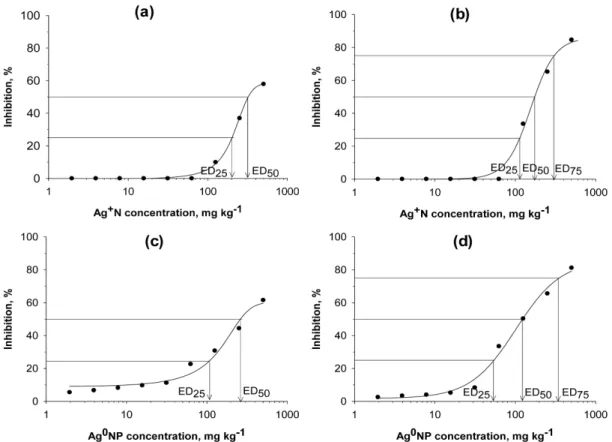
Ag 나노용액의 미생물학적 독성 - In vitro test Figure 1에서 볼 수 있듯이, Ag+N과 Ag0NP에 노출된 Vibrio fisheri 독성은 수용액 상에서 Ag+N이 훨씬 강했다. Vibrio fisheri의 발광 저해율 25, 50, 75%를 보여주는 EC25, EC50,
EC75는 Ag+N에 15분 노출되었을 경우 EC25와 EC50는 모두 2 mg L-1 이하였고, EC75는 131mg L-1이였다. Ag0NP에 노출 되었을 경우 EC25, EC50, EC75는 각각 150, 251, 331 mg L-1 로 Ag+N의 EC 값보다 훨씬 높아 더 낮은 독성을 보여주었 다. 노출시간이 30분으로 증가할 경우, 독성도 증가하여 EC25, EC50, EC75 값이 낮아져 Ag+N 용액에서는 모두 2 mg L-1 이하였고, Ag0NP 용액에서는 각각 98, 241, 330 mg L-1 이였다.
NIER (2010)의 연구결과에서는, Ag 나노입자에 노출된 발광 박테리아의 EC50이 40.7 mg L-1 (노출시간 15분)과 21.2 mg L-1 (노출시간 30분)로 나타나, 본 연구에서 측정한 Ag+N 보다는 약한 독성을, Ag0NP 보다는 강한 독성을 보고 했다. Park (2005)의 연구결과에서는, TiO2에 노출된 발광 박테리아의 EC50이 노출시간에 따라 233.8 mg L-1 (5분), 229.1 mg L-1 (15분), 166.8 mg L-1 (30분)로 감소하여, 본 연구에 사용된 Ag0NP와 비슷한 경향을 보여주었다.
Ag 나노용액의 미생물학적 독성- Soil test Figure 2 에서 보는 것처럼, Ag 나노용액을 처리한 토양 추출액의 Vibrio fisheri 독성은 수용액 상에서 보다 낮았고, Ag+N와 Ag0NP의 독성은 서로 상반적인 경향을 보여주었다. 발광 저해율 25%와 50%를 보여주는 토양 반응용량 ED25와 ED50
은 Ag+N에 15분 노출되었을 경우 각각 196, 326 mg kg-1이
Fig. 1. Dose-response curves for inhibition of Microtox luminescence determined in aqueous solutions after 15 min (a and c) and 30 min (b and d) exposure to a dilution series of Ag+N (a and b) and Ag0NP (c and d) (Ag+N: silver ion solutions, Ag0NP:
silver nanoparticle suspensions).
Fig. 2. Dose-response curves for inhibition of Microtox luminescence determined in soil extracts after 15 min (a and c) and 30 min (b and d) exposure time. Soil extracts were prepared by shaking soil samples spiked with a dilution series of Ag+N (a and b) and Ag0NP (c and d) and by filtration (Ag+N: silver ion solution; Ag0NP: silver nanoparticle suspension).
였고, Ag0NP에 노출되었을 경우 104, 254 mg kg-1로 산출 되어, Ag+N의 ED 값이 더 높아 더 낮은 독성을 보여주었다.
수행한 실험조건 (2~500 mg Ag kg-1)에서는 75% 발광 저해 율을 관찰하지 못했다. 노출시간을 30분으로 연장할 경우, Ag+N의 ED25, ED50, ED75는 각각 112, 169, 303 mg kg-1로 15분 노출에 비해 독성이 높게 나타났고, Ag0NP의 ED25,
ED50, ED75 값 53, 124, 280 mg kg-1 보다는 독성이 더 낮게 나타났다.
Park (2008)은 Ag+ 나노용액 100 mg L-1을 토양에 처리 하였을 때, 90%의 Ag가 clay 토양에서 5분 이내에, sandy clay 토양에서 6시간 이내에, sandy loam 토양에서는 47%
의 Ag가 72시간 이내에 흡착되는 것을 밝혔다. 본 실험에서 사용한 loamy sand 토양에서도 clay 토양만큼은 아니지만, Ag가 어느 정도 토양에 흡착되었고, 이온 형태의 Ag+가 입 자 형태의 Ag0 보다 더 많이 흡착되었을 것으로 유추된다.
더구나 Ag+는 토양 부식산과 강한 thiol 복합체 (-S-Ag)를 형성하여 토양에 강하게 흡착될 수 있고, 토양 용액 중에 존 재하더라도 미생물 독성에 불활성을 보일 것으로 판단된다 (Jacobson et al., 2005). Microtox 희석제의 성분이 2%
NaCl인 것을 고려할 때, 이온형태의 Ag+는 Cl-와 반응하여 용해성이 낮은 AgCl 침전물을 형성함으로써, 일부 Ag+ 역 시 토양 입자표면에 강하게 흡착되거나 독성반응에 불활성 을 보일 것으로 판단된다. 결과적로 토양에서 Ag+N의 독성 이 Ag0NP 보다 낮아진 이유는 토양 추출액/여과액에서 활 성 Ag의 농도가 낮아졌기 때문으로 판단된다.
Lee (2006) 또한 As, Cd, Cr, Cu, Hg, Pb로 오염된 토양 을 대상으로 Microtox 생물검정법을 이용하여 Vibrio fisheri의 발광 저해율을 조사하였다. As (2.28~27.2 mg kg-1)에 노출되었을 경우, 발광저해는 5.12∼14.7%였고, Cd (0.99~10.3 mg kg-1)은 8.17∼12.9%의 발광저해를, Cr (1.56~29.1 mg kg-1)은 3.16∼12.2%, Cu (23.7~184 mg kg-1)은 8.28∼15.2%, Hg (1.65~17.6 mg kg-1)는 11.8∼
14.8%, Pb (41.0~488 mg kg-1)는 3.43∼8.14%의 발광저해 를 보여주어, 오염 중금속에 따라 독성 특성이 달랐고, Cd 와 Hg가 다른 중금속에 비해 독성이 가장 높게 나타났다.
요 약
Ag+ 이온을 주성분으로 하는 Ag+N과 Ag0 나노입자를 주 성분으로 하는 Ag0NP의 미생물학적 독성을 Microtox 생물 검정법을 이용하여 수용액과 토양에서 용량-반응관계를 이 용하여 비교, 평가하였다. 수용액 실험에서 Vibrio fisheri 의 50% 발광 저해율을 보여주는 EC50 값은 Ag+N이 Ag0NP 보다 현저히 낮게 나타나, 이온상태의 Ag+N이 독성이 훨씬 높음을 알 수 있었다. 노출시간이 15분에서 30분으로 증가 하면 독성 또한 증가했다. 반대로 토양 추출액 실험에서는
Ag+N의 ED50 값이 Ag0NP의 값 보다 높아, Ag+N의 독성이 더 낮게 나타났다. 이것은 Ag+N의 Ag+가 토양 입자 또는 부 식산에 강하게 흡착 되거나, Microtox 희석제 NaCl과 반응 하여 난용해성 AgCl 침전물을 형성하여, 토양 추출액 중의 활성 Ag 농도가 감소한 것에 기인하는 것으로 판단되었다.
Microtox 분석에 의한 Ag 나노용액의 생물학적 독성은 Ag 의 존재형태 (Ag+,Ag0), 반응매질 (수용액, 토양), 노출시간 에 따라 서로 상이한 결과를 보여 주었다.
사 사
본 연구는 2012년도 농촌진흥청 공동연구사업 (과제번 호: PJ007448042012)의 지원에 의해 이루어진 것이며 이에 감사를 드립니다.
인 용 문 헌
AZUR Environmental. 1998. The Microtox acute basic, DIN, ISO and wet test procedure. Carlsbad, Calif, USA.
Cho, G.Y. 2011. Chemicals management division. Ministry of Environment. Korea.
Feng, Q.L., J. Wu, G.Q. Chen, F.Z. Cui, T.N. Kim, and J.O.
Kim. 2000. A mechanistic study of the antibacterial effect of silver ions on Escherichia coli and Staphylococcus aureus. J. Biomed. Mater. Res. 52:662-662.
Haensch, M. and C. Emmerling. 2010. Effects of silver nanoparticles on the microbiota and enzyme activity in soil.
J. Plant Nutiri. Soil Sci. 173:554-558.
Jacobson, A.R., S. Klitzke, M.B. McBride, P. Baveye, and T.S. Steenhuis. 2005. The desorption of silver and thallium from soils in the presence of a chelating resin with thiol functional groups. Water Air Soil Poll. 160:41-54.
Jovanovic, B., L. Anastasova, E.W. Rowe, Y. Zhang, A.R.
Clapp, and D. Palic. 2011. Effects of nanosized titanium dioxide on innate immune system of fathead minnow (Pimephales promelas Rafinesque, 1820). Ecotoxicol Environ Saf. 74(7):675-683.
Lee, S.P. 2006. Ecotoxicological assessment of soils contaminated with heavy metals using soil enzymes and luminescent bacteria. Master-Thesis. Kangwon National University.
Lee, J.N. and I.Y. Hwang. 1999. Evaluation of environmental toxicities for priority water pollutants in a small watershed by bioassays. Kor. J. Environ. Toxicol. 14:135-144.
Lee, Y.S., H.S. Jeong, S.W. Kim, M.S. Yeo, H.S. Lim, E.J.
Kim, and J.S. Min. 2005. Inhibition effect of nano-silver liquid against various plant microorganisms. J. Agri. Life Environ. Sci. 16:125-133.
Liau, S.Y., D.C. Read, W.J. Pugh, J.R. Furr, and A.D. Russell.
1997. Interaction of silver-nitrate with readily identifiable groups; relationship to the antibacterial action of silver ions.
Lett. Appl. Microbiol. 25:297-283.
MOE. 2009a. Soil contamination standards methods.
2009.09. Ministry of Environment, Gwacheon. Korea.
MOE. 2009b. Enforcement Decree of the Soil Environment Conservation Act. 12th. amended. No. 333. 2009.6.25.
Ministry of Environment, Gwacheon. Korea.
MOE. 2011. Soil monitoring network and survey of soil pollution status. Annual report 2010. Ministry of Environ- ment, Gwacheon. Korea.
Morones, R., J.L. Elechiguerra, A. Camacho, K. Holt, J.B.
Kouri, J.T. Ramiyrez, and M.J. Yacaman. 2005. The bactericidal effect of silver nanoparticles. Nanotechnology 16:2346-2353.
Nam, J.J, S.J. Kim, and P.K. Park. 2006. Microtox biological toxic assessment of soils treated with sewage sludge. J.
Korean Soc. Environ. Anal. 9(3):191-198.
NIAST. 2000. Methods of soil and plant anlysis. National Institut of Agricultural Science and Technology, RDA, Suwon, Korea (In Korean).
NIER. 2010. Study on hazardous properties of manufactured silver nanoparticles. National Institute of Environmental Research.
Park, K. 2005. Toxicity of nanomaterials and strategy of risk assessment. K. Environ. Toxicol. 20(4):259-271.
Park, Y.H. 2008. Impact of the nano-silver suspension on soil quality parameters. Master-Thesis. Kangwon National University.
Salizzato, M., B. Pavoni, A.V. Ghirardini, and P.F. Ghetti.
1998. Sediment toxicity measured using Vibrio fischeri as related to the concentrations of organic (PCBs, PAHs) and inorganic (Metals, sulphur) pollutants. Chemosphere 36:2949-2968.
Slawson, R.M., H. Lee, and J.T. Trevors. 1990. Bacterial interactions with silver. Biol. Met. 3:151-154.
Sondi, I. and B.S. Sondi. 2004. Silver nanoparticles as antimicrobial agent: a case study on E. coli as a model for gram-negative bacteria. J. Colloid Interface Sci. 275:177- 182.
Throbaeck, I.N., M. Johansson, M. Rosenquist, M. Pell, M.
Hansson, and S. Hallin. 2007. Silver (Ag+) reduces denitrification and induces enrichment of novel nirK genotypes in soil. FEMS Microb. Lett. 270:189-194.
Woodrow Wilson Database. 2011. Nanotechnology consumer product inventory. http: //www.nanotechproject.org/inventories/
consumer/analysis_draft/.