토양개량제 처리가 물푸레나무와 소나무 묘목의 생장과 양분농도에 미치는 영향*
박병배1)․변재경2)․조민석3)․한시호1)․정문호4)․김세빈1)․배기강5)
1)충남대학교 산림환경자원학과․2)한국임업진흥원․3)국립산림과학원 산림생산기술연구소
4)한국광해관리공단 광해기술연구소․5)아시아산림협력기구
The Effects of Soil Improvements on Growth and Tissue Nutrient Concentrations of
Fraxinus rhynchophyllaand
Pinus densifloraSeedlings in a Nursery*
Park, Byung Bae1)․Byun, Jae Kyung2)․Cho, Min Seok3) Han, Si Ho1)․Jung, Mun Ho4)․Kim, Se Bin1) and Bae, Kikang5)
1)Department of Environment and Forest Resources, Chungnam National University,
2)Korea Forestry Promotion Institute,
3)Forest Practice Research Center, National Institute of Forest Science,
4)Institute of Mine Reclamation Technology, Mine Reclamation Corp,
5)ASEAN-ROK Forest Cooperation.
ABSTRACT
The production of high quality seedlings is a very important phase in silvicultural systems for successful reforestation or restoration. The purpose of this study was to measure both growth performances and nutrient responses of Fraxinus rhynchophylla and Pinus densiflora seedlings, which are commercially planted in Korea, according to soil improvement treatments. We applied 8 types of soil improvements: control with no treatment, compost B and compost Y as organic materials,
* 본 연구는 산림청 ‘산림과학기술개발사업(과제번호:S211415L010110)’ 연구비 지원을 받아 일부 수행되었음.
First author:Park, Byung Bae, Department of Environment & Forest Resources, College of Agriculture and Life Science, Chungnam National University, 99 Daehak-ro, Yuseong-gu, Daejeon 305-764,
Tel:+82-42-821-5747, E-mail:[email protected]
Corresponding author:Bae, Kikang, ASEAN-ROK Forest Cooperation Secretariat, 8th Floor, 9 Gukhoe-daero 62-gil, Yeongdeungpo-gu, Seoul, Republic of Korea 150-874,
Tel:+82-2-785-8991, E-mail:[email protected]
Received:29 December, 2015. Revised:28 February, 2016. Accepted:28 January, 2016.
- 41 -
vermiculite, perlite, two level of zeolite, and mix of vermiculite, perlite, and zeolite as inorganic materials in a permanent national nursery. Only compost B treatment significantly increased soil pH, organic matter, total nitrogen, available phosphorus, exchangeable potassium and calcium at the 0-10 cm soil depth. The growth of F. rhynchophylla and P. densiflora was the highest at the compost B treatment and the lowest at the vermiculate treatment. Compost B treatment allocated more carbon to aboveground than belowground by 39%, especially to foliage. On the vector diagnosis, there was
‘shortage’ on compost B treatment because of all increases of N contents, N concentrations, and growth and ‘over accumulation’ on vermiculite treatment because of more N uptake compared with dry weight increase. This study suggested optimal use of soil improvements is very important to improve soil quality in a permanently used nursery.
Key Words:Compost, Perlite, Seedling quality, Vector diagnosis, Vermiculite.
I. 서 론
건전한 묘목 생산은 조림 초기 활착율을 높 이고 생장을 증가시키기 위해 매우 중요한 조 림과정이다. 특히 생육환경이 열악한 척박지 조림이나 장기간 훼손된 산림을 복원하기 위해 서는 묘목 형질과 더불어 생리적 특성도 우수 해야 한다.
일반적으로 양묘장에서는 묘목의 생장을 유지 하기 위해 시비처리를 하고 있다(Timmer, 1996;
Son et al., 1998; Shin et al., 1999; Park et al., 2010). 시비는 지속적인 묘목 생산으로 인해 빠 져나가는 토양 양분을 보충해주어 묘목의 생장 을 증진시키고, 묘목의 세근량을 증가시켜 식재 초기 활착률을 높이며, 묘목의 내건성과 내한성 및 내병성을 키워준다(Carlson, 1981; Imo and Timmer, 1999; Quoreshi and Timmer, 2000). 또 한, 시비처리는 묘목의 지하부와 지상부의 비율, 수고와 근원경의 비율과 같은 외부 형태를 변형 시킬 뿐만 아니라 식물체내 양분비에 영향을 주 어 식재지에서의 생존율에 큰 영향을 줄 수도 있 다(Bayala et al., 2009; Dumroese et al., 2005;
Quoreshi and Timmer, 2000; Timmer and Stone, 1978).
최근에 용기묘 조림의 장점이 부각되고 있음 에도(Grossnickle and El-Kassaby, 2016), 우리나 라는 현재 양묘생산량의 50% 정도를 60년대 이 후 전국적으로 조성된 고정 양묘장에서 생산하 고 있다(Korea Forest Service, 2015). 고정된 묘 포에서 여러 해 반복적으로 묘목을 생산할 경우 고온과 저온, 가뭄과 홍수와 같은 기상여건의 변동에 취약해질 수 있고, 그로인해 병․충이 빈번히 발생할 수 있다. 특히, 토양의 물리․화 학성은 단일 수종의 연속 생산, 속효성 화학비 료의 무분별한 사용, 중장비를 이용한 식재 및 굴취에 의한 토양 답압, 지하수의 장기간 관수 에 의한 염류 집적으로 악화될 수 있다. 따라서 고정 포지에서 토양의 이화학적 성질 악화, 토 양 미생물 활동 저하, 종자 발아 및 묘목 생장 저하, 병․충해 발생과 포지 주변 토양 및 하천 오염을 방지하기 위해 토양특성을 고려한 적절 한 시비가 요구된다(Andersen and Hansen, 2000;
Broschat, 1995).
심경이나 객토 방법은 토양의 물리․화학적 성질을 개량하여 뿌리 발달 향상, 토양 병․해 충 감소, 토양 염류 정상화, 생산성 증대, 주변 토양으로 오염원 배출 감소의 효과가 있다. 그 러나 객토에 적합한 토양을 주변에서 공급받기
어려운 경우에는 토양개량제 처리가 대안이 될 수 있다. 토양개량제 처리는 토양의 통기성과 투 수성을 증진시켜 뿌리 생육을 촉진시키는 동시 에 유기물 함량을 증진시킬 수 있다(Warkentin, 1984; Kang et al., 2004). 하지만, 토양개량제 처 리시 토양개량제 종류별 특성이나 묘포지의 토 양상태, 수종별 효과에 대해서는 이해가 부족한 실정이다(Kang et al., 2004).
이 연구의 목적은 장기간 묘목 생산에 이용된 고정 포지를 대상으로 다양한 토양개량제 처리 가 토양 개량 및 경제수종인 물푸레나무와 소나 무 묘목의 초기 생장과 양분함량에 미치는 영향 을 구명하는 것이다. 이 연구에서는 양분벡터분 석을 통해 식물체 양분농도와 양분함량, 생장 사이의 복잡한 상관관계를 주관적 편견 없이 해 석함으로써 장기간 사용한 고정 묘포의 토양을 개량할 수 있는 기술을 제시할 수 있을 것으로 판단된다.
II. 재료 및 방법
1. 연구지역 및 연구대상 수종
본 연구는 경기도 양평에 위치한 용문양묘사업 소(경기도 양평군 용문면 어수길 91; 북위 37° 48’, 동경 127° 60’)에서 수행되었다. 이 지역의 2007년 의 연평균기온은 12.5°C, 연강수량은 1,403 mm 이
다(Korea Meteorological Administration, 2007).
물푸레나무와 소나무는 시험 전년도에 파종한 1 년생 묘목으로 각각 용문양묘사업소와 평창양 묘사업소에서 생산되었다.
2. 실험 설계
시험지는 용문양묘사업소 내에서 장기간 묘목 생산에 이용된 포지를 깊게 (45 cm) 경운한 후에 1 m × 25 m의 묘상을 동서로 배치하였다. 포지 와 포지 사이에는 100 cm 간격의 완충 지역을 두 었다. 묘상 위에 1 m × 1 m 크기의 조사구를 만 들고, 조사구 사이에는 100 cm 이상 거리를 두어 완충역할과 동시에 작업로로 이용하였다.
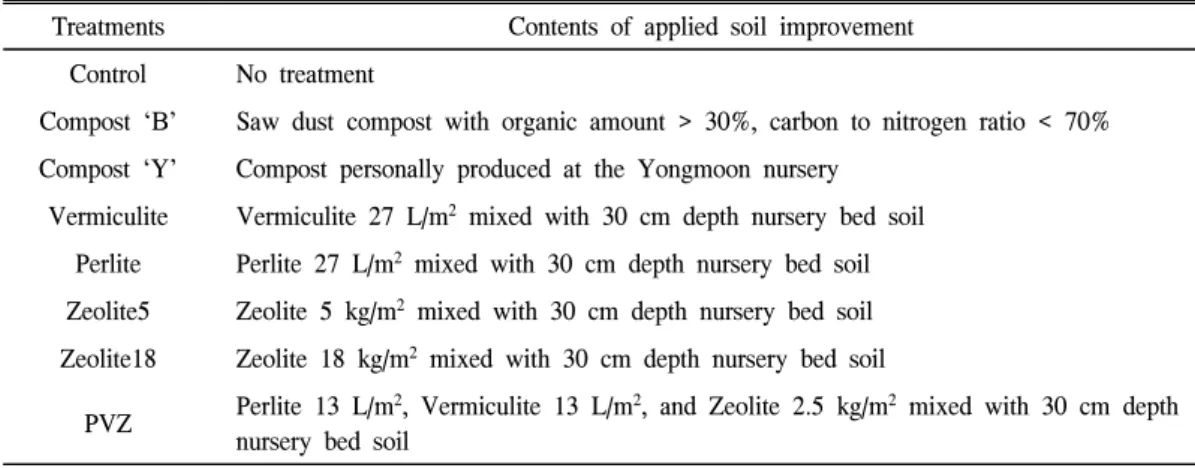
이 실험에서는 대조구를 포함하여 8가지 토 양개량처리를 아래와 같이 수행하였다. 대조구 로 쓰인 무처리, 톱밥퇴비(이후부터 ‘퇴비B’로 명칭함)와 청초퇴비(이후부터 ‘퇴비Y’로 명칭 함), 질석(vermiculite), 펄라이트(perlite), 비석 (zeolite) 2수준, 그리고 질석+펄라이트+비석 혼 합처리(Table 1)를 30 cm 깊이의 묘포 토양과 잘 섞어 처리하였다. 모든 처리는 3회 반복을 두 어 포지에 무작위로 배치하였다(2 수종 × 8 토양 개량제처리 × 3 반복 = 48 시험구).
묘고와 근원경이 유사한 묘목을 선정하여, 1 m × 1 m 처리구에 물푸레나무는 64본(묘목과 묘목 사이의 식재 거리 12.5 cm), 소나무는 90본(묘목
Table 1. Summary of soil improvement treatments.
Treatments Contents of applied soil improvement
Control No treatment
Compost ‘B’ Saw dust compost with organic amount > 30%, carbon to nitrogen ratio < 70%
Compost ‘Y’ Compost personally produced at the Yongmoon nursery Vermiculite Vermiculite 27 L/m2 mixed with 30 cm depth nursery bed soil
Perlite Perlite 27 L/m2 mixed with 30 cm depth nursery bed soil Zeolite5 Zeolite 5 kg/m2 mixed with 30 cm depth nursery bed soil Zeolite18 Zeolite 18 kg/m2 mixed with 30 cm depth nursery bed soil
PVZ Perlite 13 L/m2, Vermiculite 13 L/m2, and Zeolite 2.5 kg/m2 mixed with 30 cm depth nursery bed soil
과 묘목 사이의 식재 거리 11.1 cm)을 식재하였 다. 모든 식재는 하루 안에 이루어졌고, 식재 후 충분히 관수하였다. 묘목의 초기 생장을 조사하 기 위하여 식재 2주 후에 간장과 근원경을 측정 하였다. 근원경은 지상으로부터 1 cm 높이에서 측정하였으며, 측정한 자리에 흰 페인트로 표시 하여 이후에도 같은 위치를 측정할 수 있도록 하였다. 식재 후 4주 동안 3일 간격으로 관수하 였고, 그 후는 건조시에 충분히 관수하였다. 실 험 기간 동안 잡초를 연 3회 제거하였다.
3. 생장 측정
처리에 따른 생장반응을 측정하기 위해 처리 20주 후에 2수종 모두 간장과 근원경을 측정하 였다. 가장자리 효과를 제거하기 위하여 가장자 리 3줄을 제외하고 안쪽에서 묘고와 근원경을 측정하였다. 바이오매스 생산량을 측정하기 위 하여 물푸레나무를 대상으로 조사구 중심부에 서 임의로 4본을 선정하여 뿌리가 상하지 않도 록 굴취하였다. 굴취된 묘목은 흐르는 물로 3번 이상 씻어 뿌리 표면의 흙을 제거하였다. 씻은 묘목을 잎, 줄기, 뿌리로 나누어 65°C의 항온기 에서 1주일간 건조시킨 후 부위별 건중량을 측 정하였다.
4. 토양 및 식물체 양분 분석
묘목 식재 전 토성과 화학성을 조사하기 위하 여 임의의 3지점을 선정한 후 토양 깊이 0-10, 20-30, 30-60, 60-100 cm에서 토양을 채취하여 아래와 같이 분석하였다.
토양개량제 처리 후에 토양의 물리성과 화학 성을 분석하기 위해 무작위로 3지점을 선정하고 0-10 cm 깊이에서 토양 시료를 채취하였다. 토성 은 30°C에서 hydrometer법을 사용하여 측정하 였다. 유기물 함량은 Tyurin법으로 측정하였으 며, 토양산도(pH)와 전기전도도(EC)는 10g의 토 양을 증류수에 1:5 비율로 희석하여 측정하였 다. 전질소는 1g의 토양시료를 Micro-Kjeldahl법
으로 측정하였고, 유효인산 (P2O5)은 Lancaster 법을 이용하였다. 치환성 양이온 K+, Ca2+, Mg2+, Na+은 1N의 NH4OAc을 이용해 추출한 뒤 Atomic Absorption Spectrometer(AA280FS, USA) 를 사용해 측정하였다. 양이온치환능력(CEC)은 1N의 HN4OAc와 CH3COOH용액으로 양이온을 추출한 후 Brown법으로 측정하였다.
물푸레나무 조직의 질소(N), 인(P), 칼륨(K) 농도를 측정하기 위해 건조한 식물체를 부위별 로 나누어 Wiley mill로 곱게 간 후, H2SO4와 HClO4 혼합용액을 이용하여 Block digestor(BD-46, Lachat Ins., USA)방법으로 유기물을 분해하였다.
전처리를 마친 시료는 Automated Ion Analyzer (Quik Chem AE, Lachat Ins., USA)를 이용해 식 물체 N, P 농도를 측정하였고, Atomic Absorption Spectrometer(AA280FS, USA)를 이용해 식물체 K 농도를 측정하였다.
5. 양분벡터분석 (Vector diagnosis)
처리에 따른 물푸레나무의 생장과 양분변화 를 설명하기 위해 수정된 양분벡터분석(Haase and Rose, 1995; Timmer, 1996)을 적용하였다.
양분벡터분석에 대한 해석은 다음과 같다. 식물 체 양분농도가 식물 생장과 식물체 양분함량 증 가만큼 증가하지 않을 때 ‘양분결핍’으로 판단 한다(vector C). 적정한 양분농도에서 생장과 양 분함량이 증가하는 동안 농도가 일정하게 유지 되는 경우 ‘양분최적’으로 판단한다(vector B).
농도는 증가하지만 생장 변화가 없는 경우는 양 분을 과다하게 소비하는 ‘양분과다’ 상태로 판 단한다(vector D). 생장이 감소하는 경우는 양분 에 의한 ‘과량집적’ 또는 ‘양분결핍’ 상태로 판 단할 수 있다(E, F). ‘양분희석‘(vector A)은 특정 원소의 결핍으로 인한 생장 제한이 다른 원소에 의해 해소될 때 나타나는 것으로 판단된다.
6. 통계분석
Duncan의 다중 비교 검정(Duncan’s multiple
comparison tests)을 이용하여 토양개량제처리에 따른 토양특성과 식물체 양분 농도를 유의수준 5%에서 통계 분석(SAS 9.3)하였다. 간장과 근원 경은 식재 초기 값을 고려한 공분산분석(Covariate analysis)을 유의수준 5%에서 수행하였다.
III. 결과 및 고찰
1. 토양 특성
토양개량제 처리 전 묘포장 토양의 물리․화 학적 특성은 조사된 100 cm 깊이까지 산림토양
이나 농업토양의 일반적인 특징을 보이지 않았다 (Table 2, Figure 1). 모래와 미사 함량은 0-60 cm 깊이까지 큰 변화가 없었고, 60 cm 이상 깊은 토 양에서 낮은 함량을 보였으나 통계적 유의성은 없었다(각각 P = 0.10, 0.39). 반면 점토는 60 cm 이상 깊은 토양에서 가장 낮은 함량을 보였다(P
< 0.01). 상층 토양의 pH는 전국 산림토양 A층 의 pH 5.48보다는 낮았다(Jeong et al., 2002). 깊 은 토양층의 pH는 상층 토양보다 pH 단위 1 정 도 높았으며(P < 0.01), 전국 산림토양 B층의 pH 5.52와 유사했다(Jeong et al., 2002; Jeong et al.,
Table 2. Soil characteristics before soil improvement treatments at different soil depths.
Soil depth (cm)
0-10 20-30 30-60 60-100
Texture
Sand (%) 62.8 (1.5)yz 59.9 (1.1) 60.5 (4.6) 76.4 (7.7)
Silt (%) 29.1 (1.8) 30.5 (1.0) 32.9 (3.9) 21.5 (8.2)
Clay (%) 8.1 (1.2)a 9.6 (0.2)a 6.6 (1.4)a 2.1 (0.4)b
Chemical properties
pH 4.9 (0.1)b 4.8 (0.1)b 5.3 (0.2)ab 5.7 (0.1)a
Organic matter (%) 1.44 (0.07)a 1.37 (0.11)a 0.83 (0.22)a 0.38 (0.03)b Total N (g kg-1)w 0.9 (0.1)a 1.0 (0.1)a 0.7 (0.2)ab 0.4 (0.1)b Available P (mg kg-1)x 164.8 (5.9)a 150.2 (22.8)ab 73.1 (17.4)b 80.9 (20.3)b Exchangeable K+
(cmolc kg-1) 0.23 (0.03) 0.20 (0.03) 0.23 (0.04) 0.24 (0.06)
Exchangeable Ca2+
(cmolc kg-1) 0.72 (0.06) 0.76 (0.07) 1.11 (0.20) 1.03 (0.15)
Exchangeable Mg2+
(cmolc kg-1) 0.21 (0.09) 0.11 (0.03) 0.18 (0.04) 0.22 (0.05)
Exchangeable Na+
(cmolc kg-1) 0.06 (0.01) 0.05 (0.01) 0.06 (0.01) 0.04 (0.01)
CEC (cmolc kg-1) 10.1 (0.6)a 9.8 (0.4)a 10.1 (0.3)a 7.2 (0.8)b
EC (dS m-1) 0.21 (0.02) 0.19 (0.02) 0.21 (0.02) 0.17 (0.02)
wTotal N is the sum of organic N and inorganic N.
xAvailable P, CEC and EC represent H2PO4-, cation exchange capacity, and electrical conductivity, respectively.
yMeans with same letters are not significantly different among the soil depths at α = 0.05.
zParentheses are standard errors (n = 3).
2003). 유기물 함량과 총질소는 상층 토양 0-10 cm 와 20-30 cm 사이에는 차이가 없었지만, 60 cm 이상 깊은 토양층에서는 상층 토양의 26, 43%
정도로 낮은 함량을 보였다. 질소처럼 유효인산 은 상층 토양 0-10 cm와 20-30 cm 사이에는 차 이가 없었지만, 깊은 토양층에서 함량이 유의하 게 낮았다. 주요 양이온 함량은 깊이별 유의한 차이를 보이지 않았다. 치환성양이온 농도는 상 층부 토양에서는 깊이별 차이가 없었고, 60 cm 이상 깊은 토양층의 농도가 상층부보다 29% 낮 았다(P = 0.01).
동일 묘포장 내 토양단면 사진(Figure 1)과 관 리자에 의하면 이 지역은 과거에 논으로 이용되 었고, 양묘를 위한 포지로 전용된 후에 여러 번 의 객토가 있었다. 따라서 위와 같은 층위별 물 리적․화학적 특성은 과거 토지이용형태와 객 토에 의한 것으로 판단된다.
토양개량제 처리는 식재 수종에 관계없이 토 양 깊이 0-10 cm의 토양 특성에 유의한 영향을 주었다(Table 3). 토양 pH, 유기물함량, 총질소,
유효인산, 치환성 칼슘은 퇴비B 처리에서 가장 높았고, 치환성 마그네슘과 양이온치환용량도 통계적으로 유의하지는 않았지만 가장 높은 함 량을 보였다. 다른 토양개량제 처리는 토양 화 학성에 유의한 영향을 주지 못했다.
장기간 이용된 고정 포지에서 악화된 토양의 물리․화학성을 개선하기 위해서는 객토 또는 토양개량제를 이용할 수 있지만 그 방법을 어떻게 하느냐에 따라 효과는 달라질 수 있다(Jun et al., 2002; Korea Forest Research Institute, 2012;
An et al., 2015). 퇴비B와 퇴비Y를 제외하고 이 연구에 사용된 질석과 펄라이트는 무기질 (inorganic materials)로 질석은 통기성과 수분 보 유능력이 높고 pH는 8.0 이상이며, 펄라이트는 질석처럼 통기성은 높으나 수분 보유능력이 낮 고 pH는 5.9∼6.8로 중성에 가까운 특성이 있다 (Kang et al., 2004). 이런 토양 개량제는 일반적 으로 토양 물리성 개선에는 효과가 있으나 토양 화학성 변화에는 큰 영향을 주지 못한다. 퇴비 중에서도 퇴비Y에 비해 퇴비B가 유의한 영향을
Figure 1. The photos of soil horizons at the nursery bed near to the study plots at the same nursery.
미쳤는데 이는 퇴비B가 퇴비Y에 비해 부숙도가 높고, 제조과정 동안에 추가된 축산부산물의 영 향이 있는 것으로 판단된다(unpublished data).
또한 포지 토양의 평균 모래함량은 전국 산림토 양보다 약 2배 정도 높아서(Jeong et al., 2002), 통기성과 토양배수 개선을 위한 질석과 펄라이 Table 3. Soil characteristics after soil improvement treatments at 0-10 cm soil depth.
Treatments
Control Compost
‘B’
Compost
‘Y’ Vermiculite Perlite Zeolite5 Zeolite18 PVZ Chemical properties
pH Fraxinus
rhynchophylla 5.2 (0.2)y 6.3 (0.2) 5.6 (0.1) 5.6 (0.1) 5.3 (0.1) 5.1 (0.1) 5.3 (0.0) 5.5 (0.1) Pinus densiflora 5.4 (0.1)z 6.5 (0.0) 5.7 (0.1) 5.7 (0.0) 5.4 (0.1) 5.4 (0.1) 5.5 (0.0) 5.5 (0.0)
Organic matter Fraxinus
rhynchophylla 1.37 (0.07) 1.64 (0.25) 1.44 (0.07) 1.30 (0.02) 1.26 (0.14) 1.31 (0.03) 1.38 (0.04) 1.51 (0.02) (%) Pinus densiflora 1.31 (0.12) 1.59 (0.15) 1.30 (0.03) 1.53 (0.05) 1.41 (0.02) 1.33 (0.04) 1.17 (0.04) 1.39 (0.06)
Total Nx Fraxinus
rhynchophylla 1.0 (0.1) 1.3 (0.1) 1.0 (0.0) 1.1 (0.1) 0.9 (0.0) 1.0 (0.0) 0.9 (0.0) 1.0 (0.0) (g kg-1) Pinus densiflora 0.9 (0.0) 1.2 (0.0) 1.0 (0.0) 1.0 (0.1) 1.0 (0.0) 0.9 (0.0) 0.9 (0.0) 0.9 (0.0)
Available Pw Fraxinus
rhynchophylla 187 (6) 632 (130) 196 (2) 191 (8) 185 (9) 180 (12) 188 (3) 203 (18) (mg kg-1) Pinus densiflora 184 (3) 848 (31) 191 (4) 208 (3) 192 (7) 195 (8) 180 (3) 183 (2) Exchangeable
K+
Fraxinus
rhynchophylla 0.31 (0.10) 1.25 (0.20) 0.26 (0.01) 0.22 (0.01) 0.21 (0.03) 0.25 (0.03) 0.38 (0.07) 0.28 (0.01) (cmolc kg-1) Pinus densiflora 0.23 (0.03) 1.29 (0.12) 0.28 (0.04) 0.21 (0.01) 0.19 (0.00) 0.30 (0.03) 0.40 (0.09) 0.25 (0.02) Exchangeable
Ca2+
Fraxinus
rhynchophylla 2.07 (0.59) 5.60 (1.49) 3.72 (0.42) 1.82 (0.40) 2.11 (0.75) 1.25 (0.23) 1.98 (0.12) 2.61 (0.47) (cmolc kg-1) Pinus densiflora 1.82 (0.57) 5.20 (0.49) 2.68 (0.36) 1.80 (0.53) 1.98 (0.44) 2.05 (0.36) 2.66 (0.53) 1.65 (0.22) Exchangeable
Mg2+
Fraxinus
rhynchophylla 0.54 (0.30) 1.53 (0.59) 0.73 (0.07) 0.19 (0.04) 0.47 (0.23) 0.27 (0.09) 0.88 (0.29) 0.53 (0.10) (cmolc kg-1) Pinus densiflora 0.42 (0.13) 1.76 (0.05) 0.55 (0.10) 0.40 (0.12) 0.38 (0.08) 0.71 (0.05) 1.08 (0.26) 0.45 (0.06) Exchangeable
Na+
Fraxinus
rhynchophylla 0.20 (0.07) 0.36 (0.06) 0.13 (0.00) 0.51 (0.03) 0.13 (0.00) 0.17 (0.02) 0.27 (0.08) 0.36 (0.06) (cmolc kg-1) Pinus densiflora 0.12 (0.02) 0.34 (0.02) 0.09 (0.03) 0.41 (0.08) 0.11 (0.01) 0.17 (0.02) 0.26 (0.08) 0.32 (0.01)
CEC Fraxinus
rhynchophylla 12.3 (0.5) 15.4 (0.9) 12.8 (0.1) 11.9 (0.7) 11.4 (0.6) 11.6 (0.6) 11.9 (0.3) 11.7 (0.4) (cmolc kg-1) Pinus densiflora 10.8 (0.4) 13.3 (0.2) 11.3 (0.4) 11.8 (0.6) 11.4 (1.0) 12.3 (0.4) 11.1 (0.7) 12.5 (0.1)
EC Fraxinus
rhynchophylla 0.20 (0.04) 1.75 (0.43) 0.21 (0.01) 0.29 (0.01) 0.17 (0.01) 0.18 (0.01) 0.25 (0.05) 0.21 (0.02) (dS m-1) Pinus densiflora 0.15 (0.00) 1.11 (0.49) 0.23 (0.02) 0.26 (0.01) 0.17 (0.01) 0.21 (0.00) 0.26 (0.01) 0.21 (0.00)
wAvailable P, CEC and EC represent H2PO4-, cation exchange capacity, and electrical conductivity, respectively.
xTotal N is the sum of organic N and inorganic N.
yMeans with same letters are not significantly different among the treatments at α = 0.05.
zParentheses are standard errors (n = 3).
트 같은 무기물질 토양개량제보다는 수분 보유 력을 높일 수 있는 점토나 낮은 유기물함량을 증가시킬 수 있는 유기질비료가 더 효과적일 수 있다. An et al.(2015)은 동일 포지에서 객토 시 험을 수행한 결과 사질양토의 모래 함량(55%) 보다 15% 정도 높은 포지의 모래 함량을 낮추 기 위해서 기존 포지 토양과 객토를 1:1로 혼 합하여 30 cm 높이로 쌓은 ‘혼합’ 처리 방법이 묘목의 건조피해와 양분부족을 예방할 수 있는 경제적인 방법이라고 보고하였다.
2. 간장, 근원경 및 물질 생장
간장에 미치는 수종과 토양개량제 처리의 상 호작용 효과는 없었고(P = 0.14), 토양개량제 처 리에 따라 수고생장은 유의한 차이가 있었는데 (P = 0.05), 이는 퇴비B 처리에서 수고 생장이
유의하게 높고, 질석 처리에서 낮기 때문이다 (Figure 2). 수종별로 처리에 따른 생장 반응에 는 차이가 있었는데 물푸레나무는 퇴비B 처리 에서 수고 생장이 23% 증가하였고, 질석 처리 에서는 5% 감소한 반면, 소나무는 동일처리로 6% 증가, 2% 감소하였다. 이는 토양개량제 처 리에 대한 물푸레나무의 반응이 소나무에 비해 높음을 보여주고 있다.
근원경 생장 역시 수고 생장과 비슷한 결과 를 나타내었다(Figure 3). 두 수종 모두 토양 개 량 처리에 따라 유의한 근원경 생장 차이를 나 타내었으며(P < 0.01), 이는 퇴비B 처리에서 근 원경 생장이 높았고, 비석5와 비석18, 질석 처 리구 및 대조구에서 낮은 근원경 생장을 보였기 때문이다. 퇴비B 처리로 물푸레나무의 근원경 은 22% 증가한 반면 소나무는 단 1%만 증가하
Figure 2. Shoot height (cm) (a) Fraxinus rhynchophylla and (b) Pinus densiflora at the different soil improvement treatments. Means with same letters are not significantly different among the treatments at α = 0.05. Vertical bars show standard errors (n = 3). Abbreviations: ComB, Compost ‘B’; ComY, Compost ‘Y’; Verm, Vermiculite; Perlit, Perlite; Zeol5, Zeolite5;
Zeol18, Zeolite18; PVZ, Perlite, Vermiculite, Zeolite mixer.
Figure 3. Root collar diameter (mm) (a) Fraxinus rhynchophylla and (b) Pinus densiflora at the different soil improvement treatments. Means with same letters are not significantly different among the treatments at α = 0.05.
Vertical bars show standard errors (n = 3).
Abbreviations: ComB, Compost ‘B’; ComY, Compost ‘Y’; Verm, Vermiculite; Perlit, Perlite; Zeol5, Zeolite5; Zeol18, Zeolite18;
PVZ, Perlite, Vermiculite, Zeolite mixer.
여, 수종에 따른 토양개량제 처리 반응이 다르 게 나타났다.
물질생장량은 처리 간에 통계적인 유의성은 없었으나(P = 0.22), 수고와 근원경 생장처럼 퇴 비B 처리에서 가장 높았고(대조에 비해 39% 높 음), 질석 처리에서 가장 낮았다(대조에 비해 25% 낮음) (Figure 4). 지상부 물질생산량도 토 양개량제 처리에 따른 유의한 차이는 보이지 않 았지만(P = 0.11), 퇴비B 처리는 대조구보다 건 중량을 78% 증가시켰고, 질석 처리는 35% 감소 시켰다. 지상부와 비교하여 지하부 물질생산량 은 토양개량제 처리에 따른 차이(-19∼15%)가 크지 않았다(P = 0.48).
지하부 대 지상부 생장량 비율(root to shoot ratio)은 1.2에서 2.1의 범위를 보이고 있고 (Figure 5), 퇴비B 처리에서 가장 낮고 질석 처 리에서 가장 높았다(P = 0.03). 토양개량제 처리 효과는 줄기(가지 포함)에서 나타나지 않았고
(P = 0.21), 잎의 건중량은 처리 간에 통계적으 로 유의한 차이를 보였다(P = 0.04). 총물질생산 량 중 탄소동화작용을 하는 잎의 비율은 8%에 서 15% 범위를 보이는데, 퇴비B 처리에서 가장 높고 질석 처리에서 가장 낮았다(P = 0.06).
토양개량제 처리에 의한 토양 개량효과는 소 나무에 비해 물푸레나무에서 보다 유의한 결과 를 보이고 있다(Figure, 3, 4, and 5). 질소, 인, 칼륨은 식물생장을 제한하는 주요 양분이기 때 문에(Ingestad and Ågren, 1992; Marschner, 2002) 퇴비B 처리에 의한 토양 내 부족한 양분 의 증가가 식물체 생장을 견인한 것으로 보인 다. Kwon et al.(2008)은 NPK 복합비료의 수준 을 다르게 하여 자작나무, 물푸레나무, 잣나무, 고로쇠나무 묘목에 처리한 결과 활엽수종이 침 엽수종인 잣나무에 비해 시비처리에 대하여 민 감한 반응을 보였다. 본 연구에서 소나무에 비 해 물푸레나무가 토양개량제에 따른 높은 생장
Figure 4. Aboveground and belowground dry weight of Fraxinus rhynchophylla at the different soil improvement treatments. Vertical bars show standard errors (n = 3). Abbreviations: ComB, Compost ‘B’; ComY, Compost ‘Y’; Verm, Vermiculite; Perlit, Perlite; Zeol5, Zeolite5;
Zeol18, Zeolite18; PVZ, Perlite, Vermiculite, Zeolite mixer.
Figure 5. Biomass allocation of Fraxinus rhynchophylla at the different soil improvement treatments.
Vertical bars show standard errors (n = 3).
Abbreviations: ComB, Compost ‘B’; ComY, Compost ‘Y’; Verm, Vermiculite; Perlit, Perlite; Zeol5, Zeolite5; Zeol18, Zeolite18;
PVZ, Perlite, Vermiculite, Zeolite mixer.
반응을 보이는 것은 물푸레나무는 자유생장을 하는 수종으로 처리효과가 당년 생장에 영향을 주었고, 소나무는 고정생장을 하여 전년도에 형 성된 정아와 환경조건이 당년의 생장에 영향을 미칠 수 있기 때문이다(Won et al., 2006; Byun et al., 2007). 또한 소나무는 양분 요구도가 상대 적으로 낮고 물푸레나무는 양분 요구량이 높으 면서 초기 생장이 빠른 수종이기 때문에 퇴비B 처리 효과가 물푸레나무에서 강하게 나타난 것 으로 판단된다. 일반적으로 토양 내 가용할 양 분이나 수분이 증가하면 식물은 광합성에 의해 고정된 탄수화물을 지하부보다 지상부로의 배 분을 증가시키는 경향이 있다(McConnaughay and Coleman, 1999). Giardina et al.(2003)은 Eucalyptus saligna 시험지에 질소, 인, 칼륨과 미량양분을 시비 후 3년 동안 총1차생산량 (Gross Primary Production)이 34% 이상 증가되 었고, 대부분이 지상부 바이오매스 증가에 의한 것이라고 보고하였다. 본 연구에서도 가용할 양 분이 높은 처리에서 물질량 증가가 있었고 대부 분이 지상부에서 이뤄졌다(Figure 4, 5). 특히 토 양 양분이용성이 증가함에 따라 잎의 반응이 다 른 조직에 비해 높았는데, 이는 증가된 탄소동 화작용 조직으로 인해 수목 전체의 물질생산을 증가시켜 식재 후 활착에도 영향을 줄 것으로 판단된다.
3. 식물체 양분 해석
처리에 따른 물푸레나무 식물체 조직의 양분 반응은 잎에서 크게 나타났는데, 퇴비B 처리구 에서 질소(P < 0.01)와 인(P < 0.01)이 유의하게 높았고, 칼륨(P = 0.20)도 가장 높았지만 적은 샘플수와 처리 내 변이로 통계적 차이는 없었다 (Table 4). 줄기와 뿌리의 인 농도는 처리에 따 른 유의한 차이가 있었고, 모두 퇴비B 처리에서 가장 높았다.
Figure 6는 물푸레나무 잎의 건중량, 질소 양 분 농도, 질소 양분 흡수함량을 대조와 비교하
여 상대적으로 보여주고 있는 양분벡터분석 결 과이다. 퇴비B 처리는 생장, 양분 농도, 양분 흡 수량을 모두 증가시키는 ‘부족현상’을 보이고 있고, 퇴비Y 처리에서는 대조와 비슷한 생장을 보이고 농도와 양분함량은 증가된 ‘양분축적’
현상이 관찰되었다. 질석 처리에서는 물푸레나 무가 질소 흡수를 생장보다 높게 하여 과다 축 적이 일어나고 있다.
식물의 적절한 양분농도는 생장과 연관하여 설명해야 한다. 왜냐하면 수목이 시비량보다 반 응이 더 클 경우 수목 조직의 농도분석만으로 정확한 진단을 할 수 없기 때문이다. 농도와 생 장을 함께 분석하면 흡수량에 대한 생장 비율 변화를 해석할 수 있고 이는 식물체 내에서 발 생할 수 있는 ‘양분희석’ 또는 ‘과량집적’을 진 단할 수 있다(Timmer and Stone, 1978). 본 연구 에서 활용한 양분벡터분석은 건중량의 변화, 식
Figure 6. The relationship between concentrations, contents, and dry weight of Fraxinus rhynchophylla for nitrogen. Abbreviations:
ComB, Compost ‘B’; ComY, Compost ‘Y’;
Verm, Vermiculite; Perlit, Perlite; Zeol5, Zeolite5; Zeol18, Zeolite18; PVZ, Perlite, Vermiculite, Zeolite mixer.
물체 양분 농도의 변화, 식물체가 흡수한 양분 양 변화를 한 지면에서 분석함으로써 식물체의 양분변화를 개관적으로 파악할 수 있었다. 양분 벡터분석의 장점에도 불구하고 한 양분이 다 른 양분에 의해 영향을 받기 때문에(Weil and Mughogho, 2000), 식물체 양분상태에 대한 진 단은 하나의 양분을 대상으로 하기보다는 양분
간의 비율분석(stoichiometric analysis)과 같은 신뢰도 높은 방법을 활용하여 신중하게 진단해 야 할 것이다.
IV. 결 론
모래함량이 높고 유기물함량이 낮은 본 연구 Table 4. Tissue nutrient concentrations (g kg-1) of Fraxinus rhynchophylla at the soil improvement treatments.
Elements Treatments Tissue
Foliage Branch Root
N Control 14.15 (0.48)b 3.72 (1.51)yz 5.62 (0.18)
Compost ‘B’ 20.71 (0.99)a 5.46 (0.27) 7.07 (0.23)
Compost ‘Y’ 15.04 (0.44)b 5.64 (0.10) 6.43 (0.41)
Vermiculite 17.01 (1.51)ab 6.09 (0.34) 5.36 (0.17)
Perlite 15.32 (1.51)b 6.14 (0.06) 3.75 (1.50)
Zeolite5 15.54 (0.72)b 3.70 (1.48) 5.16 (0.60)
Zeolite18 14.78 (0.21)b 4.72 (0.14) 5.26 (0.38)
PVZ 16.62 (0.55)ab 4.49 (0.20) 3.98 (1.62)
P Control 1.21 (0.01)b 0.74 (0.03)ab 1.15 (0.02)ab
Compost ‘B’ 1.80 (0.11)a 0.80 (0.05)a 1.34 (0.02)a
Compost ‘Y’ 1.34 (0.06)b 0.83 (0.03)a 1.28 (0.05)ab
Vermiculite 1.31 (0.06)b 0.70 (0.04)ab 1.00 (0.10)b
Perlite 1.31 (0.06)b 0.75 (0.05)ab 1.13 (0.06)ab
Zeolite5 1.32 (0.11)b 0.74 (0.01)ab 1.03 (0.04)b
Zeolite18 1.18 (0.01)b 0.68 (0.02)ab 1.04 (0.03)ab
PVZ 1.37 (0.07)b 0.62 (0.03)b 1.02 (0.11)b
K Control 11.12 (0.58) 5.35 (0.82) 7.13 (0.52)
Compost ‘B’ 14.02 (1.19) 5.48 (0.45) 8.43 (0.75)
Compost ‘Y’ 9.07 (0.59) 5.90 (1.37) 6.90 (0.78)
Vermiculite 12.07 (0.35) 6.40 (1.04) 6.51 (0.21)
Perlite 12.00 (2.23) 6.23 (0.78) 6.65 (0.62)
Zeolite5 11.95 (0.70) 4.64 (0.19) 6.65 (0.97)
Zeolite18 12.68 (1.24) 5.24 (0.81) 7.58 (0.52)
PVZ 11.88 (0.71) 5.97 (0.35) 7.38 (0.81)
yMeans with same letters are not significantly different among the treatments at α = 0.05.
zParentheses are standard errors (n = 3).
지와 같은 고정 포지에서는 질석과 펄라이트 같 은 무기질 토양개량제보다는 퇴비B 같은 유기 질퇴비가 토양개량 효과가 높고 식물생장도 증 가시킴을 보여주고 있다. 이 연구는 토양개량제 는 토양 특성에 적합하게 사용해야 하고 또한 수종에 따른 특성도 고려되어 적용되야 함을 보 여주고 있다. 고정 포지에서 연작이나 화학비료 의 지속적인 사용에 의해 불량해진 토양을 사후 에 개선하기보다는, 연작 대신에 윤작을 적용하 고, 안식년 동안에 콩과 같은 녹비 식물 재배를 통해 토양의 질 저하를 예방해야 할 것이다. 건 전한 묘목을 생산하기 위해서는 포지 토양의 질 이 매우 중요한데, 지속가능한 토양 이용을 달 성하기 위해서는 보다 정교하고 체계적인 양묘 생산체계를 수립하고 정기적인 현장방문, 토양 및 식물체 분석을 통해 수종과 토양 조건에 맞 는 토양보존기술을 적용해야 할 것이다.
References
An JY․Park BB․Byun JK․Cho MS․Kim YS․
Han SH and Kim SB. 2015. The short-term effects of soil brought and subsoil inversion on growth and tissue nutrient concentrations of Fraxinus rhynchophylla, Pinus densiflora, and Pinus koraiensis seedlings in a nursery.
Journal of Korean Forest Society. 104(1):
43-49.
Andersen, L. and C. W. Hansen. 2000. Leaching of nitrogen from container plants grown under controlled fertigation regimes. Journal of Environmental Horticulture. 18(1): 8-12.
Bayala, J.․M. Dianda.․J. Wilson.․S. Ouédraogo.
and K. Sanon. 2009. Predicting field performance of five irrigated tree species using seedling quality assessment in Burkina Faso, West Africa. New Forests. 38(3):
309-322.
Broschat T. K. 1995. Nitrate, phosphate, and potassium leaching from container-grown plants fertilized by several methods. Hort- Science. 30(1): 74-77.
Byun JK․Kim YS․Yi MJ․Son YW․Kim CS․
Jeong JH․Lee CH and Jeong YH. 2007.
Growth response of Pinus densiflora, Larix Leptolepis, Betula platyphylla var. japonica and Quercus acutissima seedlings at various levels of fertilizations. Journal of Korean Forest Society. 96(3): 693-698.
Carlson, W. C. 1981. Effects of controlled-release fertilizers on the shoot and root development of outplanted western hemlock (Tsuga heterophylla Raf. Sarg.) seedlings. Canadian Journal of Forest Research. 11(4): 752-757.
Dumroese, R. K.․D. S. Page-Dumroese.․K. F.
Salifu. and D. F. Jacobs. 2005. Exponential fertilization of Pinus monticola seedlings:
nutrient uptake efficiency, leaching fractions, and early outplanting performance. Canadian Journal of Forest Research. 35(12): 2961- 2967.
Giardina, C. P.․M. G. Ryan․D. Dinkley and J. H. Fownes. 2003. Primary production and carbon allocation in relation to nutrient supply in a tropical experimental forest. Global Change Biology. 9(10): 1438-1450.
Grossnickle, S. C. and Y. A. El-Kassaby. 2016.
Bareroot versus container stocktypes: a performance comparison. New Forests 47:
1-51.
Haase, D. L. and R. Rose. 1995. Vector analysis and its use for interpreting plant nutrient shifts in response to silvicultural treatments. Forest Science. 41(1): 54-66.
Imo, M. and V. R. Timmer. 1999. Vector competition analysis of black spruce seedling
responses to nutrient loading and vegetation control. Canadian Journal of Forest Research 29(4): 474-486.
Ingestad, T. and G. I. Ågren. 1992. Theories and methods on plant nutrition and growth.
Phsiologia Plantarum. 84(1): 177-184.
Jeong JH․Kim CS․Goo KS․Lee CH․Won HG and Byun JG. 2003. Physico-chemical properties of Korean forest soils by parent rocks. Journal of Korean Forest Society.
92(3): 254-262.
Jeong JH․Koo KS․Lee CH and Kim CS. 2002.
Physico-chemical properties of Korean forest soils by regions. Journal of Korean Forest Society. 91(6): 694-700.
Jun HS․Park WC and Jung JS. 2002. Effects of soil addition and subsoil plowing on the change of soil chemical properties and the reduction of root-knot nematode in continuous cropping field of oriental melon(Cucumis melo L.). Korean Journal of Environmental Agriculture. 21(1): 1-6.
Kang JY․Lee HH and Kim KH. 2004. Physical and chemical properties of inorganic horticultural substrates used in Korea. Acta Horticulturae. 644: 237-241.
Korea Forest Research Institute. 2012. Handbook of Forest Science and Technology. pp. 1664.
Korea Forest Service. 2015. Annual Action Plan of Forest Resources in 2015. pp. 241.
Korea Meteorological Administration. 2007.
Climatological Normals of Korea. pp. 30.
Kwon KW․Park GS and Lee DG. 1998. Effects of NPK fertilization on growth of Betula platyphylla var. japonica, Fraxinus rhyn- chophylla, Pinus koraiensis, and Acer mono Seedlings, and Chemical Properties of Soil.
Korean Journal of Agriculture Science. 25(2):
160-167.
Marschner, H. 2002. Mineral nutrition of higher plants. 2nd edition. San Diego: Academic Press. pp. 889.
McConnaughay, K. D. M. and J. S. Coleman. 1999.
Biomass allocation in plants: Ontogeny or Optimality? A test along three resource gradients. Ecology. 80(8): 2581-2593.
Park BB․Byun JK․Kim WS and Sung JH. 2010.
Growth and tissue nutrient responses of Fraxinus rhynchophylla, Fraxinus mandshurica, Pinus koraiensis, and Abies holophylla seedlings fertilized with nitrogen, phosphorus, and potassium at a nursery culture. Journal of Korean Forest Society. 99(1): 85-95.
Quoreshi, M. and V. R. Timmer. 2000. Early outplanting performance of nutrient-loaded containerized black spruce seedlings ino- culated with Laccaria bicolor: A bioassay study. Canadian Journal of Forest Research.
30(5): 744-752.
Shin JA․Son Y․Hong SG and Kim YK. 1999.
Effect of N and P fertilization on nutrient use efficiency of Pinus densiflora, Larix leptolepis, and Betula platyphylla var.
japonica seedlings. Korean Journal of Environmental Agriculture. 18(4): 304-309.
Son YH․Kim ZS․Hwang JH and Park JS. 1998.
Fertilization effects on growth, foliar nutrients and extract concentrations in ginkgo seedlings.
Journal of Korean Forest Society. 87(1):
98-105.
Timmer, V. R. 1996. Exponential nutrient loading:
a new fertilization technique to improve seedling performance on competitive sites.
New Forests. 13(1-3): 275-295.
Timmer, V. R. and E. L. Stone. 1978. Comparative foliar analysis of young balsam fir fertilized
with nitrogen, phosphorus, potassium, and lime. Soil Science Society of America Journal.
42(1): 125-130.
Warkentin, B. 1984. Physical properties of forest-nursery soils: Relation to seedling growth.(In Duryea, M. L. and T. D. Landis eds., “Forest Nursery Manual: Production of Bareroot Seedlings”). Hague: Springer Netherlands. pp. 53-61.
Weil, R. R. and S. K. Mughogho. 2000. Sulfur
nutrition of maize of four regions of Malawi.
Agronomy Journal. 92(4): 649-656.
Won HK․Lee YY․Jeong JH․Koo KS․Lee CH․Lee SW․Jeong YH․Kim CS and Kim HH. 2006. Fertilization effects on soil properties, understory vegetation structure and growth of Pinus densiflora seedlings planted after forest fires. Journal of Korean Forest Society. 95(3): 334-341.