1)
Introduction
High dose intravenous methylprednisolone pulse therapy (IMPT) has been used for the treatment of moderate to severe degrees of Henoch-Schönlein purpura (HSP) nephritis [1]. Patric and Renée reported that 38 children
접수 :2010년 8월 6일 수정, :2010년 8월 26일 승인 :2010년 9월 3일
책임저자 : 이준호 경기도 성남시 분당구 야탑동, 351 차의과대학교 분당차병원 소아청소년과
Tel : 031)780-6511 Fax : 031)780-5011 E-mail : [email protected]
with HSP received high dose methylprednisolone therapy at a dose of 1,000 mg/1.73m
2three pulses every other day [6]. Also, the therapy is often used in several rheumatologic conditions such as systemic lupus erythematosus, rheu- matoid arthritis, and pemphigus vulgaris and also in treatment for acute rejection after organ transplantation [3-5]. However, it has been associated with several adverse effects inclu- ding hypertension, arrhythmias such as sinus bradycardia, atrioventricular block, atrial fibril- lation, atrial flutter, and ventricular tachycardia, gastrointestinal troubles such as nausea and
Hypokalemia-induced Polyuria with Nocturia after Intravenous Methylprednisolone Pulse Therapy in a Henoch-Schönlein
Purpura Nephritis Patient
Geun Jung Kim, M.D. and Jun Ho Lee, M.D.
Department of Pediatrics, CHA University, CHA Bundang Medical Center
= Abstract =
Patients with moderate to severe degrees of Henoch-Schönlein purpura (HSP) nephritis re- ceive high-dose intravenous methylprednisolone pulse therapy (IMPT). Although the regimen is generally safe and effective, various complications occasionally develop. administration of excessive corticosteroid can induce urinary potassium wasting leading to hypokalemia. Polyuria, one of the complications of hypokalemia, is related to both increased thirst and mild nephrogenic diabetes insipidus. And hypokalemia itself also impairs the maximal renal urinary concentration ability. Although polyuria or nocturia after IMPT is not common, it is correctable immediately by oral potassium supplementation. Therefore, during IMPT, careful history taking of nocturia as well as monitoring urine volume, serum and urine potassium level at regular follow-up are necessary because even mild hypokalemia can provoke urine concentrating ability defect. We experienced a case of 11 year-old boy with HSP nephritis who suffered from hypokalemia- induced polyuria with nocturia right after IMPT. (J Korean Soc Pediatr Nephrol 2010;14:230- 235)
Key Words : Methylprednisolone pulse therapy, Hypokalemia, Polyuria, Nocturia, Henoch-
Schönlein Purpura nephritis
vomiting, cataracts, hypokalemia, and infections [2, 5].
Herein we report our experience with an 11-year-old boy who suffered from nocturia and polyuria after receiving high-dose IMPT because of moderate degrees of HSP nephritis.
Case report
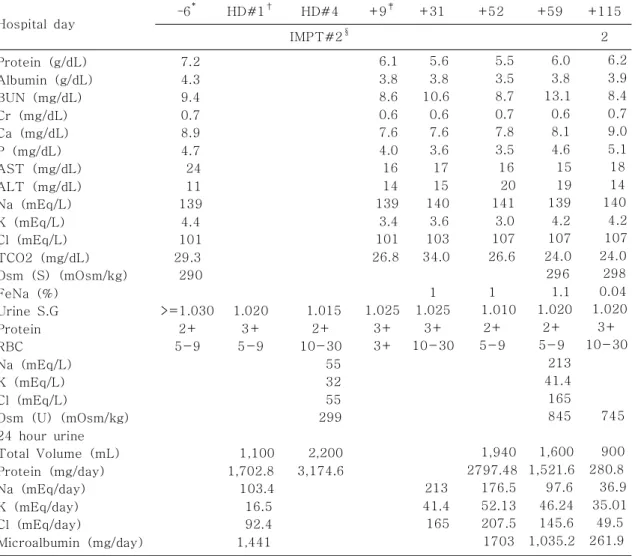
An 11-year-old boy was diagnosed with Henoch-Schönlein purpura (HSP) one week ago was admitted for renal biopsy because microscopic hematuria and nephrotic range of proteinuria had developed. There were no re- markable findings on past medical history and family history. His blood pressure was 100 mmHg systolic and 60 mmHg diastolic. Heart rate was 80 beats/min and body temperature was 36.8 . He weighed 30.2 kg (10-25th per ℃ - centile) and was 140 cm tall (25-50th percen- tile). Laboratory findings at admission were as follows (Table 1). Laboratory findings were serum protein 7.2 g/dL (normal level: 5.8-8.0 g/dL), albumin 4.3 g/dL (normal level: 3.1-5.2 g/dL), sodium 139 mEq/L (normal level: 135- 145 mEq/L), potassium 4.4 mEq/L (normal level: 3.5-5 mEq/L) and random urine analysis showed blood 2+, protein 2+, protein 380 mg/
dL, randome urine protein to creatinine ratio 3.7. On renal biopsy, his diagnosis was con- firmed as Henoch-Schönlein purpura nephritis, ISKDC grade III.
Two days after renal biopsy, intravenous methylprednisolone pulse therapy (IMPT) of 0.5 g/day was begun for three consecutive days. Subsequently oral prednisolone (Calcort) 2 mg/kg and oral cyclophospamide 2 mg/kg
were administered. After discharge, he was followed up every week taking medicines. And, blood pressure, CBC, BUN, serum creatinine, serum albumin, serum electrolytes, urinalysis, and random urine protein to creatinine ratio were monitored weekly while 24-hour urine collection for protein and electrolytes was done intermittently. His nocturia had begun right after IMPT, which was once to several times per night, and persisted for 2 months. During 2 months after IMPT, potassium level ranged between 3.0-3.6 mEq/L and 24-hour urine volume between 1.6-2.2 liter/day and urine potassium between 46-54 mEq/day. His blood pressure was maintained normotensive. His one-day voiding diary showed voiding volume of 70-200 mL, urine volume of 1,800 ml/day, 11 times of voiding frequency, and none of dysuria, urgency, incontinence, hesitancy, po- lydypsia and caffeinated drink. After he took potassium chloride (K-contin, K
+24 mEq/day), his potassium level returned to 4.2 mEq/L, 24- hour urine volume decreased to 900 ml/day.
And thereafter his nocturia had been disap- peared. Other laboratory findings were Mg 2.23 mg/dL (normal level: 1.4-2.4 mg/dL), plasma renin acitivity (PRA) 43.7 ng/mL/hr (normal level: 1.31-3.95 ng/mL/hr), aldosterone 10.2 ng/dL (normal level: supine 1-16 ng/dL, stan- ding 4-31 ng/dL), ACTH 2.0 pg/mL (normal level: AM 8-10hr 10-60 pg/mL, PM 8-10hr 6-30 pg/mL), ADH 0.19 pg/mL (normal level:
0-4.7 pg/mL), TSH 0.69 uIU/mL (normal level:
0.35-5.5 uIU/mL), FT4 1.26 ng/dL (normal
level: 0.89-1.76 ng/dL), urine cortisol 0.21
ug/day (normal level: 28.5-213.7 ug/day), urine
Osm 845 mOsm/kg (normal level: 390-1,090
mOsm/kg), urine S.G 1.020, and transtubular potassium gradient (TTKG) 3.5.
Discussion
There are few reports on development of polyuria after IMPT. But, it has already been
known that IMPT can cause hypokalemia from urinary potassium wasting [7] and that hypo- kalemia per se can induce mild polyuria as well [8].
A normal subject can, in the presence of po- tassium depletion, lower urinary potassium excretion below 25 to 30 meq per day; values
Table 1. A Flow Chart of Laboratory Findings
Hospital day – 6
*HD#1
†HD#4 +9
‡+31 +52 +59 +115
IMPT#2
§2
Protein (g/dL) Albumin (g/dL) BUN (mg/dL) Cr (mg/dL) Ca (mg/dL) P (mg/dL) AST (mg/dL) ALT (mg/dL) Na (mEq/L) K (mEq/L) Cl (mEq/L) TCO2 (mg/dL) Osm (S) (mOsm/kg) FeNa (%)
Urine S.G Protein RBC Na (mEq/L) K (mEq/L) Cl (mEq/L)
Osm (U) (mOsm/kg) 24 hour urine Total Volume (mL) Protein (mg/day) Na (mEq/day) K (mEq/day) Cl (mEq/day)
Microalbumin (mg/day)
7.2 4.3 9.4 0.7 8.9 4.7 24 11 139 4.4 101 29.3 290
>=1.030 2+
5-9
1.020 3+
5-9
1,100 1,702.8 103.4 16.5 92.4 1,441
1.015 2+
10-30 55 32 55 299
2,200 3,174.6
6.1 3.8 8.6 0.6 7.6 4.0 16 14 139 3.4 101 26.8
1.025 3+
3+
5.6 3.8 10.6 0.6 7.6 3.6 17 15 140 3.6 103 34.0
1 1.025
3+
10-30
213 41.4 165
5.5 3.5 8.7 0.7 7.8 3.5 16 20 141 3.0 107 26.6
1 1.010
2+
5-9
1,940 2797.48 176.5 52.13 207.5 1703
6.0 3.8 13.1 0.6 8.1 4.6 15 19 139 4.2 107 24.0 296
1.1 1.020 2+
5-9 213 41.4 165 845
1,600 1,521.6 97.6 46.24 145.6 1,035.2
6.2 3.9 8.4 0.7 9.0 5.1 18 14 140 4.2 107 24.0 298 0.04 1.020 3+
10-30
745
900 280.8 36.9 35.01 49.5 261.9
*
Date of following up out patient departments before admission date
†
Hospital day
‡
Date of following up out patient departments from discharge date
§
Second day of high dose methylpredisolone pulse therapy
Abbreviations: BUN, blood urea nitrogen; Cr, creatinine; Osm (S), serum osmolarity; Urine S.G,
urine specific gravity; Osm(U), urine osmolarity; Cr(U), urine creatinine
above this level reflect at least a contribution from urinary potassium wasting [9]. However, potassium wasting may be minimized or even masked if sodium and water delivery to the distal potassium secretory site is minimized by underlying volume depletion [10]. Thus, urinary sodium excretion should be above 30 to 40 meq per day to avoid this problem [11].
In this case with mild hypokalemia (<3.5 mEq/
L), keeping urine potassium level of more than 30 mEq/day for several weeks without volume depletion (urine sodium >40 mEq/L), means that his hypokalemia was due to urinary potas- sium wasting, and we think that was probably caused by IMPT because there was no other cause of renal potassium loss. Although cyc- lophosphamide can be a causative agent of hy- pokalemia in this case, we think that is highly unlikely because the characteristics of renal toxicity associated with cyclophosphamide are proximal tubular wasting of glucose, phosp- hate, bicarbonate, sodium, potassium, and amino acids and hypomagnesemia, and decreased glo- merular filtration rate [12]. And the fact that his nocturia developed from the third day after IMPT the day before cyclophosphamide treat- ment supports our belief favorably. Further- more, our review of the medical literature did not identify any possible casual relation bet- ween cyclophophamide therapy and hypoka- lemia induced polyuria.
The causes of hypokalemia due to increased urinary losses are as follows: use of diuretics, primary mineralocorticoid excess, loss of gas- tric secretions, distal flow of nonreabsorbable anions, metabolic acidosis, hypomagnesemia, use of amphotericin B, salt-wasting nephro-
pathies like Bartter and Gitelman syndrome, and polyuria [11]. Drugs with mineralocorticoid or glucocorticoid effects, such as prednisone and hydrocortisone, can cause hypokalemia because they increase potassium excretion nonspecifically through their effect on the fil- tration rate and distal sodium delivery [20]. If polyuria per se induces hypokalemia as in pri- mary polydipsia and central diabetes insipidus, urine output must be over 5 to 10 liter/day x body surface area (BSA/m
2) in children [11].
In this case, excessive corticosteroids by ad- ministering high dose of methylprednisolone seemed to induce increased urinary potassium losses leading to mild hypokalemia. Tamez- Pérez et al. [13] reported that the prevalence of mild hypokalemia in 110 patients with IMPT (1 g/day for three consecutive days) was 17.27
% and no cases of severe hypokalemia occur- red.
The development of mild polyuria, averaging
2 to 3 liters per day is one of complications of
hypokalemia [8]. The polyuria is related to
both increased thirst and mild nephrogenic dia-
betes insipidus. Increased thirst is associated
with increased central nervous system levels
of angiotensin II, a hormone that, besides its
other effects, regulates thirst. Hypokalemia
also impairs the kidney s ability to concentrate ’
the urine maximally [8]. This appears to occur
because hypokalemia causes defective activa-
tion of renal adenylate cyclase, preventing an-
tidiuretic hormone-stimulated urinary concen-
tration [14]. Several other mechanisms of K
+deprivation-induced polyuria have been pro-
posed to explain the defect in urinary concen-
trating ability in K
+depletion, including prosta-
glandin overproduction [15], primary polydip- sia [16], altered ADH release by the posterior pituitary gland [17], abnormal medullary oxi- dative metabolism [18], and reduced medullary solute [19].
For the first time, we experienced the de- velopment of polyuria and noctuira after IMPT.
So, we could not prevent patient s distress ari ’ - sing from frequent nocturia until the patient complained of it for himself. In the future, after IMPT, not only detailed history taking of noc- turia, but also monitoring of urine volume as well as serum and urine potassium level at re- gular follow-up is considered necessary beca- use even mild hypokalemia can provoke urinary concentration defect.
한 글 요 약
Henoch-Schönlein Purpura 신염 환자에서 경정맥 고용량 스테로이드
충격요법 후 발생된 저칼륨혈증으로 인한 다뇨증과 야간뇨
차의과대학교 분당차병원 소아청소년과
김 근 정ㆍ이 준 호