• 검색 결과가 없습니다.

Disturbances of motivational balance in chronic schizophrenia during decision-making tasks

N/A
N/A
Protected

Academic year: 2021

Share "Disturbances of motivational balance in chronic schizophrenia during decision-making tasks"

Copied!
9
0
0

로드 중.... (전체 텍스트 보기)

전체 글

(1)

Regular Article

Disturbances of motivational balance in chronic schizophrenia during decision-making tasks

Yang-Tae Kim, MD , 1 Hansem Sohn, MS , 2 Seungyeon Kim, MS , 2 Jihoon Oh, MD , 3 Bradley S. Peterson, MD 4 and Jaeseung Jeong, PhD 2,4 *

1

Department of Psychiatry, School of Medicine, Keimyung University, Daegu,

2

Department of Bio and Brain Engineering, Korea Advanced Institute of Science and Technology (KAIST), Daejeon,

3

College of Medicine, Catholic University of Korea, Seoul, Korea and

4

Department of Psychiatry, College of Physicians and Surgeons, Columbia University, New York, USA

Aim: The role of feedback processing in decision- making has been assessed in psychiatric patients using the Iowa Gambling Task (IGT). Although impaired performance on the IGT has been docu- mented extensively in schizophrenia patients, the neuropsychological mechanisms underlying the per- formance deficits have not yet been elucidated. There- fore, the aim of this study was to investigate the neuropsychological origins of impaired decision- making in schizophrenia patients using various ver- sions of the IGT.

Methods: Thirty chronic schizophrenia patients and 33 healthy subjects underwent computerized ver- sions of the IGT, the Variant Gambling Task (VGT), and the Shuffled Gambling Task (SGT) to assess the contributions of motivational balance and reversal learning on IGT performance. In addition, perfor- mance on the Wisconsin Card-Sorting Test (WCST) was assessed.

Results: The schizophrenia patients exhibited deficits on the IGT and SGT, particularly in later trials. No significant group difference was detected on the VGT due to the improved performance of schizophrenia patients in the earlier trials. Performance on the gam- bling tasks in the schizophrenia group did not corre- late with performance on the WCST or with the severity of clinical symptoms.

Conclusion: Deficits in motivational balance, but not reversal learning, play a dominant role in the impaired decision-making of patients with schizophrenia.

Key words: decision-making, gambling task, motiva- tional balance, reversal learning, schizophrenia.

T HE ROLE OF feedback processing, in terms of reward and punishment during decision-making, has been commonly assessed by the Iowa Gambling Task (IGT), which was initially developed to assess patients with prefrontal lesions.

1

The IGT has been subsequently used in neurology to assess the integrity

of brain regions involved in learning, including the orbitofrontal cortex (OFC), anterior cingulate cortex (ACC), and amygdala, with positive or negative feed- back.

1

Patients with OFC lesions are unable to make decisions on the IGT that maximize the total reward received.

1,2

Functional imaging studies in healthy participants have suggested that the medial prefrontal cortex makes important contributions to performance on the IGT, particularly to the anticipation of risk.

3

Neural activity in the ventromedial prefrontal cortex during affective judgment has also been correlated with the performance on the IGT,

4

and the lateral

*Correspondence: Jaeseung Jeong, PhD, Brain Dynamics Laboratory, Department of Bio and Brain Engineering, Korea Advanced Institute of Science and Technology (KAIST), Daejeon 305-701, Korea.

Email: [email protected]

Received 17 March 2011; revised 31 January 2012; accepted 1

February 2012.

(2)

OFC has been implicated in the representation of unstable stimulus–response associations during the IGT and related tasks.

5

Patients with chronic schizophrenia manifest hal- lucinations, delusions, thought disorder, and perva- sive cognitive deficits. Several studies have obtained variable results in assessing the decision-making ability of patients with schizophrenia using the IGT.

6,7

Some studies reported that schizophrenia patients exhibit poor IGT performance compared with healthy subjects,

8

whereas other studies reported no significant differences between patients and con- trols.

9

These discrepancies are likely attributable in part to the intrinsic heterogeneity of schizophrenia, variable patterns of comorbidity across the samples, the high variability in performance on the IGT and the low specificity of the IGT to characterize the diverse components of the decision-making processes.

The aim of this study was to use various gambling tasks to improve our understanding of the neuropsy- chological origins of impaired decision-making in patients with chronic schizophrenia. Multiple ver- sions of gambling tasks have been developed to delineate and assess the processes involved in decision-making. Whereas the IGT assesses the ability to evaluate both immediate rewards and future pun- ishments in decision-making, the Variant Gambling Task (VGT) assesses the capacity to examine immedi- ate punishments and future rewards simultaneously in decision-making.

1

We compared performance measures of the IGT and VGT to determine if the impaired decision-making in persons with schizo- phrenia arises from insensitivity to both types of rein- forcement or from a motivational imbalance, defined as biased responsiveness to reward or punishment.

We also investigated whether substandard perfor- mance on the IGT in persons with schizophrenia can be attributed to impairments in reversal learning.

During the IGT, subjects should overcome an initial preference for decks that provide short-term rewards to maximize future rewards. We used the Shuffled Gambling Task (SGT) in the present study to directly examine the contribution of reversal learning on per- formance during the IGT.

2

Finally, we used the Wisconsin Card-Sorting Test (WCST) to assess whether impaired decision-making in persons with schizophrenia is associated with mea- sures of executive functions. Prior studies have reported that the performance of schizophrenia patients on the IGT did not correlate significantly

with performance on WCST,

10

suggesting that distur- bances in executive functioning are unlikely to con- tribute to a poor performance on the IGT.

METHODS

Subjects

Thirty patients with chronic schizophrenia (19 male) and 33 healthy subjects (16 male) participated in this study. Schizophrenia patients were recruited from the Department of Psychiatry in Bugok National Hospi- tal. The consensus diagnoses were established by two psychiatrists according to DSM-IV criteria. The Insti- tutional Review Board (IRB) of Bugok National Hos- pital approved all experimental procedures for this study. The schizophrenia group consisted of chronic inpatients and outpatients who were functionally stable and without florid psychotic features at the time of testing. The schizophrenia patients were taking stable dosage of atypical antipsychotics, including risperidone, clozapine, olanzapine, que- tiapine, ziprasidone, or aripiprazole. All but three patients were receiving adjuvant psychotropic medi- cations (most frequently, benztropine or benzodiaz- epine). Patients with schizophrenia were excluded if they had a history of other neurological disorders, such as seizure, stroke, or head injury, or a substance abuse disorder other than caffeine or nicotine. The severity of positive and negative symptoms was evaluated using the Positive and Negative Syndrome Scale (PANSS).

The schizophrenia patients were taking stable dosage of atypical antipsychotics. The medication dosage of risperidone (400–600 mg), clozapine (150–300 mg), olanzapine (250–375 mg), quetiap- ine (750–1000 mg), ziprasidone (300–400 mg), and aripiprazole (375 mg) was quantified using chlorpro- mazine equivalents. All but three patients were receiving adjuvant psychotropic medications, most frequently benztropine (1–2 mg) or benzodiazepine (1–2 mg).

11

Healthy subjects were recruited as controls from the neighboring towns of Bugok National Hospital.

They were selected such that they had a distribution

of age, sex, education, and IQ similar to the patient

group. Controls also underwent structured interviews

to exclude histories of neurological disorders and

substance abuse. Groups did not differ significantly

in age, education, gender, or IQ (Table 1). All partici-

pants provided written informed consent after

(3)

receiving a detailed explanation of the experimental procedures.

Experimental procedures

All participants were tested in two separate sessions that were 8 weeks apart. In the first session, comput- erized versions of the IGT, VGT, and WCST were used.

The order of testing was randomized. Assessment of clinical symptoms in the patients using the PANSS was performed on the same day of testing. To avoid learning effects in the IGT, only the SGT was used during the second session.

Iowa Gambling Task

The subjects were instructed that the goal of this game is to win as much money as possible. The task ended when the subject selected 100 cards, but the subject was not provided with withdrawn card count information. The subject was free to switch from one deck to another at any given time, as often as the subject wanted. This card game assesses the ability of subjects to evaluate both immediate gains and future losses. In decks A and B, selecting a card is followed by a $100 reward, and in decks C and D, followed by a $50 reward. Choice of a card, however, is randomly followed by a punishment in each of the four decks.

Every set of 10 cards from deck A or B earns $1000 but costs $1250. Conversely, every set of 10 cards from deck C or D earns $500 but costs $250. There- fore, decks A and B are disadvantageous because of a

net loss (–$250/10 cards), while decks C and D are advantageous because of a net gain (+$250/10 cards).

A net score for the overall 100 cards and each block of 20 cards was obtained by subtracting the total number of disadvantageous decks from that of the advantageous decks [(C + D)–(A + B)].

Variant Gambling Task

The task design of the VGT is similar to the IGT, but the difference is in the schedule of punishment and reward. This game examines the capacity of subjects to evaluate both immediate losses and future gains.

In decks E and G, selecting a card is followed by a

$100 punishment. In decks F and H, selecting a card is followed by a $50 punishment. Choice of a card, however, is randomly followed by a reward in each of the four decks. Every set of 10 cards from deck E or G costs $1000 but earns $1250. In contrast, every set of 10 cards from deck F or H costs $500 but earns $250.

Thus, decks E and G are advantageous because of a net gain (+$250/10 cards), while decks F and H are disadvantageous because of a net loss (–$250/10 cards). A net score is then obtained for the overall 100 cards and each block of 20 cards by subtracting the total number of disadvantageous decks from that of the advantageous decks [(E + G)–(F + H)].

Shuffled Gambling Task

The SGT was developed to test the role of reversal learning in IGT performance.

2

The design of the SGT Table 1. Subject characteristics

Characteristic

Schizophrenia patients (n = 30)

Control subjects

(n = 33) Analysis

Mean SD Mean SD t d.f. P

Age (years) 29.2 5.7 27.8 3.0 1.17 43.16 0.24

Education (years) 14.0 1.9 14.8 1.4 -1.81 61 0.07

IQ 100.5 13.2 101.7 10.8 -0.40 61 0.68

Duration of illness (years) 5.7 4.4 PANSS

Positive scale 11.5 3.2

Negative scale 14.7 4.9

General scale 29.0 7.5

Total 55.4 13.9

n % n % c

2

d.f. P

Male gender 19 63.3 16 48.5 1.40 1 0.24

PANSS, Positive and Negative Symptom Scale.

(4)

is identical to that of the IGT except for two factors.

First, the order of the cards is changed to eliminate the need to overcome an initial preference for the high-gain decks. In the first several turns of the IGT, initial preference for the high-risk decks develops because each deck reveals only wins and the riskier decks have higher wins. The cards from 1 to 8 in each deck were moved to the bottom of the respective decks, so that each deck began at card 9. Accordingly, the losses in relation to the high-risk decks were expe- rienced on the first few trials, eliminating the need for reversal learning. In addition, the original cards from 11 to 14 are switched in deck B. A second difference in the SGT is that the card decks are changed to avoid the learning effect of the IGT (A→C; B→A; C→D; and D→B). Therefore, decks B and D are advantageous, while decks A and C are disadvantageous. A net score is then obtained for the overall 100 cards and each block of 20 cards by subtracting the total number of disadvantageous decks from that of the advantageous decks [(B + D)–(A + C)].

Wisconsin Card-Sorting Test

The computerized version of the WCST was used in this study. Subjects sort response cards until they have matched six categories or sorted all 128 cards.

Cards are matched according to different dimensions, such as color, form and number. After 10 consecutive correct cards have been drawn, a new sorting prin- ciple is instituted without warning. The number of categories completed and number of preservative errors are measured as the performance of the test.

Statistical analysis

To test the hypothesis that diagnostic groups would differ in performance across the three gambling tasks, independent-sample t-tests were performed on the net scores in each gambling task. Paired-sample t-tests assessing task differences within each group (without contrasts between the VGT and the SGT) were carried out as planned comparisons to isolate specific components of the impaired decision- making processes. We also conducted post-hoc t-tests for the net score in each block of 20 card selections to assess the temporal patterns of card selections, pro- vided that the previous independent-samples and paired-samples t-tests reached statistical significance.

In the post-hoc t-tests, we used the Bonferroni correction to reduce the Type 1 error associated with

multiple comparisons. A Spearman correlation coefficient was used to determine whether the net scores of the three gambling tasks were correlated with each other, with the performance on the WCST, or with the ratings of symptom severity within the schizophrenia group. All findings were considered statistically significant for P < 0.05 with (two-tailed).

All t-tests were performed after a Levene test for equality of variances, with a correction applied if needed. Effect sizes were estimated using Cohen’s d or partial h.

2

RESULTS

The independent-sample t-tests showed that the net scores of the schizophrenia patients were significantly lower on the IGT and SGT, but not on the VGT, compared with healthy controls (Table 2). Paired- sample t-tests showed that patients performed significantly worse on the IGT than on the VGT (t(29) = -2.15, P = 0.04, Cohen’s d = 0.483) and SGT (t(29) = -3.07, P = 0.005, Cohen’s d = 0.547). The controls did not differ significantly in their net scores for the IGT and VGT, whereas their net scores were significantly lower for the IGT than the SGT (t(32) = -3.45, P = 0.002, Cohen’s d = 0.496). The absence of group differences on the VGT, but not on the IGT, as well as the increased net scores of the patients from the IGT to the VGT indicates a motiva- tional imbalance in the schizophrenia patients because the alteration implemented in the VGT was to invert the valence of feedbacks from the IGT.

To directly test directly whether the patients with schizophrenia have deficits on reversal learning com- pared with the control subjects, we first quantified the degree of improvement across two tasks by subtract- ing the SGT from the net score of the IGT in each subject. The change in performance in the patients, however, did not differ significantly from that of the controls (17.70 ⫾ 29.45 in controls and 13.73 ⫾ 24.51 in patients, mean ⫾ S.D; t(61) = 0.577, P = 0.566, Cohen’s d = 0.148). The extent to which reversal learning contributes to performance on the IGT therefore seems to be comparable across groups.

To assess the temporal patterns of card selections

in the two groups during the three gambling tasks,

we conducted post-hoc, independent-sample t-tests

across groups in each block of the IGT and SGT. There

were significant group differences during the third

(5)

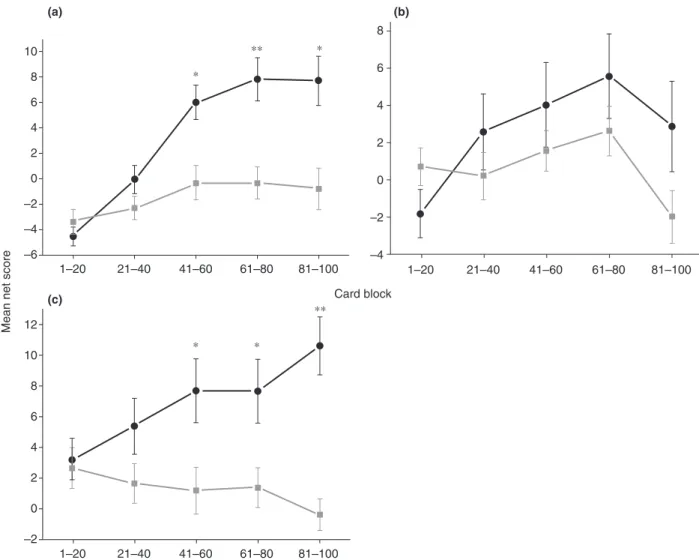
block (t(61) = -3.29, P = 0.002, Cohen’s d = -0.842), fourth block (t(57.51) = -3.87, P < 0.001, Cohen’s d = -1.021), and fifth block (t(61) = -3.29, P = 0.002, Cohen’s d = -0.842) on the IGT (Fig. 1a) and during the fifth block (t(49.32) = -5.10, P < 0.001, Cohen’s d = -1.452) on the SGT (Fig. 1c). But we could not find any significant group differences during the VGT (Fig. 1b).

Post-hoc, paired-sample t-tests in the control sub- jects indicated significant differences in net scores between the IGT and SGT on the first block (t(32) = -5.48, P < 0.001, Cohen’s d = 1.240) and second block of trials (t(32) = -3.34, P = 0.002, Cohen’s d = 0.631). Furthermore, net scores of the patients differed significantly between the IGT and VGT on the first block (t(29) = -3.97, P < 0.001, Cohen’s d = 0.764) and between the IGT and SGT on the first block (t(29) = -4.28, P < 0.001, Cohen’s d = 0.954) and second block (t(29) = -3.30, P = 0.003, Cohen’s d = 0.653). These results indicate that

the group differences in the net scores of the IGT and SGT primarily occurred during the later portions of the gambling tasks, whereas significant differences between gambling tasks in the net scores of each block of the each group originated from earlier trials of the designated tasks.

Groups differed significantly in performance on the WCST. Consistent with previous studies, the schizophrenia patients completed significantly fewer categories (P = 0.001) and made more errors than controls (P < 0.001 for total errors; P = 0.003 for pre- servative errors; Table 2). Performance on the IGT was correlated significantly with performance on the SGT in the patient group (r = 0.411, P = 0.024;

Table 3). Net scores on the decision-making tasks did not correlate significantly with either WCST perfor- mance or PANSS scores in the patient group, indicat- ing that deficits in decision-making likely did not originate from problems in executive functioning or as a by-product of illness severity.

Table 2. Neuropsychological performance

Characteristic

Schizophrenia patients (n = 30)

Control subjects

(n = 33) Analysis

Mean SD Mean SD t d.f. P Cohen’s d

Iowa Gambling Task

Net score -7.2 24.28 16.9 28.4 3.60 61 0.001 0.922

deck A 20.3 6.2 17.1 7.1 1.90 61 0.061 0.487

deck B 33.2 10.4 24.4 9.7 3.44 61 0.001 0.881

deck C 24.0 5.9 27.5 13.8 -1.32 44.40 0.191 -0.396

deck D 22.3 9.8 30.8 14.0 -2.79 57.42 0.007 -0.736

Variant Gambling Task

Net score 3.3 19.0 13.3 46.8 -1.13 43.12 0.262 -0.3442

deck E 23.0 12.6 29.9 19.3 -1.67 55.61 0.100 -0.448

deck F 30.5 10.1 24.5 16.5 1.75 53.74 0.085 0.477

deck G 28.6 12.5 26.7 15.1 0.51 61 0.609 0.131

deck H 17.8 7.1 18.7 12.2 -0.37 61 0.709 -0.095

Shuffled Gambling Task

Net score 6.5 25.8 34.6 41.6 -3.24 54.10 0.002 -0.881

deck A 25.6 12.6 21.1 18.9 1.11 56.14 0.271 0.296

deck B 36.3 13.2 44.0 15.5 -2.14 60.76 0.036 -0.549

deck C 21.1 9.7 11.5 7.6 4.35 61 <0.001 1.114

deck D 16.9 1.3 23.2 15.4 -1.90 56.43 0.063 -0.506

Wisconsin Card-Sorting Test

Categories completed 4.2 2.1 5.8 0.7 -3.79 34.60 0.001 -1.289

Total errors 36.5 22.9 15.8 13.8 4.27 46.81 <0.001 1.248

Perseverative errors 18.9 11.6 10.6 9.0 3.16 54.53 0.003 0.856

Net score, no. selected cards from advantageous decks minus number of chosen cards from disadvantageous decks.

(6)

DISCUSSION

We assessed the performance on a variety of gam- bling tasks (IGT, VGT, and SGT) in patients with chronic schizophrenia to understand the origin of their impairments in decision-making. Whereas per- formance on the IGT and SGT in the patients with schizophrenia was worse than that of the controls, the groups did not differ in their performance on the VGT. These results indicate that the schizophrenia patients made decisions in a less profitable manner on both the IGT and SGT, although both groups

exhibited relatively better performance on the SGT than on the IGT. Therefore, even though the patients still performed worse than the controls on the SGT, they likely performed better on the SGT than on the IGT because of the absence of demands for the rever- sal learning in the SGT. This indicates that the perfor- mance of both groups was affected by reversal learning.

The performance differences between the IGT and SGT were derived primarily from the later trials of the tasks. With respect to task differences in each group, we found that reversal learning is responsible for the 10

12 10 8 6 4 2 0

Mean net score

–2

8 6 4 2 0 –2

8

6

4

2

0

–2

–4 –4

–6 1–20

∗∗

∗∗

21–40 41–60

Card block

61–80 81–100 1–20 21–40 41–60 61–80 81–100

1–20 21–40 41–60 61–80 81–100

(a) (b)

(c)

Figure 1. (a) Performance on the five blocks of the (a) Iowa Gambling Task, (b) Variant Gambling Task and (c) Shuffled Gambling

Task for ( 䊉) healthy subjects (n = 33) and (䊏) schizophrenia patients (n = 30). (a) Significant differences between the two groups

were detected in the third block (t = -3.29, d.f. = 61, P = 0.002), fourth block (t = -3.87, d.f. = 57.51, P < 0.001), and fifth block

(t = -3.29, d.f. = 61, P = 0.002). (b) There was no significant difference between the two groups in the five blocks. (c) Significant

differences between the two groups were detected in the third block (t = -2.54, d.f. = 57.58, P = 0.014), the fourth block (t = -2.56,

d.f. = 52.61, P = 0.014), and the fifth block (t = -5.10, d.f. = 49.32, P < 0.001). Data given as mean ⫾ SD. *P < 0.01; **P < 0.001.

(7)

relatively better performance during the initial trials of the SGT in both healthy subjects and schizophre- nia patients. Schizophrenia patients, however, did not exhibit deficits in reversal learning compared with controls when measured by the improved per- formance between the IGT and SGT. The increased performance in the patient group on the VGT relative to the IGT was particularly pronounced in the first block, while the differential performance between the IGT and VGT is absent in healthy subjects. In summary, schizophrenia patients displayed a prefer- ence for decks that yielded high immediate gains despite greater delayed losses on the IGT and SGT, leading to fewer gains overall. In addition, the patients also opted more for decks that yielded high immediate losses but larger delayed gains on the VGT. These results suggest that the distorted sensitiv- ity to positive or negative feedback, rather than defi- cits in reversal learning, primarily contributes to impaired performance on the IGT in schizophrenia patients.

12

Recently, it was shown that patients with schizo- phrenia exhibit intact implicit sensitivity to reward and reduced weighting to punishments during evalu- ation of probabilistic gambles.

13

In addition, the absence of the endowment effect, that is, asymmetry between ‘willingness to pay’ and ‘willingness to accept’ in a non-risky situation, was recently reported in schizophrenia.

14

Elevated performance of patients from the IGT to the VGT might illustrate contribution of the impaired punishment processing in schizo- phrenia. Similar performances in the VGT, but not in the IGT, between the two groups are in line with the hypothesis that biased sensitivity to punishments is mainly implicated in the motivation imbalance in schizophrenia.

Another potential source of bias in the motiva- tional balance in patients with schizophrenia could be abnormal risk perception.

13,15,16

In addition to ver-

idical estimation of the expected (or average) value, an accurate appraisal of its risk (the statistical vari- ance of trial-by-trial outcomes) is indispensable, par- ticularly under uncertain situations or in a dynamic environment.

17

In such a volatile setting, optimal control of the learning rate must reflect the amount of risk associated with each alternative to update its value based on experience feedback in the framework of reinforcement learning models.

18,19

Hence, deficits in risk assessment may lead to compromised across- block learning in schizophrenia patients that is dis- tinct from the steep learning curve of healthy subjects (Fig. 1). In line with this hypothesis, the decision- making patterns of the patients during all of the gambling tasks suggested an enhanced risk-taking behavior. In the IGT, the advantageous decks (C, D) are favorable not only in terms of the larger mean or expected value (+$250 per 10 cards) but also in the sense of a smaller risk (C < D < A < B in terms of increasing risk). In the VGT, however, the advanta- geous decks (E, G) with larger expected values exhibit higher risk than the disadvantageous decks (F, H) because the reversal of valence, such as changing deck B of the IGT into deck E of the VGT, does not affect the risk itself (F < H < G < E in terms of increasing risk).

20

Thus, schizophrenia patients might consis- tently select decks with more risk, regardless of the expected value, such as decks A and B in the IGT and decks E and G in the VGT. But this is not consistent with the normal performance observed in schizo- phrenia patients on the Game of Dice Task (GDT), which also involves risk-sensitive decision-making, suggesting that their perception of risk is relatively intact.

8,13

Unlike the GDT and other explicit decision- making tasks that lack ambiguity, the assessment of risk has to be accomplished implicitly by learning from experiences in the gambling task.

21

Therefore, the hypothesis that decisions made by patients with schizophrenia are affected by the erroneously per- Table 3. Test performance and PANSS score for schizophrenia patients

VGT SGT WCST-C WCST-TE WCST-PE PANSS-P PANSS-N PANSS-G PANSS-T

IGT 0.129 0.411* -0.165 0.097 0.124 -0.038 -0.055 0.017 -0.002

VGT – -0.018 -0.13 0.149 0.102 0.049 0.126 0.08 0.118

SGT – – 0.299 -0.281 -0.352 -0.105 0.127 0.135 0.078

*Correlation between the net scores of IGT and SGT is statistically significant (P = 0.024). C, category completed; G, general score; IGT, Iowa Gambling Task; N, negative score; P, positive score; PANSS, Positive and Negative Symptom Scale;

PE, perseverative error; SGT, Shuffled Gambling Task; T, total score; TE, total error; VGT, Variant Gambling Task;

WCST, Wisconsin Card-Sorting Test.

(8)

ceived risk should be investigated further to clarify the aforementioned source of motivational imbal- ance in the patients: the lack of risk aversion and/or loss aversion.

13,14

We expected that schizophrenia patients in the present study would exhibit a smaller amount of improvement in performance on the SGT over the IGT compared with the control subjects because our previous work demonstrated impairments in reversal learning in persons with schizophrenia.

8

We found, however, that the degree to which the performance on the SGT is enhanced compared to that on the IGT is not significantly different between the two groups.

This result implies that problems with reversal learn- ing play at most an ancillary role in impairing the performance of the IGT in schizophrenia. This con- clusion was supported by our previous finding that performance on the Simple Reversal Learning Task did not correlate significantly with performance on the IGT.

8

Furthermore, the significant correlation between performances on the IGT and SGT in the patient group suggests that processes other than reversal learning cause impaired decision-making on the IGT of schizophrenia patients.

The neurobiological underpinnings of motiva- tional imbalance are likely to involve systems that regulate enforcement learning and goal-directed behaviors, including the midbrain dopaminergic system and its projections.

22

The modest indepen- dence of reversal learning and performance on the IGT suggests that the OFC is unlikely to contribute to impaired decision-making in the present patients with schizophrenia. Moreover, the previous findings that OFC patients exhibit total insensitivity to future consequences support this suggestion.

23

The precise mechanisms by which the hypothesized abnormality in dopaminergic neurotransmission would distort motivation requires further study.

Finally, we must acknowledge several limitations of this study and future prospective studies. First, medications may have positively or adversely affected the decision-making capacity in the participants with schizophrenia.

24

The effects of antipsychotic medica- tions on decision-making are relatively unknown and warrant investigation in future studies.

25

Second, the influence that impaired decision-making has on the symptoms of psychosis, cognitive impairment, poor motivation, and diminished emotional expression is unknown and requires more study to understand the functional relevance of motivational imbalance in persons with schizophrenia. Finally, identification of

the neurobiological origins of impaired decision- making will require more detailed studies using func- tional neuroimaging methods and a carefully devised behavioral parsing of the information processing pathways that contribute to decision-making.

2

ACKNOWLEDGMENTS

The authors thank Dr Antoine Bechara for provid- ing information about stimulus materials and testing procedures used in the gambling tasks. This work was supported by the Korea Science and Engi- neering Foundation (KOSEF) grant funded by the Korea government (MOST) (No.M10644000005- 06N4400-00510, No.R01-2007-000-21094-0 and No.M10644000013-06N4400-01310). The authors declare no conflict of interest.

REFERENCES

1. Emotion BA. Decision making and the orbitofrontal cortex. Cereb. Cortex 2000; 10: 295–307.

2. Fellows LK, Farah MJ. Different underlying impairments in decision-making following ventromedial and dorsolat- eral frontal lobe damage in humans. Cereb. Cortex 2005;

15: 58–63.

3. Fukui H, Murai T, Fukuyama H, Hayashi T, Hanakawa T.

Functional activity related to risk anticipation during per- formance of the Iowa gambling task. Neuroimage 2005; 24:

253–259.

4. Northoff G, Grimm S, Boeker H et al. Affective judgment and beneficial decision making: Ventromedial prefrontal activity correlates with performance in the Iowa gambling task. Hum. Brain Mapp. 2006; 27: 572–587.

5. Windmann S, Kirsch P, Mier D et al. On framing effects in decision making: Linking lateral versus medial orbitofron- tal cortex activation to choice outcome processing. J. Cogn.

Neurosci. 2006; 18: 1198–1211.

6. Dunn BD, Dalgleish T, Lawrence AD. The somatic marker hypothesis: A critical evaluation. Neurosci. Biobehav. Rev.

2006; 30: 239–271.

7. Sevy S, Burdick KE, Visweswaraiah H et al. Iowa gambling task in schizophrenia: A review and new data in patients with schizophrenia and co-occurring cannabis use disor- ders. Schizophr. Res. 2007; 92: 74–84.

8. Lee Y, Kim YT, Seo E et al. Dissociation of emotional decision-making from cognitive decision-making in chronic schizophrenia. Psychiatry Res. 2007; 152: 113–

120.

9. Evans CE, Bowman CH, Turnbull OH. Subjective aware- ness on the Iowa gambling task: The key role of emotional experience in schizophrenia. J. Clin. Exp. Neuropsychol.

2005; 27: 656–664.

(9)

10. Shurman B, Horan WP, Nuechterlein KH. Schizophrenia patients demonstrate a distinctive pattern of decision- making impairment on the Iowa gambling task. Schizophr.

Res. 2005; 72: 215–224.

11. Marangell L, Martinez J (eds). Concise Guide to Psychophar- macology. American Psychiatric Association, Washington, DC, 2006.

12. MacDonald AW 3rd, Carter CS, Kerns JG et al. Specificity of prefrontal dysfunction and context processing deficits to schizophrenia in never-medicated patients with first- episode psychosis. Am. J. Psychiatry 2005; 162: 475–484.

13. Heerey E, Bellwarren K, Gold J. Decision-making impair- ments in the context of intact reward sensitivity in schizo- phrenia. Biol. Psychiatry 2008; 64: 62–69.

14. Tremeau F, Brady M, Saccente E et al. Loss aversion in schizophrenia. Schizophr. Res. 2008; 103: 121–128.

15. Prentice KJ, Gold JM, Carpenter WT Jr. Optimistic bias in the perception of personal risk: Patterns in schizophrenia.

Am. J. Psychiatry 2005; 162: 507–512.

16. Hutton SB, Murphy FC, Joyce EM et al. Decision making deficits in patients with first-episode and chronic schizo- phrenia. Schizophr. Res. 2002; 55: 249–257.

17. Bossaerts P. Risk and risk prediction error signals in ante- rior insula. Brain Struct. Funct. 2010; 214: 645–653.

18. Nassar MR, Wilson RC, Heasly B, Gold JI. An approxi- mately bayesian delta-rule model explains the dynamics of belief updating in a changing environment. J. Neurosci.

2010; 30: 12 366–12 378.

19. Sohn H, Kim S. Simple reinforcement learning models are not always appropriate. J. Neurosci. 2006; 26: 11 511–

11 512.

20. Bechara A, Tranel D, Damasio H. Characterization of the decision-making deficit of patients with ventrome- dial prefrontal cortex lesions. Brain 2000; 123: 2189–

2202.

21. Kim YT, Sohn H, Jeong J. Delayed transition from ambiguous to risky decision making in alcohol depen- dence during Iowa gambling task. Psychiatry Res. 2011;

190: 297–303.

22. Laviolette SR. Dopamine modulation of emotional pro- cessing in cortical and subcortical neural circuits: Evidence for a final common pathway in schizophrenia? Schizophr.

Bull. 2007; 33: 971–981.

23. Bechara A, Dolan S, Hindes A. Decision-making and addiction (part II): Myopia for the future or hyper- sensitivity to reward? Neuropsychologia 2002; 40: 1690–

1705.

24. Beninger RJ, Wasserman J, Zanibbi K, Charbonneau D, Mangels J, Beninger BV. Typical and atypical antipsychotic medications differentially affect two nondeclarative memory tasks in schizophrenic patients: A double disso- ciation. Schizophr. Res. 2003; 61: 281–292.

25. Waltz JA, Frank MJ, Robinson BM, Gold JM. Selective

reinforcement learning deficits in schizophrenia support

predictions from computational models of striatal-cortical

dysfunction. Biol. Psychiatry 2007; 62: 756–764.

수치

Table 3). Net scores on the decision-making tasks did not correlate significantly with either WCST  perfor-mance or PANSS scores in the patient group,  indicat-ing that deficits in decision-makindicat-ing likely did not originate from problems in executive
Figure 1. (a) Performance on the five blocks of the (a) Iowa Gambling Task, (b) Variant Gambling Task and (c) Shuffled Gambling Task for ( 䊉) healthy subjects (n = 33) and (䊏) schizophrenia patients (n = 30)

참조

관련 문서

Communication effectiveness lies in the accuracy of facts, statistics, and decisions. • Effective managers are at the center of information / to facilitate task

The index is calculated with the latest 5-year auction data of 400 selected Classic, Modern, and Contemporary Chinese painting artists from major auction houses..

Respiratory acidosis and metabolic alkalosis : chronic lung disease and diuretics 5.. Mixed acute and chronic respiratory acidosis : chronic lung disease

Randomised, double blind, placebo controlled study of fluticasone propionate in patients with moderate to severe chronic obstructive pulmonary disease: the

Chronic kidney disease (partial update): Early identification and management of chronic kidney disease in adults in primary and secondary care (Clinical

This solution includes Smart Monitoring, which checks the status of miners and the mining in real-time, and provides the information necessary for optimal decision

1 John Owen, Justification by Faith Alone, in The Works of John Owen, ed. John Bolt, trans. Scott Clark, &#34;Do This and Live: Christ's Active Obedience as the

-The square module stands free in the garden of the house as a canopy -consisted of a thin shell supported at each of its corners by equally thin reinforced concrete piers.