Article https://doi.org/10.14478/ace.2017.1047
1. Introduction
1)
Due to rapid urbanization and modern civilization, indoor air pollu- tion has become one of the pervasive environmental problems[1,2].
Exposure to volatile organic compounds (VOCs) has been an indoor environmental quality (IEQ) concern in buildings for many years[3,4].
† Corresponding Author: Catholic Kwandong University, Environmental Engineering, Gangneung 21507, South Korea Tel: +82-33-649-7535 e-mail: [email protected]
pISSN: 1225-0112 eISSN: 2288-4505 @ 2017 The Korean Society of Industrial and Engineering Chemistry. All rights reserved.
Paints have traditionally been developed to decorate and to protect the building materials of houses[5]; however, it is widely used material which consists of variety of airborne chemicals and other harmful chemical substances which were released to the atmosphere after applying. Therefore, use of low quality of paint as a building material is the major contributor to the poor indoor air quality[6]. Two types of paints are generally used for construction and household materials;
namely, solvent and water based paints. Solvent based paints contain organic solvents, possibly emits a wide variety of volatile organic com- pounds (VOCs). Similarly, water-based paint also contains a variety of harmful chemicals[7]. The VOCs are predominant chemical pollutants
견운모를 이용한 벽마감용 천연페인트 제조
김무늬⋅랄문시아마⋅이승목†⋅진강중*
가톨릭관동대학교 환경공학과, *(주)동양이앤피
(2017년 5월 19일 접수, 2017년 6월 5일 심사, 2017년 6월 19일 채택)
Preparation of Natural Wall Paint by Using Sericite Clay
Munui Kim, Lalhmunsiama, Seung-Mok Lee†, and Kang-Jung Jin*
Environmental Engineering, Catholic Kwandong University, Gangneung 21507, South Korea
*DongYang E&P, Ltd. Seosan, South Korea
(Received May 19, 2017; Revised June 5, 2017; Accepted June 19, 2017)
초 록
급격한 도시화와 인구 증가로 인한 건물의 밀폐성 증가로 심각한 실내 공기 오염을 야기하고 있다. 몇몇 실내 공기 오염물질 중 페인트에서 방출되는 휘발성 유기화합물(VOCs)이 주요 관심사이다. 따라서 친환경적인 페인트 제품 개 발에 대한 요구가 증가하고 있다. 본 연구에서는 점토광물인 견운모를 사용하여 벽마감용 천연페인트를 제조하였다.
소규모 챔버를 사용하여 벽마감용 천연페인트에 존재하는 독성물질 확인 실험을 하였으며, 2개의 상업용 페인트와 비교 분석하였다. 총 VOC 양은 trace로 권장 실내 공기질 기준보다 낮은 것으로 나타났다. 벽마감용 천연페인트에서 톨루엔은 검출되지 않았으며 포름알데히드가 trace 레벨로 측정되었다. 독성지수 분석결과 2가지 친환경 상업용 페인 트와 비교하여 본 연구에서 개발된 천연페인트가 낮은 유해물질 방출을 나타내었다. 건축자재등급 실험에서 벽마감용 천연페인트가 1등급으로 분류되었다. 이상의 연구결과에서 나타난 바와 같이 벽마감용 천연페인트의 주성분으로 견 운모를 사용하는 것이 실내 공기질을 관리하는데 유용할 것이라 판단된다.
Abstract
Due to the rapid urbanization and increased population, there is an increase in airtight nature of buildings which causes serious indoor air pollution. Among several indoor air pollutants, volatile organic compounds (VOCs) emitted from paint are of major concern. Therefore, there is an urge for the development of environmental friendly paint products. In this wok, a natural wall paint (NWP) was prepared by utilizing a natural clay material “sericite” as a main component. A small chamber test was carried out to identify the toxic substances release from NWP and the results were compared with two eco-friendly commer- cial paints. The total VOCs were detected in trace level inside the test chamber and their concentrations were below the rec- ommended indoor air quality standards. Toluene was not detected for NWP, whereas formaldehyde was observed in trace level. The toxicity index results were compared with two commercial paints and found that NWP exhibited less harmful gas emission. Based on certification rating of building materials, NWP can be classified as the first grade of building materials.
Due to the above advantages, the use of sericite as a major component in NWP will be a useful technique to maintain the indoor air quality.
Keywords: indoor pollution, natural paint, clay, volatile organic compounds
which significantly influence the indoor air quality and simultaneously influencing human health[8,9]. A review article is available in the liter- ature reporting the emission of VOCs from interior paints[5]. Exposure to VOCs exhibits adverse health effects including nose and throat dis- comfort, emesis, epistaxis, headache, nausea, fatigue, and dizziness[10].
In this perspective, considerable attention was received from regulatory bodies to paint manufacturer. Thus, development of a paint which has good decorative properties and concurrently provides a healthy and com- fortable indoor environment is a challenging task for the researcher[11].
Recently, many paints described as “indoor air purifying” have been launched in the market[12,13]. Several researches focused on the uti- lization of various abundant natural and eco-friendly materials to pre- pare eco-friendly paint which emit little or no VOC to the environment. Natural paints are biodegradable and free of petrochem- icals ingredients. Among the available natural resources, clay minerals are an attractive and promising class of material due to their potential use in a wide range of conventional applications. In general, clay mate- rials in paints acts as filler, stable against weathering; moreover, they protect from corrosion and erosion[14]. Paints made from clay materi- als are composed of earth-based minerals that have very low odor, and zero or low content of VOC. Most of the clays are easy to obtain from the mining industry and the other ingredients are also obtained easily in local market to prepare natural clay paint.
Sericite is one the clay mineral composed mainly of silicon dioxide and aluminium oxide[15]. Sericite is abundantly available in various countries including South Korea and is available with an economic price of $0.5/kg[16]. The physical properties of sericite are similar to that of traditional coating pigments[17]. Along with this, sericite has various advantageous properties, viz., acid-durability, fireproofing and electrical insulating properties[18]. Also it was reported that natural sericite emits far-infrared radiation that helps to activate the body[19].
The main objective of the present investigation was development of natural wall paint from easily available natural sericite clay mineral to reduce the harmful effects of various commercial paints. Furthermore, the total amount of VOC, toluene and formaldehyde released from the NWP and toxicity index were also assessed to obtain indoor air quality standard.
2. Materials and Methods
2.1. Materials
Sericite clay used in this study was obtained from Dongyang Mine, Samchuck, South Korea. Thickener (TYLOSE HS30000YP2, ISO Korea), dispersing agent (Sokalan PA 30, ISO Korea), antifoaming agent (NDW, ISO, Korea), resin (YE-110, Yongjin industries, Korea) and other chemicals were industrial grade reagents and were used as received. De-ionized water was used as the main diluent of the paint.
Two commercial eco-friendly water based paints coded as B and C were obtained from local companies.
2.2. Preparation of paint
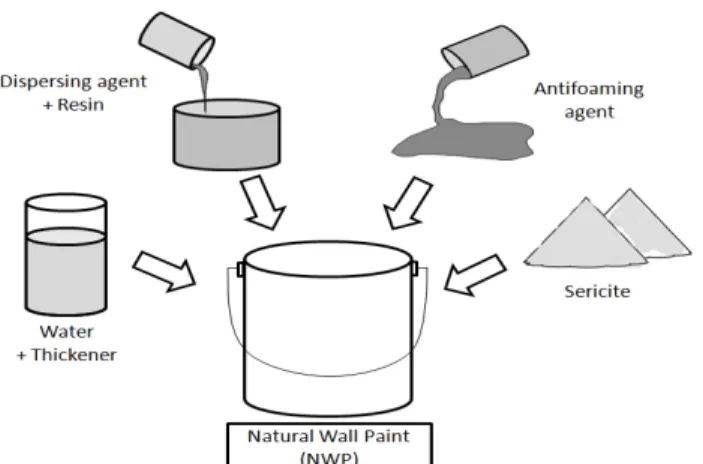
The paint which contains sericite as a major component was pre- pared by simple method. The schematic diagram for the preparation of natural paint is shown in Figure 1.
The process includes four steps and the preparation steps are as fol- lows : Initially, 0.22% thickener solution was prepared by adding an appropriate amount of thickener to definite quantity of water and it was homogeneously mixed. The mixture was continuously stirred and the dispersing agent (0.22%) and resin (5.0%) were added slowly. And then the anti-foaming agent (0.14%) was added. The above mixture was blended with sericite using disper mixer (Woowon mechanics) at around 20 ℃ and the final product obtained is called natural wall paint (NWP). The percentage compositions of all the materials used are giv- en in Table 1.
2.3. Chemical Composition of NWP
The detailed composition of the various materials used in the pre- pared NWP was shown in Table 1. It could be observed from Table 1 that the major composition of the NWP is sericite (54.69%) and wa- ter (39.73%). In general, water-soluble paints consist of 35% of filler, 20% of binder, 3% of pigment, 35 of water and 7% of additive [20,21], but the NWP used in this study is expected to be eco-friendly because it consists of about 5% of natural binder.
2.4. Analysis of pollutants from paint samples
A small test system was set up to analyze the emitted pollutants from the paint samples as shown in Figure 2. The measurement con- ditions are shown in Table 2. Volatile organic compounds (VOCs) in the test chamber were analyzed using KSM ISO 11890-2 : 2007 standards. Indoor air quality testing standards process (MOE Notice No.
Figure 1. Schematic representation for the preparation of natural wall paint (NWP).
Component Content, %
Water 39.73
Sericite 54.69
Thickener 0.22
Dispersing agent 0.22
Antifoaming agent 0.14
Resin 5.00
Table 1. Composition of Materials Used in NWP
2010-24) was used to analyze formaldehyde and the toluene in the pres- ent inside test chamber. NES 713 (Naval Engineering Standard 713) toxic gas detection method was used for the toxicity assessment of the entire paint sample. Further, the NWP was assessed for its capability to remove various pungent compounds such as ammonia (NH3), hydro- gensulfide (H2S), trimethylamine (C3H9N), formaldehyde (HCHO) and methanethiol (CH3SH).
3. Results and Discussion
3.1. Analysis of toxic substances
A small test chamber system was designed to simulate the air circu- lation in the real house. Further, to determine the efficiency of NWP, results were compared with the emission analysis results of two com- mercially available paint products named as paint B and paint C.
3.1.1. Total volatile organic compounds
Total volatile organic compounds (TVOC) analysis showed that trace amount of TVOC was detected in NWP; paint B showed 0.286 mg/m2h, and paint C is 0.555 mg/m2h, respectively. Recommendations based on indoor air quality are 0.5 mg/m2h, where as natural wall paint and paint B are below the standard, where paint C was little beyond the standard. In general majority of the VOC emission was from the organic binder used in the preparation of paint. Compared with com- mercial paints B and C, NWP has exhibited trace amount of TVOC this is because it contains a very low amount VOC. The constituents of Sericite (54%) + water (39%) may include ecofriendly chemicals as well total VOCs analysis data resulted trace amount of VOCs. In addi- tion, Sericite naturally contains K+ ions in interlayer space. It was therefore proposed that electron donor-acceptor complexes between surface electron donor functions and the aromatic compound from VOCs acting as electron acceptor are responsible for the elimination of VOCs.
3.1.2. Toluene and Formaldehyde
The analysis results showed that toluene was not detected in natural wall paint, whereas 0.001 and 0.002 mg/m2h were found to be released from paint B and C, respectively. It is recommended that the amount
of toluene present in indoor air should be less than 1 mg/m2h and the NWP, paint B and paint C were comply with the limits.
Analysis for formaldehyde results showed that formaldehyde was present in trace level in natural wall paint, paint B and paint C (trace, the limit of detection: 0.0001 mg/m2h).
According to the Indoor air quality standards recommended by Korea Ministry of Environment the limit for formaldehyde was 0.12 mg/m2h. The observed concentrations for all the paint samples were significantly lower than the limits thus all the paint samples were con- sidered to be safe in term of formaldehyde discharged.
3.2. Toxicity index and classification of building materials Toxicity index using gas emission concentrations and lethal concen- tration for NWP, paint B, and paint C were 2.2 ppm, 2.4 ppm, and 3.9 ppm, respectively. The MIL (Military Specifications and Standards) according to U.S. Department of Defense standards was 1.5~5 ppm.
From the results it was found that concentration of all three paints were comply with the limits.
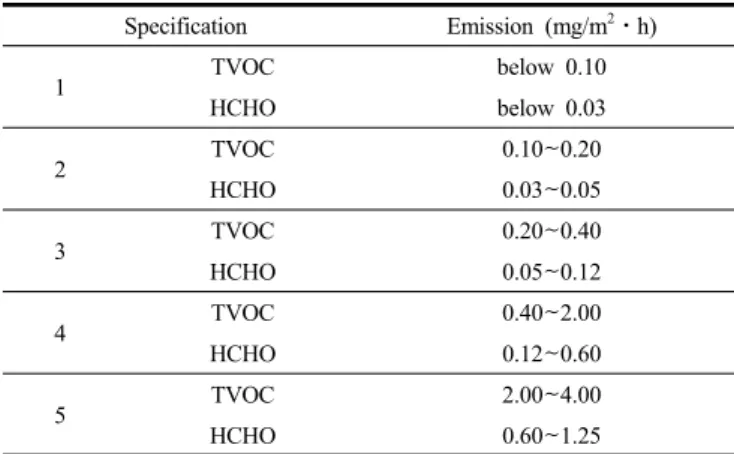
Based on the emission of TVOC and HCHO, building materials have been classified into five categories (Table 3). Table 4 shows the results of toxicant analysis of each paint. The material which emits TVOC below 0.10 ppm and HCHO below 0.03 ppm has been classi- fied into first category material. In case of NWP the emission of TVOC and HCHO were both below the levels of class first specifica- tion thus NWP can be certified as first category paint. Whereas both paint B and paint C were considered as third and fourth category materials.
Figure 2. Schematic diagram of small chamber test system.
Specification Conditions
Temperature 24.7 ℃~25.3 ℃
Relative humidity 47%~53%
Trial period (chamber) 7 days Number of air changes 0.50 times/h
Sample load factor 0.4 m2/m3
Spread 188 g/m2
Table 2. Small Chamber Analysis Condition
Specification Emission (mg/m2⋅h)
1 TVOC below 0.10
HCHO below 0.03
2 TVOC 0.10~0.20
HCHO 0.03~0.05
3 TVOC 0.20~0.40
HCHO 0.05~0.12
4 TVOC 0.40~2.00
HCHO 0.12~0.60
5 TVOC 2.00~4.00
HCHO 0.60~1.25
Table 3. Certification Rating of Building Materials
3.3. Natural wall paint (NWP) as air purifier
In addition to the above studies, NWP was assessed for its capability to remove various compounds such as ammonia (NH3), hydro- gensulfide (H2S), trimethylamine (C3H9N), formaldehyde (HCHO), and methanethiol (CH3SH). These compounds have a pungent odor and possibly cause uncomfortable to human environment even at low level concentrations. A decrease in the concentration of various compounds in presence of NWP as a function of time is shown in Figure 3. It is an interesting to observe that all of the above mentioned compounds were rapidly reduced to extremely low level within a short period of time (approximately 7 h). A similar removal trends were obtained for all the studied compounds except methanethiol. In case of meth- anethiol, the removal was relatively slower and approximately 70 % re- moval was achieved within 24 h. It was observed that sericite and its composites exhibited comparable adsorption capacities for different kinds of pollutants. The complex adsorption mechanism involved in the removal of pollutants likes VOCs and odour with sericite was due to the 1) physical adsorption mechanism, 2) cation exchange mechanism, 3) chemical adsorption mechanism (Lewis acid/base mechanism).
Overall, the studied pungent compounds were efficiently reduced inside the test chamber of NWP and suggest that NWP is useful for maintain- ing the indoor air quality.
4. Conclusion
In this research, eco-friendly paint was developed by utilizing the natural abundant low-cost sericite clay material. The properties of the NWP were assessed in a small test chamber and the results were com- pared with two commercial paints. The results demonstrate that the
amount of VOC released by NWP into the air was insignificant.
Moreover, the other toxic chemicals such as toluene and formaldehyde emitted from NWP were infinitesimally small and below the recom- mended limit. The analyses results of NWP were compared with com- mercial paints and it was observed that NWP was better than commer- cial paints in terms of toxicity index. Therefore, NWP prepared by uti- lizing the natural sericite clay mineral must be an useful paint to main- tain healthy environment for human body.
References
1. H. Nakashima, D. Nakajima, Y. Takagi, and S. Goto, Volatile or- ganic compound (VOC) analysis and anti-VOC measures in wa- ter-based paints, J. Health Sci., 53, 311-319 (2007).
2. C. Yu and D. Crump, A review of the emission of VOCs from polymeric materials used in buildings, Build. Environ., 33, 357-374 (1998).
3. L. Zhong, F. C. Su, and S. Batterman, Volatile organic compounds (VOCs) in conventional and high performance school buildings in the U.S., Int. J. Environ. Res. Public Health, 14(1): 100 (2017).
4. T. M. Stafford, Indoor air quality and academic performance, J.
Environ. Econ. Manag., 70, 34-50 (2015).
5. T. Brock, M. Groteklaes, and P. Mischke, European Coatings Handbook, 412, Vincent Verlag Hannover, Germany (2006).
6. C. Yu and D. Crump, Methods for measuring VOC emission from interior paints, Surf. Coat. Int., 83, 548-556 (2000).
7. H. Guo and F. Murray, Characterization of total volatile organic compound emissions from paints, Clean Prod. Process., 2, 28-36 (2000).
8. Y. M. Kim, S. Harrad, and R. M. Harrison, Concentrations and sour- ces of VOCs in urban domestic and public microenvironments, Environ. Sci. Technol., 35, 997-1004 (2001).
9. J. Xiong, L. Wang, Y. Bai, and Y. Zhang, Measuring the charac- teristic parameters of VOC emission from paints, Build. Environ., 66, 65-71 (2013).
10. A. P. Jones, Indoor air quality and health. Atmos. Environ., 33, 4535-4564 (1999).
11. J. Auvinen and L. Wirtanen, The influence of photocatalytic in- terior paints on indoor air quality, Atmos. Environ., 42, 4101-4112 (2008).
12. N. S. Allen, M. Edge, G. Sandoval, J. Verran, J. Stratton, and J.
Maltby, Photocatalytic coatings for environmental applications.
Photochem. Photobiol., 81, 279-290 (2005).
13. T. Salthammer, F. Fuhrmann, N. Schulz, and N. Siwinksi, Removal of indoor contaminants by photocatalytic reaction. In:
Proceedings of Healthy Buildings 2006, 4-8, Lisbon, Portugal Natural wall paint Paint B Paint C Indoor air quality criteria
TVOC (mg/m2h) trace 0.286 0.555 0.5
Toluene (mg/m2h) ND 0.001 0.002 1
HCHO (mg/m2h) trace trace trace 0.12
Toxicity Index (ppm) 2.2 2.4 3.9 1.5-5
Certification rating for building materials 1 3 4
Table 4. Summary of Test Results
Figure 3. Effect of time on various the toxic substances concentrations using NWP.
(2006).
14. J. Konta, Clay and man: clay raw materials in the service of man, Appl. Clay Sci., 10, 275-335 (1995).
15. Y. S. Perng, E. L. C. Wang, C. C. Lu, and L. S. Kuo, Application of sericite to LWC coatings, TAPPI J., 7, 21-26 (2008).
16. J. O. Kim, S. M. Lee, and C. Jeon, Adsorption characteristics of sericite for cesium ions from an aqueous solution, Chem. Eng..
Res. Des., 92, 368-374 (2014).
17. Y. S. Perng, E. I. C. Wang, C. C. Lu, and L. S. Kuo, Performance of sericite as a pigment for coating paper, Appita Journal: Journal of the Technical Association of the Australian and New Zealand Pulp and Paper Industry, 59, 379-384 (2006).
18. Y. J. Shih and Y. H. Shen, Swelling of sericite by LiNO3-hydro-
thermaltreatment, Appl. Clay. Sci., 43, 282-288 (2009).
19. C. H. Lee, J. W. Roh, C. Y. Lim, J. H. Hong, J. K. Lee, and E.
G. Min, A multicenter, randomized, double-blind, placebo-con- trolled trial evaluating the efficacy and safety of a far infra- red-emitting sericite belt in patients with primary dysmenorrhea, Compliment. Ther. Med., 19, 187-193 (2011).
20. C. K. Sia, S. H. M. Nor, P. Ong, and M. S. C. Othman, Preparation of paint by using palm oil fly ash, pofa based pigment, The 3rd International Conference on Mechanical Engineering Research, Kuantan, Malaysia (2015).
21. The Essential Chemical Industry - On Line, Paints, http://www.es- sentialchemicalindustry.org/materialsandapplications/paints.html (2013).