Print ISSN 1738-3684 / On-line ISSN 1976-3026 OPEN ACCESS DOI 10.4306/pi.2011.8.1.1
ORIGINAL ARTICLE
The Clinical Research Center for Depression Study:
Baseline Characteristics of a Korean Long-Term Hospital-Based Observational Collaborative Prospective Cohort Study
Tae-Suk Kim1,2, Seung Hee Jeong2,3, Jung-Bum Kim2,4, Min-Soo Lee2,5, Jae-Min Kim2,6, Hyeon-Woo Yim2,3 and Tae-Youn Jun1,2
1Departments of Psychiatry, 3Preventive Medicine, The Catholic University of Korea School of Medicine, Seoul, Korea
2Clinical Research Center for Depression, Seoul, Korea
4Department of Psychiatry, Keimyung University School of Medicine, Daegu, Korea
5Department of Psychiatry, College of Medicine, Korea University, Seoul, Korea
6Department of Psychiatry, Chonnam National University Medical School, Gwangju, Korea
ObjectiveaaThe Clinical Research Center for Depression (CRESCEND) study is a 9-year observational collaborative prospective cohort study for the clinical outcomes in participants with depressive disorders in Korea. In this study, we examined the baseline characteristics of the depressive participants as the hospital-based cohort.
MethodsaaParticipants were assessed using various instruments including the Clinical Global Impression scale, 17-item Hamilton De- pression Rating Scale (HDRS-17), Hamilton Anxiety Rating Scale, Brief Psychiatric Rating Scale, Social and Occupational Functioning As- sessment Scale, Beck Depression Inventory-Second Edition, Scale for Suicide Ideation, and World Health Organization Quality of Life as- sessment instruments-abbreviated version. Also, personal histories of medical and psychiatric illnesses and the range of socio-epidemiolo- gic and clinical data were collected from each participant.
ResultsaaOne thousand one hundred eighty three participants were recruited from 18 hospitals. The mean age of the participants was 47.9±15.9 year-old, 74.4% were female, 82.9% had been diagnosed of major depressive disorder, 40.9% were experiencing their first de- pressive episode, and 21.4% had a past history of suicide attempts. The majority (85.3%) of the participants were moderately to severely ill.
The average HDRS-17 was 19.8±6.1. Significant gender differences at baseline were shown in age, education, marriage, employment, re- ligion, and first depressive episode.
ConclusionaaThe baseline findings in the CRESCEND study showed some different characteristics of depression in Korea, suggesting a possibility of ethnic and cultural factors in depression. Psychiatry Investig 2011;8:1-8 Key Wordsaa Depression, Hospital-based, Longitudinal, Observational, Prospective.
INTRODUCTION
Depression [especially, major depressive disorder (MDD)] is a common psychiatric disorder typically associated with signifi- cant suffering, high morbidity and mortality rates, and psycho- social impairment.1 The 12-month prevalence and the lifetime
prevalence rates of MDD are estimated at 6.6% and 16.2%, re- spectively.2,3 However, considering that depression is often un- der-recognized and undertreated in the community,4 the actu- al prevalence of the depression may be much higher.
Depression is associated with a wide range of negative con- sequences, including a significant worsening of comorbid me- dical conditions, a high mortality risk related to suicide, and a socioeconomic burden resulting from functional impairment.5-7 The magnitude of socioeconomic burden and disability asso- ciated with depression is increasing. The World Health Organi- zation (WHO) has reported that by 2020, major depression will be second only to ischemic heart disease as a cause of disabili- ty worldwide. This socioeconomic burden will be even greater in the developing countries, where major depression may be the
Received: June 1, 2010 Revised: August 27, 2010
Accepted: September 7, 2010 Available online: October 7, 2010
Correspondence: Tae-Youn Jun, MD, PhD
Department of Psychiatry, The Catholic University of Korea School of Medicine, 62 Yeouido-dong, Yeongdeungpo-gu, Seoul 150-713, Korea
Tel: +82-2-3779-1250, Fax: +82-2-780-6577, E-mail: [email protected]
cc This is an Open Access article distributed under the terms of the Creative Commons Attribution Non-Commercial License (http://creativecommons.org/licenses/by- nc/3.0) which permits unrestricted non-commercial use, distribution, and reproduc- tion in any medium, provided the original work is properly cited.
leading cause of disability by 2020.8,9
Depression is a clinical syndrome having pronounced hetero- geneity in risk factors, clinical presentation, clinical course, and treatment responsiveness.10 Also its clinical aspects display eth- nic and cultural variations.11 To address the many issues depres- sion presents, a nationwide clinical study, as well as international efforts for consensus regarding depression is needed.
In Korea, depression is also a common psychiatric disorder.
The 12-month prevalence and the lifetime prevalence rates of the MDD are 1.7% and 4.3%, respectively.12 These rates are low- er than those found in the United States2,3 and in European coun- tries,13 and are similar to those in East-Asian countries.14-16 The reported low prevalence of depression in Korea may reflect the fact that there are enormous social stigma attached to depres- sion, ethnic and cultural influences, and methodological differ- ences.11,12,17
Despite the relatively low prevalence of depression, depres- sion has a deep impact on Korean society. The socioeconomic burden of depression in Korea cost over 1.5 billion US dollars in 2004.18 Also, the suicidal rate in Korea is on the increase, up to 26.1 persons per 100,000 people in 2005, which was the high- est position in the Organization for Economic Cooperation and Development (OECD) countries.19 The continuous increase of depression itself and suicide, which is one of the serious out- comes of depression, prompted mental health professionals to thoroughly investigate clinical aspects of depression in Korea.
Unfortunately, up to now, many investigators in Korea have pre- ferred biological or pharmacological studies to clinical studies of depression due to the relatively easy accessibility of the fund- ing and the fact that there is no long-term prospective clinical study for depression with a large cohort in Korea.
The Clinical Research Center for Depression (CRESCEND) study is a long-term (phase 1, 1-year; phase 2, 8-year) observa- tional collaborative prospective cohort study of clinical out- comes in participants with depressive disorders. The primary objective of the CRESCEND study is to investigate the clinical risk factors, courses, and outcomes of depression in the Kore- an society. The secondary objectives include evaluating the changes in the quality of life and the risk of suicide according to the clinical course of depression, as well as the actual social and economic burden of depression, and providing the clinical evidence for the development of Korean-specific diagnostic tools and clinical practice guidelines. The CRESCEND study is the first nationwide long-term observational prospective cohort study investigating actual medical care for depressive disorders to be conducted in Korea. The aims of this article are to intro- duce an overview of the CRESCEND study as well as to provide the baseline socio-epidemiologic and clinical findings of the participants.
METHODS
Study populationFrom January 2006 to August 2008, 1,183 participants were enrolled in the CRESCEND study. The 18 hospitals collaborat- ing in this study included psychiatric departments of 16 univer- sity hospitals and 2 general hospitals from all over Korea. Each hospital completed a predetermined clinical report form of the participants in each visit and recorded the data in the home- page of the CRESCEND (www.smileagain.or.kr) within 2 days.
The inclusion criteria for the study participants were 1) an age over 7 years and 2) a Diagnostic and Statistical Manual of Mental Disorders, Fourth Edition (DSM-IV),20 diagnosis of MDD, dysthymic disorder, or depressive disorder, not other specified (NOS), as determined by a DSM-IV-based structured clinical interview.21 Exclusion criteria were 1) a current or life- time comorbid DSM-IV diagnosis of schizophrenia, other psy- chotic disorders, bipolar disorders, organic psychosis, or demen- tia, and 2) a current or past history of any significant medical and neurological illnesses.
The consent form and the research protocol were approved by the respective university and/or hospital institutional review boards. All participants reviewed the informed consent form and signed in the presence of research staff before participat- ing in the study.
Study design
The CRESCEND study included two phases, I and II, with a total of 9 follow-up years. The phase I study period was 1 year.
In phase I, if the eligible participants entered the study at base- line, each participant visited the hospital and was assessed at 1, 2, 4, 8, 12, 24, and 52 weeks. The phase II study, an extension study from 1 year to 9 years (total 8 years), in which the partici- pants will be evaluated annually.
At baseline, the participants underwent a diagnostic evalu- ation and a retrospective personal history of their medical or psychiatric illnesses and treatment. Also, a variety of socio-ep- idemiologic and clinical data were collected. The clinical, social, and functional outcomes associated with the treatment includ- ing clinician- and self-administered measures were evaluated at each visit.
The clinician-administered measures included the Clinical Global Impression scale (CGI),22 the 17-item Hamilton Depres- sion Rating Scale (HDRS-17),23 the Hamilton Anxiety Rating Scale (HARS),24 the Brief Psychiatric Rating Scale (BPRS),25 and the Social and Occupational Functioning Assessment Scale (SOFAS).20
The CGI, which is widely used of extant brief assessment tolls in psychiatry, is a 7-point observer-rated scale that meas- ures illness severity and global improvement or change. The
HDRS-17 is the most widely used clinical-administered depres- sion assessment scale. Each item pertains to symptoms of de- pression experienced over the past week. The HARS is a 14-item clinician-administered rating scale and provides an overall measure of the severity of global anxiety including psychic and somatic symptoms. The BPRS is an 18-item clinician-rated tool designed to assess change in severity of psychopathology. The items of the BPRS focus on symptoms that are common in psy- chotic disorder including schizophrenia and other psychotic disorders as well as those found in severe mood disorders. The SOFAS is a 100-point, single-item scale that rates functioning on a hypothetical continuum of mental health to mental illness.
It focused on the individual’s level of social and occupational functioning and is not directly influenced by psychological sy- mptoms.
The self-administered measures consisted of the Beck De- pression Inventory-Second Edition (BDI-II),26 the Scale for Sui- cide Ideation (SSI),27 and the World Health Organization Qual- ity of Life assessment instruments-abbreviated version (WHO- QOL-BREF).28
The BDI-II a 21-item self-report instrument intended to as- sess the existence and severity of symptoms of depression. It was revised in 1996 to be more consistent with DSM-IV criteria for depression than the original BDI. The SSI is a 21-item, 3-point Likert self-administered scale that asks about suicide ideation during the past week. The severity of suicide ideation is calcu- lated by summing the rating for the first 19 items. The WHO- QOL-BREF is a 26-item instrument to assess the quality of life, which measures the following broad domains: physical health, psychological health, social relationships, and environment. It is a shorter version of the original WHOQOL that may be more convenient for use.
Twice a year, the raters in each individual hospital participat- ed in formal consensus meetings concerning the use of the rat- er-administered assessment instruments including the HDRS- 17, the HARS, the BPRS, and the SOPAS. The consensus meet- ings consisted of an observation of the administration of the evaluations by an experienced supervisory psychiatrist and an actual administration via videotapes featuring standard MDD patients with or without psychotic features.
Statistical analysis
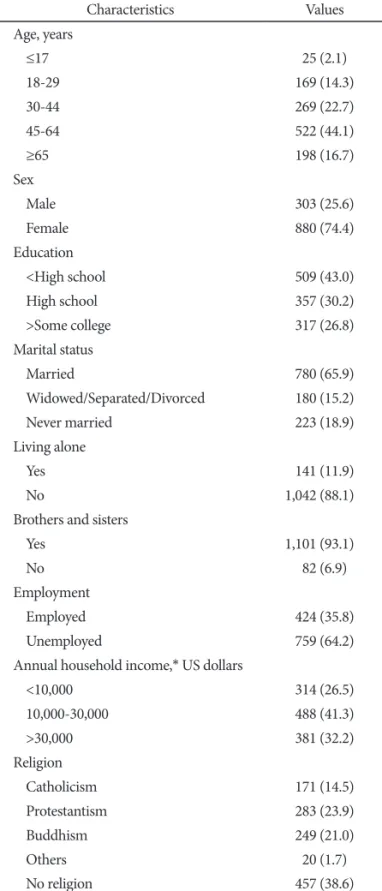
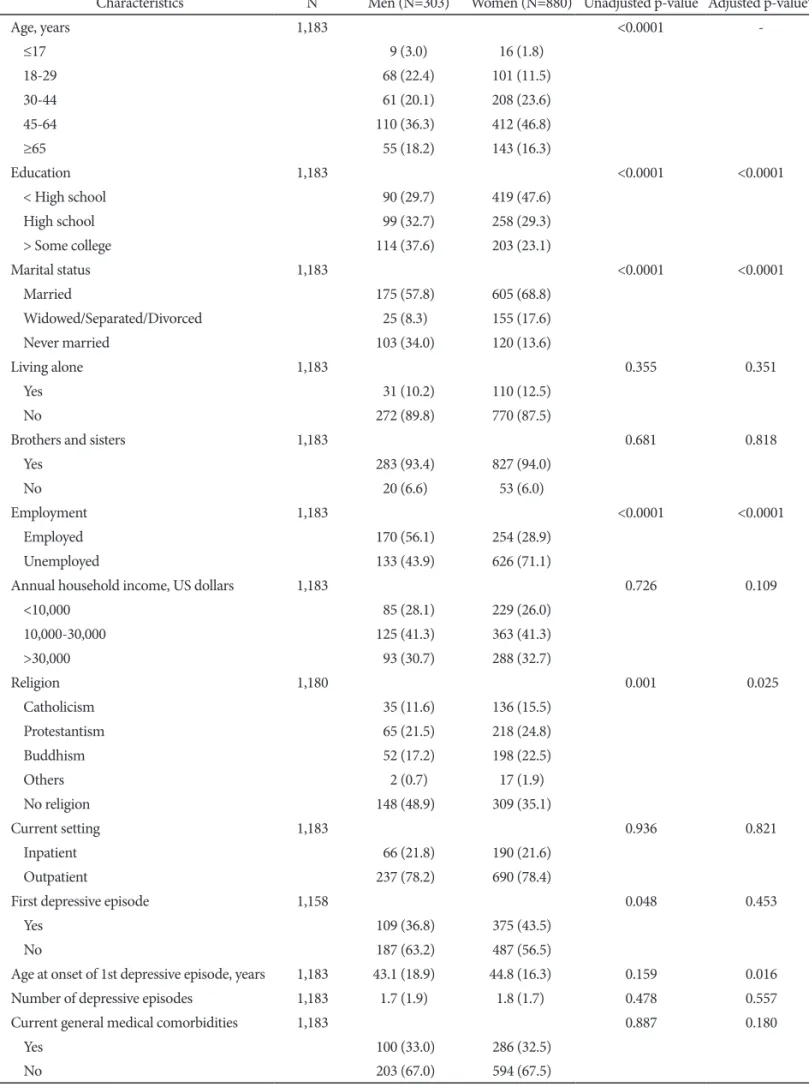
All data were presented as number (percentage) for categor- ical variables and as mean (standard deviation) for continuous variables. Descriptive statistics were used to characterize the study participants at baseline in Table 1 and 2. In Table 3, the chi-square test and unpaired t-test were conducted to compare the categorical and the continuous variables, respectively, be- tween men and women. Also, to adjust for the differences in age between men and women, multivariate logistic regression and
analysis of covariance methods were used for the categorical and the continuous variables, respectively. The statistical sig- nificance for all tests was set at p<0.05. All statistical analyses were conducted using Statistical Analysis System (SAS), ver- sion 9.1 (SAS Institute Inc., Cary, NC).
Table 1. Socioepidemiologic characteristics at baselin
Characteristics Values
Age, years
≤17 25 (2.1)
18-29 169 (14.3)
30-44 269 (22.7)
45-64 522 (44.1)
≥65 198 (16.7)
Sex
Male 303 (25.6)
Female 880 (74.4)
Education
<High school 509 (43.0)
High school 357 (30.2)
>Some college 317 (26.8)
Marital status
Married 780 (65.9)
Widowed/Separated/Divorced 180 (15.2)
Never married 223 (18.9)
Living alone
Yes 141 (11.9)
No 1,042 (88.1)0.
Brothers and sisters
Yes 1,101 (93.1)0.
No 82 (6.9)
Employment
Employed 424 (35.8)
Unemployed 759 (64.2)
Annual household income,* US dollars
<10,000 314 (26.5)
10,000-30,000 488 (41.3)
>30,000 381 (32.2)
Religion
Catholicism 171 (14.5)
Protestantism 283 (23.9)
Buddhism 249 (21.0)
Others 20 (1.7)
No religion 457 (38.6)
*cutoffs of 10,000 and 30,000 US dollars mean the approximate min- imum and average costs of a family of 4 members, respectively, in 2006 in Korea (National Statistics Office, 2007)
RESULTS
Sociodemographic characteristics
A total of 1,183 participants with depression were enrolled in this study. The sociodemographic characteristics of the par- ticipants at baseline are shown in Table 1. The mean±standard deviation of age and education levels in all participants were 47.9±15.9 year-old and 10.4±4.5 years, respectively. The age ranged between 11 and 83 years old. Fifty-nine participants (5.0%) were not educated at all. Overall, more women (74.4%) than men participated in the study. Among the 780 married par- ticipants, only 12 persons (1.5%) had remarried. Fifty-nine per- sons (6.1%) had no children among 960 participants who had been married. Nine hundred eighty-one participants (82.9%)
had a diagnosis of MDD according to the DSM-IV criteria, among which only 24 persons had psychotic features at base- line. The participants who were diagnosed with dysthymic dis- order or depressive disorder, NOS at baseline, were 38 (3.2%) and 164 (13.9%) persons, respectively.
Clinical characteristics
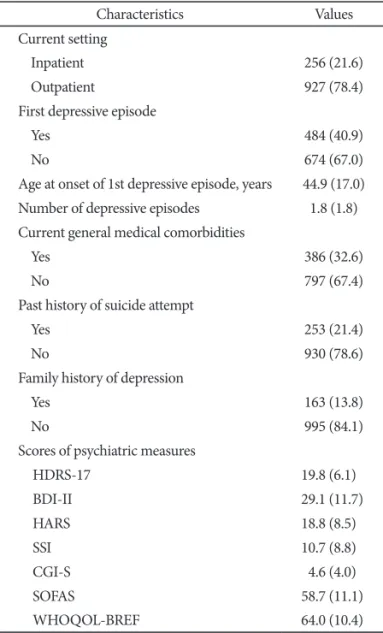
The clinical characteristics of the participants at baseline were summarized in Table 2. At baseline, most of the partici- pants (83.8%) took one or more antidepressant medications.
Forty-eight participants (4.1%) had 5 or more depressive epi- sodes. The youngest and oldest ages of onset of the first depres- sive episode were 10 and 83 years old, respectively. The most fre- quent medical comorbidity was hypertension (178 persons, 15.0%). In the participants who had a past history of suicide at- tempts (253 persons, 21.4%), the mean±standard deviation number of suicide attempts and age at first suicide attempt were 2.1±2.7 and 31.0±13.8 year-old, respectively. Two hundred eigh- ty participants (23.7%) had experienced adverse life events be- fore the age of twelve, such as the death of the siblings and par- ents, sexual or physical abuse, the separation/divorce or econo- mic crisis of the parents, natural disaster, and bullying.
Overall, the participants were moderately to severely ill (1,009 persons, 85.3%), based on CGI-severity. Only 29 depressive participants (2.5%) were in the remission state (HDRS-17 ≤7) at baseline. The mean±standard deviation scores of CGI-severi- ty in MDD, dysthymic disorder and depressive disorder NOS were 4.7±1.0, 3.8±1.0, and 4.4±1.0, respectively. Also, the mean±
standard deviation scores of HRDS-17 among the three groups were 20.2±6.0, 16.5±5.7, and 18.2±6.0, respectively.
Gender differences
Table 3 summarized gender differences with respect to the socioepidemiologic and clinical characteristics of the depressive participants at baseline. The mean age for women (48.8 years) was higher than that for men (45.5 years)(unadjusted p<0.0001).
The gender groups differed in terms of education group (p<
0.0001, adjusted for age). Women had fewer years of education (9.9 years) than men (11.9 years)(p<0.0001, adjusted for age).
There was a significant gender difference in marital status (p<
0.0001, adjusted for age). Widowed, separated, or divorced wom- en were more than 7 times as prevalent in this sample as men hav- ing the same status. Employment status differed by gender (p<
0.0001, adjusted for age). Among the unemployed women, 466 women (74.4%) were housewives. There was a significant differ- ence in religion status by gender (p=0.025, adjusted for age): more men (48.9%) than women (35.1%) indicated a lack of religious beliefs.
The proportion of women (78.4%) and men (78.2%) who were recruited from the outpatient setting were similar. Women who Table 2. Clinical characteristics at baseline
Characteristics Values
Current setting
Inpatient 256 (21.6)
Outpatient 927 (78.4)
First depressive episode
Yes 484 (40.9)
No 674 (67.0)
Age at onset of 1st depressive episode, years 44.9 (17.0) Number of depressive episodes 1.8 (1.8) Current general medical comorbidities
Yes 386 (32.6)
No 797 (67.4)
Past history of suicide attempt
Yes 253 (21.4)
No 930 (78.6)
Family history of depression
Yes 163 (13.8)
No 995 (84.1)
Scores of psychiatric measures
HDRS-17 19.8 (6.1) 0
BDI-II 29.1 (11.7).
HARS 18.8 (8.5) 0
SSI 10.7 (8.8) 0
CGI-S 4.6 (4.0).
SOFAS 58.7 (11.1).
WHOQOL-BREF 64.0 (10.4).
HDRS-17: 17-item Hamilton Depression Rating Scale, BDI-II: Beck Depression Inventory-Second Edition, HARS: Hamilton Anxiety Rating Scale, SSI: Scale for Suicide Ideation, CGI-S: Clinical Global Impression scale–Severity, SOFAS: Social and Occupational Func- tioning Assessment Scale, WHOQOL-BREF: World Health Orga- nization Quality of Life assessment instruments-abbreviated version
Table 3. Gender differences of the baseline characteristics
Characteristics N Men (N=303) Women (N=880) Unadjusted p-value Adjusted p-value*
Age, years 1,183 <0.0001 -
≤17 9 (3.0) 16 (1.8)
18-29 68 (22.4) 101 (11.5)
30-44 61 (20.1) 208 (23.6)
45-64 110 (36.3)0 412 (46.8)
≥65 55 (18.2) 143 (16.3)
Education 1,183 <0.0001 <0.0001
< High school 90 (29.7) 419 (47.6)
High school 99 (32.7) 258 (29.3)
> Some college 114 (37.6)0 203 (23.1)
Marital status 1,183 <0.0001 <0.0001
Married 175 (57.8)0 605 (68.8)
Widowed/Separated/Divorced 25 (8.3)0 155 (17.6)
Never married 103 (34.0)0 120 (13.6)
Living alone 1,183 0.355 0.351
Yes 31 (10.2) 110 (12.5)
No 272 (89.8)0 770 (87.5)
Brothers and sisters 1,183 0.681 0.818
Yes 283 (93.4)0 827 (94.0)
No 20 (6.6)0 53 (6.0)
Employment 1,183 <0.0001 <0.0001
Employed 170 (56.1)0 254 (28.9)
Unemployed 133 (43.9)0 626 (71.1)
Annual household income, US dollars 1,183 0.726 0.109
<10,000 85 (28.1) 229 (26.0)
10,000-30,000 125 (41.3)0 363 (41.3)
>30,000 93 (30.7) 288 (32.7)
Religion 1,180 0.001 0.025
Catholicism 35 (11.6) 136 (15.5)
Protestantism 65 (21.5) 218 (24.8)
Buddhism 52 (17.2) 198 (22.5)
Others 2 (0.7) 17 (1.9)
No religion 148 (48.9)0 309 (35.1)
Current setting 1,183 0.936 0.821
Inpatient 66 (21.8) 190 (21.6)
Outpatient 237 (78.2)0 690 (78.4)
First depressive episode 1,158 0.048 0.453
Yes 109 (36.8)0 375 (43.5)
No 187 (63.2)0 487 (56.5)
Age at onset of 1st depressive episode, years 1,183 43.1 (18.9)0. 44.8 (16.3). 0.159 0.016
Number of depressive episodes 1,183 1.7 (1.9)0. 1.8 (1.7). 0.478 0.557
Current general medical comorbidities 1,183 0.887 0.180
Yes 100 (33.0)0 286 (32.5)
No 203 (67.0)0 594 (67.5)
had experienced their first depressive episode at baseline were more prevalent in this sample than men, but it was not signif- icantly different after adjusting for age (p=0.453). Men had a so- mewhat earlier onset of their first depressive episode (mean of 43.1 years) than women (mean of 44.8 years, p= 0.016, adjusted for age). The proportions of women and men with respect to the number of depressive episodes and the presences of current gen- eral medical comorbidities, past history of suicide attempts, and family history of depression were similar. Also, mean scores of in- dividual psychiatric measures at baseline did not differ by gen- der in this study.
DISCUSSION
The CRESCEND study is the first long-term prospective col- laborative observational cohort study investigating the natural course and outcome of depressive patients to be conducted in Korea. The participants were enrolled in 18 hospitals from all over Korea and the distribution of participated hospitals reflect- ed the spread of population in Korea. Though a number of nat- uralistic cohort studies of depression have been conducted all over the world (especially in the Western world), there are still numerous questions about the clinical and socioeconomic out- comes resulting from actual clinical and medical practices for depression; the results of those studies are difficult to extend to Eastern societies given broad ethnic and cultural differences.
The CRESCEND study was designed to investigate the more long-term comprehensive outcomes of depression in order to overcome the limitations stated above. In this report we have
described the research methodology of the CRESCEND study and reported the baseline findings from the depressive samples.
Some interesting baseline findings were found in the CRE- SCEND study.
Though the age distribution of this study was statistically nor- mal, the child and adolescent depressive participants (≤17 year- old) were very few (2.1%), but the proportion of geriatric depres- sive participants (≥65 year-old) was relatively high (16.7%).
This finding may be an artifact of methodological problems for specific age groups such as parental reluctance to permit chil- dren to participate in the study and indirectly, reflection of re- cent lower birth rate and more increased aged population in Korea. The female prevalence in this study was 74.4%. The gen- der ratio of 2.9 seen in women vs. men willing to enroll in this study is higher than that of several previous reports,2,29,30 but similar to that reported in the Korean Epidemiologic Catchment Area study.12 Though a higher female prevalence in depression study may indicate that women have greater tendency to seek treatment, or greater willingness to participate in the study,29 this finding may be influenced by the actual gender prevalence of de- pression in Korea. However, the ethnic or cultural differences of a heightened stigma of depression among men could be also considered.11
Several distinctive clinical findings of depression at baseline were revealed in the CRESCEND study. First, the mean age at onset of the first depressive episode in this study was 44.9 years old, which is higher than that of previous studies.31-33 Textbooks typically suggest a mean age of onset for depression of about 40 years. Considering that the mean age of enrolled participants Table 3. Continued
Characteristics N Men (N=303) Women (N=880) Unadjusted p-value Adjusted p-value*
Past history of suicide attempt 1,183 0.745 0.583
Yes 67 (22.1) 186 (21.1)
No 236 (77.9)0 694 (78.9)
Family history of depression 1,158 0.846 0.770
Yes 40 (13.5) 123 (14.3)
No 256 (86.5)0 739 (85.7)
Scores of psychiatric measures
HDRS-17 1,183 19.8 (6.3)00. 19.8 (6.0).0 0.877 0.476
BDI-II 1,037 29.1 (12.3)0. 29.1 (11.5). 0.994 0.729
HARS 1,183 18.5 (8.8)00. 18.9 (8.5).0 0.516 0.919
SSI 0.990 11.5 (9.3)00. 10.4 (8.6).0 0.089 0.412
CGI-S 1,183 4.6 (1.1)0. 4.6 (1.0). 0.281 0.592
SOFAS 1,152 57.6 (12.0)0. 59.0 (10.8). 0.075 0.034
WHOQOL-BREF 0.998 63.9 (11.3)0. 64.0 (10.1). 0.866 0.882
*adjusted for age. HDRS-17: 17-item Hamilton Depression Rating Scale, BDI-II: Beck Depression Inventory-Second Edition, HARS: Hamil- ton Anxiety Rating Scale, SSI: Scale for Suicide Ideation, CGI-S: Clinical Global Impression scale–Severity, SOFAS: Social and Occupational Functioning Assessment Scale, WHOQOL-BREF: World Health Organization Quality of Life assessment instruments-abbreviated version
was 47.9, which is also higher, compared to the previous stud- ies, this finding may reflect a fact of depression in Korea. How- ever, problems of the participants related to inadequate infor- mation and the social stigma about depression in the Korean society should not be overlooked. Second, among 1,183 depres- sive participants, 21.6% had a past history of one or more self- reported suicide attempts. This is higher than the prevalence of 16.5% found in the Sequenced Treatment Alternatives to Relieve Depression (STAR*D) study.34 The difference at base- line in the history of suicide attempts between the two studies may be mainly due to sampling procedures and settings, but it should be emphasized that Koreans have the highest rate of sui- cide among OECD countries. Thirdly, the prevalence of a fam- ily history of depression in this study was only 13.8%, which is lower than that of the previous studies.35,36 The family history of depression is an important factor for predicting the likeli- hood of a person having depression as well as the severity and outcome of depression.37 Some possible explanations of this find- ing may be 1) no use of a structured interview form to determine family history of depression, 2) lack of reliable information of depression in the participants’ family, and 3) unwillingness to expose the history of familial depression due to the cultural stig- ma of depression.
In these baseline results, some gender differences noted among the depressive participants in socioepidemiologic data (e.g., high- er education level in males, higher employment in males, and higher religion-seeking tendency in females) may be influenced in part by cultural gender differences in current Korean society.
These findings were inconsistent compared to Western coun- tries.29,38 Interestingly, no gender difference adjusted for age in past history of suicide attempts was found in this study. One of the most consistent research findings in the literature on sui- cide is that men have higher suicide rates than women, even th- ough women make more suicide attempts than men.39 In Ko- rea, one person every 90 seconds attempted suicide regardless of actual suicide success in 2003.40 This finding reflects the rel- ative increase of suicide attempts in Korean depressive men, which might be related to increased psychosocial stress in men directly influenced by the recent economic crisis in Korea.41
This study has several limitations. While the cross-sectional observational methodology is useful for the better understand- ing of real-life clinical practice, there are limitations on the caus- al inferences that can be drawn due to uncontrollable confound- ing factors, selection bias, and reverse causality. Though the results of this study were cross-sectional and observational, the CRESCEND study itself was designed as a prospective cohort study. Thus, further analyses of the longitudinal data may over- come several limitations. In this study, nearly three-fourths of participants with depression were enrolled from outpatient set- tings. This fact may have resulted in a selection bias that influ-
enced findings of symptom severity, the presence of psychotic symptoms, and the frequency of subtypes of depression includ- ing dysthymic disorder and depressive disorder NOS. Only 2.0 percent of depressive participants, all of whom were enrolled from the inpatient setting, had psychotic features. However, the differences in depressive symptom severity at baseline between inpatients and outpatients were not significant in this study.
The CRESCEND study is the first long-term hospital-based prospective collaborative observational cohort study investigat- ing the in situ course and outcome of depressive participants to be conducted in Korea. In this cohort study, we will investigate the Korean-specific characteristics of depression including psy- chopathology, risk factors, clinical courses, and prognosis and establish the clinical evidences to develop the clinical practice guidelines for depression in the Korean society. A series of the results from the CRESCEND study will provide valuable infor- mation about real-life clinical practices for depression in Korea as well as the ethnic and cultural differences in depression be- tween the East and the West.
Acknowledgments
This research was supported by a grant of the Korea Health 21 R&D, Min- istry of Health and Welfare, Republic of Korea (A050047).
The list of 16 university hospitals and 2 general hospitals which participate in the CRESCEND study is below;
Affiliated hospitals of the Catholic University of Korea (Seoul St. Mary’s Hospital, Seoul; St. Mary’s Hospital, Seoul; Uijeongbu St. Mary’s Hospital, Ui- jeongbu; Incheon St. Mary’s Hospital, Incheon; St. Vincent’s Hospital, Suwon);
Chonnam National University Hospital, Gwangju; Chonnam National Uni- versity Hwasun Hospital, Hwasun; Chosun University Hospital, Gwangju;
Hanyang University Hospital, Guri; Inje University Pusan Paik Hospital, Bu- san; Kangwon National University Hospital, Chuncheon; Keimyung Univer- sity Dongsan Medical Center, Daegu; Korea University Anam Hospital, Seoul;
Sunchunhyang University Bucheon Hospital, Bucheon; Sunchunhyang Uni- versity Hospital, Seoul; Sungkyunkwan University Kangbuk Samsung Hos- pital, Seoul; Bongseng Memorial Hospital, Busan; Maryknoll Medical Cen- ter, Busan.
REFERENCES
1. Fava M, Cassano P. Mood Disorders: major depressive disorder and dys- thymic disorder. In: Stern TA, Rosenbaum JF, Fava M, Biederman J, Rauch SL, editors. Massachusetts General Hospital Comprehensive Clinical Psychiatry. Philadelphia: Mosby, 2008, p.391-398.
2. Kessler RC, Berglund P, Demler O, Jin R, Koretz D, Merikangas KR, et al. The epidemiology of major depressive disorder: results from the Na- tional Comorbidity Survey Replication (NCS-R). JAMA 2003;289:3095- 3105.
3. Kessler RC, Berglund P, Demler O, Jin R, Merikangas KR, Walters EE.
Lifetime prevalence and age-of-onset distributions of DSM-IV disor- ders in the National Comorbidity Survey Replication. Arch Gen Psychiatry 2005;62:593-602.
4. Gelenberg A. Depression is still underrecognized and undertreated. Arch Intern Med 1999;159:1657-1658.
5. Bostwick JM, Pankratz VS. Affective disorders and suicide risk: a reex- amination. Am J Psychiatry 2000;157:1925-1932.
6. Greenberg PE, Kessler RC, Birnbaum HG, Leong SA, Lowe SW, Ber- glund PA, et al. The economic burden of depression in the United States:
how did it change between 1990 and 2000? J Clin Psychiatry 2003;64:
1465-1475.
7. Katon WJ. Clinical and health services relationships between major de- pression, depressive symptoms, and general medical illness. Biol Psychi- atry 2003;54:216-226.
8. Murray CJ, Lopez AD. Global mortality, disability, and the contribution of risk factors: Global Burden of Disease Study. Lancet 1997;349:1436- 1442.
9. Murray CJ, Lopez AD. Alternative projections of mortality and disabili- ty by cause 1990-2020: Global Burden of Disease Study. Lancet 1997;349:
1498-1504.
10. Rush AJ. The varied clinical presentations of major depressive disorder.
J Clin Psychiatry 2009;68 Suppl 8:4-10.
11. Ballenger JC, Davidson JR, Lecrubier Y, Nutt DJ, Kirmayer LJ, Lépine JP, et al. Consensus statement on transcultural issues in depression and anxiety from the International Consensus Group on Depression and An- xiety. J Clin Psychiatry 2001;62 Suppl 13:47-55.
12. Cho MJ, Kim JK, Jeon HJ, Suh T, Chung IW, Hong JP, et al. Lifetime and 12-month prevalence of DSM-IV psychiatric disorders among Ko- rean adults. J Nerv Ment Dis 2007;195:203-210.
13. Alonso J, Angermeyer MC, Bernert S, Bruffaerts R, Brugha TS, Bryson H, et al. Prevalence of mental disorders in Europe: results from the Eu- ropean Study of the Epidemiology of Mental Disorders (ESEMeD) proj- ect. Acta Psychiatr Scand Suppl 2004;21-27.
14. Chen CN, Wong J, Lee N, Chan-Ho MW, Lau JT, Fung M. The Shatin community mental health survey in Hong Kong. II. Major findings. Arch Gen Psychiatry 1993;50:125-133.
15. Hwu HG, Chang IH, Yeh EK, Chang CJ, Yeh LL. Major depressive disor- der in Taiwan defined by the Chinese diagnostic Interview Schedule. J Nerv Ment Dis 1996;184:497-502.
16. Kawakami N, Shimizu H, Haratani T, Iwata N, Kitamura T. Lifetime and 6-month prevalence of DSM-III-R psychiatric disorders in an urban community in Japan. Psychiatry Res 2004;121:293-301.
17. Chang SM, Sohn JH, Lee JY, Choi JH, Cho SJ, Jeon HJ, et al. Character- stics and diagnostic criteria for depression in Korea. J Korean Neuropsy- chiatr Assoc 2007;46:447-452.
18. Jung SH. The socioeconomic burden of suicide and depression in Korea.
Seoul, Korea: National Center for Mental Health Research and Educa- tion; 2005.
19. Korea National Statistical Office. Annual report on the cause of death sta- tistics of 2005. Seoul, Korea; 2006.
20. American Psychiatric Association. Diagnostic and Statistical Manual of Mental Disorders, 4th edition (DSM-IV). Washington, DC: American Psy- chiatric Press; 1994.
21. First MB, Spitzer RL, Gibbon M, Williams JB. User’s Guide for the Struc- tured Clinical Interview for DSM-IV Axis I Disorders Research Version (SCID-I). New York: New York State Psychiatric Institute, Biometrics Re- search; 1996.
22. Guy W. ECDEU Assessment Manual for Psychopharmacology, Revised, Rockville: National Institute of Mental Health; 1976.
23. Hamilton MA. A rating scale for depression. J Neurol Neurosurg Psychi- atry 1960;23:56-62.
24. Hamilton MA. The assessment of anxiety states by rating. Br J Med Psy- chol 1959;32:50-55.
25. Overall JE, Gorham DR. The Brief Psychiatric Rating Scale. Psychol Rep 1962;10:779-812.
26. Beck AT, Steer RA, Brown GK. Manual for the Beck Depression In- ventory-II. San Antonio, Tx: Psychological Corporation; 1996.
27. Beck AT, Kovacs M, Weissman M. Assessment of suicidal intention:
The Scale for Suicide Ideation. J Consult Clin Psychol 1979;47:343-352.
28. The WHOQOL Group. Development of the World Health Organization WHOQOL-BREF quality of life assessment. The WHOQOL Group. Psy- chol Med 1998;28: 551-558.
29. Marcus SM, Young EA, Kerber KB, Kornstein S, Farabaugh AH, Mitch- ell J, et al. Gender differences in depression: findings from the STAR*D study. J Affect Disord 2005;87:141-150.
30. Weissman MM, Bland RC, Canino GJ, Faravelli C, Greenwald S, Hwu HG, et al. Cross-national epidemiology of major depression and bipolar disorder. JAMA 1996;276:293-299.
31. Akerblad AC, Bengtsson F, von Knorring L, Ekselius L. Response, remis- sion and relapse in relation to adherence in primary care treatment of de- pression: a 2-year outcome study. Int Clin Psychopharmacol 2006;21:
117-124.
32. Eaton WW, Shao H, Nestadt G, Lee HB, Bienvenu OJ, Zandi P. Popu- lation-based study of first onset and chronicity in major depressive dis- order. Arch Gen Psychiatry 2008;65:513-520.
33. Rush AJ, Trivedi MH, Wisniewski SR, Nierenberg AA, Stewart JW, Warden D, et al. Acute and longer-term outcomes in depressed outpa- tients requiring one or several treatment steps: a STAR*D report. Am J Psychiatry 2006;163:1905-1917.
34. Claassen CA, Trivedi MH, Rush AJ, Husain MM, Zisook S, Young E, et al. Clinical differences among depressed patients with or without a his- tory of suicide attempts: findings from the STAR*D trial. J Affect Disord 2007;97:77-84.
35. Husain MM, Rush AJ, Wisniewski SR, McClintock SM, Fava M, Nieren- berg AA, et al. Family history of depression and therapeutic outcome:
findings from STAR*D. J Clin Psychiatry 2009;70:185-195.
36. Sullivan PF, Wells JE, Joyce PR, Bushnell JA, Mulder RT, Oakley-Browne MA. Family history of depression in clinic and community samples. J Af- fect Disord 1996;40:159-168.
37. Weissman MM, Merikangas KR, Wickramaratne P, Kidd KK, Prusoff BA, Leckman JF, et al. Understanding the clinical heterogeneity of major depression using family data. Arch Gen Psychiatry 1986;43:430-434.
38. Dekker J, Koelen JA, Peen J, Schoevers RA, Gijsbers-van Wijk C. Gender differences in clinical features of depressed outpatients: preliminary evi- dence for subtyping of depression? Women Health 2007;46:19-38.
39. Kerkhof A. Attempt suicide: patterns and trends. In: Hawton K, Van Heer- ingen K, editors. The International Handbook of Suicide and Attempt- ed suicide. Chichster: John & Wiley & Sons Ltd, 2000, p.49-64.
40. Lee DW, Kim MS, Lee MS. Community psychiatry approach to suicide prevention. Psychiatry Investig 2006;3:51-56.
41. Khang YH, Lynch JW, Kaplan GA. Impact of economic crisis on cause- specific mortality in South Korea. Int J Epidemiol 2005;34:1291-1301.