K.-W. Lee ・ K.-H. Kim ・ B.-H. Lee ( ) 경상대학교 응용생명과학부, 농업생명과학연구원
(Division of Applied Life Science (BK21), Institute of Agriculture and Life Science, Gyeongsang National University) e-mail: [email protected]
K.-W. Lee ・ S.-H. Lee
농촌진흥청 국립축산과학원 초지사료과
(Grassland & Forages Division, National Institute of Animal Science, RDA)
형질전환 톨 페스큐 개발의 최근 동향
이기원 ・ 이상훈 ・ 김경희 ・ 이병현
Recent advance in genetic transformation of tall fescue
Ki-Won Lee ・ Sang-Hoon Lee ・ Kyung-Hee Kim ・ Byung-Hyun Lee
Received: 27 November 2009 / Accepted: 5 December 2009
ⓒ Korean Society for Plant Biotechnology
Abstract Tall fescue is an open-pollinated, perennial, cool season grass species widely used for forage and turf. Tre- mendous progress has been made in genetic transformation of tall fescue in the past decade. Methods for generating transgenic tall fescue plants have been developed based on biolistic transformation and Agrobacterium-mediated trans- formation. Potentially useful agronomic genes have been tested to environmental stress tolerance, herbicide tolerance and improve forage quality in tall fescue plants. We review progress in biotechnological improvement of tall fescue and discuss future molecular breeding of this species.
Keywords Tall fescue, genetic transformation, molecular breeding, transgenic plants
서 론
톨 페스큐 (Festuca arundinacea Schreb.)는 기온이 15~
21℃ 정도인 아시아 온대지역, 유럽 및 북아메리카 등에 서 잘 자라는 다년생의 한지형 화본과 작물로서 절개지, 사방공사, 공원, 골프장 등에 있어서 토양보존용 및 잔디 용으로도 많이 개발되어 이용되고 있는 초종 중에 하나 이다 (Buckner et al. 1979). 톨 페스큐는 척박한 토양, 습지
및 음지에서도 잘 생장하며, 다양한 환경 스트레스에도 비교적 잘 적응하여 우리나라에서는 주로 초지조성에 이 용되고 있는 주요한 사료작물에 속한다. 그러나 이러한 환경적응성의 우수함에도 불구하고 여름철 기온이 25℃
이상의 고온이 장기간 지속될 때에는 생육이 정지하는 하고현상을 일으켜 사료의 품질저하와 생산성이 감소되 는 것으로 알려져 있다 (Fieser and Vanzant 2004). 또한 톨 페스큐는 다른 화본과 사료작물에 비하여 잎이 거칠어서 가축이 즐겨 채식하지 않아 기호성이 낮으며, 특히 출수 기 이후에는 사료가치가 급격히 저하되는 등의 단점이 있다 (Fieser and Vanzant 2004). 이러한 단점을 보완하기 위해 전 세계적으로도 선발과 교잡을 통하여 톨 페스큐 의 품질을 높이고자 하는 전통적인 육종법에 의한 연구 가 활발히 진행되고 있으며 (Sleper 1985; Van Wijk et al.
1993), 지금까지 국내에서는 외국에서 도입한 품종을 이 용하고 있었으나, 최근 농촌진흥청 국립축산과학원에서 관행의 전통육종방법을 이용하여 국내 최초로 톨 페스큐
‘그린마스터’ 신품종을 육성하여 농가 공급을 위한 종자 를 증식 중에 있다. 그러나 톨 페스큐와 같은 대부분의 화본과 목초들은 자가불화합성 특성으로 인해 종래의 관 행 육종방법을 이용하여 신품종을 개발하는 것은 넓은 공간과 오랜 시간이 소요되어 현실적으로 많은 어려움이 있다.
최근에는 목초 또는 사료작물로의 유용유전자의 도입 에 의한 분자육종법을 통한 신품종 개발 연구가 많이 시 도되고 있다 (Spangenberg et al. 1998).
따라서 본 논문에서는 전 세계적으로 활발하게 추진되 고 있는 대표적인 화본과 목초인 톨 페스큐의 국내외 연 구동향, 주요 연구결과 및 향후 전망에 대해 살펴보고자 한다.
DOI:10.5010/JPB.2009.36.4.336
Review
Fig. 1 Plant regeneration from mature seed-derived callus of tall fescue. (A) Calli induced from mature seeds cultured on the callus induction medium. (B) Embryogenic callus formed from a seed. (C) and (D) Plant regeneration from embryogenic calli in the regeneration medium. (E) Plantlets cultured in the rooting medium.
(F) and (G) Whole plants grown in pots under green house
톨 페스큐 조직배양에 관한 연구 동향
형질전환 기술을 이용한 신품종 톨 페스큐를 개발하기 위해서는 우선 효율적인 조직배양체계가 확립되어 있어 야 하며 이는 매우 중요한 핵심기술이다. 식물의 조직배 양기술은 우량종묘 생산, 유용물질 생산, 유용유전자 도 입을 통한 저항성 및 기능성 신품종 개발 등의 목적으로 널리 이용되고 있다 (Doran 2000). 조직배양 기술에 의한 식물체 재분화 효율은 초종에 따라 큰 차이를 보이며 동 일한 초종에서도 품종, 배양 조직, 식물생장조절물질의 종류와 농도, 배양 배지에 첨가되는 물질에 따라 많은 차 이가 있다 (Somers et al. 2003; Zhang and Rouf Mian 2003).
지금까지 톨 페스큐의 조직배양에 관한 연구는 성숙배 (Lowe and Conger 1979), 미숙배 (Bai and Qu 2000), 미성숙 화서 (Eizanga and Dahleen 1990) 등을 이용한 식물체 재분 화에 관한 연구가 보고된 바 있다. 그러나 톨 페스큐는 품종에 따라 캘러스 유도, 증식 및 식물체 재분화 능력에 많은 차이를 보이고 있으며 (Bai and Qu 2000), 특히 식물 체 재분화 능력이 있는 배발생 캘러스가 유도되는 효율 이 매우 낮기 때문에 실제로 형질전환에 적용하기에는 효율적이지 못한 측면이 있다. 최근 톨 페스큐 조직배양 의 방법으로는 성숙종자를 유래의 캘러스를 이용하여 재 분화하는 방법이 많이 이루어지고 있다 (Zhang et al. 2006).
또한 국내에서는 김 등 (Kim et al. 2005)에 의해 생장조절 물질의 종류와 농도에 따른 톨 페스큐의 캘러스 유도와 배양효율, 생장조절물질에 따른 식물체의 재분화효율, 품종에 따른 배양효율, 기본배지 및 배지에 첨가되는 탄
소원의 종류에 다른 배양효율 등에 관한 체계적인 연구 결과가 보고된 바 있다 (Fig. 1).
톨 페스큐 형질전환 방법에 관한 연구 동향
지금까지 톨 페스큐의 형질전환을 위해 사용된 방법에 는 protoplast를 이용한 유전자의 직접도입법 (Wang et al.
1992; Ha et al. 1992; Dalton et al. 1995; Kuai et al. 1999), 현탁배양 세포로부터 선발한 재분화율이 높은 특이 품종 을 선발한 후, 미분화 세포에 bombardment를 이용한 형질 전환(Spangenberg et al. 1995; Cho et al. 2000; Wang et al.
2001; Wang et al. 2003; Chen et al. 2003; Chen et al. 2004;
Hu et al. 2005) 등이 보고된 바 있다 (Table 1). 그러나 이 러한 형질전환기법은 고가의 장비를 요구하고 특히 식물 체의 genome내에 도입유전자가 복수의 copy 수로 삽입되 어 내재성 유전자의 불활성화, 도입유전자의 크기에 따 른 제한, 염색체의 재배치, 유전성의 복잡성 등으로 인해 널리 보급되고 있지 못한 실정이다.
이에 비해 Agrobacterium을 이용한 형질전환 기법은 가 장 경제적이며 genome 내에 1~2 copy의 적은 copy 수로 도입되며, 특히 비교적 분자량이 큰 DNA 단편도 안정적 으로 도입하는 것이 가능한 매우 효율적인 형질전환 기 법 중에 하나로 알려져 있다. 지금까지의 Agrobacterium 법에 의한 형질전환은 주로 쌍자엽 두과식물에는 많이 이용되어 왔으나, 단자엽 화본과 식물 형질전환에는 낮 은 형질전환 효율로 인하여 제한적으로 이용되어 왔다.
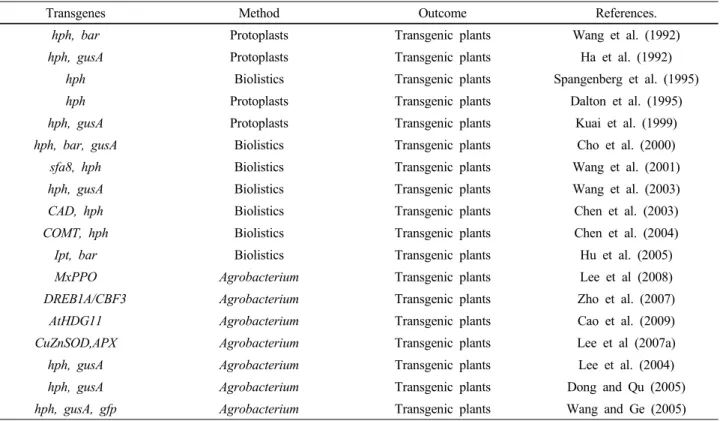
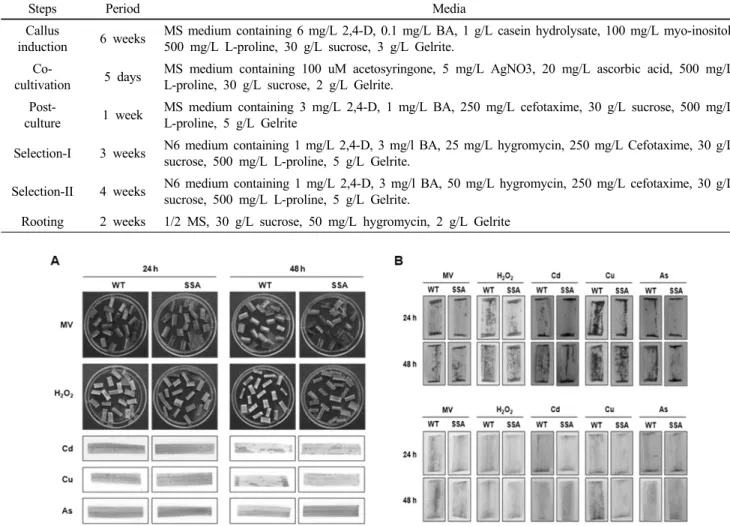
하지만 최근 Agrobacterium법에 의한 화본과 식물의 형질 전환에 대한 보고가 벼, 밀, 보리, 사탕수수 및 수수 등에 서도 보고되어 다른 화본과 작물로의 응용범위가 점점 넓어지고 있다. 한편 Agrobacterium을 이용한 톨 페스큐의 형질전환은 Lee 등 (Lee et al. 2004)에 의해 최초로 보고되 었으며 (Fig. 2), 그 형질전환 프로토콜과 배지조성은 Table 2에 나타낸 바와 같다.
그 이후로 지난 몇 년 동안 Table 1에 나타낸 바와 같이 다양한 유용 유전자들이 도입된 톨 페스큐 형질전환체가
Agrobacterium 형질전환법을 이용하여 개발되었다 (Lee etal. 2004; Dong and Qu 2005; Wang and Ge 2005; Lee et al.
2007; Zhao et al. 2007; Lee et al. 2008; Cao et al. 2009).
톨 페스큐 형질전환식물체 개발에 관한 연구 동향
환경 스트레스 저항성 톨 페스큐
목초나 사료작물들은 초지나 사료포장에 파종되는 순
간부터 병충해와 같은 생물적 스트레스뿐만 아니라 건
Table 1 Genetic transformation of tall fescue plants
Transgenes Method Outcome References.
hph, bar Protoplasts Transgenic plants Wang et al. (1992)
hph, gusA Protoplasts Transgenic plants Ha et al. (1992)
hph Biolistics Transgenic plants Spangenberg et al. (1995)
hph Protoplasts Transgenic plants Dalton et al. (1995)
hph, gusA Protoplasts Transgenic plants Kuai et al. (1999)
hph, bar, gusA Biolistics Transgenic plants Cho et al. (2000)
sfa8, hph Biolistics Transgenic plants Wang et al. (2001)
hph, gusA Biolistics Transgenic plants Wang et al. (2003)
CAD, hph Biolistics Transgenic plants Chen et al. (2003)
COMT, hph Biolistics Transgenic plants Chen et al. (2004)
Ipt, bar Biolistics Transgenic plants Hu et al. (2005)
MxPPO Agrobacterium Transgenic plants Lee et al (2008)
DREB1A/CBF3 Agrobacterium Transgenic plants Zho et al. (2007)
AtHDG11 Agrobacterium Transgenic plants Cao et al. (2009)
CuZnSOD,APX Agrobacterium Transgenic plants Lee et al (2007a)
hph, gusA Agrobacterium Transgenic plants Lee et al. (2004)
hph, gusA Agrobacterium Transgenic plants Dong and Qu (2005)
hph, gusA, gfp Agrobacterium Transgenic plants Wang and Ge (2005)
Fig. 2 Tall fescue transformation mediated by Agrobacterium tumefaciens. (A) Mature seed-derived embryogenic callus used for A. tumefaciens co-cultivation. (B) GUS staining of hygromycin- resistant calli. (C) Regeneration of hygromycin-resistant tallfescue plantlets on the selection medium. (D) GUS staining of a shoot regenerated from hygromycin-resistant callus. (E) GUS staining of whole plant of transgenic tall fescue. (F) A transgenic plant established in the green house
조, 고온, 저온, 염 및 중금속 등의 물리・화학적인 환경스 트레스에 직면하게 된다. 이와 같은 각종 스트레스에 노 출되면 생체 내에서 필수원소인 산소 (O
2)가 superoxide
radical (·O
2), hydrogen peroxide (H
2O
2), hydroxyl radical (·OH) 등과 같은 반응성이 높은 독성의 활성산소종 (reactive oxygen species, ROS)으로 변하게 된다 (Foyer et al. 1994; Asada 1999).
이들 ROS는 강력한 산화력을 가지고 있어서 세포막의 파괴, 단백질 분해, DNA 합성 억제, 광합성반응 억제, 엽 록체 파괴 등 생체 내에서 심각한 생리적인 장해를 주며 심할 경우는 식물체가 고사하게 된다. 이러한 환경스트 레스에 대해 방어하기 위해 superoxide dismutase (SOD), peroxidase (POD), catalase (CAT) 등과 같은 항산화효소와 ascorbate (vitamin C, ascorbic acid), 비타민 E (tocopherol), glutathione 등의 저분자 항산화물질이 식물체내에서 활성 산소 제거에 관여한다 (Foyer et al. 1994; Noctor and Foyer 1998). 특히 식물세포에 있어서 엽록체는 고농도의 산소 와 광합성 전자전달계가 존재하는 세포내 소기관이기 때 문에 외부의 환경스트레스를 받으면 다량의 활성산소가 생성되어 직접적으로 손상을 받아 작물의 생산성 감소를 초래한다. 따라서 복합적인 환경스트레스 하에서도 내성 을 가지도록 엽록체의 항산화기구를 효율적으로 제어할 수 있다면 식물의 생산성 향상에 크게 기여할 수 있을 것 이다.
최근 목초 및 사료작물에 유용유전자의 도입을 통한 신 품종 개발 연구가 많이 시도되고 있으며 특히, 환경스트 레스에 대한 내성을 향상시키기 위한 톨 페스큐의 형질 전환 식물체 개발에 관한 연구가 많이 보고되고 있다.
즉, 건조 스트레스 저항성에 관한 보고 (Zhao et al. 2007),
Table 2 Composition of the media used for tall fescue transformation
Steps Period Media
Callus
induction 6 weeks MS medium containing 6 mg/L 2,4-D, 0.1 mg/L BA, 1 g/L casein hydrolysate, 100 mg/L myo-inositol, 500 mg/L L-proline, 30 g/L sucrose, 3 g/L Gelrite.
Co-
cultivation 5 days MS medium containing 100 uM acetosyringone, 5 mg/L AgNO3, 20 mg/L ascorbic acid, 500 mg/L L-proline, 30 g/L sucrose, 2 g/L Gelrite.
Post-
culture 1 week MS medium containing 3 mg/L 2,4-D, 1 mg/L BA, 250 mg/L cefotaxime, 30 g/L sucrose, 500 mg/L L-proline, 5 g/L Gelrite
Selection-I 3 weeks N6 medium containing 1 mg/L 2,4-D, 3 mg/l BA, 25 mg/L hygromycin, 250 mg/L Cefotaxime, 30 g/L sucrose, 500 mg/L L-proline, 5 g/L Gelrite.
Selection-II 4 weeks N6 medium containing 1 mg/L 2,4-D, 3 mg/l BA, 50 mg/L hygromycin, 250 mg/L cefotaxime, 30 g/L sucrose, 500 mg/L L-proline, 5 g/L Gelrite.
Rooting 2 weeks 1/2 MS, 30 g/L sucrose, 50 mg/L hygromycin, 2 g/L Gelrite
Fig. 3 (A) Visible damage in detached leaves of wild-type and SSA transgenic tall fescue plants (expressing both SOD and APX) exposed to MV, H
2O
2, and heavy metals for 24 h or 48 h. (B) Histochemical detection of H
2O
2and O
2in detached leaves of wild-type and SSA plants exposed to MV, H
2O
2, and heavy metals for 24 h or 48 h
건조와 염의 복합스트레스 저항성에 관한 보고 (Cao et al. 2009) 및 기타 다양한 중금속 스트레스 저항성 (Lee et al. 2007a; Lee et al. 2007b) (Fig. 3)에 대해 많이 보고되고 있다.
제초제 저항성 톨 페스큐
톨 페스큐는 점점 아열대 기후로 변해가고 있는 우리 나라의 기후조건에 있어서 재배하기에 가장 알맞은 목초 품종 중에 하나이다. 그러나 초지 조성 시 잡초 종자의 혼입으로 인한 잡초발생은 초지에서의 목초의 초기생장 과 정착을 방해하고 전 생육기간에 걸쳐 생육을 방해함 으로써 초지의 생산성을 급격히 떨어뜨릴 뿐 아니라, 수 확 후의 조사료의 품질을 현격히 떨어뜨리는 요인으로 작용한다. 특히 종자로의 잡초종자 혼입은 종자의 판매 나 수출 또한 불가능하게 하는 요인으로 작용한다. 더욱 이 잔디 식재지에서의 잡초의 혼입은 잔디면의 불균일성
과 품질저하의 직접적인 요인이 되고 있다. 이러한 잡초
들을 제거하기 위한 비용은 광할한 면적에 재배되는 톨
페스큐와 같은 목초 또는 잔디용 작물의 경우 더욱 막대
한 비용이 소요된다. 지금까지 목초지에 있어서 잡초방
제는 잡초로 오염된 초지의 표토를 깊이 경운하여 초지
를 갱신하거나, 인력에 의한 잡초제거가 주를 이루고 있
으나 이러한 방법은 막대한 비용과 시간을 요하는 비효
율적인 방법이다. 따라서 가장 효율적인 잡초방제 방법
은 제초제에 대해서 저항성을 가지는 목초를 개발하여
재배하면서 비선택성 제초제를 이용하는 것이다. 그러나
지금까지의 관행 육종법으로는 제초제 저항성 신품종 개
발에 관한 접근은 불가능하다. 이와 같은 기존의 관행육
종의 한계를 극복하기 위한 유일한 대안으로서 최근 급
속히 발달하고 있는 분자수준의 생명공학기술을 식물육
종에 접목하여 응용하는 것이 필수적이라 하겠다. 따라
서 유전자 형질전환기술을 이용한 제초제 저항성 톨 페
스큐 신품종을 개발하게 되면 효율적인 잡초방제가 가능
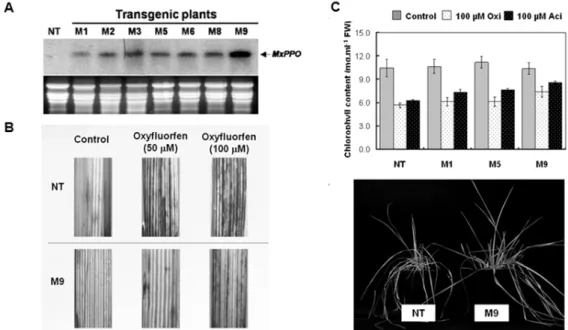
Fig. 4 Herbicide resistant transgenic tall fescue plants. (A) Northern analysis of MxPPO in non-tansformant (NT) and transgenic transgenic tall fescue plants expressing a MxPPO gene. (B) Effect of herbicide (oxyfluorfen and acifluorfen) treatments on in vivo H
2O
2production. (C) Effect of herbicide (oxyfluorfen and acifluorfen) treatments on chlorophyll content and Comparison of the phenotype of oxyfluorfen-treated transgenic plant and non-transgenic plant
한 목초 및 잔디종자를 생산할 수 있음으로 해서 국내의 부족한 조사료자원의 자급율 향상 및 우수 잔디식재지 조성을 위한 우량 잔디 종자생산에 활용될 수 있을 것 이다.
톨 페스큐에 있어서 제초제 저항성 식물체 개발에 관 한 보고는 거의 없는 실정이다. 최초의 보고는 protoplast 를 이용한 marker 유전자로 알려진 bar 유전자를 이용한 제초제 저항성 보고가 최초이다 (Kuai et al. 1999). 그 이 후로 본 실험실에서 Agrobacterium을 이용한 형질전환기 법으로 Myxococcus xanthus에서 분리한 diphenyl-ethers계 제초제 저항성 유전자인 protoporphyrinogen oxidase (PPO) 가 도입된 형질전환 톨 페스큐를 개발하였으며, 개발된 형질전환체는 PPO에 대해 높은 제초제 저항성을 나타내 었다 (Lee et al. 2008; Fig. 4).
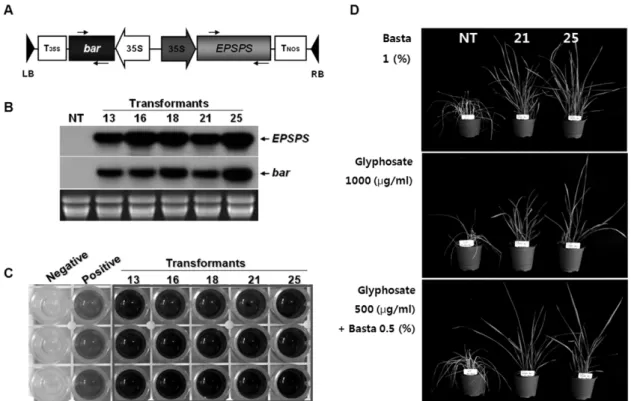
또한, 더욱 효율적인 잡초방제를 위해 이용하고자 현 재 포장에서 가장 많이 이용되고 있는 비선택성 제초제 인 근사미 (Glyphosate)와 Basta (glufosinate)에 대해 동시에 저항성을 가지는 형질전환체를 개발하고자, glyphosate 저 항성 유전자인 5-enolpyruvylshikimate-3-phosphate synthase (EPSPS) 와 Basta® 저항성 유전자인 bar 유전자가 동시에 도입된 벡터를 구축한 후, 톨 페스큐에 도입한 결과 두 가지 제초제를 동시에 처리했을 때에도 높은 저항성을 나타내었다 (김 등. 2008; Fig. 5).
소화율을 높인 형질전환 톨 페스큐
지금까지 목초와 사료작물에 있어서 사료품질을 개선
시키기 위한 연구는 자연 돌연변이체를 이용한 전통적인 육종방법에 의해 진행되어져 왔다. 현재는 생명공학 기 술의 발달로 인해 목초의 품질개선에 관한 새로운 육종 방법이 가능하게 되었다. 즉 조사료 품질에 있어서 가장 큰 제한인자인 낮은 소화율의 요인인 식물세포벽의 lignin 성분을 감소시키기 위하여 lignin 생합성에 관여하는 유 전자의 발현을 down-regulation시킴으로서 목초의 사료가 치를 개선시키는 것이다. 이러한 접근법은 제지산업 분 야에서 일찍이 펄프의 수율을 높이기 위해 사용되었었으 며, 목본류에서는 상당한 성공사례가 보고된 바 있다.
가축들 중에서 초식동물, 특히 반추위를 가지는 소와 같은 반추동물들에 있어서 목초나 사료작물의 반추위 내 에서의 건물소화율은 식물체의 노화 및 숙기가 진행됨에 따라 10% 이상 감소한다 (Stone 1994). 이러한 건물소화율 의 저하는 여름철 목초의 사료 영양적 가치를 현저히 저 하시키는 주된 요인이 되고 있다. 지금까지 목초 및 사료 작물의 건물소화율을 증가시켜 영양가치를 향상시키기 위한 연구가 한우 및 낙농산업에 있어서 가장 중요한 육 종목표 중의 하나로 추진되어 왔다 (Smith et al. 1997). 그 러나 목초의 건물소화율에 관여하는 유전자들의 유전력 이 낮을 뿐만 아니라, 많은 수의 유전자가 관여하고 있음 으로 인해 교잡에 의한 전통적인 육종방법으로는 개량하 는데 장기간이 소요되어져 왔다 (Baucher et al. 1998).
목초에 있어서 숙기가 진행됨에 따라 소화율을 저하시
키는 가장 주된 요인 중의 하나는 목초의 생육과정에 있
어서 숙기가 진행되는 동안 세포벽 lignin 함량이 증가됨
으로 인한 목질화 (lignification) 때문으로 알려져 있다 (Buxton
Fig. 5 Generation of dual herbicides-resistant transgenic tall fescue plants. (A) T-DNA region of two herbicides expression vector. (B) Northern analysis of non-transgenic (NT) and transgenic tall fescue plants expressing EPSPS and bar genes. (C) ELISA analysis of EPSPS using transgenic tall fescue plants. (D) Phenotype comparison of non-transgenic plant (NT) and transgenic plants with 10 days after spraying herbicides treatments
et al. 1988). 식물 세포벽의 목질화 반응은 lignin과 lignin 전 구체인 monolignols의 생합성 과정의 복잡한 대사경로를 통하여 조절 합성되며 (Dixon et al. 1996), 아직도 그 경로가 완전히 밝혀지지 않은 상태이다. 지금까지 밝혀진 바에 의하면 식물에 있어서 lignin은 coniferyl alcohol에서 유래 한 guaicyl lignin (G-unit), sinapyl alcohol에서 유래한 syringyl lignin (S-unit), 및 p-coumaryl alcohol로부터 유래된 p-hy- droxyphenyl lignin (H-unit)으로 구성되어 있다. 식물의 세 포벽 구성 성분 중 조섬유 성분은 직접 분해하지 못하고 반추위 내의 미생물에 의해 분해되어져 부분적으로 소화 가 가능하다. 그러나 lignin 성분은 소화가 전혀 불가능할 뿐만 아니라, 단백질, cellulose, hemicellulose등의 세포벽 성분들의 소화작용을 방해한다. 따라서 lignin 함량이 많 은 목초는 소화율을 감소시키고, 건물섭취량을 감소시킴 으로서 결과적으로 가축의 생산성을 감소시키는 결과를 초래한다. 그러므로 목초의 lignin 함량을 저하시키면 소 화율을 향상시킬 수 있을 것이다. 최근 lignin 생합성에 관여하는 유전자들 중 caffeic acid 3-O-methyltransferase (COMT) 유전자 (Chen et al. 2004)와 cinnamyl alcohol dehydrogenase (CAD) 유전자 (Chen et al. 2003)를 RNAi로 down regulation 시킨 형질전환 톨 페스큐가 개발된 바 있 으며, 이들의 실용적 활용 가능성을 제시한 바 있다.
결 론
지금까지 유전자 변형 농산물의 안전성에 대한 국제적 논란이 제기되고 있음에도 불구하고 유전자 변형 작물의 재배면적은 점차 확대되고 있는 추세이다. 이와 더불어 유전자원의 독점화 및 유전자원 확보의 국가 간 경쟁이 치열해지고 있는 상황 하에서 우리나라도 지적 재산권 확보의 강화와 미래 식량안보차원에서 축산선진국에 대 한 비교우위를 확보하기 위한 미래기술 개발이 시급하 다. 최근에는 축산선진국을 중심으로 분자육종법에 의한 목초 및 사료작물의 신품종 개발이 활발하게 진행되고 있으며, 그 결과 알팔파 (Week et al. 2008; Montague et al.
2007), 화이트 클로버 (Voisey et al. 1994; Schmidt et al.
2004), 톨 페스큐, 페레니얼 라이그라스 (Sato and Takamizo.
2006; Hisano et al. 2005) 등의 형질전환에 의한 신품종 개
발에 관한 많은 연구 결과가 보고되고 있다. 따라서 국내
에서도 최근 확립된 여러 가지 분자육종 원천기술을 바
탕으로 우리나라에서 많이 재배되고 있는 사료작물에 적
용시켜 양질의 사료작물 개발 연구를 시급히 수행하여야
할 것이다. 나아가 최근 본격적으로 시작된 축산선진국
들의 목초와 사료작물을 대상으로 하는 게놈 프로젝트를
비롯한 사료작물분야의 분자육종연구에 대비한 국제경
쟁력을 가지기 위해서도 이러한 시도는 더욱 중요하며,
국내 자급조사료 생산기반을 확립을 위해서도 필수적인 연구 분야라 할 수 있겠다.
사 사
본 연구는 노촌진흥청 바이오그린21 사업의 연구비지 원 (과제번호: 20070301034015) 및 KRIBB 주요사업의 연 구비 지원에 의해 이루어진 것이며, 이에 감사드립니다.
인용문헌
김진석 최정섭 이병현 이기원 이상훈 (2008) 두 가지 제초제 에 대하여 저항성을 가지는 항생제 마커프리 형질전환 페스투카 속 식물체. 특허출원. 10-2008-0100802 Asada K (1999) The water-water cycle in chloroplasts: scavenging
of active oxygens and dissipation of excess photons. Annu Rev Plant Physiol Plant Mol Biol. 50:601-639
Bai Y and Qu R (2000) An evaluation on callus induction and plant regeneration of 25 turf-type tall fescue (Festuca arundinacea Schreb.) cultivars. Grass Forage Sci 55: 326-330
Buckner RC, Powell JB, Frakes RV (1979) Historical development.
In: Buckner RC and Bush LP (eds), Tall Fescue. Agronomy 20, Am Soc of Agronomy, Madison pp 1-8.
Baucher M, Bernard VMA, Chavert B, Besle JM, Opsomer C, Van Montagu M, Botternan J (1998) Down-regulation of cinnamyl alcohol dehydrogenase in transgenic alfalfa (Medicago sativa L.) and the effect on lignin composition and digestibility.
Plant Molecular Biology. 39:437-447
Buxton DR and Russell JR (1988) Lignin constituents and cell- wall digestibility of grass and legume stems. Crop Science.
28:553-558