A Case of Antiphospholipid Syndrome Refractory to Secondary Anticoagulating Prophylaxis after Deep Vein Thrombosis- Pulmonary Embolism
Kang Mo Gu, M.D., Jong Wook Shin, M.D., Ph.D. and In Won Park, M.D., Ph.D.
Division of Allergy and Pulmonary Medicine, Department of Internal Medicine, Chung-Ang Universitiy Hospital, Chung-Ang University College of Medicine, Seoul, Korea
Antiphospholipid syndrome (APS) is an acquired systemic autoimmune disorder characterized by a combination of clinical criteria, including vascular thrombosis or pregnancy morbidity and elevated antiphospholipid antibody titers. It is one of the causes of deep vein thrombosis and pulmonary embolism that can be critical due to the mortality risk. Overall recurrence of thromboembolism is very low with adequate anticoagulation prophylaxis. The most effective treatment to prevent recurrent thrombosis is long-term anticoagulation. We report on a 17-year-old male with APS, who manifested blue toe syndrome, deep vein thrombosis, pulmonary thromboembolism, and cerebral infarction despite adequate long- term anticoagulation therapy.
Keywords: Antiphospholipid Syndrome; Venous Thrombosis; Pulmonary Embolism; Cerebrovascular Disorders; Blue Toe Syndrome
bidity, and elevated titers of antiphospholipid (aPL) antibod- ies, which are the lupus anticoagulant (LA), anticardiolipin (aCL) antibodies, and/or anti-β2 glycoprotein-I antibodies
1. One of the common clinical manifestations of APS is venous thrombosis. At least 20% of cases of deep vein thrombosis, with and without pulmonary embolism, may be associated with aPL
2.
After the first thromboembolic event, warfarin is recom- mended for secondary prevention in APS patients
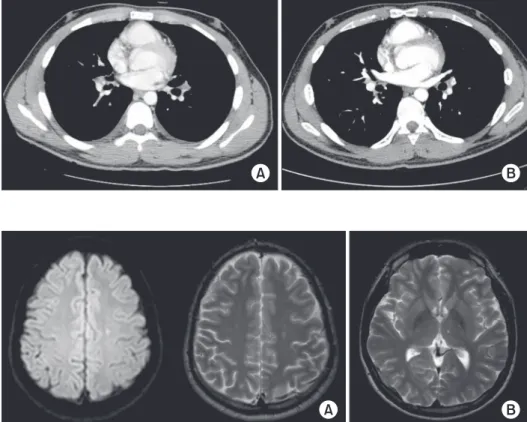
3. We report a patient who was confirmed to have APS, of which manifested on blue toe syndrome, deep vein thrombosis, and pulmonary thromboembolism. For this patient, appropriate long-term anticoagulation with warfarin was administered but cerebrovascular accident developed during anticoagulation period.
Case Report
A 17-year-old male patient was admitted with dyspnea on exertion 10 days ago.
Fifteen days ago, this patient visited outpatient clinic due to Copyright © 2014
The Korean Academy of Tuberculosis and Respiratory Diseases.
All rights reserved.
Introduction
The antiphospholipid syndrome (APS) is an acquired sys- temic autoimmune disorder characterized by a combination of clinical criteria of vascular thrombosis or pregnancy mor-
Address for correspondence: In Won Park, M.D., Ph.D.
Division of Allergy and Pulmonary Medicine, Department of Internal Medicine, Chung-Ang Universitiy Hospital, Chung-Ang University College of Medicine, 102 Heukseok-ro, Dongjak-gu, Seoul 156-755, Korea
Phone: 82-2-6299-1401, Fax: 82-2-825-7571 E-mail: [email protected]
Received: Oct. 3, 2014 Revised: Dec. 10, 2014 Accepted: Dec. 10, 2014
cc