Pulmonary Foreign Body Granulomatosis in Dental Technician
Sung Jun Chung, M.D.
1, Gun Woo Koo, M.D.
1, Dong Won Park, M.D.
1, Hyun Jung Kwak, M.D.
1, Ji Young Yhi, M.D.
1, Ji-Yong Moon, M.D.
1, Sang-Heon Kim, M.D.
1, Jang Won Sohn, M.D.
1, Ho Joo Yoon, M.D.
1, Dong Ho Shin, M.D.
1, Sung Soo Park, M.D.
1, Ju Yeon Pyo, M.D.
2, Young-Ha Oh, M.D.
2and Tae-Hyung Kim, M.D.
1Departments of
1Internal Medicine and
2Pathology, Hanyang University College of Medicine, Seoul, Korea
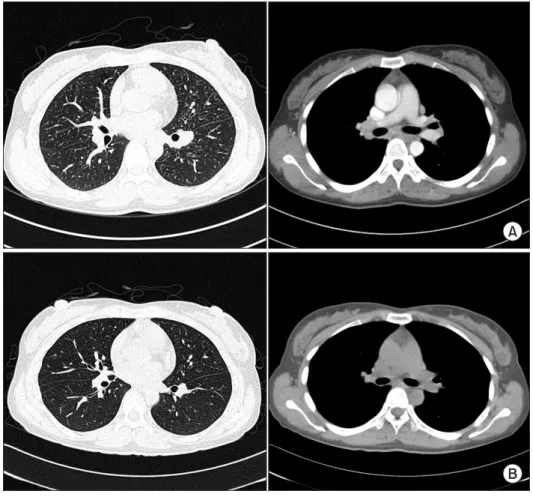
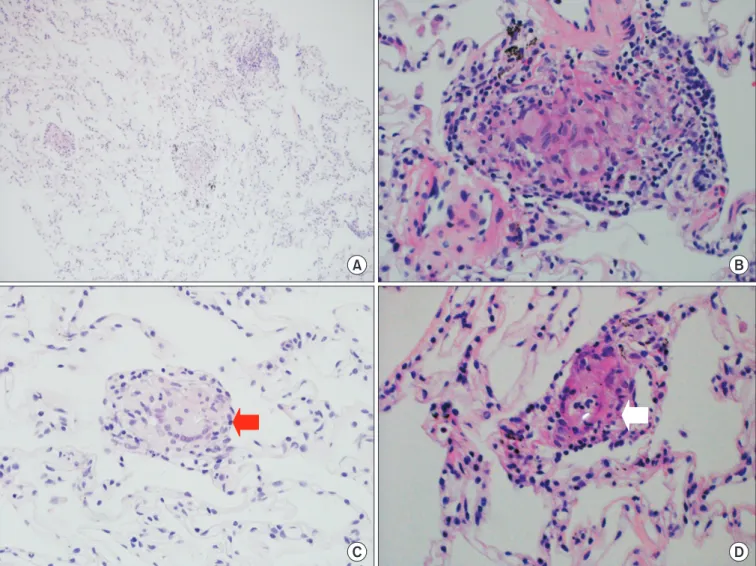
Occupational lung diseases are caused by several toxic substances including heavy metals; however, the exact pathologic mechanisms remain unknown. In the workplace, dental technicians are often exposed to heavy metals such as cobalt, nickel, or beryllium and occasionally develop occupational lung diseases. We described a case of occupational lung disease in a patient who was employed as a dental technician for over a decade. A 31-year-old, non-smoking woman presented with productive cough and shortness of breath of several weeks duration. Chest computed tomography revealed a large number of scattered, bilateral small pulmonary nodules throughout the lung field, and multiple mediastinal lymph nodes enlargement. Percutaneous needle biopsy showed multifocal small granulomas with foreign body type giant cells suggestive of heavy metals inhalation. The patient’s condition improved on simple avoidance strategy for several months. This case highlighted the importance of proper workplace safety.
Keywords: Lung Disease; Dental Technicians
Common occupational lung diseases include pneumoco- niosis, occupational asthma, lung granulomatosis, hypersensi- tivity pneumonitis, silicosis, asbestosis, contact dermatitis, and sick building syndrome
1-7.
Various types of pneumoconioses have been reported in dental technicians
1,8, which are named according to the re- lated toxic materials such as silicosis, asbestosis, hard metal disease, and the so-called dental technician’s pneumoconio- sis, in which Cr-Co-Mo alloys could play a role
1. Dental techni- cians are, indeed, exposed to various dusts and other forms of chemicals when polishing and grinding prosthetics and dur- ing casting operations
1. And, these occupational exposure can be different from person to person according to the working conditions and used materials
4.
Therefore, dental technicians should be aware of the risk of occupational lung diseases
3,7and also should be educated about proper protection and proper environment of work- place
3,4,7. Once occupational lung diseases are suggested, they should visit hospital for confirmative diagnosis and proper management.
Because early radiologic findings of occupational lung dis- eases are non-specific, differential diagnosis might be very Copyright © 2015
The Korean Academy of Tuberculosis and Respiratory Diseases.
All rights reserved.
Introduction
There are many occupational lung diseases related to vari- ous toxic substances
1, and respiratory system is a major route of occupational diseases
2. Heavy metals, such as cobalt, nickel, or beryllium are one of the most common substances that is found in occupational lung diseases.
Address for correspondence: Tae-Hyung Kim, M.D.
Division of Pulmonary and Critical Care Medicine, Department of Internal Medicine, Hanyang University Guri Hospital, Hanyang University College of Medicine, 153 Gyeongchun-ro, Guri 11923, Korea
Phone: 82-31-560-2240, Fax: 82-31-553-7369 E-mail: [email protected]
Received: Aug. 24, 2014 Revised: Dec. 4, 2014 Accepted: Jan. 7, 2015
cc