Introduction
Compared to general population, health care workers (HCWs) are at increased risk of tuberculosis (TB) infection through occupational exposure to TB patients
1,2. Considering that about 5%–15% of TB infected people are at risk for devel- oping TB during their lifetime
3, HCWs with latent TB infection (LTBI) are potential risk group for TB leading to transmission of Mycobacterium tuberculosis to other HCWs and patients.
Therefore, LTBI screening and treatment for HCWs is an im- portant component of TB infection control measures in the hospitals
4.
In hospitals, many HCWs from different occupations are
The Prevalence and Risk Factors of Latent Tuberculosis Infection among Health Care Workers Working in a Tertiary Hospital in South Korea
Jae Seuk Park, M.D., Ph.D.
Department of Internal Medicine, Dankook University College of Medicine, Cheonan, Korea
Background: The risk of tuberculosis (TB) infection among health care workers (HCWs) is higher than as noted among workers in the general population. The prevalence and risk factors of TB infection among HCWs were assessed in a tertiary hospital in South Korea, resulting in a conclusion of an intermediate TB burden within the country.
Methods: This cross-sectional study enrolled HCWs who underwent a QuantiFERON-TB Gold In-Tube (QFT-GIT) test to detect the presence of a latent TB infection (LTBI), in patients admitted to a tertiary hospital in South Korea in 2017. The departments of the hospital were divided into TB-related and TB-unrelated departments, which were based on the risk of exposure to TB patients. In this sense, the risk factors for LTBI, including current working in the TB-related departments, were analyzed.
Results: In this case, a total of 499 HCWs (54 doctors, 365 nurses and 80 paramedical personnel) were enrolled in this study. The median age of the subjects was 31 years (range, 20–67 years), 428 (85.8%) were female, and 208 (41.7%) were working in the TB-related departments. The prevalence of LTBI was 15.8% based on the QFT-GIT. Additionally, the prevalence of experience of exposure to pre-treatment TB patents was higher among HCWs working in the TB-related departments, than among HCWs working in the TB-unrelated departments (78.8% vs. 61.9%, p<0.001). However, there was no significant difference in the prevalence of LTBI between the two groups (17.3% vs. 14.8%, p=0.458). On a review of the multivariate analysis, only the factor of age was independently associated with an increased risk of LTBI (p=0.006).
Conclusion: Broadly speaking, the factor of age was associated with an increased risk of LTBI among the HCWs in South Korea. However, those workers current working in the TB-related departments was not associated with an increased risk of LTBI.
Keywords: Latent Tuberculosis; Healthcare Worker; Republic of Korea
Address for correspondence: Jae Seuk Park, M.D., Ph.D.
Department of Internal Medicine, Dankook University College of Medicine, 119 Dandae-ro, Dongnam-gu, Cheonan 31116, Korea Phone: 82-41-550-3055, Fax: 82-41-556-3256
E-mail: [email protected] Received: Mar. 7, 2018 Revised: May. 4, 2018 Accepted: Jul. 3, 2018
cc It is identical to the Creative Commons Attribution Non-Commercial License (http://creativecommons.org/licenses/by-nc/4.0/).
Copyright © 2018
The Korean Academy of Tuberculosis and Respiratory Diseases.
working in various departments. And, studies conducted in South Korea have reported varying prevalence of LTBI among HCWs from 17% to 37%
5-7. Therefore, it is important to find out who is at high risk for TB infection in order to determine the priority of LTBI screening and treatment.
Because the risk of TB infection depends on the proximity and duration of exposure to infectious TB patients, HCWs working in the respiratory medicine, emergency department, medical intensive care unit, pulmonary function test and bronchoscopy unit and laboratory processing suspected or confirmed M. tuberculosis specimens are known to be at high risk of TB infection
4,6,8,9. Thus, the Korea Centers for Disease Control and Prevention (KCDC) recommended that HCWs working in the departments with increased risk of TB infec- tion (TB-related departments) receive annual screening for LTBI
10.
Recently, interferon-gamma release assay like QuantiF- ERON-TB Gold In-Tube (QFT-GIT) is widely used for the diagnosis of LTBI because it has several advantages over the tuberculin skin test (TST) such as higher specificity without cross-reactivity with bacillus Calmette–Guérin strains or en- vironmental mycobacteria
11. And, several studies targeting HCWs have suggested that a positive QFT-GIT result is a bet- ter indicator of LTBI than a positive TST result
6,12.
To date, the risk factors of TB infection of HCWs using QFT- GIT have not been thoroughly evaluated in South Korea, an intermediate TB burden country with the annual notification rate of new TB cases as 60.4 per 100,000 population in 2016
10. Therefore, analyzing the prevalence and various risk factors of TB infection of HCWs, including current working in the TB- related departments, is important for determining the priority for LTBI screening and treatment in South Korea.
This study assessed the prevalence and the risk factors for LTBI, including current working in the TB-related depart- ments, among HCWs working in a tertiary referral hospital in South Korea.
Materials and Methods
1. Study subjects and design
This cross-sectional study was conducted from June 2017 to December 2017 in a 700-bed tertiary referral hospital in South Korea. Approximately 350 TB patients are treated at the hospital annually. Of the 540 HCWs involved in the patient care, 515 underwent QFT-GIT test according to the national LTBI screening program, excluding 25 HCWs who had history of TB treatment or were positive for previous LTBI test (TST or interferon-γ release assay). They also underwent chest radiography to exclude active TB. Of the 515 HCWs who un- derwent QFT-GIT test, 499 agreed to participate in the study.
A questionnaire was administered to each participant to col-
lect demographic data and known risk factors of TB infection;
occupation (doctor, nurse, paramedical personnel), specific departments in which they work, duration of employment as a HCW, experience of exposure to pre-treatment TB patients both inside and outside the hospital. The departments of the hospital were divided into TB-related and TB-unrelated de- partments according to KCDC recommendation
10. TB-related departments include outpatient and inpatient departments of respiratory medicine and infection, outpatient department of pediatric respiratory medicine, pulmonary function test and bronchoscopy unit, emergency department, medical intensive care unit, chest section of radiology department, microbiology section of laboratory. TB-unrelated departments include out- patient and inpatient departments of internal medicine and pediatrics not included in the TB-related departments, obstet- rics, and gynecology, etc. The study protocol was approved by the Institutional Review Board of the Dankook University Hospital (2017-06-015) and written informed consents were provided by all participants.
2. QuantiFERON-TB Gold In-Tube test
QFT-GIT was used for the diagnosis of LTBI in this study.
QFT-GIT test was performed according to the manufacturer’s recommendations (Qiagen Ltd., Carnegie, VIC, Australia).
The blood samples were mixed with M. tuberculosis specific antigens (early secreted antigenic target-6, culture filtrate protein 10, and TB 7.7), mitogen phytohemagglutinin (posi- tive control) and saline (negative control) and incubated for 16‒24 hours. The detection and quantification of interferon- gamma by enzyme-linked immunosorbent assay was used to measure in vitro responses to TB antigens. All values were interpreted after subtracting the value of the negative control.
The QFT-GIT test results were interpreted as positive if the interferon-γ level in response to TB antigen ≥0.35 IU/mL and
>25% of Nil value.
3. Statistical analysis
Data are expressed as a number (%) or median (range or in-
terquartile range). All statistical analyses were performed us-
ing the SPSS version 19.0 (SPSS Inc., Chicago, IL, USA). Com-
parison between HCWs working in the TB-related and TB-
unrelated departments were analyzed using the chi-square
test for categorical variables. Continuous variables were
analyzed using Mann-Whitney U test. Risk factors for LTBI
were evaluated using logistic regression analysis. Independent
variables for multivariate analysis were selected on the basis
of their statistical significance in univariate analysis and clini-
cal significance. A two-tailed p-value of <0.05 was considered
to be statistically significant.
Results
1. Characteristics of participants
Of the 499 participants, 428 (85.8%) were female and the median age was 31.0 years (range, 20–67 years). The median length of employment as a HCW was 7.0 years (range, 1–38 years). The occupations of the HCWs includes 54 doctors (10.8%), 365 nurses (73.1%), and 80 paramedical personnel (16.0%) (radiology and laboratory technicians, nursing as- sistants, etc.). All were human immunodeficiency virus test negative. Nine (1.8%) were medicated with diabetes mellitus, and 18 (3.6%) were current smoker. Of the 499 participants, the prevalence of LTBI based on QFT-GIT positivity was 15.8%. There were no radiologically active TB patients among the participants.
2. Prevalence of LTBI and comparisons between HCWs working in the TB-unrelated and related departments Clinical characteristics of 291 HCWs working in the TB- unrelated departments and 208 HCWs working in the TB- related departments are shown in Table 1. The median age of HCWs working in the TB-unrelated and related departments was 32.0 years (range, 20–64 years) and 30.0 years (range, 20–
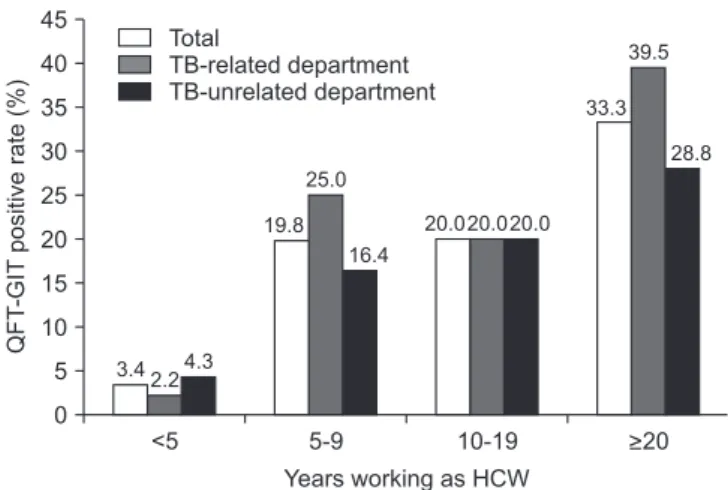
67 years), respectively. The median length of work as a HCW in the TB-unrelated and related departments was 7.0 years (range, 1–38 years) and 6.0 years (range, 1–35 years), respec- tively. There were no differences between the two groups in age (Figure 1), duration of work as HCWs (Figure 2), and sex.
But, prevalence of experience of exposure to pre-treatment TB patients was higher in HCWs working in the TB-related departments than HCWs working in the TB-unrelated depart- ments (78.8% vs. 61.9%, p<0.001). More doctors were included in the TB-unrelated departments and more paramedical personnel were included in the TB-related departments. The prevalence of LTBI among HCWs working in the TB-related departments was higher than that of HCWs working in the TB- unrelated departments, but it was not statistically significant (17.3% vs. 14.8%, p=0.458).
3. Risk factors for LTBI
On univariate logistic regression analysis, age (odds ratio [OR], 1.094; 95% confidence interval [CI], 1.064–1.124) and duration of work as HCW (OR, 1.096; 95% CI, 1.065–1.128) were significantly associated with increased risk of LTBI (Table 2). Other known risk factors such as current working in the TB-related departments, occupation, experience of exposure to pre-treatment TB patients were not associated with in- creased risk of LTBI. Multivariate analysis showed that only age was independently associated with increased risk of LTBI (OR, 1.069; 95% CI, 1.019–1.121) (Table 3).
Discussion
LTBI treatment is known to be one of the important strate- gies to prevent the development of TB and block the transmis- sion of M. tuberculosis to other people. However, since the benefit of LTBI treatment is not prominent compared to the cost for screening and treatment for LTBI, LTBI screening and treatment is generally recommended for people whose ben- efit outweighs the cost
13. It is therefore important to determine who is at high risk for TB infection in order to select the target groups for LTBI screening and treatment.
In general, HCWs working in the TB-related departments are known to be at high risk for TB infection
4.8. Thus, the KCDC recommended that HCWs who are working in the TB- related departments receive annual screening for LTBI
10. As expected, this study showed that experience of exposure to pre-treatment TB patients were more frequent in HCWs work- ing in the TB-related departments than HCWs working in the TB-unrelated departments (78.8% vs. 61.9%). Considering that TB patients have the highest infectivity before treatment, this finding suggests that HCWs working in the TB-related depart- ments are at higher risk of TB infection than those working in the TB-unrelated departments.
This study showed that the prevalence of LTBI among HCWs working in the TB-related departments was higher than that of HCWs working in the TB-unrelated departments, but unexpectedly it was not statistically significant (17.3% vs.
14.8%, p=0.458). Possible explanations for this unexpected re-
sult are as follows. In large hospitals, HCWs may work in sev-
eral departments in rotation. And, HCW might have moved
from TB-unrelated department to TB-related department
recently. Considering that it takes about 8 weeks for QFT-GIT
conversion after exposure to infectious TB patients, QFT-GIT
may give false-negative result if it is conducted during the win-
dow period
14. Considering the high prevalence of TB in South
Korea, it seems that out-hospital exposure to TB patients also
diluted the difference between the two groups
10. In a multi-
center study conducted in South Korea also showed that
current working in the TB-related departments was not asso-
ciated with positive QFT-GIT result. However, HCWs with ex-
perience of working in the TB-related departments was inde-
pendently associated with positive QFT-GIT result
6. Another
study conducted at a tertiary hospital in South Korea showed
that the positive rate QFT-GIT was higher among HCWs
who had frequent direct contact with TB patients in the TB-
related departments than those who had no history of direct
contact with TB patient in the TB-unrelated departments
15.
Another study conducted in military hospitals of South Korea
also showed that the risk of LTBI was higher in HCWs who
took care of TB patients for one year or more
16. These findings
suggest that longer duration of work in the TB-related depart-
ments is better risk factor of LTBI than the current working in
the TB-related departments in South Korea.
The transmission of TB in the hospital is also affected by the efficiency of TB infection control measures. In resource-limit- ed countries, HCWs are at increased risk of exposure to TB pa- tients within the hospitals due to lack of isolation rooms and inadequate TB infection control measures. In these settings,
LTBI among HCWs was consistently associated with mark- ers of occupational exposure to TB patients such as work- ing in TB clinic, long duration of employment as HCW
17,18. However, in resource-rich countries, the risk of TB infection among HCWs becomes closer to general population because Table 1. Clinical characteristics and QunatiFERON-TB Gold In-Tube results of participants
Characteristic All participants
(n=499) TB-unrelated
departments (n=291) TB-related
departments (n=208) p-value*
Age, median (range), yr 31.0 (20 to 67) 32.0 (20 to 64) 30.0 (20 to 67) 0.498
<30 233 (46.7) 135 (46.4) 98 (47.1) 0.959
30‒39 114 (22.8) 65 (22.3) 49 (23.6)
40‒49 126 (25.3) 76 (26.1) 50 (24.0)
≥50 26 (5.2) 15 (5.2) 11 (5.3)
Sex
Male 71 (14.2) 38 (13.1) 33 (15.9) 0.436
Female 428 (85.8) 253 (86.9) 175 (84.1)
Occupation
Doctor 54 (10.8) 39 (13.4) 15 (7.2) 0.001
Nurse 365 (73.1) 219 (75.3) 146 (70.2)
Paramedical personnel 80 (16.0) 33 (11.3) 47 (22.6)
Years working as HCW, median (range) 7.0 (1 to 38) 7.0 (1 to 38) 6.0 (1 to 35) 0.405 Years working as HCW
<5 206 (41.3) 117 (40.2) 89 (42.8) 0.921
5‒9 91 (18.2) 56 (18.9) 36 (17.3)
10‒19 100 (20.0) 60 (20.6) 40 (19.2)
≥20 102 (20.4) 59 (20.3) 43 (20.7)
Experience of exposure to pre-treatment TB patients
No 155 (31.1) 111 (38.1) 44 (21.2) <0.001
Yes 344 (68.9) 180 (61.9) 164 (78.8)
Current smoking
No 481 (96.4) 280 (96.2) 201 (96.6) >0.999
Yes 18 (3.6) 11 (3.8) 7 (3.4)
Co-morbidities
No 490 (98.2) 286 (98.3) 204 (98.1) >0.999
Yes 9 (1.8) 5 (1.7) 4 (1.9)
QFT-GIT level, median (IQR), IU/mL 0.010 (–0.003 to 0.088) 0.010 (–0.002 to 0.063) 0.010 (–0.003 to 0.117) 0.400 QFT-GIT result
Negative 420 (84.2) 248 (85.2) 172 (82.7) 0.458
Positive 79 (15.8) 43 (14.8) 36 (17.3)
Values are presented as number (%) unless otherwise indicated.
*p-values compare between TB-unrelated and TB-related departments.
TB: tuberculosis; HCW: health care worker; QFT-GIT level: QuantiFERON-TB Gold In-Tube level (TB Ag-Nil); IQR: interquartile range.
transmission of TB in the hospitals is reduced or prevented by implementation of effective TB infection control measures
1. In a study conducted in the United States, a resource-rich coun- try, showed that non-occupational factors such as old age and foreign birth account for most of TB infections arising among HCWs
19. In most tertiary hospitals in South Korea, including the hospital included in this study, patients diagnosed or sus- pected of having TB are admitted to isolation rooms equipped with negative pressure ventilation until they are no longer
infectious. And HCWs and visitors entering such rooms are required to wear N95 respirators. In the present study, known risk factors for TB infection such as current working in the TB- related departments, experience of exposure to pre-treatment TB patients were not associated with increased risk of LTBI among HCWs. These findings suggest that TB infection con- trol measures employed by the hospital of this study have mitigated the transmission of TB in the hospital
20,21. In a study conducted in Taiwan, an intermediate TB burden country like South Korea, also showed that experience of unprotected ex- posure to TB patients was not associated with increased risk of LTBI among HCWs
11.
Compared to young HCWs, older HCWs are more likely to be exposed to TB patients during their life either within the hospital or in the community. It is not surprising, therefore, that several studies, including this study, have shown that old age was significantly associated with increased risk of LTBI Table 2. Univariate logistic regression analysis of risk
factors for latent TB infection among HCWs
Characteristic OR (95% CI) p-value
Age 1.094 (1.064 – 1.124) <0.001
Male sex 1.372 (0.722 – 2.605) 0.334
Occupation
Doctor - -
Nurse 0.715 (0.338 – 1.509) 0.378
Paramedical personel 1.277 (0.538 – 3.031) 0.579 Experience of exposure to
pre-treatment TB patients 1.116 (0.658 – 1.896) 0.683 Current working in the TB-
related department 1.207 (0.744 – 1.958) 0.445 Duration of work as HCW 1.096 (1.065 – 1.128) <0.001 Current smoking 2.115 (0.732 – 6.110) 0.166 Co-morbidity (DM) 1.532 (0.312 – 7.516) 0.599 TB: tuberculosis; HCW: health care worker; OR: odds ratio; CI: con- fidence interval; DM: diabetes mellitus.
Table 3. Multivariate logistic regression analysis of risk factors for latent TB infection among HCWs
Characteristic OR (95% CI) p-value
Age 1.069 (1.019 – 1.121) 0.006
duration of work as HCW 1.033 (0.982 – 1.087) 0.209 Experience of exposure to pre-
treatment TB patients
0.776 (0.435 – 1.385) 0.392
Current working in the TB- related department
1.309 (0.775 – 2.212) 0.314
TB: tuberculosis; HCW: health care worker; OR: odds ratio; CI: con- fidence interval.
<30 60
50
40
30
20
QFT-GITpositiverate(%) 10
Age (yr) 0
30-39 40-49 >50
5.1 6.1 4.4
19.318.4 20.0
27.030.0 25.0
42.3 54.6
33.3 Total
TB-related department TB-unrelated department
Figure 1. QuantiFERON-TB Gold In-Tube (QTF-GIT) positive rate according to age. There was no difference in the QFT-GIT positive rate between tuberculosis (TB)-related and TB-unrelated depart- ments in each age group.
<5 45
40 35 30 25 20 15 10 5
QFT-GITpositiverate(%)
Years working as HCW 0
5-9 10-19 >20
Total
TB-related department TB-unrelated department
3.42.24.3 19.8
25.0
16.4 20.0
33.3 39.5
28.8
20.020.0