• 검색 결과가 없습니다.

Mast Cells and Vascular Endothelial Growth Factor Expression in Neoangiogenesis of Cervical Intraepithelial Neoplasia and Invasive Squamous Cell Carcinomas of the Uterine Cervix

N/A
N/A
Protected

Academic year: 2021

Share "Mast Cells and Vascular Endothelial Growth Factor Expression in Neoangiogenesis of Cervical Intraepithelial Neoplasia and Invasive Squamous Cell Carcinomas of the Uterine Cervix"

Copied!
10
0
0

로드 중.... (전체 텍스트 보기)

전체 글

(1)

자궁경부상피내종양과 침윤성 편평상피암종의 혈관신생에서 비만세포와 혈관내피성장인자의 발현

원광보건대학 임상병리과1, 원광대학병원 병리과2

제갈승주1․이정아2․노종섭2

Mast Cells and Vascular Endothelial Growth Factor Expression in Neoangiogenesis of Cervical Intraepithelial Neoplasia and Invasive Squamous Cell Carcinomas of the Uterine Cervix

Seung-Joo Jekal

1

, Jung-Ah Lee

2

, and Jong-Sup Rho

2

Department of Clinical Laboratory Science, Wonkwang Health Science College, Iksan 570-750, Korea

1

Deparment of Pathology, Wonkwang University Hospital, Iksan 570-711, Korea

2

To determine the correlation between mast cells(MCs) and neoangiogenesis in the growth and progression of cervical cancer, we investigated mast cell density(MCD), microvessel density(MVD) and the expression of vascular epithelial growth factor(VEGF) in cervical intraepithelial neoplasia and invasive suqamous cell carcinoma of the uterine cervix. Forty-five cervical intraepithelial neoplasia(CIN I, II and III), 15 microinvasive carcinomas, 15 invasive squamous cell carcinomas and 20 normal cervical epithelia were included in this study. MCs were stained with anti-c-Kit antibody and alcian blue, microvessels with anti-factor VIII antibody and VEGF with anti-VEGF antibody. The adjacent fields of both normal and neoplastic epithelium were used for counting MCs and microvessels. Computerized image analysis was used to evaluate MCD and MVD. MCD and MVD were the mean numbers per 1mm

2

counted in 5-10 high and low power fields respectively. In both c-Kit and alcian blue stained sections, MCD progressively increased along the continuum from CIN I to invasive squamous cell carcinoma(p<0.001). MVD increased significantly with cervical neoplasia progression, from CIN to invasive squamous cell carcinoma (p<0.001). In double c-Kit and Factor VIII-stained sections, MCs were mainly present in the areas adjacent to newly formed blood vessels. However, there were no significant differences in MCD and MVD between normal epithelum and CIN I. A strong correlation was also observed between MCD and MVD. In double VEGF and alcian blue-stained sections, VEGF was expressed in only MCs. Strong VEGF-positive MCs were particularly abundant around the tumorous region. Our results suggest that MCs may upregulate neoangiogenesis by VGEF secretion in the development and progression of cervical neoplasia

Key Words : Mast cell, Neoangiogenesis, Vascular endothelial growth factor, Uterine cervix, Neoplasia

대한임상검사학회지 : 37권 제3호, 197-206, 2005

1)

교신저자 : 제갈승주, (우)570-750 전북 익산시 신룡동 344-2, 원광보건대학 임상병리과

Tel : 063-840-1215 E-mail : [email protected]

(2)

I. 서 론

혈관신생(neoangiogenesis)은 종양의 성장과 전이에 있 어 필요한 혈액 공급원으로서 중요한 역할을 하는 것으 로 알려져 있으며(Folkman, 1990; Weidner, 1993), 몇몇 종양의 정량적 연구에서는 종양 내 혈관신생이 종양의 전이와 환자의 예후를 예측할 수 있는 의미 있는 지표임 을 보여 주었다(Maeda 등, 1995; Saeki 등, 1997).

최근 비만세포는 주요 기능으로 알려진 알러지 및 염 증질환의 관련성 외에 종양을 대상으로 한 연구에서 종 양 간질부위나 그 주변부위에 많이 증가하며, 비만세포의 수적 증가가 암의 성장과 침윤, 전이 그리고 예후와 상관 성이 있는 것으로 보고되어 있다(Dabbous 등, 1986;

Jekal, 1999; Elpek 등, 2001; Acikalin 등, 2005). 아직 이 들 종양 주변부에 출현하는 비만세포가 종양의 기능적 관련성에 대해서는 정확히 밝혀져 있지 않으나 여러 연 구에서 비만세포가 혈관신생에 관여함으로써 종양의 진 행을 유도할 것이라는 증거들을 보여 주었고(Takanami 등, 2000; Toth 등, 2000; Ranier 등, 2003), 유방암과 전립 선암에서는 종양 주변의 혈관신생이 혈관내피성장인자 (vascular endothelial growth factor: VEGF)에 의해 촉진 될 것이라는 가능성을 시사하였다(Gasparini, 2000; Toth 등, 2000). 자궁경부암의 경우에 있어서도 비만세포는 자 궁경부상피내종양에서 침윤암종으로 진행하면서 종양상 피 주변에 비만세포밀도(mast cell index: MCD)가 증가하 고, 증가된 비만세포가 혈관신생과 밀접하게 연관되어 있 음을 보여 주었다(Benitez-Bribiesca 등, 2001; Cabanillas- Saez 등, 2002). 뿐만 아니라 자궁경부의 침윤전암종과 침 윤암종에 관한 연구에서는 미세혈관밀도(microvessel density: MVD)가 암의 진행 및 예후 사이에 상관성이 있 는 것으로 조사되었고(Ozalp 등, 2003), Sotiropoulou 등 (2004)도 미세혈관밀도가 상피내암종에 비해 미소침윤 암종에서 뚜렷한 증가를 보여 종양의 초기 침윤단계에서 혈관신생이 활발하게 이루어진다는 것을 암시하였으며, Lee 등(2003)은 자궁경부암의 진행과정에서 일어나는 혈 관신생이 종양세포로부터 유래한 VEGF에 의한 것으로 가정하였다. 이처럼 자궁경부암에서 비만세포의 증가와 혈관신생이 매우 밀접하게 관련되어 있다는 보고가 있음 에도 불구하고 자궁경부암의 발생과 진행과정에서 비만 세포가 어떻게 혈관신생을 촉진하는지에 대한 연구는 거 의 없는 실정이다.

따라서 본 연구는 자궁경부상피내종양과 침윤성 편평

상피암종의 신생혈관 형성과정에서의 비만세포와 VEGF 의 역할을 규명하기 위해 시도하였다.

II. 재료 및 방법

1. 재 료

본 실험에는 1999년부터 2004년까지 원광대학병원 병 리과에 의뢰된 자궁경부 생검조직 중 총 95건을 임의로 선별하여 사용하였다. 환자의 평균 연령은 47세(27-72세) 이었다. 선별된 조직은 다시 관찰하여 병변부위가 뚜렷하 게 보존된 조직만을 골라 형태의 특징에 따라 정상조직 (20건), 자궁경부상피내종양(cervical intraepithelial neo- plasia: CIN) I등급(13건), CIN II등급(15건). CIN III등급 (17건) 그리고 침윤성 편평상피암종을 다시 미소침윤암종 (icroinvasive carcinoma: MI)(15건)과 침윤암종(invasive carcinoma: IC)(15건)으로 나누어 총 6군으로 분류하였다.

모든 조직은 10% 중성완충포르말린에 고정된 것을 사용 하였다.

2. 방 법

1) 일반 병리조직학적 검사

10% 중성완충포르말린에 고정된 조직을 자동침투기를 사용하여 파라핀블록을 만든 후 박절기를 이용하여 4 ㎛ 두께로 박절하였다. 파라핀절편은 자일렌에서 탈파라핀 하여 하강계열 알코올단계의 함수과정을 거친 후 hema- toxylin-eosin(HE)염색을 하여 canada balsam으로 봉입하 였다.

2) 조직화학적 검사

비만세포의 분비과립 및 형태를 보기 위하여 Enerback

(1966)의 alcian blue/safranin 염색에서 대조염색을

safranin 대신 nuclear fast red로 바꾸어 사용하였다. 그

과정은 탈파라핀 후 함수한 절편을 1% alcian blue

8GX(0.7N HCl에 용해한 후 농염산으로 pH 0.3으로 조

정)에 옮겨 37℃에서 2시간 30분간 염색한 다음 0.7N

HCl에 잠시 헹군 후 nuclear fast red 용액으로 30분간 대

조염색하여 수돗물에 헹군 후 탈수 및 투명화하여 canada

balsam으로 봉입하였다. Alcian blue 8GX 및 nuclear fast

red는 모두 Sigma(Sigma Co., St. Louis, Mo, USA) 제품

(3)

을 사용하였다.

3) 면역조직화학적 염색

MicroProbe System(Fisher Scientific Co., USA)을 사용 하여 면역염색을 수행하였다. 비만세포 마커로 c-kit을, 내피세포 마커로 factor VIII, 그리고 신생혈관 형성 마커 로 VEGF를 택하여 각각 rabbit polyclonal anti-human c-kit(1:300, Dako, Glostrup, Denmark), mouse mono- clonal anti-human factor VIII-related Ag(1:50, Neo- Markers, Westinghouse Drive Fremont, USA) 및 mouse monoclonal anti-human VEGF(AB-5)(1:20, Oncogene, Cambridge, UK)를 사용하여 면역염색하였다. 그 과정을 간단히 요약하면 탈파라핀 후 함수한 절편을 항원부활을 위해 c-Kit은 pepsin에 넣어 45℃에서 4분간 두었으며, Factor VIII와 VEGF는 citrate buffer, pH6.0에 넣어 microwave oven에서 15분간 가열하였다. 그 다음 hydro- gen peroxidase block(Lab Vision, Westinghouse, USA)에 옮겨 45℃에서 7분간 방치하여 endogenous peroxidase를 차단한 후, 각각의 1차 항체에 넣어 냉장고에서 12시간 반응시켰다. 이어 2차 항체와 HRP polymer가 결합된 Super PicTure Polymer Detection Kit(Zymed, San Francisco, USA)를 사용하여 실온에서 30분간 반응시킨 다음 AEC(Zymed, San Francisco, USA)로 발색시켰다.

마지막으로 Mayer hematoxylin을 사용하여 대조염색한 후 Universal mount(Research genetics, Huntsville, USA) 로 봉입하였다. 각 단계마다 슬라이드는 Immuno/ DNA buffer(Invitrogen, Carlsbad, USA)를 사용하여 수세하였 다. 음성대조로는 1차항체를 사용하지 않았다.

4) Factor VIII-c-Kit 및 VEGF-alcian blue의 이중염색 비만세포와 미세혈관과의 조직학적 관련성을 보기 위 해 Factor VIII-c-Kit 이중염색을 하였으며, 비만세포에서 VEGF 발현을 확인하기 위해 VEGF-alcian blue 이중염색 을 하였다. Factor VIII-c-Kit 이중염색 과정은 탈파라핀 후 함수한 절편을 항원부활을 위해 pepsin으로 처리한 후 3% H

2

O

2

에 넣어 45℃에서 7분간 두어 endogenous peroxidase를 차단하였다. 이어 mouse monoclonal anti-human factor VIII-related Ag(1:50, NeoMarkers, Westinghouse Drive Fremont, USA)에 옮겨 냉장고에서 하루밤 반응시킨 후 Super PicTure Polymer Detection Kit(Zymed, San Francisco, USA)에 넣어 실온에서 30분 간 둔 다음 AEC를 사용하여 발색하였다. 그 다음

Immuno/DNA buffer로 수세한 후, citrate buffer, pH6.0에 넣어 microwave oven에서 20분간 가열하였고, 실온에서 10분간 식힌 후 enhancer(Zymed, San Francisco, USA)에 옮겨 45℃에서 30분간 두었다. 이어 rabbit polyclonal anti-human c-Kit(1:300, Dako, Glostrup, Denmark)에 옮 겨 45℃에서 30분간 반응시킨 후, Universal LSAB+AP kit Link(Dako, Glostrup, Denmark)에 옮겨 45℃에서 20분 간 반응시켰다. 그 다음 Universal LSAB+AP kit Strep- tavidin AP(Dako, Glostrup, Denmark)를 45℃ 20분간 반 응시킨 후 AP-blue substrate kit에 옮겨 실온에서 15분간 발색시킨 후 Universal mount로 봉입하였다. VEGF- alcian blue 이중염색과정은 탈파라핀 후 함수한 절편을 항원부활을 위해 citrate buffer, pH6.0에 넣어 microwave oven에서 15분간 가열한 다음 3% H

2

O

2

에 넣어 45℃에서 7분간 방치하여 endogenous peroxidase를 차단하였다. 그 다음 mouse monoclonal anti-human VEGF(AB-5)(1:20, Oncogene, Cambridge, UK)에 옮겨 냉장고에서 12시간 반응시킨 후 Super PicTure Polymer Detection Kit(

Zymed, San Francisco, USA)에 넣어 실온에서 30분간 둔 다음 AEC를 사용하여 발색시켰다. 이 슬라이드는 alcian blue, pH0.3을 사용하여 37℃에서 30분간 대조염색한 후 Universal mount(Research genetic, Huntsville, USA)를 사 용하여 봉입하였다.

5) 영상분석

단위면적당 MCD와 MVD를 구하기 위해 CCD 카메라 (Thosiba U-CMAD -2, Japan)가 부착된 현미경(Olymphus BX 50, Olymphus Optical Ltd,. Japan)을 사용하여 c-Kit 면역염색표본(배율 X200)과 alcian blue 염색표본(X200) 그리고 Factor VIII 면역염색표본(X100)으로부터 정상조 직과 CIN 병변의 경우는 상피 바로 밑 부분에서, 미소침 윤암종과 침윤암종의 경우는 종양세포 주변의 간질에서 5-10 시야를 선택하여 영상을 획득하여 컴퓨터에 저장하 였다. 저장된 영상은 분석 소프트웨어인 Image-Pro Plus ver 3.01(Media Cyberbetics Inc., USA)을 사용하여 1 mm

2

당 비만세포와 미소혈관의 평균수를 세어 각각 MCD 와 MVD로 하였다.

6) 통계분석

각 군간 통계학적 차이는 일원분산분석(on-way

analysis of variance: ANOVA test)을 사용하여 조사하였

고 MCD와 MVD의 상관성을 보기 위해 Pearson's

(4)

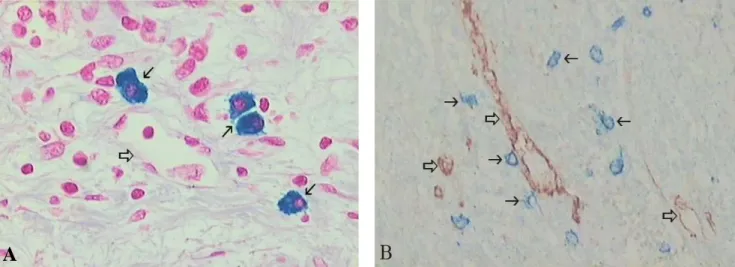
Fig. 2. Mast cells(arrow) stained with alcian blue(A) and Factor VIII/c-Kit(B). Mast cells were located in area adjacent to the

microvessel(open arrow) around the tumor foci. Original magnification X400(A), X200(B).

Fig 1. Mast cells stained with alcian blue(A) and immunostained with c-Kit(B) in invasive squamous cell carcinoma of the uterine

cervix. Asterisk(✱) indicates tumoral epithelium; arrow indicates the mast cell. Original magnification X200.

correlation coefficient를 적용하였다. p값이 0.05 이하이면 통계학적으로 유의한 것으로 판정하였다. 분석에는 SPSS ver 10.0 프로그램을 사용하였다.

III. 결 과

1. 비만세포의 분포와 밀도

자궁경부 조직 내의 비만세포 형태와 아형의 종류를 보기 위해 Enerback(1966)의 원법에 따라 alcian blue 염 색 후 safranin으로 대조염색한 결과 모두 청색으로 염색 되어 alcian blue-양성세포임을 확인하고 배경염색을 위해 safranin 대신 nuclear fast red를 사용하여 대조염색하였 다. 또한 c-kit 면역염색을 하여 alcian blue-양성 비만세포

와 c-kit-양성 비만세포 밀도를 비교하였다. 그 결과 자궁 경부 정상조직, 자궁경부상피내종양, 침윤암종 조직 내의 비만세포는 난원형, 다각형 및 방추형으로 상피 기저막 밑의 간질조직이나 종양세포 주변부의 혈관 가까이에 출 현하였으며 과립형과 탈과립형의 두 형태로 관찰되었다 (Fig. 1, 2).

Alcian blue 염색표본에서 1 ㎟ 평균 비만세포 밀도를 구한 결과 정상(26.2±9.4개)에 비해 CIN I 등급(34.6±10.8 개)에서 약간 증가하였으나, 통계학적으로 의의가 없었다 (p=0.149). 그러나 CIN I

등급에서 CIN

II

등급(55.0±9.2

개)(p<0.001), CIN III

등급(65.4±6.0개)(p<0.001), 미소침

윤암종(77.9±9.7개)(p<0.001), 침윤암종(89.5±11.8개) (p<

0.001)로 진행하면서 각 군간 모두 통계학적으로 유의하 게 증가하였다(Fig. 3). c-kit-양성 비만세포 역시 1 mm

2

당 정상조직(44.8±7.2개)에 비해 CIN I등급(50.7±12.3개)

A B

A

(5)

Fig. 5. Microvessels immunostained with anti-Factor VIII in section of both normal tissue(A) and invasive squamous cell

carcinoma(B) of the uterine cervix. Original magnification X200.

Fig. 3. Mast cell density in normal, CIN and invasive squamous

cell carcinoma of the uterine cervix. Bar represent mean±SD of the six groups.

N, normal tissue; CIN, cervical intraepithelial neoplasia; MI, microinvasive carcinoma, IC, invasive carcinoma.

NS, no significant compared with normal and MI respectively;

* p<0.05 compared with the data of CIN II, CIN III and MI respectively; **p<0.01 compared with the data of CIN I, CIN II, CIN III respectively.

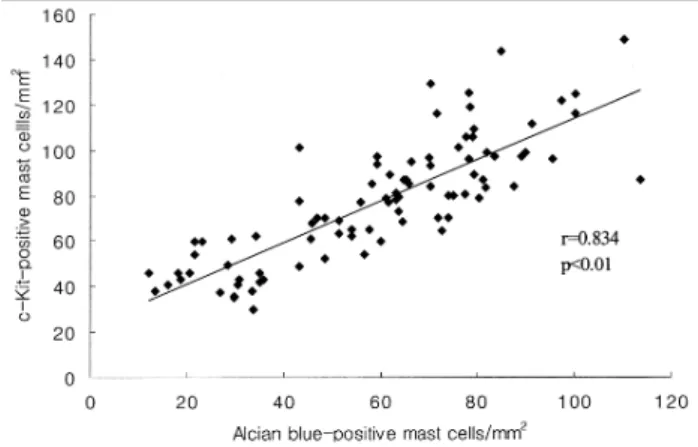
은 약간 증가하였을 뿐 통계학적으로 유의한 차이가 없 었으나(p=0.839), CIN I 등급에서 CIN II등급(69.7±12.1 개)(p<0.01), CIN III 등급(84.0±10.1개) (p<0.05), 미소침 윤암종(99.4±19.8개)(p<0.05) 으로 진행하면서 각 군간 모 두 통계학적으로 유의한 증가를 나타내었다. 그러나 미소 침윤암종에 비해 침윤암종(106.0±18.7개)에서는 약간의 증가는 있었으나 통계학적으로 유의한 차이가 없었다 (p=0.782)(Fig. 3). 비만세포에 대한 alcian blue 염색과 c-Kit 면역염색을 비교한 결과 alcian blue-양성 비만세포 에 비해 c-Kit-양성 비만세포가 전 군에서 높게 출현하였 으나, 두 염색 방법 간에 상관관계를 조사한 결과 매우

Fig 4. Correlation between c-kit-positive and alcian blue-

positive mast cells in normal, CIN and invasive squamous cell carcinoma of the uterine cervix. Linear correlation for two elements is highly significant.

상관성이 높은 것으로 나타났다(Fig. 4).

2. 미세혈관의 밀도

Factor VIII을 사용하여 미세혈관을 면역염색한 결과

정상조직에 비해 자궁경부상피내종양 그리고 침윤암종으

로 진행하면서 미세혈관 수의 증가와 함께 염색강도가

점점 강하게 나타남을 관찰할 수 있었다(Fig. 5). 미세혈

관은 1 mm

2

당 정상조직(11.2±3.1개)에 비해 CIN I 등급

(14.9±3.0개)에서 약간 증가하였으나 통계학적 유의성은

없었다(p=0.320). 그러나 CIN I등급에서 CIN II등급

(6)

Fig. 6. Microvessel density in normal, CIN and invasive

squamous cell carcinoma of the uterine cervix. Bar represent mean±SD of the six groups.

NS, no significant compared with normal; * p<0.05 compared with the data of CIN I, CINII, CIN III and MI respectively
(20.5±2.3개)(p<0.05), CIN III 등급(25.7±3.4개)(p<0.05), 미소침윤암종(31.3±7.45개)(p<0.05), 침윤암종(37.1±7.9 개)(p<0.05)으로 진행하면서 각 군간 모두 통계학적으로 유의하게 증가하였다(Fig. 6).

3. 비만세포 밀도와 미세혈관 밀도의 상관관계

자궁경부 정상조직에서 CIN의 I, II, III 등급을 거쳐, 미소침윤암종과 침윤암종으로의 진행과정에서 비만세포 밀도 증가에 대한 미세혈관 밀도 증가의 상관성을 조사 한 결과 두 변수 간에 매우 유의한 상관성을 보였다(r

=0.795, p<0.01)(Fig. 7).

4. VEGF 발현세포

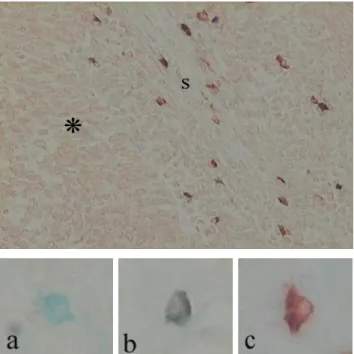
신생혈관 형성인자 분비세포를 동정하기 위해 각 군 별 자궁경부조직의 일부를 선택하여 VEGF 면역염색한 결과 VEGF-양성세포는 침윤암종에서 가장 많이 출현하 였고, 종양의 간질부와 종양 인접부위에서 가장 강하게 발현되었으며, VEGF-양성세포의 출현부위는 비만세포 출현부위와 일치하였다(Fig. 8). 또한 VEGF-양성세포가 비만세포인가를 확인하기 위해 alcian blue로 대조염색한 결과 비만세포에서만 VEGF가 발현되는 것을 관찰할 수 있었으며, VEGF-양성 비만세포는 종양부위로부터 멀어 질수록 VEGF 염색 강도가 점점 약해지는 것을 관찰할 수 있었다(Fig. 8a,b,c).

Fig. 7. Correlation between MCD and MVD in normal, CIN and

invasive squamous cell carcinoma of the uterine cervix. Linear correlation for two elements is highly significant.

Fig. 8. VEGF-postive mast cells in tumor stroma(S). VEGF-

positive mast cells were confirmed by using a VEGF/alcian blue double staining. VEGF-positivity in the cytoplasm of mast cells showed a different reactions depending on the distance between tumor foci and adjacent stroma. The most strong reactions were observed in the cytoplasm of mast cells located at the closest in tumor foci(*). a, weak; b, moderate; c, strong reactions. Original magnification X4000.

III. 고 찰

비만세포는 결장-직장암(Lashner, 1992), 폐선암종

(Takanami 등, 2000), 유방암종(Kankkunen 등, 1997)에서

(7)

증가하며. 유방암종에서는 겨드랑이 림프절 전이가 없는 환자에 비해 전이가 있는 환자에서 특히 많이 증가하는 것으로 보고되어 있다(Thorensen 등, 1982). 또한 랫트를 이용한 동물실험에서는 종양 이식부위에서 비만세포의 증가는 신생혈관 수를 증가시켜 종양의 증식과 전이에 영향을 미친다는 것을 암시하였다(Dethlefsen 등, 1995) 이 같은 결과는 그 후 폐의 침윤전암종과 암종(Fisseler- Eckhoff 등, 1996), 유방의 상피내관암종(Engels 등, 1997) 그리고 자궁경부상피내종양(Dobbs 등 1997)에서 정상조 직에 비해 혈관형성이 뚜렷이 증가한다는 보고들에 의해 증명되어 왔다. 우리의 실험 결과 비만세포와 미세혈관의 밀도가 정상조직과 CIN I 등급 사이에는 유의한 차이가 없었으나, CIN II 등급에서 침윤암종으로 진행하면서 뚜 렷하게 증가하였으며, 증가된 비만세포가 종양 주변의 혈 관 가까이에 분포하고 있어서 비만세포 밀도와 미세혈관 밀도의 증가가 종양의 발생과 진행에 있어서 서로 매우 유기적인 연관이 있음을 확인하였다. 이 결과는 다른 종 양에서의 결과(Toth 등, 2000; Benitez-Bribiesca 등, 2001) 와 일치할 뿐만 아니라 자궁경부내상피내병변과 침윤암 종에 대한 연구에서 CIN I 등급에 비해 CIN II와 CIN III 등급에서 미세혈관밀도가 유의하게 증가하며, 침윤전암 종보다 침윤암종에서 미세혈관밀도가 증가한다는 보고 (Ozalp et al, 2003)와 상피내암종에 비해 미소침윤암종에 서 미세혈관밀도가 유의하게 증가하는데 이는 종양의 침 윤이 혈관신생을 촉진한다는 결과(Sotripoulou 등, 2004) 와도 일치하였다. 따라서 이미 여러 연구자들에 의해 제 기된 종양의 성장이나 상처 치유과정에서 혈관신생이 비 만세포의 중재로 이루어진다는 가정이 자궁경부의 종양 증식과 발생과정에도 그대로 적용됨을 확인할 수 있었다.

한편 종양 진행의 후기 단계에서 비만세포의 탈과립은 흔하게 관찰되는 소견이다. 사람 유방암에 관한 연구에서 비만세포의 탈과립은 생존율 저하와 관계가 있으며 (Hartweit et. al, 1984), In vivo의 관찰에서도 비만세포의 활성과 비만세포로부터 방출된 중개물질이 종양의 증식 률을 높이는 반면, 약물에 의한 비만세포 활성 억제 작용 을 방해하는 하는 것으로 나타났다(Dabbous 등, 1991).

본 실험에서도 자궁경부상피내종양에 비해 침윤암종에서 종양세포 주변에 출현하는 비만세포에서 탈과립이 많이 나타났으며, 탈과립세포들은 주로 혈관 가까이 분포하고 있음을 관찰할 수 있었다. 이는 비만세포가 종양의 혈관 신생에 매우 밀접하게 관여한다는 것을 구조적으로 보여 주는 것이다. 뿐만 아니라 비만세포는 다양한 cytokines에

의해 탈과립되어 잠재적 혈관신생 인자인 vascular endothelial growth factor(VEGF), basic fibroblast growth factor(bFGF) 및 stem cell factor(SCF)의 방출을 일으키는 것으로 알려져 있다(Reed 등, 1995; Grutzkau 등, 1998;

Zhang 등, 2000).

이 중 VEGF가 혈관신생의 가장 강력한 중개물질로 알려져 있다(Pierce 등, 1995). VEGF는 이량체(dimeric)로 된 헤파린 결합 당단백질(heparin-binding glycoprotein)로 PDGF(platelet-derived growth factor) family의 하나로 처 음 종양세포 배양액으로부터 발견되었으며(Keck 등, 1989), 내피세포에 고도로 특이적인 세포분열촉진 활성을 갖고 있는 것으로 보고되어 있다(Sanger 등, 1983). 또한 VEGF는 종양의 혈관신생 이외에 다른 질환의 혈관신생 에서 상당히 기여하는 것으로 생각하고 있다(Ferrara 등, 1992; Dvorak 등, 1995). 자궁경부암에서도 Kim 등(2003) 은 VEGF가 자궁경부암의 혈관신생을 촉진하며, VEGF 의 발현은 p53에 의해 조절되는 것으로 보고하였다.

우리의 연구에서는 각 군에서 일부 조직만을 택하여

VEGF로 면역염색한 결과 자궁경부내상피내종양의 등급

이 높아지고 침윤암종으로 진행 할수록 VEGF-양성세포

가 많아짐을 관찰할 수 있었다. 또한 침윤암종에서도 종

양에 가까운 부위에 존재한 것일수록 염색강도가 강하고

종양으로부터 멀리 존재하는 것일수록 염색강도가 약하

게 나타나 부위에 따라 VEGF의 발현양이 차이가 있음을

알 수 있었다. 더욱이 VEGF/alcian blue 이중염색결과

VEGF-양성세포는 모두 비만세포로 확인되어 VEGF는

비만세포에서 분비되는 주요 중개제의 하나임을 확인할

수 있었다. 이러한 결과는 혈관신생이 자궁경부암의 발생

과 진행과정에서 매우 중요하며, 종양에서의 혈관신생은

비만세포에서 분비되는 VEGF에 의해 촉진된다는 것을

의미한다. 이는 Kim 등(1998)의 위암 연구에서 VEGF 발

현군이 비발현군에 비해 미세혈관 수가 증가하였다는 것

과 Toth 등(2000)의 전립선암의 진행에서의 VEGF-양성

비만세포 수가 증가할수록 미세혈관 수가 증가하였다는

것과 일치하는 결과이다. 따라서 자궁경부암의 발생과 진

행과정에서는 종양세포들로부터 분비되는 cytokine에 의

해 비만세포가 동원되고, 이들 비만세포로부터 방출된

VEGF에 의해 혈관신생이 이루어져 종양의 진행을 촉진

할 것으로 생각된다. 뿐만 아니라 VEGF가 위암의 림프

절 전이 환자에서 특히 높게 발현되며(Maeda 등, 1995),

VEGF 비발현군에 비해 발현군에서 생존률이 낮아진다는

보고들(Han 등, 1999)을 종합해 볼 때, 자궁경부암의 전

(8)

이와 환자의 예후에 있어서도 VEGF가 매우 많은 영향을 미칠 것으로 충분히 예견할 수 있었다. 따라서 이후 비 만세포로부터 분비된 VEGF가 자궁경부암의 전이와 예후 에 어떻게 영향을 미치는 가에 대한 연구가 필요할 것으 로 생각된다.

IV. 결 론

자궁경부암의 발생과 진행에서 혈관신생에 미치는 비 만세포의 역할을 밝히기 위하여 자궁경부상피내종양과 침윤편평상피암종을 대상으로 비만세포밀도, 미세혈관 수 및 VEGF의 발현양상을 조사하였다. 조사결과 비만세 포밀도는 정상조직과 CIN I 등급에서는 통계학적 차이가 없었으나 CIN I등급에서 침윤암종으로 진행하면서 통계 학적으로 뚜렷한 증가를 나타내었다(p<0.001). 미세혈관 밀도 역시 CIN I 등급에서 침윤암종으로 진행하면서 통 계학적으로 뚜렷하게 증가하였으며(p<0.001), 비만세포밀 도와 미세혈관밀도 사이의 상관성을 조사한 결과 매우 높은 상관성을 나타내어 비만세포의 증가가 미세혈관 증 가에 매우 밀접한 관계가 있음을 확인할 수 있었다. 뿐만 아니라 혈관신생 마커로 알려진 VEGF에 대한 면역염색 결과 CIN과 침윤암종에서 VEGF에 강한 양성을 보이는 세포가 모두 비만세포임을 확인하였고, VEGF-양성 비만 세포는 특히 종양세포 가까이에 존재하는 것일수록 강한 양성을 보였으며, 흔히 탈과립 상태로 혈관 가까이에 존 재하는 것을 관찰할 수 있었다. 이상의 결과를 종합해 볼 때 자궁경부상피내종양과 침윤암종 내에 증가하는 비만 세포는 VEGF를 분비하여 혈관신생을 촉진하여 암의 발 생과 진행에 밀접히 관여하는 것으로 생각된다.

참 고 문 헌

1. Acikalin MF, Oner U, Topcu I, Yasar B, Kiper H, Colak E. Tumor angiogenesis and mast cell density in the prognostic assessment of colorectal carcinoma.

Digestive and Liver Disease 37:162-169, 2005.

2. Benitez-Bribiesca L, Wong A, Utrera D, Castellanos E. The role of mast cell tryptase in neoangiogenesis of premalignant and malignant lesions of the uterine cervix. J Histochem Cytochem 49:1061-1062, 2001.

3. Cabanillas-Saez A, Schalper JA, Nicovani SM,

Rudolph MI. Characterization of mast cells according to their content of tryptase and chymase in normal and neoplastic human uterine cervix. Int J Gynecol Cancer 12:92-98, 2000.

4. Dabbous MK, Haney L, Nicolson GL, Eckley D, Woolley DE. Mast cell modulation of tumour cell proliferation in rat mammary adenocarcinoma 13762NF. Br J Cancer 63:873-878, 1991.

5. Dabbous MK, Walker R, Haney L, Carter LM, Nicolson GL, Woolley DE. Mast cells and matrix at the sites of tumour invasion in rat mammary adenocarcinoma. Br J Cancer 54:459-465, 1986.

6. Dethlefsen SM, Matsuura N, Zetter BR. Mast cell accumulation at sites of murine tumor implantation:

implications for angiogenesis and tumor metastasis.

Invasion Metastasis 14:395-408, 1995.

7. Dobbs SP, Hewett PW, Johnson IR, Carmichael J, Murry JC. Angiogenesis is associated with vascular endothelial growth factor expression in cervical intraepithelial neoplasia. Br J Cancer 76:1410-1415, 1997.

8. Dvorak HF, Brown LF, Detmar M, Dvorak AM.

Vascular permeability factor/vascular endothelial growth factor, microvascular hyperpermeability, and angiogenesis. Am J Pathol 146:1029-1039, 1995.

9. Elpek O, Gelen T, Aksoy H, Erdogan A, Dertsiz L, Dermircan L, Keles N. The prognostic relevance of angiogenesis and mast cells in squamous cell carcinoma of the oesophagus. J Clin Pathol 54:940- 944, 2001.

10. Enerback L. Mast cells in rat gastrointestinal mucosa.

Acta Pathol Microbiol Immunol Scand 66:303-312, 1966.

11. Engels K, Fox SB, Witehouse RM, Gatter KC, Harris AL. Up-regulation of thymidine phosphorylase expression is associated with a discrete pattern of angiogenesis in ductal carcinoma in situ of the breast.

J Pathol 182:414-420, 1997.

12. Ferrara N, Houck K, Jakeman L, Leung DW.

Molecular and biological properties of the vascular

endothelial growth factor family of proteins. Endocr

Rev 13:18-32, 1992.

(9)

13. Fisseler-Eckhoff A, Rothstein D, Muller KM.

Neovasculisation in hyperplastic, metaplastic and potentially preneoplastic lesions of the bronchial mucosa. Virchows Arch 429:95-100, 1996.

14. Folkaman J. What is the evidence that tumours are angiogenesis dependant? J Natl Cancer Inst 82:4-6, 1990.

15. Gasparini G. Prognostic value of vascular endothelial growth factor in breast. The Oncologists 5:37-44, 2000.

16. Grutzkau GA, Kruger-Krasagakes S, Baumeister H.

Synthesis, storage, and release of vascular endothelial growth factor/vascular permeability factor (VEGF/

VPF) by human mast cells: implications for the biological significance of VEGF206. Mol Biol Cell 9:875-884, 1998.

17. Han GS, Cha SJ, Park YK, Chi KC, Park SJ, Lim HM, Park SI, Park US. Prognostic significance of VEGF in human stomach cancer. J Korean Cancer Assoc 32:297-303, 2000.

18. Hartweit F, Thorensen S, Tangen M, Maartman-Moe H. Mast cell changes and tumor dissemination in human breast carcinoma. Invasion Metastasis 4:146- 55, 1984.

19. Jekal SJ, Cha HH, Choi YJ, Rho JS, Kwak HI. Mast cells in squamous intraepithelial lesions and squamous cell carcinoma of uterine cervix. Korean J Clin Lab Sci 31(2);250-257, 1997.

20. Kankkunen JP, Harvima IT, Naukkarinen A.

Quantitative analysis of tryptase and chymase containing mast cells in benign and malignant breast lesions. Int J Cancer 72:385-388, 1997.

21. Keck PJ, Hauser SD, Krivi G. Vacular permeability factor, an endothelial cell mitogen related to PDGF.

Science 246:1309-1312, 1989.

22. Kim MI, Kim SY, Lee JJ, Yoon HJ, Kim YW, Cho KS. Prognostic effect of vascular endothelial growth factor and angiogenesis in Gastric Carcinoma. Cancer Research and Treatment 35:218-223, 2003.

23. Lashner BA. Risk factors for small bowel cancer in Crohn's disease. Dig Dis Sci 37:1179-1184, 1992.

24. Maeda K, Chung YS, Takatsuka S, Ogawa Y, Onoda

N, Sawada T, Kato Y, Nitta A, Arimoto Y, Kondo Y.

Tumor angiogenesis and tumor cell proliferation as prognostic indicators in gastric carcinoma. Br J Cancer 72:319-323, 1995.

25. Ozalp S, Yalcin OT, Oner U, Tanir HM, Acikalin M, Sarac I. Microvessel density as a prognostic factor in preinvasive and invasive cervical lesions. Eur J Gynaecol Oncol 24(5):425-428, 2003.

26. Pierce EA. Avery RL, Foly ED, Aiello LP, Smith LE.

Vascular endothelial growth factor/vascular perme- ability factor expression in a mouse model of retinal neovasculization. Proc Natl Acad Sci USA 92:905- 909, 1995.

27. Ranier G, Labriola A, Achille G, Florio, Zito AF, Grammatica L, Paradiso A. Microvessel density, mast cell density and thymidine phosphorylase expression in oral squamous carcinoma. Int J Oncol 21:1317- 1323, 2002.

28. Reed JA, Albino AP, McNutt NS. Human cutaneous mast cells express basic fibroblast growth factor. Lab Invest 72:215-22, 1995.

29. Saeki T, Tanada M, Takashima S, Saeki H, Takiyama W, Nishimoto M, Moriwaki S. Correlation between expression of platelet-derived endothelial celll growth factor(thymidine phosphrylase) and microvessel density in early-stage human colon carcinomas. Jpn J Clin Oncol 27(4)::227-230, 1997.

30. Senger DR, Galli SJ, Dvorak AM, Perruzzi CA, Harvey VS, Dvorak HF. Tumor cells secrete a vascular permeability factor promotes accumulation of ascites fluid. Science 219:983-985, 1983.

31. Sotiropoulou M, Diakomanolis E, Elsheikh A, Loutradis D, Markaki S, Michalas S. Angiogenic properties of carcinoma in situ and microinvasive carcinoma of the uterine cervix. Eur J Gynaecol Oncol 25(2):219-221, 2004.

32. Takanami I, Takeucji K, Naruke M. Mast cell density is asssociated with angiogenesis and poor prognosis in pulmonary adenocarcinoma. Cancer 88:2686-2692, 2000.

33. Thorensen S, Tangen M, Harveit F. Mast cells in the

axillary nodes of breast cancer patients. Diag Histo-

(10)

patholo 5:65-67, 1982.

34. Toth T, Jimi S, Kawamoto N, Takebayashi S.

Prostatic carcinoma. Correlation between neovasculari- zation and peritumor accumulation of mast cells overexpressing vascular endothelial growth factor.

Med Bull. Fukuoka Univ 27(1):13-23, 2000.

35. Weidner N. Tumor angiogenesis: review of current applications in tumour prognostication. Semin Diagn Pathol 10:302-13, 1993

36. Zhang W, Stoica G, Tasca SI, Kelly KA, Meininger

CJ. Modulation of tumor angiogenesis by stem cell

factor. Cancer Res 60:6757-6762, 2000

수치

Fig 1. Mast cells stained with alcian blue(A) and immunostained with c-Kit(B) in invasive squamous cell carcinoma of the uterine  cervix
Fig. 5. Microvessels immunostained with anti-Factor VIII in section of both normal tissue(A) and invasive squamous cell  carcinoma(B) of the uterine cervix
Fig. 8. VEGF-postive mast cells in tumor stroma(S). VEGF-  positive mast cells were confirmed by using a VEGF/alcian blue  double staining

참조

관련 문서

Differential Expression of Desmoglein1, Desmoglein3, Epithelial Membrane Antigen, Ber-EP4 and CD10 in Basal Cell Carcinoma and Squamous Cell Carcinoma

Objective :::: The neovascularization is an essential a factor for the growth of solid organ cancer, and especially vascular endothelial growth factor (VEGF)

Here, we found that TAMR-MCF-7 cells had undergone EMT, evidenced by mesenchymal-like cell shape, down-regulation of the basal E-cadherin expression

Objective: The purpose of this study was to analyze recent trend in incidence of basal cell carcinoma and squamous cell carcinoma in patients from the Gwangju City

In this study, platelet-derived growth factors-BB (PDGF-BB), vascular endothelial growth factor (VEGF), and insulin-like growth factor-1 (IGF-1) were quantified in the PRF

4 &gt; Effects of Taro on COX-2 expression and iNOS expression(hot water) in human thyroid cancer cells. The cells were pretreated for 48hours with either

These results suggest that the bilobalide inhibits the cell proliferation and induces the apoptotic cell death in FaDu human pharyngeal squamous cell carcinoma via both

Taken together, these results suggested that latex containing the ficin inhibited the cell growth and induced apoptosis by caspase and Bcl-2 family signaling pathway in