1
Copyright © 2018 The Korean Society of Fisheries and Aquatic Science pISSN:0374-8111, eISSN:2287-8815
서 론
대장균
(Escherichia coli)
은사람이나가축의장내에주로서 식하는세균이며,
가축사육환경및축·
수산식품유래에서의 항균제내성균모니터링지표세균으로사용되고있으며,
내성 균의항균제내성패턴의변화와확산메커니즘을이해하는데 아주유용한세균으로알려져있다(Levin et al., 1997; NIFDS,
2015).
또한,
대장균은패류의위생품질평가뿐만아니라유럽연합에서는생식용또는가공원료용패류를생산하는해역의 등급을분류하는 지표종으로사용하고있다
(European Com- mission, 2004).
한산거제만해역은경상남도거제시와통영시한산면에둘러 싸인반폐쇄성내만으로주로굴및멍게가양식되고있으며
,
자란만사량도해역은경상남도고성군과통영시사량면사이에위치한해역으로굴
,
피조개,
가리비등주로패류가양식되 고있는해역이다.
한산거제만및자란만사량도해역주변배 수유역에는자연하천,
생활하수관,
하수처리장등수많은점오 염원(point-sources)
들이위치하고있으며,
이들육상오염원에 서해역으로유입되는배출수에포함된분변계대장균및대장 균은건·
우기시한산거제만및자란만사량도해역에서양식되 고있는패류의위생품질을악화시키는주된요인으로알려져 있다(Lee et al., 2010; Ha et al., 2011; Mok et al., 2016; Mok et al., 2016).
항균제내성균이하천수
,
생활하수등육상오염원배출수를 통하여패류생산해역으로유입되며해양수계에존재하는동 종또는이종세균간에integron, plasmid
및transposon
과같 은이동성내성인자(mobile element)
가수평적전이(horizontal
transfer)
를통해내성균확산또는다제내성균출현을야기시한산거제만 및 자란만사량도 해역 육상오염원 배출수에서 분리한 대장균의 항균제 내성 패턴
박큰바위*·김송희·함인태·류아라·권지영·김지회
1·유홍식·이희정·목종수
국립수산과학원 식품위생가공과, 1국립수산과학원 연구기획과
Antimicrobial Resistance Patterns of Escherichia coli Isolated from Discharged Water from Inland Pollution Sources in the Hansan-Geoje- man and Jaranman-Saryangdo Areas of Korea
Kunbawui Park*, Song Hee Kim, In Tae Ham, A Ra Ryu, Ji Young Kwon, Ji Hoe Kim
1
, Hong Sik Yu, Hee Jung Lee and Jong Soo MokFood Safety and Processing Research Division, National Institute of Fisheries Science, Busan 46083, Korea
1Research and Development Planning Department, National Institute of Fisheries Science, Busan 46083, Korea
We investigated patterns of antimicrobial resistance in Escherichia coli isolated from the water discharged from in- land pollution sources in the Hansan-Geojeman and Jaranman-Saryangdo areas of Korea. A total of 217 strains of E.
coli were isolated from 23 point-sources. These strains were tested for their susceptibility to 16 antimicrobial agents used in Korea for medical or veterinary therapy. The highest level of antibiotic resistance among the isolated strains was to tetracycline 10.6%, followed by ampicillin (3.2%), nalidixic acid (2.8%), rifampin (1.8%), trimethoprim (1.8%), trimethoprim/sulfamethoxazole (1.8%), chloramphenicol (1.4%), streptomycin (1.4%), cephalothin (0.5%) and gentamicin (0.5%). Resistance to at least one antimicrobial agent was present in 17.1% of the E. coli isolates.
Only four of the isolated strains of E. coli showed multiple antibiotic resistance, which is defined as resistance to more than four antibiotics.
Key words: Escherichia coli , Antimicrobial resistance, Inland pollution source, Hansan·Geojeman, Jaranman·Saryangdo
This is an Open Access article distributed under the terms of the Creative Commons Attribution Non-Commercial Licens (http://creativecommons.org/licenses/by-nc/3.0/) which permits unrestricted non-commercial use, distribution, and reproduction in any medium, provided the original work is properly cited.
https://doi.org/10.5657/KFAS.2018.0001 Korean J Fish Aquat Sci 51(1) 1-7, February 2018
Received 6 November 2017; Revised 28 November 2017; Accepted 9 December 2017
*Corresponding author: Tel: +82. 51. 720. 2642 Fax: +82. 51. 720. 2619
E-mail address: [email protected]
킬수있다
(Fiqueira et al., 2011; Moura et al., 2012; Moura et al., 2014; Kotlarska et al., 2015).
또한항균제내성균확산및 다제내성균출현은질병의치료및예방뿐만아니라성장촉진 목적으로사용되는항균제와밀접한관계가있는것으로알려 져있다(Van den Bogaard and Stobberingh, 1999).
한편
,
패류생산해역에서강우발생으로해역주변에소재한 육상오염원에서배출되는오염물질이패류중의세균학적오 염도를증가시킨다는연구(Park et al., 2011; Park et al., 2012)
와생산해역패류양식장에서분리한대장균의항균제내성특 성과다제내성균분포에대한연구는활발하게이루어지고있 으나(Park et al., 2013; Jo et al., 2016; Kwon et al., 2016),
육상 오염원배출수중에존재하고있는대장균에대한항균제내성 특성과이들항균제내성균이패류생산해역에미치는영향평 가에관한연구는미비한실정이다.
본연구에서는패류생산해역의위생관리를위한육상오염원 관리대책과배출수에포함된항균제내성균이패류양식장에서 의항균제내성균출현과확산에미치는영향평가를이해하는 데기초자료로활용하고자한산거제만및자란만사량도해역 주변배수유역에위치한육상오염원배출수에서
E. coli
를분리 하고,
분리된E. coli
의항균제내성특성을조사하였다.
재료 및 방법
육상오염원 조사지점 및 배출수 채취
한산거제만및자란만사량도해역배수유역에소재한육상오 염원배출수에존재하는대장균의항균제내성특성을조사하
기위하여
2013
년에한산거제만및자란만사량도해역에위치한육상오염원을각각
12
개소(
하천수7
개소,
마을하수2
개소및하수처리장
3
개소)
및11
개소(
하천수7
개소,
마을하수1
개소 및하수처리장3
개소)
의조사지점을설정하고,
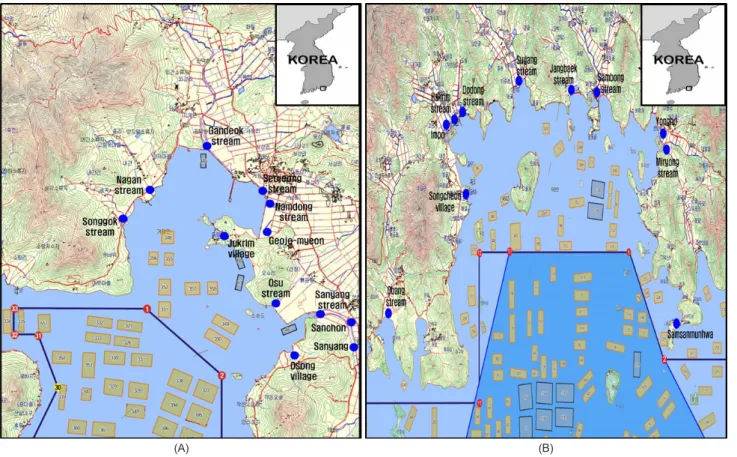
이들육상오염원 에서방출되는배출수를채취하였다(Fig. 1).
배출수는멸균된비이커로채수한다음
1 L
무균채수병에옮겨담고, 10℃
이하로보관하여실험실로운반하였으며
,
즉시대장균을분리하기 위한시험시료로사용하였다.
대장균의 분리
육상오염원배출수중의대장균의분리는
The recommend- ed procedures for the examination of seawater and shellfish
(APHA, 1970)
를일부 변형하여사용하였다.
배출수시료를lauryl tryptose broth (Difco, USA)
에접종하여배양한후가스 가생성되어있는시험관을멸균된일회용loop (10 µL)
로EC broth (Difco, USA)
에접종하여44.5℃
에서24
시간추가배양Fig. 1. Sampling locations of inland pollution sources from the Hansan-Geojeman (A) and Jaranman-Saryangdo (B) area.
(A) (B)
하였으며
,
가스생성이확인된시험관배양액을tryptone bile glucuronoide agar (Oxoid, UK)
에획선도말하여전형적인반 응을나타내는청색집락(blue colony)
또는청녹색집락(blue- green colony)
을분리하여동정하였다.
대장균의 동정
대장균추정균주인청색또는청녹색집락을
tryptic soy agar (Merck, Germany)
에순수분리배양한후0.85% NaCl
완충용 액에배양균을현탁하여McFarland No. 0.5
로희석조정하였 고, VITEK 2 GN card (BioMerieux Vitek, France)
에각각의 균현탁액을주입시킨후VITEK system (BioMerieux Vitek,
France)
를이용하여대장균을동정하고,
항균제감수성시험균주로사용하였다
. 항균제 감수성 시험
육상오염원배출수에서분리한대장균에대한항균제감수성 시험은
Acar and Goldstein (1991)
의디스크확산법을사용하 였다.
먼저,
각분리균주를muller hinton broth (Merck, Ger- many)
에서배양한다음,
균배양액의농도를McFarland No.
0.5
로 희석 조정하였으며희석한균액을muller hinton agar (Merck, Germany)
평판에도말하고5
분간실온에서방치한후조사대상항균제디스크
(Φ 8 mm)
를평판에고착시켰다.
감수성시험에는
amikacin (30 µg; AN), amoxicillin/clavu- lanic acid (20 µg/10 µg; AMC), ampicillin (10 µg; AM), aztre- onam (30 µg; ATM), cefazolin (30 µg; CZ), cefotetan (30 µg;
CTT), cephalothin (30 µg; CF), chloramphenicol (30 µg; C), gentamicin (10 µg; GM), nalidixic acid (30 µg; NA), pipemi- dic acid (20 µg; PIP), rifampin (5 µg; RA), streptomycin (10 µg; S), tetracycline (30 µg; TE), trimethoprim (5 µg; TMP), trimethoprim/sulfamethoxazole (1.25 µg/23.75 µg; SXT)
등16
종으로OXOID
사(UK)
의 항균제디스크제품을사용하였으며
,
미국CLSI (2012)
의정도관리허용기준(quality control
range)
에부합됨을확인한후분리한대장균에대한항균제감수성시험을실시하였다
.
결과 및 고찰
E. coli 분리 균주 현황
한산거제만및자란만사량도해역에위치한주요육상오염원 배출수중에존재하는대장균의항균제감수성을알아보기위 하여
2013
년에육상오염원배출수(
하천수14
개소,
마을하수3
개소및하수처리장6
개소)
를채취하여E. coli
균주를분리하였 으며,
그분리현황을Table 1
에나타내었다.
육상오염원
23
개소에서총E. coli 217
균주를분리하였으며,
하천수(14
개소)
및마을하수(3
개소)
에서각각181
균주및36
균 주가분리되었으나,
하수처리장(6
개소)
배출수에서는E. coli
가분리되지않았다
.
시료채취당시하수처리장에는자외선(ultra- violet)
살균장치가설치되어작동중에있었으며, Shin et al.
(2004)
은하수방류수중의E. coli
는자외선램프하고의접촉시간과유량에따라살균효과는약간의차이는보였지만
, E. coli
이
1-5
분사이에99%
이상의사멸하였다는연구결과로볼때자외선살균효과에의해하수처리장배출수에서
E. coli
가분리되 지않은것으로추정된다.
E. coli 분리 균주의 항균제 내성 특성
한산거제만및자란만사량도해역의육상오염원배출수에서 분리한
E. coli (
총217
균주)
를대상으로16
종의항균제에대해 감수성시험을실시하였으며,
그항균제내성결과를Table 2
에나타내었다.
분리된E. coli 217
균주는tetracycline (10.6%)
에대한내성율이가장높은것으로확인되었으며, ampicilline, nalidixic acid, trimethoprim, trimethoprim/sulfamethoxazole, rifampin, streptomycin, chloramphenicol, gentamicin, cepha- lothin
에대해서는4%
이하의내성율을나타내었고, amikacin, amoxicillin/clavulanic acid, aztreonam, cefazolin, cefotetan, pipemidic acid
에대해서는모든분리된E. coli
균주에서감수 성인것으로확인되었다.
Kwon et al. (2016)
은 남해안창선 해역의육상오염원에서분리한대장균의항균제내성을조사한결과
, tetracycline
및ampicillin
내성율이각각96.7%
및81.5%
로나타났다고보고 하였으며, Cho et al. (2014)
은낙동강및금호강에서분리된E.
coli
는nalidixic acid, aztreonam
및gentamicin
내성율이각각83.1%, 60.2%
및38.6%
이었다고보고하여본연구결과에서 확인된항균제내성율보다는상당히높았다.
이러한항균제내 성율결과차이는육상오염원주변에존재하는의료시설,
축산 농가등과같이항균제사용빈도가많은시설의폐수유입여부 등육상오염원의종류(source)
에기인한것으로추정되며,
육 상오염원배출수에서의항균제내성균의출현은주로폐수처 리장,
가축사육시설등의배출수및처리되지않은오수등이 방류되어하천등으로유입됨으로써야기된다고알려져있다(Peak et al., 2007; Ferreira da Silva M et al., 2007; Reinthaler et al., 2010).
한편
,
강우발생후하천수,
생활하수등육상오염원의배출 수가패류생산해역으로유입되어패류중의세균학적오염도 가증가하였다는연구결과(Lee et al., 2010; Park et al., 2011;
Park et al., 2012)
로볼때육상오염원배출수에존재하는항균 제내성균이패류에서분리되는항균제내성균에직접적인영 향을미칠수있을것으로사료되며, Kwon et al. (2016)
은남해 안창선해역배수유역에소재한육상오염원과이들오염원과 인접한패류양식장에서채취한지중해담치(Mytilus gallopro-
vincialis)
에서분리한대장균의항균제내성을조사한결과,
지 중해담치에서분리된대장균의항균제내성은육상오염원의영 향에기인된것으로판단되었다고보고하였다.
이상의연구결Table 1. Distribution of Escherichia coli isolates in the discharged water from inland pollution source in the drainage area of Hansan- Geojeman and Jaranman-Saryangdo area
Area Type of discharge Sampling station No. of Escherichia coli isolates
Hansan-Geojeman
Domestic waste water Jukrim village 25
Osong village 0
Waste water treatment facility
Geoje-myeon 0
Sanchon 0
Sanyang 0
Stream water
Songgok 13
Nagan 4
Gandeok 16
Seojeong 43
Namdong 9
Osu 10
Sanyang 10
Jaranman-Saryangdo
Domestic waste water Songcheon village 11
Waste water treatment facility
Samsanmunhwa 0
Yongho 0
Impo 0
Stream water
Miryong 8
Sambong 17
Jangbaek 1
Suyang 17
Dodong 12
Hakrim 21
Obang 0
Table 2. Antimicrobial resistance of Escherichia coli isolates in the discharged water from inland pollution source
Antimicrobial agents Disc potency (µg/disk) Diffusion zone break point (mm) No. of isolates (%)
Amikacin (AN) 30 <14 0 (0.0)
Amoxicillin/clavulanic acid (AMC) 20/10 <13 0 (0.0)
Ampicillin (AM) 10 <13 7 (3.2)
Aztreonam (ATM) 30 <10 0 (0.0)
Cefazolin (CZ) 30 <14 0 (0.0)
Cefotetan (CTT) 30 <12 0 (0.0)
Cephalothin (CF) 30 <14 1 (0.5)
Chloramphenicol (C) 30 <12 3 (1.4)
Gentamicin (GM) 10 <12 1 (0.5)
Nalidixic acid (NA) 30 <13 6 (2.8)
Pipemidic acid (PIP) 20 <17 0 (0.0)
Rifampin (RA) 5 <17 4 (1.8)
Streptomycin (S) 10 <11 3 (1.4)
Tetracycline (TE) 30 <14 23 (10.6)
Trimethoprim (TMP) 5 <10 4 (1.8)
Trimethoprim/sulfamethoxazole (SXT) 1.25/23.75 <10 4 (1.8)
과를종합해볼때
,
수산물생산해역에서의항균제내성균출현 예방을위해서는육상오염원의관리가체계적으로이루어져야 할것으로여겨진다.
여러종류의항균제에내성을나타내는내성균들을다제내성 균
(Multiple antimicrobial resistance bacteria; MARB)
이라고 부르며,
하천수,
생활하수등육상오염원배출수에존재하는다 제내성균이수산물생산해역으로유입되어수산물을오염시키 거나수영등해양레저활동을하면서직ㆍ
간접적으로인체에 게영향을미칠수있어육상오염원배출수에존재하는다제내 성균은공중보건학적측면에서세계적인문제로대두되고있다(Den nesen et al., 1998; Souli et al., 2008).
본연구에서
4
종이상의항균제에내성을나타내는다제내성 균은E. coli 4
균주(1.9%)
로간덕천(3
균주)
및서정천(1
균주)
에 서분리되었으며(Table 3),
이들하천주변에위치한주거지역에서처리되지않은오수에서유입된것으로추정된다
. Kwon
et al. (2016)
은창선해역주변배수유역에소재한육상오염원배출수에서분리한
E. coli
의다제내성균비율이90.9%
이었으 며, Son et al.(2009)
은어류양식장사육해수에서분리한E. coli
의
55.8%
가4
종이상의항균제에내성을가지고있는것으로확인되었고
, Park et al.(2017)
은굴,
멍게및해삼에서분리한E.
coli
중의다제내성균비율이23.1%
이었다고보고하였다.
이러 한결과를차이는항균제에직접적인노출이많은어류양식장 의경우에는잦은항균제사용으로인하여다제내성균이많이분리된것으로여겨지며
,
육상오염원배출수경우에는하천주 변에위치한가축사육시설의축산폐수,
주거지역에서방출되 는생활하수유입차이에기인된것으로추정된다.
Tendencia and Pena (2001)
은항균제를전혀사용하지않은 새우양식장보다는 항균제를 사용하고 있는 양식장에서의다 제내성균비율이높았다고보고하였다.
또한,
식품의약품안전 평가원(NIFDS, 2015)
는소,
돼지및닭의분변에서분리된E.
coli
의다제내성률을조사한결과,
소에서분리한E. coli
균주 의24.7%,
돼지에서는분리한E. coli
균주의64.6%,
닭에서는90.1%
가3
종이상의항균제에내성을나타내었다고보고하였다
.
이상의결과로볼때,
하천수,
생활하수등과같이육상오 염원배출수를통하여항균제내성균이지속적으로수산물생 산해역으로유입되며,
패류등수산물에서의항균제내성균의출현빈도가증가할수있을것으로추정되며
, E. coli
가가진항균제내성인자가인간에게질병을유발시킬수있는병원성
세균에게전이될가능성도높아질것으로사료된다
. Lee et al.
(2007)
는부산지역하천에서plasmid
매개성광범위β–lactam
분해효소(extended spectrum β–lactamase)
를생성하는E. coli
와Klebsiella pneumoniae
를분리하였으며,
이들세균이가진 내성인자는항균제감수성대장균에게전달되었다고보고하 였다.
따라서육상오염원에서분리되는항균제내성균과이들내성 균이가지고있는항균제내성인자
(plasmid, transposon, inte- gron)
들이장염비브리오균(Vibrio parahaemolyticus)
등과같 은해양상재병원성세균에게미치는영향에관한연구에활용 될수있도록육상오염원배출수에대한항균제내성균모니터 링과분리된내성균의내성기작에대한연구가지속적으로수 행되어야할것으로사료된다.
한편으로패류등수산물생산해 역에서항균제내성균출현및확산방지를위해생활하수,
축산 폐수등육상유래오염물질의해양유입차단을위한오염원관 리대책수립이요구된다.
사 사
이 논문은
2018
년도 국립수산과학원 수산과학연구사업(R2018056)
의지원으로수행된연구이며연구비지원에감사드립니다
.
References
Acar JF and Goldstein FW. 1991. Disk susceptibility test. In:
Antibiotics in Laboratory Medicine, Lorian, V. Ed., Wil- liams & Wilkins, Philadelphia, U.S.A., 17-52.
APHA (American Public Health Association) 1970. Recom- mended procedures for the examination of seawater and shellfish. 4th Ed. American Public Health Association, Washington D.C., U.S.A., 1-47.
Cho JK, Kim HD, Kwon SH, Kim JH, Jang SI, Park CK and Table 3. Antimicrobial resistance profiles of Escherichia coli iso-
lates in the discharged water from inland pollution source No. of
antimicrobials Most frequent patterns No. of resistant isolates Total
(%)
0 180 82.9
1
S 1
13.8
C 2
NA 2
AM 3
RA 3
TE 19
2
AM/CF 1
1.4
S/TE 1
RA/TE 1
4 NA/ TE/TMP/SXT 1
AM/NA/TMP/SXT 1 0.9
5 AM/NA/ TE/TMP/SXT 1 0.5
7 AM/C/GM/NA/S/TMP/SXT 1 0.5
AM, ampicillin; CF, cephalothin; C, chloramphenicol; GM, gen- tamicin; NA, nalidixic acid; RA, rifampin; S, streptomycin; TE, tetracycline; TMP, trimethoprim; SXT, trimethoprim/sulfamethox- azole.
Kim KS. 2014. Prevalence of antimicrobial resistance and integrons in extended-spectrum β-lactamases producing
Escherichia coli isolated from Nakdong and Gumho river.
Korean J Vet Serv 37, 19-27. http://dx.doi.org/10.7853/
kjvs.2014.37.1.19.
CLSI (Clinical and Laboratory Standard Institute) 2012. Per- formance standards for antimicrobial susceptibility testing.
CLSI document M100-S22. Clinical and Laboratory Stan- dard Institute, Wayne, U.S.A., 44-128.
Dennesen PJ, Bonten MJ and Weinstein RA. 1998. Multiresis- tant bacteria as a hospital epidemic problem. Ann Med 30, 176-185.
European Commission. 2004. Regulation (EC) No 854/2004 of the European Parliament and of the Council of 29 April 2004 laying down specific rules for the organization of offi- cial control on products of animal origin intended for human consumption. Official J Europ Union L139, 206-321.
Ferreira da Silva M, Vaz-Moreira I, Gonzalez-Pajuelo M, Nunes OC and Manaia CM. 2007. Antimicrobial resistance pat- terns in Enterobacteriaceae isolated from an urban waste- water treatment plant. FEMS Microbiol Ecol 60, 166-176.
Figueira V, Serra E and Manaia CM. 2011. Differential patterns of antimicrobial resistance in population subsets of Esche-
richia coli isolated from waste and surface waters. Sci Total
Environ 409, 1017-1023.Ha KS, Yoo HD, Shim KB, Kim JH, Lee TS, Kim PH, Ju JY and Lee HJ. 2011. Evaluation of the influence of inland pol- lution sources on shellfish growing areas after rainfall events in Geoje bay, Korea. Korean J Fish Aquat Sci 44, 612-621.
Kotlarska E, Luczkiewicz A, Pisowacka M and Burzynski A.
2015. Antibiotic resistance and prevalence of class 1 and 2 integrons in Escherichia coli isolated from two wastewater treatment plants, and their receiving waters (Gulf of Gdansk, Baltic Sea, Poland). Environ Sci Pollut Res Int 22, 2018- 2030. http://dx.doi.org/ 10.1007/s11356-014-3474-7.
Jo MR, Park YS, Park K, Kwon JY, Yu HS, Song KC, Lee HJ, Oh EG, Kim JH, Lee TS and Kim PH. 2016. Antimicrobial resistance in Escherichia coli isolated from shellfish farms on the west coast of Korea. Korean J Fish Aquat Sci 49, 13- 19. http://dx.doi.org/10.5657/KFAS.2016.0013.
Kwon SJ, Lee KJ, Jung YJ, Park SG, Go KR, Yang JH and Mok JS. 2016. Antimicrobial resistance of Escherichia coli iso- lates from mussel Mytilus galloprovincialis farms and in- land pollution sources in the Changseon area, Korea. Kore- an J Fish Aquat Sci 49, 564-572. http://dx.doi.org/10.5657/
KFAS.2016.0564.
Lee TS, Oh EG, Yu HD, Ha KS, Yu HS, Byun HS and Kim JH.
2010. Impact of rainfall events on the bacteriological water quality of the shellfish growing area in Korea. Korean J Fish Aquat Sci 43, 406-414.
Lee HK, Kim HJ and Kim GD. 2007. Typing of extended- spectrum β-Lactamases of Escherichia coli and Klebsiella
pneumoniae isolated from rivers in Busan, Korea. Kor J Mi-
crobiol 43, 116-123.Levin BR, Lipsitch M, Perrot V, Schrag S, Antia R, Simonsen L, Walker NM and Stewart FM. 1997. The population genetics of antibiotic resistance. Clin Infect Dis 24, 9-16.
Mok SM, Lee KJ, Kim PH, Lee TS, Lee HJ, Jung YJ and Kim JH. 2016. Bacteriological quality evaluation of seawater and oysters from the Jaranman-Saryangdo area, a designated shellfish growing area in Korea: Impact of inland pollution sources. Marine Pollution Bulletin 108, 147-154. http://
dx.doi.org/10.1016/j.marpolbul.2016.04.036.
Mok JS, Lee TS, Kim PH, Lee HJ, Ha KS, Shim KB, Lee KJ, Jung YJ and Kim JH. 2016. Bacteriological quality evalu- ation of seawater and oysters from the Hansan-Geojeman area in Korea, 2011-2013: impact of inland pollution sourc- es. Springersplus 5, 1-16. http://dx.doi.org/10.1186/s40064- 016-3049-9.
Moura A, Pereira C, Henriques I and Correia A. 2012. Novel gene cassettes and integrons in antibiotic-resistant bacteria isolated from urban wastewaters. Res Microbiol 163, 92- 100.
Moura A, Araujo S, Alves MS, Henriques I, Pereira A and Cor- reia ACM. 2014. The contribution of Escherichia coli from human and animal sources to the integron gene pool in coastal waters. Front Microbiol 419, 1-15. http://dx.doi.org/
10.3389/fmicb.2014.00419.
NIFDS (National Institute of Food and Drug Safety Evaluation).
2015. Monitoring of antimicrobial resistance in animals and carcasses. NIFDS, Cheongju, Korea, 1-129.
Park K, Jo MR, Lee HJ, Kwon JY, Son KT and Lee TS. 2011.
Evaluation of the effect of the dischatged water from Bong stream after events on the bacteriological water quality in Gangjinman, Korea. Korean J Fish Aquat Sci 44, 622-629.
Park K, Jo MR, Kim YK, Lee HJ, Kwon JY, Son KT and Lee TS. 2012. Evaluation of the effects of the inland pollution sources after rainfall events on the bacteriological water quality in Narodo area, Korea. Korean J Fish Aquat Sci 45, 414-422. Http://dx.doi.org/10.5657/KFAS.2012.0414.
Park K, Park JY, Jo MR, Yu HS, Lee HJ, Kim JH, Oh EG, Shin SB Kim YK and Lee TS. 2013. Antimicrobial resistance in
Escherichia coli isolated from shellfish farms in the south-
ern coast of Korea. Korean J Fish Aquat Sci 46, 528-533.http://dx.doi.org/10.5657/KFAS.2013.0528.
Park K, Ryu AR, Kim SH, Ham IT, Kwon JY, Kim JH, Yu HS, Lee HJ and Mok JS. 2017. Antimicrobial Resistance of
Escherichia coli isolated from Oyster Crassostrea gigas,
Sea Squirts Halocynthia roretzi and Sea Cucumbers Apos-tichopus japonicas. Korean J Fish Aquat Sci 50, 494-499.
http://dx.doi.org/10.5657/KFAS.2017.0494.
Peak N, Knapp CW, Yang RK, Hanfelt MM, Smith MS, Aga DS and Graham DW. 2007. Abundance of six tetracycline resistance genes in wastewater lagoons at cattle feedlots
with different antibiotic use strategies. Environ Microbiol 9, 143-151.
Reinthaler FF, Feierl G, Galler H, Haas D, Leitner E, Mascher F, Melkes A, Posch J, Winter I, Zarfel G and Marth E. 2010.
ESBL-producing E. coli in Austrian sewage sludge. Water Res 44, 1981-1985.
Shin DH, Kim JH, Kim JM, Go SM, Mo HW and Lee YT. 2004.
A study on design of module factor for sewage effluent dis- infection by ultraviolet. Appl Chem Eng 8, 697-700.
Son KT, Oh EG, Park K, Kwon JY, Lee HJ, Lee TS and Kim JH.
2009. Antimicrobial susceptibility of Escherichia coli iso- lated from fish farms on the southern coast of Korea. Kore- an J Fish Aquat Sci 42, 322-328. http://dx.doi.org/10.5657/
KFAS.2009.0322.
Souli M, Galani I and Gianmarellou H. 2008. Emergence of ex- tensively drug-resistant and pandrug-resistance gram nega- tive bacilli in Europe. Euro Surveill 47, 1-11.
Tendencia EA and Pena LD. 2001. Antibiotic resistance of bac- teria from shrimp ponds. Aquaculture 195, 193-204.
Van den Bogaard AE and Stobberingh EE. 1999. Antibiotic us- age in animals: impact on bacterial resistance and public health. Drugs 58, 589-607.