366
Copyright © 2019 The Korean Society of Fisheries and Aquatic Science pISSN:0374-8111, eISSN:2287-8815
서 론
세계수산양식산업은지속적으로성장하고있으며
,
이미전 세계수산물소비량의절반이상을차지하고있다(FAO 2016).
양식생산에있어사료는
60%
이상의비중을차지하는 중요한요소이며
,
그수요는수산양식산업의발전속도보다빠르 게증가될것으로예상된다(Tacon and Metian, 2015).
어유는 풍부한필수지방산과에너지를가진지질원으로서양어사료에 널리사용되고있으며(Hertrampf and Piedad-Pascual, 2002),
값비싼단백질을대체하기위한에너지원으로이용된다.
특히DHA, EPA
는해산어류의성장과사료효율에직접적으로영향을미치는필수지방산이며
,
면역기능증강과생리활성을조절 하는역할을하는것으로알려져있다(NRC, 2011).
하지만최근환경오염과기후변화에의한어획량감소로인해어분및어 유의생산과공급이불안정해지고있으며
,
가격또한상승하고 있다.
지속가능한어유대체원료의발굴은향후수산양식산 업발전의필수요소로간주된다(Tacon and Metian, 2008).
식 물성유지를이용한어유대체효과는유지의종류,
지방산조 성,
어종및성장단계에따라상이하게나타난다(Emery et al., 2016).
대표적인어유대체원료인대두유의경우,
해산어류의 사료내어유를50%
이상대체할수있는것으로보고되고있다(Izquierdo et al., 2005; Martínez-Llorens et al., 2007; Piede- causa et al., 2007; Peng et al., 2008). Diacylglycerol (DAG)
은두개의지방산사슬이결합된화합물로서유화제역할을하 는식품첨가물로주로사용되며,
인위적으로합성하여생산된 다(Jiao et al., 2019).
일반적으로지질은triacylglycerol (TAG)
넙치(Paralichthys olivaceus) 사료 내 어유(Fish oil) 대체원으로써의 diacylglycerol 이용성 평가
오대한·김민기·윤관식
1·이경준*
제주대학교 해양생명과학과, 1㈜시너젠
Evaluation of Diacylglycerol as an Alternative to Dietary Fish Oil in Diets for Juvenile Olive Flounder Paralichthys olivaceus
Dae-Han Oh, Min-Gi Kim, 1Kawn-Sik Yun and Kyeong-Jun Lee*
Department of Marine Life Sciences, Jeju National University, Jeju 63243, Korea
1Synergen Inc., Bucheon 14574, Korea
The objective of this study was to investigate the utilization of diacylglycerol (DAG) as a new dietary ingredient replacing fish oil in feed for juvenile olive flounder Paralichthys olivaceus . Fish oil based control diet (CON) was prepared and four other diets were formulated by replacing 50% of the fish oil in CON with one of five DAG: DAGL (1,3-lauryl glycerol) or DAGP (1,3-palmityl glycerol) in low or high concentrations (designated as DAGLL, DA- GLH, DAGPL and DAGPH). Another diet was prepared replacing 100% of the fish oil in CON with a 1:1 mixture (DAGLP) of DAGL and DAGP. Olive flounder (13.4 g) were fed to apparent satiation, twice a day, for 12 weeks.
Following the feeding trials, no significant differences were observed in growth performance, blood parameters and non-specific immune responses between CON and any of the DAG groups. Polyunsaturated fatty acid levels were not significantly affected by the inclusion of DAGs. Thus, DAGL or DAGP could be used to replace up to 50% of fish oil in fish feed without reducing growth performance, health or innate immunity. The replacement of up to 100% of dietary fish oil in olive flounder feed by DAGLP is also feasible.
Key words: Olive flounder, Diacylglycerol, Fish oil replacement, Growth, Immunity
*Corresponding author: Tel: +82. 64. 754. 3423 Fax: +82. 64. 756. 3493 E-mail address: [email protected]
This is an Open Access article distributed under the terms of the Creative Commons Attribution Non-Commercial Licens (http://creativecommons.org/licenses/by-nc/3.0/) which permits unrestricted non-commercial use, distribution, and reproduction in any medium, provided the original work is properly cited.
Received 3 June 2019; Revised 1 July 2019; Accepted 1 August 2019
저자 직위: 오대한(연구원), 김민기(대학원생), 윤관식(대표), 이경준(교수) https://doi.org/10.5657/KFAS.2019.0366
Korean J Fish Aquat Sci 52(4), 366-373, August 2019
형태
(93-98%)
로섭취되며, lipase
에의해2-monoacylglycerol
(2-MAG)
과두개의지방산으로분해되어소장융모를통해흡수된다
(Birari and Bhutani, 2007).
흡수된분해물은중성지방 형태로재구성된후phospholipid
및cholesterol
과결합하여lipoprotein
의일종인chylomicron
상태로혈중으로방출된다(Bach and Babyan, 1982).
반면DAG
의약70%
를차지하는1, 3-DAG
는lipase
에의해1-
또는3-MAG
로분해되어융모로 흡수되며,
이때TAG
의재구성은2-MAG
없이는쉽게이루어 지지않는다(Ijiri et al., 2006; Takase, 2007).
따라서혈중지방 산과재결합하지않고간에저장되는대신분해되어에너지원 으로사용되는특성을가진다.
현재까지양식사료분야에서의DAG
와관련된연구는전무한실정이다.
넙치는우리나라에서가장많이생산되는해산양식어종이 다
. 2018
년도넙치생산량은37,238
톤으로전체양식생산량의 약46.2%
를차지하고있으며,
이중약59.5%
인22,169
톤이제 주도에서생산되고있다(KOSIS, 2018).
넙치는육상수조식양식장에서유수식시스템을이용하여양식되고있으며
,
양식에 사용되는사료의약85%
가생사료형태로공급되고있는실정 이다(KOSIS, 2018).
조만간국내에서도전면배합사료로의전 환이실현될경우,
양어용배합사료사용량은매우큰폭으로상 승할것으로예상된다.
양어사료의품질과가격안정화는물론,
지속가능한양식산업을위해서는어분대체원료뿐만아니라새 로운어유대체원료개발이시급한실정이다.
따라서,
이연구는 우리나라주요양식어종인넙치를대상으로새로운원료소재 인합성DAG (1,3-lauriyl-glycerol or 1,3-palmityl-glycerol)
의 어유대체가능성을평가하기위해수행되었다.
재료 및 방법
실험사료
실험에사용된
DAG
는㈜
시너젠에서제공되었다.
사료공급 실험은총4
종류의DAG (DAGLL,
저순도1,3-lauryl glycerol;
Table 1. Dietary formulation and proximate composition of the experimental diets for juvenile olive flounder Paralichthys olivaceus (% of dry matter)
Ingredients Experimental diets
CON DAGLL DAGLH DAGPL DAGPH DAGLP
Fish meal 55.0 55.0 55.0 55.0 55.0 55.0
Soybean meal 6.0 6.0 6.0 6.0 6.0 6.0
Corn gluten meal 4.0 4.0 4.0 4.0 4.0 4.0
Wheat flour 26.5 26.5 26.5 26.5 26.5 26.5
Mineral mix1 1.0 1.0 1.0 1.0 1.0 1.0
Vitamin mix2 1.0 1.0 1.0 1.0 1.0 1.0
Choline chloride 0.5 0.5 0.5 0.5 0.5 0.5
Fish oil 6.0 3.0 3.0 3.0 3.0 -
DAGLL3 - 3.0 - - - -
DAGLH4 - - 3.0 - - -
DAGPL5 - - - 3.0 - -
DAGPH6 - - - - 3.0 -
DAGLP7 - - - - - 3.0
Proximate composition (% of dry matter)
Crude protein 48.9 48.6 48.9 48.2 48.8 48.7
Crude lipid 11.6 11.1 11.3 10.9 11.5 10.8
Crude ash 10.7 10.3 9.9 10.4 10.6 10.4
EPA+DHA 1.62 1.27 1.29 1.23 1.27 0.93
1MgSO4.7H2O, 80.0; NaH2PO4.2H2O, 370.0; KCl, 130.0; Ferric citrate, 40.0; ZnSO4.7H2O, 20.0; Ca-lactate, 356.5; CuCl, 0.2; AlCl3. 6H2O, 0.15; Na2Se2O3, 0.01; MnSO4.H2O, 2.0; CoCl2.6H2O, 1.0. 2L-ascorbic acid, 121.2; DL-α tocopheryl acetate, 18.8; thiamin hydrochloride, 2.7; riboflavin, 9.1; pyridoxine hydrochloride, 1.8; niacin, 36.4; Ca-D-pantothenate, 12.7; myo-inositol, 181.8; D-biotin, 0.27; folic acid, 0.68; p-aminobezoic acid, 18.2; menadione, 1.8; retinyl acetate, 0.73; cholecalficerol, 0.003; cyanocobalamin, 0.003. 3DAGLL, low purity 1,3-lauryl glycerol. 4DAGLH, high purity 1,3-lauryl glycerol. 5DAGPL, low purity 1,3-palmityl glycerol. 6DAGPH, high purity 1,3-palmityl glycerol. 7DAGLP, 50% low purity 1,3-lauryl glycerol+50% low purity 1,3-palmityl glycerol. Con, control; EPA, eicosapentaenoic acid;
DHA, docosa hexaenoic acid.
DAGLH,
고순도1,3-lauryl glycerol; DAGPL,
저순도1,3-pal- mityl glycerol; DAGPH,
고순도1,3-palmityl glycerol)
를사 용하여진행하였다.
사료공급실험디자인은어유가첨가된대 조구(CON)
와4
종류의DAG
로대조구의어유를각각50%
대 체한4
개의 실험구(DAGLL, DAGLH, DAGPL, DAGPH)
와DAGLL
과DAGPL
을1:1 (v:v)
로혼합하여대조구어유를100%
대체한1
개의실험구(DAGLP)
로총6
가지가설정되었 다.
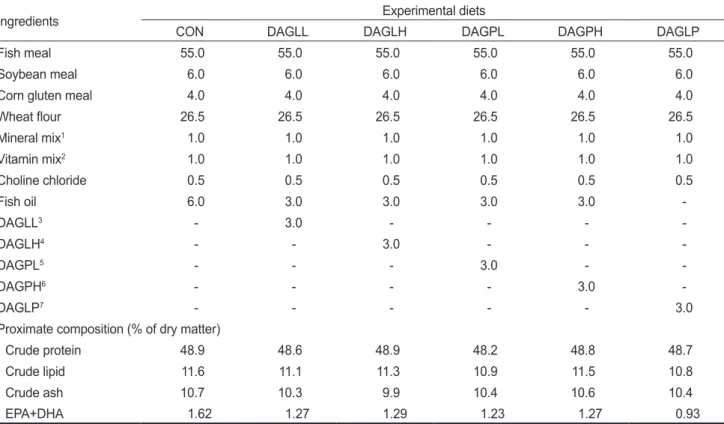
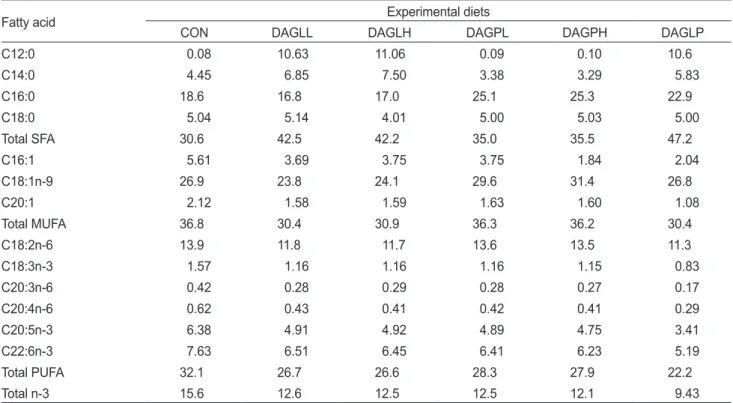
실험사료제작에사용된사료조성표와실험사료의일반성 분및지방산조성은Table 1, 2
에나타내었다.
실험사료는우선 사료원료들을혼합기에넣어완전히섞은다음,
어유와DAG
를첨가하였다.
고체상태의DAG
는비커에옮겨약60°C
의증 류수에서중탕하여액체형태로만들어첨가하였다.
그후,
사 료원료총량의30%
에해당하는증류수를첨가하여사료혼합 기로혼합,
반죽하였다.
혼합,
반죽물은소형초파기(SMC-12, Kuposlice, Busan, Korea)
를이용하여알맞은크기로성형하였 다.
실험사료는12 h
동안건조기에서25°C
로건조시킨후,
사료 공급전까지-20°C
에보관하면서사용하였다.
실험어 및 사육관리
실험에사용된넙치치어는제주도내종묘배양장에서구입 하여제주대학교해양과학연구소로운송되었다
.
실험어류는2
주동안시판배합사료를공급하면서실험환경에적응할수있 도록순치되었다.
예비사육후넙치(
초기평균무게, 13.4±0.1
g)
는총18
개의150 L
원형PP
수조에각수조당40
마리씩무 작위로배치되었다.
사육수는모래여과해수를사용하여2-3 L/
min
의유수량이공급되도록조절하였고,
모든실험수조에용 존산소유지를위하여에어스톤을설치하였다.
사육수온은자연수온
(15-21°C)
에의존하였으며광주기는형광등을이용하여12 h light/12 h dark
로유지되었다.
실험사료공급은1
일2
회(08:00, 18:00)
만복공급을하였으며사료공급실험은총12
주 간진행되었다.
어체 측정 및 혈액 분석
사료공급실험종료후
,
실험어의무게,
개체수,
사료공급량 을조사하여증체율,
일간성장률,
사료전환효율,
단백질이용효 율,
사료섭취량을산출하였다.
최종무게 측정후,
수조당6
마 리의어류를무작위로선별하여2-phenoxyethanol (200 ppm)
용액으로마취시킨후6
마리중3
마리에서헤파린처리된주 사기를이용하여꼬리미병부에서채혈을하였다.
채혈된전혈 은hematocrit, hemoglobin
및대식세포활성(nitrobluetetrazo- lium, NBT)
분석에이용되었다.
분석후,
남은혈액은alanine aminotransferase (ALT), aspartate aminotransferase (AST)
분 석을위해원심분리기를이용하여5,000 g
로10
분간원심분리 후,
혈장(plasma)
을분리하였다.
나머지3
마리어류의혈액은 헤파린이처리되지않은주사기를이용하여채혈되었으며채 혈된전혈은상온에서60
분방치시킨후원심분리기로(5,000
Table 2. Fatty acid composition of the experimental diets (% total fatty acids)
Fatty acid Experimental diets
CON DAGLL DAGLH DAGPL DAGPH DAGLP
C12:0 0.08 10.63 11.06 0.09 0.10 10.6
C14:0 4.45 6.85 7.50 3.38 3.29 5.83
C16:0 18.6 16.8 17.0 25.1 25.3 22.9
C18:0 5.04 5.14 4.01 5.00 5.03 5.00
Total SFA 30.6 42.5 42.2 35.0 35.5 47.2
C16:1 5.61 3.69 3.75 3.75 1.84 2.04
C18:1n-9 26.9 23.8 24.1 29.6 31.4 26.8
C20:1 2.12 1.58 1.59 1.63 1.60 1.08
Total MUFA 36.8 30.4 30.9 36.3 36.2 30.4
C18:2n-6 13.9 11.8 11.7 13.6 13.5 11.3
C18:3n-3 1.57 1.16 1.16 1.16 1.15 0.83
C20:3n-6 0.42 0.28 0.29 0.28 0.27 0.17
C20:4n-6 0.62 0.43 0.41 0.42 0.41 0.29
C20:5n-3 6.38 4.91 4.92 4.89 4.75 3.41
C22:6n-3 7.63 6.51 6.45 6.41 6.23 5.19
Total PUFA 32.1 26.7 26.6 28.3 27.9 22.2
Total n-3 15.6 12.6 12.5 12.5 12.1 9.43
CON, control; DAGLL, low purity 1,3-lauryl glycerol; DAGLH, high purity 1,3-lauryl glycerol; DAGPL, low purity 1,3-palmityl glycerol;
DAGPH, high purity 1,3-palmityl glycerol; DAGLP, 50% low purity 1,3-lauryl glycerol+50% low purity 1,3-palmityl glycerol..
g)
혈청을분리하여면역관련분석에사용되었다. Hematocrit
은microhematocrit technique
방법으로분석하였으며, hemo- globin, AST, ALT
함량은자동 생화학분석기(Express plus system, Bayer, USA)
를이용하여측정하였다.
대식세포활성(NBT)
은Anderson and Siwicki (1995)
의방법을기초로분석 되었다.
혈청내MPO
활성은Kumari and Sahoo (2005)
의방 법으로그리고lysozyme
활성은Hultmark et al. (1980)
의방법 을기초로분석되었다.
일반성분 및 지방산 분석
실험사료의일반성분분석은
AOAC (1995)
방법에따라수분 은상압가열건조법(125°C, 3 h),
조회분은직접회화법(550°C, 6 h),
조단백질은 자동조단백질분석기(Kejltec system 2300,
Sweden)
로분석하였으며,
지방은Folch et al. (1957)
의방법 에따라Soxhlet
추출장치(Soxhlet heater system C-SH6, Ko- rea)
를 이용하여 분석하였다.
실험사료와 전어체에서의지방 산분석은Folch et al. (1957)
의방법에따라지방을추출하여Metcalfe and Schmitz (1961)
방법으로methylation
한후gas chromatography (Agilent technologies, 6890N, USA)
를이용 하여분석하였다.
통계학적 분석
실험사료의배치는완전확률계획법
(Completely randomized design)
을실시하고,
성장및분석결과는SPSS (Version 12.0)
프로그램을이용하여One-way ANOVA
로통계분석된다.
데 이터값의유의차는Tukey's test (P≤0.05)
로비교되었다.
데이Table 4. Blood parameters of juvenile olive flounder Paralichthys olivaceus fed the six experimental diets for 12 weeks
Hematocrit
(%) Hemoglobin (g/dL) AST1
(U/L) ALT2 (U/L) CON 23.7±0.3 2.06±0.46 38.7±3.49 10.1±0.7 DAGLL 22.7±1.7 1.72±0.40 45.5±8.84 12.0±1.4 DAGLH 22.3±3.5 1.62±0.36 40.6±3.97 11.7±3.2 DAGPL 25.4±1.8 1.76±0.31 38.9±1.95 11.9±3.1 DAGPH 21.6±2.6 1.44±0.07 42.3±4.54 12.0±0.4 DAGLP 24.3±2.7 1.86±0.11 46.3±6.44 11.0±0.9 Mean values of triplicate groups are presented as mean±SD. The lack of superscript letter indicates no significant differences among treatments. 1Aspartate aminotransferase (AST). 2Alanine amino- transferase (ALT). CON, control; DAGLL, low purity 1,3-lauryl glycerol; DAGLH, high purity 1,3-lauryl glycerol; DAGPL, low purity 1,3-palmityl glycerol; DAGPH, high purity 1,3-palmityl glycerol; DAGLP, 50% low purity 1,3-lauryl glycerol+50% low purity 1,3-palmityl glycerol.
Table 5. Non-specific immune responses of juvenile olive flounder Paralichthys olivaceus fed the six experimental diets for 12 weeks
NBT1
(absorbance) MPO2
(absorbance) Lysozyme (μg/mL)
CON 0.68±0.06 1.07±0.14 57.6±12.2
DAGLL 0.62±0.03 1.47±0.20 54.7±5.9
DAGLH 0.67±0.16 1.16±0.13 66.1±4.4
DAGPL 0.69±0.09 1.25±0.12 62.1±4.5
DAGPH 0.60±0.12 1.13±0.28 70.1±14.3
DAGLP 0.65±0.11 1.23±0.17 72.0±5.8
Mean values of triplicate groups are presented as mean ± SD.
The lack of superscript letter indicates no significant differences among treatments. 1Nitro blue-tetrazolium activity. 2Myeloperoxi- dase activity. CON, control; DAGLL, low purity 1,3-lauryl glyc- erol; DAGLH, high purity 1,3-lauryl glycerol; DAGPL, low purity 1,3-palmityl glycerol; DAGPH, high purity 1,3-palmityl glycerol;
DAGLP, 50% low purity 1,3-lauryl glycerol+50% low purity 1,3-palmityl glycerol.
Table 3. Growth performance of juvenile olive flounder Paralichthys olivaceus (mean initial body weight 13.4±0.1 g) fed the six experimen- tal diets for 12 weeks
FBM(g)1 WG(%)2 SGR(%)3 FCR4 PER5 FI6 Survival (%)
CON 47.2±0.2 256±3 1.49±0.01 1.23±0.07 1.68±0.09 41.8±2.3 89.2±9.0
DAGLL 48.0±3.1 254±25 1.49±0.08 1.17±0.04 1.77±0.06 40.1±2.5 88.2±7.8
DAGLH 48.7±5.3 265±41 1.52±0.13 1.19±0.16 1.75±0.24 41.5±0.6 87.3±6.8
DAGPL 47.1±1.4 252±13 1.48±0.04 1.19±0.07 1.76±0.10 39.9±0.6 97.1±2.9
DAGPH 45.6±1.7 242±13 1.45±0.05 1.28±0.08 1.63±0.10 41.1±0.5 87.3±12.2
DAGLP 48.4±2.6 258±20 1.50±0.07 1.12±0.07 1.86±0.12 39.1±0.5 96.1±3.4
Mean values of triplicate groups are presented as mean±SD. The lack of superscript letter indicates no significant differences among treat- ments. 1Final mean body weight (g). 2Weight gain (%)=(final body weight - initial body weight)/initial body weight×100. 3Specific growth rate (%) =[(loge final body weight-loge initial body weight)/days]×100. 4Feed conversion ratio=dry feed fed/wet weight gain. 5Protein efficiency ratio=wet weight gain/total protein given. 6Feed intake (g/fish)=dry feed fed/fish. CON, control; DAGLL, low purity 1,3-lauryl glycerol; DAGLH, high purity 1,3-lauryl glycerol; DAGPL, low purity 1,3-palmityl glycerol; DAGPH, high purity 1,3-palmityl glycerol;
DAGLP, 50% low purity 1,3-lauryl glycerol+50% low purity 1,3-palmityl glycerol.
Aminikhoei et al., 2013).
사료내필수지방산함량이대상어종 의요구량을충족할경우,
경제적인배합사료제조를위해상대 적으로저렴한지질원료들을사용하여도무방할것으로판단 된다(Kim and Lee 2019).
혈액분석결과는
Table 4
에나타내었다. Hematocit
은21.6- 25.4%, hemogloibin
은1.44-2.06g/dL, AST
는38.7-46.3U/L, ALT
는10.1-12.0 U/L
로나타났으며,
모든실험구간에유의 적인차이가없었다. Hematocrit
은혈액내적혈구가차지하는 비중을백분율로나타낸것으로hemoglobin, AST, ALT
와함 께어류의일반적인건강도를가늠하는간접지표로사용된다(Kristoffersson et al., 1974).
혈액내AST
와ALT
는체내아미 노산의대사에관여하는효소로써,
어류의간또는심장이손상 을입을경우혈중으로방출되어수치가증가하게된다.
혈액분 석결과,
모든실험구간에유의적인차이가없는것으로보아DAG
를이용한어유대체에따른넙치의건강에도아무런이상이없을것으로판단된다
.
비특이적면역분석결과는
Table 5
에나타내었다. NBT ac- tivity
는0.60-0.68, MPO
는1.07-1.47, lysozyme
은54.7-72.0
μg/mL
로 나타났으며,
마찬가지로 모든 실험구 간에유의적인 차이가없었다
. NBT activity
는호중구의호흡폭발동안의Table 6. Fatty acid composition (% of total fatty acids) of the whole body in juvenile olive flounder Paralichthys olivaceus fed the experi- mental diets for 12 weeks
Fatty acid Experimental diets
Con DAGLL DAGLH DAGPL DAGPH DAGLP
C12:0 0.00±0.00b 2.81±0.08ab 5.30±0.44a 0.00±0.00b 0.00±0.00b 3.78±2.18a
C14:0 4.29±0.11b 4.98±0.09ab 6.57±0.16a 3.39±0.28b 3.58±0.19b 5.40±1.23a
C16:0 18.2±0.24 19.0±0.88 17.78±0.15 20.9±0.31 20.0±1.66 19.0±0.32
C18:0 4.17±0.11 4.45±0.03 4.51±0.38 4.36±0.14 4.28±0.01 4.51±0.22
Total SFA 28.5±0.63c 30.0±0.13abc 29.4±1.17bc 32.6±0.95abc 35.6±0.96a 34.2±2.91ab C16:1 7.15±0.34a 3.68±1.66b 5.21±0.21ab 5.37±0.24ab 5.53±0.66ab 4.83±0.32ab
C18:1n-9 25.4±2.33 28.0±0.36 25.1±1.29 28.9±0.16 28.4±1.16 26.3±0.26
C20:1 1.18±0.20 0.80±0.08 0.80±0.03 0.93±0.04 0.96±0.38 0.73±0.07
Total MUFA 34.7±1.23 35.8±0.21 35.7±0.44 33.7±2.15 31.9±1.15 32.8±0.92
C18:2n-6 12.3±1.48 13.2±0.78 12.1±0.17 13.1±0.15 13.5±1.22 12.7±0.65
C18:3n-3 1.83±0.17 1.74±0.03 1.72±0.03 1.83±0.08 1.74±0.14 1.72±0.04
C20:3n-6 1.26±0.13 1.08±0.02 1.08±0.06 1.04±0.03 1.18±0.15 1.05±0.10
C20:4n-6 7.18±1.88 5.12±0.14 5.10±0.14 5.44±0.05 5.84±1.06 5.05±0.36
C20:5n-3 2.68±0.13 2.27±0.10 2.31±0.01 2.38±0.12 2.41±0.25 2.23±0.17
C22:6n-3 8.93±0.16 8.60±0.19 8.51±0.31 8.56±0.04 8.67±0.07 8.35±0.70
Total PUFA 36.8±0.06 34.2±0.07 34.9±1.61 33.7±1.20 32.5±0.19 33.0±1.99
Total n-3 13.6±0.83 13.0±0.29 12.8±0.47 12.7±0.17 12.7±0.16 12.7±0.78
Mean values of triplicate groups are presented as mean±SD. The lack of superscript letter indicates no significant differences among treat- ments. Values in the same row having different superscript letters are significantly different (P<0.05). CON, control; DAGLL, low purity 1,3-lauryl glycerol; DAGLH, high purity 1,3-lauryl glycerol; DAGPL, low purity 1,3-palmityl glycerol; DAGPH, high purity 1,3-palmityl glycerol; DAGLP, 50% low purity 1,3-lauryl glycerol+50% low purity 1,3-palmityl glycerol.
터는평균값
±
표준편차(mean±SD)
로나타내었다.
백분율데 이터는arcsine
변형값으로계산하여통계분석하였다.
결과 및 고찰
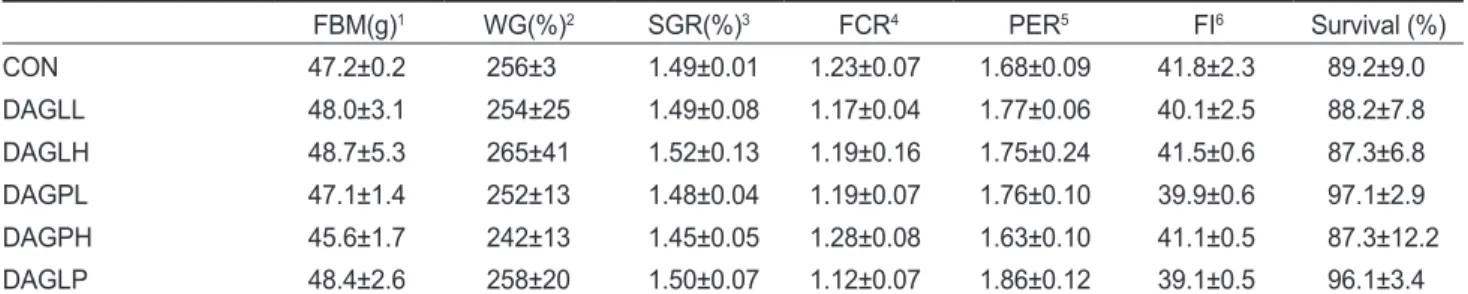
성장관련결과는
Table 3
에나타내었다.
생존율은모든실험구에서
85%
이상의양호한생존율을 보여사육환경및질병등의외부적영향없이사료공급실험이원활히진행된것 을확인할수있었다
.
증체율,
일간성장률,
사료전환효율,
단백 질이용효율분석결과, DAG
로어유를50%
대체한DAGLL,
DAGLH, DAGPL, DAGPH
실험구와 대조구간에유의적인차이가없었으며
,
어유를100%
대체한DAGLP
실험구도대 조구와유의적인차이를보이지않았다.
모든실험구에서넙치 의성장과사료효율에차이가없었던것은실험사료의필수지 방산함량이넙치의요구량에충족되었기때문인것으로판단 된다(Kim and Lee, 2019).
넙치의필수지방산(n-3 HUFA)
요 구량은0.8-1.4%
로알려져있으며(NRC 2011),
다른어종을대 상으로한연구에서도필수지방산요구량이충족된사료공급 시사료내지질의종류가성장과사료계수에영향을주지않는 것으로보고되었다(Bell et al., 2003; Peiedecausa et al., 2007;
oxidative radical
생성량을측정하여대식세포의활성을확인 하는방법이다(Kumari and Sahoo, 2005). MPO
는과산화효 소로써hypochlorous acid
를만들어병원체를사멸시키는기 능을하며, lysozyme
은세균세포벽의peptideglycan
의β-1,4-
glucoside
결합을가수분해하여세균의세포벽을파괴하는기능을한다
(Kim et al., 2011).
비특이적면역분석결과,
모든실 험구간에유의적인차이가없는것으로보아DAG
를이용한 어유대체에따른비특이적면역에도전혀이상이없을것으 로사료된다.
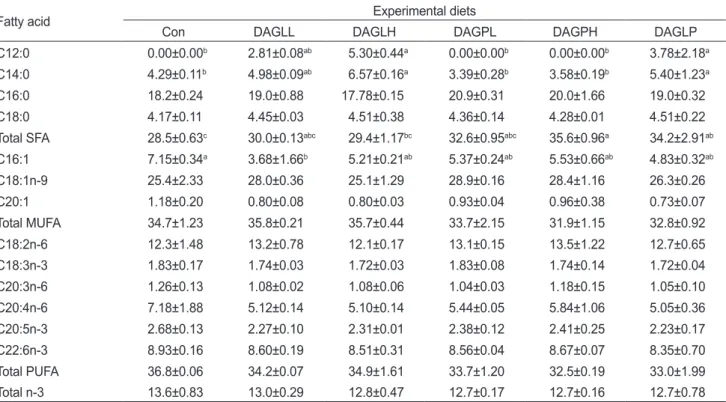
전어체 지방산분석결과는
Table 6
에 나타내었다. 1,3-lau- ryl glycerol
이첨가된DAGLL, DAGLH, DAGLP
실험구에 서lauric acid
가축척된것을확인할수있었다. Lauric acid
는12
개의탄소축을가진포화중쇄지방산(medium-chain fatty
acid)
으로다양한세균에항균효과를갖는것으로보고되고있다
(Jensen, 2002; Nair et al., 2004a, 2004b; Thormar et al., 2006; Park et al., 2007). Lauric acid
의항균활성기작은세 균의전자전달계와인산화작용을방해함으로서에너지생성 을저해시켜세균을사멸시키는것으로추정되고있다(Wieck- owski and Wojtczak, 1998; Desbois and Smith, 2010). DA- GLL, DAGLH, DAGLP
실험어의체내에서lauric acid
가축 척된것으로보아세균성질병에대한저항효과를기대할수있 을것으로판단되며,
이와관련된추가연구가요구된다. DHA, EPA,
고도불포화지방산(PUFA)
함량은DAG
가첨가된실험 구가대조구에비해다소감소하는경향을보였으나,
실험구간 에유의적인차이는없었다.
이러한결과는사료내DHA, EPA,
고도불포화지방산함량과유사한경향을나타낸다.
일반적으 로어체지방산조성은공급되는사료의지방산조성에영향 을받으며,
이는여러어종을대상으로선행된연구를통해알 려져있다(Montero et al., 2005; Martínez-Llorens et al., 2007;
Fountoulaki et al., 2009).
또한대상어종의필수지방산요구량 이충족된사료를섭취한어류의일반성분은사료의지질원에 영향을받지않는다고보고되고있다(Ng et al., 2003; Kim et al., 2010; Aminikhoei et al., 2013).
따라서
DAG
는넙치배합사료내6%
가량의어유를100%
까 지대체할수있으며,
이러한대체수준은넙치의일반적인건강 도,
면역활성및필수지방산대사에악영향을전혀미치지않 는것으로판단된다.
추후DAG
의대사특성을고려한단백질 절약효과및DAG
에함유된lauric acid
의질병저항효과에관 한연구가추가적으로요구된다.
사 사
이연구는
㈜
시너젠의연구비지원으로수행된연구이며연구 비지원에감사드립니다.
References
Aminikhoei Z, Choi J, Lee SM and Kim KD. 2013. Effects of different dietary lipid sources on growth performance, fatty acid composition and antioxidant enzyme activity of juve- nile rockfish, Sebastes schlegeli. J World Aquacult Soc 44, 716-725. https://doi.org/10.1111/jwas.12070.
Anderson DP and Siwicki AK. 1995. Basic hematology and se- rology for fish health programs. In: Shariff M, Arthur JR, Subasinghe RP (Eds.), Diseases in Asian aquaculture II.
Philippines fish health section, Asian Fisheries Society, Ma- nila, 185.
AOAC (Association of Official Analytical Chemists). 1995. Of- ficial methods of analysis.16th edn. Association of Official Analytical Chemists, Arlington, Virginia.
Bach AC and Babayan VK. 1982. Medium-chain triglycer- ides: an update. Am J Clin Nutr 36, 950-962. https://doi.
org/10.1093/ajcn/36.5.950.
Bell JG, McGhee F, Campbell PJ and Sargent JR. 2003. Rape- seed oil as an alternative to marine fish oil in diets of posts- molt Atlantic salmon Salmo salar: changes in flesh fatty acid composition and effectiveness of subsequent fish oil “wash out”. Aquaculture 218, 515-528. https://doi. org/10.1016/
S0044-8486(02)00462-3.
Birari RB and Bhutani KK. 2007. Pancreatic lipase inhibi- tors from natural sources: unexplored potential. Drug Discov Today 12, 879-889. https://doi.org/10.1016/j.
drudis.2007.07.024.
Desbois AP and Smith VJ. 2010. Antibacterial free fatty acids:
activities, mechanisms of action and biotechnological poten- tial. Appl Microbiol Biotechnol, 85, 1629-1642. https://doi.
org/10.1007/s00253-009-2355-3.
Emery JA, Norambuena F, Trushenski J and Turchini GM.
2016. Uncoupling EPA and DHA in fish nutrition: Dietary demand is limited in Atlantic salmon and effectively met by DHA alone. Lipids 51, 399-412. https://doi.org/10.1007/
s11745-016-4136-y.
FAO (Food and Agriculture Organization of the United Na- tions). 2016. The state of world fisheries and aquaculture.
FAO Fisheries Report, Retrieved from http://www.fao.
org/3/a-i5555e.pdff on Aug 15, 2019.
Folch J, Lee M and Sloane-Stanley GH 1957. A simple method for the isolation and purification of total lipids from animal tissues. J Biol Chem 226, 497-509.
Fountoulaki E, Vasilaki A, Hurtado R, Grigorakis K, Karacostas I, Nengas I, Rigos G, Kotzamanis Y, Venou B and Alexis MN. 2009. Fish oil substitution by vegetable oils in commer- cial diets for gilthead sea bream (Sparus aurata L.); effects on growth performance, flesh quality and fillet fatty acid profile: recovery of fatty acid profiles by a fish oil finishing diet under fluctuating water temperatures. Aquaculture 289, 317-326. https://doi.org/10.1016/j.aquaculture.2009.01.023.
Hultmark D, Steiner H, Rasmuson T and Boman HG. 1980. In- sect immunity: purification and properties of three inducible bactericidal proteins from hemolymph of immunized pupae of Hyalophora cecropia. Eur J Biochem 106, 7-16. https://
doi.org/10.1111/j.1432-1033.1980.tb05991.x.
Hertrampf JW and Piedad-Pascual F. 2002. Handbook on ingre- dients for aquaculture feeds. Kluwer Academic Publishers, Dordrecht.
Ijiri Y, Naemura A, Yamashita T, Meguro S, Watanabe H, To- kimitsu I and Yamamoto J. 2006. Dietary diacylglycerol extenuates arterial thrombosis in apoE and LDLR deficient mice. Thromb Res 117, 441-417. https://doi.org/10.1016/j.
thromres.2005.04.001.
Izquierdo MS, Montero D, Robaina L, Caballero MJ, Rosen- lund G and Ginés R. 2005. Alterations in fillet fatty acid pro- file and flesh quality in gilthead seabream (Sparus aurata) fed vegetable oils for a long term period. Recovery of fatty acid profiles by fish oil feeding. Aquaculture, 250, 431-444.
https://doi.org/10.1016/j.aquaculture.2004.12.001.
Jensen RG. 2002. The composition of bovine milk lipids: Janu- ary 1995 to December 2000. J Dairy Sci 85, 295-350. https://
doi.org/10.3168/jds.S0022-0302(02)74079-4.
Jiao Y, Yun KS, Nyachoti M and Kim IH. 2019. Effect of dietary supplementation of diacylglycerol on growth performance, nutrient digestibility, and blood profiles in growing pigs fed corn-SBM based diet. Can J Anim Sci, 1-19. https://doi.
org/10.1139/CJAS-2018-0165.
Kim KD, Kim JD, Lim SG, Kang YJ and Son MH. 2010. Ef- fects of dietary lipid sources on the growth and body compo- sition of the far eastern catfish, Silurus asotus. Korean J Fish Aquat Sci 43, 445-450.
Kim KW, Kim SS, Jeong JB, Jeon YJ, Kim KD, An CM and Lee KJ. 2011. Effects of dietary fluid on growth performance, immune responses, blood components, and disease resis- tance against Edwardsiella tarda and streptococcus iniae in olive flounder Paralichthys olivaceus. Korean J Fish Aquat Sci 44, 644-652. https://doi.org/10.5657/KFAS.2011.0644 KOSIS (Korean Statistical Information Service). 2018. Survey
on the status of fish culture. Retrieved from http://kosis.kr/
publication/publicationThema.do?pubcode=JL on Mar 12, 2019.
Kim E and Lee SM. 2019. Effect of different dietary compo- sition of linoleic acid, eicosapentaenoic acid and docosa- hexaenoic acid on the growth and fatty acid profile of olive flounder Paralichthys olivaceus. Korean J Fish Aquat Sci 52, 49-58. https://doi.org/10.5657/KFAS.2019.0049.
Kristofferson R, Broberg S, Oskari A and Pekkarinen M. 1974.
Effect of a sublethal concentration of phenol on some blood plasma enzyme activities in the pike (Esoxlucius L.) in brackish water. Ann Zool Fennici 11, 220-223. https://doi.
org/10.1007/bf00677929.
Kumari J and Sahoo PK. 2005. Effects of cyclophosphamide on
the immune system and disease resistance of Asian catfish
Clarias batrachus. Fish Shellfish Immunol 19, 307-316.
Martínez-Llorens S, Vidal AT, Moñino AV, Torres MP and Cerdá MJ. 2007. Effects of dietary soybean oil concentration on growth, nutrient utilization and muscle fatty acid composi- tion of gilthead sea bream (Sparus aurata L.). Aquac Res 38, 76-81. https://doi.org/10.1111/j.1365-2109.2006.01636.x.
Metcalfe LD and Schmitz AA. 1961. The rapid preparation of fatty acid esters for gas chromatographic analysis. Anal Chem 33, 363-364. https://doi.org/10.1021/av60171a016.
Montero D, Robaina L, Calballero MJ, Ginés R and Izquierdo MS. 2005. Growth, feed utilization and flesh quality of Eu- ropean sea bass (Dicentrarchus labrax) fed diets containing vegetable oils: A time-course study on the effect of a re- feeding period with a 100% fish oil diet. Aquaculture 248, 121-134. https://doi.org/10.1016/j.aquaculture.2005.03.003.
Nair MKM, Joy J and Venkitanarayanan KS. 2004a. Inactiva- tion of Enterobacter sakazakii in reconstituted infant for- mula by monocaprylin. J Food Prot 67, 2815-2819. https://
doi.org/10.4315/0362-028X-67.12.2815.
Nair MKM, VasudevanP, Hoagland T and Venkitanarayanan K.
2004b. Inactivation of Escherichia coli O157: H7 and Liste- ria monocytogenes in milk by caprylic acid and monocapry- lin. Food Microbiol 21, 611-616. https://doi.org/10.1016/j.
fm.2004.01.003.
NRC (National Reaearch Council). 2011. Nutrient requirements of fish and shrimp. The National Academy Press, Washing- ton DC, U.S.A.
Ng WK, Lim PK and Boey PL. 2003. Dietary lipid and palm oil source affects growth, fatty acid composition and muscle a-tocopherol concentration of African catfish, Clarias gari-
epinus. Aquaculture 215, 229-243. https://doi.org/10.1016/
S0044-8486(02)00067-4.
Park YW, Juárez M, Ramos M and Haenlein GFW. 2007. Physi- co-chemical characteristics of goat and sheep milk. Small Rumin Res 68, 88-113. https://doi.org/10.1016/j.smallr- umres.2006.09.013.
Peng S, Chen L, Qin JG, Yu N, Long Z, Te J and Sun X. 2008.
Effects of replacement of dietary fish oil by soybean oil on growth performance and liver biochemical composition in juvenile black seabream, Acanthopagrus schlegeli. Aqua- culture 276, 154-161. https://doi.org/10.1016/j.aquacul- ture.2008.01.035.
Piedecausa MA, Mazón MJ, García BG and Hernández MD.
2007. Effects of total replacement of fish oil by vegetable oils in the diets of sharp snout seabream (Diplodus pun-
tazzo). Aquaculture 263, 211-219. https://doi.org/10.1016/j.
aquaculture.2006.09.039.
Tacon AGH and Metian M. 2008. Global overview on the use of fish meal and fish oil in industrially compounded aquafeeds:
trends and future prospects. Aquaculture 285, 146-158.
https://doi.org/10.1016/j.aquaculture.2008.08.015.
Tacon AGH and Metian M. 2015. Feed matter: satisfying the feed demand of aquaculture. Rev Fish Sci & Aquac 23, 1-10. https://doi.org/10.1080/23308249.2014.987209.
Takase H. 2007. Metabolism of diacylglycerol in humans.
Asia Pac J Clin Nutr 16, 398-403. https://doi.org/10.6133/
apjcn.2007.16.s1.72.
Thormar H, Hilmarsson H and Bergsson G. 2006. Stable con- centrated emulsions of the 1-monoglyceride of capric acid (monocaprin) with microbicidal activities against the food- borne bacteria Campylobacter jejuni, Salmonella spp., and
Escherichia coli. Appl Environ Microbiol 72, 522-526.
https://doi.org/10.1128/AEM.72.1.522-526.2006.
Więckowski MR and Wojtczak L. 1998. Fatty acid‐induced uncoupling of oxidative phosphorylation is partly due to opening of the mitochondrial permeability transition pore.
FEBS letters 423, 339-342. https://doi.org/10.1016/S0014- 5793(98)00118-5.