Effects of various concentrations of garlic powder and garlic extract in the diets on growth, serum chemistry and immune response of
juvenile olive flounder Paralichthys olivaceus
Sung Hwoan Cho†, Sang-Min Lee* and Mun-Gyeong Kwon**
Division of Marine Environment and BioScience, College of Ocean Science and Technology, Korea Maritime University, Busan 606-791, Korea
*Faculty of Marine Bioscience & Technology, Kangnung-Wonju National University, Gangneung 210-702, Korea
**National Fisheries Research & Development Institute, Busan 619-705, Korea
Effects of various concentrations of garlic powder and garlic extract in the diets on growth, serum chemistry and immune response of olive flounder were determined. Thirty-five juvenile fish averaging 5.1 g were randomly distributed into 21 of 180 L flow-through tanks. Seven experimental diets with various concentrations of garlic powder (GP) and garlic extract (GE) were prepared in triplicate: GP-0 without garlic supplementation, GP-0.5, GP-1, GP-2, GP-3 and GP-5 diets containing garlic powder at the concentrations of 0.5, 1, 2, 3 and 5%, respectively at the expense of wheat flour and finally, GE-0.4 diet containing 0.4% garlic extract were prepared. At the end of the 8-week feeding trial, serum chemistry of fish was measured. In addition, twenty fish from each tank were artificially infected with E. tarda for the following 96 h to monitor cumulative mortality. Weight gain of fish fed GP-0 diet was higher than that of fish fed GP-1, GP-2, GP-3 and GP-5 diets. No difference in serum criteria (total protein, glucose, glutamate oxaloacetate transaminase, cholesterol and triglyceride levels) of olive flounder was found among the experimental diets except for glutamate pyruvate transaminase. Lysozyme activity of fish fed GP-0, GP-1, GP-3 and GE-0.4 diets was higher than that of fish fed GP-5 diet. The highest cumulative mortality was 93.3% in fish fed GP-0 diet at 96 h after E. tarda infection, followed by GP-3, GP-1, GP-5, GP-2, GP-0.5 and GE-0.4 diets. In considering these results, dietary inclusion of garlic powder and garlic extract has no distinctive positive effect on improvement in growth, serum chemistry and immune response of olive flounder in this experimental conditions, therefore, its application should be carefully considered.
2)
Key words :Olive flounder Paralichthys olivaceus, Garlic powder, Garlic extract, Lysozyme activity, E. tarda
Since olive flounder Paralichthys olivaceus has been one of the most important marine finfish for aquaculture in Korea, many feeding trials to determine dietary nutrients requirement (Lee et al., 2000; Alam et al., 2002; Lee et al., 2002), optimum feeding ratio/frequency
†Corresponding Author : Sung Hwoan Cho Tel: 82-51-410-4755, Fax: 82-51-404-4750,
E-mail:[email protected]
(Lee et al., 1999; Cho et al., 2006b), alternative protein sources for fishmeal in the diets (Sato and Kikuchi, 1997;
Kikuchi, 1999) for fish have been reported.
In addition, dietary additives, such as herbal medicine (Kim et al., 1998, 2000), culture broth of lactic acid bacteria in herb (Acanthopanax koreanum) extract (Jhon et al., 2009), green tea (Cho et al., 2006a, 2007), chitosan (Cha et al., 2008), extract of mushroom mycelium
(Phellinus linteus and Coriolus militaris) (Kim et al., 2006a), microalgae, Chlorella ellipsoidea (Kim et al., 2002) and macroalga, Hizikiafusi formis (Pham et al., 2006), wood vinegar (Lee et al., 2008) and glucan (Kim et al., 2006b) were effective to improve performance and/or immune response of olive flounder. However, mortality of fish resulting from outbreak of disease frequently occurs during year-round and it eventually lowers fish production. Therefore, development of new additive for aquafeed is still highly needed.
The use of natural resources as dietary additives has several advantages, such as food safety for human consumption and minimizing the risk of side-effects.
Garlic (Allium sativum) containing allicin, allyl cysteine, ajoene, allin and related components (Afzal et al., 2000;
Chung, 2006) has been known to have antibacterial, antimicrobial, anti-inflammatory, antioxidant and/or antitumourigenic effects (Afzal et al., 2000; Shin and Kim, 2004; Chung, 2006; Wilson and Demmig-Adams, 2007). It was also known to lower cholesterol of men (Steiner et al., 1996) and hyperlipidemia in rats (Kang et al., 2008). Therefore, garlic seems to have high potential for aquafeed as an immunostimulant as well.
Dietary inclusion of fermented garlic powder was effective against Vibrio anguillarum and Streptococcus ininae infection, but not for Edwardsiella tarda (Kim et al., 2010). In above study, however, fish were grown and challenge test were performed in low temperature (16-18°C). Since those disease occurs frequently in olive flounder at high temperature (over 20°C), more studies in high temperature are needed. In addition, Lee et al.
(2010) reported that injection of garlic extract effectively enhanced nonspecific immunity and resistance against
E. tarda and S. ininae when fish were grown at 20-22°C.
In this study, therefore, effects of various concentrations of garlic powder and garlic extract in the diets on growth, serum chemistry and immune response of juvenile olive flounder were determined.
Materials and Methods
Experimental conditions
Juvenile olive flounder were purchased from a private hatchery (Taean, Chungcheongnam Do, Korea), transferred to the laboratory and acclimated for 2 weeks before an initiation of the feeding trial. During the acclimation period, fish were fed with commercial extruded pellet containing 54% crude protein and 11%
crude lipid twice a day. Thirty-five juvenile fish averaging 5.1 g were randomly distributed into 21 of 180 L flow-through tanks (water volume: 150 L) and water flow rate of tank was 6.8 L/min. The water source was the sand-filtered natural seawater and aeration supplied to each tank. Water temperature ranged from 18.4 to 24.1°C (mean±SD: 21.5±1.16°C) and photoperiod followed natural condition.
Preparation of garlic powder and extract for the experimental diets Garlic powder (crude protein: 19.0%, crude lipid: 0.8% and ash: 3.1%) and garlic extract (Edentownfnb, Incheon, Korea) were used as the additives. Seven experimental diets with various concentrations of garlic powder (GP) and garlic extract (GE) were prepared in triplicate: GP-0 without garlic supplementation, which was used as control diet, GP-0.5, GP-1, GP-2, GP-3 and GP-5 diets containing garlic powder at the concentrations of 0.5, 1, 2, 3 and 5%,
respectively at the expense of wheat flour and finally, GE-0.4 diet containing 0.4% garlic extract were prepared (Table 1). Fishmeal, dehulled soybean meal and corn gluten were used as the protein source for the experimental diets. And wheat flour and fish and soybean oils were used as the carbohydrate and lipid sources, respectively. All experimental diets were prepared to satisfy dietary nutrient requirements for olive flounder
(Lee et al., 2000, 2002). The ingredients of the experimental diets were well mixed with water at a ratio of 3:1 and pelletized with a pellet-extruder. The experiment diets were dried at room temperature overnight and stored to -20°C until use. All fish were hand-fed to apparent satiation twice a day (07:00, 17:00), seven days a week, for 8 weeks.
Experimental diets
GP-0 GP-0.5 GP-1 GP-2 GP-3 GP-5 GE-0.4
Ingredients (%)
Fishmeal 50 50 50 50 50 50 50
Soybean meal 12.5 12.5 12.5 12.5 12.5 12.5 12.5
Corn gluten meal 5 5 5 5 5 5 5
Wheat flour 25 24.5 24 23 22 20 25
Garlic powder1 0.5 1 2 3 5
Garlic extract2 +
Fish oil 2 2 2 2 2 2 2
Soybean oil 3 3 3 3 3 3 3
Vitamin premix3 1 1 1 1 1 1 1
Mineral premix4 1 1 1 1 1 1 1
Choline 0.5 0.5 0.5 0.5 0.5 0.5 0.5
Table 1 Ingredients and chemical composition (%, DM basis) of the experimental diets
Nutrient (%, DM)
Dry matter 82.7 82.1 80.6 77.6 78.0 78.2 83.9
Crude protein 51.5 51.9 51.6 52.0 53.8 51.8 52.1
Crude lipid 8.9 9.8 9.9 10.8 10.6 10.9 10.0
Ash 8.4 9.3 9.2 9.2 9.2 8.4 9.2
1Garlic powder and 2Garlic extract were supplied from Edentownfnb (Incheon, Korea).
3Vitamin and 4Mineral premix were same as Cho et al. (2007)’s study.
+ indicated that 0.4% garlic extract was included instead of same amount of water.
Chemical analysis of the experimental diets and fish Five fish from each tank at the termination of the feeding trial were sacrificed for proximate analysis.
Crude protein was determined by the Kjeldahl method (Kjeltec 2100 Distillation Unit, Foss Tecator, Hoganas, Sweden), crude lipid was determined using an ether-extraction method (Soxtec TM 2043 Fat Extraction System, Foss Tecator, Hoganas, Sweden), moisture was determined by oven drying at 105°C for 24 h, fiber was determined using an automatic analyzer (Fibertec, Tecator, Hoganas, Sweden) and ash was determined using a muffle furnace at 550°C for 4 h, all methods were according to standard AOAC (1990).
Chemical analysis of blood
Blood samples were obtained from the caudal vein of randomly chosen three fish from each tank by syringes after they were starved for 24 h at the end of the feeding trial. Serum was collected after centrifugation (6,000 rpm for 5 min), stored freezer at -70°C as separate aliquots for analysis of total protein, glucose, glutamate oxaloacetate transaminase (GOT), glutamate pyruvate transaminase (GPT), cholesterol and triglyceride (TG), and analyzed by using automatic chemistry system (Vitros DT60 II, Vitros DTE II, DTSC II Chemistry System, Johnson and Johnson Clinical Diagnostics Inc., New York, USA).
Lysozyme activity assay
The turbidimetric assay for lysozyme was carried out according to Parry et al. (1965). Briefly, test serum (100
μL) was added to 2 mL of a suspension of Micrococcus lysodeikticus (0.2 mg/mL, Sigma, MO, USA) in a 0.05 M sodium phosphate buffer, pH 6.2. The reaction was carried out at 25°C and absorbance at 530 nm was measured after 0.5 and 4.5 min on a spectrophotometer. A lysozyme activity unit was defined as the amount of enzyme producing a decrease in absorbance of 0.001/min.
Challenge test
Twenty five fish from each tank were randomly chosen at the end of the 8-week feeding trial and shown to be free from bacterial infection. The bacteria used for the challenge were obtained as a reference pathogenic strain of E. tarda that was previously isolated from olive flounder (National Fisheries Research and Development Institute, Korea). A culture suspension of E. tarda was prepared after being cultured in agar for 24 h, collected, washed and suspended in a sterile 0.85% saline solution and counted. Fish were artificially infected by intraperitoneal injection with 0.1 mL of culture suspension of pathogenic E. tarda containing 4 × 10⁸ bacteria/mL. Fish were monitored for the following 96 h after E. tarda infection and dead fish were removed every 3 h for the first 24 h, 6 h for the second 24 h and 12 h for the last 48 h.
Statistical analysis
One-way ANOVA and Duncan’s multiple range test (Duncan, 1955) were used to analyze the significance of the difference among the means of treatments through SAS version 9.1 (SAS Institute, Cary, NC, USA).
Results
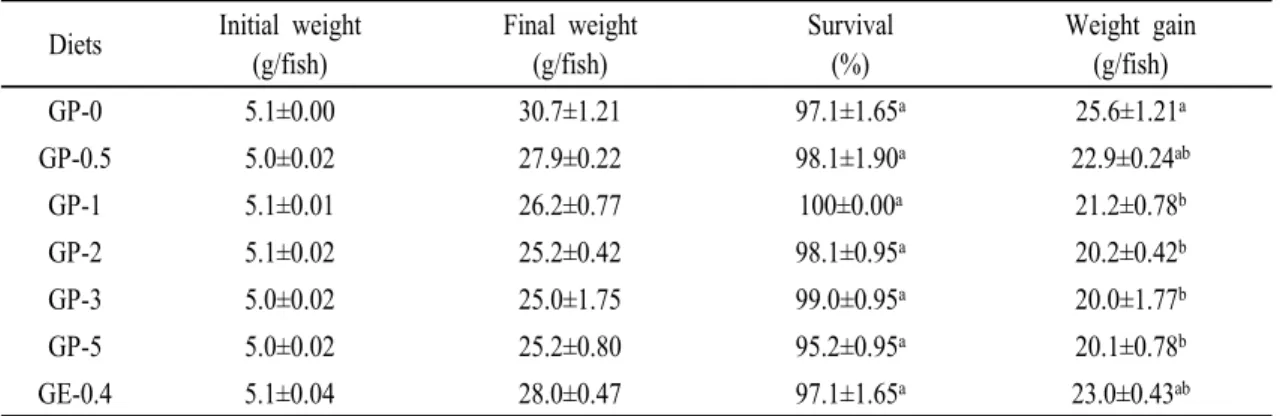
Survival was not significantly (P>0.05) different among the experimental diets (Table 2). However, weight gain of olive flounder fed GP-0 diet was significantly (P<0.05) higher than that of fish fed GP-1, GP-2, GP-3 and GP-5 diets, but not significantly (P>0.05) different from that of fish fed GP-0.5 and GE-0.4 diets.
Feed consumption of olive flounder fed GP-0 diet was significantly (P<0.05) higher than that of fish fed GP-1, GP-2, GP-3 and GP-5 diets, but not significantly (P>0.05) different from that of fish fed GP-0.5 and GE-0.4 diets (Table 3). Feed efficiency ratio (FER) of olive flounder fed GP-0 and GP-1 diets was significantly (P<0.05) higher than that of fish fed GP-3 and GP-5 diets. Protein efficiency ratio (PER) of olive flounder fed GP-0 diet was significantly (P<0.05) higher than
that of fish fed GP-2, GP-3, GP-5 and GE-0.4 diets.
Condition factor (CF) of olive flounder was not significantly (P>0.05) different among the experimental diets. However, hepatosomatic index (HSI) of olive flounder fed GP-0 diet was significantly (P<0.05) higher than that of fish fed GP-1, GP-2, GP-3 and GP-5 diets.
Serum total protein, glucose, GOT, cholesterol and triglyceride levels of olive flounder was not significantly (P>0.05) different among the experimental diets (Table 4). However, GPT of olive flounder fed GP-1 diet was significantly (P<0.05) higher than that of fish fed GP-0, GP-0.5, GP-3 and GP-5 diets.
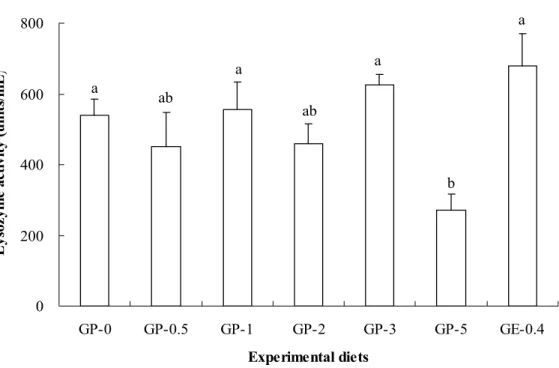
Lysozyme activity of olive flounder fed GP-0, GP-1, GP-3 and GE-0.4 diets, which was the highest, was significantly (P<0.05) higher than that of fish fed GP-5 diet, but not significantly (P>0.05) different from that of fish fed GP-0.5 and GP-2 diets (Fig. 1).
Diets Initial weight (g/fish)
Final weight (g/fish)
Survival (%)
Weight gain (g/fish)
GP-0 5.1±0.00 30.7±1.21 97.1±1.65a 25.6±1.21a
GP-0.5 5.0±0.02 27.9±0.22 98.1±1.90a 22.9±0.24ab
GP-1 5.1±0.01 26.2±0.77 100±0.00a 21.2±0.78b
GP-2 5.1±0.02 25.2±0.42 98.1±0.95a 20.2±0.42b
GP-3 5.0±0.02 25.0±1.75 99.0±0.95a 20.0±1.77b
GP-5 5.0±0.02 25.2±0.80 95.2±0.95a 20.1±0.78b
GE-0.4 5.1±0.04 28.0±0.47 97.1±1.65a 23.0±0.43ab
Values (means of triplicate±SE) in the same column sharing the same superscript letter are not significantly different (P>0.05).
Table 2 Survival (%) and weight gain (g/fish) of olive flounder fed the experimental diets with various concentrations of garlic powder and garlic extract for 8 weeks
Diets Feed consumption
(g/fish) FER1 PER2 CF3 HSI4
GP-0 22.0±0.67a 1.17±0.019a 2.26±0.037a 0.93±0.035a 2.50±0.086a
GP-0.5 21.1±0.27ab 1.08±0.025ab 2.09±0.048abc 0.86±0.027a 2.17±0.074ab GP-1 19.3±0.22cd 1.09±0.029a 2.12±0.055ab 0.91±0.011a 2.04±0.095b GP-2 18.9±0.11d 1.07±0.022abc 2.05±0.043bc 0.89±0.018a 1.84±0.034b
GP-3 20.7±0.67b 0.96±0.056c 1.79±0.105d 0.88±0.012a 1.99±0.217b
GP-5 20.5±0.02bc 0.98±0.037bc 1.90±0.072cd 0.89±0.023a 1.99±0.074b GE-0.4 21.5±0.23ab 1.07±0.023abc 2.05±0.045bc 0.91±0.026a 2.17±0.081ab Values (means of triplicate±SE) in the same column sharing the same superscript letter are not significantly different (P>0.05).
1Feed efficiency ratio (FER) = Weight gain of fish/feed consumed.
2Protein efficiency ratio (PER) = Weight gain of fish/protein consumed.
3Condition factor (CF) = Fish weight (g) × 100/total length (cm)3.
4Hepatosomatic index (HSI) = Liver weight × 100/fish weight.
Table 3. Feed consumption (g/fish), feed efficiency ratio (FER), protein efficiency ratio (PER), condition factor (CF) and hepatosomatic index (HSI) of olive flounder fed the experimental diets with various concentrations of garlic powder and garlic extract for 8 weeks
0 200 400 600 800
GP-0 GP-0.5 GP-1 GP-2 GP-3 GP-5 GE-0.4
Experimental diets
Lysozyme activity (units/mL)
a
a
a a
b ab ab
Fig. 1. Lysozyme activity (units/mL) of olive flounder fed the experimental diets containing various concentrations of garlic powder and garlic extract. Values (means of triplicate±SE) in the same letter are not significantly different (P>0.05).
Mortality was initially observed in all fish groups at 48 h after E. tarda infection. Mortality of fish fed GP-0 diet was relatively high compared to that of fish fed the other diets containing various concentrations of garlic powder and extract at 84 h after E. tarda infection,
but no significant (P>0.05) difference was observed (Fig.
2). Cumulative mortality of fish fed GP-0 diet was 93.3%, which was highest, followed by 88.3, 86.7, 85.1, 85.0, 83.3 and 78.3% for GP-3, GP-1, GP-5, GP-2, GP-0.5 and GE-0.4 diets, respectively at 96 h.
Cumulative mortality (%)
100
80
60
40
20
0
0 12 24 36 48 72 84 96
Elapsed time (h)
GP-0
GP-0 GP-0.5 GP-1 GP-2 GP-3 GP-5 GP-0.4
Fig. 2. Cumulative mortality (%) of olive flounder fed the experimental diets containing various concentrations of garlic powder and garlic extract after Edwardsiella tarda infection for the following 96 h (means of triplicate±SE).
Discussion
No adverse effect of garlic on weight gain of fish fed GP-0.5 and GE-0.4 diets, but adverse effect of fish fed GP-1, GP-2, GP-3 and GP-5 diets in this study indicated that dietary inclusion of garlic powder more than 0.5% could deteriorate growth of fish. However, administration of fermented garlic did not deteriorate growth of olive flounder when fish were administrated with 0.5, 1 and 2% fermented garlic into the diets (Kim et al., 2010). This difference could be resulted from that
olive flounder effectively utilized the diets containing 0.5-2% garlic powder because it was fermented with Bacillus spp at high temperature in the latter study.
Dietary supplementation of herb (Kim et al., 1998, 2000), glucan (Kim et al., 2006b), C. ellipsoidea powder (Kim et al., 2002) and wood vinegar (Lee et al., 2008) improved weight gain of olive flounder, on the contrary, Shiau and Yu (1999) reported that dietary inclusion of chitin and chitosan depressed growth of hybrid tilapia (Oreochromis niloticus × O. aureus). Therefore, effect of administrative additives on fish performance may vary
depending on fish species, dose of additives and/or fish nutritional/physiological status. Therefore, application of administrative additives to improve performance of fish should be carefully considered.
No difference in weight gain and feed consumption of fish fed GP-0.5 and GE-0.4 diets, but lower weight gain and less feed consumption of fish fed GP-1, GP-2, GP-3 and GP-5 diets compared to those of fish fed GP-0 diet in this study indicated that dietary inclusion of more than 0.5% garlic powder might depress growth of fish probably resulted from their poor palatability. Similarly, dietary inclusion of 2% fermented garlic powder lowered feed consumption of olive flounder (Kim et al., 2010).
Administration of various sources of additives improved feed efficiency resulted from the increased weight gain of fish (Kim et al., 1998, 2000, 2002; Lee et al., 2008). The liver of olive flounder fed the diets containing more than 0.5% garlic powder in this study
seemed to result into its shrinkage. Similarly, dietary supplementation of 3% fresh garlic powder lowered liver weight of hyperlipidemic rats compared to that fed the diet without garlic supplementation (Kang et al., 2008).
No difference in serum total protein, glucose, GOT, cholesterol and triglyceride levels of olive flounder among the experimental diets was probably resulted from wide variation in those values within the same treatment (Table 4). Kim et al. (2010) reported that hemoglobin, myeloperoxidase activity and cholesterol level of fish was not affected by concentration of fermented garlic. However, it is difficult to explain why fish fed GP-1 diet only showed high GPT level. Dietary inclusion 1% green tea lowered GPT of olive flounder (Cho et al., 2007). In addition, administrative C.
ellipsoidea (Kim et al., 2002) and green tea (Cho et al., 2007) lowered serum cholesterol and low-density lipoprotein cholesterol, respectively.
Diets Total protein (g/dL)
Glucose (mg/dL)
GOT (IU/L)
GPT (IU/L)
Cholesterol (mg/dL)
TG (mg/dL) GP-0 3.0±0.21a 35.3±1.91a 23.3±4.77a 3.3±0.54b 179±15.8a 129±14.1a GP-0.5 2.7±0.15a 31.3±6.50a 20.7±0.54a 3.7±1.19b 139±20.9a 111±19.4a GP-1 2.8±0.12a 35.3±4.01a 32.7±4.72a 15.7±5.86a 180±5.8a 173±10.9a GP-2 2.8±0.05a 40.3±3.47a 23.0±2.36a 5.7±1.19ab 165±7.1a 124±15.8a GP-3 2.5±0.22a 33.0±2.62a 18.3±2.42a 3.3±0.98b 146±14.8a 115±8.8a GP-5 2.3±0.07a 37.0±5.50a 20.3±3.31a 2.7±0.27b 137±8.0a 108±2.8a GE-0.4 2.7±0.14a 35.0±2.87a 23.7±1.66a 5.3±0.72ab 165±10.7a 139±3.6a Values (means of triplicate±SE) in the same column sharing the same superscript letter are not significantly different (P>0.05).
Table 4. Serum chemical composition in olive flounder at the end of the 8-week feeding trial
Higher lysozyme activity of olive flounder fed GP-0, GP-1, GP-3 and GE-0.4 diets than GP-5 diet was observed
in this study (Fig. 1). Similarly, there was no positive correlation between the effect of immunostimulants and
dosage, in addition, high dosage might not enhance or inhibit the immune response (Lee et al., 2008). However, lysozyme activity of olive flounder tended to be increased by dietary inclusion of fermented garlic (Kim et al., 2010) and injection of garlic extract or immersion of garlic juice (Lee et al., 2010). In addition, dietary inclusion of glucan and wood vinegar improved lysozyme activity of olive flounder (Kim et al., 2006b;
Lee et al., 2008).
Unlike desirable (antibacterial, antimicrobial, anti-inflammatory, antioxidant and/or antitumourigenic) effects of allicin, allyl cysteine, ajoene, allin and related components in garlic (Afzal et al., 2000; Shin and Kim, 2004; Chung, 2006; Wilson and Demmig-Adams, 2007) on mammals, no distinctive improvement in mortality of olive flounder fed diets containing garlic powder and garlic extract after E. tarda infection was found in this study (Fig.
2), probably indicating that effect of administration of garlic powder and garlic extract on immune response might vary depending on animals tested and be still controversial. Different results in administration of garlic even in olive flounder were reported. For instance, Kim et al. (2010) demonstrated that dietary administration of fermented garlic powder did not improve disease resistance against E. tarda, but did for V. anguillarum and S. iniae when fish were grown in low temperature for 5 weeks, on the other hand, Lee et al. (2010) reported that administration of garlic extract and garlic juice enhanced nonspecific immunity and disease resistance of olive flounder against E. tarda and S. iniae at 20-22°C.
Administrative chitosan (Cha et al., 2008), green tea (Cho et al., 2006a) and wood vinegar (Lee et al., 2008) lowered mortality of olive flounder after artificial
infection. Pham et al. (2006) also showed that no cumulative mortality of olive flounder fed the diet containing 6% Hizikiafusi formis after S. iniae infection and the enhanced nonspecific immune response of fish resulted from polyphenol compounds in macroalgae were observed.
Administration of dietary inclusion of garlic powder and extract did not achieve distinctive improvement in growth, serum chemistry and immune response of olive flounder in this experimental conditions, therefore, its application should be carefully considered.
Acknowledgment
This work was funded by a grant from the National Fisheries Research & Development Institute (NFRDI) (RP-2009-AQ-056).
References
Alam, M.S., Teshima, S., Koshio, S. and Ishikawa, M.:
Arginine requirement of juvenile Japanese flounder Paralichthys olivaceus estimated by growth and biochemical parameters. Aquaculture 205:127-140.
2002.
AOAC.: Official methods of analysis, 15th edition.
Association of Official Analytical Chemists, Arlington, Virginia, USA. 1990.
Afzal, M., Ali, M., Thomson, M. and Armstrong, D.: Garlic and its medicinal potential. Inflammopharm., 8:123-148. 2000.
Cha, S., Lee, J., Song, C., Lee, K. and Jeon, Y.: Effects of chitosan-coated diet on improving water quality
and innate immunity in the olive flounder, Paralithchys olivaceus. Aquaculture 278:110-118. 2008.
Cho, S.H., Lee, S.M., Park, B.H., Ji, S.C., Kwon, M., Kim, Y., Lee, J.H., Park, S. and Han, H.K.: Effect of dietary inclusion of various sources of green tea on immune system and challenging test of juvenile olive flounder Paralichthys olivaceus. J.
Aquacult., 19:84-89. 2006a.
Cho, S.H., Lee, S., Park, B.H. and Lee, S.: Effect of feeding ratio on growth and body composition of juvenile olive flounder Paralichthys olivaceus fed extruded pellets during the summer season. Aquaculture 251:78-84. 2006b.
Cho, S.H., Lee, S., Park, B.H., Ji, S.C., Lee, J.H., Bae, J. and Oh, S.: Effect of dietary inclusion of various sources of green tea on growth, body composition and blood chemistry of juvenile olive flounder Paralichthys olivaceus. Fish Physiol. Biochem., 33:49-57. 2007.
Chung, L.Y.: The antioxidant properties of garlic compounds:
allyl cysteine, alliin, allicin, and allyl disulfide.
J. Med. Food 9:205-213. 2006.
Duncan, D.B.: Multiple range and multiple F tests. Biometrics 11:1-42. 1955.
Jhon, B., Kim, M., Kim, Y. and Heo, M.: Effects of the culture broth of lactic acid bacteria cultured in herb extract on growth promotion and nonspecific immune response of aquacultured fish. J. Life Sci.
19:87-93. 2009.
Jo, J.K., Yoon, S.Y., Kim, J.S., Kim, Y.W., Yun, K., Kwon, I.K. and Chae, B.J.: Effect of garlic extract supplementation on growth performance, nutrient
digestibility, carcass characteristics and meat composition in broilers. Korean J. Pollut. Sci., 36:287-292. 2009.
Kang, M., Lee, S., Shin, J., Kang, S., Kim, J. and Sung, N.: Effect of garlic powder with different processing on lipid metabolism in 1% cholesterol fed rats.
J. Korean Soc. Food Sci. Nutr., 37:162-169. 2008.
Kikuchi, K. Use of defatted soybean meal as a substitute for fish meal in diets of Japanese flounder (Paralichthys olivaceus). Aquaculture 179:3-11.
1999.
Kim, D.S., Kim, J.H., Jung, C.H., Lee, S.Y., Lee, S.M.
and Moon, Y.B.: Utilization of obosan (dietary herbs) I. Effects on survival, growth, feed conversion ratio and condition factor in olive flounder, Paralichthys olivaceus. J. Aquacult., 11:213-221. 1998.
Kim, J.H., Moon, Y.B., Jeong, C.H. and Kim, D.S.: Utilization of dietary herb obosan Ⅲ. Growth of juvenile olive flounder, Paralichthys olivaceus. J.
Aquacult., 13:231-238. 2000.
Kim, K., Bai, S., Koo, J., Wang, X. and Kim, S.: Effects of dietary Chlorella ellipsoidea supplementation on growth, blood characteristics, and whole-body composition in juvenile Japanese flounder Paralichthys olivaceus. J. World Aquacult. Soc., 33:425-431. 2002.
Kim, M.J., Kim, M.C., Kim, T., Kim, K.U. and Heo, M.S.:
Effect of dietary supplementation of extracts of mushroom mycelium on survival and growth of juvenile flounder, Paralichthys olivaceus. J.
Aquacult., 19:231-235. 2006a.
Kim, Y., Kim, K., Lee, S., Park, G., Okorie, O.E., Kang,
Y.J. and Bai, S.C.: Dietary β-1, 3 glucan on growth and immune responses in juvenile olive flounder, Paralichthys olivaceus. J. Aquacult., 19:247-253.
2006b
Kim, S., Song, J., Lim, S., Jeong, J.B., Jeon, Y., Yeo, I.
and Lee, K.: Effects of dietary supplementation of fermented garlic powder on immune responses, blood components, and disease resistance against principal fish disease of juvenile olive flounder, Paralichthys olivaceus in low temperature season.
J. Anim. Sci Tech., 52:337-346. 2010.
Lee, Y., Kim, S. and Chung, D.: Effect of garlic diets on blood coagulation of cholesterol-fed male rats. J.
Korean Chem. Soc., 3:15-22. 1986.
Lee, S., Seo, C. and Cho, Y.: Growth of the juvenile olive flounder (Paralichthys olivaceus) fed the diets at different feeding frequencies. J. Kor. Fish Soc., 32:18-21. 1999.
Lee, S., Cho, S.H. and Kim, K.D.: Effects of dietary protein and energy levels on growth and body composition of juvenile flounder (Paralichthys olivaceus). J.
World Aquacult. Soc., 31:306-315. 2000.
Lee, S.M., Park, C.S. and Bang, I.C.: Dietary protein requirement of young Japanese flounder Paralichthys olivaceus fed isocaloric diets. Fish.
Sci., 68:158-164. 2002.
Lee, S., Park, G.J. and Bai, S.: Effects of dietary wood vinegar supplementation on growth and immune responses of juvenile olive flounder, Paralichthys olivaceus. J. Kor. Fish. Soc., 41:248-252. 2008.
Lee, J.H., Woo, S.H., Eom, Y.H., Hwang, B.O., Kwon, M.G., Bang, J.D. and Park, S.I.: Effects of garlic Allium sativum on the immune responses of olive
flounder Paralichthys olivaceus. J. Fish Pathol., 23:69-83. 2010.
Parry, R.M., Chandau, R.C. and Shahani, R.M.: A rapid and sensitive assay of muramidase. Proc. Soc. Exp.
Bio. Med., 119:384-386. 1965.
Pham, M.A., Lee, K.J., Lee, B.J., Lim, S.J., Kim, S.S., Lee, Y.D., Heo, M.S. and Lee, K.W.: Effects of dietary Hizikiafusi formis on growth and immune responses in juvenile olive flounder (Paralichthys olivaceus). Asian-Aust. J. Anim.
Sci., 19:1769-1775. 2006.
Sato, T. and Kikuchi, K.: Meatmeal as a protein source in the diet of juvenile Japanese flounder. Fish.
Sci., 63:77-880. 1997.
Shiau, Y. and Yu, Y.: Dietary supplementation of chitin and chitosan depresses growth in tilapia, Oreochromis niloticus × O. aureus.
Aquaculture179:439-446. 1999.
Shin, S.H. and Kim, M.K.: Effect of dried powder or ethanol extracts of garlic flesh and peel on antioxidative capacity in 16-month-old rats. Korean J. Nutrition 37:633-644. 2004.
Steiner, M., Khan, A.H., Holbert, D. and Lin. R.I.: A double-blind crossover study in moderately hypercholesterolemic men that compared the effect of aged garlic extract and placebo administration on blood lipids. Amer. J. Cli. Nut., 64:866-870.
1996.
Wilson, E.A. and Demmig-Adams, B.: Antioxidant, anti-inflammatory, and antimicrobial properties of garlic and onions. Nutr. Food Sci., 37:178-183. 2007.
You, S.J., Ahn, B.K. and Kang, C.W.: Effects of dietary garlic powder on growth performance and mRNA
expression of hepatic HMG-CoA reductase in broiler chickens. J. Anim. Sci. Technol., 51:307-314.
2009.
Manuscript Received : December 6, 2010 Revised : December 21, 2010 Accepted : December 24, 2010