JFM SE, 25(6), pp. 1239 1244, 2013. www.ksfme.or.kr 수산해양교육연구 제 권 제 호 통권 호, 25 6 , 66 , 2013. http://dx.doi.org/10.13000/JFMSE.2013.25.6.1239
.
서 론Ⅰ
목 과에 속하
Dinophysiales , Amphisoleniaceae
는 와편모조는 하각 부분은 눈에 띄게 크고 길게 늘어나 있는 반면 상각 부분은 매우 축소되어 있 어 형태적으로 매우 독특한 구조를 가진다 또한 . 몇몇 종의 경우는 하각의 가운데 부분이 비교적 넓은 mid-body라고 불리는 형태를 보이기도 한다 (Taylor, 1987; Steidinger & Tangen, 1997; Hernández- Becerril & Meave, 1999). 그리고 Amphisolenia와 Triposolenia 속의 대부분의 종들은 열대 및 아열 대 해역에 분포하는 것으로 보고되어 있으며 (Ballantine, 1961; Hernández-Becerril & Meave, 1999;
현재까지 Gómez, 2005; Gul & Saifullah, 2007),
Amphisolenia 속에는 32 , Triposolenia 속에는 종 10 종이 보고되어 있다 (Gómez, 2005).
이 연구에서는 지금까지는 열대나 아열대 연안 해역에서 주로 관찰 보고되면서 우리나라에서는 아직 보고된 사례가 없는 것으로 알려진 Amphisolenia 속 종3 (A. bidentata, A. inflata, A. thrinax 과 ) Triposolenia 속 종1 (T. bicornis 을 보고하고 이 종들의 구분할 ) 수 있는 방법으로서 그 형태를 도설하였다.
재료 및 방법
.
Ⅱ
와편모조 시료는 2007년 2, 4, 9, 11월에 제주 도 연안에서 망목 20 ㎛의 플랑크톤 네트를 이용 하여 채집하였다 채집한 시료는 현장에서 바로 .
한국 미기록 와편모조 종
4 (Amphisolenia와 Triposolenia 형태 )
정민민 김형신 국립수산과학원
( 제주대학교)
Morphology of Four Dinoflagellate Species (Amphisolenia and Triposolenia) Newly Recorded from Korea
Min-Min JUNG Hyeung-Sin KIMㆍ
(*National Fisheries Research & Development Instituteㆍ Cheju National University)
Abstract
Morphology of 4 dinoflagellates species, Amphisolenia bidentata, A. inflata, A. thrinax and Triposolenia bicornis, which belong to the Dinophysiales, were studied by light and scanning electronmicroscope. The plankton samples for this study were collected from Jeju-Do, South Korea in February, April, September and November 2007. Three Amphisolenia species have large cell size (125~890 ㎛) then T. bicornis (45~50 ㎛). Cells of Amphisolenia and Triposolenia with unique morphological features were divided into the head, neck, anterior part of the body (APB), mid-body and posterior process. This is the first record of those four species from Korea.
Key words : Amphisolenia, Dinoflagellate, Triposolenia
Corresponding author : 064-750-4320, [email protected]
* (RP-AQ-2013-131) .
농도의 포르말린으로 고정하였다 실험실로
5% .
옮겨진 시료는 광학현미경(Nikon E200)과 주사전 자현미경(SEM, JSM-6700F)을 이용하여 형태 관 찰과 종 분류를 실시하였다.
Hernández-Becerril and Meave (1999), 및 Kofoid
등에 의하면 과에 속하는
(1907) Amphisoleniaceae
종들은 그 독특한 외부 형태를 설명하기 위하여 기존의 와편모조 세포 각 부분의 명칭과는 다른 용어를 이용하고 있으며 세포의 각 부분을 , head, neck, anterior part of the body (APB), mid-body, 그리고 posterior process로 나눈다. head는 episome 과 cingulum을 합한 부분, neck은 head 아래로 가 늘고 길게 늘어난 부분으로 sulcus 부분을 포함한 다. shoulder는 neck의 바로 아래 부분으로 가늘게 이어진 neck의 폭에 비해 현저하게 배 쪽으로 튀 어나온 부분으로 종편모가 위치하는 곳이다 그. 리고 mid-body는 세포의 가장 넓은 부분으로 핵 과 그 외의 세포 원형질이 모여 있는 곳이다.
는 바로 아래부터 가 시작
APB shoulder mid-body
되기 바로 전까지의 부분으로 비교적 좁은 부분 이다 마지막으로 비교적 넓은 . mid-body의 아래쪽 부분에서 길게 신장되어 나오는 posterior process 로 Amphisolenia 속의 경우는 개1 , Triposolenia 속 에서는 개가 존재한다 이 논문에서도 이들 용2 . 어를 사용하였다(Fig. 1).
[Fig. 1] Terminology and morphology of Amphisolenia and Triposolenia
.
결 과Ⅲ
Amphisolenia bidentata Schr der ö
(Figs. 2-7) 세포 길이는 750 890 ∼ ㎛로 분포한다 세포 크. 기에 비해 상각은 매우 축소되어 있으며 반대로 , 하각은 아래쪽으로 가늘고 길게 발달해 있어서 현미경 관찰 시 독특한 형태가 쉽게 관찰 가능하 다(Figs. 2, 6, 7). head는 넓고 비교적 편평한 타 원형의 상각과 횡구 날개 (cingular list)가 수평을 이루며 세포의 가장 위쪽에 위치한다 상각의 표. 면에는 등 쪽에서 배 쪽을 가로 지르는 능선이 한 줄 있으며 그 능선을 기준으로 양쪽에 여러 개의 구멍(pore)이 분산되어 있다(Fig. 7). 횡구 날 개 역시 여러 개의 든든한 rib에 의해 지지되어 있었다(Figs. 6, 7). 반면 횡구 날개에 비해 종구 , 날개는 매우 작아서 관찰하기 어려운 편이었다상각과 횡구를 포함한 부분
(Figs. 2, 3, 7). head 은 세포의 축을 기준으로 약간 기울어져 있다
[Figs. 2-5] Amphisolenia bidentata by light microscope and diagram of the tip of posterior process. Fig. 2. Right lateral view (scale bar: 100 ), Fig. 3. head ㎛ (H), neck (N), shoulder (S), APB (A) and mid-body (M) of the species. Fig.
4. Posterior process and the tip (black circle). Fig. 5. Three spines (arrows) of the tip
길이의 약 배 길이의 이 (Fig. 6). head 3 neck head 아래쪽으로 곧장 뻗어있고 그 아래에는 배 쪽으 로 shoulder가 조금 돌출되어 있다. shoulder의 아 래쪽으로 APB와 함께 위 아래로 가느다란 방추 형의 mid-body가 위치하며 세포의 원형질은 거의 대부분이 이곳에 집중되어 위치한다(Fig. 3). 세포 전체 길이의 약 1/2에 해당하는 길이의 posterior
가 아래쪽을 향해 거의 직선으로
process mid-body
연결되는데 그 끝 부분, (black circle in Fig. 4)은 배 쪽으로 약간 구부러져 있으며 구부러지기 시 작하는 부분과 그 말단에는 짧고 견고한 spine이
개 있다
3 (Figs. 4, 5).
[Figs. 6-7] Amphisolenia bidentata by scanning electron microscope (SEM). Fig. 6. Left lateral view of head (scale bar: 10 ), ㎛ Fig. 7. Cingular lists and the anterior with several ribs (r), pores (p) and sulcal lists (sl) (scale bar: 10 )㎛
Amphisolenia inflata
Murray et Whitting (Fig. 8) 세포 길이는 125 130 ∼ ㎛이다 상각은 매우 축. 소되어 있어서 거의 관찰이 불가능 할 정도로 작 다 그와 반대로 하각은 매우 길게 발달해 있다. .부분 길이와 거의 동일한 길이의 이 아
Head neck
래쪽을 향해 뻗어있고, 그 아래로 비교적 큰 가 배 쪽을 향해 돌출되어 있다 그리고
shoulder .
그 아래에 neck의 길이와 거의 동일한 길이의
가 위치해 있다 와 의 경계가
APB . APB mid-body
뚜렷하며 비교적 크고 둥근 mid-body가 세포의 거의 중앙부에 위치해 있다 그리고 그 아래쪽으. 로 하나의 posterior process가 아래쪽을 향해 곧게 뻗어 있으며 그 끝 부분은 비교적 날카롭다, (Fig.
8).
[Fig. 8] Amphisolenia inflata with relatively large shoulder (S) (scale bar: 10 )㎛
Amphisolenia thrinax
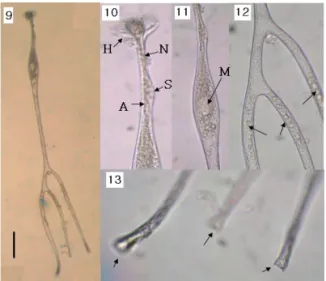
Sch tt (Figs. 9-13)ü 세포 길이는 800 860 ∼ ㎛이며 하각의 아래쪽 끝부분에 개의 3 antapical ends를 가진다(Fig. 9).세포 전체를 대략 등분 하였을 때 위쪽 3 1/3 부 분에 head, neck, shoulder, APB 및 mid-body가 위 치하며(Figs. 9 11), ∼ 가장 아래 쪽 1/3 부분에는
에서 세포 아래쪽으로 길게 신장된 mid-body
의 말단부에 포크모양과 같이 세 posterior process
갈래로 분지된 antapical ends가 위치한다(Figs. 9, 상각을 포함하는 는 매우 작고 그
12, 13). head ,
밑으로 head의 약 배 길이의 2 neck이 위치한다. 의 바로 아래에 배 쪽으로 돌출한 가
neck shoulder
있고 그 아래로 짧고 좁은 APB가 위치한다(Fig.
10). mid-body는 A. bidentata와 유사한 크기이거나 약간 크다(Fig. 11). 그리고 mid-body 아래로 길게 신장된 posterior process의 말단에 위치한 포크 형 태의 antapical ends의 최 말단부에는 짧은 spine이
개씩 관찰 되었다
2 (Fig. 13).
[Figs. 9-13] Apmphisolenia thrinax, light microscope.
Fig. 9. Left lateral view (scale bar: 100 ), Fig. 10. Head (H), neck (N),
㎛
shoulder (S) and APB (A) of the species.
Fig. 11. mid-body (M). Fig. 12. The forked three antapical ends of posterior process and symbionts (arrows). Fig. 13.
Tip of the three antapical ends showing its two spines (arrows)
Triposolenia bicornis
Kofoid (Fig. 14)세포 길이가 45 50 ∼ ㎛로 비교적 소형종이다. 상각은 매우 축소되어 있어 head는 세포 전체에 서 차지하는 비율이 극히 미미하다. head의 아래 로 head 길이의 약 4.5 5∼ 배 정도 긴 길이의 neck 이 길게 신장하며 바로 이어서 , shoulder가 배 쪽 으로 돌출하여 존재한다 그리고 그 아래로 매우 . 짧은 APB가 존재한다. mid-body는 세포의 거의 중앙부에 위치하는데 측면에서 보면 약간 둥근 삼각형 모양을 한다 그리고 . mid-body에서 길이 가 거의 동일하고 좌우대칭을 이루는 두 개의
가 아래쪽으로 신장하는데 직선
posterior processes ,
이 아니라 세포 안쪽을 향해 약간 구부러져 있으 며 각각의 , posterior process의 구부러진 부분의 바깥쪽으로 여러 개의 톱니모양 결절이 존재 하 였다 세포의 전체 형태를 . mid- body를 중심으로
보면 shoulder는 배 쪽으로 약간 기울어져 있으 며 이와 달리 , neck은 등 쪽으로 기울어져 있는 것을 알 수 있다(Fig. 14).
[Fig. 14] Triposolenia bicornis with marginal tubercles (T) and conspicuous shoulder (S) (scale bar: 10 )㎛
.
고 찰Ⅳ
이 논문에서 보고하는 아열대 및 열대 유래의 미기록 종4 (A. bidentata, A. inflata, A. thrinax, T.
bicornis 은 아열대와 열대 해산어종을 해수관상어) 로서 양식 개발하기 위한 먹이생물 탐색 과정에 서 채집되었다 지금까지 우리나라 연안에서 보. 고된 다른 온대해역의 와편모조와는 달리 이번에 이 논문을 통하여 보고하는 Amphisolenia 속과 Triposolenia 속에 속하는 종은 아열대 및 열대 해 역에 주로 분포한다(Hernández-Becerril and Meave, 1999).
세포 형태 또한 여러 가지 특징을 가지는데 하 각에 비해 상각이 매우 축소되어 있는 점은
목의 다른 여러 속의 종들과 유사 Dinophysiales
하나 Amphisolenia 속과 Triposolenia 속의 종은 횡 구 날개는 비교적 뚜렷하게 관찰되지만 종구 날 개는 매우 작아서 광학현미경으로는 관찰이 매우 어렵다(Hernández- Becerril and Meave, 1999).
Amphisolenia 속에 속하는 종은 일반적으로 에서 아래로 길게 뻗은 하나의
mid-body posterior
만을 가진다 이 의 끝은
process . posterior process
단순한 형태를 하거나 말단부가 포크와 같이 분 지된 형태를 나타내는 종이 있다 또한 . posterior
의 맨 끝부분은 둥근 형태를 하거나 그와 process
반대로 날카롭게 잘려나간 형태를 하기도 하며, 그 끝 부분에 몇 개의 미세한 돌기(spine)를 가지 는 종도 있다 (Kofoid, 1907; Gul and Saifullah, 2007; Hernández-Becerril et al., 2008).
이 연구에서 관찰된 Amphisolenia 속의 종 역3 시 아열대나 열대지방에서 일반적으로 관찰되는 Amphisolenia 속에 속하는 종과 큰 차이 없이
으로 부터 하나의 가 아
mid-body posterior process 래쪽으로 길게 뻗어 있는 점은 공통점으로 관찰 되었다.
그러나 A. bidentata의 경우는 posterior process 의 말단이 분명하게 배 쪽으로 구부러져 있는 반 면, A. inflata의 경우는 구부러짐 없이 일직선으 로 아래를 향하며 그 말단은 비교적 날카롭고 뾰 족하였고 A. thrinax는 posterior process의 말단부 에 포크형태로 3분지 되어 있어 3종 모두
의 말단부가 매우 독특한 형태를 posterior process
취하고 있어 다른 Amphisolenia 속의 종류와 구분 이 가능하였다 또한 . A. bidentata와 A. thrinax 두 종의 mid-body는 방추형이지만 그 두께가 비교적 얇은데 비해 A. inflata의 경우는 mid-body 부분이 앞의 두 종에 비해 두껍고 분명하였다 이에 반. 해 APB는 종 모두 잘 발달되지 못하여 작고 빈3 약하였다.
Triposolenia 속의 종은 Amphisolenia 속에 비교 하여 잘 발달된 shoulder를 가지며 비교적 넓은 ,
는 약간 둥근 삼각형 모양의 주머니 형 mid-body
태를 나타내며 그 곳으로부터 길이가 거의 동일
한 두 개의 posterior process가 세포 아래쪽을 향 하여 신장한다 이들 . posterior process는 보통 바 깥쪽으로 구부러진 형태를 한다 그리고 그 바깥. 쪽 가장자리에 몇 개의 날카로운 결절(tubercles)을 가지는 종이 있으며, posterior process의 말단부는 어떠한 돌기도 가지지 않거나 미세하고 날카로운 돌기를 가지는 종이 있다 또한 . Amphisolenia 속과 달리 Triposolenia 속의 독특한 특징으로 APB가 배 쪽(dorsal part)을 향해 약 10-20° 정도 기울어 진 것을 들 수 있다 그리고 . neck은 10°에서 35°
정도 배 쪽으로 치우쳐 있다 (Hernández-Becerril 이번 연구에서도
and Meave, 1999). T. bicornis는 Amphisolenia 속의 종과 달리 잘 발달한 3 shoulder 와 넓고 삼각형에 가까운 구형의 mid-body 그리고
로부터 뻗어 나온 개의
mid-body 2 posterior process 등 Triposolenia 속의 종에서 볼 수 있는 특징을 갖 추고 있었다 그러나 대부분의 . Triposolenia 속의 종이 대형종인데 반해 T. bicornis의 경우는 세포 길이가 45 50 ∼ ㎛로 비교적 작았다.
Amphisolenia 속의 몇몇 종에서는 남조류에 속 하는 Synechococcus나 Prochlorococcus와 같은 내 부 공생 생물이 존재하는 것으로 보고되어 있다 (Lucas 1991: Hallegraeff and Jeffrey 1984). 그들 종 가운데 A. thrinax의 경우는 mid-body 아래로 길게 신장된 posterior process의 말단에 세 갈래로 분지된 포크 형태의 antapical ends가 위치하는데, 이 포크형태로 분지되는 시작 부위에는 내부 공 생생물로 알려진 남조류의 한 종인 Synechoccus carcerarius의 군집이 관찰되었다.
Reference
Ballantine, D.(1961). Gymnodinium chukwaniin. sp.
and other marine dinoflagellates collected in the vicinity of Zanzibar, J. Protozool., 8, 217 228.
Gómez, F.(2005). A list of free-living dinoflagellates species in the world’s oceans, Acta Bot. Croat., 64, 129 212.
Gul, S. and Saifullah, S. M.(2007). Genus Apmphisolenia Stein from North-West Arabian Sea Shelf of Pakistan, Pak. J. Bot., 39, 561 576.
Hallegraeff, G. M. and Jeffrey, S. W.(1984). Tropical phytoplankton species and pigments of continental shelf waters of North and North-West Australia, Marine Ecology Progress Series, 20, 59 74.
Hernández-Becerril, D. U. and Meave del Castillo, M.
A. E.(1999). A new dinoflagellate from the Indian Ocean : a link between the genera Amphisolenia and Triposolenia (Dinophyceae)? J. Phycol., 38, 108 113.
Hernández-Becerril, D. U. Ceballos-Corona, J. G. A.
Esqueda-Lara, K. Tovar-Salazar, M. A. and León-Álvarez, D.(2008). Marine planktonic dinoflagellates of the order Dinophysiales (Dinophyta) from coasts of the tropical Mexican Pacific, including two new species of the genus Amphisolenia, J. Mar. Biol.
Ass. U. K., 88, 1 15.
Kofoid, C. A.(1907). Reports of the scientific results of the expedition to eastern tropical Pacific, In charge of Alexander Agassiz, by the U. S. Fish
Commission Steamer “Albatross”, from October, 1904, to March, 1905, Liut, Commander L. M.
Garret U. S. N. ,commanding. . New species of dinoflagellates, Bull. Mus. Comp. Zool. Harv., 50, 162 207
Lucas, I. A. N.(1991). Symbionts of the tropical Dinophysiales (Dinophyceae), Ophelia, 33, 213 224.
Steidinger, K. A. and Tangen K.(1997). Dinoflagellates, In: Identifying Marine Phytoplankton, edited by Tomas C. R., Academic Press, SanDiego, pp. 387
584.
Taylor, F. J. R.(1987). Dinoflagellate morphology, In:
The Biology of Dinoflagellates, edited by Taylor F. J. R., Blackwell Scientific Publications, Oxford, pp. 24 91.
논문접수일 : 2013년 07월 27일 심사완료일 : 1차 - 2013년 09월 24일
차 년 월 일
2 - 2013 10 08 게재확정일 : 2013년 10월 24일