Original article KOREAN JOURNAL OF APPLIED ENTOMOLOGY
한국응용곤충학회지 ⓒ The Korean Society of Applied Entomology
Korean J. Appl. Entomol. 53(2): 97-101 (2014) pISSN 1225-0171, eISSN 2287-545X
DOI: http://dx.doi.org/10.5656/KSAE.2014.01.1.083
Gelechiidae Collected from Is. Ulleung-do in the East Sea, Reporting a Newly Recorded Species from Korea and an Unknown Species
Kyu-Tek Park, Minyoung Kim1* and Bong-Kyu Byun2
The Korean Academy of Science and Technology, Seongnam 463-808, Republic of Korea
1Department of Agricultural Biotechnology, Seoul National University, 599 Gwanak-ro, Gwanak-gu, Seoul 151-921, Republic of Korea
2Department of Biological Science and Biotechnology, Hannam University, 461-6, Yuseong-gu, Daejeon 305-811, Republic of Korea
울릉도에서 채집된 뿔나방과의 보고 및 2 미기록종
박규택ㆍ김민영1*ㆍ변봉규2
한국과학기술한림원, 1서울대학교, 2한남대학교
ABSTRACT: In a faunal survey of the Gelechiidae (Lepidoptera: Gelechioidea) from Is. Ulleung-do in the East Sea of Republic of Korea, one species of Gelechiidae, Bagdadia gnomia Ponomaranko, is reported for the first time from Korea and an unknown species of the genus Bryotropa was discovered. In addition, eight species of Gelechiidae including a little known species, Dichomeris anisacuminata Li & Zheng, were first recorded from Is. Ulleung-do. Images of adults and genitalia for the newly recorded species and a little known species are provided.
Key words: Is. Ulleung-do, New record, Gelechiidae, Lepidoptera
초 록: 울릉도의 곤충상 조사결과, 뿔나방과 (나비목: 뿔나방상과)의 10종이 채집되었다. 그 중 Bagdadia gnomia Ponomaranko과 Bryotropa sp.
의 2종은 우리나라에서 처음으로 기록되었으며, 채집이 어려운 Dichomeris anisacuminata Li & Zheng도 함께 조사되었다. 이들 종 동정에 필요한 성충과 생식기 사진을 함께 기재한다.
검색어: 울릉도, 미기록종, 뿔나방과, 나비목
*Corresponding author: [email protected]
Received December 29 2013; Revised January 6 2014 Accepted January 20 2014
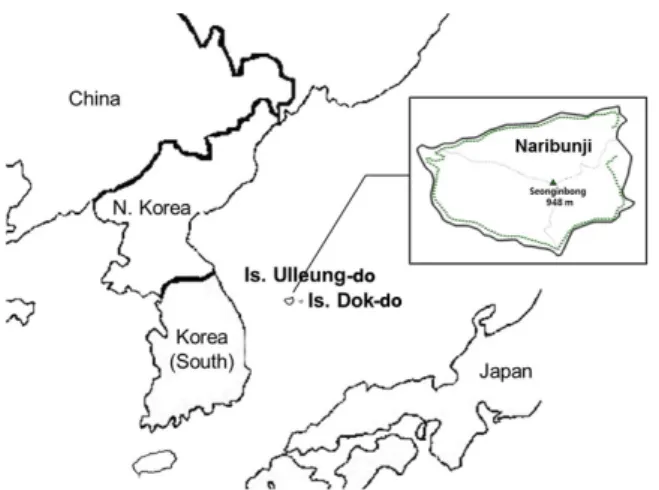
Is. Ulleung-do is located about 270 km east from Phohang in the East Sea, more than three and half hours by express passenger ship. The island is 72.56 km2 width with a population of less than 13,000 residents. Mt. Seonginbong (ca. 984 m) is the highest with a broad basin called Naribunji which is 1.5-2.0 km2 width and located at 860m above sea level in the middle of the island. There are two crater basins with two villages: Narimaeul in the North and Albongmaeul in the Southwest (Park, 1997).
Only few insect surveys have been conducted due to a long distance from the Korean Peninsula and an inconvenient approach.
The first fauna survey on Lepidoptera in Is. Ulleung-do was conducted by Cho (1955), who first reported five species of moths and 26 species of butterflies, and later (1965) listed 267 species of moths and 83 species of butterflies. Recently Byun et al. (1996) reported 137 species of 24 families with 43 additional species for the fauna of Is. Ulleung-do, but no species of family Gelechiidae has been known from the island to date. The family Gelechiidae is one of the largest and least known families of micromoths, comprising more than 4,700 known species belonging to about 500 genera in the world. The family contains a total of 172 species in the Peninsula (Park and Ponomarenko, 2007; Byun et al. 2009).
Of the eight known species of Gelechiidae in this study,
Fig. 1. Map indicated the location of Is. Ulleung-do.
Anarsia ulneungensis Park & Ponomarenko which is still known as endemic to Korea, and a little known species, Dichomeris anisacuminata Li & Zheng are illustrated.
Materials and methods
This study is based on specimens collected from the Naribunji of Is. Ulleung-do, during June in 2006 by light traps using a Mercury vapor-lamp of 220 V/200 W, and deposited in the Korea National Arboretum (KNA), Pocheon, Korea. The wingspan is measured from the left apex to the right apex of the forewing. For morphological studies, external structures and genital characters were examined under a stereo microscope (Olympus SZ51; Olympus, Japan). A Canon 500D camera (Canon, Japan) was used for the digital photography. The color standard for the description of adults follows Kornerup and Wanscher (1978).
Results
Bagdadia gnomia Ponomarenko (Figs. 2, 3, 3a, 3b)
Bagdadia gnomia Ponomarenko, 1995. Actias, 2: 50. TL:
Primorye, Russian Far East.
Capidentalia gnomia: Ponomarenko, 1997: 49; 1999: 254.
Bagdadia gnomia: Sattler, 1999: 238; Park & Ponomarenko, 2007: 179.
Diagnosis. Male genitalia (Figs. 3, 3a-b). Bagdadia gnomia is differed from B. claviformis (Park, 1983) by the male
genital characters: 1) cucullus with dilated part beyond distal 3/4 length; 2) valvella stout, bifurcated apically.
Material examined. 4♂, Is. Ulleung-do, Naribunji, 19-20.
vi. 2006 (MY Kim & MY Chae), gen. slide no. KNA-3161, KNA-3163.
Distribution. Korea (new record), Russian Far East (Primorye), Japan.
Remarks. The genus Bagdadia Amsel was originally placed in family Scythrididae by Rebel (1901), and later transferred to family Gelechiidae by Sattler (1973). The genus mostly occurs in East Asia: two species in the Russian Far East, four species in China, and two species in Korea.
The male genitalia is characterized by having a crown-shaped uncus and elongate valva.
Bryotropha sp. (Figs. 4, 5, 5a, 5b)
Diagnosis. The female genitalia (Figs. 5, 5a-b) are characterized by the large signum with short posterior spine laterally and a long anterior process serrated along lateral margins. Only one female was available to be examined.
The species is probably an undescribed and will be described when additional material is available.
Material examined. 1♀, Is. Ulleung-do, Naribunji, 19-20.
vi. 2006 (MY Kim & MY Chae), gen. slide no. KNA-3167.
Distribution. Korea (new record).
Caryocolum pullatella (Tengström)
Caryocolum pullatella Tengström, 1848, Finl. Fjäril.:
126; Park, 1993: 18; Park, 2004: 37; Park & Ponomarenko, 2007: 79. TL: Finland.
Material examined. 1♂, Is. Ulleung-do, Naribunji, 19-20.
vi. 2006 (MY Kim & MY Chae), gen. slide no. KNA-3168.
Distribution. Korea (throughout the country, including Jeju), Japan, Russia (European Part, Irkutsk region, Transbaikalia), Europe, North America.
Remarks. This species was reported for the first time from Korea by Park (1993), and it is one of the common species in Korea.
Angustialata gemmellaformis Omelko
Angustialata gemmellaformis Omelko, 1988, Ent. Obozr.,
Figs. 2-6. 2. Adult of Bagdadia gnomia Ponomaranko; 3. Male genitalia; Bagdadia gnomia Ponomaranko. 3a. Ditto, lateral view; 3b. Ditto, aedeagus; 4. Adult of Bryotropa sp.; 5. Female genitalia of Bryotropa sp.; 5a. Ditto, ostial part; 5b. Ditto, close-up of signum. 6. Adult of Dichomeris anisacuminata Li & Zheng; 6a, Male genitalia of Dichomeris anisacuminata Li & Zheng; 6b, Ditto, close-up of posterior part; 6c, aedeagus.
67: 150; Lee & Park, 2000: 64; Park, 2004: 49; Park &
Ponomarenko, 2007: 179. TL: Ussuri, Russia.
Material examined. 3♂, Is. Ulleung-do, Naribunji, 19-20.
vi. 2006, (MY Kim & MY Chae), gen. slide no. KNA-3162, KNA-3171.
Distribution. Korea (Central), China, Russian Far East, Japan.
Remarks. The genus Angustialata Omelko is monotypic, which was described from Ussuri, the Russian Far East. The genus is superficially close to genus Stenolechia Meyrick, but it is characterized by having a pair of unique shapes of signa in the female. This species was reported for the first time from Korea by Lee & Park (2000), based on specimens collected in the central part of the Peninsula.
Agrolamprotes micella (Dennis & Schiffermüller)
Agrolamprotes micella Dennis & Schiffermüller, 1775, Ank.
Syst. Werkes Schmett. Wien.: 140 (Tinea); Park & Ponomarenko, 2006: 277; Park & Ponomarenko, 2007: 23. TL: Europe.
Material examined. 1♂, 3♀, Is. Ulleung-do, Naribunji, 19-20. vi. 2006 (MY Kim & MY Chae), gen. slide no. KNA- 3160.
Distribution. Korea (Central, Jeju), Japan, China, Russian Far East, Europe.
Remarks. This species was reported for the first time from Korea by Park & Ponomarenko (2006), and has been found in the Prov. Gangwon and Is. Jeju-do.
Altenia inscriptella (Christoph)
Altenia inscriptella Christoph, 1882. Bull. Soc. Nat. Mosc., 57: 25 (Teleia); Park, 1992: 17; Park, 2004: 63; Park &
Ponomarenko, 2007:120. TL: E. Siberia.
Material examined. 4♂, Is. Ulleung -do, Naribunji, 19-20.
vi. 2006 (MY Kim & MY Chae).
Distribution. Korea (throughout the country, including Jeju), Russian Far East, Japan.
Remarks. This species was reported for the first time from Korea by Park (1992).
Evippe syrictis (Meyrick)
Recurvaria syrictis Meyrick, 1936. Exot. Microlep. 5:
43. TL: Japan.
Material examined. 1♀, Is. Ulleung-do, Naribunji, 19-20.
vi. 2006 (MY Kim & MY Chae), gen. slide no. KNA-3176.
Distribution. Korea (North, Central), China, Japan, Russian Far East.
Remarks. This species was first reported from Korea by Park (2004), based on male specimens. The female was found for the first time in Korea.
Dichomeris anisacuminata Li & Zheng (Figs. 6, 6a-c) Dichomeris anisacuminata Li & Zheng, 1996. SHILAP Revta. Lipid., 24 (95): 231; Sohn, 2007. TL: China.
Material examined. 1♂, Is. Ulleung-do, Naribunji, 19-20.
vi. 2006 (MY Kim & MY Chae), gen. slide no. KNA-3169.
Distribution. Korea (Central, Is. Ulleung-do), China.
Remarks. This species was described based on two male and one female specimens from Jiangxi in China. Sohn (2007) reported this species for the first time from Korea, based on specimens collected in the central part of Korea.
Larvae of this species were reared from Quercus mongolica (Sohn, 2007). The male genitalia (Figs. 6a-c) are characterized by having long, symmetric processes of juxta and the aedeagus with heavily sclerotized spine-like process apically and two different length of slender processes arising from middle.
Dichomeris rasilella (Herrich & Schäffer)
Dichomeris rasilella Herrich & Schäffer, 1854. Syst.
Bearb. Schmett. Eur., 5: 191; Park, 1983: 505; Park, 1994:
16; Park & Hodges, 1995: 52; Park, 2004: 94; Park &
Ponomarenko, 2007:153. TL: Europe.
Material examined. 1♂, Is. Ulleung-do, Naribunji, 19-20.
vi. 2006 (MY Kim & MY Chae), gen. slide no. KNA-3160.
Distribution. Korea (throughout the country, including Jeju), China, Taiwan, Japan, Russia (European Part, Far East), Europe.
Remarks. This species was reported for the first time from Korea by Park (1983), and is one of the common species in Korea.
Anarsia ulneungensis Park & Ponomarenko
Anarsia ulneungensis Park & Ponomarenko, 1996. Kor.
J. Ent., 26(4): 343; Park & Ponomarenko, 2007: 182. TL:
Dodong, Is. Ulleung-do, Korea.
Material examined. 1♂, Is. Ulleung-do, 6. viii. 1995 (KT Park).
Distribution. Korea (endemic).
Remarks. This species was reported for the first time from Korea by Park (1983), and has been found throughout the country, including Is. Jeju-do.
Acknowledgments
This study was financially supported by the National Institute of Biological Resources (NIBR), Ministry of Environment, Korea. We thank Dr. Houhun Li, Nankai University, Nankai, China for his comments for identification of the species.
Literature Cited
Byun, B.K., Lee, B.Y., Kim, S.S., 1996. Lepidoptera of the Is.
Ulleung, Korea. J. Lepid. Soc. Korea. 9, 26-33.
Byun, B.K., Park, K.T., Bae, Y.S., Lee, B.W., 2009. A check list of
the microlepidoptera in Korea. Korea National Arboretum. 413 pp.
Cho, B.S., 1955. The fauna of Dagelet Island (Ulneung-do). Bull.
Sungkyunkwan Univ. 2, 179-266.
Cho, B.S., 1965. Beitrage zur Kenntnis der Insekten-fauna Insel Dagelet (Ulleung-do). Commemoration Thesis of 60th Aniversary (Natural Sciences), Korea Univ. pp. 157-205.
Park, H.D., 1997. The physical geography of Ulneung-do Island.
The Geographical Journal of Korea. 31, 27-40.
Park, K.T., Ponomarenko, M.G., 2007. In: Park, K.T. (eds.).
Gelechiidae of the Korean Peninsula and adjacent territories (Lepidoptera). Insects of Korea series 12. 312 pp.
Sohn, J.C., 2007. Faunistic contribution to the Korean micro- lepidoptera and Pyralids (1). 40 species new to Korea. Tinea 20, 12-27.