*1 Received on July 15, 2008; accepted on February 23, 2009
*2 Department of Forest Products and Technology, College of Agriculture, Chonnam National University, Gwangju 500-757, South Korea
† Corresponding author : Woo Yang Chung (e-mail: [email protected])
A Study on the Distribution and Time Dependent Change of Wood Temperature by Solar Radiation*
1Hui Lan Xu*
2, Wook Kang*
2, and Woo Yang Chung*
2†ABSTRACT
The fluctuation of physical properties in wood or wood composites is an important subject when the materials in building and construction. Sorption and desorption occur in wood when exposed to the open air, and the temperature distribution in wood can fluctuate as a result of changes in environmental temper- ature, solar radiation, humidity, and wind velocity. In this study, the temperature difference and fluctuation caused by outdoor environment among different wood species were analyzed using a numerical method.
The effect on the process of heat transfer in wood caused by environmental factors was investigated using 1-dimensional partial differential equation with real boundary and initial conditions. The experimental data have been used to check the accuracy of programming code. Through analysis, it was found out that den- sity and moisture content have a negative effect on thermal diffusivity of wood.
Keywords : wood, solar radiation, temperature distribution, thermal diffusivity
1. INTRODUCTION
The significant presence of wood in build- ings, the energy design of wood frame buildings and the evaluation of their energy performance depends in part on thermal properties of wood products. Thermal properties of wood are well documented by many researchers (Avramidis et al., 1992; Peter, 1977; Siau, 1995). TenWolde et al. (1988) researched heat properties of wood and wood panel products used in buildings. They derived linear equations for thermal conducti- vity and specific heat of solid wood and wood
panels as a function of density and moisture content. When wood is used in outside wall of a building, the heat transfer behavior in it will fluctuate as a result of changes in environmental temperature, solar radiation, humidity, and wind velocity. Although heat and mass transfer char- acteristics of drying is well documented (Dedic, 2000; Olek et al., 2003), heat transfer behavior of wood as affected by real outdoor environ- ment is poorly understood.
In contrast, the analysis of heat and mass
transfer behavior in related to the real outdoor
environment is well developed in building de-
partment. Sami (2003) considered periodic con- ditions which including temperature and solar radiation to measure heat behavior of walls and roofs. Tsilingiris (2002) studied the unsteady state of heat conduction in building walls which used the finite difference method. His research in- cluded development of a simulation model suit- able for investigating the dynamic behavior of structural wall elements, under the effect of the time dependent drying function of solar radia- tion and ambient temperature.
Based on the thermal properties of wood and thermal analysis of buildings, in this study, the effect in process of heat transfer in wood cau- sed by outdoor environment was investigated using 1-dimensional partial differential equation with real boundary and initial condition.
2. MATERIALS and METHODS
2.1. Materials
More than 3 years natural conditioned wood was chosen. Selection was depended on density and moisture content. The status of samples is shown in Table 1.
2.2. Methods
All of species were made in two work pieces.
One was used for thermocouple attaching and the other for weighting. All of the sample surfa-
ces were coated by oil-based paint except one surface that was exposed to the open air. The five painted surfaces were insulated by Styro- foam. The purpose of these treatments was to simulate the condition of 1-dimensional heat and mass transfer. All of the exposed surfaces were tangential section.
Samples with large differences in density (cedrela and willow) were coated with black water borne paint on their exposure surface in order to fix the value of emissivity (0.95).
Thermocouples were adhered to the sample surface, center and bottom. The adhesion meth- od of thermocouples on the surfaces and bot- toms were fixed with aluminum tape, and the center had a hole drilled and fixed with glue.
The emissivity of aluminum tape is only 0.03.
Aluminum tape can reflect solar radiation to de- crease effect of the surface temperature by itself.
So we can assume temperature of sample sur- face and aluminum tape is equal to each other.
In order to diminish influence of thermocouple adhesion treatment on temperature of center and bottom, the three measuring points were not leave in the same line. A simplified schematic of analysis model is shown in Fig. 1.
Each temperature data was measured and re- corded in real time during the experiment.
Samples were weighed in 3 hours intervals. So
we can record amount of sorption moisture
from the exposed surface. From amount of
sorption moisture, we can calculate heat of
Fig. 1. Simplified schematic of analysis model.
Fig. 2. Divided element and heat transfer phenomena.
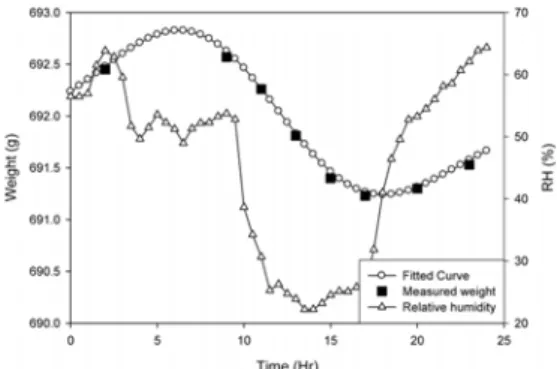
Fig. 3. Curve fitting of weight fluctuation (Chinese cedrela, November 11, 2006).
vaporization. During the experiment, weather data including solar radiation, humidity, temper- ature, and wind velocity were downloaded from the Gwanju Regional Meteorological Admini- stration.
2.3. Analysis Methods
The heat and mass transfer process can be defined 1-dimensional as the sample treatment.
The process of heat transfer in wood took into consideration radiation, convection, conduction, moisture sorption, and desorption. 1-dimensional unsteady state partial differential equation was used to describe the heat and mass transfer pro- cess with real boundary and initial conditions.
In this study, wood is considered diffuse gray surface in order to regard both emissivity and absorbtivity as the same value. The heat transfer coefficient was determined by density and tem- perature. The amount of sorption and desorption were determined by weight change of samples.
Fig. 2 shows the data of governing equation, boundary condition, and discretization. At x = 0, the sample was insulated by Styrofoam, and the gradient of heat flux was considered to be zero.
The average temperature of sample at 12 p.m.
was considered to be initial condition in each sample. Solar radiation, infrared sky radiation, convection and moisture fluctuation accompany- ing latent heat evaporation and condensation take place on the surface (x = L). As mentioned the amount of weight fluctuation was checked at 3 hours intervals, and the curve fitting method was used to simulate whole weight fluctuation. Fig.
3 illustrates the curve fitting results.
Equation 1 is the governing equation. Boun- dary conditions are shown in equations 2 and 3, while equation 4 reflects the initial condition.
(1)
Boundary condition:
(2)
∞ σ
∙
(3)
Initial condition: t = 0 : T = T
i(4) Wh., I
S: radiation flux (W/m
2)
α : absorbtivity
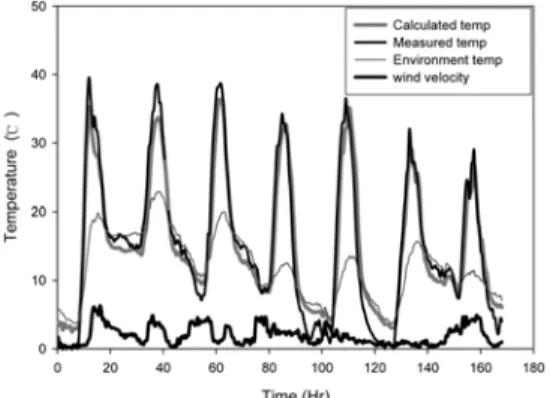
Fig. 4. Comparison between simulation results and experiment results (Chinese cedrela, surface temperature, November 8∼14, 2006).
h
cis heat transfer coefficient. In this study, it was determined only by wind velocity (Loveday et al., 1996).
h
c= 16.21V
s0.452(5) Wh., h
c: heat transfer coefficient (W/m
2K)
V
s: wind velocity (m/s)
k is heat conductivity. k is determined by wood density and temperature (Harada et al., 1998).
0.00249 0.000145 0.000184
k = + ρ + × (6) T
Wh., k: heat conductivity (W/m K) ρ: wood density (kg/m
3)
In this study, we assumed the specific heat capacity was influenced by moisture content and temperature (Steinhagen et al., 1988).
2000 8.71 4.98
C
p= + × + m T (7)
Wh., C
p: specific heat capacity (J/Kg K) m : moisture content (%)
T : wood temperature (°C)
The sky temperature was calculated by equa- tion 8 (Ashrae, 1999).
0.0522( )
1.5273.15 T
sky= T
∞+
Wh., T
∞: environmental temperature (°C)
The finite difference method was used to solve the unsteady state and nonlinear governing equa- tion. One of the steps of the finite difference method involves dividing the domain into a dis- crete one. In this study, the domain was divided into 10 elements (see Fig. 2) by fully implicit method. Afterwards, TDMA (tridiagonal matrix algorithm) was used to solve the discretised equation.
3. RESULTS and DISCUSSION
3.1. Simulation Verification Using Ex- periment Results
In order to verify the accuracy of the simu- lation results, they were compared with ex- perimental results. Fig. 4 shows the comparison of surface temperatures. As mentioned before, cedrela and willow coated by black water borne paint on their open air surface to fix the emis- sivity and absorptivity value.
The difference between simulation and ex-
perimental results was less than 6%. The big-
gest gap occurred during the night. From the
theory of radiation, it is known that the surface
temperature at night should be similar to the en-
Fig. 5. Computer simulation results between high density and low density (Chinese cedrela, back temperature, November 11, 2006).
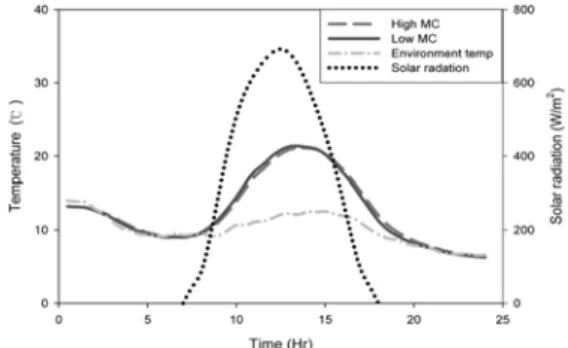
Fig. 6. Computer simulation data between high MC and low MC (Douglas fir, back temperature, November 11, 2006).
vironmental temperature. However, the meas- ured surface temperature was much lower than the calculated one at night. This is mainly caused by the cooling effect. Sample surfaces were ob- served to have been wetted by dew before sunrise.
3.2. Density-Dependent Heat Behavior Simulation results were used to analyze heat behavior of the whole samples. The samples which differ only in density exhibited different heat transfer behavior. From Fig. 5, it can be seen that heat transfer behavior of a high den- sity sample is delayed in a sample with low density. Heat conductivity mainly depends on density (equation 6). From the equation 1,
is the value of heat diffusivity. Though the con- ductivity increased with the density, the resul- tant value of diffusivity is largely influenced by density rather than conductivity. It means diffusivity inverse to density. This is the main reason why a sample with high density has slower temperature movement in heat transfer.
3.3. Moisture–Dependent Heat Beha- vior
The same species with different moisture con-
tents have different values of specific heat capacity. Heat capacity mainly depends on mo- isture content (equation 7). A sample with high moisture content has a high value of the heat capacity. Fig. 6 illustrates the comparison re- sults of samples with different moisture content.
From the Figure, it can be seen that heat trans- fer behavior of the high moisture content sam- ple is delayed in the sample with low moisture content. Obviously, the value of heat diffusion coefficient (
) was inversely proportional to the value of heat capacity. In this sample’s sim- ulation, values of emissivity and absorptivity are hard to determine. So we used inverse method.
The value of emissivity and absorptivity were determined until the adjusted results mirrored the experimental results. The adjusted value of Douglas fir’s emissivity and absorptivity was 0.4.
3.4. Thermal Exchange between the Testing Surface and the Environment
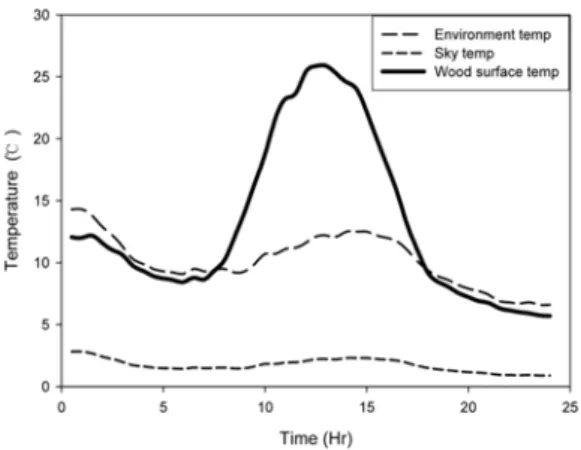
The relationship between sample surface tem-
perature, ambient temperature, and the sky tem-
perature are shown in Fig. 7 Throughout the
day, the difference between the surface temper-
Fig. 7. Temperature of sample surface, environment and sky temperature on a clear day (Chinese cedrela, surface temperature, November 11, 2006).
ature and sky temperature varied from 4.9°C to 23.7°C, whereas the difference between the am- bient temperature and sky temperature was from 5.7°C to 11.5°C.
One significant point emerging from Fig. 7 is regardless the solar radiation conditions, the in- frared heat flow always leaves the sample sur- face (T
s>T
sky). During the daytime, sample sur- face heated by solar radiation. Also, during the day time sample surface cooled both by con- vection of air and by infrared sky radiation, whereas during the night the sample surface is heated by convection of the ambient air and is cooled by infrared sky radiation (Oliveti et al., 2003).
4. CONCLUSION
Wood conductivity, heat capacity, and heat diffusion coefficient were influenced by density and moisture content. In this study, the effect to the process of heat transfer in wood caused by environment condition was investigated using 1-dimensional partial differential equation with real boundary and initial conditions. The ex-
This work was supported by Grant of the Korean Ministry of Education, Science and Tech- nology (The Regional Core Research Program/
Biohousing Research Institute) and the Brain Korea 21 Program funded by the Ministry of Education, Republic of Korea.
REFERENCE
1. Dedic, A. 2000. Simplifying convective heat and mass transfer in moisture desorption of beech wood by introducing characteristic transfer co- efficients, Holz als Roh-und Werkstoff 58(2): 96
∼101.
2. Anton TenWolde, J. Dobbin McNatt, and L.
Krahn. 1988. Thermal Properties of Wood and Wood Panel Products for Use in Buildings, OAK RIDGE NATIONAL LABORATORY.
3. ASHRAE Applications Handbook. 1999. Cha- pter 32.
4. Oliverti, G., N. Arcuri, and S. Ruffolo. 2003.
Experimental Investigation on Thermal Radi- ation Exchange of Horizontal Outdoor Surfaces, Building and Environment 38(1): 83∼89.
5. Steinhagen, H. P. 1977. Thermal Conductivity Properties of Wood, Green or Dry, from -40°C to +100°C: a Literature Review, Forest Products Laboratory.
6. Siau, J. F. 1995. Wood: Influence of Moisture on Physical Properties, Chapter 5.
7. Loveday D. L. and A. H. Taki. 1996. Convective Heat Transfer Coefficients at a Plane Surface on a Full-Scale Building Facade, International Journal of Heat and Mass Transfer 39(8): 1729∼1742.
8. Tsilingiris, P. T. 2002. On the Transient Thermal
Behavior of Structural Walls - the combined Effect of Time Varying Solar Radiation and Ambient Temperature, Renewable Energy 27(2):
319∼336.
9. Sami A. Al-Sanea. 2003. Finite-Volume Thermal Analysis of Building Roofs under Two-dimen- sional Periodic Conditions, Building and Envi- ronment, 38(8): 1039∼1049.
10. Avramidis, S. and P. Lau. 1992. Thermal Coef- ficients of Wood Particles by a Transient Heat Flow Method, Holzforschung 46(5): 449∼453.
11. Steinhagen H. P. and H. W. Lee. 1988. Enthalpy method to compute radial heating and thawing of logs, Wood Fiber Sci 20(4): 415∼421.
12. Harada, T., T. Hata, and S. Ishihara. 1998. Ther- mal Constants of Wood during the Heating Process Measured with the Laser Flash Method, Journal of Wood Science 44(6): 425∼431.
13. Olek, W., J. Weres, and R. Guzenda. 2003.
Effects of Thermal Conductivity Data on Accu- racy of Modeling Heat Transfer in Wood, Hol- zforschung 57(3): 317∼325.