재배와 야생 지치의 추출물과 용매별 분획물의 항산화효과
김진숙1†․강명화2
1농촌진흥청 국립농업과학원 농식품자원부
2호서대학교 식품영양학과
Antioxidant Activity of Solvent Fractions from Cultivated and Wild Gromwell
Jin-Sook Kim1† and Myung-Hwa Kang2
1
Dept. of Agrofood Resources National Academy of Agricultural Science, RDA, Gyeonggi 441-853, Korea
2
Dept. of Food Science and Nutrition, Hoseo University, Chungnam 336-795, Korea
Abstract
In order to set up an accurate quality criteria for the Boraginaceae that have been traditionally used for medical purposes and food colorant, and to assess its viability as functional food ingredient, antioxidant tests were conducted on the wild and cultivated plants. Variety of indicators including total contents of phenol, DPPH, SOD-liked effect, hydroxy radical-scavenging effect, lecithin oxidation inhibitory effect, etc were analyzed.
Wild and cultivated gromwell's total contents of phenol in their methanol extracts were 0.14% and 0.13%, while they were most active in ethyl acetate extracts and n-hexane extracts, respectively. IC50 values of methanol extract of the wild and cultivated plants were 794.41 μg/mL and 971.86 μg/mL, indicating that the wild plant is more responsive (p<0.05) to low concentration. Also the wild and cultivated plants were most active in ethyl acetate fraction and n-hexane extracts when their IC50 values were measured by each solvent extracts.
SOD-liked effects of both plants were concentration dependent while methanol extracts were more active (p<0.05) in 500 μg/mL than other solvent extracts. Hydroxy radical-scavenging effect of both plants showed less than 50% activity in concentration of 1,000 μg/mL except in chloroform fraction and n-hexane fraction.
Lecithin oxidation inhibitory effects of the wild and cultivated plants were active in methanol and solvent extracts of 200∼1000 μg/mL. Especially it showed 90% of high inhibitory effect in 1,000 μg/mL of chloroform fraction.
Hence, both wild and cultivated Boraginaceae were analyzed to be viable as functional food ingredient.
Key words: gromwell, antioxidant activity, Boraginaceae
†Corresponding author. E-mail: [email protected]
†Phone: 82-31-299-0440, Fax: 82-31-299-0443
서 론
지치(Lithospermum erythrorhizon Sieb. et Zucc.)는 뿌 리의 외피 부위에 적색소를 함유하고 있는 지치과(Boragi-
naceae) 식물로 지초(芝草), 자초(紫草), 자근(紫根), 혹은 자
단(紫丹) 등으로 불리는 여러해살이풀이며, 주로 남부지역의 야산에서 흔하게 볼 수 있었지만 현재는 야생종이 소실되어 가고 있는 실정이다. 재배 유통되고 있는 지치는 2년생 이전 의 저렴한 중국산이 많고, 국내산은 그 양이 적으나 2년생 이후의 것이 대부분이다. 일반적으로 지치는 2년생 이후부 터 약효가 발현되는 것으로 보고 그 이상의 것을 민간요법, 전통식품에 사용하는데 보통 지치 뿌리의 성상은 야생종과 재배종에 따라 다를 뿐, 그 명칭에 대한 정확한 정의가 없는 상태이다(1). 이에 본고에서는 야생종과 재배종은 재배방법 의 차이로만 구분지어 표현하기로 한다. 야산에서 자연적으 로 자라는 야생종은 한두 번 뒤틀리면서, 밭에서 재배되는재배종은 바로 땅속을 파고들면서 자라는 것으로 알려지고 있다(2). 지치과 식물 중에서 지치 품목에 관한 국내외의 연 구 성과는 단순하게 지치과 식물의 종(species)의 분류 없이 일반적 내용에 관해서만 다루어져 왔다. 지치의 성분 확인에 관한 연구로는 naphthoquinone pigments 유도체가 함유되 어 있는 shikonin 물질 및 그 이성질체로 alkannin이 존재한 다고 알려져 있으며, 지치 추출물의 용매 분획에 의한 성분 분리로부터 NMR에 의한 물질 확인으로 shikonin과 그 유도 체들의 구성 성분을 동정 분리해냈다(3,4). 또한 원산지에 따 른 동양산과 서양산 지치의 구성성분이 다름을 확인하였는 데, 동양산의 색소성분은 shikonin(2-α-hydroxy-δ-methyl- 5,8-dihydroxy-1,4-naphthoquinone)이며, 대개 monoacetyl 유도체로 함유되어 있는 반면에 서양산의 색소 성분은 alk- annin과 광학이성질체 관계인 것으로 알려져 있고, 재배 방 법에 따라서도 성분과 활성이 달라진다고 한다(2-4). 지치에 대한 약리작용으로는 shikonin에 의한 신진대사의 산화환원
반응 조절, 창상과 화상면의 신생 촉진, acethylshikonin 및 shikonin에 의한 항염증과 창상 치유 촉진 효과, shikonin과 그 유도체 화합물에 의한 항종양 작용, 혈당강하 등이 인정 되었으며 그 외에 습진, 피임 등에도 효과적인 것으로 알려 져 있다(5-15). 지치가 지닌 shikonin 및 그 유도체 화합물의 구성 양상에 따라 생리활성능이 다르므로 야생 및 재배 지치 에 대한 정확한 품질제시를 위한 생리활성능 검토가 필요하 다(16). 이에 지치의 shikonin과 그 유도체 화합물의 정량 보고에 의하면 야생 지치에 함유된 shikonin 화합물은 3.1%, 재배 지치에는 2.65%인 것으로 보고된다(2). 따라서 지치과 식물에 대한 기능성식품 소재로서 가치를 확인하고자 재배 방법이 상이한 야생 지치와 재배 지치로부터 methanol 추출 물을 조제하여 용매 극성 차이에 의한 분획물을 처리하여 그 항산화활성능을 조사하였다.
재료 및 방법
재료
본 실험에 사용한 지치 뿌리는 경북 영천지역에서 야생으 로 자란 것과 재배한 것을 한약상회로부터 구입하여 물에 3회 씻은 다음, -70oC에서 1일간 급속 냉동시킨 다음 진공동 결건조기(Ilshin Lab Co., Ltd., Yangju, Korea)에서 건조한 후, -20oC의 냉동고(CA-G11XZ, LG Electronics, Seoul, Korea)에 보관하면서 사용하였다. 추출용 용매는 시약용 1급 (Duksan Pure Chemical Co., Ltd., Ansan, Korea)으로 me- thanol과 n-hexane을 사용하였고, column chromatography 용으로 acetonitrile(Aldrich Chemical Co., Milwaukee, WI, USA) 등을 사용하였다.
추출물 제조 및 용매분획
동결건조 한 야생 지치는 70%의 methanol로 상온에서 24 시간씩 3회 반복 추출한 후 여과하고 rotary evaporator(R- 205, Buchi Labotechnik AG Co., Flawil, Switzerland)로 40
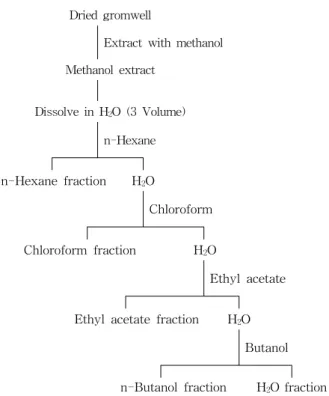
oC 이하에서 감압 농축하여 짙은 적색을 갖는 methanol 추출 물을 얻었고(2,17), 이를 Fig. 1과 같이 물에 현탁한 후 n- hexane을 가하여 분획하고 여과한 후 감압 농축하여 n-hex- ane 분획물(fraction)을 2.47 g를 얻었다. 이를 chloroform, ethyl acetate, n-butanol 및 H2O 등의 용매로 순차 분획하여 chloroform 분획물 1.51 g, ethyl acetate 분획물 1.08 g, n- butanol 분획물 4.10 g, H2O 분획물 85.91 g를 얻었다(Table 1). 건조한 재배 지치에 대하여서도 야생 지치의 경우와 같은 Fig. 1의 방법으로 methanol 추출물 29.21 g를 얻은 다음, 순차적으로 용매 분획하여 n-hexane 분획물 1.20 g, chloro- form 분획물 2.67 g, ethyl acetate 분획물 1.14 g, n-butanol 분획물 3.55 g, H2O 분획물 86.24 g를 획득하였다(Table 1).
총 폴리페놀 함량 측정
총 페놀성 화합물 함량은 Folin-Denis법을 약간 변형한 것
Dried gromwell
Extract with methanol Methanol extract
Dissolve in H2O (3 Volume) n-Hexane
n-Hexane fraction H2O
Chloroform
Chloroform fraction H2O
Ethyl acetate
Ethyl acetate fraction H2O Butanol
n-Butanol fraction H2O fraction Fig. 1. Fractionation of the methanol extract from gromwell.
Values are mean of extraction yield from wild and cultivated gromwell.
Table 1. Extraction yields of solvent fractions fractionated from gromwell (Lithospermum erythrorhizon Sieb. et Zucc.)
Solvent fractions Extraction yield (%) Wild Cultivated
Methanol 36.23±0.371) 29.21±0.59
n-Hexane Chloroform Ethyl acetate n-Butanol H2O
2.47±0.08 1.51±0.06 1.08±0.02 4.10±0.01 85.91±0.21
1.20±0.09 2.67±0.02 1.14±0.06 3.55±0.02 86.24±0.26
1)Values are mean±SD (n=3).
으로 시료를 methanol에 녹여 만든 검액 1 mL에 증류수 5 mL과 Folin-Ciocalteau 시약 0.1 mL를 넣고 잘 섞어 3분간 방치한 다음 Na2CO3 포화용액 0.2 mL를 넣는다. 증류수로 2 mL 되게 희석하여 1시간 방치하고 3,000 rpm에서 10분간 원심분리 한 다음 725 nm에서 흡광도를 측정하였다(18). 표 준 곡선은 quercetin(Sigma Co., St. Louis, MO, USA)을 시 료와 같은 방법으로 반응시키고 흡광도를 측정한 후 작성하 여 시료의 총 페놀성 화합물 함량을 계산하였다. 이때의 shi- konin은 작게는 quercetin 화합물로서 분류되는 total phenolic compound에 속하는 화합물이므로 표준품으로 quercetin을 사용하였다.
전자공여능 측정
Electron donating ability(EDA)는 야생 및 재배 지치의 methanol 추출물과 용매별 분획물에 대한 각각의 검액이 1,1-diphenyl-2-picrylhydrazyl(DPPH)에 대한 시료 첨가구
Table 2. Contents of total phenolics in solvent fractions fractionated from cultivated and wild gromwell Solvent fraction
Gromwell
Total phenolics (μg/mg)
Methanol n-Hexane Chloroform Ethyl acetate n-Butanol H2O
Wild Cultivated
14.11±0.95 12.46±0.67
121.10±1.06 353.10±2.12
94.48±0.18 161.73±1.24
200.73±1.59 138.85±0.35
22.99±1.50 31.11±0.09
2.66±0.04 10.07±0.19 t-value
(p-value)
2.46 (0.07)
-169.53 (<0.01)
-92.96* (<0.01)
66.55 (<0.01)
-9.36* (0.01)
-66.10 (<0.01)
1)Values are mean±SD (n=3). *p<0.05.
와 시료 무 첨가구의 흡광도 감소율을 표시한 것으로 Blois 방법을 변형하여 측정하였다(19). Methanol에 녹인 4 mL 시료액에 0.08 mM DPPH액 1 mL를 첨가하고 암소에서 30 분간 방치하여 반응 후 525 nm에서 흡광도를 측정하였다.
IC50은 검체 농도에 따른 전자공여능 변화 곡선으로부터 산 화를 50% 억제시키는 농도로 표기하였다. EDA(%)=[1-
(A/B)]×100 (A: 시료 첨가시의 흡광도, B: 시료 무 첨가시 의 흡광도).
SOD-liked activity 측정
야생 및 재배 지치의 methanol 추출물 및 용매별 분획물 에 대한 각각의 검액 0.2 mL에 tris-HCl buffer(pH 8.5) 3.0 mL와 0.2 mM pyrogallol 0.5 mL를 가하여 10분간 방치한 후 1 N-HCl로 반응을 정지시킨 후 420 nm에서 UV-visible spectrophotometer(Ultraspec 3000, Pharmaca biotech, NJ, USA)로 측정하였다(20).
SOD-liked activity(%)=100-(A/B×100)
(A: 시료 첨가시의 흡광도, B: 시료 무 첨가시의 흡광도) Hydroxy radical scavenging activity 측정
FeSO4/EDTA(ethylenediaminetetraacetic acid) 용액 0.2 mL, 10 mM 2-deoxyribose 0.2 mL, 야생 및 재배 지치의 methanol 추출물과 용매별 분획물에 대한 각각의 검액 0.1 mL와 0.1 M phosphate-buffer(pH 7.4) 1.3 mL, 10 mM H2O2
0.2 mL를 가하고 37oC 항온수조에서 2시간 동안 반응시킨 후 20% TCA(trichloroacetic acid) 용액 1 mL, 0.67% TBA (thiobarbituric acid) 2 mL를 가하여 100oC에서 15분 가열한 후 급속히 냉각시켜 532 nm에서 흡광도를 측정하여 항산화 활성을 비교하였다(21). Hydroxyl radical scavenging activity(%)=100-(A/B×100), A는 시료 첨가시의 흡광도, B는 시료 무 첨가 시의 흡광도이다.
Lecithin oxidation inhibitory 측정
Chroloform 10 mL에 egg yolk lecithin 1 g을 녹인 후 각 시험관에 100 μL씩 주입시킨 후 질소가스로 용매를 제거하 였다. 야생 및 재배 지치의 methanol 추출물 및 용매별 분획 물 0.1 mL와 Tris-KCl buffer(0.01 M Tris-HCl, 0.175 M KCl(pH 7.4)에 2 mM FeSO4, 2 mM ascorbic acid를 첨가하 여 혼합한 후 37oC에서 30분간 incubating 한 후 과산화지질 을 TBARS법(2-thiobarbituric acid relative substance)에
의하여 측정하였다(20). Relative antioxidative effect(%)=
100-(A/B×100), A는 시료 첨가시의 흡광도, B는 시료 무 첨가 시의 흡광도이다.
통계처리
통계분석은 SAS(Statistical Analysis System) 통계프로 그램을 사용하여 분산분석(ANOVA)을 실시하였고(22), 각 시료 간의 유의성 검증은 Duncan's multiple range test를 사용하였다(p<0.05).
결과 및 고찰
지치 추출 성분에는 lithospermic acid 및 rosmarinic acid 의 phenolic acid 화합물이 있는 것으로 밝혀진 바 있다(23).
Shikonin 화합물이 산화 제거 반응에 효과적이라는 선행된 연구 결과를 토대로 야생 및 재배 지치의 색소 추출물 및 용매별 분획물에 대하여 산화반응에 관계되는 factor에 관하 여 조사하였다. 즉 항산화능으로 총 페놀성 화합물 함량과 전자공여능은 서로 상관관계에 있는 것으로 밝혀진 바 있어 용매별 분획물에 대해 이를 분석하였다.
총 페놀성 화합물 함량
총 페놀성 화합물은 식물계에 널리 분포되어 있는 2차 대 사산물의 하나로서 다양한 구조와 분자량을 가진다. 이들은 phenolic hydroxyl기를 가지기 때문에 단백질 및 기타 거대 분자들과 결합하는 성질을 가지며, 항산화 효과 등의 생리활 성 기능도 가진다. 야생 및 재배 지치의 용매별 분획물에 대하여 총 페놀성 화합물 함량을 측정한 결과는 Table 2와 같다. 야생 지치에서의 총 페놀성 화합물 함량은 ethyl acetate 분획물 200.73 μg/mg, n-hexane 분획물 121.10 μg/
mg, chloroform 분획물 94.48 μg/mg, n-butanol 분획물 22.99 μg/mg, H2O 분획물 2.66 μg/mg 순으로 확인되었다.
재배 지치는 n-hexane 분획물 353.10 μg/mg, chloroform 분획물 161.73 μg/mg, ethyl acetate 분획물 138.85 μg/mg, n-butanol 분획물 31.11 μg/mg, H2O fraction 10.07 μg/mg 순으로 야생 지치와는 다른 양상이었다. 이를 통합하여 총 페놀성 화합물 함량을 비교해 보면 재배 지치의 n-hexane 분획물이 가장 높았고, 다음으로 야생 지치의 ethyl acetate 분획물, 재배 지치의 chloroform 및 ethyl acetate 분획물, 야생 지치의 n-hexane 및 chloroform 분획물 순으로 재배 지치가 야생 지치에서 보다 많은 총 페놀성 화합물을 보유하
Table 3. Radical scavenging effect of solvent fractions fractionated from cultivated and wild gromwell Solvent fraction
Gromwell
IC50 (μg/mL)1)
Methanol n-Hexane Chloroform Ethyl acetate n-Butanol H2O
Wild Cultivated
794.41±19.70 971.86±13.43
459.19±3.94 70.90±0.18
306.94±11.14 89.82±1.55
122.95±4.45 312.64±1.39
1198.49±3.44 946.95±7.70
8860.48±1.70 1057.34±1.14 t-value
(p-value)
-12.89* (<0.02)
170.52* (<0.01)
33.44* (0.01)
-70.47 (<0.01)
51.66 (<0.01)
660.34 (<0.01)
1)Amount required for 50% reduction of DPPH. 2)Values are mean±SD (n=3). *p<0.05.
Fig. 2. Superoxide anion dismutase activity of solvent fractions fractionated from cultivated and wild gromwell. A: cultivated gromwell, B: wild gromwell. *p<0.05.
였다. 특히 chloroform 및 n-butanol 분획물에서의 야생 및 재배 지치의 총 페놀성 화합물 함량은 야생 지치가 재배 지 치보다 적었다(p<0.05). 이상의 결과는 야생 및 재배 지치의 총 페놀성 화합물 함량 차이는 용매 극성에 따라 추출수율이 서로 다르게 나타났기 때문인 것으로 보인다. 또한 야생 및 재배 지치의 총 페놀성 화합물을 포함하고 있는 용매별 분획 물은 비교적 극성이 낮은 n-hexane, chloroform, 그리고 ethyl acetate 분획물에서 많이 용출되는 것으로 나타났다.
선행된 연구로부터 식물 뿌리 부위의 ethanol 추출물에 대한 총 페놀성 화합물 함량은 백련근 5.13 mg/g, 홍련근 4.92 mg/g, 산뽕나무 3.35 mg/g, 무 0.201 mg/mL로 밝혀진 것으 로 볼 때 지치에 비해 그 함량이 적었다(24-26).
전자공여능
DPPH법은 토코페놀, 비타민 C, polyhydroxyl 방향족 화 합물, 방향족 아민류에 의해 환원되어 짙은 붉은 자색이 탈 색되는 정도를 나타내는 항산화 물질의 수소공여능으로 알 려져 있다. 즉 전자공여능은 활성 radical에 전자를 공여하여 식품 중의 지방질 산화를 억제하는 목적으로 사용되고 있을 뿐만 아니라 인체 내에서 활성 라디칼에 의한 노화를 억제하 는 작용의 목적으로 사용되고 있다(27). 선행 연구를 볼 때 모든 식물로부터 추출한 물질의 전자공여능은 농도 의존적 이지 않으므로 본 실험에서는 활성을 50% 저하시키는 IC50
을 기준으로 하였다. 야생 및 재배 지치의 methanol 추출물, n-hexane, chloroform, ethyl acetate, n-butanol, 그리고 H2O
등의 용매별 분획물의 전자공여능은 Table 3과 같다. 재배 지치의 용매 분획물의 IC50은 n-hexane 70.90 μg/mL, chloro- form89.82 μg/mL, ethyl acetate 312.64 μg/mL, n-butanol 분획물 946.95 μg/mL로 용매 극성 차이에 따라 활성도가 순차적으로 떨어지는 것으로 나타났다. 그러나 야생 지치에 서의 IC50은 ethyl acetate 122.95, chloroform306.94, n-hex- ane 459.19, n-butanol 분획물 1198.49 μg/mL로 재배 지치와 는 달리 ethyl acetate 분획물에서 가장 저해 활성이 좋은 것으로 나타나 용매 극성에 따른 활성 차이는 없었다. 또한 같은 용매 분획물에서 야생 및 재배 지치의 IC50을 보면, ethyl acetate 분획물에서는 야생 지치가 재배 지치보다 활성산소 저해능이 좋았지만 유의적이지 않았고, n-hexane 및 chloro- form 분획물에서는 재배 지치가 야생 지치보다는 활성산소 저해능이 좋았다(p<0.05). 특히 지치 methanol 추출물은 야 생 지치 794.41 μg/mL, 재배 지치 971.86 μg/mL로 야생 지치 가 재배 지치에 비해 낮은 농도에서 전자공여 효과가 좋았다 (p<0.05). 이를 Table 1에 제시한 추출수율과 비교하면 야생 지치 36.23%, 재배 지치 29.21%로 야생 지치가 재배 지치보 다 약 7% 정도 많으므로 추출물 형태로 사용 시 재배 지치보 다 야생 지치가 더 효율적일 것이다.
SOD 유사활성 측정
야생 및 재배 지치의 추출물과 분획물의 SOD 유사활성을 측정한 결과는 Fig. 2와 같다. 재배 지치의 methanol 추출물, n-hexane, n-butanol 및 H2O 분획물 층에서는 10 μg/mL에
Concentration (μg/mL) Concentration (μg/mL)
Fig. 3. Hydroxyl radical scavenging activity of solvent fractions fractionated from cultivated and wild gromwell. A: cultivated gromwell, B: wild gromwell. *p<0.05.
Fig. 4. Relative antioxidation effects of solvent fractions fractionated from cultivated and wild gromwell. A: cultivated gromwell, B: wild gromwell. *p<0.05.
서 500 μg/mL까지 농도의존적으로 활성이 증가하였고 특히 methanol 추출물에서 높은 활성을 나타내었다(p<0.05). 야 생 지치에서는 methanol 추출물, n-butanol 및 H2O 분획물 층에서는 10 μg/mL에서 500 μg/mL까지 농도의존적으로 활 성이 증가하는 경향을 보였고 특히 methanol 추출물에서 높 은 활성을 나타내었으며 용매 극성이 낮은 n-butanol 및 H2O 순으로 높은 활성을 나타내었다. 이러한 결과와 비교해 볼 때 지치 추출물은 superoxide anion 제거능이 높은 물질을 함유하고 있는 것으로 판단되고, 야생과 재배 지치 모두 항 산화성을 가지는 기능성식품 소재으로서의 활용 가능성이 시사되었다.
Hydroxyl radical 소거능 측정
생물의 호흡과정에서 생성되는 유해활성산소종(ROS: re- active oxygen species)인 활성산소 라디칼이 생체 고분자의 산화를 통하여 노화나 암 발생 등 만성질환의 원인이 된다는 것으로 보고되고 있다(28). 야생과 재배 지치의 methanol 추 출물과 n-hexane, chloroform, ethyl acetate, n-butanol, 그
리고 H2O 용매별 분획물에 대한 hydroxyl radical 소거활성 은 Fig. 3과 같다. 야생과 재배 지치의 n-hexane, chloroform 및 ethyl acetate 용매 분획물층에서는 10 μg/mL에서 1000 μg/mL까지 농도의존적으로 활성이 증가하는 경향이었으나 유의적이지는 않았다. 야생과 재배 지치의 n-hexane 분획물 을 제외한 methanol, chroloform, ethyl acetate, n-butanol 및 H2O의 분획물에서는 10~1000 μg/mL의 전 농도에서 소 거능이 약한 것으로 유의적이지 않았다. 다만 n-hexane 분 획물에서는 hydroxyl radical 소거능이 200 μg/mL 농도 이 후에 소거능이 급격히 증가되었다(p<0.05).
Lecithin oxidation 저해활성 측정
Lecithin 소거능은 과산화지질의 생성을 촉진하는 과산화 수소 생성과정에 peroxidase를 첨가하여 물과 산소분자로 환원시켜 최종적으로 산화를 저해하는 능력을 측정하는 것 (29)으로 그 결과는 Fig. 4와 같다. 야생과 재배 지치의 chlo- roform 분획물 1,000 μg/mL 농도에서는 모두 가장 높은 활성 을 나타내었고(p<0.05) 다음으로는 야생 지치의 n-hexane
Concentration (μg/mL) Concentration (μg/mL)
Concentration (μg/mL)
Concentration (μg/mL)
분획물층과 재배 지치의 ethyl acetate 분획물층에서 높은 활성을 나타내었으나 유의적 차이는 없었다.
요 약
식품의 색소원 및 약용으로 사용되어 오던 지치과 식물에 대한 정확한 품질지표를 마련하고자 재배방법이 다른 야생 과 재배 지치에 대한 산화제거 물질과 관계되는 총 페놀 화 합물 함량, 전자공여능, SOD 유사활성, hydroxy radical 소 거능, lecithin oxidation 저해활성 등의 항산화능을 조사하였 다. 지치의 methanol 추출물에 대한 총 페놀 함량은 야생 지치 0.14%, 재배 지치 0.13%이었고 용매별 분획물에 있어 서 가장 높은 활성을 나타낸 것은 야생 지치의 경우 ethyl acetate 분획물, 재배 지치의 경우 n-hexane 분획물이었다.
지치의 methanol 추출물에 있어서 DPPH radical 50% 저해 효과인 IC50은 야생 지치 794.41 μg/mL, 재배 지치 971.86 μg/mL로서 야생 지치가 재배 지치보다 적은 농도에서 높은 활성을 나타내었다(p<0.05). 또한 용매별 분획물의 IC50에 있어, 야생 지치는 ethyl acetate 분획층, 재배 지치는 n- hexane 분획물에서 가장 높은 활성을 보였다. 또한 야생과 재배 지치의 SOD 활성 효과는 10∼500 μg/mL 농도에서 의존적인 활성을 나타내었고 특히 메탄올 추출물은 농도 500 μg/mL에서는 다른 용매 분획물보다도 높은 활성을 나 타내었다. Hydroxy radical 소거 활성은 야생과 재배 지치 모두 1,000 μg/mL 농도에서 chloroform 분획층과 n-hexane 분획층을 제외하고 50% 이하의 가장 낮은 활성을 나타내었 다. 마지막으로 lecithin 산화저해 활성은 야생과 재배 지치 의 메탄올과 용매별 분획물의 농도 200∼1000 μg/mL에서 높 은 활성을 나타내었고 특히 농도 1,000 μg/mL의 chloroform 층에서는 90% 내외의 높은 제어효과를 확인하였다. 이상의 결과로 야생과 재배 지치 모두 항산화성을 가지는 기능성식 품으로서의 활용 가능성이 높을 것으로 분석되었다.
문 헌
1. Hsu HY, Chen YP, Hong M. 1982. The chemical constitutes of oriental herbs. Oriental Healing Arts Institute, CA, USA, p 170.
2. Kim JS, Han YS, Kang MH. 2006. Identification of shikonin and its derivatives from Lithospermum erythrorhizon.
Korean J Food Sci Technol 35: 177-181.
3. Sugimura T, Sato S. 1983. Mutagens-carcinogens in foods.
Cancer Res 43: 2415-2421.
4. Dees C, Askari M, Garrett S, Gehers K, Henley D, Ardies CM. 1997. Estrogenic and DNA-damaging activity of Red No 3 in human breast cancer cells. Environmental Health
Perspectives 105: 625-632.
5. Kim AN. 1999. Anticancer effect of Lithospermum erytho-
rhizon against L1210 cell in relation with catalase, super-
oxide dismutase and glutathione peroxidase. MS Thesis.Sangmyung University, Seoul, Korea. p 30-56.
6. Song GY, Lee HJ, Khil JH, Kim SH. 2002. Study on 2- thio-DMNQ-S160, A derivative of shikonin antitumor con- stituent of Lithospermum erythorhizon. Korean J Oriental
Physiology & Pathology 16: 542-546.
7. Zheng XG, Jin GZ, Song GY, Hoon C, Ahn BZ. 1998.
Haloacetylshikonin derivatives: synthesis and evaluation of antitumor activity. J Pharm Soc Korea 42: 159-164.
8. Cho H, Chung YS, Bang MS, Ryu SR, Jo BW. 1998.
Synthesis of shikonin derivatives and evaluation of their antitumor activity. Appl Chem 2: 396-399.
9. Yoon Y, Kim YO, Lim NY, Jeon WK, Sung HJ. 1999.
Shikonin, an ingredient of Lithospermum erythrorhizon in- duced apoptosis in HL60 human premyelocytic leukemia cell line. Planta Med 65: 535-535.
10. Hashimoto S, Xu M, Masuda Y, Amchi T, Nakajo S, Cao J, Myakoshi M, Ida Y, Nakaya K. 1999. β-Hydroxy- isovalerylshikonin inhibits the cell growth of various cancer cell lines and induces apoptosis in leukemia HL-60 cells through a mechanism different from those of Fas and etoposide. J Biochem 125: 17-23.
11. Assimopoulou AN, Boskou D, Papageorgiou VP. 2004.
Antioxidant activities of alkannin, shikonin and Alkanna
tinctoria root extracts in oil substrates. Food Chemistry
87: 433-438.12. Takashi S, Toshiki M, Yoshie M, Tsuneji N. 1998. Evalua- tion of superoxide anion radical scavenging activity of shi- konin by electron spin resonance. Int J Pharm 174: 133-139.
13. Weng XC, Xiang GQ, Jiang AL, Liu YP, Wu Ll, Dong XW, Duan S. 2000. Antioxidant properties of components ex- tracted from puccoon. Food Chem 69: 143-146.
14. Chen X, Oppenheim J, Howard OM. 2001. Shikonin, a com- ponent of antiinflammatory Chinese herbal medicine, se- lectively blocks chemokine binding to CC chemokine re- ceptor-1. Int Immunopharmacol 1: 229-236.
15. Ozaki Y, Ohno A, Abe K, Saito Y, Satake M. 1993.
Comparative study on the accelerative effect of “koushikon”
and “nanshikon” and their constituents on proliferation of granuloma tissue in rats. Biol Pharm Bull 16: 683-685.
16. Park YH, Chang SK. 2000. Effects of shikonin pigments from the roots of Lithospermum erythrorhizon on rabbit platelets. J Fd Hyg Safety 15: 167-172.
17. Na GM, Han HS, Ye SH, Kim HK. 2004. Extraction charac- teristics and antioxidative activity of Cassia tora L.
extracts. Korean J Food Culture 19: 499-505.
18. Gutfinger T. 1981. Polyphenols in olive oils. J Am Oil Chem
Soc 58: 966-968.
19. Blois MS. 1958. Antioxidant determination by the use of a stable free radical. Nature 181: 1199-1204.
20. Tsuda T, Oshinori YF, Katsumi O, Yamamoto A, Kawakishi S, Osawa T. 1995. Antioxidative activity of tamarined ex- tract prepared from the seed coat. Nippon Shikuhin Kashi 42: 430-435.
21. Chung SK. 1997. Hydroxy radical scavenging effects of species and scavengers from brown mustard. Biosci Biotech 61: 118-123.
22. SAS. 2000. User's guide. SAS Institute, Cary, NC, USA.
p 633.
23. Tang W, Eisenbrand G. 1992. Chinese drugs of plant origin.
Springer-Verlag, Berlin, Heidelberg, Germany.
24. Jeonge CH, Son KB, Kim JH, Kang SK, Park EY, Shim KI. 2010. Antioxidant and anticancer activities of lotus
(Nelumbo nucifera) leaf and root. Korean J Food Preserv
17: 131-138.25. Sa JH, Kim YS, Shin IC, Shim TH, Wang MH. 2004.
Photoprotective effect and antioxidative activity from dif-
ferent organs of Morus bombycis Koidzumi. Kor J Phar-
macogn 35: 207-214.
26. Jung MS, Lee GS, Chae HJ. 2004. In vitro biological activity assay of ethanol extract of radish. J Korean Soc Appl Biol
Chem 47: 67-71.
27. Ahn EY, Shin DH, Oh JA, Baek NI. 1998. Isolation and identification of antimicrobial active substance from Gly-
cyrrhiza uralensis FISCH. Korean J Food Sci Technol
30: 680-687.
28. Droge W. 2002. Free radicals in physiological control of cell function. Physiol Rev 82: 47-95.
29. Kim TS, Choi MK, Kim JS, Han JW, Kang MH. 2009.
Screening of lignan compounds and antioxidant activity of
chungkukjang fermented with defatted sesame flour. Kore- an J Food Sci Technol 38: 1580-1586.
(2010년 3월 2일 접수; 2010년 5월 20일 채택)