청미래덩굴 잎(Smilax china L.) 용매 분획물의 항산화 및 항균 효과
⁃연구노트⁃
김주영․성기운․정신교 경북대학교 식품공학부
Antioxidant and Antimicrobial Effects of Solvent Fractions from Smilax china L. Leaves
Joo-Young Kim, Gi-Un Seoung, and Shin-Kyo Chung School of Food Science and Biotechnology, Kyungpook National University
ABSTRACT To utilize Smilax china L. leaves as a natural preservatives, solvent fractions from crude methanol extract were prepared and investigated their antioxidant and antimicrobial activities against Staphylococcus aureus.
Antioxidant activities were examined by 1,1-diphenyl-1-picrylhydrazyl radical scavenging and ferric ion reducing anti- oxidant power assays. Ethyl acetate fraction from Smilax china L. leaves exhibited the strongest antioxidant and anti- microbial activities among the fractions (P<0.05), as well as the highest total phenolic and total flavonoid contents.
Caffeic acid, ferulic acid, quercetin, and kaempferol contents in the ethyl acetate fraction from Smilax china L. leaves were determined by TLC and HPLC. In aqueous phase, as well as the n-butanol and n-hexane fractions, quercetin, ferulic acid, and kaempferol were detected in small amounts. Ferulic acid, which showed the highest content, is the major active compound from Smilax china L. leaves.
Key words: Smilax china L. leaves, solvent fractions, antioxidant, antimicrobial activities, ferulic acid
Received 2 June 2014; Accepted 28 July 2014
Corresponding author: Shin-Kyo Chung, School of Food Science and Biotechnology, Kyungpook National University, Daegu 702- 701, Korea
E-mail: [email protected], Phone: +82-53-950-5778
서 론
식품의 보존과 유통 중에 생기는 영양 성분의 산화는 외관 과 향미에 나쁜 영향을 미친다. 또한 병원성 세균의 오염과 증식으로 인한 식품 위해 사고의 발생을 방지하기 위하여 식품 첨가물로서 합성 보존료의 사용이 일반화되어 왔다.
그러나 소비자들의 건강 지향적인 식품 소비 경향과 안전성 에 대한 요구가 높아짐에 따라, 여러 가지 향신료와 약용식 물과 같은 다양한 천연물로부터 보존료를 개발하기 위하여 많은 연구가 이루어지고 있다(1-3)
청미래덩굴(Smilax china L.)은 백합과에 속하는 덩굴성 관목으로 명감나무 또는 망개나무라 불리며 우리나라 중남 부와 중국 및 일본에 널리 분포되어 있다(4,5). 청미래덩굴 의 잎은 두껍고 넓은 타원형이며, 예로부터 상하기 쉬운 음 식의 보존과 포장에 이용되었으며(6), 청미래덩굴의 잎으로 싼 망개떡은 경남 의령 지역의 전통식품으로 현재까지 전국 적으로 유통되고 있다. 청미래덩굴의 뿌리는 토복령이라고 하여 한방에서 소화기 질병과 이뇨, 하리, 이질 및 수종 등의 치료약으로 사용되고 있으며(7) 성분에 관한 연구로는 6종
의 spirostane 배당체가 분리 보고되었다(8). 또한 청미래덩 굴 잎으로부터 천연 보존료를 개발하기 위하여 전자공여능, 아질산염 소거능(9)과 같은 항산화 활성과 항당뇨 효과에 대하여 α-amylase와 α-glucosidase 저해 활성(10)을 추출 물 수준에서 조사된 바가 있으나 활성물질에 관하여는 현재 까지 거의 보고된 바가 없다.
본 연구에서는 청미래덩굴 잎의 메탄올 조추출물을 용매 의 극성에 따라 분획하여 이의 항산화 활성과 항산화 성분을 조사하고 한국인의 주요 식중독 세균인 Staphylococcus aureus에 대한 항균 효과를 측정하였다. 또한 활성이 강하 게 나타난 ethyl acetate 분획물을 TLC와 HPLC로 분석하 여 활성물질을 규명하였기에 보고하고자 한다.
재료 및 방법
실험 재료 및 시약
실험용 시료는 청미래덩굴 잎을 경남 함안 지역에서 채취 하여 음건한 후 분쇄하여 선별(>25 mesh) 사용하였다. Gallic acid, trolox, naringin, caffeic acid, ferulic acid, querce- tin, kaempferol, 1,1-diphenyl-1-picrylhydrazyl(DPPH), ferric chloride, sodium acetate, ferric chloride, potas- sium ferricyanide 2,4,6-tris(2-pyridyl)-1,3,5-triazine (TPTZ)는 Sigma Chemical Co.(St. Louis, MO, USA)의 제품을 사용하였고, methanol 등의 추출용 용매는 일급 시
약(Duksan Co., Seoul, Korea), HPLC 용매는 J.T. Baker (Phillipsburg, NJ, USA) 제품을 사용하였다. Tryptic soy broth 배지는 Difco Co.(Detroit, MI, USA)의 것을 사용하 였다.
추출 및 용매 분획
분말 시료 15 g에 10배량의 methanol을 가한 후 실온에 서 12시간 동안 2회 추출하여 여과하고 감압 농축하여 조추 출물 4.80 g을 얻었다. 이를 다시 10% methanol에 현탁하 여 극성에 따라 순차적으로 용매 분획하고 감압농축 하여 n-hexane(1.18 g), ethyl acetate(0.81 g), n-butanol(0.92 g), 물(1.90 g) 분획물을 얻었다.
DPPH radical 소거 활성 측정
DPPH 방법은 붉은 색의 DPPH radical이 항산화 물질로 부터 직접 전자를 얻어서 탈색되는 정도를 분광법으로 측정 하는 방법으로 단일 화합물이나 추출물 시료에 많이 쓰인다 (11). DPPH radical 소거 활성은 Blois(12)의 방법에 따라 시료 100 μL(2.5 mg/mL)에 300 μM DPPH 시액 900 μL를 가하여 잘 섞은 다음, 30분간 암실에서 방치하고 517 nm에 서 흡광도를 측정하여 표준물질인 gallic acid 검량선의 회 귀식에서 gallic acid equivalent μM(GAE μM)로 환산하여 나타내었다.
Ferric ion reducing antioxidant power(FRAP) 측정 항산화 물질이 Fe(Ⅲ)-TPTZ(2,4,6-tripyridyl-s-tri- azine)를 Fe(Ⅱ)-TPTZ로 환원시키는 원리(13)를 이용하 여 측정하였다(14). Acetate buffer(300 mM, pH 3.6)와 10 mM TPTZ solution, 20 mM의 ferric chloride sol- ution(FeCl3・6H2O)을 10:1:1 비율로 37°C에서 섞어서 10 분간 방치하여 반응 시액(cocktail solution)을 만든다. 시료 250 μL(2.5 mg/mL)와 cocktail solution 1.75 mL를 혼합 하여 암실에서 30분간 방치 후 590 nm에서 흡광도를 측정 하여 trolox의 검량선의 회귀식에서 trolox equivalent μM (TE μM)로 나타내었다.
총 페놀성 화합물(total phenolic content) 함량 측정 시료 용액(2.5 mg/mL) 100 μL에 2 N Folin-Ciocalteau 시약 50 μL와 20% Na2CO3 300 μL를 가하여 실온에서 15 분간 방치한 후 증류수 1 mL를 넣고 원심분리 하여 상등액을 725 nm에서 흡광도를 측정하였다(15). 표준물질로 gallic acid 검량선의 회귀식에서 시료 중의 총 페놀성 화합물의 함량을 GAE mM로 환산하였다.
총 플라보노이드 화합물(total flavonoid content) 함량 측정 총 플라보노이드 화합물 함량은 Zhishen 등(16)의 방법
으로 측정하였다. 시료 용액(2.5 mg/mL) 70 μL에 50%
ethanol 430 μL를 가한 후 5% NaNO2 50 μL를 넣고 1시간 동안 방치하고 10% Al(NO3)3・9H2O 50 μL를 넣고 6분간 방치한다. 1 N NaOH 500 μL를 넣고 510 nm에서 흡광도를 측정하였으며 naringin의 검량선의 회귀식에서 naringin equivalent mM(NAE mM)로 환산하여 나타내었다.
항균 활성 측정
항균 활성은 agar diffusion method(17,18)로 측정하였 다. Tryptic soy broth(Difco Co.)로 37°C에서 배양하여 S. aureus 균주(ATCC 6538)를 활성화시킨 후 660 nm에서 흡광도를 0.3으로 조절하고 agar를 첨가한 평판 배지에 200 μL씩 접종하고 도말하였다. 멸균된 paper disc에 시료를 농 도별로 흡수하고 건조하여 배지 위에 밀착시키고 37°C에서 18∼24시간 배양하여 캘리퍼스(Dial Calipers, Alltrade, Long Beach, CA, USA)를 이용하여 paper disc 주위의 저 해환의 직경(mm)을 측정하였다.
Thin layer chromatography(TLC)
TLC 분석은 silica gel 60 glass plate(20×20 cm, Merck, Darmstadt, Germany)를 이용하여 ethyl acetate/
hexane/ chloroform/ acetic acid(40:30:30:2, v/v/v/v) 혼 합 용매로 하여 전개하고 UV lamp로 ethyl acetate 분획물 과 표준물질(caffeic acid, ferulic acid, quercetin, kaemp- ferol)과의 Rf 값을 비교하여 분석하였다.
High performance liquid chromatography(HPLC) 청미래덩굴 잎의 분획물을 methanol에 녹이고 여과 (0.45 μm filter)하여 HPLC(1260 Infinity Quaternary LC System, Agilent Technologies, Waldbronn, Germany)에 ZORBAX Eclipse Plus C18 column(4.6×150 mm, 5 μm, Agilent Technologies, Lawrence, KS, USA)을 사용하여 280 nm에서 분석하였다. Injection volume은 10 μL, 이동 상은 용매 A(2% acetic acid in 30% methanol)와 B(2%
acetic acid in acetonitrile)를 유속 0.2 mL/min으로 A액과 B액의 비율 100:0(v/v)에서 70분까지 0:100(v/v)의 비율로 농도기울기법으로 분석하였다. 함량 측정은 표품 caffeic acid, ferulic acid, quercetin, kaempferol을 이용하여 작 성한 검량선의 회귀식에서 구하였다.
통계처리
모든 실험은 3회 반복하였으며 SAS(Statistical Analysis System, Version 9.3, SAS Institute Inc., Cary, NC, USA) 를 이용하여 Duncan의 다중검정법으로 유의차를 검정하였 다(P<0.05).
Table 1. 1,1-Dipheny-1-picrylhydrazyl (DPPH) radical scaveng- ing and ferric ion reducing antioxidant power (FRAP) activities of solvent fractions from Smilax china L. leaves
Fraction1) DPPH (μM GAE) FRAP (μM TE) A
B E H
47.83±8.34d2) 206.47±13.89b 270.71±4.67a 128.44±10.74c
46.06±5.26c 51.41±0.80c 205.00±26.84a 83.25±1.50b
1)Fraction A: aqueous phase, B: n-butanol, E: ethyl acetate, H:
n-hexane.
2)Values with different letters within the same column are sig- nificantly different at P<0.05.
Values are expressed as the mean±SD.
Table 2. Total phenolic content and total flavonoid content of solvent fractions from Smilax china L. leaves
Fraction1) Total phenolic
content (mM GAE) Total flavonoid content (mM NAE) A
B E H
0.86±0.03b2) 0.61±0.02c 3.55±0.45a 0.85±0.05b
22.88±2.46b 38.26±1.40b 184.70±6.10a 46.48±3.96b
1)Fraction A: aqueous phase, B: n-butanol, E: ethyl acetate, H:
n-hexane.
2)Values with different letters within the same column are sig- nificantly different at P<0.05.
Values are expressed as the mean±SD.
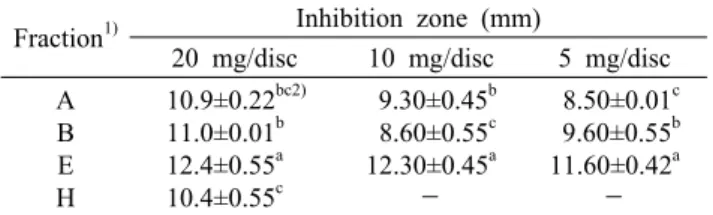
Table 3. Antimicrobial activities of solvent fractions from Smilax china L. leaves against S. aureus
Fraction1) Inhibition zone (mm)
20 mg/disc 10 mg/disc 5 mg/disc A
B E H
10.9±0.22bc2) 11.0±0.01b 12.4±0.55a 10.4±0.55c
9.30±0.45b 8.60±0.55c 12.30±0.45a
-
8.50±0.01c 9.60±0.55b 11.60±0.42a
-
1)Fraction A: aqueous phase, B: n-butanol, E: ethyl acetate, H:
n-hexane.
2)Values with different letters within the same column are sig- nificantly different at P<0.05.
Values are expressed as the mean±SD.
결과 및 고찰
청미래덩굴 잎 용매 분획물의 항산화 활성
청미래덩굴 잎을 극성에 따라 용매 분획하여 분획물을 제 조하고 항산화 활성을 측정하였다. Table 1에 청미래덩굴 잎의 용매 분획물의 DPPH radical 소거 활성과 FRAP 활성 을 나타내었다. DPPH 활성은 ethyl acetate 분획물이 가장 높은 소거능 활성을 보였고 n-butanol, n-hexane, 물 분획 물의 순으로 낮았다. Ethyl acetate의 분획물은 n-hexane 분획물의 2배 이상의 활성을 나타내었다. FRAP 활성 또한 ethyl acetate가 역시 가장 높았으나, DPPH 활성과는 달리 n-hexane, n-butanol, 물 분획물의 순으로 낮게 나타났다.
이는 n-butanol 분획물보다 n-hexane 추출물 중에 많이 함유된 비극성의 환원성 물질들이 작용한 것으로서 겨우살 이 추출물이 ethyl ether 분획물에서 강한 항산화 활성을 나타내었다는 보고(19)와 유사하다.
총 페놀성 화합물 및 총 플라보노이드 화합물 함량 식물의 2차 대사산물로서 하나 이상의 수산기가 치환된 벤젠환을 가지고 있는 phenolic acid, flavonoid, antho- cyanin, condensed tannin과 같은 다양한 구조의 화합물을 폴리페놀 화합물이라고 하며 수산기가 유리 라디칼 소거와 금속 이온을 포착 반응에 직접 참여하여 항산화 활성을 비롯 하여 다양한 생리활성을 나타낸다(11). 폴리페놀 화합물의 함량을 측정하는 방법으로 산화 환원 반응에 의하여 총 페놀 성 화합물을 정량하는 Folin-Denis 방법(20)을 변용한 Folin-Ciocalteau 시약에 의한 간단하고 신속한 방법(15) 이 많이 쓰인다.
청미래덩굴 잎 분획물의 대한 총 페놀성 화합물과 총 플라 보노이드 화합물의 함량을 측정한 결과를 Table 2에 나타내 었다. 각 분획물에 대한 총 페놀성 화합물은 ethyl acetate 분획물이 n-hexane과 n-butanol, 물 분획물의 4배 이상 높은 것을 확인할 수 있었다. 또한 총 플라보노이드 화합물 도 총 페놀성 화합물의 함량과 같이 ethyl acetate 분획물에 서 함량이 가장 높았으며, n-hexane 분획물의 3.5배, n- butanol 분획물의 4.5배에 달하였다. 과일과 채소류의 총
페놀성 화합물과 항산화 활성은 상관성이 크며(21,22), 청 미래덩굴 잎 분획물에서도 항산화 활성이 가장 큰 ethyl acetate 분획물의 총 페놀성 화합물의 함량이 두드러지게 높게 나타났다.
항균 활성
청미래덩굴 분획물의 항균 활성은 S. aureus에 대하여 paper disc diffusion method를 이용하였으며 그 결과는 Table 3과 Fig. 1에 있다. 항균 활성은 ethyl acetate 분획 물이 가장 높았으며 aqueous phase와 n-butanol 분획물은 비슷한 inhibition zone을 나타냈고 n-hexane 분획물이 가 장 낮은 항균 활성을 보였다. 각 분획물의 20 mg/disc에서 모두 inhibition zone이 발견되었으며, n-hexane 분획물은 20 mg/disc 이하에서는 inhibition zone이 나타나지 않았다.
이는 청미래덩굴 뿌리 추출물의 ethyl acetate 분획물에 서 항균 활성이 높게 나타났고(8), 암대극 추출물의 ethyl acetate 분획물에서도 또한 전반적으로 높은 항균 활성을 나타내었다는 보고(23)와 유사하다.
TLC 및 HPLC를 이용한 활성 성분 분석
TLC 방법으로 ethyl acetate 분획물 중의 활성 성분을 조사하였다. 표준물질과 비교하여 Rf 값 0.45에서 ferulic acid, 0.27에서 caffeic acid, 0.24에서 quercetin을 확인할 수 있다. 또한 역상 HPLC 방법으로 청미래의 분획물 중에서
Fig. 1. Antimicrobial activities by the solvent fraction from Smilax china L. leaves. 1, 20 mg/disc; 2, 10 mg/disc; 3, 5 mg/
disc; 4, 2.5 mg/disc.
Fig. 2. HPLC chromatogram of solvent fractions from Smilax china L. leaves. Aqueous phase (A), n-butanol (B), ethyl acetate (C), and n-hexane (D). 1, caffeic acid; 2, ferulic acid; 3, quercetin; 4, kaempferol.
Table 4. Content of phenolic compounds of solvent fractions from Smilax china L. leaves (Unit: ppm) Fraction1) Caffeic acid Ferulic acid Quercetin Kaempferol
A2) B E H
ND ND 25.29±0.44
ND
ND 1.25±0.63b3)
87.47±4.67a ND
3.07±0.02b 3.20±0.03b 14.60±0.13a 3.06±0.01b
ND ND 22.16±0.41a 3.95±0.20b
1)Fraction A: aqueous phase, B: n-butanol, E: ethyl acetate, H: n-hexane.
2)Sample concentration: 2.5 mg/mL.
3)Values followed by different letters within the same column are significantly different at P<0.05.
Values are expressed as the mean±SD.
표준물질과의 retention time을 비교하여 caffeic acid, ferulic acid, quercetin, kaempferol을 확인하였다(Fig.
2). 표준물질에 의한 검량선의 회귀식을 통해 구한 활성 성 분의 함량을 Table 4에 나타내었다. 청미래덩굴 잎의 분획 물 중 ethyl acetate 분획물(2.5 mg/mL)에서 caffeic acid, ferulic acid, quercetin, kaempferol이 검출되었으며 그중 ferulic acid 함량이 87.47±4.67 ppm으로 가장 높았으며, caffeic acid(25.29±0.44 ppm), kaempferol(22.16±0.41 ppm), quercetin(14.60±0.13 ppm)의 순으로 나타났다.
Aqueous phase에서는 quercetin이 3.07±0.02 ppm, n- butanol 분획물에서는 ferulic acid와 quercetin이 1.25±
0.63 ppm, 3.20±0.03 ppm으로 나타났으며, n-hexane 분 획물에서는 quercetin과 kaempferol이 3.06±0.01 ppm과 3.95±0.20 ppm으로 모든 ethyl acetate 분획물보다 낮은 함량이 검출되었다.
청미래덩굴 잎의 ethyl acetate 분획물 중 가장 높은 함량 을 나타낸 ferulic acid는 인삼(24), 귀리(25) 등에서 항산화 성 물질로, 백두옹(26)에서 항균성 물질로 동정된 바가 있으 므로 청미래덩굴 잎의 ethyl acetate 분획물이 항산화 및
항균 활성을 나타내는 주요 활성 물질로 사료된다.
요 약
우리나라에 널리 자생하는 청미래덩굴 잎을 천연 보존료로 써 활용하기 위하여 청미래덩굴 잎 추출물을 n-hexane, ethyl acetate, n-butanol로 분획하고 항산화 활성과 식중 독 세균인 Staphylococcus aureus에 대하여 항균 활성을 조사하였으며 활성 성분을 TLC와 HPLC로 분석하였다.
DPPH radical 소거능 활성은 ethyl acetate, n-butanol, n-hexane 분획물의 순으로 높게 나타났고, 총 페놀성 화합 물 함량 역시 ethyl acetate 분획물이 가장 높았다(P<0.05).
총 플라보노이드 화합물의 함량은 ethyl acetate 분획물이 다른 분획물보다 월등히 높았다. 청미래덩굴 잎의 용매 분획 물은 시험균주인 S. aureus에 대하여 12.4∼8.5 mm의 생육 저해환을 나타내었으며 ethyl acetate 분획물의 항균 활성 이 가장 강하였다(P<0.05). 항균 활성과 항산화 활성이 강 하게 나타난 청미래덩굴의 ethyl acetate 분획물을 TLC로 확인 후 다른 분획물들과 HPLC로 분석하여 caffeic acid, ferulic acid, quercetin, kaempferol을 확인하고 그 함량을 측정하였다. Ethyl acetate 분획물이 다른 분획물에 비해 높은 phenolic compounds 함량을 나타냈고, ferulic acid 가 그중 가장 높은 함량을 나타내어 청미래덩굴 잎의 항산화 및 항균 활성을 나타내는 주요 활성 물질로 사료된다.
REFERENCES
1. Chung SK, Osawa T, Kawakishi K. 1997. Hydroxyl radical- scavenging effects of spices and scavengers from brown mustard (Brassica nigra). Biosci Biotech Biochem 61: 118- 123.
2. Kim EY, Baik IH, Kim JH, Kim SR, Rhyu MR. 2004.
Screening of the antioxidant activity of some medicinal plants. Korean J Food Sci Technol 36: 333-338.
3. Lee BW, Shin DH. 1991. Antimicrobial effect of some plant extract and their fractionates for food spoilage microorgan- ism. Korean J Food Sci Technol 23: 205-211.
4. Kim TJ. 1993. Alpine flowers of Korea. Kyohaksa, Seoul, Korea. p 542.
5. Cha BC, Lee EH. 2007. Antioxidant activities of flavonoids from the leaves of Smilax china Linee. Kor J Pharmacogn 38: 31-36.
6. Choi HY. 2004. Antimicrobial effect of ethanol extract of Smilax china leaf. Korean J Sanitation 19: 22-30.
7. Park JH, Kim JM, Do WI. 2002. Pharmacognostical study on the To Bog Ryung. Kor J Pharmacogn 33: 169-172.
8. Son KH, Seo JH, Lee JM, Kwon SJ, Chang SY, Lee KS.
2001. Isolation and quantitative determination of dioscin from Smilacis Chinae Radix. Kor J Pharmacogn 32: 153- 156.
9. Jin TY, Park JR, Kim JH. 2004. Electron donating abilities, nitrite scavenging effects and antimicrobial activities of Smilax china leaf. J Korean Soc Food Sci Nutr 33: 621-625.
10. Lee SY, Kim JH, Park JM, Lee IC, Lee JY. 2014. Antiox-
idant activity and inhibition activity against α-amylase and α-glucosidase of Smilax china L. Korean J Food Preserv 21: 254-263.
11. Kim MJ, Park EJ. 2011. Feature analysis of different in vitro antioxidant capacity assays and their application to fruit and vegetable samples. J Korean Soc Food Sci Nutr 40: 1053- 1062.
12. Blois MS. 1958. Antioxidant determinations by the use of a stable free radical. Nature 181: 1199-1200.
13. Benzie IF, Strain JJ. 1996. The ferric reducing ability of plasma (FRAP) as a measure of ''antioxidant power'': the FRAP assay. Anal Biochem 239: 70-76.
14. Shahrokh K, Rong T, Djamila R, Raymond Y, Rupasinghe HPV. 2008. Polyphenol composition and total antioxidant capacity of selected apple genotypes for processing. J Food Compos Anal 21: 396-401.
15. Singleton VL, Orthofer R, Lamuela-Raventos RM. 1999.
Analysis of total phenolic and other oxidation substrates and antioxidants by means of Folin-Ciocalteu reagent. Method Enzymol 299: 152-178.
16. Zhishen J, Mengcheng T, Jianming W. 1999. Determination of flavonoid contents in mulberry and their scavenging ef- fects on superoxide radicals. Food Chem 64: 555-559.
17. Davidson PM, Parish ME. 1989. Methods of testing the effi- cacy of food antimicrobials. Food Technol 43: 148-155.
18. Park SW, Woo CJ, Chung SK, Chung KT. 1994. Antimicro- bial and antioxidative activities of solvent fraction from Humulus japonicus. Korean J Food Sci Technol 26: 464- 470.
19. Kang SJ, Chung SK. 2011. Antioxidant and antimicrobial activities of Korean mistletoe (Viscum album var. colo- ratum) extracts against food poisoning bacteria. Korean J Food Preserv 19: 919-924.
20. Folin O, Denis W. 1912. On phosphotungstic-phosphomo- lybdic compounds as color reagents. J Biol Chem 12: 239- 249.
21. Proteggente AR, Pannala AS, Paganga G, Van Buren L, Wagner E, Wiseman S, Van De Put F, Dacombe C, Rice- Evans CA. 2002. The antioxidant activity of regularly con- sumed fruit and vegetables reflects their phenolic and vita- min C composition. Free Radic Res 36: 217-233.
22. Lee SO, Lee HJ, Yu MH, Im HG, Lee IS. 2005. Total poly- phenol contents and antioxidant activities of methanol ex- tracts from vegetables produced in Ulung island. Korean J Food Sci Technol 37: 233-240.
23. Kim JY, Lee JA, Yoon WJ, Oh DJ, Jung YH, Lee WJ, Park SY. 2006. Antioxidative and antimicrobial activities of Euphorbia jolkini extracts. Korean J Food Sci Technol 38:
699-706.
24. Wee JJ. 1988. Isolation and identification of constituents from antioxidant and hematopoietic fractions of Panax gin- seng C.A. Meyer. PhD Dissertations. Seoul National Univer- sity, Seoul, Korea.
25. Xing YM, White PJ. 1997. Identification and function of antioxidants from oat groats and hulls. J Am Oil Chem Soc 74: 303-307.
26. Cho JY, Moon JH, Park KH. 2000. Isolation and identi- fication of 3-methoxy-4-hydroxybenzoic acid and 3-methoxy- 4-hydroxycinnamic acid from hot water extracts of Hovenia dulcis Thunb and confirmation of their antioxidative and antimicrobial activity. Korean J Food Sci Technol 32: 1403- 1408.