석면 슬레이트 해체작업의 공정분석 및 위험성평가에 관한 연구
오현수⋅김정민 * ⋅장성록 †
부경대학교 안전공학과⋅
*
명성 E&C(2014. 9. 25. 접수 / 2014. 10. 28. 수정 / 2014. 10. 29. 채택)
A Study on the Process Analysis and the Risk Assessment for Removal Work of the Asbestos Cement Slate
Hyunsoo Oh⋅Jeong-Min Kim * ⋅Seong Rok Chang †
Department of Safety Engineering, Pukyong National University*
MyungSung Engineering & Construction(Received September 25, 2014 / Revised October 28, 2014 / Accepted October 29, 2014)
Abstract : Asbestos is given to a variety of six naturally occurring silicate minerals. These minerals possess high tensile strength,
flexibility, resistance to chemical and thermal degradation, and electrical resistance. These minerals have been used for decades in thousands of commercial products, such as insulation and fireproofing materials, automotive brakes, textile products, cement and wallboard materials. When handled, asbestos can separate into microscopic-size particles that remain in the air and are easily inhaled. It is now known that prolonged inhalation of asbestos fibers can cause serious and fatal illnesses including malignant lung cancer, mesothelioma, and asbestosis. Therefore the use of asbestos and asbestos products has dramatically decreased in recent years. Also all constructions including asbestos should be removed under strictly controlled conditions and very tightly implemented health & safety management systems. In this study, the process of the removal work of the asbestos cement slate was analyzed by IDEF-0 modeling and evaluated by 4M risk assessment method. The results show that removal work of the asbestos cement slate was classified five process and eighteen detail process. The risk of safety side the higher than the risk of health side in 4M risk assessment.Key Words : asbestos cement slate, risk assessment, process analysis, 4M, IDEF0
†
Corresponding Author : Seong Rok Chang, Tel : +82-51-629-6468, E-mail : [email protected]
Department of Safety Engineering, Pukyong National University, 45, Yongso-ro, Nam-gu, Busan 608-737, Korea
1.
서 론석면이란 백만 년 전에 화산활동에 의해 발생한 화성 암의 일종으로 사문석(Serpentine) 및 각섬석(Amphibole) 계의 자연광물에서 채취된 섬유 모양의 규산염 화합물 로서 백석면 , 갈석면, 청석면, 투각섬석, 양기석, 직섬석 등 6종의 섬유상 광물이 포함된다. 석면은 뛰어난 내화 성, 방부성, 단열성, 내마모성, 강한 인장력, 절연성으로 건설자재로는 각종 석면 슬레이트, 비닐타일, 벽의 칸막 이, 천장재 온수파이프 등으로 사용되었다. 특히 석면은 광물성 무기물로 대표적인 무기물인 시멘트와 결합이 잘되어 시멘트를 주원료로 생산되는 시멘트 가공 건축 자재에 가장 많이 사용되었다 1-3) .
우리나라에서는 과거 소량의 석면이 생산되었으나 ,
산업체에 사용된 석면은 거의 전량을 수입에 의존하였 다. 수입량은 60년대부터 차츰 증가하여 80~90년대 연간 8만 톤 정도가 수입되어 가장 정점을 이루었고, 90년대 후반부터 차츰 감소하여 2006년도에는 6천 톤 정도만 수입되었다. 수입 석면의 80% 이상이 건축자재 로 사용되었는데, 70년대에는 약 96%가 건축자재인 슬 레이트에 사용되었으나, 90년대에는 슬레이트와 보온 단열재인 건축내장재 , 천장재, 바닥재 등에 약 82%를 사용하여 왔다 4) .
그러나 최근에 와서야 석면이 인체의 호흡기를 통해
흡입되어 악성중피종, 석면폐, 폐암 등을 일으킨다는 것
이 밝혀졌고 , 1997년 WHO(World Health Organization)
산하 국제암연구소 (IARC, International Agency for
Research Cancer)에서 석면을 1급 발암물질로 지정하였
다. 국내에서는 1990년 7월 산업안전보건법 및 시행규 칙에 석면을 특정 화학물질 1류로 분류했고, 1997년 5 월 청석면, 갈석면의 제조⋅수입⋅양도⋅제공 또는 사 용금지를 대통령령으로 개정하였다. 또한, 1999년부터 2003년까지 석면함유물질 및 석면 종류에 따른 추가사 용금지 조항이 공포되었으며 , 석면의 노출기준을 강화 하였다 . 그리고 2003년 7월 산업안전보건법 및 산업보 건기준에 관한 규칙이 개정되면서 석면해체⋅제거작업 허가제 및 해체⋅제거작업의 조치기준을 신설하여 건 축물 해체⋅제거작업을 엄격히 관리하도록 하였다 3,5) . 그리고 2009년부터는 석면 해체⋅제거업체 등록제도 및 석면조사기관 지정제도 , 석면정도관리 제도 등을 시 행하였다. 따라서 현재의 법제도하에서 석면 및 관련 제품의 제조, 수입, 사용 단계에서는 근로자의 석면노출 가능성은 근본적으로 차단되어 있는 상태이지만 , 기존 석면이 포함된 건축자재 또는 석면이 함유된 설비를 제 거 및 해체하는 작업과 이들 폐기물을 수집, 운반 및 처 리하는 근로자는 석면 노출가능성이 높은 작업이다 6,7) . 석면 해체⋅제거 작업과 관련된 기존의 연구들을 조 사한 결과 석면 해체⋅제거 작업의 공기 중 석면농도 및 보건관리실태에 관한 연구 외 다수는 보건적인 측 면의 연구들이었다 8-14) . 그리고 석면해체산업의 활성화 를 위한 제도⋅정책 개선방안 연구 외 다수는 석면 해 체⋅제거 작업의 문제점과 개선방안을 제시한 연구들
이었다 15-21) . 석면분진이 인체에 미치는 영향이 크기 때
문에 석면 해체⋅제거작업과 관련된 대부분의 연구들 은 석면 노출과 관련한 보건적 측면의 실태조사와 정 책 및 제도에 관한 연구들이 대부분이었다 .
그러나 기존 연구들 중에서는 석면 해체⋅제거 작업 공정의 안전측면을 고려한 연구는 없는 실정이다. 따 라서 본 연구에서는 석면 해체⋅제거 작업에 대한 공 정분석과 위험성평가를 실시하여 안전측면에서 석면 해체⋅제거작업의 위험성을 도출하여 개선방안을 모색 하고자 한다.
2.
연구대상 및 방법2.1 연구대상
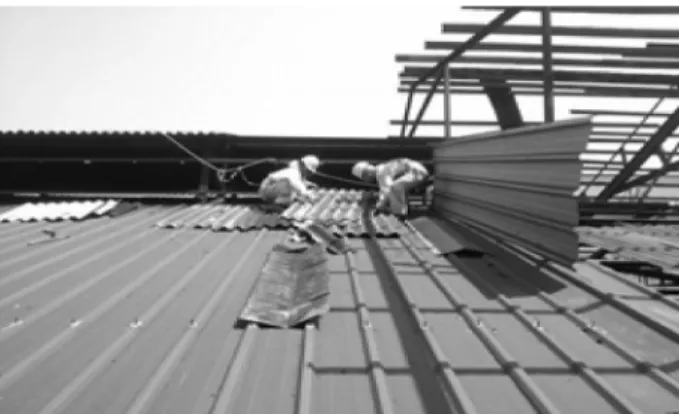
법적으로 일정량 이상 석면이 함유된 모든 설비나 건 축물들이 석면 해체⋅제거작업에 해당되고, 석면의 사 용용도가 다양하여 석면 해체⋅제거작업의 범위는 광 범위하다 할 수 있다 . 따라서 본 연구에서는 Fig. 1과 같 이 석면 해체⋅제거작업 중 빈도가 높고, 현장에서 위 험성이 높다고 판단한 석면 슬레이트(지붕재) 해체작업 을 대상으로 공정분석과 위험성평가를 실시하였다.
Fig. 1. Removal work of the asbestos cement slates.
2.2 연구방법
석면 슬레이트 해체작업의 위험성평가를 수행하기 위해 해체작업에 대한 공사계약부터 석면 슬레이트 해 체 완료까지의 전체 공정을 IDEF-0 (Integration DEFinition-0)를 이용하여 공정분석을 실시하였다. 그리 고 위험성평가 전문가 1명과 석면 해체⋅제거 작업 경 력이 3년 이상인 현장 전문가 5명이 최근 3년간 석면 해체작업 사고사례 자료를 바탕으로 Brainstorming을 통해 위험성평가를 실시하였다. 위험성평가 방법으로 는 4M 리스크 평가기법을 이용하였다.
IDEF는 1981년 미 공군의 ICAM(Integrated Computer Aided Manufacturing) 프로그램에서 시리즈로 개발되었 다. IDEF 시리즈 중 가장 먼저 개발된 IDEF-0는 기업, 조직의 실체를 추상화하여 모델링 (As-Is)하고 작성된 모 델의 체계적인 분석을 통해 문제점을 추출하여 개선된 기업의 모델 (To-Be)을 설계할 수 있도록 개발된 시스템 분석 , 설계 방법론으로 기능모형(function modeling) 구축 을 위해 조직이나 시스템의 의사결정 , 행동, 활동을 모델 링 할 수 있다 22,23) . IDEF-0 모델은 Fig. 2와 같이 박스형 태의 function name과 화살표로 구성된 input, output, control, mechanism으로 이루어져 있다.
Function name은 수행되는 기능의 활동을 나타내며, input은 수행되는 활동을 위해 투입되는 입력물이나 선
Fig. 2. Arrow positions and roles.
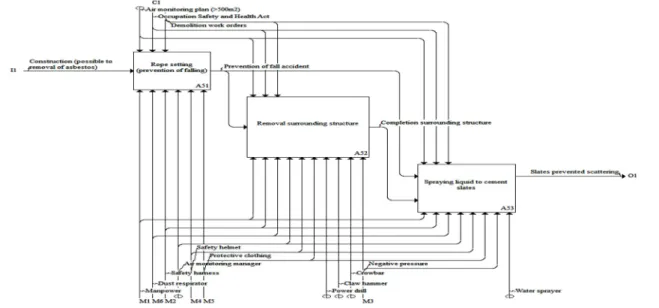
Fig. 3. Example of IDEF-0.
행공정의 산출물을, output은 활동의 결과로 발생된 산 출물이나 후행 공정의 입력물을 의미한다. Control에는 일정 계획, 지침 등 활동의 수행을 통제할 수 있는 방 법들을 표시하고, mechanism에는 활동을 위해 필요한 인력이나 장비와 같은 자원들을 표시한다 24-26) .
위험성평가 기법 중에 하나인 4M 리스크 평가 기법 은 공정(작업)내 잠재하고 있는 유해⋅위험요인을 Man, Machine, Media, Management의 4가지 분야로 위 험성을 파악하여 위험제거 대책을 제시하는 방법으로 위험성 계산은 한국산업안전공단의 4M 리스크 평가 기법에 관한 기술지침(KOSHA Guide X-14-2012)의 빈 도, 강도, 위험도를 이용하였다 27) .
3.
연구 결과3.1 공정분석
석면 슬레이트 해체작업에 대한 법적인 규정들을 검 토하고 현업 전문가의 작업 진행 설명 및 작업지시서 를 바탕으로 기능분석을 실시하여, 주요기능과 세부기 능을 추출하였다. 그 결과 석면 슬레이트 해체작업은 Table 1과 같이 5개의 공정과 18개의 세부공정으로 진 행된다 .
석면 슬레이트 건축물을 해체하기 위해 먼저 고용노 동부장관에게 등록한 전문 석면 해체⋅제거업자와 공 사계약을 체결하고 건축물의 석면 함유량을 조사 및 전문 석면 폐기물 처리업체와 폐기물 처리계약을 체결 한다. 그리고 노동부 및 지자체에 석면 해체 신고를 위 한 서류작성 및 석면 분진발생을 예방하기 위한 사전
준비 작업 후 노동부의 현장점검으로 작업허가를 받아 야 한다. 작업허가가 나면 석면 슬레이트를 해체하고 노동부와 지자체 및 발주자에게 해체 완료를 보고함으 로써 석면 슬레이트 해체작업이 완료된다 .
Table 1. List of removal process of asbestos cement slates
Level 0 Level 1 Level 2
Removal of asbestos cement slates in construction
Construction contract Contents monitoring of
asbestos Contract of waste
treatment
Document work &
preparatory work
Submission of document Plastic sheeting Installation of temporary structure Establishing hygiene facilities and
Negative Pressure Government permission Removal of equipment test
Safety education
Removal of asbestos cement
slates
Rope setting (prevention of falling) Removal surrounding structure Spraying liquid to cement slates
Pulling out nails Removal of cement slates
Loading waste material Packing waste material Removal of hygiene facilities and
equipment
Removal of temporary structure Transporting waste material and
landfill Completion report
Process
Evaluation Score Number of item
Current
evaluation Improved
evaluation Man Machine Media Management
Plastic sheeting 3.00 2.00 2 1 0 1
Installation of temporary structure 4.25 4.25 2 1 0 1
Establishing hygiene facilities and Negative Pressure 5.50 2.67 2 1 1 0
Removal of equipment test 4.50 2.00 1 0 0 1
Rope setting (prevention of falling) 3.25 3.25 3 0 0 1
Removal surrounding structure 6.00 3.33 1 1 2 1
Spraying liquid to cement slates 8.50 5.50 2 0 1 1
Pulling out nails and removal of cement slates 11.43 5.60 3 1 2 1
Loading and packing waste material 4.43 2.00 3 3 1 0
Removal of hygiene facilities and equipment and temporary structure 3.50 3.50 2 0 1 1
Table 2. The result of 4M risk assessment and risk factor 공정분석 자료 및 석면 해체⋅제거작업과 관련된 산 업안전보건법, 석면 해체⋅제거 작업지침(KOSHA Guide), 현장의 작업지시서 등을 참고하여 IDEF-0 방법론으로 모델링하였다. 석면 슬레이트를 사용한 건축물을 제거 하기 위해서 사용되는 control은 산업안전보건법, 폐기물 관리법, 공사계약서, 석면 해체⋅제거 작업 계획서, 인계 서 등 13개의 항목이 있으며, mechanism으로는 발주자, 석면제거업체, 석면조사기관, 폐기물 처리업체, 노동부, 지자체 등 34개 항목이 있는 것으로 분석되었다.
Fig. 3은 석면 슬레이트 해체작업 공정에서 level 2의 18개 세부공정 중 추락방지 로프 설치, 기타 구조물 해 체, 슬레이트에 비산방지 약품살포 공정에 대한 IDEF-0의 예시이다. 사전준비 작업이 완료되면, 추락 방지 로프 설치 후 석면 슬레이트를 제거하기 위해 방 해가 되는 기타구조물들의 해체가 이루어지고, 슬레이 트 해체시 석면분진의 비산을 방지하기 위해 슬레이트 에 비산방지 약품을 살포하는 공정이다. 이때 해체작 업의 통제수단(control)으로 으로는 작업 중 공기질 측 정(500m 2 이상일 때), 산업안전보건법, 작업지시서가 필요하고, 자원(mechanism)으로는 해체인력, 공기질 측 정자, 방진마스크, 안전모, 안전그네, 방진복, 음압기, 전동드릴, 빠루, 장도리, 분무기 등이 필요한 것으로 나 타났다 .
3.2 4M 리스크 평가
IDEF-0 방법론으로 모델링 된 공정분석을 바탕으로 4M 리스크 평가를 수행하였다. 공정분석에서 서류작 업과 폐기물 운반 및 매립을 제외한 13개의 석면 슬레 이트 해체 작업공정을 추출하였다. 폐기물 운반 및 매 립은 폐기물 수거업체 업무로 석면 슬레이트를 해체하 는 현장 작업과 별개이기 때문에 제외하였다 . 추출된 13개의 세부 단위 작업공정을 원활한 위험성평가를 위
해 슬레이트 못 제거-슬레이트 해체, 폐 슬레이트 적재 -폐 슬레이트 보양, 위생설비와 장비 철수-가설구조물 해체 등 연속적으로 이루어지는 2개의 공정을 1개의 공정으로 통합하여 총 10개의 단위공정에 대해 위험성 평가를 수행하였다 . IDEF-0 모델링의 공정분석 정보는 4M 리스크 평가표 작성 전에 선행되는 안전보건상 위 험정보의 공정순서, 기계⋅기구 및 설비 등에 대한 상 세내용 작성을 위한 기본정보로 활용하였다.
석면 슬레이트 해체작업의 10개 단위공정에 대한 4M 리스크 평가 결과 도출된 위험요인과 평균 위험도 는 Table 2와 같다. 10개 단위공정에서 Man 21개, Machine 8개, Media 8개, Management 8개로 총 45개의 위험요인이 도출되었다 . 그리고 10개 단위공정 중 슬 레이트 못 제거 및 해체작업의 평균위험도가 11.43으 로 가장 위험하다고 평가되었고 , 슬레이트에 비산방지 약품 살포가 8.5점으로 두 번째로 위험한 것으로 평가 되었다 . 2개 공정은 지붕재로 사용되는 슬레이트 위에 서 작업을 수행하는 고소작업이기 때문에 전도 및 추 락의 위험성 때문에 높게 평가되었다.
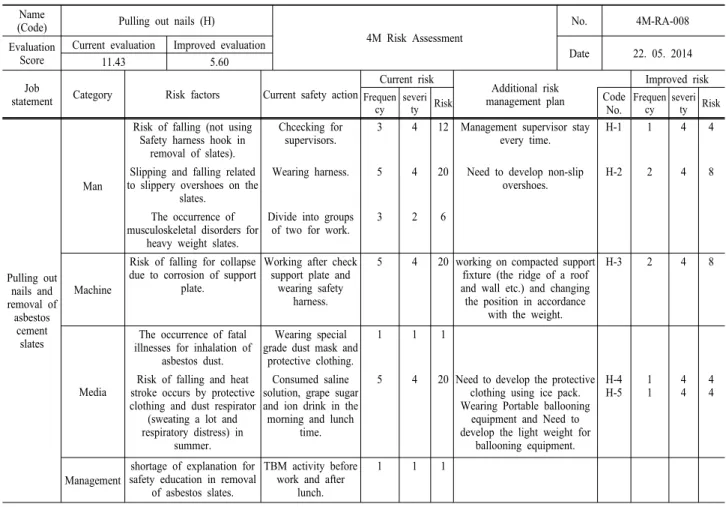
평균위험도가 가장 높은 슬레이트 못 제거 및 해체 작업의 4M 위험성 평가 예시는 Table 3과 같다. 슬레 이트 못 제거 및 해체 작업에서는 안전화 위에 신는 덧 신이 슬레이트의 이끼 때문에 미끄러워 전도 및 추락 위험과 슬레이트 지지판 부식으로 인한 붕괴로 인한 추락위험, 여름철 위생복으로 인한 땀과 분진마스크로 인한 호흡곤란 등으로 열사병 발생으로 전도 및 추락 위험 등 3가지 잠재 위험요인이 빈도와 강도가 가장 높은 것으로 나타났고, 위험도가 20으로 가장 높게 평 가되었다.
4M 리스크 평가 기법에 관한 기술지침(KOSHA
Guide X-14-2012)에서 리스크 수준은 1-3점(무시할 수
있는 위험), 4-6점(미미한 위험), 8점(경미한 위험), 9-12
Name
(Code) Pulling out nails (H)
4M Risk Assessment
No. 4M-RA-008
Evaluation Score
Current evaluation Improved evaluation
Date 22. 05. 2014
11.43 5.60
Job
statement Category Risk factors Current safety action
Current risk
Additional risk management plan
Improved risk Frequen
cy severi
ty Risk Code
No.
Frequen cy
severi ty Risk
Pulling out nails and removal of
asbestos cement
slates
Man
Risk of falling (not using Safety harness hook in
removal of slates).
Chcecking for
supervisors. 3 4 12 Management supervisor stay
every time. H-1 1 4 4
Slipping and falling related to slippery overshoes on the
slates.
Wearing harness. 5 4 20 Need to develop non-slip
overshoes. H-2 2 4 8
The occurrence of musculoskeletal disorders for
heavy weight slates.
Divide into groups
of two for work. 3 2 6
Machine
Risk of falling for collapse due to corrosion of support
plate.
Working after check support plate and
wearing safety harness.
5 4 20 working on compacted support fixture (the ridge of a roof and wall etc.) and changing the position in accordance
with the weight.
H-3 2 4 8
Media
The occurrence of fatal illnesses for inhalation of
asbestos dust.
Wearing special grade dust mask and
protective clothing.
1 1 1
Risk of falling and heat stroke occurs by protective clothing and dust respirator
(sweating a lot and respiratory distress) in
summer.
Consumed saline solution, grape sugar and ion drink in the morning and lunch
time.
5 4 20 Need to develop the protective clothing using ice pack.
Wearing Portable ballooning equipment and Need to develop the light weight for
ballooning equipment.
H-4
H-5 1
1 4
4 4
4
Management
shortage of explanation for safety education in removal
of asbestos slates.
TBM activity before work and after
lunch.
1 1 1