Research Article Open Access
15
제초제 내성 형질전환 벼와 잡초성 벼의 표현형질 비교
고은미1·안주희1·남기정1·남경희1·박기웅2·백경환3·김창기1*
1한국생명공학연구원 바이오평가센터, 2충남대학교 식물자원학과, 3전남대학교 응용생물공학부
Phenotype Comparison between Herbicide Tolerant Transgenic Rice and Weedy Rice
Eun Mi Go1, Joo Hee An1, Ki Jung Nam1, Kyong-Hee Nam1, Kee Woong Park2, Kyoungwhan Back3, and Chang-Gi Kim1*
1Bio-Evaluation Center, KRIBB, Cheongwon 363-883, Korea
2Department of Crop Science, Chungnam National University, Daejeon 305-764, Korea
3Division of Applied Bioscience and Biotechnology, Chonnam National University 500-757, Korea (Received on February 7, 2013; Revised on February 26, 2013; Accepted on March 4, 2013)
ABSTRACT. The phenotypic traits of herbicide-tolerant transgenic rice were compared with those of wild type (Dongjin) as well as two accessions (Hwaseong-aengmi 1 and Gwangyang-aengmi 12) of weedy rice. This study was conducted to investigate whether unintentional alterations in phenotypic characteristics occurred in the transgenic rice and whether the altered traits were similar to those in the two weedy rices. All qualitative traits studied were similar in the transgenic or wild-type rice. On the other hand, awn presence, flag leaf attitude and grain color differed considerably between herbicide-tolerant transgenic rice and weedy rice. As for quantitative traits, plant height, the number of tillers per plant and shoot dry weight were significantly greater for weedy rice than transgenic or wild-type rice. Grain weight per plant and 1000-grain weight of transgenic (or wild-type) rice were significantly greater than those of weedy rice. Transgenic rice shattered less than the other rices. Amylose and protein contents in embryos of transgenic rice were significantly different from those of weedy rice. The potential for weediness of the transgenic rice may be assessed using phenotype comparison between transgenic and weedy rice as shown in this study.
Key words: Herbicide, Phenotype, Transgenic rice, Weediness, Weedy rice
서 론
식물생명공학기술의 급속한 발전에 따라 제초제 내성, 해충저항성, 환경스트레스 내성 등 다양한 형질을 갖는 형 질전환 작물의 개발 및 재배가 증가하고 있다. 형질전환 작물 개발은 부족한 식량 생산에 대응하기 위한 한 가지 방안으로 간주되고 있지만, 형질전환 작물의 잠재적 위해 성에 대한 우려 역시 계속되고 있다(Snow et al., 2005;
Tiedje et al., 1989). 그 중 하나는 형질전환 작물이 유해 잡초가 되어 농업생산성을 감소시키고, 자연생태계에 침 입할 가능성이다(Keeler, 1989; Parker and Kareiva, 1996).
따라서 형질전환 작물을 재배하기 이전에 잡초화 가능성 에 대한 충분한 평가가 이루어져야 할 필요가 있다(Purrington and Bergelson, 1995).
형질전환 작물의 잡초화 가능성을 평가하기 위해서는 작물의 생활사, 경합력, 분산능, 종자의 휴면과 지속성 등 다양한 속성에 대한 검토가 필요하다(Crawley, 1990). 형 질전환 유채와 모본의 경합력을 비교한 연구(Fredshavn et al., 1995; Ramachandran et al., 2000)와 형질전환 클로버 와 모본의 경합력을 비교한 연구(Godfree et al., 2004) 등 이 보고되었으며, 환경에서 형질전환 유채 종자의 지속성 (Crawley et al., 1993; Hails et al., 1997) 및 감자의 지속 성에 대한 연구(Kim et al., 2010)도 보고된 바 있다. 호주 에서는 형질전환 목화를 대상으로 적응도(fitness)를 조사 하거나(Eastick and Hearnden, 2006) 잡초위해성평가 프로 토콜에 적용하여 형질전환 목화의 잡초화 가능성이 낮다
*Corresponding author.
Phone) +82-43-240-6543, FAX) +82-43-240-6549 E-mail) [email protected]
고 판단한 사례도 있다(Rogers et al., 2007).
형질전환 작물의 잡초화 가능성을 평가하기 위한 상기 방법과 함께 형질전환 작물의 표현형과 잡초성 근연종의 표현형을 비교함으로써 형질전환 작물의 잡초화 가능성을 예측하는데 도움이 될 것으로 판단된다. 잡초성 근연종은 우세한 경합력과 탈립성 등 작물과 구분할 수 있는 뚜렷 한 특성을 갖기 때문에, 만약 형질전환으로 인해 모본과
는 달리 잡초성 근연종에 보다 가까운 표현형이 나타난다 면 그 형질전환 작물의 잡초화 가능성이 높다고 판단할 수 있을 것이다. 이와 같은 표현형의 비교는 주로 형질전 환 작물과 근연종과의 교잡집단을 대상으로 이루어져 왔 다(Kim et al., 2004; Oard et al., 2000; Song et al., 2011).
잡초성 벼는 동남아시아, 아메리카 및 남부 유럽 등 세 계 대부분의 쌀 생산 지역에서 재배 벼의 수확량과 품질 Table 1. Measurement methods for phenotype assessment of transgenic, wild-type and weedy rice.
Characteristics Measurement methods
Plant height (cm) Measured from ground level to tip of the tallest leaf blade Shoot dry weight (g) Weight of dried shoot in 65oC for 5 days
No. of tillers per plant Record of total number of tillers per plant
Flag leaf attitude 1 (erect), 3 (semi-erect), 5 (horizontal), 7 (recurved) Days to 50% heading Record of days from planting to 50% heading
No. of panicles per plant Record of total number of panicles per plant at maturity
Panicle length (cm) Measured from the base to the top of the panicle of the principal culm No. of spikelets per panicle Record of total number of spikelets per panicle at maturity
Seed shattering Measured as grain breaking tensile strength (BTS, gf) using a digital force gauge (FG-5000A, Lutron, Taiwan) (Ji et al. 2006)
Time of maturity 1 (very early), 3 (early), 5 (medium), 7 (late), 9 (very late)
Ripened grains (%) Measured from the number of submerged grains in proportion to total number of grains in 30 g NaCl/L solution
Awn presence 1 (absent), 2 (present)
Awn color 1 (light gold), 2 (gold), 3 (brown), 4 (reddish brown), 5 (light red), 6 (red), 7 (light purple), 8 (purple), 9 (black)
Grain weight per plant (g) Total weight of grains per plant 1000-grain weight (g) Weight of 1000-grains
Color of tip of lemma 1 (white), 2 (yellowish), 3 (brown), 4 (red), 5 (purple), 6 (black)
Lemma color 1 (light gold), 2 (gold), 3 (brown), 4 (reddish to light purple), 5 (purple), 6 (black) Lemma phenol reaction 1 (absent), 9 (present)
Lemma intensity of phenol reaction 3 (light), 5 (medium), 7 (dark) Glume length (mm) Measured using vernier calipers Grain length (mm) Measured using vernier calipers Grain width (mm) Measured using vernier calipers
Decorticated grain color 1 (white), 2 (light brown), 3 (variegated brown), 4 (dark brown), 5 (light red), 6 (red), 7 (variegated purple), 8 (purple), 9 (dark purple/black)
Decorticated grain shape 1 (round), 2 (semi-round), 3 (half spindle-shaped), 4 (spindle-shaped), 5 (long spindle-shaped)
Decorticated grain length (mm) Measured using vernier calipers Decorticated grain width (mm) Measured using vernier calipers
Endosperm amylose content (%) Measured using Infratec 1241 grain analyzer (FOSS, Denmark) Endosperm water content (%) Measured using Infratec 1241 grain analyzer (FOSS, Denmark) Endosperm protein content (%) Measured using Infratec 1241 grain analyzer (FOSS, Denmark)
Germination percentage (%) Calculated as the percentage of seeds which germinate at the final count (14 days) at constant (25oC) and alternating temperature (20oC for 16h and 30oC for 8h).
을 감소시키는 주요 잡초다(Busconi et al., 2012; Song et al., 2011). 아시아의 이앙 논에서는 잡초성 벼가 성공적으 로 방제되어 왔지만, 이앙 논이 담수직파 논으로 바뀌는 지역에서는 방제에 어려움을 겪고 있다(Delouche et al., 2007). 잡초성 벼는 오랜 기간 동안 재배 벼와 동일한 지 역에 분포하면서 자연교잡 및 유전자 이입 등을 통하여 재배 벼와 유사한 형태와 생리를 갖게 되었지만, 종자가 쉽게 탈립하며 장기간 휴면을 하는 등 일부 특성에서 재 배 벼와 차이가 있는 것으로 알려져 있다(Ellstrand et al., 2010; Xia et al., 2011).
본 연구에서는 PPO (protoporphyrinogen oxidase) 유전 자를 도입하여 PPO 저해 제초제에 대한 내성을 갖도록 개발된 형질전환 벼(Lee et al., 2007)를 재료로 하여 모본 인 동진벼와 잡초성 벼 두 계통과의 표현형의 특성을 비 교하였다. PPO 유전자가 도입된 벼에서 모본보다 잡초성 벼와 더 가까운 특성이 나타나는지를 관찰함으로써 PPO 유전자 도입 형질전환 벼의 잡초화 가능성을 평가하는 기 초자료로 활용하고자 하였다.
재료 및 방법
농촌진흥청으로부터 환경방출실험승인(승인번호 2012- 020)을 받은 뒤 충북 청원군 오창읍에 위치한 한국생명공 학연구원 격리포장(농촌진흥청 지정번호 RDA-가AB-2011- 013)에서 포장시험을 수행하였다.
PPO 저해 제초제내성 형질전환 벼(Oryza sativa L., CPPO06 이벤트, T5 세대)와 모본인 동진벼의 종자는 전 남대학교로부터 분양을 받아 사용하였다. 이 형질전환 벼 는 토양 세균인 Myxococcus xanthus의 PPO 유전자를 도 입하여 개발한 것으로, Ubi 프로모터와 nos 터미네이터의 조절을 받고 있다(Lee et al., 2007). 잡초성 벼인 화성앵 미 1 (Accession No. YW2612)과 광양앵미 12(Accession
No. YW2402)는 영남대학교로부터 분양을 받아 사용하였다.
볍씨는 2012년 4월 12일에 파종하였으며, 35일 후 격리 포장에 손이앙하였다. 실험구는 3반복 난괴법으로 배치하 였으며, 관행농법에 따라 재배하였다. 2012년 8월과 9월 에 벼의 출수기를 관찰하였으며, 탈립으로 인한 종자의 소 실을 막기 위하여 출수 후 벼의 화서를 그물망으로 씌워 수확기까지 유지하였다. 2012년 10월 16일에 각 실험구별 로 10주씩을 수확하여 형질을 조사하였다. 양적형질과 질 적형질 조사는 농촌진흥청의 농업과학기술 연구조사분석 기준(안) (2003) 및 국립종자관리소의 신품종 심사를 위한 작물별 특성조사요령(벼) (2005)를 참고하여 실시하였다 (Table 1). 또한, 벼의 종실인장강도(grain breakage tensile strength)를 측정하여 탈립성의 척도로 사용하였다(Ji et al., 2006).
벼 유전형이 각 형질에 미치는 영향은 일원일차분산분석 (one-way ANOVA)으로 5% 유의수준에서 검정하였으며, 분 산분석 결과 통계적으로 유의한 차이가 관찰될 경우 Tukey's HSD 검정을 이용하여 평균의 차이를 검정하였다. 모든 통 계분석은 Statistica (Version 8.0, Statsoft) 통계 패키지를 이용하여 실시하였다.
결과 및 고찰
형질전환 벼와 모본의 질적 형질은 모두 다르지 않았으 므로(Table 2) 형질전환으로 인하여 PPO 저해 제초제에 대한 내성 획득 이외의 다른 질적 형질은 변하지 않은 것 으로 판단된다. 반면 화성앵미 1과 광양앵미 12의 질적형 질은 형질전환 벼 및 모본과 큰 차이가 있었다. 형질전환 벼와 모본의 지엽은 직립하였지만, 화성앵미 1의 지엽은 수 평이었으며, 광양앵미 12의 지엽은 반직립하였다(Table 2).
또한 형질변화 벼와 동진벼의 종실에는 까락이 없었지만 잡초성 벼의 종실에는 갈색 까락이 있었다. 까락은 잡초 Table 2. Qualitative characteristics of transgenic, wild-type and weedy rice.
Characteristics Transgenic Wild-type Hwaseong-aengmi 1 Gwangyang-aengmi 12
Flag leaf attitude 1 1 5 3
Awn presence 1 1 9 9
Awn color - - 3 3
Time of maturity 5 5 7 7
Color of tip of lemma 2 2 3 3
Lemma color 1 1 3 2
Lemma phenol reaction 1 1 9 1
Lemma intensity of phenol reaction - - 7 -
Decorticated grain color 2 2 5 4
Decorticated grain shape 2 2 3 3
성 벼에서 관찰되는 특성 중 하나로 경기지역에서 수집한 잡초성 벼 170개 계통 중 71%에서(Park et al., 1999), 전 국적으로 수집한 1,300 여개 계통의 잡초성 벼 중 61%에 서(Suh, 2003) 까락이 관찰된 바 있다.
형질전환 벼와 모본의 성숙기는 중간이었지만, 잡초성 벼의 성숙기는 늦은 것으로 나타났다(Table 2). 부선색은 형질전환 벼와 모본이 연노랑색인 반면에, 잡초성 벼는 갈 색이었다. 외영의 페놀 반응은 화성앵미 1에서만 진하게 나타났다. 페놀 반응은 주로 Indica 형 잡초성 벼에서 나 타나는 특성으로 알려져 있지만 Japonica 형 잡초성 벼의 31%에서도 페놀 반응이 관찰되었다(Suh et al., 1992a). 형 질전환 벼와 모본의 현미 색은 황금색인 반면에, 화성앵 미 1과 광양앵미 12는 각각 담적색과 짙은 갈색이었다. 잡 초성 벼는 현미 색이 적색, 갈색 및 흑색인 계통도 보고 되고 있으며(Park et al., 1999; Suh et al., 1992a), 이와 같 은 잡초성 벼 현미의 다양한 색은 재배 쌀의 품질을 감소 시키는 원인이 된다. 화성앵미 1과 광양앵미 12는 모두 중 원형으로 장폭비가 2.00~2.49의 범위 내에 있었다. 따라서 화성앵미 1과 광양앵미 12는 Indica 형인 장립형 잡초성 벼가 아닌 Japonica 형인 단립형 잡초성 벼에 해당된다 (Suh et al., 1992a). 형질전환 벼와 모본은 모두 장폭비가 1.50~1.99의 범위에 있는 단원형으로 장폭비가 더 작았다.
양적형질 대부분은 벼의 유전형에 따라 통계적으로 유 의한 차이를 나타냈다. 영양생장은 형질전환 벼나 모본보 다 잡초성 벼에서 우세했다(Fig. 1). 초장은 화성앵미 1과 광양앵미 12가 형질전환 벼와 모본에 비해 각각 22%와 40% 더 크게 나타났다(Fig. 1A). 이와 같이 잡초성 벼의 큰 초장은 재배 벼와의 광 경합에서 유리한 형질이 될 수 있다(Kuk et al., 1997; Suh et al., 1992b). 분얼 수는 화성 앵미 1이 형질전환 벼나 모본에 비해 유의하게 더 많았다 (Fig. 1B). 지상부 건물중은 분얼이 많고, 키가 큰 잡초성 벼 두 계통이 형질전환 벼나 모본에 비해 더 무거웠으나
통계적인 차이는 형질전환 벼 및 모본과 광양앵미 12 사 이에서만 관찰되었다(Fig. 1C).
형질전환 벼와 모본의 개화시기는 일치하였는데, 파종 후 126일에 출수를 시작하여 132일째 출수를 마쳤으며, 출수기까지 128일이 소요되었다(Fig. 2). 화성앵미 1은 파 종 후 121일째부터 출수를 시작하여 형질전환 벼나 모본 에 비해 출수는 빨랐지만, 143일째에 출수를 마쳐 전체 출 수 기간은 가장 길었다. 광양앵미 12는 전체적인 출수 기 간은 짧았으나 다른 벼에 비해 출수시가 늦어 파종 후 142 일째에 출수를 하였고, 출수기까지 148일이 소요되었다.
생식생장은 전반적으로 형질전환 벼와 모본의 형질이 잡초성 벼에 비해 더 우세하였다. 주당 수수는 화성앵미 1이 가장 많은 반면 광양앵미 12가 가장 적었으며, 수장 은 화성앵미 1이 유의하게 가장 길었다(Fig. 3A, B). 수당 Fig. 1. Vegetative characteristics of transgenic (TR), wild-type (WT) and weedy rice (HA: Hwaseong-aengmi 1; GA: Gwangyang- aengmi 12). Data are means + standard deviations. Values followed by the same letters are not significantly different (HSD test, p <
0.05).
Fig. 2. Cumulative percentage of flowering panicles per plant of transgenic (TR), wild-type (WT) and weedy rice (HA:
Hwaseong-aengmi 1; GA: Gwangyang-aengmi 12).
영화수는 화성앵미 1이 가장 적었고, 나머지 벼는 차이가 없었다(Fig. 3C). 광양앵미 12와 모본의 주당 영화수는 서 로 통계적인 차이가 없었다. 모본의 등숙율은 화성앵미 1 과 광양앵미 12의 등숙율에 비해 유의하게 높았다(Fig.
3D). 또한, 주당 종실중과 천립중 모두 잡초성 벼 두 계통 이 형질전환 벼 및 모본에 비해 더 가벼웠다(Fig. 3E, 3F).
형질전환 벼는 종실인장강도가 잡초성 벼에 비해 높게 나 타나 탈립이 쉽게 일어나지 않음을 알 수 있었다(Fig. 4).
국내에서 조사한 809계통의 재래 적미 중 85%에서 탈립 이 쉽게 일어남이 보고된 바 있다(Suh et al., 1992a). 따 라서 형질전환 벼가 쉽게 탈립하지 않는다는 것은 이 벼 의 잡초화 가능성이 낮음을 나타내는 하나의 지표가 될 수 있을 것이다.
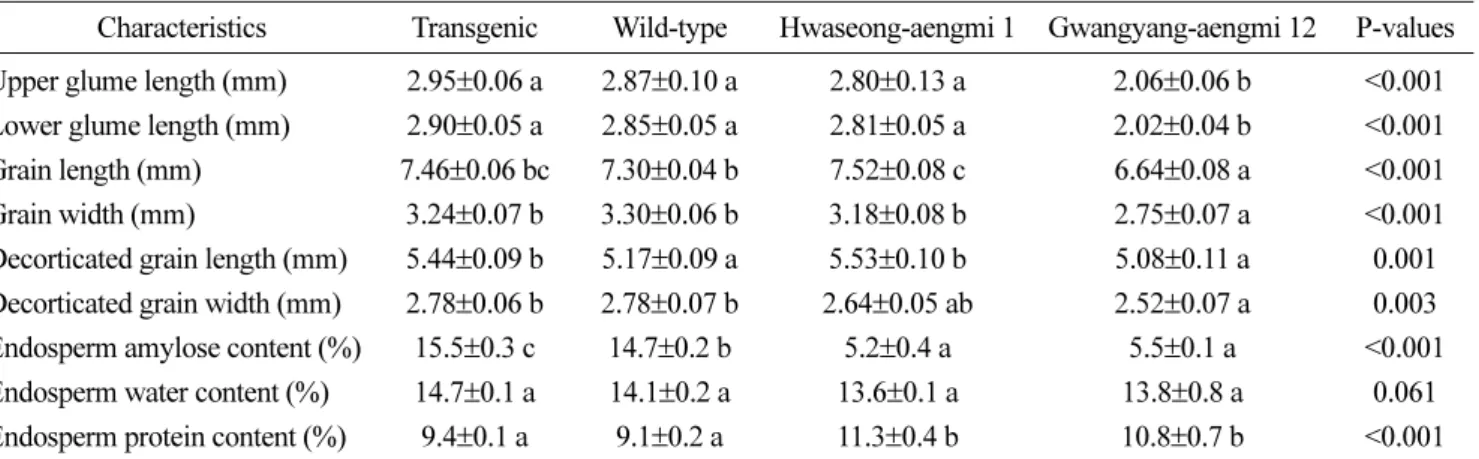
호영 상부와 하부 길이 및 호영 폭은 형질전환 벼와 모 본에 비해 광양앵미 12에서 더 짧았다(Table 3). 광양앵미 12의 벼알 길이 및 폭, 현미의 길이 및 폭이 가장 짧았다.
잡초성 벼 종자 배유의 아밀로스 함량은 형질전환 벼와 모 본에 비해 유의하게 낮았지만, 단백질 함량은 높았다(Table 3). 국내에서 수집된 Indica 형 잡초성 벼의 아밀로스 함 량은 20~26%였으며(Heu et al., 1990), 주로 Indica 형인 미국의 잡초성 벼의 아밀로스 함량 또한 22 ~ 26%로 보 고된 바 있다(Gealy and Bryant, 2009). 본 실험에서 형질 전환 벼와 모본의 아밀로스 함량은 15% 정도로 이보다 낮았으며, 화성앵미 1과 광양앵미 12는 5% 정도로 낮았 다. 배유의 수분 함량은 벼 계통 간에 유의한 차이가 없었다.
25oC 항온과 20oC / 30oC 변온 조건에서 벼의 유전형에 따른 발아율 차이는 관찰되지 않았다(Fig. 5). 그러나 항 온과 변온 조건에서의 발아속도는 화성앵미 1과 광양앵미 12가 형질전환 벼와 모본에 비해 빠른 것으로 나타났다.
잡초성 벼는 항온 조건과 변온 조건에서 100% 가깝게 발 아하였으며, 휴면성은 거의 없었다. 종자의 휴면성은 잡초 성 벼의 특징 중 하나이지만(Ellstrand et al., 2010; Xia et al., 2011), 한국 재래 적미의 수확 직후 발아율이 99% 이 상으로 높아 휴면성이 없었다는 보고도 있다(Suh and Ha, 1993).
이상과 같이 PPO 저해 제초제 내성 형질전환 벼는 모 본인 동진벼와 표현형을 비교하였을 때 질적형질은 동일 하였고, 양적형질 중 일부(낮은 탈립성, 높은 아밀로스 함 량, 긴 현미 길이) 형질에서는 모본과 유의하게 차이가 났 지만, 나머지 형질에서는 통계적인 차이가 관찰되지 않았 다. 형질전환 벼의 표현형은 이와 같이 대부분 재배품종인 동진벼와 유사하였지만, 잡초성 벼의 표현형과는 질적, 양 Fig. 3. Reproductive characteristics of transgenic (TR), wild-type
(WT) and weedy rice (HA: Hwaseong-aengmi 1; GA: Gwangyang- aengmi 12). Data are means + standard deviations. Values followed by the same letters are not significantly different (HSD test, p < 0.05).
Fig. 4. Seed shattering measured as breakage tension strength (BTS) of transgenic (TR), wild-type (WT) and weedy rice (HA: Hwaseong-aengmi 1; GA: Gwangyang-aengmi 12). Data are means + standard deviations. Values followed by the same letters are not significantly different (HSD test, p < 0.05).
적으로 큰 차이가 있었다. 이와 같은 결과로 PPO 저해 제 초제에 내성을 갖는 유전자를 벼에 도입하였을 때 근연 잡초인 잡초성 벼와 유사한 표현형을 나타내지 않으며, 목 적 형질을 제외하고 나머지 형질은 모본과 유사하여 잡초 화 가능성은 낮다고 판단하였다.
형질전환 벼의 잡초화 가능성을 보다 정확히 예측하기 위해서는 경합력, 자연 환경에서의 휴면성, 월동성, 생활 사 변화 등의 평가가 종합적으로 이루어져야 할 것이다.
또한 본 실험과 같이 형질전환 벼와 잡초성 벼의 표현형 을 비교한다면 형질전환 벼의 잡초화 가능성을 예측하는 기초 자료로 활용할 수 있을 것이다.
요 약
제초제 내성 형질전환 벼와 모본(동진벼) 및 잡초성 벼
두 계통(화성앵미 1과 광양앵미 12)의 표현형질을 비교하 였다. 형질전환 벼와 모본의 질적형질은 모두 유사하였지 만, 까락의 유무, 지엽 자세 및 종실 색은 형질전환 벼와 잡초성 벼 사이에 큰 차이가 있었다. 양적형질 중에서 초 장, 분얼 수 및 지상부 건물중은 형질전환 벼나 모본에 비 해 잡초성 벼에서 유의하게 우세했다. 형질전환 벼 및 모 본의 주당 종실중과 천립중은 잡초성 벼에 비해 유의하게 무거웠다. 형질전환 벼는 모본 및 잡초성 벼에 비해 탈립 이 용이하지 않았으며, 형질전환 벼의 배유 아밀로스 및 단백질 함량은 잡초성 벼와 유의한 차이가 있었다. 이와 같은 형질전환 벼와 잡초성 벼 표현형질의 비교 연구는 형질전환 벼의 잡초화 가능성 예측에 활용될 수 있을 것이다.
주요어 : 제초제, 표현형, 형질전환 벼, 잡초화 가능성, 잡 초성 벼
Table 3. Grain size and endosperm characteristics of transgenic, wild-type and weedy rice.
Characteristics Transgenic Wild-type Hwaseong-aengmi 1 Gwangyang-aengmi 12 P-values Upper glume length (mm) 2.95±0.06 a 2.87±0.10 a 2.80±0.13 a 2.06±0.06 b <0.001 Lower glume length (mm) 2.90±0.05 a 2.85±0.05 a 2.81±0.05 a 2.02±0.04 b <0.001 Grain length (mm) 7.46±0.06 bc 7.30±0.04 b 7.52±0.08 c 6.64±0.08 a <0.001 Grain width (mm) 3.24±0.07 b 3.30±0.06 b 3.18±0.08 b 2.75±0.07 a <0.001 Decorticated grain length (mm) 5.44±0.09 b 5.17±0.09 a 5.53±0.10 b 5.08±0.11 a 0.001 Decorticated grain width (mm) 2.78±0.06 b 2.78±0.07 b 2.64±0.05 ab 2.52±0.07 a 0.003 Endosperm amylose content (%) 15.5±0.3 c 14.7±0.2 b 5.2±0.4 a 5.5±0.1 a <0.001 Endosperm water content (%) 14.7±0.1 a 14.1±0.2 a 13.6±0.1 a 13.8±0.8 a 0.061 Endosperm protein content (%) 9.4±0.1 a 9.1±0.2 a 11.3±0.4 b 10.8±0.7 b <0.001 Data are means±standard deviations. P-values are from one-way analysis of variance. Values within rows followed by the same letters are not
significantly different (Tukey’s HSD test, p < 0.05).
Fig. 5. Cumulative germination of transgenic (TR), wild-type (WT) and weedy rice (HA: Hwaseong-aengmi 1; GA: Gwangyang- aengmi 12) at (A) 25oC and (B) 20oC / 30oC.
Acknowledgements
We thank Prof. H.S. Suh at the Yeongnam University for providing seeds of weedy rice. This research was supported by grants from the Next-Generation BioGreen21 Program, Rural Development Administration and the National Research Foundation of Korea funded by Ministry of Educa- tion, Science & Technology, Republic of Korea (No. 2011 0028162).
References
Busconi, M., Rossi, D., Lorenzoni, C., Baldi, G. and Fogher, C.
2012. Spread of herbicide-resistant weedy rice (red rice, Oryza sativa L.) after 5 years of Clearfield rice cultivation in Italy. Plant Biol. 14:751-759.
Crawley, M.J. 1990. The ecology of genetically engineered organisms: Assessing the environmental risks, pp. 133-150, In:
Mooney, H.A. and Bernardi, G. (Eds.). Introduction of Genetically Modified Organisms into the Environment. John Wiley & Sons, Inc., Chichester, UK.
Crawley, M.J., Hails, R.S., Rees, M., Kohn, D. and Buxton, J.
1993. Ecology of transgenic oilseed rape in natural habitats.
Nature 363:620-623.
Delouche, J.C., Burgos, N.R., Gealy, D.R., de San Martn, G.Z., Labrada, R. et al. 2007. Weedy Rices Origin, Biology, Ecology and Control. FAO Plant Production and Protection Paper 188. FAO, Rome, Italy.
Eastick, R.J. and Hearnden, M.N. 2006. Potential for weediness of Bt cotton in northern Australia. Weed Sci. 54:1142-1151.
Ellstrand, N.C., Heredia, S.M., Leak-Garcia, J.A., Heraty, J.M., Burger, J.C. et al. 2010. Crops gone wild: evolution of weeds and invasives from domesticated ancestors. Evol. Appl. 3:494- 504.
Fredshavn, J.R., Poulsen, G.S., Huybrechts, I. and Rudelsheim, P.
1995. Competitiveness of transgenic oilseed rape. Transgenic Res. 4:142-148.
Gealy, D.R. and Bryant, R.J. 2009. Seed physicochemical characteristics of field-grown US weedy red rice (Oryza sativa) biotypes: Contrasts with commercial cultivars. J. Cereal Sci.
49:239-245.
Godfree, R.C., Woods, M.J., Young, A.G., Burdon, J.J. and Higgins, T.J.V. 2004. Growth, fecundity and competitive ability of transgenic Trifolium subterraneum subsp. subterraneum cv.
Leura expressing a sunflower seed albumin gene. Hereditas 140:229-244.
Hails, R.S., Rees, M., Kohn, D.D. and Crawley, M.J. 1997. Burial
and seed survival in Brassica napus subsp. oleifera and Sinapis arvensis including a comparison of transgenic and non- transgenic lines of the crop. Proc. R. Soc. Lond. B 264:1-7.
Heu, M.H., Cho, Y.C. and Suh, H.S. 1990. Cross affinity of Korean weedy rice to the cultivars. Korean J. Crop Sci. 35:233- 238. (In Korean)
Ji, H.S., Chu, S.H., Jiang, W., Cho, Y.I., Hahn, J.H. et al. 2006.
Characterization and mapping of a shattering mutant in rice that corresponds to a block of domestication genes. Genetics 173:995-1005.
Keeler, K.H. 1989. Can genetically engineered corps become weeds? Bio/Technology 7:1134-1139.
Kim, C.G., Kim D.Y., Moon, Y.S., Kim, H.J., Kim, D.I. et al. 2010.
Persistence of genetically modified potatoes in the field. J.
Plant Biol. 53:395-399.
Kim, K.U., Lee, J.H., Lee, I.J., Shin, D.H. and Kim, S.U. 2004.
Hybridization of LM (Living Modified) rice with weedy rices.
Kor. J. Weed Sci. 24:51-55. (In Korean)
Kuk, Y.I., Guh, J.O. and Chon, S.U. 1997. Difference of classification, growth and herbicidal tolerance in collected weedy rice (Oryza sativa). Kor. J. Weed Sci. 17:31-43. (In Korean)
Lee, K., Yang, K., Kang, K., Kang, S., Lee, N. and Back, K. 2007.
Use of Myxococcus xanthus protoporphyrinogen oxidase as a selectable marker for transformation of rice. Pestic. Biochem.
Physiol. 88:31-35.
National Seed Management Office. 2005. Test Guidelines of Rice (Oryza sativa L.) for Application and Registration of New Varieties. Anyang, Korea. (In Korean)
Oard, J., Cohn, M.A., Linscombe, S., Gealy, D. and Gravois, K.
2000. Field evaluation of seed production, shattering, and dormancy in hybrid populations of transgenic rice (Oryza sativa) and the weed, red rice (Oryza sativa). Plant Sci. 157:13- 22.
Park, J.S., Cho, Y.C., Han, S.W., Ju, Y.C., Park, K.Y. and Rho, Y.D.
1999. Characteristics of weedy rices on paddy field in Kyonggi area. Kor. J. Weed Sci. 19:299-306. (In Korean)
Parker, I.M. and Kareiva, P. 1996. Assessing the risks of invasion for genetically engineered plants: Acceptable evidence and reasonable doubt. Biol. Conserv. 78:193-203.
Purrington, C.B. and Bergelson, J. 1995. Assessing weediness of transgenic crops: Industry plays plant ecologist. Trends Ecol.
Evol. 10:340-342.
Ramachandran, S., Buntin, G.D., All, J.N., Raymer, P.L. and Stewart Jr., C.N. 2000. Intraspecific competition of an insect- resistant transgenic canola in seed mixtures. Agron. J. 92:368- 374.
RDA. 2003. Standard for Research, Survey and Analysis of Agricultural Science Technology. Rural Development Administration, Suwon, Korea. (In Korean)
Rogers, D.J., Reid, R.E., Rogers, J.J. and Addison, S.J. 2007.
Prediction of the naturalisation potential and weediness risk of transgenic cotton in Australia. Agr. Ecosyst. Environ. 119:177- 189.
Snow, A.A., Andow, D.A., Gepts, P., Hallerman, E.M., Power, A., Tiedje, M.J., et al. 2005. Genetically engineered organisms and the environment: Current status and recommendations. Ecol.
Appl. 15:377-404.
Song, X., Wang, Z. and Qiang, S. 2011. Agronomic performance of F1, F2 and F3 hybrids between weedy rice and transgenic glufosinate-resistant rice. Pest Manag. Sci. 67:921-931.
Suh, H.S. 2003. Characterization of Weedy Rice Germplasm.
Yeongnam University, Daegu, Korea. (In Korean)
Suh, H.S., Park, S.Z. and Heu, M.H. 1992a. Collection and
evaluation of Korean red rices. I. Regional distribution and seed characteristics. Korean J. Crop Sci. 37:425-430. (In Korean)
Suh, H.S., Ha, W.G. and Song, Y.C. 1992b. Collection and evaluation of Korean red rices. II. Yield component, culm and panicle length. Korean J. Crop Sci. 37:431-435. (In Korean) Suh, H.S. and Ha, W.G. 1993. Collection and evaluation of Korean red rices. Ⅴ. Germination characteristics on different water and soil depth. Korean J. Crop Sci. 38:128-133. (In Korean) Tiedje, J.M., Colwell, R.K., Grossman, Y.L., Hodson, R.E.,
Lenski, R.E., Mack, R.N., et al. 1989. The planned introduction of genetically engineered organisms: Ecological considerations and recommendations. Ecology 70:298-315.
Xia, H.B., Xia, H., Ellstrand, N.C., Yang, C. and Lu, B.R. 2011.
Rapid evolutionary divergence and ecotypic diversification of germination behavior in weedy rice populations. New Phytol.
191:1119-1127.