1경북대학교 생명공학부, 702-701 대구광역시 북구 산격동 1370(School of Life Sciences and Biotechnology, Kyungpook National University, Daegu 702-701, Korea).
* 연락저자(Corresponding author):Phone) +82-53-950-7364, Fax) +82-53-943-6925, E-mail) [email protected]
(Received August 23, 2010; Examined September 17, 2010; Accepted September 24, 2010)
Expression Site of Protoporphyrinogen Oxidase Influences on Herbicide Resistance in Transgenic Rice
Sunyo Jung1*
형질전환 벼에서 Protoporphyrinogen Oxidase의 발현 위치가 제초제 저항성에 미치는 영향
정 선 요1*
ABSTRACT The effect of Protox expression site on herbicidal resistance was investigated in wild-type and transgenic rice plants imposed by peroxidizing herbicide oxyfluorfen. The transgenic rice systems involved the plastidal expression of Arabidopsis protoporphyrinogen oxidase (Protox;
AP line) and the dual expression of Myxococcus xanthus Protox in chloroplasts and mitochondria (TTS line). The oxyfluorfen-treated TTS4 line showed the lower levels of cellular leakage and malonyldialdehyde and the sustained capacity of 5-aminolevulinic acid synthesis, compared to the oxyfluorfen-treated AP and wild-type lines. During oxyfluorfen action, the TTS4 line had greater herbicide resistance than the AP1 line, indicating that the dual expression of M. xanthus Protox in chloroplasts and mitochondria prevented the accumulation of photodynamic protoporphyrin IX more effectively than the expression of Arabidopsis Protox only in chloroplasts. These results suggest that the ectopic expression of Protox in mitochondria greatly contributes to the herbicidal resistance in rice plants.
Key words: 5-aminolevulinic acid; herbicide resistance; oxidative stress; oxyfluorfen; protoporphyrinogen oxidase.
INTRODUCTION
Tetrapyrrole biosynthesis is important in plants because it provides many essential molecules that are involved in light harvesting, energy transfer,
signal transduction, detoxification, and systemic acquired resistance (Grimm 1998; Molina et al.
1999; Smith et al. 1993). The porphyrin ring system is derived from 5-aminolevulinic acid (ALA). ALA is formed in plants from the five-carbon skeleton of
glutamate in unit of the C5 pathway (Beale 1978;
von Wettstein et al. 1995). The last common step in the tetrapyrrole pathway to heme and chlorophyll is the oxidation of protoporphyrinogen IX (Protogen IX) to protoporphyrin IX (Proto IX), which is catalyzed by protoporphyrinogen oxidase (Protox, EC 1.3.3.4) (Jacobs and Jacobs 1987; Matringe et al. 1992). Plants express two Protox isozymes:one is associated with the chloroplast envelope and thylakoid membranes (Matringe et al. 1992), and the other is localized to mitochondria (Smith et al.
1993).
There is increased interest in the mechanisms of plant chlorophyll synthesis owing to recent studies describing the light-dependent action of photobleaching diphenylether herbicides including oxyfluorfen and acifluorfen (Jacobs and Jacobs 1993; Jung and Back 2005; Kouji et al. 1988; Lee et al. 2003;
Lydon and Duke 1988). They are photodynamically active and competitively block the substrate-binding region of Protox. The acute toxicity of oxyfluorfen is a result of the accumulation of Protogen IX, which is oxidized in the cytoplasm to Proto IX by a nonspecific plasma membrane-bound peroxidase (Jacobs et al. 1991; Lee and Duke 1993). Proto IX in the cytoplasm is not metabolized by the porphyrin biosynthetic pathway because of Mg-chelatase and Fe-chelatase, which use Proto IX as a substrate, are located in chloroplasts and mitochondria. Cytoplasmic Proto (gen) IX, a potent photosensitizer, absorbs light that is used in detrimental reactions in which energy or electrons are subsequently transferred to oxygen, resulting in the formation of highly reactive oxygen, rapid lipid peroxidation, and cell death.
In the transgenic plants overexpressing Protox gene in either chloroplasts or mitochondria, the action of Protox-inhibiting herbicides was decreased by preventing the accumulation of Protogen IX, decreas- ing the light-dependent phytotoxicity (Ha et al. 2004;
Jung et al. 2006; Lermontova and Grimm 2000;
Warabi et al. 2001). This study investigated whether the expression site of Protox tightly correlates to the peroxidizing-herbicide resistance in the two transgenic rice systems involving the expression of Arabidopsis Protox in chloroplasts (AP line) (Ha et al. 2004) and the dual expression of Myxococcus xanthus Protox in chloroplasts and mitochondria (TTS line) (Jung et al. 2006). The relation between the levels of cellular leakage and oxidative status was monitored in the two transgenic and WT lines imposed by oxifluorfen compared with controls.
The regulation of ALA level upon the herbicidal treatment was also compared to the wild-type and transgenic rice plants.
MATERIALS AND METHODS
Plant materials and growth conditions
The T4 generations of homozygous rice lines (AP1) (Ha et al. 2004) expressing Arabidopsis Protox in chloroplasts and the T3 generations of homozygous rice line (TTS4) expressing Myxococcus xanthus Protox in chloroplasts and mitochondria (Jung et al.
2006) were used for physiological experiments. Seeds of wild-type and transgenic lines were planted, and seedlings were potted in paddy soil and grown in the greenhouse, which was kept at 28 to 30℃.
Parts of leaves from 3-week-old rice plants were taken for experiments.
Herbicide treatment
Technical-grade oxyfluorfen for conductivity mea- surement was generously provided by Kyungnong (Gyeongju, Korea). Commercially available oxyfluorfen (Goal®) was used for the foliar application test.
Three-week-old rice plants were sprayed with 20 µM oxyfluorfen, placed in darkness for 12 h to
allow absorbance, and then illuminated for 30 h.
The treated leaf tissues were used for determination of malonyldialdehyde (MDA) and ALA analyses.
Cellular leakage
The rice leaf tissues were treated with oxyfluorfen as described previously (Kenyon et al. 1985; Lee et al. 1995) by cutting mature leaves to 4-mm squares (0.1 g fresh wt.) and then placing them in a 6-cm diameter polystyrene Petri dish containing 5 mL of 1% sucrose, 1 mM 2-(N-morpholino)ethanesulfonic acid (MES, pH 6.5) with or without the herbicide dissolved in acetone. The MES buffer was used to reduce the oxyfluorfen-caused change in the pH of bathing solution. The controls contained the same amount of the solvent without the herbicide. The final concentration of acetone in all dishes was 1%
(v/v). The tissues were incubated with 20 µM of oxyfluorfen in a growth chamber at 25℃ in darkness for 12 h and then exposed to continuous light at 250 µmol m-2 s-1 photosynthetically active radiation (PAR) for 24 h. Cellular leakage was determined periodically by detecting the electro- conductivity of the bathing medium using a conduc- tivity meter (Cole-Parmer Instruments) as previously described (Lee et al. 1995). Because of differences in the background conductivity of different treatment solutions, the results were expressed as changes in conductivity upon exposure to light.
Determination of malonyldialdehyde content For the measurements of oxidative stress in leaves, the thiobarbituric acid (TBA) test, which determines MDA as an end product of lipid peroxidation (Buege and Aust 1978), was used. Leaves (0.1 g) were homogenized in 2 mL of a solution of 0.5% TBA in 20% trichloroacetic acid. The homogenate was cen- trifuged at 20,000× g for 15 min. and the supernatants were collected. The supernatants were heated in
boiling water for 25 min., and the reaction was stopped by placing the reaction tubes in an ice bath.
Then the samples were centrifuged at 20,000× g for 15 min., and the absorbance of the supernatant at 532 nm was recorded for each sample and corrected for nonspecific turbidity at 600 nm. The MDA concentration was calculated using a molar extinction coefficient of 156 mM-1 cm-1 (Buege and Aust 1978).
ALA-synthesizing capacity
ALA-synthesizing capacity was measured as described by Papenbrock et al. (1999). Leaf disks were harvested for each sample, incubated in 20 mM phosphate buffer containing 40 mM levulinic acid in the light for 6 h, and frozen in liquid nitrogen. Samples were homogenized, resuspended in 1 mL of 20 mM K2HPO4/KH2PO4 (pH 6.9), and centrifuged at 10,000× g. The 500-µL supernatant was mixed with 100 µL ethylacetoacetate, boiled for 10 min., and cooled for 5 min.. An equal volume of modified Ehrlichs reagent was added and the absorption of the chromophore was determined at 553 nm with the spectrophotometer.
RESULTS AND DISCUSSION
Comparison of herbicidal resistance in transgenic rice plants expressing either Arabidopsis or M.
xanthus Protox
In the previous study, the transgenic rice over- expressing M. xanthus Protox (TTS) showed greatly increased Protox activity in both chloroplasts and mitochondria in comparison with wild-type, which suggested that the M. xanthus Protox was dually targeted into both organelles (Jung et al. 2006).
However, the introduction of Arabidopsis Protox (AP) into rice led to the ectopic expression of Protox only in chloroplasts (Ha et al. 2004). The
overexpression of Protox in the two transgenic rice lines resulted in greater herbicidal resistance to peroxidizing herbicide oxyfluorfen in comparison to wild-type line. In the present study, the wild-type and transgenic lines, AP1 and TTS4, were exposed to oxyfluorfen treatment to assess the effect of differential Protox expression site on herbicidal resistance.
The necrotic phenotypes of herbicide-treated plants typically display leaf desiccation, veinal necrosis, and leaf deformation (Knörzer and Böger 1999).
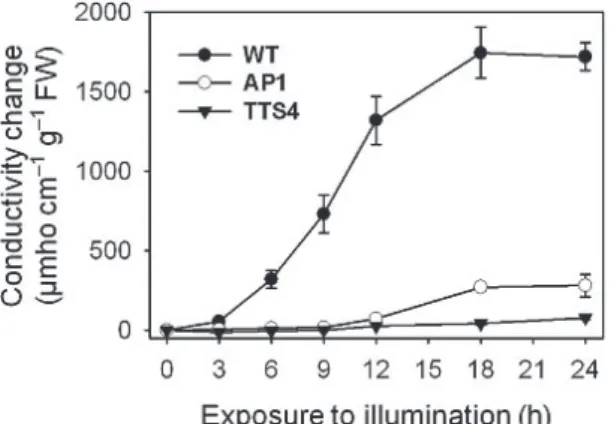
With 20 µM oxyfluorfen treatment, the necrosis of leaf squares (data not shown) in wild-type plants was associated with time-dependent increases in conductivity until 18 h after illumination (Fig. 1), an indication of cellular leakage, caused by an accumulation of Proto IX. Excited Proto IX molecules present in excess interact with O2 and give rise, by triplet-triplet interchange, to highly toxic 1O2, that in turn trigggers membrane lipid
Fig. 1. Effect of oxyfluorfen on time-dependent change of cellular leakage from leaf squares of rice plants. Conductivity, which reflects electrolyte leakage, was measured in the bathing solution after leaf segments were treated with 20 µM oxyfluorfen. Tissues were exposed to continuous white light at 250 μmol m-2 s-1 PAR for 24 h following a 12-h dark incubation. WT, wild type;
AP1, transgenic line overexpressing Arabidopsis Protox; TTS4, transgenic line overexpressing M.
xanthus Protox. The data represent the mean ± S.E. of three replicates.
peroxidation, protein denaturation, and pigment bleaching (Dolphin 1994; Reinbothe et al. 1996). In the transgenic line, AP1, the conductivity began to drastically increase 12 h after illumination and then continuously increased until 18 h after the illu- mination (Fig. 1). In contrast, the TTS transgenic line, TTS4, showed only a minor increase in conductivity in response to oxyfluorfen treatment.
Overall, the dual expression of M. xanthus Protox in chloroplasts and mitochondria in the TTS4 line resulted in a lesser increase in conductivity during oxyfluorfen action than that of the AP1 line, indi- cating the reduction in the leakage of photo- sensitizing Protogen IX from chloroplasts and mitochondria to the cytosolic membranes.
MDA content, which is a measure of lipid peroxidation, was assayed in rice plants. The levels of MDA were the same in the untreated leaf disks of wild-type and the two transgenic lines (Fig. 2).
The MDA level in the wild-type line was greatly
Fig. 2. Effect of foliar application of oxyfluorfen on MDA production from leaf tissues of rice plants.
MDA production was measured in leaf tissues after treatments with oxyfluorfen. Three-week- old rice plants were sprayed with a 20 µM concentration of oxyfluorfen, placed in darkness for 12 h to allow absorbance, and then illuminated for 30 h. WT, wild type; AP1, transgenic line overexpressing Arabidopsis Protox; TTS4, transgenic line overexpressing M. xanthus Protox.
The data represent the mean ± S.E. of three replicates.
increased up to 150% in response to 20 µM of oxyfluorfen treatment, but it was not altered in the transgenic line, TTS4. The AP1 line showed 51%
increase in MDA production relative to its control.
Membrane disruption by nonenzymatic lipid peroxidation destroys cellular compartments, causes loss of solutes and dehydration, and finally leads to cell death (Mock et al. 1999). Due to the remark- able reactivity of all tetrapyrroles, living organisms have a substantial danger that uncontrolled chemical reactions may occur (Jung et al. 2006, 2008; Yao and Greenberg 2006).The dual expression of Protox in TTS plants efficiently prevented the oxyfluorfen- caused accumulation of Proto(gen) IX, thereby suffering less oxidative stress due to the reduced production of reactive oxygen species, compared to the wild-type and AP1 plants.
The effect of oxyfluorfen on ALA-synthesizing capacity
The rate of synthesis of the porphyrin precursors is tightly controlled to reflect the requirements of the plant for chlorophyll in the light. ALA is a key precursor in the early step of porphyrin biosynthesis such as chlorophyll and heme, and its formation may be the rate limiting step (von Wettstein et al.
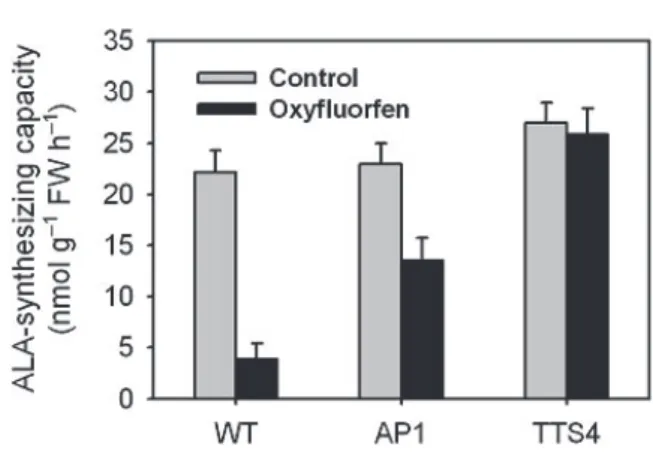
1995). The ALA-synthesizing capacity was signifi- cantly decreased in the oxyfluorfen-treated wild- type and AP1 transgenic lines, as compared to controls, with a greater decrease in the wild-type line (Fig. 3). The accumulated levels of Protogen IX caused by oxyfluorfen treatment were toxic enough to cause the deregulation of the precursor ALA in the wild-type and AP1 transgenic lines. The Protogen IX accumulation due to Protox inhibition may cause the feedback inhibition of ALA synthesis for decreasing the new synthesis of Protogen IX in the oxyfluorfen-treated plants. However, the transgenic line TTS4 did not alter the ALA-synthesizing capacity
Fig. 3. Effect of oxyfluorfen on the ALA-synthesizing capacity in WT and transgenic plants. Three-week- old rice plants were sprayed with a 20 µM concentration of oxyfluorfen, placed in darkness for 12 h to allow absorbance, and then illuminated for 30 h. WT, wild type; AP1, transgenic line overexpressing Arabidopsis Protox; TTS4, transgenic line overexpressing M. xanthus Protox. The data represent the mean ± S.E. of three replicates.
in response to oxyfluorfen treatment (Fig. 3), demonstrating that the ALA synthesis in TTS line was not disturbed by oxyfluorfen treatment.
In conclusion, this study provides evidence of a relation of Protox expression site with herbicidal resistance in rice plants. Both wild-type and APl lines greatly increased the levels of conductivity and MDA in response to oxyfluorfen (Figs. 1 and 2), which may be due to a drastic accumulation of Proto IX in the oxyfluorfen-treated tissues. However, the transgenic line TTS4 did not show any sign of oxidative stress with oxyfluorfen treatment. The herbicidal resistance in TTS4 may be because of the dual expression of M. xanthus Protox in chloroplasts and mitochondria, which greatly reduces the leakage of photosensitizing Protogen IX from chloroplasts and mitochondria to the cytosolic membranes. This result also suggests that the increased expression level of Protox in mitochondria greatly contributes to the herbicidal resistance in rice plants. The elucidation of a critical role of Protox activity in herbicidal resistance from this study is particularly
important because it may provide the basis for the construction of new, porphyrin-based, photobleaching herbicides to be exploited in modern weed control.
ACKNOWLEDGEMENTS
This research was supported by Kyungpook National University Research Fund, 2007.
요 약
과산화계 제초제 oxyfluorfen이 처리된 비형질전 환 벼와 형질전환 벼에서 Protox 발현 위치가 제초제 저항성에 미치는 영향을 비교하였다. Arabidopsis protoporphyrinogen oxidase(Protox; AP 계통)를 색소 체에만 발현하는 형질전환 벼와 Myxococcus xanthus Protox 유전자를 색소체와 미토콘드리아에 모두 발현 하는 형질전환 벼(TTS 계통)가 형질전환 시스템으 로 사용되었다. Oxyfluorfen이 처리된 TTS4 계통은 AP 계통이나 비형질전환 벼에 비해 낮은 수준의 세 포질 누출 및 malonyldialdehyde를 보여주었고, 높 은 5-aminolevulinic acid 합성 능력을 유지하였다.
Oxyfluorfen 작용 동안, TTS4 계통은 AP1 계통보다 높은 제초제 저항성을 보여주었는데, 이는 색소체만 에서의 Arabidopsis Protox의 발현에 비해 색소체와 미토콘드리아에서의 M. xanthus Protox의 쌍발현이 광역학적인 protoporphyrin IX의 축적을 더 효율적으 로 억제하였기 때문일 것이다. 이 결과들은 미토콘드 리아 내 Protox의 발현이 Protox 저해형 제초제에 대 한 식물의 저항성에 크게 기여함을 의미한다.
REFERENCES
Beale, S. I. 1978. δ-Aminolevulinic acid in plants:
its biosynthesis, regulation, and role in plastid development. Annu. Rev. Plant Physiol. 29:
95-120.
Buege, T. A., and S. D. Aust. 1978. Microsomal lipid peroxidation. Method. Enzymol. 52:302- 310.
Dolphin, D. 1994. Photomedicine and photody- namic therapy. Can. J. Chem. 72:1005-1013.
Grimm, B. 1998. Novel insights in the control of tetrapyrrole metabolism of higher plants. Curr.
Opin. Plant Biol. 1:245-250.
Ha, S. B., S. B. Lee, Y. Lee, K. Yang, N. Lee, S.
M. Jang, J. S Chung, S. Jung, Y. S. Kim, S. G.
Wi and K. Back. 2004. The plastidic Arabidopsis protoporphyrinogen IX oxidase gene, with or without the transit sequence, confers resistance to the diphenyl ether herbicide in rice. Plant Cell Environ. 27:79-88.
Jacobs, J. M., and N. J. Jacobs. 1987. Oxidation of protoporphyrinogen to protoporphyrin, a step in chlorophyll and haem biosynthesis. Purification and partial characterization of the enzyme from barley organelles. Biochem. J. 244:219-224.
Jacobs, J. M., and N. J. Jacobs. 1993. Porphyrinogen accumulation and export by isolated barley (Hordeum vulgare L.) plastids:effect of diphenyl ether herbicides. Plant Physiol. 101:1181-1187.
Jacobs, J. M., N. J. Jacobs., T. D. Sherman and S.
O. Duke. 1991. Effects of diphenyl ether herbicides on oxidation of protoporphyrinogen to protoporphyrin in organellar and plasma membrane enriched fractions of barley. Plant Physiol. 97:197-203.
Jung, S., and K. Back. 2005. Herbicidal and anti- oxidant responses of transgenic rice overexpressing Myxococcus xanthus protoporphyrinogen oxidase.
Plant Physiol. Biochem. 43:423-430.
Jung, S., Y. Lee and K. Back. 2006. A tobacco plastidal transit sequence cannot override the dual targeting capacity of Myxococcus xanthus protoporphyrinogen oxidase in transgenic rice.
Pestic. Biochem. Physiol. 86:49-56.
Jung, S., H. J. Lee, Y. Lee, K. Kang, Y. S. Kim, B. Grimm and K. Back. 2008. Toxic tetrapyrrole accumulation in protoporphyrinogen IX oxidase- overexpressing transgenic rice plants. Plant Mol.
Biol. 67:535-546.
Kenyon, W. H., S. O. Duke and K. C. Vaughn. 1985.
Sequence of effects of acifluorfen on physio- logical and ultrastructural parameters in cucmber cotyledon discs. Pestic. Biochem. Physiol. 24:
240-250.
Knörzer. O. C., and P. Böger. 1999. Antagonizing peroxidizing herbicides. pp. 303-328. In P.
Böger and K. Wakabayashi, eds. Peroxidising Herbicides. Springer-Verlag, Berlin Heidelberg New York.
Kouji, H., T. Masuda and S. Matsunaka. 1988.
Action mechanism of diphenyl ether herbicides:
light-dependent O2 consumption in diphenylether- treated tobacco cell homogenate. J. Pestic. Sci.
13:495-499.
Lee, H. J., and S. O. Duke. 1993. Protoporphyrinogen IX-oxidizing activities involved in the mode of action of peroxidizing herbicides. Agric. Food Chem. 42:2610-2618.
Lee, H. J., M. V. Duke, J. H. Birk, M. Yamamoto and S. O. Duke. 1995. Biochemical and phys- iological effects of benzheterocycles and related compounds. J. Agric. Food Chem. 43:2722- 2727.
Lee, H. J., Y. I. Kuk and S. Jung. 2003. Alleviation of membrane-associated herbicidal activity induced by acifluorfen-methyl with reductants.
Kor. J. Weed Sci. 23:351-358.
Lermontova, I., and B. Grimm. 2000. Overexpression of plastidic protoporphyrinogen IX oxidase leads to resistance to the diphenyl-ether herbicide acifluorfen. Plant Physiol. 122:75-83.
Lydon, J., and S. O. Duke. 1988. Porphyrin synthesis
is required for photobleaching activity of the p-nitrosubstituted diphenyl ether herbicides.
Pestic. Biochem. Physiol. 31:74-83.
Matringe, M., J. M. Camadro, M. A. Block, J.
Joyard, R. Scalla, P. Labbe and R. Douce.
1992. Localization within the chloroplasts of protoporphyrinogen oxidase the target enzyme for diphenylether-like herbicides. J. Biol. Chem.
267:4646-4651.
Mock, H. P., W. Heller, A. Molina, B. Neubohn, H. Sandermann and B. Grimm. 1999. Expres- sion of uroporphyrinogen decarboxylase or coproporphyrinogen oxidase antisense RNA in tobacco induces pathogen defence responses conferring increased resistance to tobacco mosaic virus. J. Biol. Chem. 274:4231-4238.
Molina, A., A. Volrath, D. Guyer, K. Maleck, J. Ryals and E. Ward. 1999. Inhibition of protoporphyrinogen oxidase expression in Arabidopsis causes a lesion-mimic phenotype that induces systemic acquired resistance. Plant J. 17:667-678.
Papenbrock, J., H. P. Mock, E. Kruse and B. Grimm.
1999. Expression studies in tetrapyrrole biosyn- thesis:inverse maxima of magnesium chelatase and ferrochelatase activity during cyclic pho- toperiods. Planta 208:264-273.
Reinbothe, S., C. Reinbothe, K. Apel and N. Lebedev.
1996. Evolution of chlorophyll biosynthesis-the challenge to survive photooxidation. Cell 86:
703-705.
Smith, A. G., O. Marsh and G. H. Elder. 1993.
Investigation of the subcellular location of the tetrapyrrole-biosynthesis enzyme coproporphyrinogen oxidase in higher plants. Biochem. J. 292:503- 508.
von Wettstein, D., S. Gough and C. G. Kannangara.
1995. Chlorophyll biosynthesis. Plant Cell 7:
1039-1057.
Warabi, E., K. Usui, Y. Tanaka and H. Matsumoto.
2001. Resistance of a soybean cell line to oxyfluorfen by overproduction of mitochondrial protoporphyrinogen oxidase. Pestic. Manag.
Sci. 57:743-748.
Yao, N., and J. T. Greenberg. 2006. Arabidopsis ACCELERATED CELL DEATH2 modulates programmed cell death. Plant Cell 18:397-411.