S. I. Lee ・ H. U. Kim ・ D. Shin ・ J. A. Kim ・ J. K. Hong ・ Y. M. Kim ・ Y.-H. Lee ・ B. S. Koo ・ S. J. Kwon ・ S. C. Suh ( ) Department of Agricultural Biotechnology, National Academy of Agricultural Science (NAAS), RDA, Suwon 441-707, Korea e-mail: [email protected]
Overproduction of 5-enolpyruvylshikimate-3-phosphate synthase (EPSPS) confers resistance to the herbicide glyphosate in transgenic rice
Soo In Lee ・ Hyun Uk Kim ・ Dongjin Shin ・ Jin A Kim ・ Joon Ki Hong ・ Young Mi Kim ・ Yeon-Hee Lee ・ Bon Sung Koo ・ Sun Jong Kwon ・ Seok Chul Suh
Received: 2 November 2011 / Accepted: 15 November 2011
ⓒKorean Society for Plant Biotechnology
Abstract Plants expressing Agrobacterium sp. strain CP4 5-enolpyruvylshikimate-3-phosphate synthase (CP4 EPSPS) are known to be resistant to glyphosate, a potent herbicide that inhibits the activity of the endogenous plant EPSPS. In order to develop herbicide-resistant rice, we prepared transgenic rice plants with CP4 EPSPS gene under the control of CaMV 35S promoter for over-expression. A recombinant plasmid was transformed into rice via Agrobacterium-mediated transformation. A large number of transgenic rice plants were obtained with glyphosate and most of the transformants showed fertile. The integration and expression of CP4 EPSPS gene from regenerated plants was analyzed by Southern and northern blot analysis. The transgenic rice plants had CP4 EPSPS enzyme activity levels more than 15-fold higher than the wild-type plants. EPSPS enzyme activity of transgenic rice plants was also identified by strip-test method. Field trial of transgenic rice plants further confirmed that they can be selectively survived at 100% by spay of glyphosate (Roundup
®) at a regular dose used for conventional rice weed control.
Keywords CaMV 35S promoter, CP4 EPSPS, Agrobac- terium-mediated transformation, glyphosate, transgenic rice
Introduction
Agriculture has been developing to fill up economic output and the overall human food supply. Weeds compete with crops for water, nutrients and lights and cause the
reduction of total crop yield up to 9.5% (Giri and Laxmi.
2000). Weed seeds can also reduce the quality of the crop significantly. The use of herbicides such as glyphosate to control weeds allows the grower more efficient crop management together with improved yield (Hinchee et al.
1993). Glyphosate (N-phosphonomethylglycin) is known as a broad-spectrum systemic herbicide against both broadleaf and cereal weeds. Glyphosate inhibits the 5-enolpyruv- lshikimate-3-phosphate synthase (EPSPS) involved in the synthesis of the aromatic amino acids as like tyrosine, tryptophan and phenylalanine through the shikimate pathway in algae, higher plants, bacteria, and fungi (Haslam 1983).
But the shikimate pathway is absent in mammals, therefore, EPSPS is an attractive target for the development of new antimicrobial agents effective against bacterial, parasitical, and fungal pathogens.
It was found some of microorganisms have different version of EPSPS showing resistant to glyphosate inhibition.
Especially, Agrobacterium sp. strain CP4 5-enolpyruvylshikimate- 3-phosphate synthase (CP4 EPSPS) was cloned as glyphosate- resistant gene (Steinruecken and Amrhein. 1980; Barry et al. 1992; Padgette et al. 1995; CaJacob et al. 2004). And this gene was used to develop glyphosate resistant transgenic plants including soybean, corn, and cotton. EPSPS-based glyphosate resistance in plants has been genetically engi- neered by two approaches. The first mechanism is based on the overproduction of the wild-type EPSPS. Glyphosate tolerance in this case results from inhibited EPSPS activity in the presence of glyphosate due to overproduction of EPSPS relative to glyphosate concentration in the affected plant tissue. By over-expressing a glyphosate- resistant CP4 EPSPS, many species of glyphosate-resistant transgenic plants have been developed (Barry et al. 1992; CaJacob et al. 2004), including petunia (Shah et al. 1986), soybean (Padgette et al. 1995), tobacco (Daniell et al. 1996; Ye et al. 2001), canola (Krieb and Zeng 2002), corn (Heck et al.
DOI:http://dx.doi.org/10.5010/JPB.2011.38.4.272
Research Article
Fig. 1 Structure of the plasmid pSB-EPSPS for expression of EPSPS in transgenic rice plants. The EPSPS gene is controlled by the CaMV 35S promoter and the nos 3’ region. BR, right border; BL, left border; TP, sequence encoding a chloroplast transit peptide
2005), and cotton (Nida et al. 1996).
The second mechanism relies on the expression of mutant genes encoding glyphosate-tolerant EPSPS in plants. Ex- pression of a mutant aroA gene from Salmonella typhimurium in transgenic tobacco plants has been demonstrated to confer tolerance to the herbicide glyphosate (Comai et al. 1985).
Howe et al. (2002) obtained several transgenic plants after particle bombardment of embryogenic corn callus and selection with the herbicide glyphosate. They have been mutated a maize EPSPS gene to produce a modified enzyme resistant to inhibition by glyphosate. And it was also applied to goosegrass (Baerson et al. 2002), tobacco (Wang et al.
2003), rapeseed (Kahrizi et al. 2007), Rice (Lin et al.
2008) for developing glyphosate-resistant. In this paper, we describe the overproduction of CP4 EPSPS in transgenic rice plants, which confers tolerance to the herbicide glyphosate.
Material and methods
Construction of the CaMV35S-EPSPS gene
The pSB-EPSPS was constructed by the following procedure (Fig. 1). The 0.8-kb CaMV 35S promoter was placed at Sac I and Bam HI sites at the CP4 EPSPS cDNA. And the transit peptide (TP) was used for transport of EPSPS enzyme by chloroplast. The pSB-EPSPS was introduced into A. tumefaciens LBA4404 (pSB1) (Komari et al. 1996) by triparental matings (Ditta et al. 1980) and bacteria resistant to tetracycline (10 mg L
-1) and spectinomycin (50 mg L
-1) were selected. Each co-integrates formed between pSB1 and pSB-EPSPS was confirmed by restriction analysis of the mini-preparations of plasmids from A.
tumefaciens (An et al. 1988).
Rice transformation
The embryogenic calli from rice seeds of the japonica variety Nagdongbyeo were co-cultivated with Agrobacterium tumefaciens (Hiei et al. 1994; Lee et al. 2001) carrying the pSB-EPSPS plasmid. Co-cultivation was for 2-3 days in
the dark (at 25℃) on 2N6 medium (Chu et al. 1975) supplemented with 100 μM acetosyringone. The cultivated calli were washed with water containing 250 mg L
-1cefotaxime and then transferred onto NB medium containing 6 mg L
-1glyphosate and 250 mg L
-1cefotaxime for 8 weeks. Actively proliferating calli were further transferred onto regeneration medium (2 mg L
-1kinetin, 0.5 mg L
-1NAA, 6 mg L
-1glyphosate and 250 mg L
-1cefotaxime) for 4-8 weeks and subquently onto 1/2MS medium (Murashige and Skoog 1962) for 3 weeks. A light/dark cycle of 16/8 h was provided during regeneration and rooting. Regenerated plants were grown to maturity in the glasshouse.
Southern and Northern blot analysis
Genomic DNA was extracted from young leaf and stem tissues of rice plants based on Dellaporta et al. (1989) with modification. A total of 5 μg DNA from each sample was digested with 50 units of Bam HI/Sac I and fract- ionated on a 0.8% (w/v) agarose gel by electrophoresis.
DNA was transferred to a nylon membrane (Amersham).
Southern hybridization was carried out according to the method of Sambrook et al. (1989) with
32P-labeled CP4 EPSPS cDNA as probe.
For Northern blot analysis, total RNA was isolated from T1 leaves by using the Trizol extraction kit (Gibco-BRL).
Fifteen micrograms of total RNA was electrophoresed in a 1% (w/v) formaldehyde-containing agarose gel and blotted onto a nylon membrane (Amersham).
32P-labeled CP4 EPSPS cDNA was used as probe.
EPSPS enzyme assay
EPSPS activity was determined by measuring inorganic phosphate release using the malachite green dye assay described by Nafziger et al. (1984) with minor modification.
Leaves of wild-type and transgenic rice plants were
ground using a motor and pestle. One gram of cell powder
was suspended in 2 ml of 50 mM HEPES-NaOH (pH 7.0),
10% glycerol (v/v), 0.1 mM DTT, 0.1 mM (NH
4)
6Mo
7O
24.
4H
2O with 1% polyvinylpolypyrolidone (w/v). The reaction
mixture contained, in final volume of 0.1 ml, 100 mM
Table 1 Production of transgenic rice plants harboring pSB-EPSPS plasmid by Agrobacterium-mediated transformation
Plasmid Exp No. of callus No. of plants
regenerated
No. of fertile plants Plated Selected
pSB-EPSPS 1 320 252 20 19
pSB-EPSPS 2 820 423 50 47
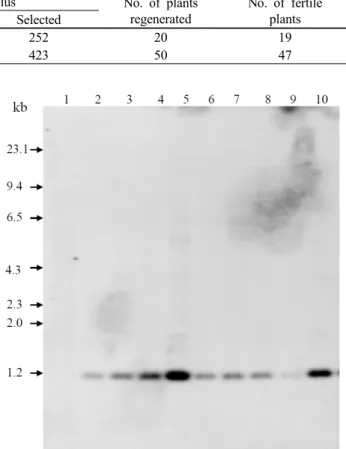
Fig. 2 Southern blot analysis of genomic DNA from transgenic rice plants. Five micrograms of DNA from each transgenic plant of pSB-EPSPS was digested with Bam HI/Sac I, resolved on a 0.8% agarose gel, blotted onto a nylon membrane, and hybridized with 32P-labeled EPSPS gene. Lane 1, DNA from wild-type plant;
2, EPSPS-1; 3, EPSPS-2; 4, EPSPS-3; 5, EPSPS-4; 6, EPSPS-5;
7, EPSPS-6; 8, EPSPS-7; 9, EPSPS-8; 10, EPSPS-9, transgenic plants transformed with pSB-EPSPS
Hepes-NaOH (pH 7.4), 1 mM shikimate-3-phosphate (S3P), 1 mM phosphor-enol-pyruvte (PEP) and a limiting amount of enzyme; 0.5 mM ammonium heptamolybate was added to inhibit phosphatases. After an appropriate incubation period (up to 20 min), the reaction was stopped by the addition of 1 ml of colorimetric solution (9.2 mM malachite green and 8.5 mM (NH
4)
6MoO
24·4H
2O in 1 M HCl, with 2 g l
-1of the zwitterionic detergent CHAPS added in order to stabilize color development) followed, after exactly 1 min, by 0.1 ml of 34% (w/v) sodium citrate solution.
After 15 min at room temperature, samples were read at 660 nm against blanks in which S3P had been omitted.
Herbicide application
Resistance to herbicide was examined on the T1 plants.
The T1 seeds from selfed T0 plants were planted in pots and cultured in the field. After 3 weeks, rice leaves from untransformed and transformed plants were sprayed with 1.6% (v/v) Roundup (Monsanto, USA) in field. Changes in the morphology and pigmentation of leaves were monitored for 4 weeks.
Results and Discussion
Production of fertile transgenic rice plants
Glyphosate, the active ingredient in Roundup, has favorable environmental features, such as rapid soil binding and biodegradation, and extremely low mammalian toxicity (Franz 1985). To generate transgenic rice plants showing glyphosate tolerance for weed control in the field, a CP4 EPSPS gene under the regulation of the CaMV 35S promoter to achieve over-expression were introduced to rice embryogenic microcalli by Agrobacterium-mediated transformation. The CP4 EPSPS gene contains a DNA segment encoding a maize chloroplast transition peptide, which would direct the CP4 EPSPS to the organelle where the shikimate pathway is located (Fig. 1). Embryogenic calli were co-cultivated in callus induction medium containing 6 mg L
-lglyphosate for 3 weeks. Frequency of antibiotic resistant microcalli formation from co-cultivated calli is shown in Table 1. These glyphosate-resistant calli
were transferred to regeneration medium and 70 green plants were regenerated from glyphosate-resistant calli and transplanted to soil in the greenhouse (Table 1). Adapted T0 plantlets in the greenhouse were transplanted and cultured in the field and we investigated the morphology and fertility of transformants. Transformants harboring CP4 EPSPS gene showed no fertility defects.
During adaptation period in a greenhouse, genomic
DNA from leaf of regenerated plantlets was extracted and
southern blot analysis was performed with full length of
CP4 EPSPS gene as probe to examine whether T-DNA
was inserted into the rice genome. Before southern blot
analysis, genomic DNA was digested with Bam HI/Sac I
released a 1.2 kb fragment corresponding to the complete
EPSPS expression cassette. As shown in figure 2, all of
transformants contained CP4 EPSPS gene and this result
demonstrates that the stable integration of the CP4 EPSPS
in the genome of rice plants (Fig. 2). Next to examine the
Table 2 Segregation of the EPSPS gene expression in transgenic rice
Plant line No. of Seeds
planted
No. of RoundupR positive seedl. (%)
No. of RoundupR negative seedl.
EPSPS-1 EPSPS-2 EPSPS-3 EPSPS-4 EPSPS-5 EPSPS-6 EPSPS-7 EPSPS-8 EPSPS-9 EPSPS-10 EPSPS-11 EPSPS-12 EPSPS-13 Wild-type
52 56 53 56 54 55 56 52 57 57 53 59 53 55
46 (88.5) 47 (83.9) 46 (86.8) 55 (98.2) 47 (87.0) 51 (92.7) 55 (98.2) 39 (75.0) 52 (91.2) 34 (59.6) 38 (71,7) 56 (94.9) 51 (96.2)
0
6 9 7 1 7 4 1 13
5 13 15 3 2 -
Fig. 3 Constitutive expression of EPSPS gene was confirmed by Northern blot hybridization analysis. Fifteen micrograms of total RNA was fractionated in a 1% agarose gel and blotted onto a nylon membrane hybridized with [α-32P]dCTP-labeled EPSPS as a probe. Equal loading was evident in the stained rRNA in a parallel- running gel. Lane 1, RNA from wild-type plant; 2, EPSPS-1; 3, EPSPS-2; 4, EPSPS-3; 5, EPSPS-4; 6, EPSPS-5; 7, EPSPS-6; 8, EPSPS-7, transgenic plants transformed with pSB-EPSPS
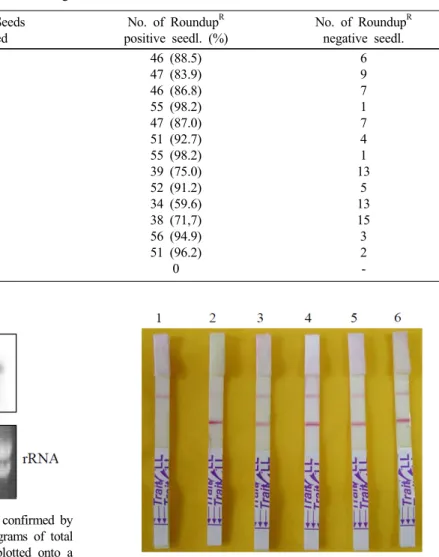
Fig. 4 Qualitative strip tests for the detection of EPSPS. Lane 1, wild-type plant; 2, EPSPS-1; 3, EPSPS-2; 4, EPSPS-3; 5, EPSPS-4;
6, EPSPS-5, transgenic rice plants. Two lines indicate a positive Roundup, wheres one line indicates a negative Roundup
expression of CP4 EPSPS gene in transformants, total RNA from leaves of primary transformants plants was isolated and Northern blot analysis was performed with a 654 bp fragment of the CP4 EPSPS gene as probe. As shown figure 3, the endogenous rice EPSPS transcripts were not detect, and no signal band was observed in wild-type plant, whereas, 1.2-kb CP4 EPSPS transcript was found in all the transgenic plants. These results indicated that CP4 EPSPS gene was integrated into rice chromosome.
Inheritance of glyphosate resistance
To examine the inheritance of the introduced foreign genes, we tested T1 seed on glyphosate resistance (6 μg/ml in MSG medium) using about 50 seeds for each independent
plantlet. The number of glyphosate resistance was examined after 2 weeks and summarized in shown in Table 2. As shown in Table 2, 75% of T1 seeds of independent plantlets showed resistance and 25% of seeds showed sensitive against glyphosate apply. These results implied that the CP4 EPSPS gene is inserted into genome as a single copy. However, some of transformant showed 5 to 1 ratio and this transgenic plant might contain the CP4 EPSPS gene as multi copy.
Glyphosate resistance of seeds should be related to CP4 EPSPS protein expression in transformants. To examine this possibility, we extracted total protein from leaves of transformants and observed the existence of CP4 EPSPS protein with AgroStrip GMO RR test kit (KisanBio Co.).
Membrane strip of RR test kit was completely wet in
reaction mixture of wild-type and transgenic rice plants. As
shown in Figure 4, a second line below the control line
Table 3 Enzyme activity of EPSPS in transgenic lines
Plant line Pi released
(nmol/mg) EPSPS-1
EPSPS-2 EPSPS-3 EPSPS-4 EPSPS-5
164.8 245.8 150.0 142.4 144.6
*In wild-type plant, 8.12 nmol of Pi released per minute per milligram of protein
Fig. 5 Glyphosate tolerance of transgsnic rice plant in the field.
The wild-type plants (WT) and transgenic lines (EPSPS-1, EPSPS-2, and EPSPS-3) were sprayed with a 1.6% (v/v) Roundup solution (equivalent to 20 l/ha). The photograph was taken 4-week-old seedlings after herbicide application
was developed in the transgenic rice, but it was absent in wild-type plant (Fig. 4). This result means CP4 EPSPS protein is expressed in EPSPS overexpression transgenic rice plants.
Next, we measured the CP4 EPSPS activity with crude extracts of the transgenic plants using a phosphate (Pi) release assay as described in Materials and Methods. The CP4 EPSPS enzyme activity of wild-type showed 8.12 nmol of Pi released per minute per milligram of protein, but the activity of transgenic line was at least 15-fold higher than that in the wild-type plant (EPSPS line 1 to 5;
164.8, 245.8, 150.0, 142.4, and 144.6, respectively, Table 3). It should be noted that CP4 EPSPS protein is expressed and its expression confers glyphosate resistance in CP4 EPSPS overexpression transgenic rice.
Glyphosate tolerance in transgenic rice plants in the field
Spaying with the commercial herbicide in the field clearly demonstrated that plant transformed with the CP4 EPSPS gene under control of the CaMV 35S promoter was fully protected against the herbicide Roundup. First damage symp-
toms in the controls due to the herbicide treatment with Roundup were observed within 4 weeks the plants were completely killed. The transgenic lines (EPSPS-1, -2, -3) did not show observable damages and survived against the spraying (Fig. 5). Because the CaMV 35S promoter directs constitutive high-level expression of foreign genes in plants, we hypothesize that glyphosate tolerance in the transgenic plants results from the overproduction of CP4 EPSPS. Here we demonstrated the potential of the use of the EPSPS gene as a convenient selectable and screenable marker in rice transformation and show transgenic rice plants that completely resistant to the herbicide glyphosate.
The present study confirms that CP4 EPSPS gene encoding a 5-enolpyruvylshikimate-3-phosphate synthase coupled to an over- expression promoter was expressed in rice seeds.
Furthermore, the increase of mRNA apparently causes the much higher levels of CP4 EPSPS enzyme activity found in the glyphosate-resistant transgenic rice plants. We suggest that glyphosate tolerance is an extremely useful research tool for rice biotechnology. Genetic engineering can contribute to alternative weed control by the devel- opment of herbicide resistance and the improved biosynthesis of microbial toxins. Herbicide resistance is expected to allow greater use of nonleachable and/or rapidly degraded herbicides that are currently selective for a given crop.
The science of herbicide tolerance research has made a tremendous impact on several areas of plant enzymology, gene expression, and physiology.
Acknowledgement
This work was supported by grant from the National Academy of Agricultural Science (PJ907049), Rural Devel- opment Administration (RDA), Republic of Korea.
References
An G, Evert PR, Mitra A, Ha SB (1988) Binary vectors. In: Gelvin SB, Schilperoort RA (eds) Plant Molecular Biology Mannual A3, pp. 1-19. Kluwer Academic Press, Dordrecht
Baerson SR, Rodriguez DJ, Tran M, Feng Y, Biest NA, Dill GM (2002) Glyphosate-resistant goosegrass. Identification of a mutation in the target enzyme 5-enolpyruvylshikimate-3- phosphate synthase. Plant Physiol 129: 1265-1275
Barry G, Kishore G, Padgette S, Taylor M, Kolacz K, Weldon M, Re D, Fincher K, Hallas L (1992) Inhibitors of amino acid biosynthesis: strategies for imparting glyphosate tolerance to crop plants. Curr Top Plant Physiol 7: 139-145
Cao J, Duan X, McElroy D, Wu R (1992) Regeneration of
herbicide resistant transgenic rice plants following micro- projectile-mediated transformation of suspension culture cells. Plant Cell Rep 11:586-591
Chu CC, Wang CS, Sun CS, Hsu C, Yin KC, Chu CY, Bi FY (1975) Establishment of an efficient medium for anther culture of rice through comparative experiments on the nitrogen sources. Sci Sin 18:659-668
Comai LD, Facciotti D, Hiatt WR, Thompson G, Rose RE, Stalker DM (1985) Expression in plants of a mutant aroA gene from Salmonella tymphimurium confers tolerance to glyphosate.
Nature 317:741-744
Daniell H, Datta R, Varma S, Gray S, Lee S-B (1998) Containment of herbicide resistance through genetic engineering of the chloroplast genome. Nature Biotech 16:345-348
Dellaporta SL, Wood J, Hicks JB (1983) A plant DNA minipreparation version II. Plant Mol Biol Rep 1:19-21 Ditta G, Stanfield S, Corbin D, Helinski DR (1980) Broad host
range DNA cloning system for Gram-negative bacteria:
Construction of a gene bank of Rhizobium meliloti. Proc Natl Acad Sci USA 77:7347-7351
Franz JE (1985) In The Herbicide Glyphosate (Ed. by Grossman E, Atkinson D), pp3-17. London: Butterworths
Giri CC, Laxmi GV (2000) Production of transgenic rice with agronomically useful genes: an assessment. Biotechnol adv 18:653-683
Haslam E (1993) Acid: Metabolism and Metabolites. Wiley, Chichester, UK
Heckern GR, Amstrong CL, Astwood JD, Behr CF, Bookout JT, Brown SM, Cavato TA, DeBoer DL, Deng MY, George C, Hillyard JR, Hironaka CM, Howe AR, Jekse EH, Ledesma BE, Lee TC, Lirette RP, Mangano ML, Mutz JN, Qi Y, Rodriguez RE, Sihdu SR, Silvanovich A, Stoecker MA, Yingling RA, You J (2005) Development and characterization of a CP4 EPSPS-based, glyphosate-tolerant corn event. Crop Sci 45:329-339
Hiei Y, Ohta S, Komari T, Kumashiro T (1994) Efficient transformation of rice (Oryza sativa L.) mediated by Agrobacterium and sequence analysis of the boundaries of the T-DNA. Plant J 6:271-282
Hinchee MA, Padgette SR, Kishore GM, Delannay X, Fraley RT (1993) Herbicide-Tolerant Crops. In: Kung S-K, Wu R (eds) Transgenic Plants vol. 1, pp 243-263. Academic Press, London
Howe AR, Gasser CS, Brown SM, Padgette SR, Hart J, Parker GB, Fromm ME, Amstrong CL (2002) Glyphosate as a selectable agent for the production of fertile transgenic maize (Zea mays L.) plants. Mol Breed 10:153-164
Kahrizi D, Salmanian AH, Afshari A, Moieni A, Mousavi A (2007) Simultaneous substitution of Gly96 to Ala and Ala183 to Thr in 5-enolpyruvylshikimate-3-phosphate synthase gene of E.
coli (k12) and transformation of rapeseed (Brassica napus L.) on order to make tolerance to glyphosate. Plant Cell Rep 26:95-104
Krieb R, Zeng Q (2002) Herbicide-resistant transgenic canola PV-BNGT04 (RT73) and compositions and methods for detection thereof. Monsanto Technology L. L. C. WO 0236831A. St. Louis, MO: Monsato Technology
Komari T, Hiei Y, Saito Y, Kumashiro T (1996) Vectors carrying two separate T-DNAs for co-transformation of higher plants mediated by Agrobacterium tumefaciens and segregation of transformants free from selection markers. Plant J 10:165-174 Nafziger ED, Widholm JM, Steinrucken HC, Killmer JL (1984)
Selection and characterization of a carrot cell line tolerant to glyphosate. Plant Physiol 76:571-574
Lee SI, Kim HU, Lee Y-H, Suh S-C, Lim YP, Lee H-Y, Kim H-I (2001) Constitutive- and seed-specific expression of a maize lysine-feedback-insensitive dihydrodipicolinate synthase gene leads to increased free lysine levels in rice seeds.
Molecular Breed 8:75-84
Lin C, Feng J, Xu X, Zhao T, Ye G, Shen Z (2008) A built-in strategy for containment of transgenic plants: creation of selectively terminable transgenic rice. PLoS one 3:1-6 Murashige T, Skoog F (1962) A revised medium for rapid growth
and bioassays with tobacco tissue culture. Physiol Plant 15:473-497
Nida DL, Kolacz KH, Beuhler RE, Deaton WR, Schuler WR, Amstrong TA, Taylor ML, Evert CC, Logan GL, Padgette SR, Fuchs RL (1996) Glyphosate-tolerant cotton: genetic char- acterization and protein expression. J Agri Food Chem 44:1960-1966
Padgette SR, Kolacz KH, Delannay X, Re DB, LaVallee BJ, Tinius CN, Rhodes WK, Otero YI, Barry GF, Eichholtz DA, Peschke VM, Nida DL, Taylor NB, Kishore GM (1995) Development, identification and characterization of a glyphosate-tolerant soybean line. Crop Sci 35:1451-1461
Sambrook J, Fritsch EF, Maniatis T (1989) Molecular Cloning: A Laboratory Manual, 2nd ed. Cold Spring Harbor Laboratory Press, Cold Spring Harbor, NY
Shah D, Horsch R, Klee HJ, Kishore GM, Winter JA, Tumer N, Hironaka CM, Sanders PR, Gasser CS, Aykent S, Siegel NR, Rogers SG, Fraley RT (1986) Engineering herbicide tolerance in transgenic plants. Science 233:478-481
Steinruecken HC, Amrhein N (1980) The herbicide glyphosate is a potent inhibitor of 5-enolpyruvyl shikimic acid 3-phosphate synthase. Biochem Biophys Res Commun 94:1207-1212 Wang HY, Li YF, Xie LX, Xu P (2003) Expression of a bacterial
aroA mutant, aroA-M1, encoding 5-enolpyruvylshikimate- 3-phosphate synthase for the production of glyphosate- resistant tobacco plants. J Plant Res 116:455-460