Evaluation of Pollen Viability of Nakdongbyeo, Two Transgenic Rice Lines, Its Hybrids with Weedy Rice, and Subsequent Selfed Progenies: F
2and F
3Sita Ram Ghimire, Eun-Young Sohn, Dong-Hyun Shin, In-Jung Lee and Kil-Ung Kim*
Division of Plant Biosciences, College of Agriculture and Life Sciences, Kyungpook National University, Daegu, Korea
Received January 8, 2009 /Accepted June 30, 2009This experiment was conducted to evaluate pollen viability of Nakdongbyeo, transgenic rice lines, an F
1hybrid from a cross between Milyang weedy rice and ABC-promoter transgenic rice line containing basta-resistant (bar) gene and subsequent selfed progenies, F
2and F
3. The reaction of pollen with 3-{4,5 dimethylthiazolyl-2}-2,5-diphenyl monotetrazolium bromide (MTT) as a staining chemical immediately after pollen shedding showed maximum pollen viability of 86% in Nakdongbeyo, 75% in ABC-pro- moter transgenic rice line, 62% in ubiquitin-promoter transgenic line, 68% in F
1, 79% in F
2and 78%
in F
3. Viability gradually declined during subsequent observations at 20-minute intervals. However, there was a drastic decline in pollen viability after 40 minutes of pollen shedding. The mean difference of pollen viability among rice lines and time was highly significant, indicating significantly different pollen viabilities at different time intervals. Maximum viability of 36.2% was observed in F
3and mini- mum viability of 3.5% was found in F
2at 90 min after pollen shedding. Results of this experiment on pollen viability and longevity elucidate potential risks of pollen-mediated flow of herbicide-resistant gene from transgenic rice lines and possible integration of it into the weedy rice population.
Key words : Pollen viability, MTT, ABC-promoter transgenic rice line, transgene, resistant
*Corresponding author
*Tel:+82-53-950-5710, Fax:+82-53-958-6880
*E-mail : [email protected]
Introduction
Pollen viability is an ability of pollen to perform its func- tions of delivering sperm cells for successful fertilization [17]. After compatible interaction between pollen grains and stigma surface, the pollen germinates and forms pollen tube, which grows through stigma and style to deliver sperm cells to the ovule [2]. Evaluation of pollen viability based on ob- servation of those functions is cumbersome and time-con- suming [7]. Many short-cut methods that reflect the com- petence of the pollen to perform pollination and subsequent fertilization have been devised [17]. Pollen viability has been evaluated by various staining techniques such as tetrazolium salts to investigate dehydrogenase activity [12], aniline blue to detect callose in pollen wall and pollen tube [5], ob- servation of pollen germination and pollen tube in vivo [16], iodine in potassium iodide (lugol solution) to determine starch content and fluorescein diacetate to determine ester- ase activity and the intactness of the plasma membrane by in vitro and in vivo germination tests [6]. In a study con- ducted in cotton, pollen viability assays showed different estimates of viability and germination of pollen samples tak-
en from the same anther. The authors have asserted that those differences could be due to the specific characteristics of the pollen grains assayed by each method [14]. The choice of method to estimate pollen viability depends on the crop species [1]. In monocot crop species, such as sorghum, maize, and rice, different reliable methods for estimating pollen viability have been reported [11,22]. Khatun and Flowers conducted pollen viability tests in rice and com- pared a number of staining methods such as aniline blue in lactophenol, tetrazolium salts and fluorescein diacetate to assess pollen viability together with in vitro pollen germina- tion and reported that staining with MTT best correlated with pollen germination.
With rapid advancement in transgenic technology, more
and more transgenic rice varieties are being released for
testing. However, there have been reports that pollen-medi-
ated gene flow occurs from transgenic rice to its cultivated,
weedy and wild counterparts [24] causing tremendous
bio-safety concerns [18]. A recent study has indicated that
pollen management has been regarded as a method to mini-
mize transgene flow in maize [11]. Consequently, knowledge
on viability and longevity of pollen in newly generated
transgenic lines could be helpful in developing various
methods to restrict pollen flow in crop species that have po-
tential of natural out crossing.
Recent investigation has revealed that a recombinant fu- sion of Escherichia coli for trehalose phosphate synthase (TPS) and trehalose phosphate phosphatase (TPP) genes were in- troduced into Korean rice cultivar Nakdongbyeo; the trans- genic lines performed better than the non-transformed culti- var for drought tolerance [8]. The plasmid construct con- sisted of maize ubiquitin or ABA promoter linked to the TPSP coding region, and the 3’ region of the potato protei- nase inhibitor (pinΙΙ), as well as a gene expression cassette comprised the 35S promoter, the bar-coding region, and 3’-region of the nopaline synthase gene (nos).Two similar plasmid constructs, but with different promoters, were then introduced into Nakdongbyeo by agrobacterium-mediated gene transfer. For agrobacterium-mediated transformation, callus induction, co-cultivation with A. tumefaciens, and se- lection of transformed calli were performed [8]. In a similar experiment [3] in transgenic lines of indica rice consisting of two different promoters, it had been reported that trans- genic lines were more tolerant to drought and salt stresses than the non-transformed counterpart. Nonetheless, very limited references have been available for pollen viability and longevity of transgenic rice, its hybrid with weedy coun- terparts and subsequent selfed progenies in order to derive understanding on reproductive fitness of introgressed prog- enies F
2and F
3. This study was conducted for evaluating pollen viability and longevity of ABC-promoter and maize ubiqutin promoter transgenic rice lines, Nakdongbyeo, F
1hybrid, from a cross between Milyang weedy rice as pollen recipient and ABC-promoter transgenic line as pollen donor, and its subsequent selfed generations F
2and F
3.
Materials and Methods Plant materials
Transgenic rice lines constructed with drought tolerant TPSP gene and herbicide resistant bar gene along with in- serts of either abscisic acid or maize ubiquitin promoters, respectively identified as ABC-promoter transgenic line and Ubi-promoter transgenic lines were acquired from Korea Research Institute for Bioscience and Biotechnology, Daejon, Korea. Milyang weedy rice was obtained from the seed stock of Division of Plant Biosciences, Kyungpook National University because in a previous study performed by Kim et al. 2005, this strain was found susceptible to glufosinate herbicide [10]. Hand pollination was performed between weedy rice as pollen recipient and transgenic lines as pollen
donor. F
1hybrids and subsequent progenies F
2and F
3were grown and maintained in the greenhouse [4] for pollen col- lection and viability evaluation.
Preparation of stain
Sucrose solution of 5% was prepared by dissolving 5 gram of sucrose in water to make final volume of 100 ml. To make 0.9% final concentration of 3-{4,5dimethylthiazolyl-2}-2, 5-diphenyl monotetrazolium bromide (MTT), 0.1125 gram of MTT was dissolved in 5% sucrose solution to make total volume of 12.5 ml of MTT in 5% sucrose solution [9,15].
Collection of pollen and assessment of viability
Panicles, which had more than two-third coming out of flag leaf sheath, were chosen at 9:00-10:00 AM on the third week of August. Selected panicles were detached from the plant and kept with base of panicle immersed in 0.1% etha- nol solution for 15-20 minutes. The ethanol solution made simultaneous coming out of anthers from spikelet and shed- ding of pollen grains from anther sac. Pollen grains were collected in the clean beaker by gently inverting and shaking the spikelet inside the beaker. Collected pollen was mounted on the glass slide at time intervals of 0 min, 20 min, 40 min, 60 min, and 90 min after shedding and a drop of MTT stain was added on the slide. It was then observed under light microscope at 100X magnification and digital images were taken and evaluated for the number of viable and dead on the basis of texture, shape, and stain pattern observed, as described by previous authors [9,23]. Dead pollen was iden- tified and confirmed on the basis of observation on texture, structure and stain patterns of pollen grains after heating it in oven at 80
oC for 2 hr and treating with MTT stains, which aided in the reliable confirmation between dead and live pollen (two categories). Photographs of the slides of each time interval and rice lines were taken. Five individual observations with approximately same number of pollen in a microscopic view were randomly selected for image analysis. The statistical analysis was conducted by PROC GLM in Statistical Analysis Systems (SAS). The Error Mean Square was used to test each of the treatment sources of variation based on expected mean squares for fixed treat- ment effects as described in Steele and Torrie [21].
Results and Discussion
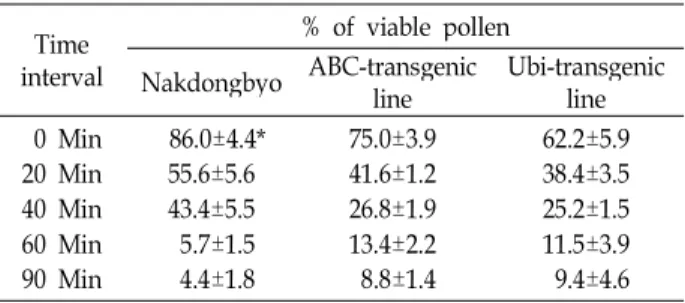
MTT staining immediately after pollen shedding showed
maximum pollen viability of 86% in Nakdongbeyo, 75% in ABC-promoter transgenic rice line, 62% in Ubi-promoter transgenic line, 68% in F
1, 79% in F
2and 78% in F
3(Table 1, 3).
The lower estimate of pollen viability in transgenic lines than that of non-transformed cultivar, Nakdongbyeo, was because of greater number of pollen grains with abnormal
Table 1. Comparison of pollen viability of transgenic rice lines and their non-transformed check
intervalTime
% of viable pollen
Nakdongbyo ABC-transgenicline Ubi-transgenic line 0 Min
20 Min 40 Min 60 Min 90 Min
86.0±4.4*
55.6±5.6 43.4±5.5 5.7±1.5 4.4±1.8
75.0±3.9 41.6±1.2 26.8±1.9 13.4±2.2 8.8±1.4
62.2±5.9 38.4±3.5 25.2±1.5 11.5±3.9 9.4±4.6
*Mean±S.E. (n=5)
Table 2. ANOVA of pollen viability and longevity of Nakdongbyeo, ABC-promoter and Ubi-promoter transgenic lines
Sources df F-value Pr > F Remarks
Replication Rice line Duration Line X Duration
4 2 105
0.40 24.08 183.25 5.79
0.8061
<0.0001
<0.0001
<0.0001
ns1)
****
********
1)Non-significant; ****Significantly different at 0.01% level.
Table 3. Pollen viability of F1, F2 and F3
Time interval % of viable pollen
F1 F2 F3
0 Min 20 Min 40 Min 60 Min 90 Min
68.2±5.4*
57.2±1.4 39.0±1.6 7.3±0.6 4.7±1.1
78.8±1.2 63.2±2.8 40.6±2.3 10.0±3.0 3.5±1.2
78.4±1.9 66.2±1.9 61.4±2.4 45.2±3.7 36.2±2.9
*Mean±S.E. (n=5)
Table 4. ANOVA of pollen viability and longevity of F1, F2&
F3
Sources df F-value Pr > F Remarks
Replication Rice line Duration Line X Duration
42 48
106.250.35 306.75 11.76
0.8403
<0.0001
<0.0001
<0.0001
ns1)
****
********
1)Non-significant; ****Significantly different at 0.01% level.
morphology in transgenic lines. Viability of pollen gradu- ally declined in all rice lines at subsequent observations un- til 20 min (Table 1, 3). However, there was a drastic reduc- tion in pollen viability after 40 min of pollen shedding ex- cept for F
3(Fig. 1~6). The maximum pollen viability of 36.2% was observed in F
3, 9.4% in Ubi-promoter transgenic line, 8.8% in ABC-promoter transgenic line, 4.4% in Nakdongbyeo and 3.5% in F
2at 90 min after pollen shedding. The mean difference among rice lines and time interval was found significant suggesting that different lines demonstrated varying pollen viability at different time in- tervals (Table 2, 4). The interaction of rice line and time in- terval was also significant suggesting that pollen of differ- ent rice line have interaction effects at varying time interval of pollen shedding (Table 2, 4). The pollen viability in Nakdongbyeo was consistently higher until 40 min than both transgenic lines, but the lowest (4.4%) at 90 min among three rice lines (Table 1). This result supports the finding that pollen longevity of cultivar does not depend on initial pollen viability [20]. However, Pollen viability in F
3was consistently higher than both F
1and F
2until 90 min of pollen shedding.
Pacini et al. conducted pollen viability study on six angio-
sperm species including tall fescue. The authors have re-
ported that pollen of this grass species could survive in open
air for more than 48 h, but was completely dead at 72 hr
of anther opening [13]. Furthermore, the authors found that
pollen viability was related to pollination behavior in six an-
giosperm species and pollen grains withstand changes in
volume due to variations in water content, relative humidity
and temperature. Similar other studies have reported that
the loss of viability in different species has been correlated
with water loss and maintenance of the dehydrated state,
both in nature and the laboratory [9]. Wang et al. in his ex-
periment on studying viability and longevity of transgenic
and non-transgenic tall fescue reported that pollen viability
of transgenic and non-transgenic pollen reduced to 5% in
30 min, with complete loss of viability in 90 min. However,
under cloudy atmospheric conditions, 50% of the pollen re-
mained viable until 60 min and 5% pollen showed viability
up to 150 min. The authors further illustrated that relative
humidity did not significantly influence pollen viability. The
results obtained in our study corresponds with above find-
ings for the patterns of loss in pollen viability in transgenic
rice lines and their succeeding out-crossed and selfed proge-
nies with respect to time and environmental conditions such
Fig. 1. Viability of ABC-promoter transgenic pollen at 40
minutes after shedding. Fig. 2. Viability of Ubi-promoter transgenic pollen at 40 minutes after shedding.
Fig. 3. Viability of Nakdongbyeo pollen at 40 minutes after
shedding. Fig. 4. Viability of F1 pollen at 40 minutes after shedding.
Fig. 5. Viability of F2 pollen at 40 minutes after shedding. Fig. 6. Viability of F3 pollen at 40 Minutes after shedding.
as temperature and humidity. During experiment, rice pani- cles chosen and detached from the main plants were imme- diately kept in beaker with 0.1% ethanol, brought to the lab- oratory, which was then maintained at room temperature (20~22
oC) and relative humidity of 50~60% until the via- bility was completed the same day.
A study conducted to investigate pollen competition be- tween cultivated and wild rice species has revealed that for-
eign pollen has several disadvantages for pollination and fertilization during pollen germination and pollen tube-style interaction, consequently resulting into significantly low fer- tilization and seed set [19]. The authors have reported that pollen competition between the compatible species and for- eign pollen acts as a substantial barrier for out crossing.
However, hybridization could occur if foreign pollen arrives
earlier than the compatible species pollen and pollen com-
petition would not prevent out crossing. Given the less chan- ces of outcrossing in self-pollinated weeds like Milyang wee- dy rice, the amount of seed set in the progeny carrying un- desirable herbicide resistant traits could still pose risk [4].
In our experiment, pollen viability of transgenic lines, F
1and F
2decreased drastically when time elapsed especially from 40 min to 60 min while that of F
3decreased gradually (Table 1). At 40, 60 and 90 min after shedding, viability of F
3pollen was the highest. This result indicates more chances that in- trogressed F
3progeny of Milyang weedy rice could pose greater risk to pollen mediated transgene flow than that of F
1and F
2.
This study was aimed to identify a transgenic line be- tween the two with ABC and Ubiquitin promoters, re- spectively, that would be relatively safe. Based on the results that F
1of crossing between weedy rice and ABC-promoter transgenic line showed significantly higher seed set [4] than between weedy rice and Ubi-promoter transgenic line, we chose F
1, F
2& F
3of a cross between weedy rice and ABC-pro- moter transgenic line for further investigation of pollen via- bility and longevity. Based on those results it is found that out crossing of Milyang weedy rice by ABC-promoter trans- genic pollen and subsequent introgression of herbicide re- sistant gene in the F
2and F
3generation with greater pollen viability, poses risk of herbicide-resistant weedy rice in the field condition than that could be possible from pollen of Ubi-promoter transgenic rice line.
Acknowledgements
This research was funded by Ministry of Science and Technology, Republic of Korea. We would like to express thanks to Korea Research Institute for Bioscience and Biotechnology (KRIBB), Taejon, Korea for making available the rice seeds of ABC-promoter and Ubi-promoter transgenic lines. We are highly thankful to Dr. Soon-Ki Park, Division of Plant Biosciences, KNU, for sharing facilities to evaluate pollen viability in his laboratory premises.
References
1. Dafni, A. and D. Firmage. 2000. Pollen viability and lon- gevity: practical, ecological and evolutionary implications.
Plant Systematics and Evolution
222, 113-132.2. Eckardt, N. A. 2005. VANGUARD1-At the forefront of pol- len tube growth.
The Plant Cell
17, 327-329.3. Garg, A. K., J. K. Kim, T. G. Owens, A. P. Ranwala, Y. D.
Choi, L. V. Kochian, and R. J. Wu. 2002. Trehalose accumu- lation in rice plants confers high tolerance levels to different abiotic stresses.
PNAS
99, 15898-15903.4. Ghimire, S. R., E. Y. Sohn, D. H. Shin, I. J. Lee, and K. U.
Kim. 2008. Genetic characteristics of progeny of the hybrids between a glufosinate resistant transgenic rice and weedy rice (
Oryza sativa
).Korean Journal of Weed Science
29, 24-31.5. Hauser, E. J. P. and J. H. Morrison. 1964. The cytochemical reduction of nitroblue tetrazolium as an index of pollen viability.
American Journal of Botany
51, 748-752.6. Heslop-Harrison, J. and Y. Heslop-Harrison. 1970.
Evaluation of pollen viability by enzymatically induced flu- orescence: intracellular hydrolysis of fluorescein diacetate.
Stain Technology
45, 115-120.7. Heslop-Harrison, J., Y. Heslop-Harrison, and K. R.
Shivanna. 1984. The evaluation of pollen quality and a fur- ther appraisal of the flurochromatic (FCR) test procedure.
Theor. Appl. Genet.
67, 367-376.8. Jang, I. C., S. J. Oh, J. S. Seo, W. B. Choi, I. S. Sang, C.
H. Kim, Y. S. Kim, H. S. Seo, Y.D. Choi, B. H. Nahm, and J. K. Kim. 2003. Expression of a bifunctional fusion of the
Escherichia coli
genes for trehalose-6-phosphate synthase and trehalose-6-phosphate phosphatase in transgenic rice plants increases trehalose accumulation and abiotic stress tolerance without stunting growth.Plant Physiol.
131, 516-524.9. Khatun, S. and T. J. Flowers. 1995. The estimation of pollen viability in rice.
Annals of Botany
46, 151-154.10. Kim, K. U., J. H. Lee, I. J. Lee, D. H. Shin, and S. U. Kim.
2004. Hybridization of LM (Living modified) rice with wee- dy rices.
Korean Journal of Weed Science
24, 51-56.11. Luna, V. S., M. J. Figueroa, M. B. Baltazar, L. R. Gomez, R. Townsend, and J. B. Schoper. 2001. Maize pollen lon- gevity and distance isolation requirements for effective pol- len control.
Crop Science
41, 1551-1557.12. Norton, J. D. 1966. Testing of plum pollen viability with tetrazolium salts.
Journal of American society for Horticultural Science
89, 132-134.13. Pacini, E., G. G. Franchi, M. Lisci, and M. Nepi. 1997. Pollen viability related to type of pollination in six angiosperm species.
Annals of Botany
80, 83-87.14. Pline, W. A., K. L. Edmisten, T. Oliver, J. W. Wilcut, R.
Wells, and N. S. Allen. 2002. Use of digital image analysis, viability stains, and germination assays to estimate conven- tional and glyphosate-resistant cotton pollen viability.
Crop Science
42, 2193-2200.15. Rodriguez-Riano, T. and A. Dafni. 2000. A new procedure to assess pollen viability.
Sexual Plant Reproduction
12, 241-244.16. Satake, T. and M. Shibata. 1992. Male sterility caused by cooling treatment at the microspore stage stage in rice plants. XXXI. Four components participating in fertilization.
Japanese Journal of Crop Science
61, 454-462.17. Shivanna, K. R., H. F. Linsken, and M. Cresti. 1991. Pollen viability and vigor.
Theor. Appl. Genet.
81, 38-42.18. Snow, A. 2002. Transgenic crops - why gene flow matters.
Nature Biotechnology
20, 542.19. Song, Z. P., B. R. Lu, Y. G. Zhu, and J. K. Chen. 2002. Pollen competition between cultivated and wild rice species (
Oryza sativa and O. rufipogon
).New Phytologist
153, 289-296.20. Song, Z. P., B. R. Lu, and J. K. Chen. 2001. A study of pollen viability and longevity in
Oryza rufipogon
,O. sativa
, and their hybrids.International Rice Research Newsletter
26, 31-32.21. Steele, R. G. D. and J. H. Torrie. 1980. Principles and proce- dures of statistics: A biometrical approach. Second edition.
McGraw-Hill Publishing Company, New York.
22. Tuinstra, M. R. and J. Wedel. 2000. Estimation of pollen via-
bility in grain sorghum.
Crop Science
40, 968-970.23. Wang, Z. Y., Y. X. Ge, M. Scott, and G. Spangenberg. 2004.
Viability and longevity of pollen from transgenic and non- transgenic tall fescue (
Festuca arundinacea
) (poaceae) plants. American Journal of Botany
91, 523-530.24. Zhang, N. Y., S. Linscombe, and J. Oard. 2003. Out-crossing frequency and genetic analysis of hybrids between trans- genic glufosinate herbicide-resistant rice and the weed, red rice.