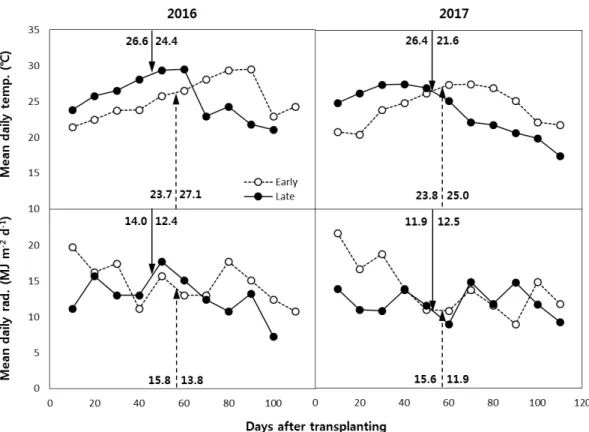
Determination of crop season in temperate area is critical to yield performance of rice due to much greater variation of temperature in a year than tropical regions. An example was reported that the amplitude of mean temperature in a year reached 30 ℃ in a temperate region while it was only 5 ℃ in a tropical region (Yang et al., 2007b), indicating that crops could be subjected to a wide variation of environment according to cropping season in temperate area. Therefore, determination of cropping season is an important management practice for temperate environments.
Cock & Yoshida (1972) reported that photosynthetic activity during grain filling stage had a much greater effect on carbo- hydrate accumulation in rice grains than translocation of assi- milates stored in plants at flowering stage. Similar result was reported in comparison of climatic environments contributing
to rice grain yield before and after flowering (Yang et al., 2008a). During grain filling of japonica rice, optimum tem- perature for high grain yield and quality has been reported in the environment-controlled studies (Yoshida & Hara, 1977;
Kim, 1983) and also in the field trials (Choi et al., 2011;
Yang et al., 2015). Some studies have investigated the effects of solar radiation on rice gain yield and quality (Dobermann et al., 2000; Evans & De Datta, 1979; Islam & Morison, 1992; Xing et al., 2017; Yang et al., 2015; Yoshida & Hara, 1977).
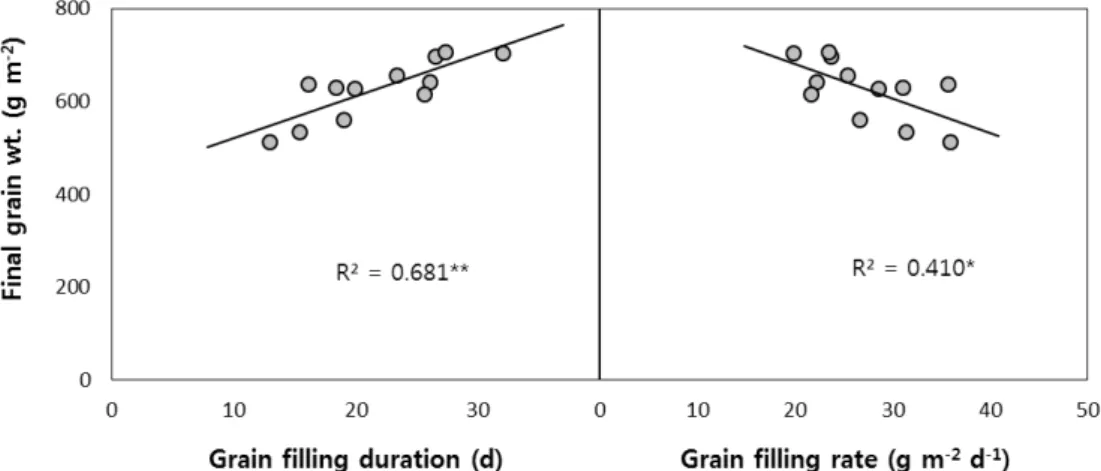
After flowering, grain growth of rice shows a sigmoid curve undergoing three phases: lag phase, linear increasing phase, and late filling phase (Cho et al., 1988; Yoshida, 1981). Among these, linear increasing phase, called effective grain filling period, is regarded more important than the duration of ripening japonica rice with wide environmental variation. Higher grain yields were attained in 2017 than in 2016 and with late planting than with early planting. The high grain yield accompanied a comparatively lesser increase in grain weight at the early filling stage but more gain in grain weight occurred during the late filling stage. Final grain weight correlated positively with grain filling duration but negatively with grain filling rate. Extended grain filling duration was associated with higher cumulative temperature and cumulative solar radiation for an effective grain filling period. The reduction in SPAD value × leaf dry weight from heading to harvest significantly correlated with final grain dry weight in a positive manner. No significant relation was found between grain filling duration and the decrease in SPAD value × leaf dry weight during the grain filling period. The results suggest that grain filling duration and loss of leaf activity during ripening independently contribute to environmentally induced yield improvement in temperate japonica rice.
Keywords : grain filling duration, grain yield, leaf activity, temperate rice
ⓒ 본 학회지의 저작권은 한국작물학회지에 있으며, 이의 무단전재나 복제를 금합니다.
This is an Open-Access article distributed under the terms of the Creative Commons Attribution Non-Commercial License (http://creativecommons.org/licenses/by-nc/3.0) which permits unrestricted non-commercial use, distribution, and reproduction in any medium, provided the original work is properly cited.
1)
Crop Cultivation and Environment Research Division, Department of Central Area Crop Science, National Institute of Crop Science, Rural Development Administration, Suwon 16429, Korea
†
Corresponding author: Woonho Yang; (Phone) +82-31-695-4130; (E-mail) [email protected]
<Received 28 March, 2018; Revised 26 May, 2018; Accepted 14 June, 2018>
from heading to harvest (Yoshida, 1981). In rice, the rate and duration of grain filling affect final grain weight and density (Jongkaewwattana & Geng, 2001). When investigated on a single panicle basis, high-yielding genotypes of rice were attributed to rapid grain filling rate, not long grain filling duration (Cho et al., 1987; Jones et al., 1979). However, when tested on a single grain basis, co-contribution of duration and rate of grain filling to grain size was observed (Fujita et al., 1984) while inferior grains on a panicle were associated with shorter grain filling duration (Cho et al., 1988). When tested on area basis, high yielding cultivars demonstrated long grain filling duration in both japonica rice (Yang et al., 2007a) and indica rice (Yang et al., 2008b). It has not been clarified yet why grain yield in rice showed such different responses when tested on a panicle or single grain basis and on area basis. However, area-based analysis would have more direct impact in relation to grain yield since productivity is based on land area and a panicle or a grain is one of the elements that comprise productivity.
The above-mentioned studies focused on genotypic ability of rice in relation to the comparative contribution of duration and rate of grain filling to grain yield. Several studies explored the effects of environments such as temperature and radiation on the duration and rate of grain filling. In some studies, high temperature shortened grain filling duration and accelerated grain filling rate of rice (Ahmed et al., 2015; Fujita et al., 1984; Yoshida & Hara, 1977). In other studies, however, high temperature during grain filling period did not affect grain filling duration (Lee et al., 2015) and it did not reduce potential grain dry matter increase rate (Kobata & Uemuki, 2004). While low radiation resulted in the reduction in grain filling percentage and consequent yield loss, it caused only a slight delay in grain filling of a whole panicle of rice (Yoshida & Hara, 1977).
There has been an argument whether source activity, re- presented by photosynthesis and related parameters such as nitrogen concentration, chlorophyll content, and mass of leaves (Park & Lee, 2003a), is limiting rice grain yield. Park & Lee (2003b) compared leaf senescence of different rice genotypes and reported that delayed senescence of upper leaves and rapid senescence of lower leaves were positively associated with grain yield. Wei et al. (2018) observed that rice genotypes with early senescence and poor source/sink ratio had relatively high grain nitrogen concentration, which was related to low
grain yield. This finding indicates that high-yielding rice genotypes have low nitrogen concentration in grains, hence late senescence or high source/sink ratio is required to breed high-yielding rice varieties. Meanwhile, Kim et al. (2011) suggested that earlier termination of grain filling under high temperature was resulted from loss of sink activity, not from earlier leaf senescence. Contrary findings in the studies by Kim et al. (2011) and Wei et al. (2018) may indicate that effect of source activity on grain yield of rice is different depending whether their variations come from genotypes or environments.
Although there are accumulated information on the relation- ships among grain filling rate, grain filling duration and grain yield, most investigations have been made to account for genotypic variations. In addition, source activities in relation to senescence have been studied mainly focusing on the approach to determine whether they are limiting grain filling and yield of rice. This study was performed with aims to clarify (1) if environmental variation of grain filling duration has a positive relationship with grain yield, (2) whether loss of leaf activity during grain filling contributes to grain yield, and (3) if grain filling duration and loss of leaf activity during grain filling stage are interlinked in a given genetic background of tem- perate rice.
MATERIALS AND METHODS
Experimental site, plant material and treatments Field experiments were conducted at the research farm of the National Institute of Crop Science, Suwon, Republic of Korea (37°27 ′N, 126°99′E, 34-m elevation) in 2016 and 2017.
A temperate japonica rice cultivar with short growth duration,
‘Baegilmi’, was selected as a plant material to widen climatic
variations in the range of appropriate growth period of rice
in Korea. This cultivar was transplanted on May 26 for early
planting and on June 25 for late planting to induce wide
variations of temperature and radiation during grain filling
period of rice. Mean daily temperature from planting through
heading of 2016 and 2017 were among the highest in the
last 10 years (Fig. 1). From heading to harvest, year 2016 had
the highest temperature while year 2017 showed the lowest
temperature level during the past 10 years in both early and
late planting. It was estimated that plant materials in this study
were subjected to considerable climatic variations by controlling planting times and experimental years.
Plots, with planting date as a treatment, were laid out in a randomized block configuration with three replicates at the same fields for two years. The soil was a Fluvaquentic Endoaquetps with pH 5.1, 18.2 g organic C kg
-1, and 7.7 cmol kg
-1cation exchange capacity to 30 cm depth.
Crop management
Seeds submerged in tap water were dried at room tempera- ture, then 130 g of seeds were packed in each gauge zipper bag. The bags were submerged for 48 hours in a 30 ℃ solution diluted from 8%-ipconazole by 1/500 with water. Then the seeds were soaked in water at 30 ℃ for following 24 hours.
The pre-germinated seeds in a bag were sown in seedling trays then kept at 30 ℃ for 48 hours until seedling emergence. To prevent the damage of emerged seedlings from high irradiance, trays were kept under the shadow for 24 hours before settling them on seedbeds.
Crop management followed the standard cultural practices for rice in Korea. Thirty-day old seedlings were machine- transplanted at a hill spacing of 0.3 × 0.14 m with 3-5 seedlings per hill for each transplanting date. Fertilizers were manually broadcasted and incorporation into paddy soil was made only for basal application. Ninety kg N ha
-1was split-applied by 50% at basal, 20% at tillering initiation, and 30% at panicle initiation stage. Forty-five kg P ha
-1was applied as a basal
fertilizer immediately before puddling the fields. Fifty-seven kg K ha
-1was split-applied: 70% at basal and 30% at panicle initiation. The experimental fields were flooded at 1-3 cm depth for 7 days from transplanting. Then 5-10 cm water depth was maintained until 40 days after heading (DAH) when the fields were permanently drained, except for 5-7 days at mid-tillering stage of rice for intermediate field drainage.
Weeds and pests were controlled by chemicals to avoid biomass and yield loss. Mixture of benzobicyclon at 0.125 L of active ingredient (a.i.) and thiobencarb at 1.5 L of a.i.
ha
-1was applied at one day after puddling fields to control germinating weeds. Additionally, mixture of bromobutide at 0.75 L, imazosulfuron at 0.075 L, and mefenacet at 1 L of a.i.
ha
-1was applied at 12-15 days after transplanting to control young weeds. Carbofuran at 1 kg and isoprothiolane at 4.8 kg of a.i. ha
-1were applied at basal to control insects and diseases. Cnaphalocrocis medinalis (rice leaf folder) was controlled by spraying etofenprox at 0.16 L of a.i. h
-1during grain filling stage of rice.
Weather data collection, plant sampling and measure- ments
Daily mean temperature and solar radiation, collected from the Suwon Meteorological Bureau located about 500 m apart from the experimental fields, were used to calculate tempera- ture and solar radiation during effective grain filling periods.
Plant samplings were made 6 times at 10-day interval from Fig. 1. Mean daily temperature from planting to heading and from heading to harvest in 2016 and 2017, compared to the
variation of temperature for 10 years from 2008 to 2017 when measured on May 26 for early planting and on June
25 for late planting.
heading to 50 DAH to measure the traits related to grain filling and leaf activity. For each time, after sampling 20 hills (0.84 m
2) for each replicate, number of panicles for each hill was counted and averaged. Then, five hills showing average number of panicles from the 20 hills were selected for further measure- ments. Chlorophyll meter readings were made at upper, middle, and lower parts on the flag leaf of a main culm for each of the selected five hills, using SPAD-502 (Soil Plant Analysis Dev. (SPAD) Section, Minolta Camera Co., Osaka, Japan).
The average SPAD value from the five hills was used as a replicate. After removing roots, the five hills for each replicate were combined and separated into leaves, culm + leaf sheath, and panicles. Panicles were manually threshed into rachis and spikelets. Then filled spikelets were separated from unfilled spikelets by submerging them in tap water. Filled spikelets and unfilled spikelets were counted to calculate spikelet number per panicle, grain filling percentage, and individual grain weight.
Filled spikelets and leaves were oven-dried at 70 ℃ to constant weight to determine dry weight.
Data analysis
Grain yield and yield attributes were analyzed following analysis of variance with experimental years and planting times as independent variables, using SPSS statistical software.
Time-series data for the grain dry weight were used to analyze duration and rate of grain filling. Grain filling process for each replicate was fitted by Richards (1959) growth equation to calculate duration and rate of grain filling as a function of day degree after flowering, using SPSS statistical software:
BektN