• 검색 결과가 없습니다.

Distribution of Exotic Weeds on Upland Crop Field in Gyeonggi-do

N/A
N/A
Protected

Academic year: 2021

Share "Distribution of Exotic Weeds on Upland Crop Field in Gyeonggi-do"

Copied!
8
0
0

로드 중.... (전체 텍스트 보기)

전체 글

(1)

284

Research Article Weed & Turfgrass Science

Weed & Turfgrass Science was renamed from both formerly Korean Journal of Weed Science from Volume 32 (3), 2012, and formerly Korean Journal of Turfgrass Science from Volume 25 (1), 2011 and Asian Journal of Turfgrass Science from Volume 26 (2), 2012 which were launched by The Korean Society of Weed Science and The Turfgrass Society of Korea found in 1981 and 1987, respectively.

경기도 밭의 외래잡초 분포

김창석1·이인용1·이정란1·홍선희2·오영주3*

1

국립농업과학원 작물보호과,

2

고려대학교 환경생태연구소,

3

(주)미래환경생태연구소

Distribution of Exotic Weeds on Upland Crop Field in Gyeonggi–do

Chang-Seok Kim

1

, In-Yong Lee

1

, Jeong-ran Lee

1

, Sun-Hee Hong

2

, and Young-Ju Oh

3*

1

Crop Protection Division, National Academy of Science, RDA, Jeonju 565-851, Korea

2

Institute of Environment and Ecology, Korea University, Seoul, 136-701, Korea

3

Institute for Future Environmental Ecology Co., Ltd, Suwon 441-853, Korea

농경지 외래잡초의 확산은 국내에 외래잡초가 유입된 이 후에 계속해서 진행되어 왔고 작물의 재배와 관리에 많은 어려움을 주고 있다(David et al., 2004). 최근에는 외래잡 초의 생태적 영향, 기후변화에 의한 양상, 관리방법 등에 대해 관심이 높아지고 있다(Mack et al., 2000; Pimentel et al., 2000; Pimentel, 2002). 외래잡초는 다양한 침입경로를 가지고 있고 의도적으로 인간에 의해 교란되는 도로, 농경 지, 목장 등에 빠르게 침입하여 다른 자생 잡초종에 비해 서식영역의 확장이 빠르고 서식공간의 환경조건도 매우 광 범위한 생태적 특성을 가지고 있다(Gould, 1991; Jordan and

Jannink, 1997; Martinez-Ghersa et al., 2000; Mohler, 2001).

농경지에 침입한 외래잡초는 환경에 신속하게 적응하여 기 생식물, 포식 및 경쟁자로부터 효과적으로 회피하고 높은 번식력을 가져 자생 잡초에 비해 성공적인 생태적 지위를 가진다(Cox, 1993). 인간에 의한 토지이용의 변화는 생태 계의 측면에서 구성요소의 변화를 야기하고 이러한 생태 계의 변화는 외래잡초가 서식할 수 있는 공간을 제공한다 (Hong et al., 2005). 국내에는 외국에서 유입되어 분포하는 외래잡초가 38과 160속 286종류가 자라고 있는 것으로 보 고되어 있다(Park, 2009). 이중 농경지에 발생하는 외래잡 초의 종수는 총 72종으로 논에 8종, 사료용 옥수수밭에 31 종, 콩밭 12종, 초지 59종이 발생하는 것으로 보고된 바 있 ABSTRACT. We surveyed the distribution of exotic weeds in the 350 upland crop fields of Gyeonggi-do. The exotic weeds were summarized as 78 taxa including 19 families, 52 genera, 74 species and 4 varieties. Among the total exotic weeds, the summer annuals were 48.7%, the winter annuals 28.2%, and the perennials 23.1%. Compositae was dominant family (32%), followed by Gramineae (8%), Polygonaceae (8%) and Malvaceae (7%). Dominant exotic weeds in northern Gyeonggi-do were Amaranthus lividus, Ambrosia trifida, Chenopodium album, Bidens frondosa and Erigeron Canadensis, and in southern Gyeonggi-do were Chenopodium album, Erigeron Canadensis, Erigeron annuus, Taraxacum officinale and Galinsoga ciliate. The most dominant exotic weeds in the Gyeonggi-do were Chenopodium album, followed by Amaranthus blitum, Erigeron canadensis. Canonical correspondence analysis for investigation of correlation between exotic weeds occurred in northern and southern Gyeonggi-do showed that the exotic weeds in northern Gyeonggi-do were more diverse then in southern Gyeonggi-do. This information could be useful for establishment of exotic weed control methods in Gyeonggi-do.

Key words: Dominant species, Exotic weed, Gyeonggi–do, Upland crop field

Received on November 14, 2014; Revised on December 5, 2014; Accepted on December 10, 2014

*

Corresponding author: Phone) +82-31-278-7122, Fax) +82-31-278-7123; E-mail) [email protected]

© 2014 The Korean Society of Weed Science and The Turfgrass Society of Korea

This is an Open-Access article distributed under the terms of the Creative Commons Attribution Non-Commercial License & #160;

(http://creativecommons.org/licenses/by-nc/3.0) which permits unrestricted noncommercial use, distribution, & #160; and reproduc-

tion in any medium, provided the original work is properly cited.

(2)

다(Oh et al., 2002). 국내 도서지역 중 백령도, 흑산도, 추 자도, 거문도에 발생하는 외래잡초는 18과 70종으로 이중 일년생이 40%, 월년생이 30%를 차지하는 것으로 알려져 있다(Kim et al., 2010). 경기, 강원 및 제주의 농경지에서 발생하는 외래잡초를 포괄적으로 조사한 결과에서는 19과 79종으로 확인되었다(Oh et al., 2004). 본 연구는 경기도 지 역의 밭 경작지를 대상으로 외래잡초의 분포 및 발생 피도 등급을 조사하여 밭에 발생하는 외래잡초의 종류와 특징 을 밝혀내고 외래잡초의 관리를 위한 기초자료를 구축하 기 위하여 수행하였다.

재료 및 방법

외래잡초 분포 조사

외래잡초의 분포조사는 2014년 5월부터 9월까지 경기도 의 북부와 남부지역을 대상으로 실시하였다. 경기북부지역 은 가평군, 고양시, 김포시, 남양주시, 양주시, 연천군, 파주 시, 동두천시, 포천시 등 9개 시군을, 경기남부지역의 과천 시, 광명시, 광주시, 군포시, 남양주시, 부천시, 성남시, 수 원시, 시흥시, 안산시, 안성시, 안양시, 양평군, 여주시, 오 산시, 용인시, 의왕시, 이천시, 평택시, 하남시, 화성시 21개 시군을 대상으로 하였다. 총 350필지를 대상으로 하였으며, 이 가운데 경기북부는 157필지, 경기남부는 193필지를 조 사하였다. 외래잡초 분포조사 지점은 밭 위치를 위성으로 파악하여 시군의 밭이 고루 조사될 수 있도록 선정하였고 조사구의 면적은 1필지를 대상으로 하여 측정하였다. 식물 의 피도는 Braun–Blanquet (1964)의 방법으로 7개 등급(r, +, 1, 2, 3, 4, 5)을 기준으로 조사하였다.

발생 외래잡초 및 분포특성 분석

외래잡초조사 결과는 국가표준식물목록(KNA, 2007) 및 한국의 귀화식물 원색도감(Park, 2009)을 참고하였다. 출현 한 외래잡초종에 대해서는 Raunkiaer (1934)의 생활형을 기 준으로 일년생과 다년생을 구분하였고 과별 분포 비율을 산정하였다. 외래잡초의 우점순위를 알아보기 위하여 중요 치(IV)분석을 실시하였다(Curtes and Mc Intosh, 1950).

Important value (IV) = (RF + RC) / 2

지역간의 외래잡초의 분포에 의한 차이를 비교하여 보기

위하여 Canonical correspondence analysis (CCA)을 수행하 여 생태학적 관점에서 지역과 종과의 상호관계를 분석하 였다(Ter Braak, 1986).

결과 및 고찰

발생 외래잡초

경기남·북부 350개의 밭에 발생하는 외래잡초는 19과 51속 72종 6변종, 총 78분류군이 출현하는 것으로 조사되 었다. 이는 Oh et al. (2004)의 연구에서 경기도에 52종류 가 보고된 2004년에 비해 많은 종이 경기도 밭에 분포하 고 있는 것을 확인할 수 있었다. 이중 경기북부는 18과 43 속 59종 2변종, 총 61분류군, 경기남부는 15과 36속 47종 3 변종, 총 50분류군이 분포하는 것으로 나타났다. 출현한 외 래잡초 총 78종의 생활형은 경기북부가 일년생 47.5%, 월 년생 31.1%, 다년생 21.3%로 구성되었고 경기남부는 일년 생 56.0%, 월년생 28.0%, 다년생 16.0%가 출현하였다. 경기 도 전체의 외래잡초 생활형은 일년생이 48.7%, 월년생 28.2%, 다년생 23.1%로 다년생보다는 일년생과 월년생의 비율이 높았다(Table 1). 경기도 밭에 출현한 외래잡초 중 생태계교 란 생물은 가시박, 가시상추, 돼지풀, 단풍잎돼지풀, 도깨비 가지, 미국쑥부쟁이, 서양등골나물, 애기수영 8종이 출현하였다.

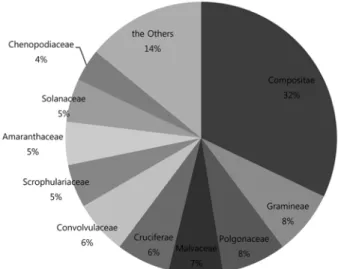
외래잡초의 과별 비율은 국화과 32%, 벼과 8%, 마디풀 과 8%, 아욱과 7%, 십자화과 6%, 메꽃과 6%, 현삼과 5%, 비름과 5%, 가지과 5%, 명아주과 4% 등으로 구성되었다 (Fig. 1) 밭 외래잡초의 과별 분포비율을 조사한 Park et al.

(2003) 에 따르면, 국화과가 우점하였는데, 본 연구에서도 이 러한 경향은 일치하였다.

외래잡초별 중요치 분석

경기도에 출현하는 외래잡초의 우점순위를 판단하기 위 한 중요치 분석에서 흰명아주가 가장 우점하는 것으로 분 석되었고 개비름, 망초, 개망초, 좀명아주, 털별꽃아재비, 단

Relative frequency (RF) (%) =

Frequency of any species Total frequency of all species ×100

Relative cover (RC) (%) =

Cover of species A Total cover of all species ×100

Table 1. Classification of exotic weeds found in Gyeonggi-do by life cycle.

No. of exotic weeds (%)

Life cycle

Total Summer

annual

Winter

annual Perennial Northern

Gyeongggi-do

29 (47.5)

19 (31.1)

13 (21.3)

61 (100) Southern

Gyeongggi-do

28 (56.0)

14 (28.0)

8 (16.0)

50 (100)

Total 38

(48.7)

22 (28.2)

18 (23.1)

78

(100)

(3)

풍잎돼지풀, 미국가막사리 순으로 우점도의 서열이 정해졌 다(Appendix 1). 흰명아주의 우점은, Oh et al. (2004) 선행 연구에서 경기도의 밭에 우점하는 외래잡초가 흰명아주,

망초, 개망초, 서양민들레, 가는털비름, 비름, 좀명아주, 어저 귀, 달맞이꽃 등인 것과 동일한 결과를 나타내었다. 또한, 생 태계교란 생물인 단풍잎돼지풀이 경작지인 밭까지 확산된 것을 확인할 수 있었다.

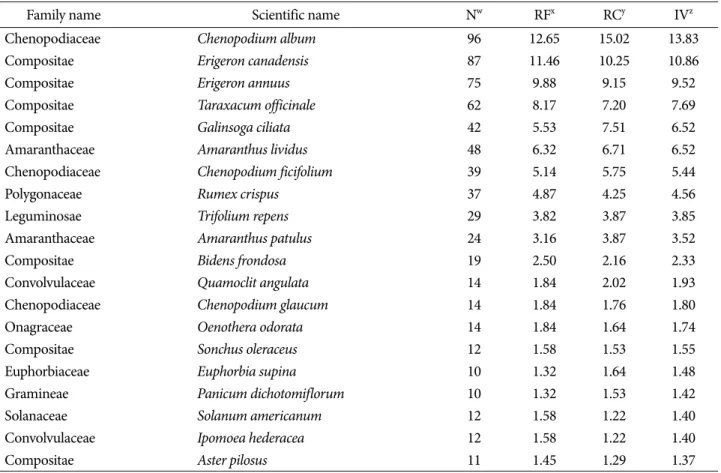
경기도 외래잡초의 발생특성은 주변의 도시 및 도로의 발달과 연관되어 있다. 경기도 북부와 남부지역에서 출현 한 외래잡초는 지역의 개발과 관리 특성에 따라 다른 발생 양상을 나타내었다. 군사지역 및 축산지역이 많은 북부지 역에서는 개비름이 가장 우점하였고, 단풍잎돼지풀, 흰명 아주, 미국가막사리, 망초, 좀명아주, 어저귀, 개망초 등이 발생하여 해외물자가 다양하게 도입되는 과정에서 지속적 으로 유입되는 외래잡초의 수가 많은 것으로 판단되었다 (Table 2). 도시 개발의 넓이와 도로가 잘 발달한 경기 남 부지역에서는, 흰명아주, 망초, 개망초, 서양민들레, 털별꽃 아재비, 개비름, 좀명아주 순으로 우점하였다(Table 3).

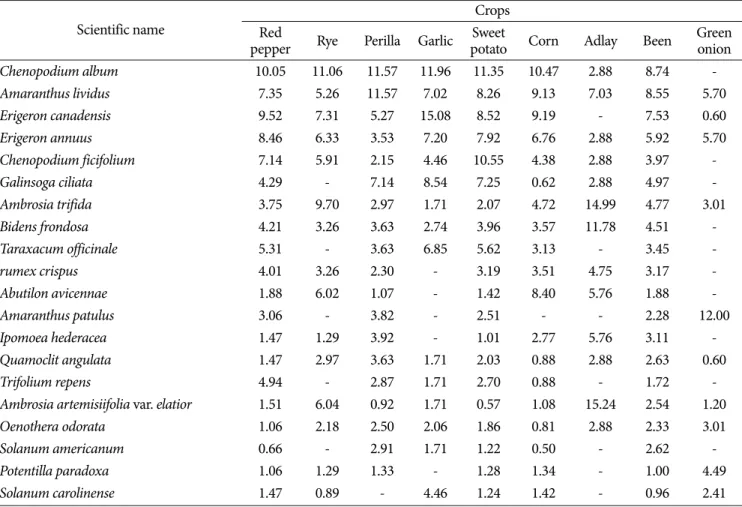
경기도의 주요 작물 경작지별 외래잡초의 출현종수는 콩 54종, 고추 46종, 들깨 47종, 옥수수 48종, 고구마 44종, 마 늘 24종, 파 30종, 호밀 34종, 율무 19종이 조사되었다. 2002 년에 조사된 옥수수 31종, 콩 12종 외래잡초의 발생 종 수 Fig. 1. Occurrence ratio of family of exotic weeds in Gyeonggi-

do.

Table 2. Importance value (IV) of exotic weeds in 9 city / gun of northern Gyeonggi-do, decreasingly ordered by IV.

Family name Scientific name N

w

RF

x

RC

y

IV

z

Amaranthaceae Amaranthus lividus 100 9.78 14.34 12.06

Compositae Ambrosia trifida 65 6.36 8.31 7.33

Chenopodiaceae Chenopodium album 58 5.68 8.90 7.29

Compositae Bidens frondosa 65 6.36 5.36 5.86

Compositae Erigeron canadensis 68 6.65 4.64 5.65

Chenopodiaceae Chenopodium ficifolium 50 4.89 6.15 5.52

Malvaceae Abutilon avicennae 40 3.91 6.01 4.96

Compositae Erigeron annuus 49 4.79 3.30 4.04

Amaranthaceae Amaranthus patulus 35 3.42 3.97 3.70

Compositae Ambrosia artemisiifolia var. elatior 31 3.03 3.93 3.48

Compositae Galinsoga ciliata 32 3.13 3.70 3.42

Convolvulaceae Ipomoea hederacea 31 3.03 3.03 3.03

Solanaceae Solanum carolinense 22 2.15 2.49 2.32

Polygonaceae Rumex crispus 29 2.84 1.64 2.24

Molluginaceae Mollugo verticillata 21 2.05 2.22 2.14

Chenopodiaceae Oenothera odorata 26 2.54 1.52 2.03

Convolvulaceae Quamoclit angulata 16 1.57 1.98 1.78

Rosaceae Potentilla paradoxa 19 1.86 1.25 1.56

Polygonaceae Rumex obtusifolius 17 1.66 1.41 1.54

Compositae Helianthus tuberosus 17 1.66 1.14 1.40

w

N: number of sampling units in which the species was accounted;

x

RF: relative frequency;

y

RC: relative cover;

z

IV : importance value.

(4)

에 비해 많은 종이 분포하고 있다. 이는 경작지에 적응한 외래잡초의 종류가 많아지거나, 잦은 경운을 통해 새롭게

유입되는 외래잡초의 종류가 많아졌기 때문인 것으로 추 정되었다(Oh et al., 2002).

발생지별 출현 외래잡초의 상관관계

외래잡초의 발생지역별 차이를 알아보기 위하여, CCA분 석으로 종 분포 패턴을 분석하였다(Fig. 4). CCA분석 결과 경기북부지역이 경기남부지역보다 외래잡초의 다양성과 분 포 종의 범위가 넓은 것으로 분석되었고 경기남부는 일부 지역을 제외하고는 거의 경기북부지역의 외래잡초 분포범 위에 포함되었다(Fig 2). CCA분석 결과에서 1축에서는 개 비름, 흰명아주, 어저귀, 단풍잎돼지풀, 서양민들레에 의해 구별되고 2축에서는 망초, 개망초, 털별꽃아재비에 의해 구 별되었다.

경기도의 밭 주변을 대상으로 350지점을 선정하여 조사 를 진행하였다. 경기도의 밭에 발생하는 외래잡초 조사결 Table 3. Importance value (IV) of exotic weeds in 21 city / gun of southern Gyeonggi-do, decreasingly ordered by IV.

Family name Scientific name N

w

RF

x

RC

y

IV

z

Chenopodiaceae Chenopodium album 96 12.65 15.02 13.83

Compositae Erigeron canadensis 87 11.46 10.25 10.86

Compositae Erigeron annuus 75 9.88 9.15 9.52

Compositae Taraxacum officinale 62 8.17 7.20 7.69

Compositae Galinsoga ciliata 42 5.53 7.51 6.52

Amaranthaceae Amaranthus lividus 48 6.32 6.71 6.52

Chenopodiaceae Chenopodium ficifolium 39 5.14 5.75 5.44

Polygonaceae Rumex crispus 37 4.87 4.25 4.56

Leguminosae Trifolium repens 29 3.82 3.87 3.85

Amaranthaceae Amaranthus patulus 24 3.16 3.87 3.52

Compositae Bidens frondosa 19 2.50 2.16 2.33

Convolvulaceae Quamoclit angulata 14 1.84 2.02 1.93

Chenopodiaceae Chenopodium glaucum 14 1.84 1.76 1.80

Onagraceae Oenothera odorata 14 1.84 1.64 1.74

Compositae Sonchus oleraceus 12 1.58 1.53 1.55

Euphorbiaceae Euphorbia supina 10 1.32 1.64 1.48

Gramineae Panicum dichotomiflorum 10 1.32 1.53 1.42

Solanaceae Solanum americanum 12 1.58 1.22 1.40

Convolvulaceae Ipomoea hederacea 12 1.58 1.22 1.40

Compositae Aster pilosus 11 1.45 1.29 1.37

w

N: number of sampling units in which the species was accounted;

x

RF: relative frequency;

y

RC: relative cover;

z

IV: importance value.

Fig. 2. Ordination diagram by Canonical correspondence

analysis (CCA) of the sampling plots on the cover value of 78

exotic weeds and habitat area. The triangle symbol was 157

investigated sites of southern Gyeonggi-do. The plus symbol

was 193 investigated sites of northern Gyeonggi-do.

(5)

과 19과 52속 74종 4변종, 총 78종류의 외래잡초가 조사되 었고 하계 일년생 식물은 48.7%, 동계 일년생은 28.2%, 다 년생은 23.1%가 출현하였다. 과별로 보면 국화과가 32%를 차지하여 가장 많은 비율로 출현하였고 벼과 8%, 마디풀 과 8%, 아욱과 7%로 구성되었다. 경기북부에서의 외래잡초 우점종은 개비름, 단풍잎돼지풀, 흰명아주, 미국가막사리, 망 초이고 경기남부에서는 흰명아주, 망초, 개망초, 서양민들레, 털별꽃아재비가 조사되었다. 경기도 전체에서는 흰명아주, 개 비름, 망초가 가장 우점하는 것으로 파악되었다. 경기북부와 경기남부지역의 외래잡초의 상관관계를 살펴보기 위한 CCA 분석결과 경기북부가 경기남부지역보다 다양한 외래잡초 가 넓게 확산되어 있는 것으로 분석되었다. 경기도에 발생 하는 외래잡초의 발생정보는 밭의 지속적인 관리방안을 수 립하는데 도움이 될 것이다.

주요어: 우점종, 외래잡초, 경기도, 밭

Acknowledgement

This study was carried out with the support of “Research Program for Agricultural Science & Technology Develop- ment” (Project No. PJ0093192013), National Academy of Agricultural Science, Rural Development Administration, Republic of Korea.

References

Braun-Blanquet, J. 1964. Pflanzensoziologie, Grundzfige der Vegetationskunde, 3rd ed. Springer, Wien-New York. USA. p.

865.

Cox, G.W. 1993. Conservation ecology: Biosphere and biosurvival.

Wm. C. Brown Publishers, IA, USA.

Curtis, J.T. and McIntosch, R.P. 1950. The interrrelations of certain analytic and synthetic phytosociological characters. Ecol.

31:434-455.

Table 4. Important value (IV) of exotic weeds by different crops in Gyeonggi-do.

Scientific name

Crops Red

pepper Rye Perilla Garlic Sweet

potato Corn Adlay Been Green onion

Chenopodium album 10.05 11.06 11.57 11.96 11.35 10.47 2.88 8.74 -

Amaranthus lividus 7.35 5.26 11.57 7.02 8.26 9.13 7.03 8.55 5.70

Erigeron canadensis 9.52 7.31 5.27 15.08 8.52 9.19 - 7.53 0.60

Erigeron annuus 8.46 6.33 3.53 7.20 7.92 6.76 2.88 5.92 5.70

Chenopodium ficifolium 7.14 5.91 2.15 4.46 10.55 4.38 2.88 3.97 -

Galinsoga ciliata 4.29 - 7.14 8.54 7.25 0.62 2.88 4.97 -

Ambrosia trifida 3.75 9.70 2.97 1.71 2.07 4.72 14.99 4.77 3.01

Bidens frondosa 4.21 3.26 3.63 2.74 3.96 3.57 11.78 4.51 -

Taraxacum officinale 5.31 - 3.63 6.85 5.62 3.13 - 3.45 -

rumex crispus 4.01 3.26 2.30 - 3.19 3.51 4.75 3.17 -

Abutilon avicennae 1.88 6.02 1.07 - 1.42 8.40 5.76 1.88 -

Amaranthus patulus 3.06 - 3.82 - 2.51 - - 2.28 12.00

Ipomoea hederacea 1.47 1.29 3.92 - 1.01 2.77 5.76 3.11 -

Quamoclit angulata 1.47 2.97 3.63 1.71 2.03 0.88 2.88 2.63 0.60

Trifolium repens 4.94 - 2.87 1.71 2.70 0.88 - 1.72 -

Ambrosia artemisiifolia var. elatior 1.51 6.04 0.92 1.71 0.57 1.08 15.24 2.54 1.20

Oenothera odorata 1.06 2.18 2.50 2.06 1.86 0.81 2.88 2.33 3.01

Solanum americanum 0.66 - 2.91 1.71 1.22 0.50 - 2.62 -

Potentilla paradoxa 1.06 1.29 1.33 - 1.28 1.34 - 1.00 4.49

Solanum carolinense 1.47 0.89 - 4.46 1.24 1.42 - 0.96 2.41

(6)

David, R.C., Antonio, D., Nicholas, J., Barabara, D.B., John, C., et al.

2004. Adaptability of plants invading North American cropland. Agric. Ecosyst. Environ. 104:379-398.

Gould, F. 1991. The evolutionary potential of crop pests. Am. Sci.

79:496-507.

Hong, S.K., Kang, H.G., Kim, U.S., Kim, J.G., Kim, C.H., et al. 2005.

Engineering of ecology conservation. pp. 165-188. In: Lee, E.J.

Invasive plants and vegetation conservation, Lifescience Publishers. Seoul, Korea.

Jordan, N.R. and Jannink, J.L. 1997. Assessing the practical importance of weed evolution: a research agenda. Weed Res.

37:237-246.

Kim, C.S., Lee, I.Y., Oh, Y.J., Oh, S.M., Kim, S.C., et al. 2010.

Occurrence of exotic weeds in several islands in Korea. Korean J. Weed Sci. 30(2):59-67. (In Korean)

KNA (Korea National Arboretum). 2007. A synonymic list of vascular plants in Korea. Pochen, Gyeonggi-do, Korea.

Mack, R.N., Simberloff, D., Lonsdale, W.M., Evans, H., Clout, M., et al. 2000. Biotic invasions: Causes, epidemiology, global consequences, and control. Ecol. Appl. 10:689–710.

Martinez-Ghersa, M.A., Ghersa, C.M. and Satorre, E.H. 2000.

Coevolution of agricultural systems and their weed companions: implications for research. Field Crops Res.

67:181–190.

Mohler, C.L. 2001. Weed evolution and community structure. pp.

444–493. In: Liebman, M., Mohler, C. and Staver, C.P. (Eds.).

Ecological management of agricultural weeds, Cambridge University Press, Cambridge, UK.

Oh, S.M., Kim, C.S., Moon, B.C. and Lee, I.Y. 2002. Inflow information and habitat current status of exotic weeds in Korea.

Korean J. Weed Sci. 22(3):280-295. (In Korean)

Oh, S.M., Moon, B.C., Kim, C.S. and Lee, I.Y. 2004. Distribution of exotic weeds in agricultural fields of the Gyeonggi, Gangwon and Jeju areas in Korea. Korean J. Weed Sci. 24(2):138-148. (In Korean)

Park, J.E., Lee, I.Y., Park, T.S., Lim, S.T., Moon, B.C., et al. 2003.

Occurrence characteristics of weed flora in upland field in Korea. Korean J. Weed Sci. 23(3):277-284. (In Korean) Park, S.H. 2009. New illustrations and photographs of naturalized

plants of Korea. Ilchokak Inc., Seoul, Korea.

Pimentel, D. 2002. Biological Invasions: Economic and Environmental Costs of Alien Plant, Animal, and Microbe Species. CRC Press, Boca Raton, FL. USA. p. 369.

Pimentel, D., Lach, L., Zuniga, R. and Morrison, D. 2000.

Environmental and economic costs of nonindigenous species in the United States. BioSci. 50:53-65.

Raunkiaer, C. 1934. Plant life forms. Clarendon press. Oxford, UK.

Ter-Braak, C.J.F. 1986. Canonical correspondence analysis: a new eigenvector technique for multivariate direct gradient analysis.

Ecol. 67:69-77.

Appendix 1. Importance value (IV) of exotic weeds in 30 city / gun of Gyeonggi-do, decreasingly ordered by IV.

Family name Scientific name Korean name N RF RC IV

Chenopodiaceae Chenopodium album 흰명아주 165 8.68 11.41 10.04

Amaranthaceae Amaranthus lividus 개비름 153 8.05 10.66 9.35

Compositae Erigeron canadensis 망초 162 8.52 6.69 7.61

Compositae Erigeron annuus 개망초 126 6.63 5.50 6.06

Chenopodiaceae Chenopodium ficifolium 좀명아주 89 4.68 5.51 5.10

Compositae Galinsoga ciliata 털별꽃아재비 83 4.37 5.65 5.01

Compositae Ambrosia trifida 단풍잎돼지풀 77 4.05 4.77 4.41

Compositae Bidens frondosa 미국가막사리 84 4.42 3.61 4.02

Compositae Taraxacum officinale 서양민들레 77 4.05 3.26 3.66

Polygonaceae rumex crispus 소리쟁이 66 3.47 2.60 3.03

Malvaceae Abutilon avicennae 어저귀 42 2.21 3.29 2.75

Amaranthaceae Amaranthus patulus 가는털비름 37 1.95 3.09 2.52

Convolvulaceae Ipomoea hederacea 미국나팔꽃 51 2.68 2.32 2.50

Convolvulaceae Quamoclit angulata 둥근잎유홍초 38 2.00 2.99 2.49

Leguminosae Trifolium repens 토끼풀 45 2.37 2.08 2.22

Compositae Ambrosia artemisiifolia var. elatior 돼지풀 37 1.95 2.33 2.14

Onagraceae Oenothera odorata 달맞이꽃 43 2.26 1.48 1.87

Solanaceae Solanum americanum 미국까마중 32 1.68 1.80 1.74

(7)

Appendix 1. Importance value (IV) of exotic weeds in 30 city / gun of Gyeonggi-do, decreasingly ordered by IV (continued).

Rosaceae Potentilla paradoxa 개소시랑개비 28 1.47 1.01 1.24

Solanaceae Solanum carolinense 도깨비가지 22 1.16 1.26 1.21

Chenopodiaceae Chenopodium glaucum 취명아주 27 1.42 0.98 1.20

Compositae Aster pilosus 미국쑥부쟁이 25 1.32 0.97 1.14

Molluginaceae Mollugo verticillata 큰석류풀 21 1.10 1.12 1.11

Gramineae Panicum dichotomiflorum 미국개기장 20 1.05 1.10 1.08

Compositae Helianthus tuberosus 뚱딴지 22 1.16 0.74 0.95

Polygonaceae rumex obtusifolius 돌소리쟁이 17 0.89 0.71 0.80

Euphorbiaceae Euphorbia supina 애기땅빈대 14 0.74 0.85 0.79

Compositae Sonchus oleraceus 방가지똥 15 0.79 0.70 0.75

Convolvulaceae Ipomoea purpurea 둥근잎나팔꽃 15 0.79 0.68 0.74

Compositae Galinsoga parviflora 별꽃아재비 15 0.79 0.63 0.71

Compositae Carduus crispus 지느러미엉겅퀴 14 0.74 0.41 0.57

Scrophulariaceae Veronica arvensis 선개불알풀 13 0.68 0.44 0.56

Cruciferae Lepidium apetalum 다닥냉이 13 0.68 0.36 0.52

Compositae Lactuca scariola 가시상추 9 0.47 0.56 0.52

Caryophyllaceae cerastium glomeratum 유럽점나도나물 10 0.53 0.37 0.45

Rosaceae Potentilla amurensis 좀개소시랑개비 9 0.47 0.33 0.40

Compositae Xanthium canadense 큰도꼬마리 9 0.47 0.29 0.38

Scrophulariaceae Veronica persica 큰개불알풀 7 0.37 0.35 0.36

Amaranthaceae Amaranthus hybridus 긴털비름 6 0.32 0.38 0.35

Compositae Senecio vulgaris 개쑥갓 8 0.42 0.27 0.35

Compositae Erechtites hieracifolia 붉은서나물 8 0.42 0.27 0.35

Polygonaceae rumex japonicus 참소리쟁이 5 0.26 0.39 0.33

Scrophulariaceae Lindernia dubia var. major 나도미국외풀 7 0.37 0.26 0.32

Cruciferae Lepidium virginicum 콩다닥냉이 6 0.32 0.29 0.30

Compositae Erigeron bonariensis 실망초 7 0.37 0.22 0.30

Cruciferae Thlaspi arvense 말냉이 6 0.32 0.26 0.29

Solanaceae Datura stramonium 독말풀 3 0.16 0.34 0.25

Polygonaceae rumex acetocella 애기수영 5 0.26 0.21 0.23

Compositae Erigeron philadelphicus 봄망초 7 0.37 0.07 0.22

Malvaceae Hibiscus trionum 수박풀 6 0.32 0.10 0.21

Scrophulariaceae Lindernia dubia 미국외풀 4 0.21 0.20 0.20

Solanaceae Physalis angulata 땅꽈리 3 0.16 0.24 0.20

Compositae Erigeron strigosus 주걱개망초 5 0.26 0.09 0.18

Cucurbitaceae Sicyos angulatus 가시박 3 0.16 0.16 0.16

Convolvulaceae Ipomoea hederacea var. intergriuscula 둥근잎미국나팔꽃 3 0.16 0.16 0.16

Phytolaccaceae Phytolacca americana 미국자리공 4 0.21 0.04 0.12

Polygonaceae rumex nipponicus 좀소리쟁이 1 0.05 0.20 0.12

Compositae Sonchus asper 큰방가지똥 3 0.16 0.07 0.11

Polygonaceae Persicaria cochinchinensis 털여뀌 2 0.11 0.11 0.11

Leguminosae Medicago hispida 개자리 3 0.16 0.03 0.09

Malvaceae Malva neglecta Wallr. 난쟁이아욱 3 0.16 0.03 0.09

(8)

Appendix 1. Importance value (IV) of exotic weeds in 30 city / gun of Gyeonggi-do, decreasingly ordered by IV (continued).

Convolvulaceae Cuscuta pentagona 미국실새삼 2 0.11 0.06 0.08

Cruciferae Brassica juncea var. integrifolia 갓 2 0.11 0.02 0.06

Compositae Xanthium strumarium 도꼬마리 2 0.11 0.02 0.06

Malvaceae Malva pusilla Smith 둥근잎아욱 2 0.11 0.02 0.06

Malvaceae Sida rhombifolia 나도공단풀 1 0.05 0.05 0.05

Compositae Tagetes minuta 만수국아재비 1 0.05 0.05 0.05

Compositae Cirsium vulgare 서양가시엉겅퀴 1 0.05 0.05 0.05

Compositae Eupatorium rugosum 서양등골나물 1 0.05 0.05 0.05

Gramineae Poa pratensis 왕포아풀 1 0.05 0.05 0.05

Euphorbiaceae Euphorbia maculata 큰땅빈대 1 0.05 0.05 0.05

Gramineae Bromus unioloides 큰이삭풀 1 0.05 0.05 0.05

Gramineae Avena fatua 메귀리 1 0.05 0.01 0.03

Compositae Gnaphalium calviceps 선풀솜나물 1 0.05 0.01 0.03

Gramineae Dactylis glomerata 오리새 1 0.05 0.01 0.03

Cruciferae Lepidium ruderale 좀다닥냉이 1 0.05 0.01 0.03

Gramineae Festuca arundinacea 큰김의털 1 0.05 0.01 0.03

수치

Table 1. Classification of exotic weeds found in Gyeonggi-do by life cycle. No. of exotic  weeds (%) Life cycle TotalSummer  annual Winter annual Perennial Northern  Gyeongggi-do 29 (47.5) 19 (31.1) 13 (21.3) 61 (100) Southern  Gyeongggi-do 28 (56.0) 14 (2
Table 2. Importance value (IV) of exotic weeds in 9 city / gun of northern Gyeonggi-do, decreasingly ordered by IV
Fig. 2. Ordination diagram by Canonical correspondence analysis (CCA) of the sampling plots on the cover value of 78 exotic weeds and habitat area
Table 4. Important value (IV) of exotic weeds by different crops in Gyeonggi-do.

참조

관련 문서

Characterization of the centromere and pericentromere retrotransposons in Brassica rapa and their distribution in the related Brassica species. Gil-Dong Hong 1,* ,

(4) Analyze the liaison of detachment, collection, screen, and transportation operation of the jujube harvester based on the information of the tree shape of jujube

2재화 2요소 헥셔-올린 모형에서는 어느 한 경제에서 어느 한 요소의 양이 증가하면, 그 요소를 집약적으로 사용하는 산업의 생산량은 증가하고 다른

• 서구의 담론이 서구 주체의 문화적 우월성을 증명하는 대상으로서만 기능하는 타자로서의 동양을 상정..

웹 표준을 지원하는 플랫폼에서 큰 수정없이 실행 가능함 패키징을 통해 다양한 기기를 위한 앱을 작성할 수 있음 네이티브 앱과

_____ culture appears to be attractive (도시의) to the

 Mechanical weed management is the physical removal of weeds

The index is calculated with the latest 5-year auction data of 400 selected Classic, Modern, and Contemporary Chinese painting artists from major auction houses..