Received 02 October 2015, Revised 30 October 2015, Accepted 09 November 2015
* Corresponding Author Soo-tai Nam(E-mail: [email protected], Tel:+82-63-850-6258)
Division of Information and Electronic Commerce, Institute of Convergence and Creativity, Wonkwang University, Iksan, 570-749, Korea Open Access
http://dx.doi.org/10.6109/jkiice.2015.19.11.2590
print ISSN: 2234-4772 online ISSN: 2288-4165한국정보통신학회논문지(J. Korea Inst. Inf. Commun. Eng.) Vol. 19, No. 11 : 2590~2596 Nov. 2015
빅 데이터 분석을 활용한 대사증후군 위험요인에 관한 메타분석
유옥경1 · 차연수1 · 진찬용2 · 김도관2 · 남수태2*
A Meta-analysis of Influencing Mediator Athletics on the Metabolic Syndrome Risk Factors Utilized Big Data Analysis
Ok-kyeong Yu
1· Youn-soo Cha
1· Chan-yong Jin
2· Do-goan Kim
2· Soo-tai Nam
2*1Obesity Research Center(Agrobio Food R & D Institute), Chonbuk National University, Jeonju 561-756, Korea
2*
Div. of Information EC(Institute of Convergence and Creativity), Wonkwang University, Iksan 570-749, Korea
요 약
메타분석은 여러 실증연구의 정량적인 결과를 통합과 분석을 통해 전체 결과를 조망할 기회를 제공하는 통계적
통합 방법이다 . 우리나라 학술지에 게재된 대사증후군 위험요인에 관한 연구들을 계량적으로 통합하고 검토해보기
위해 진행하였다. 본 연구는 대사증후군에 대한 문헌적 고찰을 통해 선행연구를 살펴보고 열거된 요인에 관한 실증
분석된 연구들을 메타분석 하기 위해 2000년-2015년 국내 학술지에 게재된 36편 논문을 연구대상으로 하였다. 메타
분석 결과 허리둘레 사전 사후 경로에서 가장 큰 효과 크기(r = .420)인 것으로 나타났다. 두 번째 큰 효과 크기는 고밀
도지단백콜레스테롤 사전 사후 경로 (r = -.402)인 것으로 나타났다. 그런데 이완기 혈압 사전 사후 경로가 가장 작은
효과 크기(r = .234)인 값을 확인할 수 있었다. 따라서 연구결과를 바탕으로 학문적 실무적 의의를 논의하였다.
ABSTRACT
A meta-analysis is a statistical integration method that delivers an opportunity to overview the entire result of integrating and analyzing many quantitative research results. This study will find meaningful mediator variables for criterion variables that affects between pre and post in the metabolic syndrome studies, on the basis of the results of a meta analysis. We reviewed a total of 36 studies related the metabolic syndrome published in Korean journals between 2000 and 2015, where a cause and effect relationship is established between variables that are specified in the conceptual model of this study. In this meta-analysis, the path between pre and post in the waist circumference showed the biggest effect size (r = .420). The second biggest effect size (r = -.402) was found the path between pre and post in the high density lipoprotein cholesterol. By the way, one the smallest effect size (r = .234) was obtained the path between pre and post in the diastolic blood pressure. Thus, we present the theoretical and practical implications of these results.
키워드 : 빅 데이터, 메타분석, 대사증후군, 비만, 다이어트
Key word : Big data, Meta analysis, Metabolic syndrome, Obesity, Diet
Ⅰ. INTRODUCTION
The metabolic syndrome be defined the clinical characteristics such as waist circumference (abdominal obesity), blood pressure disorder, fasting blood glucose, high triglycerides, and fasting high density lipoprotein cholesterol, etc. The metabolic syndrome risk factors are reported major variables such as age, gender, stress, insufficient exercise, improper eating, not healthy lifestyle habits, smoking [1-3]. The world prevalence rate of the metabolic syndrome within adult person shows an increase from 20% to 30%, Korea also reported 28.8%, which is a rate of one in four adult person [4]. In addition, cardiovascular disease risk in the target person of the metabolic syndrome is higher than twice as compared to the healthy person, and risk of diabetes mellitus occurrence is reported to be higher than at least 3.5 to 5 times. Thus, professional and systematic management is required for the prevention of complications of the metabolic syndrome [1, 5].
According to The National Cholesterol Education Program Adult Treatment Panel III (NCEP-ATP III), the metabolic syndrome acceptance criteria are presented as follows: 1) Waist circumference, Male ≥ 90cm, Female
≥ 80cm, 2) systolic blood pressure/diastolic blood pressure ≥ 130/85mmHg, 3) fasting blood glucose ≥ 110mg/dL, 4) high triglycerides ≥ 150mg/dL, 5) high density lipoprotein cholesterol, Male < 40mg/dL, Female < 50mg/dL, and medication ongoing target person are determined that it have be with the metabolic risk factors. If the five diagnostic criteria are held three or more, to classify as metabolic syndrome the patient [1]. The Korea prevalence rate of the metabolic syndrome shows continues to be an increasing trend in 1998 (23.6%), 2007-2009 (25.1%), 2010 (25.9%). The currently the worldwide obese population is increasing rapidly, the possibility that the prevalence rate of the metabolic syndrome increases is believed to very large [6].
In the method of treatment of obesity, such as exercise therapy, diet therapy, behavioral therapy, drug
therapy, etc. are presented, the drug therapy in the effect is small, and not conducted widely because of many side effects [7]. Diet is effective it is to decrease weight, it be reduced the resting metabolic rate at rest, it has the disadvantage of reducing the weight.
Therefore, exercise therapy and diet therapy, a method of going side by side behavior therapy are recommended. However, the effect of the number of studies has focused on the actual program can analyze how much emphasis or the statistical significance of results than the comparison [8].
In exercise therapy among studies that examined the effects the obesity improvement exercise therapy in Korea are listed as aerobic exercise, cycling, complex exercise, aquatic exercise, bicycling, jumping rope, taekwondo, fencing training, walking, etc., health care.
In the studies among target groups of the obese improvement could be confirm the most frequently in middle aged women, elderly, elderly women, adult, company employees, college students, middle school, junior high school girls, youth, elementary school students, etc., it is directed to various groups.
The searching of the previous research related meta analysis of influencing mediator athletics related on the metabolic syndrome and obesity, the study on
“Effectiveness of Obesity Management Programs:
Systematic Rewiew and Meta-analysis” [9], showed mostly the effect size (r = .500) or more. The study on
“An Analysis of Research on the Impact of
School-Based Physical Education for Preventing
Students' Obesity: Systematic Review and Meta
Analysis” [10], according to this study, it may
conclude that it is necessary to reform the physical
education curriculum in schools to improve the
effectiveness of preventing obesity. The study on “A
Meta-analysis of the Effects of Exercise Therapy
Applied in Obesity Studies” [7], reported these
findings suggest that exercise therapy for obesity has a
significant effect on body fat and blood lipid profiles
while exercise therapy has a relatively small effect on
weight, BMI, and FFM.
Ⅱ. RESEARCH METHODS
This study will find meaningful mediator variables for criterion variables that affect between pre and post in metabolic syndrome risk factors, on the basis of the results of a meta analysis. We reviewed a total of 36 studies related metabolic syndrome risk factors published in Korean journals between 2005 and 2015, where a cause and effect relationship is established between variables that are specified in the conceptual model of this study. The conceptual model is shown in Figure 1. The risk factors for metabolic syndrome in this study, it is only targeted factors as waist circumference, blood pressure, fasting blood glucose, triglyceride and high density lipoprotein cholesterol. Based on the methodology of meta analysis, was utilized the CMA (comprehensive meta analysis) program developed by Biostat was utilized.
Fig. 1 Conceptual model
The papers included in this study meta analysis were identified using keywords that are “Metabolic syndrome Exercise”, specifying on RISS, DBpia, eArticle in database articles of social science. A total of 483 research papers was found, consisting of 305 papers from RISS, 98 papers from DBpia and 80 papers from eArticle through the search.
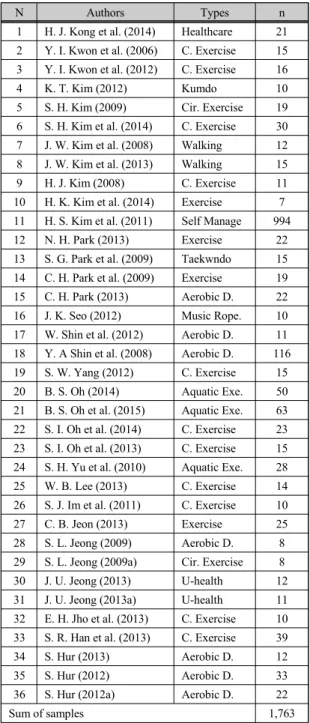
Table. 1 Studies used meta analysis
N Authors Types n
1 H. J. Kong et al. (2014) Healthcare 21 2 Y. I. Kwon et al. (2006) C. Exercise 15 3 Y. I. Kwon et al. (2012) C. Exercise 16
4 K. T. Kim (2012) Kumdo 10
5 S. H. Kim (2009) Cir. Exercise 19 6 S. H. Kim et al. (2014) C. Exercise 30 7 J. W. Kim et al. (2008) Walking 12 8 J. W. Kim et al. (2013) Walking 15
9 H. J. Kim (2008) C. Exercise 11
10 H. K. Kim et al. (2014) Exercise 7 11 H. S. Kim et al. (2011) Self Manage 994
12 N. H. Park (2013) Exercise 22
13 S. G. Park et al. (2009) Taekwndo 15 14 C. H. Park et al. (2009) Exercise 19 15 C. H. Park (2013) Aerobic D. 22 16 J. K. Seo (2012) Music Rope. 10 17 W. Shin et al. (2012) Aerobic D. 11 18 Y. A Shin et al. (2008) Aerobic D. 116 19 S. W. Yang (2012) C. Exercise 15 20 B. S. Oh (2014) Aquatic Exe. 50 21 B. S. Oh et al. (2015) Aquatic Exe. 63 22 S. I. Oh et al. (2014) C. Exercise 23 23 S. I. Oh et al. (2013) C. Exercise 15 24 S. H. Yu et al. (2010) Aquatic Exe. 28 25 W. B. Lee (2013) C. Exercise 14 26 S. J. Im et al. (2011) C. Exercise 10
27 C. B. Jeon (2013) Exercise 25
28 S. L. Jeong (2009) Aerobic D. 8 29 S. L. Jeong (2009a) Cir. Exercise 8
30 J. U. Jeong (2013) U-health 12
31 J. U. Jeong (2013a) U-health 11 32 E. H. Jho et al. (2013) C. Exercise 10 33 S. R. Han et al. (2013) C. Exercise 39
34 S. Hur (2013) Aerobic D. 12
35 S. Hur (2012) Aerobic D. 33
36 S. Hur (2012a) Aerobic D. 22
Sum of samples 1,763
This study filtered research papers published in Korean academic journals with the study criteria and then targeted a total of 36 papers for this study purpose.
The following Table 1 is the list of authors and types
used the raw data for the meta analysis. By using the collected the raw data, to calculate the number of standard deviations and samples were coded that be verified studies Influencing between pre and post in metabolic syndrome risk factors. Therefore, the mean, standard deviation and the number of samples was calculated the effect size using Equation 1.
(1)
Mean of Post Group
Mean of Pre Group
Combined Standard Deviation
Sample size of Post Group
Sample size of Pre Group
Standard Deviation of Post Group
Standard Deviation of Pre Group
To understand whether the value extracted from the same population was calculated using the equation 2 proposed by Hedges & Stock [11].
(2)
Coefficient of Homogeneity
Inverse Weighted Values
Size of Effect
(3)
Number Fail-safe
Number of Papers
Size of Effect
Small Size of Effect
In the stability test, the publication bias occurs because the data sampled for use only paper published in order to a meta analysis. Orwin [14] was devised to overcome this problem that resolved through the test of stability. The test of stability is shown in Equation 3. In Orwin [12], the author proposed a method to interpret the effect size, where ESr ≤ .10 is defined as a small effect size; ESr = .25, a medium effect size; and ESr ≥ .40, a large effect size.
Ⅲ. META ANALYSIS
The homogeneity test in the meta analysis was performed on these research subjects to find that the effect sizes of multiple independent studies are values extracted from the same population. The null hypothesis for the statistical homogeneity test is that there is no difference in the estimated effect sizes of the individual study results. Therefore, if the null hypothesis is proved, we can perform a meta analysis to obtain estimates of the overall effect size by incorporating effect size estimates. The interpretation of the homogeneity test is based on a chi-square distribution of the test statistic, Q value, since the Q value is equal to the chi-square distribution [13,14]. The results of the homogeneity test con-ducted in this study are presented in Table 2.
Table. 2 Results of homogeneity test
Paths df Critical
region Q P
(WC) Pre → Post 26 38.9 104.6 .000 (SBP) Pre → Post 25 37.6 66.2 .000 (DBP) Pre → Post 28 41.3 118.3 .000 (FBG) Pre → Post 29 42.6 172.7 .000 (TG) Pre → Post 29 42.6 73.4 .000 (HDL-C) Pre → Post 29 42.6 660.3 .000 Q: Q statistics, df: degree of freedom
Q values from paths between (WC) Pre → Post,
(SBP) Pre → Post, (DBP) Pre → Post, (FBG) Pre →
Post, (TG) Pre → Post and (HDL-C) Pre → Post are 104.6, 66.2, 118.3, 172.7, 73.4 and 660.3, respectively.
When the degrees of freedom are 26, 25, 28, 29, 29 and 29, the limit values of the chi-squared distribution become 38.9, 37.6, 41.3, 42.6, 42.6 and 42.6, respectively where p = .05. Since the Q values are larger than the limit values, the null hypothesis of homogeneity is rejected. Thus, we can establish an estimation that these are extracted from a heterogeneous population, rather than the same population. This explains that the distribution of effect sizes in all paths exceeds the standard error. In this heterogeneous case, we calculate the average effect size by using calibrated inverse variance weighting values with the random- effects model, not the fixed-effects model [13,14].
The most problematic issue of integrating studies for the meta analysis is the one related to study bias where unpublished papers were integrated with published papers into this study sample. Unpublished papers cover cases in which researchers may commit errors with insignificant research results, miss the right time of publication, and/or not meet the screening requirements of the reviewers. These problems are called publication bias, or the file drawer problem, and are explained to commit Type I mistakes [15]. This implies that papers published in journals have a high likelihood of positive results as compared to unpublished papers.
In the meta analysis, we review the validity of the research by checking the deflection possession through the stability factor, or the concept of fail-safe N. In particular, the stability factor or fail-safe N is the number of necessary studies to flip the significant findings into insignificant findings [14]. If the stability factor is 10, for example, the findings can be changed to a low effect size when 10 papers of effect size 0 are added. When fail-safe N is greater or the number of added papers is large, we can conclude that the consolidated treatment effect through a meta-analysis is true unless there is a sufficient number of unfound or unpublished papers. Based on the theory above, the results calculated using the medium effect size
suggested by Cohen [12] a represented in Table 3.
Therefore, any problem of publication bias is not found in any of the considered paths.
Table. 3 Results of calculator for fail-safe number
Paths N d, r Nfs dc
(WC) Pre → Post 27 .420 29.7
.2 (SBP) Pre → Post 26 .375 22.7 (DBP) Pre → Post 29 .234 4.9 (FBG) Pre → Post 30 .368 25.2 (TG) Pre → Post 30 .303 15.4 (HDL-C) Pre → Post 30 -.402 30.3
N: number of studies, d, r: effect size, Nfs: number fail-safe, dc: small effect size
Ⅳ. CONCLUSION and DISCUSSIONS
This study reanalyzed the research papers with the purpose to classify the results of the previous studies [16] which causal relationships between pre and post of waist circumference, blood pressure, fasting blood glucose, triglycerides, and fasting high density lipoprotein cholesterol in the designed metabolic syndrome risk factors published Korean academic journals during 2005 and 2015. Based on information from these literature reviews, paths presented in the conceptual model in this study are converted to values of average effect size by using calibrated inverse variance weighting values and a random-effects model, as shown in Table 3. After considering the meta-analysis results in detail, first, we concluded that the path between pre and post of the waist circumference had the largest effect size of (r = .420). Therefore, the effect of the mediator exercise shows an explanatory power of 18%, similar to the research study of Jho & Jho [10]. Next, the effect size in the path between pre and post of the high density lipoprotein cholesterol is (r = -.401), similar to the waist circumference. However, a comparative analysis is not possible since there is no prior meta analysis research.
Also, the effect size in the path between pre and post of
the systolic blood pressure is (r = .375), the effect of the mediator exercise shows an explanatory power of 14%.
Next, the effect size of the path between the fasting blood glucose is (r = .368), similar to the waist circumference, the effect of the mediator exercise shows an explanatory power of 14%.
Next, the effect size of the path between the triglyceride is (r = .303). Therefore, this result is lower than the effect size of the others metabolic syndrome risk factors. Finally, the effect size of the path between the diastolic blood pressure is (r = .234), the effect of the mediator exercise showed the lowest than the others metabolic syndrome risk factors. In conclusion, even though we failed to perform comparative analyses with other variables presented in the conceptual model in this study but not studied in previous meta analysis studies, the result of the study is significant in that we can estimate effect sizes on the basis of paths. We expect that the results of by this study would be touchstones to researchers in similar studies.
REFERENCES
[ 1 ] S. H. Kim, O. K. Yu, M. S. Byun, Y. S. Cha and T. S. Park,
“Effects of Weight Management Program for Middle Aged Women with Metabolic Syndrome Risk Factors,” The Korean Journal of Obesity, vol. 23, no. 2, pp. 106-115, 2014.
[ 2 ] International Diabetes Federation, The IDF consensus worldwide definition of the metabolic syndrome, 2006.
[ 3 ] K. G. Alberti and P. Z. Zimmet “Definition, diagnosis and classification of diabetes mellitus and its complications. Part 1: Diagnosis and classification of diabetes mellitus provisional report of a WHO consultation,” Diabetic Medicine, vol. 15, no. 7, pp. 539-553, 1998.
[ 4 ] E. Kim and S. W. Oh, “Gender differences in the association of occupation with metabolic syndrome in Korean adults,”
The Korean Journal of Obesity, vol. 21, no. 2, pp. 108-114, 2012.
[ 5 ] A. S. Gami, B. J. Witt, D. E. Howard, P. J. Erwin, L. A.
Gami and V. K. Somers, "Metabolic syndrome and risk of incident cardiovascular events and death: A systematic review and meta-analysis of longitudinal studies,” Journal of the American College of Cardiology, vol. 49, no. 4, pp.
403-414, 2007.
[ 6 ] O. K. Yu, S. H. Park and Y. S. Cha, “Eating Habits, Eating Behaviors and Nutrition Knowledge of Higher Grade Elementary School Students in Jeonju Area,” Korean Journal Food Culture, vol. 22, no. 6 pp. 665-672, 2007.
[ 7 ] K. B. Kim, K. I. Lim, W. Y. So, S. K. Park and W. Song, “A Meta-analysis of the Effects of Exercise Therapy,” Applied in Obesity Studies, vol. 16, no. 4, pp. 177-185, 2007.
[ 8 ] World Health Organization, The Asia-Pacific perspective:
redefining obesity and its treatment, Geneva, Ref Type:
Report, 2000.
[ 9 ] H. Y. Lee, “Effectiveness of Obesity Management Programs: Systematic Rewiew and Meta-analysis,” Journal of Korean Society for Health Education and Promotion, vol.
24, no. 4, pp. 131-146, 2007.
[10] W. S. Jho and S. M. Jho, “An Analysis of Research on the Impact of School-Based Physical Education for Preventing Students' Obesity: Systematic Review and Meta Analysis,”
The Korean Journal of Obesity, vol. 22, no. 3, pp. 167-176, 2013.
[11] L. V. Hedges and W. Stock, “The Effects of Class Size: An Exzmination of Rival Hypotheses,” American Education Res. Journal, vol. 20. no. 1, pp. 63-85, 1983.
[12] J. Cohen, Statistical Power Analysis for the Behavioral Sciences(Revised Edition), New York: Academic Press, 1977.
[13] S. S. Oh, Meta-analysis : Theory and Practice, Konkuk University Publication, 2009.
[14] R. G. Orwin, “A fail-safe N for Effect Size,” Journal of Educational Statistics, vol. 8, no. 2, pp. 157-159, 1983.
[15] R. Rosenthal, “Combining Probabilities and the File Drawer Problem,” valuation in Education, vol. 4, pp. 18-21, 1980.
[16] S. T. Nam, C. Y. Jin and J. S. Sim, “A Meta-analysis of the Relationship between Mediator Factors and Purchasing Intention in E-commerce Studies,” Journal Information Communication Convergence Engineering, vol. 12, no. 4, pp. 257-262, 2014.
Ok-kyeong Yu, First Author
Professor : Chonbuk National University
※Interesting Fields : Food Science & Human Nutrition, Obesity & Diet
Youn-soo Cha, Co-Author
Professor : Chonbuk National University
※Interesting Fields : Food Science & Human Nutrition, Obesity & Metabolic Syndrome
Chan-yong Jin, Co-Author
Professor : Wonkwang University
※Interesting Fields : MIS, E-Business, Venture Start-up, Big-Data
Do-goan Kim, Co-Author
Professor : Wonkwang University
※Interesting Fields : MIS, E-Business, Technology Start-up, Big-Data
Soo-tai Nam, Corresponding Author
Lecturer : Wonkwang University
※Interesting Fields : MIS, E-Business, Technology Management, Big-Data, Internet of Things