열성 경련에 대한 중의학 임상 연구 동향 - RCT를 중심으로 -
이보람․이은주․이지홍․장규태
경희대학교 대학원 소아과학교실
Abstract
Review of Clinical Research on Effect of Traditional Chinese Medicine for Febrile Seizure
Lee Bo Ram․Lee Eun Ju․Lee Ji Hong․Chang Gyu Tae Department of Korean Pediatrics, Graduate School, Kyung Hee University
Objectives
The purpose of this study is to provide clinical evidence of Korean medicine for febrile seizure by review of randomized controlled trials on the effect of TCM (traditional Chinese medicine) for febrile seizure.
Methods
We searched randomized controlled trials about TCM treatment of febrile seizure from the China National Knowledge Infrastructure (CNKI) (January 2008 to June 2016). The selected literatures were assessed by Jadad scale.
Results
40 papers were selected from 160 studies. Analyses of selected studies indicated that the TCM treatment group has significantly higher cure rate for febrile seizure than first aid or western medicine group. The most commonly used herbs were Gardeniae Fructus (梔子), Uncariae Ramulus cum Uncis (鉤藤), Cornus Gazeliae (羚羊角), Margarita (珍珠), Scutellariae Radix (黄芩), Glycyrrhizae Radix (甘草). The most commonly used acupoints were GV26 (人中), LI4 (合谷), KI1 (湧泉), GV20 (百會). There were no serious adverse events reported from the TCM treatment group during the treatment period.
Conclusions
TCM has been shown as not only effective but also safe treatment on febrile seizure. This finding can be widely utilized in clinical practice and can form the basis for development of clinical practice guidelines in future.
Key words : Febrile seizure, Traditional chinese medicine, Children, Randomized controlled trial, Jadad scale
Received: July 22, 2016 ∙ Revised: August 13, 2016 ∙ Accepted: August 16, 2016 Corresponding Author: Chang Gyu Tae
Department of Pediatrics of Korean Medicine, Kyung Hee University Hospital at Gang-dong, 892 Dongnam-ro, Gangdong-gu, Seoul 134-727, Republic of Korea Tel: +82-2-440-7126, Fax: +82-2-440-7143
E-mail: [email protected]
ⓒ The Association of Pediatrics of Korean Medicine. All rights reserved. This is an open-access article distributed under the tenus of the Creative Commons Attribution Non-Commercial License (http://creativecommons.org/licenses/by-nc/3.0/), which permits unrestricted non-commercial use, distribution, and reproduction in any medium, provided the original work is properly cited.
ISSN 1226-8038(Print), 2287-9463(Online), http://dx.doi.org/10.7778/jpkm.2016.30.3.078
Ⅰ. Introduction
열성 경련은 소아에서 나타날 수 있는 가장 흔한 경 련성 질환으로 소아기 경련 중 2/3을 차지하며1), 생후 3개월에서 5세 사이의 소아에서 중추 신경계통의 감염 증이나 대사 질환 없이 열과 동반되어 발생하는 경련 질환을 말한다2). 열성 경련의 유병율은 인종 및 지역에 따라 다르며 유럽이나 미국에서는 5세 이하 소아의 3-5%가 적어도 한 번 이상의 열성 경련을 경험하고 개 발도상국이나 동양권에서는 유병율이 높아 일본에서 는 7-8%가 경험하게 되며, 우리나라도 이와 비슷할 것 으로 생각된다3).
열성 경련을 겪은 환자들이 병원에 도착했을 때는 이미 경련이 멈춘 상태가 많고 지속시간이 짧아 대부 분의 경우 경련에 대한 약물치료가 필요하지 않다. 또 한 열성 경련의 예방을 목적으로 하는 지속적인 항경 련제의 사용은 대부분의 환자에게 잠재적인 이득보다 위험이 높아 더 이상 추천되지 않는다4). 열성 경련 환 아에게 해열제를 사용하는 것은 불편감을 덜어주어 전 반적인 관리에 도움을 줄 수 있으나, 해열요법이 열성 경련의 재발률을 낮춘다는 근거는 없다5).
韓醫學에서 열성 경련은 急驚風의 범주에 속하며, 急驚風의 증상은 발병이 暴急하여 高熱이 나고, 神志 煩急, 大便秘結, 小便澁難, 痰壅氣促, 牙關緊急한다.
치료법은 발작시 鍼灸治療로 대개 頭部에 있는 開竅安 神 하는 穴位를 많이 사용하며, 外感驚風, 痰食驚風, 驚恐驚風으로 辨證하여 銀翹散加味, 羚羊鉤藤湯, 玉 樞丹, 抱龍丸 등의 처방이 쓰인다6-7).
열성 경련을 자주 경험하는 부모와 가족들은 열성 경련의 재발과 예방에 관심을 가지게 되며9), 많은 보호 자들이 한방치료가 열성 경련을 예방하며, 증상을 완 화시키는 효과가 있어 긍정적인 기대를 가지고 있다는 연구도 있다10). 하지만 열성 경련에 대한 국내 연구는 Kim 등11)의 동서의학적 고찰 (1992), Choi 등10)의 어머 니의 인식도 조사 (2004), Han 등12)의 최신 지견 (2007) 으로 최근 9년간 관련 연구가 없는 실정이다. 따라서 본 연구는 최근 9년간 중국에서 출판된 열성 경련에 한방치료를 시행한 무작위 대조군 연구를 고찰하여 열 성 경련의 한의학적 치료에 관한 연구의 기초 자료로 제시하며, 향후 임상에서의 적용 및 진료지침 개발에 응용할 수 있도록 빈용된 약재와 穴位를 파악하고, 치 료의 유효성과 안전성에 대하여 고찰하고자 한다.
Ⅱ. Materials and methods
1. 선정기준
연구대상의 선정기준으로는 다음의 세 기준을 모두 만족하는 문헌을 대상으로 하였다.
1) 무작위 대조군 연구 (randomized controlled trial, RCT)로 시행된 연구
2) 열성 경련 환아 또는 열성 경련의 기왕력이 있는 환아를 대상으로 한 연구
3) 열성 경련의 급성기 치료 또는 재발 방지의 목적 으로 한의학적 중재법을 사용한 연구
2. 검색원 및 검색전략
검색원으로는 중국 국내 데이터베이스 검색 사이트인 중국학술정보원 (China National Infrastructure, CNKI) 을 사용하였다. 검색범위는 醫藥衛生科技에서 中醫學, 中藥學, 中西醫結合에 한정하였고, 검색어는 ‘高熱驚 厥’, ‘熱性驚厥’, ‘熱驚厥’, ‘熱痙攣’을 사용하였다. Han 등12)의 기존 연구에서 1999년부터 2007년까지 열성 경 련 치료에 관한 중의학 문헌을 고찰하였으므로, 2008 년 1월부터 2016년 6월까지 발표된 문헌을 대상으로 하였다. 검색일은 2016년 7월 1일이었다.
3. 문헌 선택
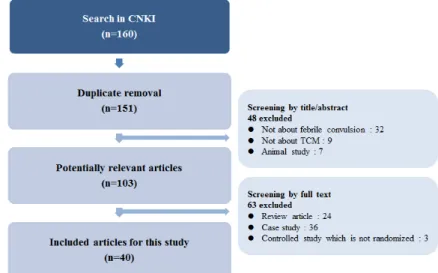
검색을 통해 CNKI에서 160편의 문헌이 검색되었고 그 중 9편의 중복된 문헌을 제외한 후 총 151편의 문헌 이 검색되었다. 먼저, 연구자가 1차로 제목 (title)과 초 록 (abstract)을 검토하여 열성 경련과 관련 없는 문헌 32편, 중의학과 관련 없는 문헌 9편, 동물 연구 7편을 제외하고 103편의 문헌이 선정되었다. 선정된 문헌을 대상으로 전문 검토를 통해 다시 선정기준에 맞지 않 는 논문을 제외하였다. 종설 문헌 (review article) 24편, 증례군 연구 (case study) 36편, 무작위화에 대한 언급이 없는 대조군 연구 (controlled study which is not random- ized) 3편으로 총 63편의 문헌이 제외되어 최종적으로 40편의 문헌이 선정되었다 (Fig. 1).
4. 자료수집 및 추출항목
선정된 문헌을 대상으로 열성 경련의 급성기 처치 와 열성 경련의 기왕력이 있는 환아를 대상으로 재발 방지를 위한 예방적 치료로 나누어서 자료를 수집하였
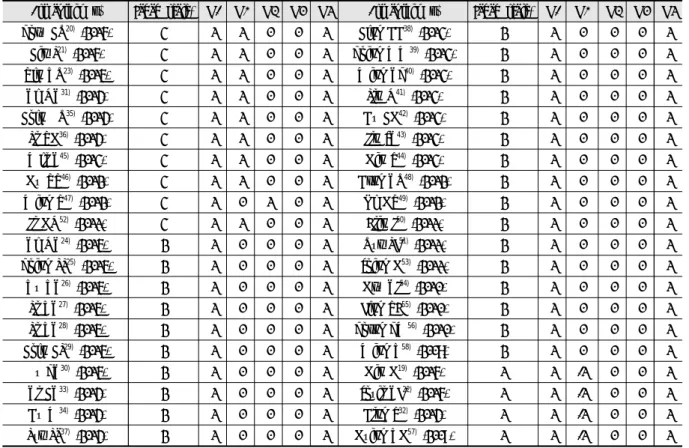
다. 각 문헌에서 연구 설계와 연구 대상의 인구통계학 적 정보, 치료방법, 치료기간, 추적기간, 평가지표와 치 료결과 및 안전성에 관한 정보를 추출하였으며, 각 문 헌을 Jadad scale로 평가하여 요약하였다 (Table 1). 중재 로 사용된 한의학적 치료방법은 따로 도표로 정리하였 다 (Table 2). 또한 변증을 시행하였는지 여부와 사용된 약재 및 穴位에 대한 정보를 분석하였다.
5. 개별 문헌의 비뚤림 위험
선정된 문헌은 Jadad scale13)로 질적 평가를 시행하 였다. Jadad scale은 Oxford quality scoring system이라고 도 알려져 있으며, 1996년 Jadad에 의해 개발된 RCT 문헌을 평가하기 위한 척도이다. 이는 세계적으로 가 장 많이 사용되는 평가도구 중의 하나이며18), 빠른 시 간 내에 평가하고자 하는 무작위 대조군 연구의 질적 인 평가를 할 수 있다는 장점이 있다. 총 5문항으로 구 성되며, 무작위 할당에 관한 평가문항 2개와 이중 맹검 에 관한 문항 2개, 철회와 탈락에 관한 문항 1개로 구 성되어있다. 1점부터 5점까지의 점수로 표현되고, 평 가 점수가 0-2점인 문헌은 질이 낮은 것으로, 3-5점인 문헌은 질이 높은 것으로 평가한다.
Ⅲ. Results
1. 연도별 분포
연도별 분포는 2016년 4편, 2015년 8편, 2014년 7 편, 2013년 8편, 2012년 4편, 2011년 4편, 2010년 3편,
2009년 1편, 2008년 1편이었다.
2. 연구 설계
열성 경련의 급성기 치료에 관한 문헌은 35편, 열성 경련의 과거력이 있으면서 발열이 24시간 이내로 지속 된 환아 또는 상기도 감염에 이환된 환아를 대상으로 열성 경련의 재발 방지를 위한 예방적 치료에 관한 문 헌은 5편이었다. 각 문헌의 연구 설계 방법은 Table 3 에 정리하였다 (Table 3).
3. 치료방법
열성 경련 환아의 응급처치로는 기도 유지, 산소 공 급, 냉각요법, 철처한 관찰 (Close observation)이 주로 사용되었다. 양약치료로는 diazepam, phenobarbital 등 의 진정제 및 신경안정제, penicillin, ampicillin 등의 항 생제와 ribavirine 등의 항바이러스제, dexamethasone 등 의 항염제, ibuprofen, aspirin 등의 해열제가 주로 사용 되었다. 각 문헌에서 사용된 한방치료의 빈도를 살펴 보면, 한약은 경구 한약 17편, 주사제 7편으로 가장 다 빈도로 활용되었으며, 침 치료는 14편, 穴位 지압은 7 편, 보류관장은 7편, 혈위첩부요법은 2편, 추나요법과 放血, 背兪穴 刮痧療法은 각 1편에서 활용되었다.
열성 경련의 급성기 치료에는 침, 穴位 지압, 한약, 보류관장, 放血, 혈위첩부요법, 背兪穴 刮痧療法 등이 다양하게 사용되었고, 열성경련의 재발 방지를 위한 예방적 치료에 사용된 한방치료는 모두 한약으로 羚角 鉤藤湯, 固本防驚湯, 七厘散, 自擬通腑瀉熱湯, 熱毒寧 注射液이었다.
Fig. 1. Flowchart of the study selection process
1st author (y)
Sam ple
C Mean age (y)
/ Female (%) Tx Tx period /
F/U period Evaluation method Result Adverse events
Jadad scale T
FA + WM vs. FA + WM + TCM (17 Articles)
Han H19) (2016) 70
35
2.4 ± 1.5 / 45.7
FA, WM (Sedatives)
8h / -
1) Seizure duration 2) Time until conscious 3) Hospital stay 4) Complication rate
1) T<C*
2) T<C*
3) T<C*
4) T<C*
- 1
35 C + Acupressure, A-Tx, HM retention enema
Zhou CQ20) (2016)
74
37 5.2 ± 3.5 / 48.6
FA, WM (Sedatives, anti-infective drug)
Until temparature
normal for 24-48h / -
1) Total effective rate 2) Fever duration
3) Recurrence frequency (rate) 4) Recurrence temparature 5) EEG abnormality 6) Epileptiform discharge
1) T>C*
2) T<C*
3) T<C*
4) T<C*
5) T<C*
6) T<C*
4 (10.8%)
3 37 5.1 ± 3.4 /
45.9 C + HM 3 (8.1%)
Cao L21) (2016) 120
60 5.23 ±
1.92 / 43.3 FA, WM (Sedatives)
3d / - 1) Total effective rate 2) Adverse events rate
1) T>C*
2) T<C*
11 (18.33%)
2 60 5.14 ±
2.25 / 48.3
C + HM retention
enema 1 (1.67%)
Shuai YF22)
(2016) 60 30 2.5 ± 1.3 / 43.3
FA, A-Tx, WM (Ibuprofen and diazepam retention enema)
C: 30min, T: 1d / 1y
1) Total effective rate 2) IQ value
1) T>C*
2) T>C*
No adverse events.
1
30 C + HM
Ren XQ23)
(2015) 80 40 - / 47.5 FA, WM
(Phenobarbital) Until seizure
stopped / - Total effective rate T>C* - 3
40 - / 45 C + Acupressure
Chen CL29) (2015) 90
45 3.2 ± 0.7 / 44.4
FA, WM (Diazepam, phenobarbital)
-
1) Total effective rate 2) Fever duration 3) Seizure duration 4) Seizure interval 5) Number of recurrence
1) T>C*
2) T<C*
3) T<C*
4) T>C*
5) T<C*
- 2
45 3.3 ± 0.8 / 48.9
C + Acupressure, A-Tx, Baesuhyeol meridian scraping or Bloodletting, Chuna manual therapy, HM retention enema, Dietary intervention
Gu ZY30) (2015) 72
36 2.6 ± 0.9 / 41.7
FA, WM (Phenobarbital, diazepam)
-
1) Seizure duration 2) Time until conscious 3) Recurrence rate
1) T<C*
2) T<C*
3) T<C*
- 2
36 2.7 ± 0.8 / 44.4
C + A-Tx, Dietary intervention, Psychological care
Li RH36) (2014) 68
34 3.25 ± 1.11 / 52.9
FA, WM (Diazepam, phenobarbital, choloral
hydrate) 21d / -
1) Total effective rate 2) Seizure duration 3) Time until conscious 4) Hospital stay
1) T>C*
2) T<C*
3) T<C*
4) T<C*
No adverse events.
3 34 3.27 ±
1.12 / 47.1 C + Acupressure, A-Tx
Luo LP37) (2014) 142
71
- / 42.3
FA, WM (Sedatives) Until a few minutes after
stopping seizure / -
1) Seizure duration 2) Time until conscious 3) Recurrence rate 4) Hospital stay
1) T<C+
2) T<C+
3) T<C+
4) T<C+
- 2
71 C + A-Tx (≥2y) or
acupressure (<2y), HM
Wang YZ40) (2013)
102 51 3.1 / 51
FA, WM (Sedatives, antibiotics,
antipyretics) - Total effective rate T>C* - 2
51 2.8 / 45.1 C + HM, A-Tx Table 1. Analysis of Articles
1st author (y)
Sam ple
C Mean age (y)
/ Female (%) Tx Tx period /
F/U period Evaluation method Result Adverse events
Jadad scale T
Lin M41)
(2013) 83 40
- / 34.9
FA, WM (Antipyretics,
sedatives, antibiotics) 5-7d / - Total effective rate T>C*
No adverse events.
2
43 C + HM
Jin SY43) (2013) 68
34
- / 41.2
FA, WM (Sedatives)
2-3min / -
1) Seizure duration 2) Time until conscious 3) Hospital stay 4) Complication rate
1) T<C*
2) T<C*
3) T<C*
4) T<C*
- 2
34 C + Acupressure, A-Tx
Hu RR46) (2012) 92
46 4.20 ±
0.60 / 45.7 FA, WM (Sedatives)
- Total effective rate T>C*
1 3 46 4.50 ±
0.50 / 47.8 C + HM 2
Wang R47) (2012) 83
40
7 / 44.6
FA, WM (Sedatives, antibiotics, antiviral
drug) 3d / - Total effective rate T>C* - 3
43 FA, WM (Antibiotics), HM retention enema
Bian J50)
(2011) 42 12 - / 33.3
FA, WM (Aminophyrine, phenobarbital, dexamethasone, antibiotics, antiviral drug)
Until waking
conscious / - Total effective rate T>C* - 2
30 - / 43.3 C + A-Tx
Feng TB55)
(2010) 68 32 - / 46.9
FA, WM (Diazepam, aminopyrine, infection
control) - Total effective rate T>C+ - 2
36 - / 50 C + HM Zhong
ZW56) (2010)
70 34
- / 34.3
FA, WM (Sedatives,
infection control) 5d / -
1) Total effective rate 2) Seizure duration 3) Recurrency rate
1) T>C*
2) T<C+
3) T<C*
- 2
36 C + HM
WM vs. WM + TCM (12 Articles)
Li XY28)
(2015) 50 25 2.74 / 52 WM (Anti-infective
drug) 3d / - Total effective rate T>C*
No adverse events.
2 25 2.61 / 48 C + HM
Ding T32) (2014) 62
30 - / 43.3
WM (Antibiotics, antiviral drug, sedatives)
3d / -
1) Total effective rate 2) Fever duration 3) Complete coolling time 4) Associated symptoms
(headache, stuffiness, sneezing, runny nose, sore throat, chilling, general malaise, eating less) disappearance time
1) T>C*
2) T<C*
3) T<C*
4) T<C*
No adverse events.
1 32 - / 43.8 C + Acupoint herbal
patching
Yi CY33) (2014) 59
30
2.6 ± 1.5 / 45.8
WM (Sedatives, antipyretics, anti-infective drug)
1d / 1y
1) Seizure duration 2) Time until waking
conscious
3) Number of recurrence 4) Recurrence rate after 1y 5) Body temparature (after 15,
30, 60min)
1) T<C*
2) T<C*
3) T<C*
4) T<C*
5) T<C*
(after 60min p>0.05)
No adverse events.
2
29 C + A-Tx, HM
Chen GQ35)
※ (2014)
64 32 - / 37.5 WM (Antipyretic drug, diazepam)
Until temparature normal (24-48h
1) Number of fever 2) Number of seizure 3) Recurrence rate
1) T<C*
2) T<C*
3) T<C*
5 (15.6%) 3
32 - / 34.4 C + HM 2 (6.25%)
1st author (y)
Sam ple
C Mean age (y)
/ Female (%) Tx Tx period /
F/U period Evaluation method Result Adverse events
Jadad scale T
without fever) /
1y 4) Epilepsy rate 4) T<C*
Ceng DD38) (2013)
70 40 2.5 / 45 WM (Anti-infective
drug, antipyretics) 7d / 1y
1) Fever duration during hospitalization 2) Number of cases of
recurrent
1) T<C+
2) T<C*
No adverse events. 2
35 2 / 48.6 C + HM 1
Du CH42) (2013) 62
31 3.13 ± 0.41 / 38.7
WM (Ibuprofen and diazepam enema)
-
1) Total effective rate 2) Time of cough, sputum,
asthma, pulmonary rales remission
3) Body temparature (after 15, 30, 45, 60min)
1) T>C*
2) T<C*
3) T<C* (15, 30, 45min),
T>C (60min, p>0.05)
- 2
32 3.18 ±
0.47 / 37.5 C + HM
Wei Y45) (2013) 60
30 2 / 40
WM (Antipyretics) + After discharge for 1y, whenever fever
occurs, eat WM. 3-5d / 1y after discharge
1) Duration of fever 2) Number of recurrence
1) T<C*
2) T<C*
No adverse events.
3
30 2.5 / 43.3
C + HM
After discharge for 1y, whenever fever occurs, eat WM and HM
Quo LF51)
※ (2011) 109 53 1.5 / 45.2
WM (If infection exists, give antibiotics, antiviral drug, If >38.5
℃ give antipyretics.)
48h / - Seizure rate within 48h T<C* - 2
56 1.6 / 46.4 C + HM Ji
HM52)※ (2011)
60
30 2.59 ± 0.81 / 46.7
WM (Anti-infective drug)
3d / - Total effective rate T>C*
No adverse events.
3 30 2.56 ±
0.75 / 36.7 C + HM
Shang H53) (2011) 186
62 2.81 ± 0.80 / 45.1
WM (If infection exists, give anti-infective drug.
Give antipyretics for
fever) 2y
1) Number of fever 2) Number of cases of
recurrence 3) Recurrent frequency 4) Serum immunoglobulin
value after Tx (g/L)
1) T<C*
2) T<C+
3) T<C+
4) T>C+
No adverse events.
2 62 2.78 ±
0.79 / 38.7
WM + Phenobarbital (For fever for 3d) 62 2.8 ± 0.82
/ 43.5
WM + HM (1w after fever dropped) Huang
XH57) (2009)
76 36
- / 39.5
WM (Remedy of cause)
6-24h / - Total effective rate T>C+ - 1
36 C + Acupoint herbal
patching
Wang X58) (2008) 151
75
- / 41.7
WM (Antibiotics, antiviral drug, sedatives)
3-5d / -
1) Total effective rate 2) Fever duration 3) Seizure duration
4) Time until conscious after seizure
1) T>C*
2) T<C*
3) T<C*
4) T<C*
6 2
76 C + HM
No adverse
events FA + WM vs. FA + TCM (6 Articles)
Zhang LL25) (2015)
66 33 - / 42.4
FA, WM (Phenobarbital, diazepam, 10%
choloral hydrate, 0.9%
Until seizure stopped / -
1) Total effective rate 2) Seizure duration
1) T>C*
2) T<C* - 2
1st author (y)
Sam ple
C Mean age (y)
/ Female (%) Tx Tx period /
F/U period Evaluation method Result Adverse events
Jadad scale T
NaCl 20 ml retention enema)
33 - / 39.4 FA, A-Tx
Xu XY26) (2015) 92
46 5.4 ± 0.5 / 43.5
FA, A-Tx, WM (5%
cholral hydrate enema, If BT>39 ℃,
diazepam) 5d / -
1) Total effective rate 2) Frequency of syncope 5min
after Tx
3) Time for temparature descent by 1 ℃ 4) Syncope recovery time 5) Hospital stay
1) T>C*
2) T<C*
3) T<C*
4) T<C*
5) T<C*
- 2
46 5.5 ± 0.4 / 47.8
FA, A-Tx, HM retention enema
Li XY27) (2015) 76
38 2.8 ± 0.8 / 44.7
FA, A-Tx, WM (Diazepam,
phenobarbital) 7d / 1y
1) Total effective rate 2) Seizure duration 3) Fever duration
1) T>C*
2) T<C*
3) T<C*
No adverse events.
2 38 2.9 ± 0.6 /
47.4 FA, A-Tx, HM
Ye MY31)
# (2014) 90
30 - / 46.7 FA, Acupressure, WM (Diazepam)
C: 12h, T: until fever dropped / 4w
1) Total effective rate 2) Recurrent rate
3) Abnormal EEG after 2, 4w 4) Average score of symptoms
and signs after Tx 5) Hospital stay 6) Hospital charge
1) T>C*
2) T<C*
3) 2w: T<C+, 4w: T<C*
4) T<C+
5) T<C+
6) T<C+
No adverse events.
3 60 - / 45 FA, HM retention
enema
Du W34)
(2014) 88 44 - / 38.6 FA, WM (Diazepam) Until seizure
stopped / - Total effective rate T>C+ - 2
44 - / 36.4 FA + A-Tx
Han T44) (2013) 60
30 2.7 ± 0.6 / 40
FA, WM (Diazepam) + After discharge for 9m, whenever fever (>38.0 ℃) without seizure occurs,, eat oral
diazepam tablets. Until seizure stopped / 9m
1) Total effective rate 2) Fever duration 3) Seizure duration 4) Resting heart rate 5) Respiratory rate 6) Recurrence rate
1) T>C*
2) T<C*
3) T<C*
4) T<C*
(Before Tx), T>C*
(After Tx) 5) T<C*
6) T<C+
3 (10%)
2
30 3.1 ± 0.3 / 43.3
FA, HM
+ After discharge for 9m, whenever fever (>38.0 ℃) without seizure occurs,, eat HM.
1 (3.33%)
FA vs. FA + TCM (2 Articles)
Zhang WW39) (2013)
92
46 5.20 ± 0.61 / 45.7 FA
- Total effective rate T>C*
1 2 46 4.51 ±
0.51 / 47.8 C + HM 2
Ke HR49) (2012) 40
20 2.5 ± 1.2 / 47.5
FA Until seizure
stopped / - (by telephone)
1) Total effective rate 2) Telephone f/u recurrence
rate
1) T>C*
2) T<C (p>0.05)
- 2
20 C + Acupressure
WM vs. TCM (2 Articles)
Ye MY24)
# (2015) 100
50 - / 48 WM (Diazepam)
3d / 12w
1) Recurrent frequency after 24, 48h
2) Recurrency rate
3) Abnormal EEG rate after 4, 12w
1) T<C+
2) T<C+
3) T<C+
- 2
50 - / 44 HM retention enema
Dong YQ48)※
(2012)
272 134
- / 34.9 WM (Diazepam)
Until normal temperature /
1y
1) Total effective rate 2) TCM effective rate 3) Comparion of weight,
abnormal rate of EEG and
1) T>C+
2) T>C+
3) T>C*
(weight), T<C*
- 2
138 HM 30d / 1y
특정 변증의 환자만 포함하여 시행한 연구는 2편
24,31)이었다. 각각 중약 신약 임상연구 지침 (<<中藥新
藥臨床研究指導原則>>)24)과 중의아과학 제 5판 (<<中 醫兒科學>>), 열성경련처리지침 (<<熱性驚厥處理指 南>>)31)을 참고하여 溫熱疫毒으로 변증된 환자를 대상 으로 하였으며, 鉤藤, 蟬蛻, 僵蠶, 厚樸, 枳實 各 12 g, 大黃 6 g으로 구성된 鉤蟬承氣湯으로 보류관장 하였다.
사용된 약재의 빈도를 살펴보면 梔子가 13회로 가 장 많이 사용되었고, 鉤藤이 10회, 羚羊角이 9회, 珍珠, 黄芩, 甘草가 8회였다 (Table 4). 穴位의 빈도를 분석해 보면, 人中이 15회로 가장 많이 사용되었으며, 合谷 (13회), 湧泉 (10회), 百會 (6회), 內關 (5회), 曲池, 太衝, 十宣 (3회) 순서였다 (Table 5).
연구에 포함된 2편의 문헌에서는 생활 관리로 음식 지도를 병행29-30)하였으며, 열성 경련에 대하여 올바르 게 교육하고 회복될 수 있다는 자신감을 심어주는 등 심리치료를 병행하고 있는 문헌30)도 1편 있었다.
4. 치료기간
33편의 문헌에서 치료기간을 표기하였다. 치료기간 은 1일 이내 (5편), 3일 이내 (8편), 1주 이내 (7편), 1달 이내 (2편), 2년 (1편)이었으며, 체온이 24-48시간 정상 일 때까지 (4편), 경련이 멈출 때까지 (5편), 의식이 회 복될 때까지 (1편)도 있었다.
5. 추적기간
11편의 문헌에서 추적기간을 표기하였다. 9편은 열 성 경련의 급성기 치료 이후 추적 관찰하였고, 2편은 열성 경련의 재발방지를 위한 치료 이후 일정기간 추
적 관찰하였다. 추적기간은 4주 (1편), 12주 (1편), 9개 월 (1편), 1년 (8편)이었다.
6. 평가지표 및 치료결과
40편 중 29편의 문헌이 primary outcome으로 ‘총유 효율’을 평가하였으며, 한방치료를 시행한 치료군이 대 조군에 비하여 총유효율이 유의하게 높았다. 그 외 사 용된 평가지표로는 경련지속시간, 경련간격, 의식회복 시간, 발열기간, 실신빈도, 재발률, 뇌파 이상비율, 뇌 전증으로 이어진 비율, 부작용 발생 비율, IQ값, 입원 기간, 입원비용, 동반증상소실시간, 체온, 안정시 심박 수, 호흡수, 면역기능 등 다양하였다.
열성 경련의 급성기 치료에 관한 모든 문헌에서 치 료군이 대조군에 비하여 총유효율이 유의하게 높았으 며, 경련지속시간, 의식회복시간, 발열기간, 재발률 등 의 평가지표가 유의하게 낮았다. 9편에서는 급성기 치 료 이후 일정기간 추적 관찰하였는데, 치료군이 대조 군에 비하여 총유효율과 IQ값이 유의하게 높았고, 재 발률, 뇌파 이상비율이 유의하게 낮았다.
열성경련의 재발 방지를 위한 예방적 치료에 관한 문헌 5편 중 3편의 연구에서 치료군이 대조군에 비하 여 총유효율이 유의하게 높게 나타났으며, 총유효율로 평가하지 않은 나머지 2편의 연구에서는 발열 횟수, 경 련 횟수, 재발률, 뇌전증발생률, 48시간 내 경련발생비 율이 유의하게 낮게 나타났다. 2편의 연구에서는 치료 후에 일정기간 추적하여 발열 횟수, 경련 횟수, 재발률, 뇌전증발생률, 뇌파 이상비율, 면역기능 이상비율을 관찰하였는데, 치료군이 대조군에 비해 모두 유의하게 낮았다.
1st author (y)
Sam ple
C Mean age (y)
/ Female (%) Tx Tx period /
F/U period Evaluation method Result Adverse events
Jadad scale T
immune function after Tx
(abnormal rate of EEG, immune function) WM vs. TCM vs. WM + TCM (1 Articles)
Hou YJ54)
※ (2010) 160 53
- / 48.8
WM (Ganciclovir)
3d / - Total effective rate WM + HM >
WM, HM+ - 2
53 HM
54 WM + HM
C: control group, T: treatment group, Tx: treatment, FA: first aid (airway maintenance, supply of oxygen, dropping temparature, close observation), WM: western medicine, TCM: traditional Chinese medicine, HM: herbal medicine, A-Tx: acupuncture treatment, EEG: electroencephalogram, min: minute, h: hour, d: day, w: week, m: month, y: year
*: p<0.05, +: p<0.01
※: study for prevention of recurrence of febrile convulsion, #: study using 'pattern identification (辨證)'
First author
(y) TCM treatment of treatment group
Han H19) (2016)
Acupressure, A-Tx (PC8, GV20, LI4, KI1), HM retention enema (Lonicerae Flos (金銀花) 6 g, Anemarrhenae Rhizoma (知母) 6 g, Paeoniae Radix Alba (白芍藥) 5 g, Uncariae Ramulus cum Uncis (鉤藤) 5 g, Salviae Miltiorrhizae Radix (丹蔘) 4 g, Angelicae Gigantis Radix (當歸) 4 g, Carthami Flos (紅花) 4 g, Persicae Semen (桃仁) 4 g, Acori Graminei Rhizoma (石菖蒲) 4 g, Cornus Gazeliae (羚羊角) 1 g)
Zhou CQ20)
(2016) HM (Cornus Gazeliae (羚羊角)) Cao L21)
(2016) HM retention enema (Fufang xiaoer tuire suppository, 複方小兒退熱栓: Isatidis Radix (板藍根), Bovis Bezoar (牛黃)) Shuai YF22)
(2016) A-Tx (GV26, GV20, LI4, PC6, LI11), HM (Cornus Gazeliae (羚羊角)) Ren XQ23)
(2015) Acupressure (GV26, SP1, LI4) Ye MY24) #
(2015)
HM retention enema (Uncariae Ramulus cum Uncis (鉤藤) 12 g, Cicadae Periostracum (蟬蛻) 12 g, Bombycis Corpus cum Batryticatus (僵蠶) 12 g, Magnoliae Cortex (厚朴) 12 g, Aaurantii Immaturus Fructus (枳實) 12 g, Rhei Rhizoma (大黃) 6 g) Zhang LL25)
(2015) A-Tx (KI1) Xu XY26)
(2015)
A-Tx (GV26, LI4, KI1), HM retention enema (Fufang xiaoer tuire suppository, 複方小兒退熱栓: Isatidis Radix (板藍根), Bovis Bezoar (牛黃)))
Li XY27) (2015)
A-Tx (GV20, GV26, LI4, LI11, PC6), HM (Gaore Zhijing Decoction, 清熱止驚湯: Chrysanthemi Flos (菊花) 10 g, Uncariae Ramulus cum Uncis (鉤藤) 10 g, Paeoniae Radix Alba (白芍藥) 10 g, Cicadae Periostracum (蟬蛻) 10 g, Rehmanniae Radix (生地黃) 6 g, Aaurantii Immaturus Fructus (枳實) 6 g, Saposhnikovia Radix (防風) 6 g, Gardeniae Fructus (梔子) 6 g, Bupleuri Radix (柴胡) 5 g, Glycyrrhizae Radix (甘草) 3 g)
Li XY28) (2015)
HM (Tongfu Xiezhuo Decoction, 通腑瀉熱湯: Rhei Rhizoma (大黃) 10 g, Raphani Semen (蘿蔔子) 10 g, Paeoniae Radix Alba (白芍藥) 10 g, Bombycis Corpus cum Batryticatus (僵蠶) 10 g, Aaurantii Immaturus Fructus (枳實) 6 g, Cicadae Periostracum (蟬蛻) 6 g, Uncariae Ramulus cum Uncis (鉤藤) 3 g, Glycyrrhizae Radix (甘草) 3 g)
Chen CL29) (2015)
Acupressure (GV26, EX-HN3, LI4, LR3), A-Tx (GV26, KI1, LI4, PC6), Baesuhyeol meridian scraping (背兪穴 刮痧療法) or Bloodletting (EX-UE11, EX-LE10, GV14, EX-HN6), Chuna manual therapy (淸肺經, 淸河水, 推三關), HM retention enema, Dietary intervention
Gu ZY30)
(2015) A-Tx (GV26, KI1, LI4), Dietary intervention, Psychological care Ye MY31) #
(2014)
HM retention enema (Gouchan chengqi decoction, 鉤蟬承氣湯: Uncariae Ramulus cum Uncis (鉤藤) 12 g, Cicadae Periostracum (蟬蛻) 12 g, Bombycis Corpus cum Batryticatus (僵蠶) 12 g, Magnoliae Cortex (厚朴) 12 g, Aaurantii Immaturus Fructus (枳實) 12 g, Rhei Rhizoma (大黃) 6 g)
Ding T32) (2014)
Acupoint herbal patching (Zhijing san, 止痙散: Gardeniae Fructus (梔子) 10 g, Bombycis Corpus cum Batryticatus (僵蠶) 10 g, Achyranthis Radix (牛膝) 10 g, Rhei Rhizoma (大黃) 3 g, Asari Herba Cum Radix (細辛) 3 g) to KI1
Yi CY33) (2014)
A-Tx (GV26, PC6, LR3, KI1, not retention of needle), HM (after waking, Zixue san, 紫雪散: Gypsum Fibrosum (石膏), Glauberitum (寒水石), Talcum (滑石), Cornus Gazeliae (羚羊角), Bubali Cornu (水牛角), Cimicifugae Rhizoma (升麻), Scrophulariae Radix (玄蔘), Glycyrrhizae Radix (甘草), Natrii sulfas (朴硝), Niterum (硝石), Aucklandiae Radix (木香), Syzygii Flos (丁香), Aquilariae Resinatum Lignum (沈香), Moschi Moschus (麝香), Cinnabaris (朱砂), Magnetitum (磁石), Aurum (金箔)) Du W34)
(2014) A-Tx (GV25) Chen GQ35) ※
(2014)
HM (Lingjiao Gouteng tang, 羚角鉤藤湯: Glycyrrhizae Radix (甘草) 10 g, Uncariae Ramulus cum Uncis (鉤藤) 9 g, Chrysanthemi Flos (菊花) 9 g, Mori Folium (桑葉) 6 g, Cornus Gazeliae (羚羊角) 4.5 g)
Li RH36)
(2014) Acupressure, A-Tx (GV26, GV20, LI4, KI1, EX-UE11 for 2-3min) Luo LP37)
(2014)
A-Tx (≥2y) or acupressure (<2y) (GV26, KI1, LI4, PC6), HM (Bupleuri Radix (柴胡), Lonicerae Flos (金銀花), Isatidis Folium (大靑葉))
Ceng DD38)
(2013) HM (Cornus Gazeliae (羚羊角)) Zhang WW39)
(2013)
HM (Qingkailing injection, 清開靈注射液: Margarita (珍珠), Gardeniae Fructus (梔子), Bubali Cornu (水牛角), Isatidis Radix (板藍根), Lonicerae Flos (金銀花), Scutellariae Radix (黄芩))
Table 2. TCM Treatment of Treatment Group
First author
(y) TCM treatment of treatment group
Wang YZ40) (2013)
HM (Qingkailing injection, 清開靈注射液: Margarita (珍珠), Gardeniae Fructus (梔子), Bubali Cornu (水牛角), Isatidis Radix (板藍根), Lonicerae Flos (金銀花), Scutellariae Radix (黄芩)) (Angong niuhuang wan, 安宫牛黄九: Bovis Bezoar (牛黃), Curcumae Radix (鬱金), Rhinocerotis Cornu (犀角), Coptidis Rhizoma (黃連), Cinnabaris (朱砂), Gardeniae Fructus (梔子), Realgar (雄黃), Scutellariae Radix (黄芩), Margarita (珍珠), Borneolum (氷片), Moschi Moschus (麝香)), A-Tx (GV26, GV20, LI4, LI11) Lin M41)
(2013)
HM (Xingnaojing injection, 醒腦靜注射液: Moschi Moschus (麝香), Curcumae Radix (鬱金), Borneolum (氷片), Gardeniae Fructus (梔子))
Du CH42) (2013)
HM (Gaore Zhijing Decoction, 清熱止驚湯: Paeoniae Radix Alba (白芍藥) 12 g, Margarita (珍珠) 10 g, Chrysanthemi Flos (菊花) 8 g, Uncariae Ramulus cum Uncis (鉤藤) 8 g, Cicadae Periostracum (蟬蛻) 8 g, Saposhnikovia Radix (防風) 6 g, Bupleuri Radix (柴胡) 6 g, Gardeniae Fructus (梔子) 5 g, Isatidis Radix (板藍根) 5 g, Rehmanniae Radix (生地黃) 5 g, Aaurantii Immaturus Fructus (枳實) 5 g, Lonicerae Flos (金銀花) 3 g, Glycyrrhizae Radix (甘草) 2.5 g)
Jin SY43)
(2013) Acupressure, A-Tx (GV26, EX-UE11, GV20, LI4, KI1) Han T44)
(2013)
HM (Annao wan, 安腦丸: Bovis Bezoar (牛黃), Margarita (珍珠), Borneolum (氷片), Coptidis Rhizoma (黃連), Curcumae Radix (鬱金), Scutellariae Radix (黄芩), Suilus Fel (猪膽汁), Realgar (雄黃), Cinnabaris (朱砂), Gardeniae Fructus (梔子)) After discharge for 9m, whenever fever (>38.0 ℃) without seizure occurs, eat Annao wan.
Wei Y45) (2013)
HM (Niuhuang Qingxin Wan, 牛黄清心丸 3 g/d: Bovis Bezoar (牛黃), Rhinocerotis Cornu (犀角), Cornus Gazeliae (羚羊角), Hoelen cum Pini Radix (茯神), Angelicae Gigantis Radix (當歸), Ligustici Rhizoma (川芎), Glycyrrhizae Radix (甘草), Paeoniae Radix Alba (白芍藥), Bupleuri Radix (柴胡), Platycodi Radix (桔梗), Armeniacae Semen (杏仁), Ampelopsis Radix (白蘞), Borneolum (氷片), Scutellariae Radix (黄芩), Coptidis Rhizoma (黃連))
After discharge for 1y, whenever fever occurs, eat WM and HM Hu RR46)
(2012)
HM (Qinkailing injection, 清開靈注射液: Margarita (珍珠), Gardeniae Fructus (梔子), Bubali Cornu (水牛角), Isatidis Radix (板藍根), Lonicerae Flos (金銀花), Scutellariae Radix (黄芩))
Wang R47) (2012)
HM retention enema (Zhenjing Tuire suppository, 鎮驚退熱栓: Cornus Gazeliae (羚羊角), Bovis Bezoar (牛黃), Gypsum Fibrosum (石膏), Bupleuri Radix (柴胡))
Dong YQ48) ※ (2012)
HM (Guben Fangjing Decoction, 固本防驚湯: Codonopsis Pilosulae Radix (黨蔘), Atractylodis Rhizoma Alba (白朮), Poria (茯笭), Glycyrrhizae Radix (甘草), Astragali Radix (黃芪), Dioscoreae Rhizoma (山藥), Alpiniae Fructus (益智仁), Polygalae Radix (遠志), Arisaemae Radix cum Fel (膽星), Aconiti Koreani Tuber (白附子), Scorpio (全蝎), Bombycis Corpus cum Batryticatus (僵蠶))
Ke HR49)
(2012) Acupressure (GV26, EX-HN3, LI4, LR3) Bian J50)
(2011) A-Tx (GV26) Quo LF51) ※
(2011)
HM (Qili san, 七厘散: Myrrha (沒藥), Borneolum (氷片), Moschi Moschus (麝香), Acaciae Folium (兒茶), Olibanum (乳香), Cinnabaris (朱砂), Draconis Sanguis (血竭), Carthami Flos (紅花))
Ji HM52) ※ (2011)
HM (Self Tongfu Xiere decoction, 自擬通腑瀉熱湯: Rhei Rhizoma (大黃) 10 g, Raphani Semen (蘿蔔子) 10 g, Paeoniae Radix Alba (白芍藥) 10 g, Bombycis Corpus cum Batryticatus (僵蠶) 10 g, Cicadae Periostracum (蟬蛻) 6 g, Aaurantii Immaturus Fructus (枳實) 6 g, Uncariae Ramulus cum Uncis (鉤藤) 3 g, Glycyrrhizae Radix (甘草) 3 g)
Shang H53) (2011)
HM (Jianer-Fangjing decoction, 健兒防驚湯: Margarita (珍珠) 15 g, Galli Stomachichum Corium (鷄內金) 15 g, Astragali Radix (黃芪) 12 g, Polygonati Rhizoma (黃精) 9 g, Pseudostellariae Radix (太子參) 9 g, Angelicae Gigantis Radix (當歸) 9 g, Paeoniae Radix Rubra (赤芍藥) 9 g, Paeoniae Radix Alba (白芍藥) 9 g, Bambusae Concretio Silicea (天竺黃) 9 g, Jian Qu (建曲) 9 g, Cicadae Periostracum (蟬蛻) 9 g, Uncariae Ramulus cum Uncis (鉤藤) 9 g, Indigo Pulverata Levis (靑黛) 3 g) Hou YJ54) ※
(2010) HM (Reduning injection, 熱毒寧注射液: Artemisiae Apiaceae Herba (菁蒿), Lonicerae Flos (金銀花), Gardeniae Fructus (梔子)) Feng TB55)
(2010)
HM (Xingnaojing injection, 醒腦靜注射液: Moschi Moschus (麝香), Curcumae Radix (鬱金), Borneolum (氷片), Gardeniae Fructus (梔子))
Zhong ZW56) (2010)
HM (Angong niuhuang wan, 安宫牛黄九: Bovis Bezoar (牛黃), Curcumae Radix (鬱金), Rhinocerotis Cornu (犀角), Coptidis Rhizoma (黃連), Cinnabaris (朱砂), Gardeniae Fructus (梔子), Realgar (雄黃), Scutellariae Radix (黄芩), Margarita (珍珠), Borneolum (氷片), Moschi Moschus (麝香))
Huang XH57)
(2009) Acupoint herbal patching (Stick Gardeniae Fructus (栀子), Persicae Semen (桃仁) to KI1 for 6-8 hours) Wang X58)
(2008)
HM (Tanreqing injection, 痰热清注射液: Scutellariae Radix (黄芩), Selenarctotis Fel (熊膽), Cornus Gazeliae (羚羊角), Lonicerae Flos (金銀花), Forsythiae Fructus (連翹))
TCM: traditional Chinese medicine, A-Tx: acupuncture treatment, HM: herbal medicine
※: study for prevention of recurrence of febrile convulsion, #: study using 'pattern identification (辨證)'
溫熱疫毒으로 변증된 환자를 대상으로 한 2편의 연
구24,31)에서는 鉤蟬承氣湯으로 보류관장을 시행한 치
료군이 양약을 사용한 대조군에 비하여 총유효율이 유 의하게 높았다.
7. 안전성
유해반응에 대하여 언급한 연구는 총 19편이었다.
그 중 11편에서는 유해반응이 전혀 발생하지 않았다고 보고하였으며, 간 및 신장기능 장애가 발생하지 않았
고 혈액검사, 혈압 등의 수치에서 치료 전후에 변화가 없었다고 기술하였다.
유해반응이 발생하였다고 보고한 문헌은 8편이었 다. 유해반응으로는 發疹, 多汗, 가벼운 졸음, 眩暈, 惡 心/嘔吐, 울음/과민성, 胃痛, 변비, 식욕저하, 두통, 소 양감 등이 있었다 (Table 6). 유해반응을 보고한 문헌 중에서 간 및 신장기능장애를 보고한 것은 없었으며, 증상은 모두 경미하여 스스로 완해되었고 치료에 영향 을 주지 않았다.
Acute treatment (35 articles)
FA + WM vs. FA + WM + TCM 17
WM vs. WM + TCM 9
FA + WM vs. FA + TCM 6
FA vs. FA + TCM 2
WM vs. TCM 1
Preventive treatment (5 articles)
WM vs. WM + TCM 3
WM vs. TCM 1
WM vs. TCM vs. WM + TCM 1
FA: first aid, WM: western medicine, TCM: traditional Chinese medicine Table 3. Study Design of Selected Articles
Frequency Herbal medications
13 Gardeniae Fructus (梔子)
10 Uncariae Ramulus cum Uncis (鉤藤) 9 Cornus Gazeliae (羚羊角)
8 Margarita (珍珠), Scutellariae Radix (黄芩), Glycyrrhizae Radix (甘草)
7 Paeoniae Radix Alba (白芍藥), Lonicerae Flos (金銀花), Bovis Bezoar (牛黃), Cicadae Periostracum (蟬蛻), Borneolum (氷片) 6 Isatidis Radix (板藍根), Aaurantii Immaturus Fructus (枳實), Bombycis Corpus cum Batryticatus (僵蠶), Moschi Moschus (麝香) 5 Rhei Rhizoma (大黃), Bupleuri Radix (柴胡), Cinnabaris (朱砂), Curcumae Radix (鬱金)
4 Bubali Cornu (水牛角), Coptidis Rhizoma (黃連)
3 Angelicae Gigantis Radix (當歸), Chrysanthemi Flos (菊花), Rhinocerotis Cornu (犀角), Realgar (雄黃)
2 Carthami Flos (紅花), Persicae Semen (桃仁), Magnoliae Cortex (厚朴), Rehmanniae Radix (生地黃), Saposhnikovia Radix (防風), Raphani Semen (蘿蔔子), Gypsum Fibrosum (石膏), Astragali Radix (黃芪)
1
Salviae Miltiorrhizae Radix (丹蔘), Acori Graminei Rhizoma (石菖蒲), Anemarrhenae Rhizoma (知母), Asari Herba Cum Radix (細辛), Achyranthis Radix (牛膝), Glauberitum (寒水石), Talcum (滑石), Cimicifugae Rhizoma (升麻), Scrophulariae Radix (玄蔘), Natrii sulfas (朴硝), Niterum (硝石), Aucklandiae Radix (木香), Syzygii Flos (丁香), Aquilariae Resinatum Lignum (沈香), Magnetitum (磁石), Aurum (金箔), Mori Folium (桑葉), Isatidis Folium (大靑葉), Suilus Fel (猪膽汁), Hoelen cum Pini Radix (茯神), Ligustici Rhizoma (川芎), Platycodi Radix (桔梗), Armeniacae Semen (杏仁), Ampelopsis Radix (白蘞), Codonopsis Pilosulae Radix (黨蔘), Atractylodis Rhizoma Alba (白朮), Poria (茯笭), Dioscoreae Rhizoma (山藥), Alpiniae Fructus (益智仁), Polygalae Radix (遠志), Arisaemae Radix cum Fel (膽星), Aconiti Koreani Tuber (白附子), Scorpio (全蝎), Myrrha (沒藥), Acaciae Folium (兒茶), Olibanum (乳香), Draconis Sanguis (血竭), Galli Stomachichum Corium (鷄內金), Polygonati Rhizoma (黃精), Pseudostellariae Radix (太子參), Paeoniae Radix Rubra (赤芍藥), Bambusae Concretio Silicea (天竺黃), Jian Qu (建曲), Indigo Pulverata Levis (靑黛), Artemisiae Apiaceae Herba (菁蒿), Selenarctotis Fel (熊膽), Forsythiae Fructus (連翹)
Table 4. Frequency of Herbal Medications That Constitute Prescriptions Used in 32 Articles for Febrile Seizure
8. Jadad scale을 이용한 개별 문헌의 비뚤림 위험 평가 Jadad scale로 평가한 결과, 1점에 해당하는 문헌은
4편 (10%), 2점에 해당하는 문헌은 26편 (65%), 3점 이 상에 해당하는 문헌은 10편 (25%)이었다 (Table 7).
Frequency Acupoints
15 GV26 (人中)
13 LI4 (合谷)
10 KI1 (湧泉)
6 GV20 (百會)
5 PC6 (內關)
3 LI4 (曲池), LR3 (太衝), EX-UE11 (十宣)
2 EX-HN3 (印堂)
1 PC8 (勞宮), SP1 (隱白), GV25 (素髎), GV14 (大推), EX-LE10 (八風), EX-HN6 (耳尖) Table 5. Frequency of Acupoints Used in 17 Articles for Febrile Seizure
Adverse events No. of patients
No. of studies
FA FA + TCM
Rash 1 1
Sweating 0 1
Total adverse events 1 2 1
Total patients 46 46 1
WM WM + TCM
Mild drowsiness 5 7
Rash 5 0
Nausea/vomiting 6 0
Total adverse events 16 7 3
Total patients 416 351 9
FA + WM FA + TCM
Dizziness/drowsiness 1 1
Neurological dysfunction 1 0
Sudden withdrawal rebound symptoms 1 0
Total adverse events 3 1 1
Total patients 98 128 3
FA + WM FA + WM + TCM
Crying/irritability 5 1
Gastric pain 4 0
Constipation 2 1
Anorexia 2 0
Rash 1 1
Headache 1 1
Nausea/vomiting 1 0
Pruritis 0 1
Sweating 0 1
Total adverse events 16 6 3
Total patients 247 247 6
FA: first aid, TCM: traditional Chinese medicine, WM: western medicine Table 6. Adverse Events