* Corresponding author: (E-mail) [email protected]
Infestation of the Longhorned Beetles Species (Cerambycidae) on Acacia seyal Del var. seyal in the Gum Arabic Belt of Sudan
Maymoona Ahmed Eisa1 and Yahia Omar Adam2
1Technische Universität Dresden, Institute of Forest Botany and Forest Zoology, Tharandt, Germany University of Kordofan, Department of Crop protection, Faculty of Natural resources &
Environmental Studies - University of Kordofan P.O Box 160 -Elobeid 51111, Sudan
2University of Khartoum, Faculty of Forestry, Dept. of Forests Management, Code 13314, Box 32 Shambat Campus, Khartoum North, Sudan
Technische Universität Dresden, Institute of International Forestry and Forest Products, Tharandt, Germany
ABSTRACT : The Acacia seyal Del. var. seyal belongs to family Mimosaceae is known locally as gum Talha tree. It is a multipurpose tree species occurs throughout the African gum belt in Savannah mostly in pure forest. In Sudan it thrives on heavy clay soils that receive an annual rainfall between 400-800 mm. It is an important source of rural energy (fuelwood and charcoal) and forage. As mentioned by Nair (2007) the economic damage causes by insect in natural forest often difficult to judge due to no enough research attention The tree is frequently affected by biotic factors among them the insect pests. During a survey in the 1980´s the tree was severely infested by the longhorned beetles (Cerambycidae) severely infesting other Acacia species, but the ecological data are overlooked. Therefore, the objective of the study was to assess infestation characteristics and to determine environmental factors triggering the attack of longhorned beetles. A temporary random sampling technique was applied to observe the damage characteristics of the longhorned beetles on tree species during May-July 2007. Five sample plots occupies by A. seyal were taken in Kordofan region directly observed for the presence of hole of emergence of the longhorned beetles, presence of dusts, presence of insect stages, girdling as well as other characteristics of damage . The study results indicate that the infestation rate of trees in the sampled sites ranged between zero and 23.08%. Further ecological researches are recommended.
Keywords : Acacia seyal Del. var. seyal, Cerambycidae, Gum belt, Infestation, Longhorned beetles, Sudan Jo u rn al o f F o re st S cie n ce
Vol. 26, No. 2, pp. 113~116, August 2010
INTRODUCTION
The species is a tender wood species growing on heavy soils in extensive stands supporting animal husbandry and providing most of the fuelwood and charcoal supply for Sudano-Sahelian cities (Malagnoux, et. al 2007). A. seyal var. seyal (Talha) is a gum-yielding tree found in the savanna belt of the Sudan which is extending north- and westwards throughout central Sudan. A. seyal (Talha gum) is among the 36 varieties of gum producing Acacias found in Sudan. The country is one of the major producers of marketable gum (Jamal and Huntsinger, 1993). Anderson (1977) mentioned that about 80% of all gums Arabic are derived from Acacia senegal, 10% from A. seyal and the remaining 10 % from A. laeta, A. camplycantha and A.
depanolobium. A. seyal is a multipurpose tree besides producing gum Talha, wood is extensively used for energy (fuel wood and charcoal) and local construction; its smoke is used as insect repellent, perfuming and cleaning women’s skin. The tree is recognized to serve many functions, good fodder, dead and live hedging, shelterbelt, sand-dune stabilizer, and atmospheric nitrogen fixation.
Pods and bark contain about 20% tannin (Vogt, 1995).
Mustafa, (1997) mentioned that due to high frequency and extent of occurrence of A. seyal Del var. seyal in the central clay plain these trees play an important ecological role in providing some protection to the clay plains as a soil cover against washout during floods. Botanically, it is small to medium-sized tree, reaching a height of 17 m and stem diameter of 60 cm under favorable conditions
114 ‧ Journal of Forest Science
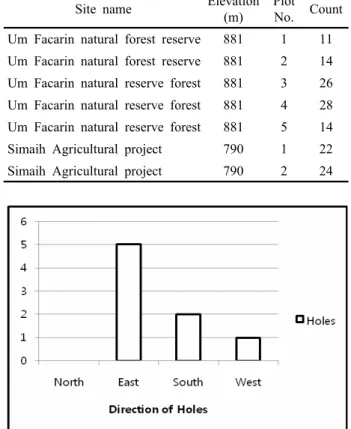
Table 1. Study Sites for A. seyal
Site name Elevation
(m)
Plot No. Count Um Facarin natural forest reserve 881 1 11 Um Facarin natural forest reserve 881 2 14 Um Facarin natural reserve forest 881 3 26 Um Facarin natural reserve forest 881 4 28 Um Facarin natural reserve forest 881 5 14 Simaih Agricultural project 790 1 22 Simaih Agricultural project 790 2 24
Fig. 1. Direction of holes of infestation (Von Maydell, 1990).
The species occurs throughout the drier parts of Africa from Senegal across to the red sea and down to Mozam- bique and Namibia (Vogt, 1995). The species is of two varieties differ markedly in their ranges; var. seyal extends westwards from central Sudan and north of latitude 18˚N, and var. fistula south of latitudes 10゚S. Both ranges overlap mainly in the upper Nile catchment, the Lake Victoria basin and the Ethiopia and East African Rift Valleys (Adams, 1967). In Sudan it is widespread on dark carking clay soil, on higher slopes of rivers and valleys, on the hard clay plains of central Sudan and on clay of seasonally wet depressions (Elamin, 1990). The majority of the natural habitats of A. seyal are found on dark crack- ing soils with over 60% clay (Harrison & Jackson, 1958).
However, within Khartoum Province (average rainfall 160 mm) A. seyal community type is confined to sufficiently watered low-lying clay soils and to the river banks.
As mentioned by El Amin, (1973), the genus Acacia represented by about 15 species of the tree species grown on the dry clay plain of the Sudan. A seyal is perhaps economically and ecologically the most important tree species in this area, it occurs in immense pure stands. It is a typical tree of African semiarid zone. The trees normally rise to about 10 meters in height but on good sites may reach 20 meters (Vogt, 1995). Other morpho- logical characteristics was described by (El Amin, 1990;
Baumer 1983).
Jamal (1994) described the major insect pests of gum Arabic trees, among them the longhorned beetles, (Cerambycidae) which end up with killing of trees.
Cerambycidae comprises one of the economically most important groups of insects worldwide, they interferes and damages forest trees (Linsley, 1959). As stated by Younis, (2006) over 40 species of insects are reported to be associated with A. seyal. These include 10 species of bruchid beetles, which may damage high proportion of stored seeds. Other beetles attack the wood such as bostrychid Sinoxylon senegalense. Other biotic factors (fire, animal browsing and human activity) were mentioned by Moilinga, (2003). Duke (1983) claimed that the fungi
Fomes rimosus, Ganoderma lucidum, Leveillula taurica, Ravenelia volkensii, Trametes meyenii, and Uromyces schweinfurthii were reported on this tree species and al- though the tree is reportedly resistant to insect attacks, felled logs may be severely damaged by wood borers.
MATERIALS AND METHODS
The study was conducted in North Kordofan State, located in dry semi-arid region between latitudes 11,15°
– 16,45° N and longitudes 27,5° – 32,15° E, and South Kordofan State which is located in the southern half of the Sudan between latitudes 9° to 13° N and longitudes 27° to 32° E. As result of a presurvey two sites were selected for A. seyal, (Um Fakarain natural reserve forest and Simaih Agricultural project). The data were collected from the two sites for investigating the ecological features of A. seyal by longhorned beetles infestation during May and July 2007. A temporary random sampling technique
Infestation of the Longhorned Beetles Species (Cerambycidae) on Acacia seyal Del var. seyal in the Gum Arabic Belt of Sudan ‧ 115
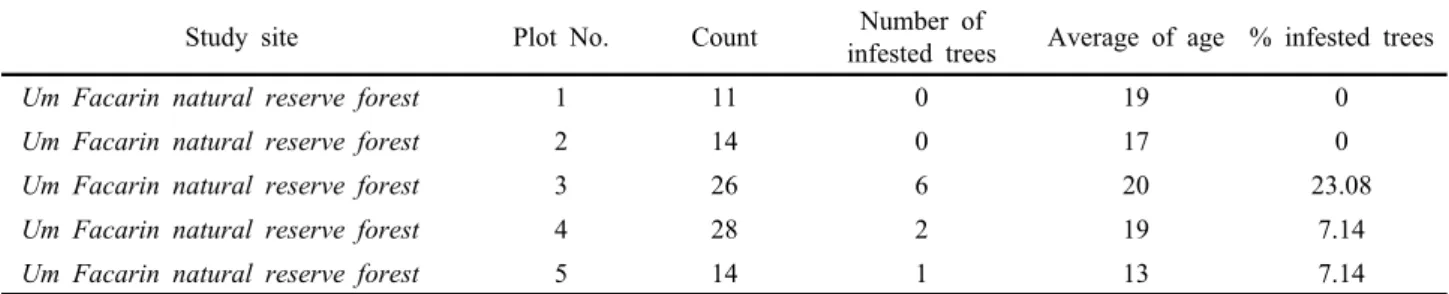
Table 2. Infestation rate study site (1)
Study site Plot No. Count Number of
infested trees Average of age % infested trees
Um Facarin natural reserve forest 1 11 0 19 0
Um Facarin natural reserve forest 2 14 0 17 0
Um Facarin natural reserve forest 3 26 6 20 23.08
Um Facarin natural reserve forest 4 28 2 19 7.14
Um Facarin natural reserve forest 5 14 1 13 7.14
Table 3. Infestation rate study site (2)
Study site Plot No. Count Number
of infested trees Average of age % infested trees
Simaih Agricultural project 1 22 0 4 0
Simaih Agricultural project 2 24 0 4 0
was applied to observe the damage characteristics of the longhorned beetles on Acacia tree species. Five sample plots were taken with the size 17.85 m (0.1 ha). The methods used for sampling the longhorned beetles was derived from Leather (2005) Table. 1
Results Um Facarin natural reserve forest study site
As shown in Table 2, the results of the first observed plot with a total number of trees (N=11), and with (N=0) no infested trees were observed. The percentage of in- festation is (0.00%) with an average tree age of 19 years (S.D ± 0.00). In the second observed plot with a total number of trees (N=14), and with (N=0) no infested trees, the percentage of infestation is (0.00%) and with average tree age of 17 (S.D ± 0.00). The results of the third observed plot with a total number of trees (N=26), and with (N=6) of observed infested trees, the percentage of infestation is (23.08%) and with average tree age of 20 years (S.D ± 0.00). The results of the fourth observed plot with a total number of trees (N=28), with infested trees (N=2), the percentage of infestation is (7.14%) with an average tree age of 19 (S.D ± 0.00). The results of the fifth plot showed a percentage of infestation of (7.14%) for a total number of trees (N=14) with (N=1) infested
trees and with average tree age of 13 (S.D ± 0.00) Simaih Agricultural project study site
Table 3 reveals that in the first plot with total number of trees (N=22) and no infested trees (N=0), with an average tree age of 4 years (S.D±0.00). The results on the same table indicate zero percentage of infestation. The same results were obtained on second plot with total number of trees (N=24) and infested trees (N=0) with an average tree age of 4 (S.D±0.00).
Discussion
The results of the surveyed sites of A. seyal indicated different infestation rates as in Table 2 and 3. These results could be demonstrated by the findings of some scholars. For example, Coulson, and Witter (1984) who stated that a site can be considered as a localized area within a forest ecosystem where a particular tree species growth associated with vegetation. The site consists of both a biotic (nonliving) and biotic (living) components.
Since different tree species have different requirements for growth, the condition of the site has a major influence on forest productivity as well as the present tree species composition. Moreover, the variation of site conditions within an ecosystem present by two important ways: a
116 ‧ Journal of Forest Science
forest ecosystem which consists of a mosaic of different site conditions and site condition changes throughout the life cycle (or rotation time) of a tree species. Site con- dition is an important factor because it contains the host material (tree species in various stages of growth) which the pest species needs for food and habitat. The avail- ability of suitable preferred and alternate hosts is a primary requisite for development of insect populations.
The variations found between sites are tree species com- position, density, and age classes. Therefore, the opportunity for insect population growth depends on the variation in different sites.
Conclusions
Not all plots surveyed indicated infestation with the longhorned beetles, infestation is correlated with the age of trees. Future study should concentrate in more eco- logical studies of the longhorned beetles as they are important forest insect pests including Acacia sp.
References
Adams, M., E. 1967. A study of the ecology of Acacia mellifera, Acacia seyal and Balanites aegyptiaca in relation to land-cleaning.
Journal of Applied Ecology 4:221-237.
Anderson, D., M. 1977. Water soluble exudates-1: gum Arabic. Proc.
Biochem. 12:24-25. In: Kananji, 1993. Exploration and seed collection of Acacia senegal in Sudan. Tree seed centre, forest research centre, Box 7089, Khartoum, Soba, Sudan: Title forest genetic resources No 22: 1-7. FAO Corporate Document Reposi- tory.
Baumer, M.1983. Notes on trees and shrubs in arid and semi-arid Regions. Environment Programme. Food and Agriculture Organ- ization of the United Nation. Rome. In: Abdel Gadir, B., E.
2009. Effect of Kiln Type and Billet Size on Acacia seyal var seyal Charcoal Quality. M.Sc., thesis, University of Khartoum, Department of Forest Products and Industries, Faculty of Forestry, Sudan, 74 p.
Coulson, R. N. and Witter, J. A. 1984. Forest Entomology, Ecology
& Management, Pp 669. John Wiley& Sons, Inc.
Duke, J. A. 1983. Acacia seyal Del. In: Handbook of energy crops.
unpublished. Web page of Purdue University, Centre for new
Crops& Plants Products. Available online at
(www.hort.purdue.edu/newcrop/duke_energy/Acacia_seyal.html, Accessed 2006 May, 10).
El Amin, H. M. 1973. Sudan Acacias. Bulletin No. 1. Forest Research Centre, Khartoum (Soba). 64 p.
El Amin, H. M. 1990. Trees and Shrubs of the Sudan.Ithaca Press, Exeter. 484 p.
El Amin, H., A. 1976. Geographical distribution of the Sudan Acacias. Forest Administration, Forest Research Institute, Bul.
No.2.
Harrison, M. N. and Jackson, J. K. 1958 - Ecological classification of the vegetation of the Sudan. Forests Bull. No. 2 Khartoum.
In: Mahmoud, A. and Obeid, A. 1971. Ecological Studies in the Vegetation of the Sudan, General Features of the Vegetation of Khartoum Province. Vegetatio Vol. 23, 3-4, pp. 153-176.
Jamal, A., and Huntsinger, L. 1993. Deterioration of a sustainable agro-silvo-pastoral system in the Sudan: the gum gardens of Kordofan. Agroforestry Systems Volume 23, Issue 1, July 1993.
Kluwer Academic Publishers. pp. 23-38.
Jamal, A.1994. Major insect pests of gum Arabic trees Acacia senegal Wild. and Acacia seyal L. in western Sudan. Journal of Applied Entomology (Germany), 117 (1):10-20. Paul Parey, Ham- burg und Berlin.
Leather, S. 2005. Insect Sampling in Forest Ecosystem. Methods in Ecology. Pp 221. Blackwell Science Ltd.
Linsley, E.G. 1959. Ecology of cerambycidae. In Annual. Rev.
Entomol. 1959, 4:99-138. Downloaded from arjournals.annualsreviews.
org by SLUB Dresden on 01/31/07.
Malagnoux, M.. Sène E.H and Atzmon N. 2007. Forests, trees and water in arid lands: a delicate balance. Unasylva 58: 24-29.
Moilinga, M. K. 2003. Autoecology of Acacia seyal Del. in the central clay plain of the Sudan. Ph.D Thesis. Department of Silviculture, Faculty of Forestry- University of Khartoum. 165 p.
Mustafa, A. F. 1997. Regeneration of A. seyal forests on the dryland of the Sudan clay plain. Tropical Forestry Reports No.
15. University of Helsinki, Department of Forest Ecology.
Nair, K. S. S. 2007. Tropical Forest Insect Pests Ecology, Impact, and Management. pp 404. Cambrige University Press.
Vogt, K. 1995. A Fieldworker`s Guide to the Identification, Pro- pagation and uses of Common Trees and Shrubs of Dryland Sudan, pp 334. SOS Sahel International (UK).
Von Maydell, H. J. 1990. Trees and Shrubs of the Sahel, Pp 525.
Deutsche Gesellschaft für Technische Zusammenarbeit (GTZ), Eschborn, Germany.
Younis, E. A. M. 2006. Yield potential of Acacia seyal (variety seyal Del.) in relation to growth parameters, methods and pos- ition of tapping. M.Sc., thesis, University of Kordofan, department of forestry & range sciences, Faculty of Natural Resources &
Environmental Studies, Sudan.
(Received August 2, 2010; Accepted September 28, 2010)