| Abstract |
Purpose: This study examined how performing chin tuck exercises in supine, sitting, and standing positions affects changes in the muscle activity of the neck and shoulder.
Methods: Seventeen men and three women with forward head posture participated in the study. The subjects performed the chin tuck exercise using a pressure biofeedback unit. After determining the ideal order for performing the chin tuck exercise in supine, sitting, and standing positions through randomized controlled trials, muscle activity was measured in the dominant-side sternocleidomastoid, scalenus anterior, upper trapezius, and levator scapulae. Muscle activity was measured three times in each muscle for each position, and the average of the three measurements was used for analysis.
Results: In this study, the chin tuck exercise performed in a supine position reduced muscle activity of the sternocleidomastoid, scalenus anterior, upper trapezius, and levator scapulae significantly more than performing the exercise in either sitting or standing positions (p < 0.05). No significant difference in muscle activity was observed when the exercise was performed in a sitting position versus a standing position (p < 0.05).
Conclusion: Performing a chin tuck exercise in a supine position is more effective for stabilizing the neck and shoulder than performing it in a sitting or standing position, as it reduces excessive tension and fatigue in the neck and shoulder.
Key Words: Chin tuck, Posture, Biofeedback unit, Muscle activity
†Corresponding Author : Ju-Hui Yang ([email protected])
Original Article Open Access
다양한 자세에 따른 턱 당기기 운동이 목과 어깨의 근활성도에 미치는 영향
안수홍⋅양주희†⋅이수경1⋅박진성2⋅조재성31)
동의대학교 보건의과학대학원, 1동의대학교 물리치료학과, 2다온웰니스, 3동의대학교 물리치료학부
Effect of Chin Tuck Exercises on Various Postures and Muscle Activity of the Neck and Shoulder
Su-Hong Ahn, P.T., M.S.⋅Ju-Hui Yang, P.T., B.S.†⋅Su-Kyong Lee, P.T., Ph.D.1⋅ Jin-Sung Park, P.T., Ph.D.2⋅Jae-Sung Jo3
Department of Biomedical Health Science, Graduate School, Dong-Eui University
1Department of Physical Therapy, College of Nersing and Healthcare Sciences, Dong-Eui University
2Daonwellness Corp.
3Physical Therapy, Dong-Eui University Received: August 13, 2020 / Revised: September 2, 2020 / Accepted: September 9, 2020
ⓒ 2020 Journal of Korea Proprioceptive Neuromuscular Facilitation Association
This is an Open Access article distributed under the terms of the Creative Commons Attribution Non-Commercial License (http://creativecommons.org/licenses/by-nc/3.0) which permits unrestricted non-commercial use, distribution, and reproduction in any medium, provided the original work is properly cited.
Ⅰ. 서 론
현대사회의 발전으로 인해 IT기계의 사용량이 증가 되고 신체활동의 감소로 인한 운동부족으로 현대인들 은 다양한 근육뼈대계 질환에 노출되어 있다(Jung, 2016). 특히, 컴퓨터와 스마트폰의 발달로 인해 앉아서 업무를 보는 시간이 지속적으로 늘어남에 따라서 올 바른 자세를 유지하지 못하여 더 많은 근육뼈대계 질 환에 노출될 가능성이 크다(Hamilton et al., 2008; Kong et al., 2013; Lee & Jung, 2009). 이에 따라 자세정렬과 관련된 문제가 급격하게 증가하고 있으며, 그 중에서 도 특징적으로 머리를 앞으로 내미는 자세인 전방 머 리 자세(forward head posture)가 나타난다고 알려져 있다(Van der Windt, 2000). 이러한 자세는 목을 지속적 으로 움직이게 만들어 목뼈에 가해지는 압박력이 증 가되어 목뼈 관절의 위치를 변화시키게 되며(Falla et al., 2007), 척추의 중심선 보다 머리가 앞쪽으로 위치 하게 되어 위쪽 목뼈의 폄과 아래쪽 목뼈의 굽힘이 동반되는 자세가 형성된다(Oh, 2018). 또한, 항상 둥근 어깨를 수반하여 몸 전체에 통증과 장애를 유발하여 기능장애를 발생시킨다(Eleni K et al., 2008). 이 자세가 장시간 지속이 되면 머리척추각은 점점 감소하고 머 리회전각은 더욱 증가하여(Shon et al., 2012) 목 주위 관절과 근육의 보상작용을 일으켜 목의 움직임에 악 영향을 미치게 된다(Neumann, 2010; Sahrmann, 2001).
특히 표면 근육인 목빗근, 앞목갈비근, 위등세모근, 어깨올림근의 길이변화와 과긴장성의 활성화가 나타 나게 된다(Khayatzadeh et al., 2017; Szeto et al., 2002;
Yang et al., 2014). 이러한 목 주변 근육들의 불균형과 기능부전은 목의 불안정성을 증가시키고 부정렬을 초 래하여 근육동원의 시간을 지연시킨다(Ahn, 2005;
Falla et al., 2004). 그러므로 전방머리자세를 가진 목 통증 환자의 증상을 개선시키기 위해서는 잘못된 생 활습관의 개선과 올바른 자세에 대한 교육과 운동이 선행되어야 하며, 이를 위한 물리치료 중재방법으로 는 턱 당기기 운동, 맥켄지 운동, 견인 치료, 신장운동 등과 같은 목 안정화 운동치료가 임상에서 많이 적용
되고있다(Kim & Shin, 2016; Lee & Lee, 2010; Nejati et al., 2015; Noh et al., 2013; Wickstrom et al., 2017).
그 중에서 턱 당기기 운동은 임상에서 많이 쓰이는 목의 안정화 운동방법 중 하나로써 다른 운동들보다 목의 과긴장과 통증 감소에 매우 효과적인 운동이라 고 보고되고 있는데(Jull et al., 2009; Kim, 2012; Yoo
& Lee, 2016), Kong 등(2010)은 턱 당기기 운동이 목뼈 관절가동술보다 통증감소에 효과적이라고 하였고 Lee 와 Lee (2010)는 턱 당기기 운동이 온열치료와 전기치료에 비해 훨씬 많은 통증을 감소시킨다고 하 였다. 이처럼 턱 당기기 운동은 목의 근력뿐 아니라 근지구력을 향상시켜 협응성을 재조건화 하여 일상생 활을 하면서 받게 되는 내⋅외부적인 압력과 스트레 스로부터 발생하는 미세손상을 보호해주고 신경근의 조절능력을 향상시켜 통증을 감소시키고 퇴행성 변화 를 예방하며, 척추사이분절 간의 결합력을 강화하는 역할을 한다(Moon, 2007). 하지만 반복적으로 턱 당기 기 운동을 시행하게 되면 목을 안정화 시키는 자세유 지근이 지속적으로 작용하여 근피로도가 발생할 수가 있다(Lee, 2020). 그에 따른 보상작용으로 목의 굽힘의 요구도가 높아져 오히려 운동수행 중에 더 많은 목 주변의 근 수축력이 발생하게 된다(Yun, 2016). 따라서 본 연구에서는 전방머리자세가 있는 대상자에게 누운 자세, 앉은 자세, 선 자세 3가지 자세에 따라 턱 당기기 운동 시 어느 자세에서 가장 근피로도 없이 효율적으 로 실시할 수 있는지 알아보고자 한다.
Ⅱ. 연구 방법 1. 연구 대상
본 연구의 대상자는 부산시에 소재한 D 대학교에 재학하고 있는 성인 남녀 20명을 대상으로 하였으며 연구의 목적에 대한 내용을 충분히 설명한 뒤 자발적 으로 연구에 참여한 자를 대상으로 실험을 진행하였 다. 연구대상자의 선정 기준은 C7의 가시돌기와 귓볼
을 연결한 수평선이 이루는 각인 머리척추각 (cranio-vertebral angle, CVA)이 50도 이하인 전방머리 자세를 가진 자(Nemmers et al., 2009), 최근 3개월동안 목 통증이 있는 자, 목뼈와 등뼈에 골절이 없는 자, 신경학적 문제가 없는 자를 대상으로 실험을 진행하 였다. 연구대상자의 제외기준은 목이나 어깨수술을 했던 이력이 있는 사람, 고혈압을 앓고 있거나, 그와 관련된 약을 복용하고 있는 사람, 6개월 이내 만성이 아닌 목통증이나 두통을 경험한 사람으로 설정하였다.
2. 측정 도구
1) 압력 생체 피드백 장치
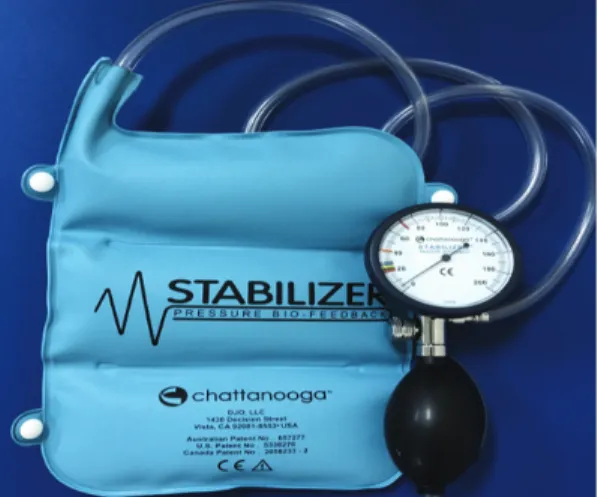
본 연구는 압력 생체 피드백 장치(Stabilizer, Chattanooga Group Inc, USA)를 이용하여 바로 누운 자세, 앉은 자세, 선 자세에서 턱 당기기 운동을 실시하 였다. 압력 생체 피드백 장치는 3가지 부분으로 팽창되 는 직사각형 쿠션과 압력계(0-200mmHg)로 구성되어 있으며(Yoo, 2014), 운동의 질적인 부분과 정확도에 대한 피드백을 간단하게 제공할 수 있는 기구로써 목 의 안정성을 높이는 운동에 많이 사용되고 있다(Kim, 2015)(Fig. 1). 또한, 내부 압력의 증가에 따라 팽창되는 비탄력적 장치로써 선택적인 근육을 훈련시킬 수 있
는 장치이다(Jull et al.,1993). 본 연구에서는 자세에 따라 턱 당기기 운동을 총 3세트 실시하였으며 1세트 는 10초간 30㎜Hg 유지하고 2초간 휴식하는 것을 1번 으로 총 10번 실시하여 운동방법을 충분히 연습한 후 본 실험을 진행하였다.
2) 표면 근전도
본 연구는 바로 누운 자세, 앉은 자세, 선 자세에 따라서 턱 당기기 수행 시 목과 어깨의 근활성도 변화 를 측정하기 위해 8채널 무선 표면 근전도(Myosystem TM DTS, Noraxon Inc., USA)를 사용하였다(Fig. 2).
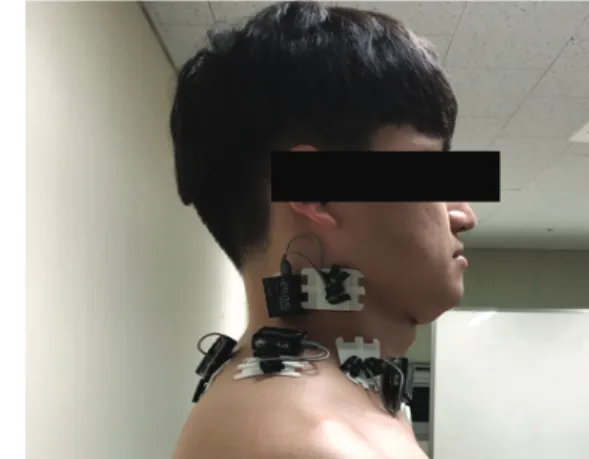
근육에 전극을 부착하기 전 피부의 저항과 청결함을 유지하기 위해 알코올 솜으로 닦아낸 후 근 섬유 방향 과 평행하게 부착하였으며 전극 간 거리는 2cm로 설정 하였다(Hermens et al., 2000). 전극은 우세측 목빗근, 앞목갈비근, 위등세모근, 어깨올림근에 부착하였으 며, 부착방법은 다음과 같다. 목빗근은 꼭지돌기와 복 장뼈 위쪽 패임의 가운데 지점에 전극을 부착하였고, 앞목갈비근은 목빗근의 빗장뼈 부분 외측으로 근섬유 가 평행하게 움직이는 방향의 경계부에 부착하였으 며, 위등세모근은 7번 목뼈 가시돌기와 어깨뼈 봉우리 사이 가운데 지점의 근복(muscle belly)부위에 근섬유 와 평행하게 2㎝ 간격으로 부착하였다. 마지막으로 어깨올림근은 목빗근과 위등세모근의 사이에 부착하 였다(Eliot, 1996; Queisser et al., 1994)(Fig. 3). 근전도 신호의 표본추출률(sampling rate)은 2,000Hz, 대역통 과필터(band pass filter)는 20-450Hz로 설정하였고 주
Fig. 1. Stabilizer. Fig. 2. Myosystem TM DTS, Noraxon Inc., USA.
파수 대역폭의 구간은 필터링을 통하여 노이즈를 제 거하였다. 수집된 표면 근전도의 신호는 RMS값으로 정량화 하였으며, 기타 신호의 처리 방법으로는 Rectification과 Smoothing을 사용하였고 근전도 신호 의 표준화 방법으로는 특정 동작을 기준 값으로 사용 하는 %RVC (reference voluntary contraction)값으로 설 정하였다(Cram et al., 1998). 측정은 자세별로 총 3번씩 5초간 측정하였으며, 앞에 1초 뒤에 1초를 제외한 중간 3초 값을 평균화하여 사용하였다.
3. 연구 방법
본 연구진행에 앞서 대상자에게 실험방법을 정확
하게 인지시키기 위해 바로 누운 자세, 앉은 자세, 선 자세에 따라서 턱 당기기 운동을 실시하였다. 충분한 운동 후, 무작위 배정(randomized controlled trial)비교 를 통해 3가지 자세별에 따라 턱 당기기의 순서를 정하 였고, 그 순서절차에 따라 압력 생체 피드백 장치를 이용하여 턱 당기기 시 우세측 목빗근, 앞목갈비근, 위등세모근, 어깨올림근의 근활성도를 측정하였다.
바로 누운 자세에서는 대상자의 무릎을 90°로 굽히고 압력 생체 피드백 장치를 목 뒤의 중앙에 위치시키고 얼굴이 지면과 수평이 되도록 자세를 취한 뒤 턱 당기 기를 실시하였다(Cho, 2019)(Fig. 4). 앉은 자세에서 턱 당기기 운동방법은 벽에 기대어 앉은 상태에서 압력 생체 피드백 장치를 목 뒤의 중앙에 위치시키고 얼굴 Fig. 3. EMG attachment site.
Fig. 4. Supine postures of chin-in exercise. Fig. 5. Sitting postures of chin-in exercise.
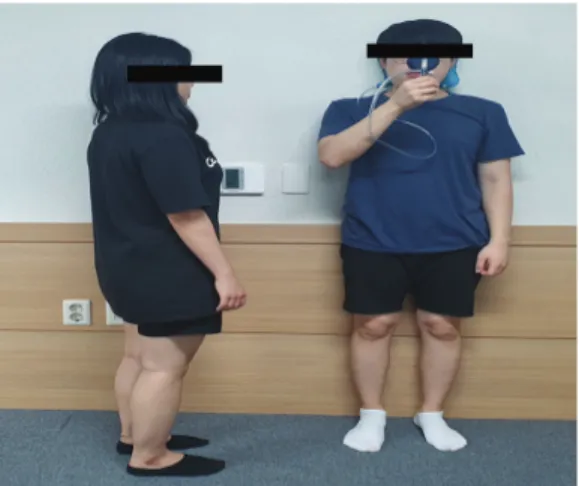
이 벽면과 수평이 되도록 자세를 취한 뒤 턱 당기기를 실시하였다(Fig. 5). 선 자세에서 턱 당기기 운동방법 은 벽에 기대어 선 상태에서 양 발을 어깨 넓이만큼 벌리고 압력 생체 피드백 장치를 목 뒤의 중앙에 위치 시키고 얼굴이 벽면과 수평이 되도록 자세를 취한 뒤 턱 당기기를 실시하였다(Fig. 6). 턱 당기기의 가동범 위는 아래턱의 중간 끝 부위와 방패연골(thyroid cartilage)간의 거리가 3cm가 될 때까지 턱을 당겼으며 (Lee, 2020), 이 때 대상자 스스로가 압력을 일정하게 유지하기 위하여 압력표시계를 보면서 실시하였다.
압력은 20㎜Hg를 기준으로 10mmHg 증가한 30mmHg 의 압력을 유지하도록 지시하였다(Cho, 2019; Jun et al., 2011). 총 3세트 실시하였으며 측정 시 압력 생체 피드백 장치를 통해 30mmHg 압력을 5초간 유지한 상태에서 근활성도를 측정하였으며, 총 3회 측정하여 평균화하였다. 대상작용을 방지하기 위하여 각 자세 마다 3회 측정 후 2분간 휴식을 취하였다(Park & Choi, 2016).
Fig. 6. Standing postures of chin-in exercise.
4. 자료 분석
본 연구의 자료는 SPSS 22.0 for Windows 프로그램 을 이용하였으며, 모든 데이터의 표기방식은 평균과 표준오차(mean±SE)를 사용하였다. 분석방법은 바로
누운 자세, 앉은 자세, 선 자세에 따라 턱 당기기 시 목과 어깨의 근활성도의 차이를 알아보기 위해 반복 측정분산분석(One-way repeated ANOVA)을 사용하였 다. 통계적 유의수준은 0.05로 설정하였다.
Ⅲ. 연구 결과 1. 연구 대상자의 일반적인 특성
본 연구는 전방머리 자세를 가진 성인 남녀 20명을 대상으로 연구를 진행하였다. 전방머리자세를 측정하 기 위해 사용하는 방법인 머리척추각은(cranio-vertebral angle, CVA) C7의 가시돌기와 귀불을 연결한 수평선 이 이루는 각도로 정의한다. 전방머리자세를 갖고 있 는 대상자는 머리척추각이 50도 이하이며 평균 머리척 추각은 41.63±6.82°, 평균나이는 25.63±2.47세, 평균 키 176.31±7.72cm, 평균 몸무게는 71.95±8.56kg이었다 (Table 1).
Characteristics
Craniovertebral angle 41.63±6.82 Sex (geneder) Male (17)/Female (3)
Age (yerars) 25.63±2.47 Height (cm) 176.31±7.72
Weight (kg) 71.95±8.56
Table 1. General characteristics of subjects (n=20)
2. 자세에 따른 턱 당기기 시 목빗근의 근활성도 비교
자세에 따른 우세측 목빗근의 근활성도 변화는 다 음과 같다(Table 2)(Table 3).
바로 누운자세에서 턱 당기기 시 앉은 자세와 선 자세에 비해 목빗근의 근활성도는 유의하게 감소하였 고(p<0.05), 앉은 자세와 선 자세에서 턱 당기기 시 선 자세에서 목빗근의 근활성도는 증가하였으나 유의 한 차이는 없었다(p>0.05).
3. 자세에 따른 턱 당기기 시 앞목갈비근의 근활성 도 비교
자세에 따른 우세측 앞목갈비근의 근활성도 변화 는 다음과 같다(Table 2)(Table 3).
바로 누운자세에서 턱 당기기 시 앉은 자세와 선 자세에 비해 앞목갈비근의 근활성도는 유의하게 감소 하였고(p<0.05), 앉은 자세와 선 자세에서 턱 당기기 시 선 자세에서 앞목갈비근의 근활성도는 증가하였으 나 유의한 차이는 없었다(p>0.05).
4. 자세에 따른 턱 당기기 시 위등세모근의 근활성 도 비교
자세에 따른 우세측 위등세모근의 근활성도 변화 는 다음과 같다(Table 2)(Table 3).
바로 누운자세에서 턱 당기기 시 앉은 자세와 선 자세에 비해 위등세모근의 근활성도는 유의하게 감소 하였고(p<0.05), 앉은 자세와 선 자세에서 턱 당기기 시 선 자세에서 위등세모근의 근활성도는 증가하였으 나 유의한 차이는 없었다(p>0.05).
Muscle Period TypeⅢSS df MS F p
SCM
Supine vs Sitting 297958.89 1.00 297958.89 17.61 0.00*
Sitting vs Standing 128104.00 1.00 128104.00 3.84 0.07
Supine vs Standing 816804.38 1.00 816804.38 17.49 0.00*
SA
Supine vs Sitting 2095961.74 1.00 2095961.74 36.27 0.00*
Sitting vs Standing 123966.65 1.00 123966.65 3.25 0.09
Supine vs Standing 3239397.60 1.00 3239397.60 28.06 0.00*
UT
Supine vs Sitting 136929.66 1.00 136929.66 9.19 0.01*
Sitting vs Standing 34834.79 1.00 34834.79 4.07 0.06
Supine vs Standing 309893.61 1.00 309893.61 8.25 0.01*
LS
Supine vs Sitting 137504.56 1.00 137504.56 9.67 0.01*
Sitting vs Standing 70563.01 1.00 70563.01 4.02 0.06
Supine vs Standing 405072.50 1.00 405072.50 11.18 0.00*
*p<0.05
Type SS: type sum of squares, df: degree of freedom, MS: mean squares
SCM: sternocleidomastoid, SA: scalenus anterior, UT: upper trapezius, LS: levator scapulae Table 3. Repeated measures ANOVA on neck and shoulder muscle activity
Muscle Supine Sitting Standing F p
SCM 264.70±41.73 386.76±59.77 466.79±75.68 44.22 0.00*
SA 348.70±54.39 672.42±81.56 751.15±105.33 60.94 0.00*
UT 150.89±10.61 233.63±32.95 275.37±48.93 56.37 0.00*
LS 187.09±17.30 270.00±29.05 329.40±44.38 104.19 0.00*
*p<0.05, Mean±SD
SCM: sternocleidomastoid, SA: scalenus anterior, UT: upper trapezius, LS: levator scapulae
Table 2. Comparison of muscle activity of the neck and shoulder muscle among the various postures of chin-in exercise (n= 20, unit: %RVC)
5. 자세에 따른 턱 당기기 시 어깨올림근의 근활성 도 비교
자세에 따른 우세측 어깨올림근의 근활성도 변화 는 다음과 같다(Table 2)(Table 3).
바로 누운자세에서 턱 당기기 시 앉은 자세와 선 자세에 비해 어깨올림근의 근활성도는 유의하게 감소 하였고(p<0.05), 앉은 자세와 선 자세에서 턱 당기기 시 선 자세에서 어깨올림근의 근활성도는 증가하였으 나 유의한 차이는 없었다(p>0.05).
Ⅳ. 고 찰
전방머리자세는 머리뼈와 목 연결부위의 전만 증 가와 함께 어깨 근육의 지속적인 근수축으로 인한 상 대적인 보상작용이 발생함에 따라(Harrison, 2003), 목 뼈 주변의 관절과 근육에 가해지는 압력을 증가시켜 (Chiu, 2002; Straker, 2002; Yip, 2008) 목과 어깨 주변의 근 긴장과 스트레스 및 통증을 유발시키게 된다(Bae, 2011). 이러한 자세는 목빗근, 앞목갈비근, 위등세모 근, 어깨올림근과 같은 표면 근육을 많이 사용함으로 써 근활성도를 과도하게 증가시킨다(Caneiro et al., 2010). 그러므로 올바른 자세를 유지하기 위해서는 깊 은 근육들을 활성화시켜 표면근육의 근활성도를 감소 할 필요가 있다(Cagnie et al., 2011). 임상에서는 목과 어깨의 표면근육들의 기능을 개선하기 위해서 목을 안정화시키고 통증을 감소시키는 턱 당기기 운동을 많이 활용하고 있다(Lee & Lee, 2010). 이처럼 턱 당기 기 운동이 전방머리자세에 효과적이라는 연구결과는 많이 있지만 어느 자세에서 실시하였을 때 가장 효과 적인지에 대한 연구는 부족한 실정이다. 따라서 본 연구에서는 바로 누운 자세, 앉은 자세, 선 자세에서 턱 당기기 시 목과 어깨의 근 활성도 차이를 알아보았 다. 본 연구 결과 목빗근의 근활성도는 바로 누운 자세 에서 264.70±41.73, 앉은 자세에서 386.76±59.77, 선 자 세에서 466.79±75.68로 나타났으며, 앞목갈비근의 근
활성도는 바로 누운 자세에서 348.70±54.39, 앉은 자세 에서 672.42±81.56, 선 자세에서 751.15±105.33로 측정 되어 두 근육 모두 바로 누운 자세에서 근활성도가 가장 낮게 나와 통계학적으로 앉은 자세와 선 자세보 다 유의하게 감소하였다. 앉은 자세는 바로 누운자세 에 비해 좁은 기저면을 가지고 있기 때문에 신체를 유지하는 안정성이 감소하여 신체의 근육을 보다 많 이 활성화시키게 된다(Hideyuki et al., 2016; Kisner &
Colby, 2010). 선 자세 또한 높은 인체 중심(center of mass, COM)과 좁은 기저면 때문에 신체의 안정성을 유지하기 위해 선행적 자세조절을 하기 때문에 많은 관절의 작용과 근육들을 활성화시키게 된다(Massion, 1992; Nam & Kim, 2017). 또한 앉은 자세와 선 자세와 같은 시상면에서 전방머리자세가 있는 환자들이 턱을 당기게 되면 머리가 지면과 평행하게 위치하게 됨에 따라 복장빗장관절과 목빗근이 수직선상에 위치하도 록 정렬시켜 목빗근과 앞목갈비근의 근긴장도를 증가 시키게 된다(Neumann, 2010). 이에 따라 길이 장력 곡 선이 변하게 되어 근육의 토크 값을 증가시켜 더 많은 근활성도를 요구하게 된다(Chiu et al., 2005; Sahrmann, 2013). 반면에 바로 누운자세는 다른 자세에 비해 기저 면이 넓어 안정성이 크다(Park et al., 2019). 또한, 턱 당기기 시 목빗근과 앞목갈비근의 근육작용이 중력과 같은 방향으로 작용하는 관상면에서의 움직임이라고 할 수 있다(Neumann, 2010). 따라서 바로 누운자세는 안정성이 크고 중력에 대항하지 않는 운동자세이기 때문에, 자세유지근의 활성도가 감소하여 근긴장도가 감소되게 나왔다고 할 수 있다.
또한, 위등세모근과 어깨올림근도 바로 누운자세 에서 턱 당기기 시 앉은 자세와 선 자세에 비해 근활성 도가 낮게 나왔다. 위등세모근의 근활성도는 바로 누운 자세에서 150.89±10.61, 앉은 자세에서 233.63±32.95, 선 자세에서 275.37±48.93로 나타났으며, 어깨올림근 의 근활성도는 바로 누운 자세에서 187.09±17.30, 앉은 자세에서 270.00±29.05, 선 자세에서 329.40±44.38로 측정되어 두 근육 모두 바로 누운 자세에서 근활성도 가 통계학적으로 앉은 자세와 선 자세보다 유의하게
감소하였다. Moon (2017)은 서 있는 자세가 다른 자세 에 비해 어깨의 근활성도가 증가한다고 하였고 Kleine 등(1999)은 앉은 자세와 선 자세와 같은 시상면에서 전방머리자세는 어깨에 정적인 부하가 걸리는 자세로 써 허리가 구부려지는 것을 방지하기 위하여 몸통의 폄근이 활성화가 됨에 따라 보상작용으로 어깨를 들 어올려 근활성도를 증가시킨다고 하였다. 이러한 자 세는 머리가 중력중심선의 앞쪽에 위치하게 되어 굽 힘의 모멘트를 증가시키고 목 뒤쪽의 근육과 함께 위 등세모근과 어깨올림근의 단축을 유발하여 긴장도가 증가한다고 하였다(Kang & Yang, 2019).
하지만 바로 누운 자세는 다른 자세에 중력중심선 이 낮기 때문에 몸통과 골반의 안정성이 증가하여 허 리뼈가 지면과 맞닿게 되는 면적이 커져 고정이 되므 로 몸통 폄근의 근활성도가 낮아지게 된다(Park et al., 2019). 이에 따라 어깨의 보상작용이 감소하게 되고 근 길이와 장력이 일정하게 유지되어 최소한의 근육 을 사용함으로써 근활성도가 낮게 나왔다고 볼 수 있 다(Neumann, 2010).
본 연구의 결과를 종합해보면 바로 누운 자세에서 턱 당기기 운동이 선 자세나 앉은 자세에 비해 목빗근, 앞목갈비근, 위등세모근, 어깨올림근의 근활성도가 낮게 나왔다. 이는 바로 누운자세에서 턱 당기기가 다른 자세에 비해 안정성이 높고 중력과 같은 방향으 로 운동을 하기 때문에 근육의 이완효과가 증가하여 근원 섬유인 액틴과 마이오신이 함께 늘어나 근육의 긴장상태를 감소시켜 근활성도가 효과적으로 감소했 다고 볼 수 있다(Cho, 2014; Partanen et al., 2010; Robb
& Pajaczkowski, 2011). 따라서 전방머리 자세를 가진 대상자에게 턱 당기기 운동을 실시할 때에는 바로 누 운자세에서 실시하는 것이 과도한 목뼈의 굽힘 토크 를 감소시키고 중력에 대항하여 머리와 목을 지지해 주기 때문에 안정성이 증가하여 근긴장도와 피로도에 많은 영향을 받지 않고 효과적으로 운동을 수행할 수 있는 자세라고 할 수 있다.
본 연구의 제한점은 첫째, 대상자의 표본 수가 20명 이므로 전체를 대표하기에는 한계가 있다. 둘째, 압력
생체피드백 장치를 이용하여 일정한 압력에 따라 운 동을 실시하였기 때문에 순수한 운동효과의 확인은 어려움이 있다. 셋째, 본 연구는 중재가 없는 측정 논문 이기 때문에 장기간의 효과를 알아볼 수 없었다. 넷째, 목과 어깨의 표면 근육만 측정하였기 때문에 추후 연 구에서는 깊은 근육들에 대한 연구도 이루어져야 할 것이다.
Ⅴ. 결 론
본 연구는 전방머리 자세를 가진 성인 남자 17명, 여자3명을 대상으로 바로 누운자세, 앉은 자세, 선 자 세에서 턱 당기기 시 우세측 목과 어깨의 근활성도 변화에 대해 알아보고자 하였다. 본 연구결과 바로 누운자세가 앉은 자세나 선 자세에 비해 13의 근활성 도가 유의하게 감소하였다. 이러한 결과는 바로 누운 자세에서 턱 당기기를 실시하는 것이 목과 어깨의 과 한 긴장도와 피로도를 줄여주어 앉은 자세나 선 자세 에 비해 상대적으로 목과 어깨를 안정화시키는데 운 동의 효과가 크다고 할 수 있다. 따라서 바로 턱 당기기 운동은 바로 누운자세에서 실시하는 것이 임상적으로 효율적이라고 볼 수 있다.
References
Ahn SH. The therapeutic approach of chronic neck pain. Journal of coaching development. 2005;7(3):15-21.
Bae YH, Lee GC. Effect of motor control training with strengthening exercises on pain and muscle strength of patients with shoulder impingement syndrome.
Journal of the Korean Society of Physical Medicine.
2011;23(6):1-7.
Baek SY. The effect of self-stretching exercises on postural improvement of patients with chronic neck pain with forward head posture. Sehan University. Dissertation
of Master’s Degree. 2020.
Cagnie B, O’leary S, Elliott J, et al. Pain-induced changes in the activity of the cervical extensor muscles evaluated by muscle functional magnetic resonance imaging. The Clinical journal of pain. 2011;27(5):
392-397.
Caneiro JP, O’Sullivan P, Burnett A, et al. The influence of different sitting postures on head/neck posture and muscle activity. Manual therapy. 2010;15(1):54-60.
Chansirinukor W, Wilson D, Grimmer K, et al. Effects of backpacks on students: measurement of cervical and shoulder posture. The Australian journal of physiotherapy. 2001;47(2):110-116.
Chiu TT, Ku WY, Lee MH, et al. A study on the prevalence of and risk factors for neck pain among university academic staff in Hong Kong. Journal of Occupational Rehabilitation. 2002;12(2):77-91.
Chiu TT, Law EY, Chiu TH. Performance of the craniocervical flexion test in subjects with and without chronic neck pain. Journal of Orthopaedic & Sports Physical Therapy. 2005;35(9):567-571.
Cho SH. The effect of myofascial release technique and forward head posture correction exercise on chronic tension-type headache. Catholic University of Busan.
Dissertation of Master’s Degree. 2014.
Cho YB. The effects of a cervical-retraction assistive tool on neck alignment for adults with forward head posture. Soonchunhyang University. Dissertation of Master’s Degree. 2019.
Eleni K, Evangelos V, Nikolaos S. Neck pain causes respiratory dysfunction. Medical Hypotheses. 2008;70(5):1009- 1013.
Eliot DJ. Electromyography of levator scapulae: new findings allow tests of a head stabilization model. Journal of manipulative and physiological therapeutics.
1996;19(1):19-25.
Falla D, Jull G, Hodges P. Feedforward activity of the cervical
flexor muscles during voluntary arm movements is delayed in chronic neck pain. Experimental brain research. 2004;157(1):43-48.
Falla D, Jull G, Hodges P. Patients with neck pain demonstrate reduced electromyographic activity of the deep cervical flexor muscles during performance of the craniocervical flexion test. Spine. 2004;29(19):2108- 2114.
Falla D, Jull G, Russell T, et al. Effect of neck exercise on sitting posture in patients with chronic neck pain.
Journal of the American Physical Therapy Association. 2007;87(4):408-417.
Hamilton MT, Healy GN, Dunstan DW, et al. Too little exercise and too much sitting: inactivity physiology and the need for new recommendations on sedentary behavior.
Current cardiovascular risk reports. 2008;2(4):292–
298.
Hansraj KK. Assessment of stresses in the cervical spinecaused by posture and position of the head. Surgical technology international. 2014;25(25):277-279.
Harrison DE, Harrisson DD, Betz JJ, et al. Increasing the cervical lordosis with chiropractic biophysics seated combined extension-compression and transverse load cervical traction with cervical manipulation:
nonrandomized clinical control trial. Journal of Manipulative Physiol Therapy. 2003;26(3):139-151.
Heo SY. The effects of hold-relax and active stretching on recoveries of muscle fatigue after computer work.
Catholic University of Busan. Dissertation of Master’s Degree. 2006.
Hermens HJ, Freriks B, Disselhorst-Klug C, et al. Development of recommendations for semg sensors and sensor placement procedures. Journal of electromyography and Kinesiology. 2000;10(5):361-374.
Hideyuki N, Kiyokazu A, Takahiro O, et al. Deep abdominal muscle thickness measured under sitting conditions during different stability tasks. Journal of Physical
Therapy Science. 2016;28(3):900-905.
Jull GA, Falla D, Vicenzino B, et al. The effect of therapeutic exercise on activation of the deep cervical flexor muscles in people with chronic neck pain. Manual therapy. 2009;14(6):696-701.
Jull GA, Kristjansson E, Dall’Alba P. Impairment in the cervical flexors: a comparison of whiplash and insidious onset neck pain patients. Manual therapy. 2004;9(2):89-94.
Jull GA, Richardson CA. Long-term effects of specific stabilizing exercises for first-episode low back pain.
Spine. 2001;(26)11:243-248.
Jun DH, Dennis WF, Kim K. The suggestion of proper pressure level in cranio-cervical flexion exercise for deep cervical flexor by ultrasonographic measurement.
Journal of the Korean society of physical medicine.
2011;6(4):497-504.
Jung SH. The effects of sports massage using thumb pressure on subjective neck pain. Chosun University.
Dissertation of Master’s Degree. 2016.
Kang HJ, Yang HS. Effects of neck and shoulder exercise program on spino-pelvic alignment in subject with forward head posture. Journal of the Korean Society of Integrative Medicine. 2019;7(4):265-272.
Kang JH, Park RY, Lee SJ, et al. The effect of the forward head posture on postural balance in long time computer based worker. Annals of rehabilitation medicine.
2012;36(1):98-104.
Khayatzadeh S, Kalmanson OA, Schuit D, et al. Cervical spine muscle-tendon unit length differences between neutral and forward head postures: biomechanical study using human cadaveric specimens. Journal of the American Physical Therapy Association. 2017;97(7):756-766.
Kim BI. Comparison of healthy women’s pelvic floor muscle movement and abdominal muscle thickness change according to exercises method in hooklying and standing posture. Daegu University. Dissertation of Doctorate Degree. 2015.
Kim CH, Shim JH. Comparison of the effects of cervical mobilization technique, neuromuscular release, and cervical traction on cervical alignment and muscle activity in people with forward head posture. Korean Journal of Neuromuscular Rehabiliation. 2016;6 (2):9-18.
Kim SC, Kim SK, Kim CS. Effect of abdominal draw in maneuver in sitting position. Journal of Rehabilitation Welfare Engineering & Assistive Technology.
2017;11(3):207-214.
Kisner C, Colby LA. Therapeutic exercise: foundation and techniques, 5th ed. Philadelphia. F.A. Davis Company.
2010.
Kleine BU, Schumann NP, Bradl I, et al. Surface EMG of shoulder and back muscles and posture analysis in secretaries typing at visual display units. International Archives of Occupational and Environmental Health.
1999;72(6):387-394.
Kong BK, Kwon MS, Lee GC, et al. The effects of neck exercise program for smart Phone-addicts with forward head posture on cervical alignment and balance ability. Journal of Korean Society of Integrative Medicine. 2013;1(2):81-92.
Lee CS. Influences of slip amount and slip angle on lumbar lordosis and sagittal balance in lumbar spondylolisthesis. Inje Medical Journal. 2002;23 (5):323-330.
Lee JH. The effects of open and closed chain exercise on the thickness of neck flexor during chin-in movement.
Kyungsung University. Dissertation of Master’s Degree. 2020.
Lee KC, Lee DY. The effects of deep neck flexor exercise on pain and neck disability index of the patients with chronic neck pain. Journal of the Korea Academia-Industrial cooperation Society. 2010;11 (11):4331-4337.
Lee KS, Jung HY. Analysis of the change of the forward
head posture according to computer using time.
Journal of the Korean Society of Physical Medicine.
2009;4(2):117-124.
Massion J. Movement, posture and equilibrium: interaction and coordination. Progress in neurobiology. 1992;38 (1):35-56.
Moon GS. The study for the spinal columns movement and muscle activities in the sitting and standing positions.
Korean journal of sports science. 2017;26(4):
1167-1180.
Moon SB, Lee WJ, Hong CB. Effects of cervical extension exercise and Mckinzie exercise on the pain and cervical muscle strength in patients with cervicalgia. The Korean Society of Sports Science. 2007;16(3):
687-698.
Nam HS, Kim HJ. Effects of arm swing with a light weight on anticipatory postural adjustment and postural stability in standing. Journal of Korea Society for Neurotheapy. 2017;21(2):31-37.
Nejati P, Lotfian S, Moezy A, et al. The study of correlation between forward head posture and neck pain in Iranian office workers. International journal of occupational medicine and environmental health. 2015;28(2):
295-303.
Nemmers TM, Miller JW, Hartman MD. Variability of the forward head posture in healthy community‐dwelling older women. Journal of geriatric physical therapy.
2009;32(1):10-14.
Neumann DA. Kinesiology of the musculoskeletal system foundations for rehabilitation, 2nd ed. St. Louis.
Elsevier Mosby. 2010.
Noh HJ, Shim JH, Jeon YJ. Effects of neck stabilization exercises on neck and shoulder muscle activation in adults with forward head posture. International Journal of Digital Content Technology and its Applications.
2013;7(12):492-498.
Oh HT. Effect of support spine of neck auto-mobilization
training on cervical spine alignment, range of motion and muscle activity in adults with forward head posture. Daegu University. Dissertation of Doctorate Degree. 2018.
Oh YT. Effect of Mckenzie stretch exercise and sports massage on the forward head posture. Archives of Orthopedic and Sports Physical Therapy. 2018;14(2):91-97.
O’Leary S, Falla D, Jull G, et al. Muscle specificity in tests of cervical flexor muscle performance. Journal of Electromyography and Kinesiology. 2007;17(1):
35-40.
Park ES, Choi SH, Shin WS. Effect of craniocervical flexion exercise with masticatory muscle contraction on deep cervical muscle thickness and neck disability index in patient with neck pain. Journal of the Korean Society of Physical Medicine. 2016;11(4):139-146.
Park HY, Won JH, Jung DY, et al. Comparing the muscle strength of the Iliopsoas with the muscle activity of the rectus femoris according to knee flexion. Journal of the Korean Society of Integrative Medicine.
2019;7(4):33-41.
Park JS, Kim JR. The muscle fatigue prediction model for various shoulder postures. The Ergonomics Society of Korea. 2008;13(2):105-110.
Park JS, Song SJ, Jung HS, et al. Effect of the head support on a change in muscle thickness for longus colli and sternocleidomastoid during cranio-cervical flexion test in subjects with forward head posture.
Physical Therapy Korea. 2016;23(3):11-20.
Partanen JV, Ojala TA, Arokoski JP. Myofascial syndrome and pain: a neurophysiological approach. Pathophysiology.
2010;17(1):19-28.
Queisser F, Blüthner R, Bräuer D, et al. The relationship between the electromyogram-amplitude and isometric extension torques of neck muscles at different positions of the cervical spine. European journal of applied physiology and occupational physiology.
1994;68(1):92-101.
Raine S, Twomey L. Posture of the head, shoulders and thoracic spine in comfortable erect standing. Australian Journal of Physiotherapy. 1994;40(1):25-32.
Raine S, Twomey LT. Head and shoulder posture variations in 160 asymptomatic women and men. Archives of physical medicine and rehabilitation. 1997;78(11):
1215-1223.
Robb A, Pajaczkowski J. Immediate effect on pain thresholds using active release technique on adductor strains:
pilot study. Journal of bodywork and movement therapies. 2011;15(1):57-62.
Sahrmann S. Movement system impairment syndromes of the extremities, cervical and thoracic spines. St. Louis.
Elsevier Mosby. 2013.
Shon MJ, Roh JS, Choi HS, et al. The effect of postural training through action observation on craniovertebral angle and cranial rotation angle of forward head posture. Journal of Korean Physical Therapy Science.
2012;19(2):17-24.
Szeto GP, Straker L, Raine SA. A field comparison of neck and shoulder postures in symptomatic and asymptomatic office workers. Applied Ergonomics.
2002;33(1):75-84.
Van der Windt DA, Thomas E, Pope DP, et al. Occupational risk factors for shoulder pain: a systematic review.
Occupational and Environmental Medicine.
2000;57(7):433-442.
Wickstrom BM, Oakley PA, Harrison DE. Non-surgical relief of cervical radiculopathy through reduction of forward head posture and restoration of cervical lordosis: a case report. Journal of physical therapy science.
2017;29(8):1472-1474.
Yang YJ, Lee SJ, Choi M. Pressure pain threshold and visual analogue scale changes in the high and low energy extracorporeal shock wave. Physical Therapy Rehabilitation Science. 2014;3(2):142-147.
Yip CH, Chiu TT, Poon AT. The relationship between head posture and severity and disability of patients with neck pain. Manual Therapy. 2008;13(2):148-154.
Yoo BH. The effects of simultaneous application of trunk stabilization exercise on the activation of contralateral lower-limb muscles during PNF lower-limb pattern.
Silla University. Dissertation of Master’s Degree.
2014.
Yoo KT, Lee HS. Effects of therapeutic exercise on posture, pain and asymmetric muscle activity in a patient with forward head posture: case report. Journal of the Korean society of physical medicine. 2016;11(4):93- 103.
Yun YS. A comparison study on the swallowing muscle activation during exercises in 3 types jaw movement.
Woosong University. Dissertation of Master’s Degree.
2016.