ISSN 1225-6552, eISSN 2287-7630 http://dx.doi.org/10.7853/kjvs.2015.38.1.51
< Original Article >
Veterinary Service
Available online at http://kjves.org
*Corresponding author: Keum-Suk Chu, Tel. +82-63-290-5381, Fax. +82-63-290-5412, E-mail. [email protected]
전북지역 전염성기관지염 바이러스의 유전적 특성
추금숙*·김지현·이정원·최광림
전라북도축산위생연구소
Genetic characterization and phylogenetic analysis of infectious bronchitis virus isolated in Jeonbuk
Keum-Suk Chu*, JI-Hyun Kim, Jeong-Won Lee, Kwang-Lim Choi
Jeollabuk-do Institute of Livestock & Veterinary Research, Jangsu 597-803, Korea (Received 11 February 2015; revised 17 March 2015; accepted 23 March 2015)
Abstract
Infectious bronchitis virus (IBV) causes an acute and highly contagious viral disease of chicken that is great economic losses to the poultry industry worldwide. Among the IBV structural proteins, the high rate spike glycoprotein S1 gene mutation and antigenic variant strains have been reported in many countries. During the years 2012∼2014, 10 IBV strains were isolated from infected chicken farms dis- tributed in provinces of Jeonbuk. Analysis of the S1 gene sequences amplified from 10 isolated strains with QX strains showed nucleotide homologies ranging from 96.5 to 95.4%. Phylogenetic analysis re- vealed that all strains were clustered into QX-like groups. This study suggests that QX-like IBVs are circulating in commercial chicken farms in Jeonbuk. Therefore, the continuing survellance is sig- nificantly important for prevention and control of BIV infection.
Key words : IBV, S1 gene, Phylogenetic analysis
서 론
Infectious bronchitis virus (IBV)는 Gammacoronavirus 의 Coronaviridae, single-stranded, enveloped RNA virus 로 대략 27 kb이다. IBV virion은 4개 구조 단백질로 spike (s) glycoprotein, membrane (M) glycoprotein, en- veloped (E) glycoprotein, nucleotide (N) glycoprotein로 구성된다. 또한 S 단백질은 S1과 S2로 나뉘며 S1은 변이 가 많은 혈청형 특이성과(serotype-specific) 바이러스 중 화(virus-neutralizing), 항체 응집억제(hemagglutination-in- hibiting antibodies) 결정기이며, S2는 두개 항원 결정 기를 포함하며 S1의 특이 항체 결합에 작용한다 (Koch 등, 1990). S1 부위의 높은 변이율로 인해 전염 성기관지염의 혈청형이나 변이주에 대한 연구가 되고
있다(Lee 등, 2010; Lee 등, 2008).
전염성기관지염(IB)은 폐사율이 높은 질병으로 호 흡기, 신장, 난관 등에 손상을 주어 산란율 저하와 이 차 세균감염 증가로 인한 농가 피해가 발생되는 질병 으로 1936년 미국에서 처음 보고 되었고(Cook 등, 2012), 이후 유럽, 아프리카, 아시아 등에서 많은 혈 청형이 분리되었으며 다양한 혈청형으로 인한 변이 주간의 완벽한 교차방어율은 낮은 것으로 보고되고 있다(Fabricant, 1998). IB 백신은 1950년대 초 미국에 서 van Roekel M41 (Mass) type이 사용된 후 H120, H52가 사용되고 있다. 일반적으로 특정지역에서 분 리된 IBV는 다른 지역으로 전파되지 않는데 일부 혈 청형은 다수의 국가에서 일정기간 전파되어 양계산 업에서 중요한 질병이다. 1997년 중국의 Qingdao에서 분리된 QX-IBV는 감염 닭의 선위 팽창이 증상으로 IBV로 의심되지 않았으나 1999년에서 2004년에 중국
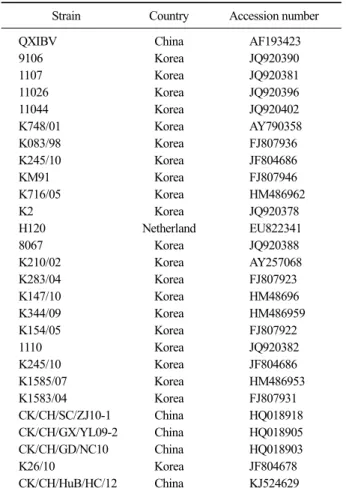
Table 1.IBV reference strains included in this study Strain Country Accession number
QXIBV China AF193423
9106 Korea JQ920390
1107 Korea JQ920381
11026 Korea JQ920396
11044 Korea JQ920402
K748/01 Korea AY790358
K083/98 Korea FJ807936
K245/10 Korea JF804686
KM91 Korea FJ807946
K716/05 Korea HM486962
K2 Korea JQ920378
H120 Netherland EU822341
8067 Korea JQ920388
K210/02 Korea AY257068
K283/04 Korea FJ807923
K147/10 Korea HM48696
K344/09 Korea HM486959
K154/05 Korea FJ807922
1110 Korea JQ920382
K245/10 Korea JF804686
K1585/07 Korea HM486953
K1583/04 Korea FJ807931
CK/CH/SC/ZJ10-1 China HQ018918
CK/CH/GX/YL09-2 China HQ018905
CK/CH/GD/NC10 China HQ018903
K26/10 Korea JF804678
CK/CH/HuB/HC/12 China KJ524629
의 4개 지역 조사에서 신장형 IB의 주요한 유전자형 인 QX-like 변이주로 분류되었다(YuDong 등, 1998;
Liu와 Kong, 2001). 또한 1995년부터 2007년까지 중 국에서 주요한 유전자형으로 연속 분리되었으며(Liu 등, 2009), 최근 여러 나라에서 QX-like IBV가 보고되 고 있다(Cook 등, 2012). 국내 IBV는 1980년에 처음 보고 되었고(Kwon 등, 2001), 백신은 H120 생독과 KM91 및 M41주의 사독 오일백신이 사용되지만 백 신 접종에도 불구하고 IBV는 꾸준히 발생하고 있다.
국내 분리된 IBV는 Mass, K-I (respiratory strains), K-II (nephropathogenetic strains)로 구분되며 지속적인 연구 가 이루어지고 있다(Choi 등, 2009; Kim 등, 2013). 이에 본 조사는 최근 전북에 발생된 전염성기관지염에 대해 중국 및 국내 분리주와의 유전적 특성을 비교하였다.
재료 및 방법
바이러스 분리 및 RNA 추출
2012∼2014년에 전북지역에서 전염성기관지염으로 진단된 농가의 시료를 사용하였다. 바이러스 분리는 조직 유제를 PBS로 10% W/V을 1,500 g에 10분 원심 후 0.2 m로 필터로 여과하여 9∼10일령의 부화란에 접종하여 2∼5일령에 요막강액을 수거하였다. 요막강 액에서 RNA추출은 TRIzol reagent (life tech)을 사용 하여 샘플 200 l에 TRIzol reagent 1 mL을 혼합하고 실온에서 5분간 반응한 후 chloroform 200 l를 추가 하여 4oC, 12,000 g에 15분 원심한 후 상층액을 수거 하였다. 상층액 500 l에 isopropanol을 추가하여 실온 에서 10분간 반응한 후 4oC, 12,000 g에 10분 원심분 리하여 상층액을 제거하였다. 75% ethanol로 세척하 여 4oC, 7,500 g에 5분간 원심 후 상층액을 제거하고 건조하여 RNase-free water 50 l를 첨가 후 55oC에 10 분 반응하여 실험에 사용하였다.
S1 gene primers
S1 gene은 국내 보고된 IBV strain을 GenBank se- quences (JQ920596)를 기초로 forward ACAGCACCT- CCTCAGGGTAT, reverse ACATGCCCTTGGGCCAT- TAT로 제작하였다. PCR은 one-step RT-PCR KIT (QIAGEN, USA)를 사용하여 50oC 30 min, 95oC 15 min 반응한 후 95oC 30 s, 55oC 30 s, 72oC 2 min 40
cycle 증폭한 후 72oC 5 min 반응 후 900 bp 증폭을 확인하였다.
Sequencing
염기서열 분석은 ABI 3130xl DNA sequencer (Applied Biosystem, Life Technologies, USA)로 수행하였다. 염 기서열 분석과 동일성은 Multilian과 CLUSTALW 및 Phylogenetic tree는 MEGA version 6을 이용하였으며, 분석된 유전자 서열은 GeneBank에 공개된 자료로 비 교하였다(Table 1).
결 과
PCR 검사 결과
IBV 감염계의 신장 유제를 부화란에 접종하여 요 막강액을 수거 후 RNA를 추출하였다. IBV S1 gene의
Fig. 1. Amino acid alignment of the S1 genes of QXIBV and 10 IBV isolates.
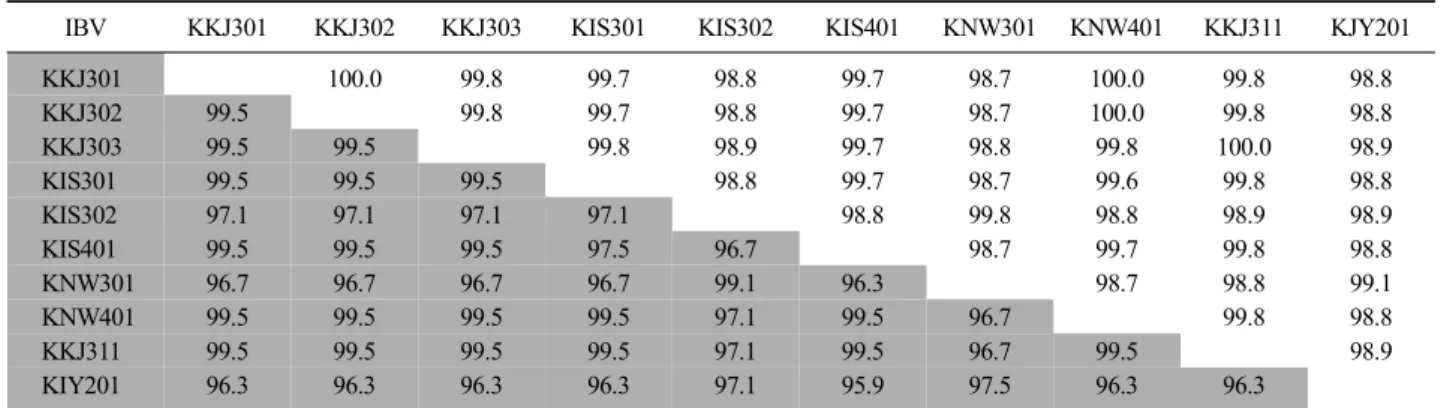
Table 3. Nucleotide and deduced amino acid identities of IBV S1 protein gene sequences
IBV KKJ301 KKJ302 KKJ303 KIS301 KIS302 KIS401 KNW301 KNW401 KKJ311 KJY201
KKJ301 100.0 99.8 99.7 98.8 99.7 98.7 100.0 99.8 98.8
KKJ302 99.5 99.8 99.7 98.8 99.7 98.7 100.0 99.8 98.8
KKJ303 99.5 99.5 99.8 98.9 99.7 98.8 99.8 100.0 98.9
KIS301 99.5 99.5 99.5 98.8 99.7 98.7 99.6 99.8 98.8
KIS302 97.1 97.1 97.1 97.1 98.8 99.8 98.8 98.9 98.9
KIS401 99.5 99.5 99.5 97.5 96.7 98.7 99.7 99.8 98.8
KNW301 96.7 96.7 96.7 96.7 99.1 96.3 98.7 98.8 99.1
KNW401 99.5 99.5 99.5 99.5 97.1 99.5 96.7 99.8 98.8
KKJ311 99.5 99.5 99.5 99.5 97.1 99.5 96.7 99.5 98.9
KIY201 96.3 96.3 96.3 96.3 97.1 95.9 97.5 96.3 96.3
*Nucleotide sequence comparison (white region), **Deduced amino acid comparison (shaded region) Table 2. Field isolate of IBV used in samples
IBV isolate Type of birds Year of isolation Clinical sign Tissue
KKJ301 Korean native chicken 2013 Nephritis Kidney
KKJ302 Korean native chicken 2013 Nephritis Kidney
KKJ303 Korean native chicken 2013 Nephritis Kidney
KIS301 Korean native chicken 2013 Nephritis Kidney
KIS302 Korean native chicken 2013 Nephritis Kidney
KNW401 Korean native chicken 2014 Nephritis Kidney
KNW301 Broiler 2013 Nephritis Kidney
KIS401 Korean native chicken 2014 Nephritis Kidney
KKJ311 Korean native chicken 2014 Nephritis Kidney
KJY201 Korean native chicken 2012 Nephritis Kidney
검출을 위해 RT-PCR을 실시한 결과 10개의 sample에 서 특이 밴드가 확인되었다(Table 2).
S1 gene 염기서열 분석 결과
분리된 10주의 IBV gene에서 염기서열 분석 후 상 동성을 비교한 결과 KKJ301, KKJ302, KNW401과
KKJ303, KKJ311은 100% 일치하였으며 분리주간 99.8∼98.5%, 국내주 KM91와 87.9∼87.5%, 중국의 QX-IBV와는 96.5∼95.4%의 동일성을 나타냈다(Table 3). 또한, 아미노산은 KKJ301, KKJ302, KKJ303, KIS301, KIS401, KNW401, KKJ311은 99.5% 일치하였으며, 분 리주간 97.5∼96.3%의 동일성을 나타냈다(Table 3).
KM91과는 68.5∼71.0%, QX-IBV와는 88.5∼94.6%의
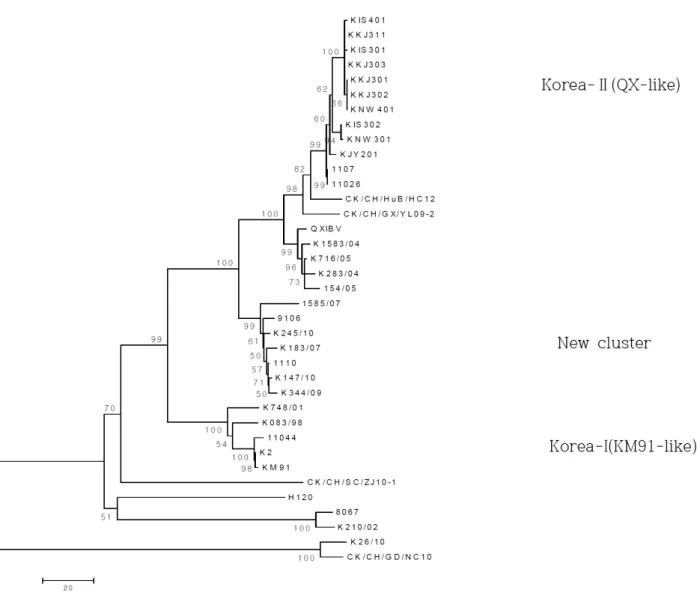
Fig. 2. IBV phylogenetic tree of S1 gene. The tree is based on the sequence of S1 genes from the 10 IBV isolates and the 16 reference strains, and ClustalW alignment method for S1 nucleotide position 100∼1,080. Phylogenetic tree were conducted with the neighbor-joining method using MEGA 6.0 version. The bootstrap values were determined from 1,000 replicates of original data.
동일성을 보였다. 또한, QX-IBV는 KKJ301, KKJ302, KKJ311, KNW401, KKJ303와 23개 부위, KIS301, KIS401과는 24개 부위가 다른 서열을 나타냈다(Fig. 1).
Phylogenetic tree 분석
분리된 10주의 IBV 염기서열에 의한 Phylogenetic tree를 분석한 결과 국내 분리된 KM91 보다 중국의 QX-IBV 계열로 국내 분리 1107, 11026 및 중국 CK/CH/GX/YL09-2, CK/CH/HuB/HC/12과 같은 계열에 속하였다(Fig. 2).
고 찰
닭전염성기관지염은 호흡기 및 신장형으로 발생되 어 세계적으로 양계의 생산성을 저하시키는 주요 질 병이다. 국내에서도 생독 및 사독 백신을 접종함에도 불구하고 다양한 변이성으로 인해 많은 혈청형과 변 이주가 지속적으로 분리되고 있다. 즉 변이주의 출현 으로 IBV 백신을 접종해도 방어 면역 저하로 인한 질병의 발생과 기존 백신의 방어율에 대한 의문이 제 기 되고 있다. 과거 국내 농장에서 발생된 IBV는 1980년대 Mass형, 1990년대 KM91형, 2000년대 중국 QX형이 출현하였고, 최근 이러한 바이러스간의 재조 합으로 인한 변이주의 출현도 보고되고 있다(Song
등, 2013).
본 조사에서 분리된 10주의 S1 염기서열은 100∼
95.8%로 높은 상동성을 보여 2012∼2014년에 발생된 전염성기관지염은 QX-like 계열로 유행됨을 확인하 였다. 또한 기존에 보고된 QX-IBV와는 96.5∼95.4%, KM91과는 87.9∼97.5%, 2011년 국내 분리주 11026과 는 99.1∼98.1%, 2010년 분리주 1110과는 93.2∼91.1%
의 상동성을 나타냈다.
Lim 등(2012)은 2007년에서 2010년에 분리된 국내 주의 백신 H120과 K2에 대한 방어율을 비교하여 K-II가 더 효과적이라고 보고하였고, Lim 등(2011)은 2005∼2010년에 분리된 국내 분리주를 Korea group II (KM91-like 및 QX-like)와도 구분되는 K-II에 속하는 new IBV 주를 분리하였고, Mo 등(2013)도 2008∼2011 년 국내 분리주에서 KM91-like, QX-like, new cluster 을 확인하였다. KAHIS 자료에 의하면 전염성기관지 염은 전국에서 2014년 77건, 2012년 41건, 2013년 58 건, 2014년 87건이 발생 되었고, 전북은 2011∼2014 년까지 109건으로 토종닭이 55건(50.4%), 육계 39건 (35.7%)이었다. 국내 IBV의 백신은 K2b (QX-like), K2a (KM91-like), K1 (M41-like)혼합 사독백신과 H120 주, K2주 생독백신 등 백신의 종류와 접종 방법도 점 안, 음수, 분무로 다양하며 품종별 백신접종 일령에 도 차이가 있다. 이러한 다양한 백신과 접종방법은 농가 방역에 혼선이 가능하다. 그러므로 바이러스 유 전형에 따른 품종별 백신 선택과 접종시기에 대한 지 침이 필요하리라 사료된다. 또한, 국내 바이러스에 대한 유전형 분석과 변이주의 감시 및 변이주에 대한 백신 계발이 지속적으로 연구되어야 한다.
결 론
전북에서 분리된 10주 IBV의 S1 gene 염기서열은 분리주간 100∼95.8%, 국내주 KM91과 87.9∼87.5%, 중국주 QX-IBV와는 96.5∼95.4%, 아미노산은 분리주 간 99.5∼96.3%를 KM91과 68.5∼71.0%, QX-IBV와는 88.5∼94.6%의 동일성을 보였다. 또한 QX-IBV는 KKJ301, KKJ302, KKJ311, KNW401, KKJ303와 23개 부위에서 KIS301, KIS401과는 24개 부위가 다른 서 열을 나타냈다. Phylogenetic tree 분석에서 K-II 및 KM91 보다 중국 분리주 QX-IBV 계열, 국내의 1107, 11026 및 중국의 CK/CH/GX/YL09-2, CK/CH/HuB/HC/12 과 같은 계열에 속하였다.
REFERENCES
Choi KS, Lee EK, Jeon WJ, Park MJ, Kim JW, Kwon JH. 2009.
Pathogenicity and antigenicity of a new variant of Korean nephropathogenic infectious bronchitis virus. J Vet Sci 10: 357-359.
Cook JK, M. Jackwood M, Jones RC. 2012. The long view: 40 years of infectious bronchitis research. Avian Pathol 41:
239-250.
Fabricant J. 1998. The early history of infectious bronchitis.
Avian Dis 42: 648-650.
Kim BY, Lee DH, Jang JH, Lim TH, Choi SW, Youn HN, Park JK, Lee JB, Park SY, Choi IS, Song CS. 2013.
Cross-protective immune responses elicited by a Korean variant of infectious bronchitis virus. Avian Dis 57:
667-670.
Koch G, Hartog L, Kant A, van Roozelaar DJ. 1990. Antigenic domains on the peplomer protein of avian infectious bronchitis virus: correlation with biological functions. J Gen Virol 71: 1929-1935.
Kwon HJ, Lee DW, Ahn YK, Yoon JU, Kim SJ. 2001. Presence of infectious bronchitis virus in Korea before 1986.
Korea J Vet Res 41: 59-65.
Lee HJ, Youn HN, Kwon JS, Lee YJ, Kim JH, Lee JB, Park SY, Choi IS, Song CS. 2010. Characterization of a novel live attenuated infectious bronchitis virus vaccine candidate derived from a Korean nephropathogenic strain. Vaccine 28: 2887-2894.
Lee EK, Jeon WJ, Lee YJ, Jeong OM, Choi JG, Kwon JH, Choi KS. 2008. Genetic diversity of avian infectious bronchi- tis virus isolates in Korea between 2003 and 2006.
Avian Dis 52: 332-337.
Lim TH, Lee HJ, Lee DH, Lee YN, Park JK, Youn HN, Kim MS, Lee JB, Park SY, Choi IS, Song CS. 2011. An emerging recombinant cluster of nephropathogenic strains of avian infectious bronchitis virus in Korea.
Infect Genet Evol 11: 678-685.
Lim TH, Kim MS, Jang JH, Lee DH, Park JK, Youn HN, Lee JB, Park SY, Choi IS, Song CS. 2012. Live attenuated nephropathogenic infectious bronchitis virus vaccine pro- vides broad cross protection against new variant strains.
Poult Sci 91: 89-94.
Liu S, Kong X. 2004. A new genotype of nephropathogenic in- fectious bronchitis virus circulating in vaccinated and non-vaccinated flocks in China. Avian Pathol 33:
321-327.
Liu S, Zhang X, Wang Y, Li C, Han Z, Shao Y, Li H, Kong X. 2009. Molecular characterization and pathogenicity of infectious bronchitis coronaviruses: complicated evolu- tion and epidemiology in china caused by cocirculation of multiple types of infectious bronchitis coronaviruses.
Intervirology 52: 223-234.
Mo ML, Hong SM, Kwon HJ, Kim IH, Song CS, Kim JH. 2013.
Genetic diversity of spike, 3a, 3b and e genes of in-
fectious bronchitis viruses and emergence of new re- combinants in Korea. Viruses 31: 550-567.
Song JE, Jeong WG, Sung HW, Kwon HM. 2013. Sequencing, phylogenetic analysis, and potential recombination events of infectious bronchitis viruses isolated in Korea.
Virus Genes 46: 371-374.
YuDong W, YongLin W, ZiChun Z, GenChe F, YiHai J, XiangE L, Jiang D, ShuShuang W. 1998. Isolation and identi- fication of glandular stomach type IBV (QX IBV) in chickens. Chinese Journal of Animal Quarantine 15: 1-3.