1. Introduction
It is essential to use a transparent electrode for many optoelectronic devices including electronic papers, organic light emitting diodes, and thin film solar cells. Until now indium tin oxide (ITO) has been most widely used transparent electrode in optoelectronic devices, flat panel display, and thin film solar cells
1-3). Diverse preparation methods have been employed to fabricate conductive transparent ITO electrode including laser ablation, magnetron sputtering, reactive electron beam evaporation, reactive thermal deposition, spray pyrolysis, and sol-gel process
4-6). Compared with many other methods, sol-gel method has advantages including easy control of solution concentration, coating on the desired area, cheap solution process without expensive and complicated equipment. The main goal of this research is to fabricate flexible and transparent electrode.
Indium is a soft and highly ductile post-transition metal, which has Mohs hardness of 1.2. Therefore, doping indium to the conjugate polymer is a proper composite to achieve flexible and conducting electrode.
Conducting polymers including polypyrrole, polyaniline, polythiophene, polyphenylenevinylene, and poly (3,4-ethylene- dioxythiophene)-poly (styreneswulfonate) (PEDOT:PSS) become a viable alternative to inorganic materials and have been used in
many devices such as various types of solar cells, organic energy storages, and flexible electronics. Conducting polymers have superior advantages such as low cost materials and process, easy process, and flexibility
7-9). Among the conducting polymers, PEDOT:PSS has been extensively used as an electrode for OLED, electrochromic windows, capacitor, and photodiode due to the high quality film formation by spin- coating and optical transparency. Insertion of PEDOT:PSS between the ITO and the emissive polymer leads to a dramatic increase the device lifetime and luminous efficiency. For these reason, many researchers have focused to increase the conductivity of the PEDOT:PSS by adding cosolvent (including dimethyl sulfoxide, ethylene glycol, methanol, and sorbitol) to the aqueous PEDOT:PSS solution and post-treatment of the spin- coated PEDOT:PSS film. This exploratory research focused on investigating the optical and electrical properties of indium doped PEDOT:PSS film.
2. Experimental
PEDOT:PSS (1.3 wt%), indium chloride (97 %) and HCl (36.5~38%) were purchased from Sigma Aldrich company and used without further purification. Deionized water (3 g) and HCl (30 mg) were added to a vial. Various amounts of indium chloride (10, 25, 50, and 75 mg) were added to the vials.
PEDOT:PSS (3 g) was added to the indium solution with
Current Photovoltaic Research 5(4) 109-112 (2017) pISSN 2288-3274
DOI:https://doi.org/10.21218/CPR.2017.5.4.109 eISSN 2508-125X
Optical and Electrical Properties of Indium Doped PEDOT:PSS
Byoung-Ju Kim ․ Kwang-Sun Kang*
New and Renewable Energy Department, Kyungil University, 50 Gamasilgil Hayangup Gyeongsan, Gyeongbuk 38428, South Korea
Received August 14, 2017; Revised November 28, 2017; Accepted December 5, 2017
ABSTRACT: Various wt. ratios of indium were doped to the poly(3,4-ethylenedioxythiophene)-poly(styreneswulfonate) (PEDOT:PSS) to enhance the conductivity and transmittance. The transmittance of the films increased with increasing the amount of indium. The field emission scanning electron microscope (FESEM) image of 2.54 wt. % of indium doped PEDOT:PSS film shows large number of aggregated indium particles. However, more than 2.54 wt. % of indium doped PEDOT:PSS films showed reduced aggregated indium particles. Moreover, 4.47 wt. % of indium doped PEDOT:PSS film showed no aggregated particles. The resistivity of pure PEDOT:PSS film showed 880 k Ω·cm. The resistivity of 1.03 wt. % indium doped film reduced approximately 26 times compared with pure PEDOT:PSS film. The resistivity of indium doped film further reduced with increasing the amount of indium, which showed approximately 0.55 k Ω·cm for the PEDOT:PSS film doped 4.47 wt. % of indium.
Key words: PEDOT:PSS, Indium, Conductivity
*Corresponding author: [email protected]
ⓒ 2017 by Korea Photovoltaic Society
This is an Open Access article distributed under the terms of the Creative Commons Attribution Non-Commercial License (http://creativecommons.org/licenses/by-nc/3.0)
which permits unrestricted non-commercial use, distribution, and reproduction in any medium, provided the original work is properly cited.
109
B.J. Kim and K.S. Kang / Current Photovoltaic Research 5(4) 109-112 (2017) 110
stirring at room temperature. The solutions were spin-coated on glass substrate at 1000 rpm and heat treated at 150 °C. The resistance and UV-visible transmittance were measured using probe station and Thermo Scientific Genesys 10S UV-visible spectrometer, respectively. The field emission scanning electron microscope (FESEM) images of spin-coated PEDOT:PSS doped with various amounts of indium were obtained using JEOL ISM-7401 scanning electron microscope.
3. Results and Discussion
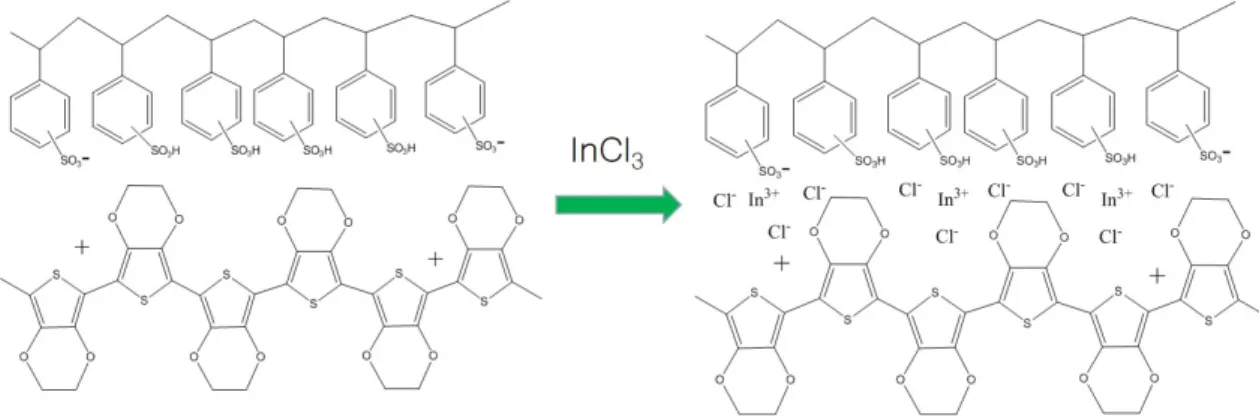
Commercially available PEDOT:PSS has greatly attracted attention because of it’s superior advantages including excellent thermal stability, high transparency in whole visible region, and aqueous solution processibility. However, low conductivity of PEDOT:PSS film limits variety use in research and industry, which is directly affect the performance of the device. Therefore, resolving the conductivity problem is a key factor to improve the device performance. Addition of organic materials including dimethyl sulfoxide, dimethylformamide, tetrahydrofuran, poly- ethylene oxide, and sorbitol improved the conductivity. Fig. 1 shows the pictorial representation of this research, which is doped indium chloride to PEDOT:PSS to improve the conductivity.
The UV-visible spectra of PEDOT:PSS films doped with various amounts of indium are shown in Fig. 2. The trans- mittance increased as the wavelength reduced, which is advantageous for solar cell application. The transmittance drastically reduced for the shorter than 320 nm due to the substrate absorption. The transmittance increased with increasing the amount of doping level of indium, which could be explained that the PEODT:PSS was replaced by indium. This result implies that more sunlight can be transmitted with increasing the indium doping level.
Many researchers have focused on indium related properties in light emitting diode (LED) and solar cell applications with various conditions, especially in aggregation of indium. Treatment of trimethylindium significantly improved the quality of the surface morphology for green LED.
10)It was reported that the aggregation of indium atoms improved the carrier concentration and showed stable electrical properties
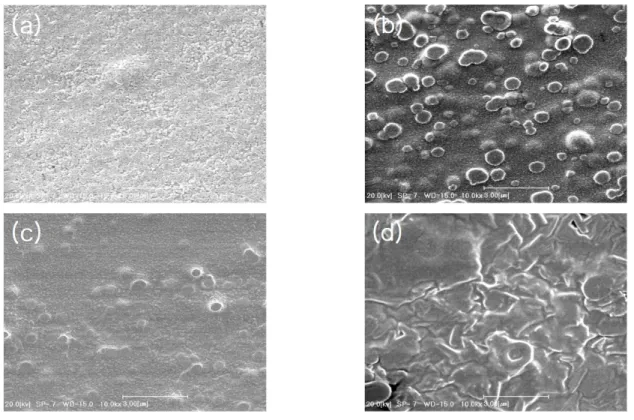
11). Therefore, investigation of indium doped materials is important to improve the electrical and optical properties for LED, solar cell, and other electronic devices. Figs. 3(a)-(d) show the surface FESEM images of 1.03, 2.54, 3.65, and 4.47 wt. % indium doped PEDOT:PSS films, respectively. The 2.54 wt. % indium doped PEDOT:PSS film shows largest aggregation of indium. More than 2.54 wt. % of indium doped films show lower aggregation of indium.
Fig. 4(a) shows the characteristic I-V curves of the indium doped PEDOT:PSS films. The resistance of the non-doped PEDOT:PSS film was 880 kΩ·cm, which was 26 times higher than the resistance of the 1.03 wt. % indium doped film. Doping small amount of indium drastically increased conductivity. Fig.
Fig. 1. Schematic representation of indium doped PEDOT:PSS
Fig. 2. UV-visible transmittance spectra of PEDOT:PSS films doped with various amount of indium
B.J. Kim and K.S. Kang / Current Photovoltaic Research 5(4) 109-112 (2017) 111
4(b) shows the effect of the indium doping to the resistance.
Since the resistance of pure PEDOT:PSS film was too high to compare the indium concentration dependent resistance, the plot of resistance of pure PEDOT:PSS film was removed for better comparison for the concentration dependency of the resistance as shown in inset Fig. 4(b). The resistance reduced with increasing the amount of indium and reached to 0.55 kΩ for the PEDOT:PSS film doped 4.47 wt. % of indium. Characteristic Schottky diode I-V curve was shown for the 4.47 wt. % indium doped film due to the work function change (work function for In (4.1 eV) and PEDOT:PSS (5.1 eV).
4. Conclusions
The conductivity and transmittance of the PEDOT:PSS film enhanced by doping indium. The UV-visible range transmittance increased with increasing the amount of doped indium. The FESEM image of 2.54 wt. % of indium doped PEDOT:PSS film showed large number of aggregated indium particles. The aggregated indium particles were disappeared with increasing the amount of indium. The resistivity of PEDOT:PSS film doped with 1.03 wt. % indium reduced approximately 26 times and further reduced with increasing the amount of indium.
Fig. 3. Surface FESEM images of PEDOT:PSS doped with (a) 1.03, (b) 2.54, (c) 3.65, and (d) 4.47 wt. %
Fig. 4. (a) I-V curves of PEDOT: PSS films doped various amount of indium and (b) resistivity of PEDOT:PSS films vs doping level of indium
B.J. Kim and K.S. Kang / Current Photovoltaic Research 5(4) 109-112 (2017) 112
Acknowledgments
This research is performed under the support of Kyungil University.
References
1. D. McGillivray, J. P. Thomas, M. Abd-Ellah, N. F. Heinig, K.
T. Leung, Appl. Mater. Interfaces 8, 34303, 2016.
2. E. Vitoratos, S. Sakkopoulos, E. Dalas, N. Paliatsas, D.
Karageorgopoulos, F. Petraki, S. Kennou, S. A. Choulis, Organic Electronics 10, 61, 2009.
3. J. Ouyang, C. W. Chu, F. C. Chen, Q. Xu, Y. Yang, Adv.
Funct. Mater. 15, 203, 2005.
4. H. W. Wang, C. F. Ting, M. K. Hung, C. H. Chiou, Y. L. Liu,
Z. Liu, K. R. Ratinac, S. P. Ringer, Nanotechnology 20, 055601, 2009.
5. A. Muramatsu, K. Kanie, T. Sasaki, M. Nakaya, KONA Power and Particle J. 33, 340, 2016.
6. H. W. Wang, G. D. Xu, J. R. Zhang, X. Yin, Bull. Korean Chem. Soc. 35, 1999, 2014.
7. A. A. Farah, S. A. Rutledge, A. Schaarschmidt, R. Lai, J. P.
Freedman, A. S. Helmy, J. Appl. Phys. 112, 113709, 2012.
8. P. W. Sze, K. W. Lee, P. C. Huang, D. W. Chou, B. S. Kao, C.
J. Huang, Energies 10, 716, 2017.
9. P. D. Angelo, G. B. Cole, R. N. Sodhi, R. R. Farnood, Nordic Pulp and Paper Res. J. 27, 486, 2012.
10. B. Xu, H. T. Dai, S. G. Wang, F. C. Chu, C. H. Huang, S. F.
Yu, J. L. Zhao, X. W. Sun, R. M. Lin, International J.
Photoenergy 952567, 2014.
11. H. Sun, S. U. Jen, S. C. Chen, S. S. Ye, X. Wang, J. Phys. D:
Appl. Phys. 50, 099501, 2017.