```
1. INTRODUCTION
Technical development using magnetic force control is widely conducted from fundamental to applied study. The magnetic force control techniques can be transferred in various applications, for example, water treatment, pollution abatement, recycling, medical application and so on.
Especially, from the standpoint of environmental conservation and cost reduction, the technology is in a great expectation as recycle technology and industrial waste treating method. In recent years, some industrial equipment using the magnetic force control techniques have been introduced to the environmental and medical field by private companies. In the environmental field, for example, the flocculation magnetic separation system is used for the treatment of ballast water for marine protection and improvement of oil productivity [1, 2]. The former is the system for separating planktons, fungus, clays and soils from ballast water which is the weight for keeping the balance of ship. In the system, the magnetic flocs are formed by addition of aggregating agent and magnetic powder to the separation subject, and then are removed by adsorption on the magnetic disc. The latter is the system for separating oil content from “associated water” which is discharged when digging crude and gas. The oil content is bound to the magnetic powder and then is separated by permanent magnet.
On the other hand, iron powder magnetic separation method is used as countermeasure technique for soil contamination [3]. This is the method for recycling soil which is contaminated by heavy metal. This is the purification technique in which heavy metals adsorbed on the magnetic powder is separated by the magnet.
Moreover, in medical field, a magnetic separation kit for
cancer stem cell is under the category. This is the kit which separates the cells expressing cancer stem cell marker using cancer stem cell marker antibody and magnetic beads. As stated above, techniques using magnetic force control have been put into actual utilization regardless of field.
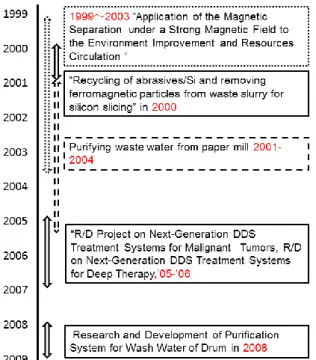
We have also conducted research and development for practical use in some of areas. In this paper, our achievements of research and development for magnetic force control technique were outlined. Fig. 1 and 2 show the chronologic table of our research and development.
The achievements are to be described for each field below.
Osaka University, Osaka, Japan
(Received 15 February 2016; revised or reviewed 24 March 2016; accepted 22 March 2016)
Abstract
The technologies using magnetic force control have been investigated toward application in various fields. Some of them have been put into practical use as the results of technological development. This paper introduces our technical development in the field of water processing, scale removal, magnetic drug delivery system, decontamination of radioactive substances and resources recycling.
Keywords : Magnetic Separation, Magneto-Archimedes method, Recycle, MDDS
* Corresponding author:
Fig. 1. The chronological table of our study from 1999 to 2009.
2. Overview of magnetic separation technology
Before introduction of each research, the outline of the magnetic separation technology which is one of the magnetic force control is explained. The magnetic separation is a technique to remove or recover the objective materials selectively with high efficiency by utilizing the difference of the magnetic property of the subject. The method of magnetic separation is categorized into 3 techniques; open gradient magnetic separation (OGMS), high gradient magnetic separation (HGMS) and magneto- Archimedes.
Open gradient magnetic separation is a method using the magnetic field generated by the magnet itself. A continuous process can be easily conducted with this method, and it is not necessary to change the magnetic filter as high gradient magnetic separation described below. However, this method has a demerit that magnetic gradient is small in comparison with high gradient magnetic separation and obtained magnetic force is small. The application examples of the methods are recycling of waste can, segregation of industrial waste and so on.
High gradient magnetic separation is a method to enhance the magnetic force acting on the object particles.
In this method, the magnetic filter, which consists of ferromagnetic thin wire, is placed in a magnetic field in order to increase the magnetic gradient. It is possible to generate much stronger magnetic force than the open gradient magnetic separation with above method. It enables to separate the paramagnetic and diamagnetic materials.
But it is hardly used for separation of paramagnetic and diamagnetic material by the issues of separation efficiency and processing costs.
Magneto-Archimedes method is the separation technique using Archimedes principle that the buoyancy
force acting on the substance in the fluid is equal to the weight of fluid displaced by the substance which acts in the upward direction. Paramagnetic materials have small positive magnetic susceptibility ranged from 10-4 to 10-6, and it can be levitated by the magnetic force if a strong magnetic field is applied. When suspending the objective particles in the paramagnetic medium which has magnetic susceptibility larger than that of objective particle, the difference in drug force acting on the object and medium by a magnet is caused. As a result, the particles are levitated because the apparent relative density of the medium becomes larger than that of the particles. Levitated position of each particle is determined by the difference of magnetic susceptibility and relative density between the medium and the objective particles. Magnet-Archimedes separation is a method utilizing the difference in the levitation position.
These three separation techniques are needed to be used depending on the magnetic susceptibility of separation targets. OGMS is the suitable for separation of ferromagnetic substances, whereas HGMS is suitable for separation of paramagnetic substances with relatively large magnetic susceptibility around 10-4, in addition to ferromagnetic substances. Magneto- Archimedes method is suitable for separation of diamagnetic and paramagnetic substances with relatively small magnetic susceptibility.
The application scope of each method is summarized in Fig.
3.
In the category of magnetic separation, the separation condition varies greatly depending on the target. However, the applicable scope becomes wide if we select the appropriate method suitable for the separation target.
3. STUDIES ON WATER PROCESSING TECHNIQUE
A study on the water processing is one of the magnetic force control technologies in the environmental field.
Regulations on the water processing are repeatedly revised [4]. Since the regulations have become strict. In stages, technological development that can meet the need is required.
From 1999 until 2003, a project called “Application of the Magnetic Separation under a Strong Magnetic Field to the Environment Improvement and Resources Circulation (funded by Japan Society for the Promotion of Science)" is conducted. This was a project to promote the implementation of the new magnetic separation Fig. 3. The applicable scopes of each magnetic separation method depending on magnetic susceptibility.
Fig. 2. The chronological table of our study from 2010 to 2017.
system for inorganic suspension wastewater in semiconductor factory (funded by Kinki Regional Bureau of International Trade and Industry)"[7] (Fig. 4). The purpose of this study is fractionation of the abrasive grain used in manufacturing of wafers of solar cell, and we have succeeded in recycle the grain developing technologies.
Subsequently, from 2001 until 2004, we developed the
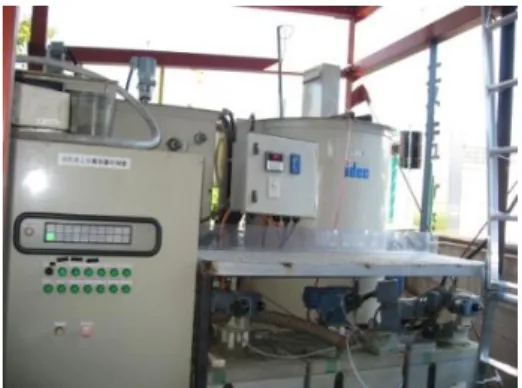
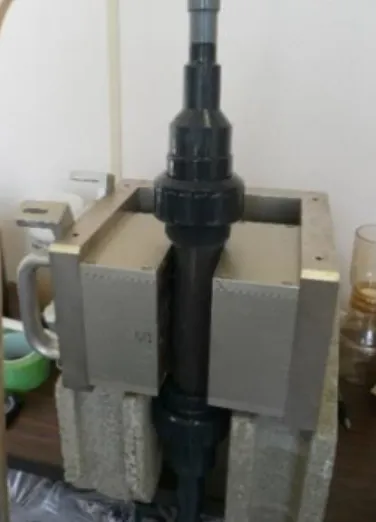
“Wastewater treatment system from paper mill using a superconducting magnetic separation (funded by NEDO) [8] (Fig. 5),” and “Purification system of drum washing water by a magnetic filter (funded by The Ministry of the Environment)” in 2008 [9, 10] (Fig. 6). In the former system, superconducting magnet (400 mm in room temperature bore, 600 mm in length, 3 T in maximum magnetic flux density) was used. In the later system, bulk magnet was used. In these studies, it has been demonstrated that a large amount of wastewater can be treated by a superconducting magnet. Moreover, it can be said that we developed the device which is comparable not only in performance but also in economic efficiency against competing technology at the time.
The accumulated technologies in these water treatment projects are applied in resources recycling technology described below.
4. STUDIES ON MDDS TECHNIQUE [11, 12]
As a medical application of magnetic force control technology, research of MDDS (Magnetic drug delivery system) has been conducted. A drug delivery system is a method to transport the drug selectively to the affected area.
This is a therapeutic method for preventing diffusion of the drug in the body, so called DDS (Drug Delivery System).
MDDS is a technology that enables more efficient drug treatment than conventional DDS by applying a precise magnetic field from outside the body in order to deliver actively to the affected area by the magnetic force. This study has been conducted for the purpose of improving the drug efficacy or reducing side effect in the anti-cancer agent. We examined for MDDS in 2006 in a project of
"Next-generation treatment system by the magnetic induction DDS (MDDS)" (Fig. 7). We succeeded to accumulate magnetite particles at a targeted site in the body by the animal experiments using rats and pigs.
We started from the research for “Magnetic drug control in the blood vessel branch”, and then developed into
“Minimally invasive high-precision control of the drug using a ferromagnetic needle” and “A non-invasive magnetic field rotation type drug delivery system”. Now, we are trying to accumulate the ferromagnetic drug noninvasively to the affected area deep inside the body, which was one of the issues of conventional MDDS for many years. We are conducting this research toward practical use.
Fig. 5. The effluent processing system.
Fig. 4. The wafer of solar cell.
Fig. 7. The experiment system of MDDS.
Fig. 6. The purification system.
5. STUDIES ON RESOURCES RECYCLING TECHNIQUE [13]
A recycling technology is one of the important applications of magnetic force control technique in the environmental field.
"Construction of recycling technology development and recycling system by Magneto-Archimedes method of rare earth (cerium oxide) (funded by New Energy and Industrial Technology Development Organization)", which is a recycling system of rare earths was conducted in 2011 (Fig. 8). Recycle of the polished agent has been needed because cerium oxide used as a glass polishing agent can be used for various purposes. In this system, cerium oxide which is a polishing agent of optical products was selectively recovered from grinding wastewater by using HGMS and Magneto-Archimedes method. By the system consisting of a permanent magnet and a superconducting magnet, it was possible to recover cerium oxide in high purity. It was also confirmed that recovered cerium oxide with this system can be reused.
Grounded in this study, we are currently working on the separation and recovery of the fluorescent material and plastic wastes. In the previous study, the possibility of accurate separation in a batch separation device is confirmed. As a next step, we are currently designing the continuous separation apparatus.
6. STUDIES ON DECONTAMINATION TECHNIQUE [14, 15]
Decontamination technology for radioactive substances is also one of the magnetic force control technologies in the environmental field. ”Development of Volume Reduction method of Radiocesium-Contaminated Soil by Air-Lift Washing Process” was conducted as a contract research by environmental research and technology development fund of Ministry of the Environment from FY2011 to FY2013.
This project was conducted for the objective of recovering the clay adsorbed radioactive cesium by wet classification of soils. However, most of radioactive cesium ions do not elute into aqueous phase only by stirring the soil suspension.
They were found to be adsorbed firmly on the specific clay minerals in the soil.
Based on above result, “Construction of decontamination scenario based on the dynamic states of cesium and development of decontamination method by magnetic force control” as a contract research by environmental research and technology development fund of Ministry of the Environment from FY2013 to FY2014 (Fig. 9). This is the study for decontaminate and reduce the volume of the contaminated soil by recovering only paramagnetic 2:1 type clay selectively from the contaminated soil which strongly absorbs cesium. This is the technology that capitalizes on the strength of HGMS that can capture the paramagnetic substance.
On the basis of model experiment in the laboratory, we are currently conducting practical investigation using actual contaminated soil in Fukushima prefecture.
7. STUDIES ON SCALE REMOVAL TECHNOLOGY [16]
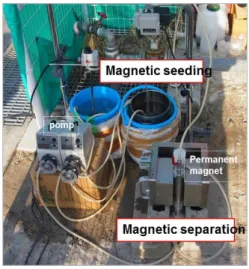
Our most recent research and development for the scale removal technology is also one of the magnetic force control technologies in the environmental field. From FY2013 to FY2015, “Geothermal power generation project, Innovative technology development for promotion of introduction of geothermal power plant, Development of scale removal technology for effective use of low-temperature geothermal resources” is in progress funded by New Energy and Industrial Technology Development Organization (NEDO) (Fig. 10). This is the engineering development for expanding induction of the geothermal power generation. The scale mainly composed of silica is generated in the feed water system of geothermal water. The scale is needed to be removed because it causes obstruction of the hot water transport pipe, the production well and reinjection wells. In order to solve the problem, the analysis of the samples of hot spring water and scale were conducted. Separation device was designed and fabricated based on the results. The device is currently tested in the field site.
Fig. 9. The experiment of soil decontamination by HGMS in Fukushima.
Fig. 8. Recycle system of the polishing agent by using HGMS and Magneto-Archimedes method.
Moreover, “Strategic basic research programs, Advanced low carbon technology research and development program, Removing iron oxide particles from boiler feed-water of thermal power plants by magnetic separation” funded by JST is in progress from FY2013 to FY2017 (Fig. 11)”. The purpose of the project is to solve the problems that deterioration in heat exchange efficiency is caused by adhesion of iron oxide scale on the inner wall of the pipes in boiler. We are considering the scale removal system using magnetic separation. Now we are considering the effective conditions of magnetic separation in the laboratory scale.
8. CONCLUSION
This paper summarized the magnetic force control technology we've been doing. These research and development for magnetic force control technology had been conducted so as to answer the needs of the age. Magnetic force control, especially in combination with the technology system of the superconducting technology, has a possibility of wide evolution. We will continue the research aiming to develop the
Ocean,” Hitachi Review, vol. 91, no. 08, pp. 672-673, 2009.
[2] T. Kinoshita, O. Bassem, Y. Sekine, T. Kadosaki, K. Suzuki, M.
Matsuura, N. Abe and H. Isogami, “Past and Future Outlook for Hitachi’s International Water Treatment Solutions Business,”
Hitachi Review, vol. 95, no. 08, pp. 556–557, 2013.
[3] K. Ito, J. Kawabata and T. Niki, “Application of Magnetic Separation to Remediation Method for Contaminated Soil and Groundwater Collection and Iron Powder as Reducer,” Cryogenics and superconductivity society of japan, vol. 46, no. 11, pp. 676-679, 2011.
[4] Ministry of Land, Infrastructure, Transport and Tourism, Water Resources in Japan (FY2014), Aug. 2014.
[5] YU Sung-Jin, S. Takeda, I. Tari, S. Nishijima and A. Nakahira, ” Development of Recovery Process of Organic Dyes using by High Gradient Magnetic Separation,” Cryogenics and Superconductivity Society of Japan, vol. 38, no. 2, pp. 77-82, 2003.
[6] S. Nishijima, “Development of the effective utilization of Blue-green algae in lake,” Superconductivity Communications, vol.
8, no. 3, pp. 9, 1999.
[7] S. Nishijima, Y. Izumi, S. Takeda, H. Suemoto, A. Nakahira, and S.
Horie, “Recycling of Abrasives From Wasted Slurry by Superconducting Magnetic Separation,” IEEE Transactions on Applied Superconductivity, vol. 13, no. 2, pp.1596, 2003.
[8] S. Nishijima and S. Takeda, “Superconducting High Gradient Magnetic Separation for Purification of Wastewater from Paper Factory,” IEEE Transactions on Applied Superconductivity, vol. 16, no. 2, pp. 1142-1145, 2006.
[9] F. Mishima, T. Terada, T. Ohnishi, K. Iino, H. Ueda, S. Nsihijima,
“High-Speed Magnetic Filtration System Using HTS Bulk Magnet for Used Wash Water of Drum,” IEEE Transactions on Applied Superconductivity, vol. 19, no. 3, pp. 2165-2168, 2009.
[10] F. Mishima, Y. Akiyama and S. Nishijima, “Research and Development of Magnetic Purification System for Used Wash Water of Drum,” IEEE Transactions on Applied Superconductivity, vol. 20, no. 3, pp. 937-940, 2010.
[11] S. Nishijima, S. Takeda, F. Mishima, Y. Tabata, M. Yamamoto, J.
Joh, H. Iseki, Y. Muragaki, A. Sasaki, K. Jun and N. Saho, “A Study of Magnetic Drug Delivery System Using Bulk High Temperature Superconducting Magnet,” IEEE Transactions on Applied Superconductivity, vol. 18, no. 2, pp. 874-877, 2008.
[12] S. Nishijima, F. Mishima, Y. Tabata, H. Iseki, Y. Muragaki, A.
Sasaki and N. Saho, “Research and Development of Magnetic Drug Delivery System Using Bulk High Temperature Superconducting Magnet,” IEEE Transactions on applied Superconductivity, vol. 19, no. 3, pp. 2257-2260, 2009.
[13] F. Mishima, T. Terada, Y. Akiyama and S. Nishijima, “High Gradient Superconducting Magnetic Separation for Iron Removal From the Glass Polishing Waste,” IEEE Transactions on Applied Superconductivity, vol. 21, no. 3, pp. 2059-2062, 2011.
[14] S. Nishijima, Y. Akiyama, F. Mishima, T. Watanabe, T. Yamasaki, S. Nagaya, S. Fukui: “Study on decontamination of radioactive cesium from soil by HTS magnetic separation system,” IEEE Transactions on Applied Superconductivity, vol. 23, no. 3, Article #.
3700405, 2013.
[15] K. Sekiya, H. Kuwahara, Y. Yoshida, S. Igarashi, N. Nomura, F.
Mishima, Y. Akiyama, S. Nishijima: “Study on Decontamination of Contaminated Soils by Magnetic Separation,” IEEE Transactions on Applied Superconductivity, vol. 24, no. 3, Article #. 3700205, 2014.
[16] N. Mizuno, F. Mishima, Y. Akiyama, H. Okada, N. Hirota, H.
Matsuura, T. Maeda, N. Shigemoto and S. Nishijima, “Removal of iron oxide with superconducting magnet high gradient magnetic separation from feed-water in thermal plant,” IEEE Transactions on applied superconductivity, vol. 25, no. 3, Article #. 3700804, 2015.
Fig. 11. The system for removal of iron oxide scale from feed water in thermal power plant using .magnetic separation.
Fig. 10. The scale removal system from feed water system of geothermal power generation by magnetic separation.