http://e-nrp.org
Comparison of lymphocyte DNA damage levels and total antioxidant capacity in Korean and American diet
Min Young Lee, Hyun A Kim and Myung Hee Kang
§Department of Food Science and Nutrition, Daedeok Valley Campus, Hannam University, 461-6 Jeonmin-dong, Yuseng-gu, Daejeon 34054, Korea
BACKGROUND/OBJECTIVE: This study aims to measure the in vitro antioxidant capacity of Korean diet (KD) with American diet (AD) as a control group and to examine the ex vivo DNA damage reduction effect on human lymphocytes.
MATERIALS/METHODS: The KD applied in this study is the standard one-week meals for Koreans (2,000 kcal/day) suggested by 2010 Dietary Reference Intakes for Koreans. The AD, which is the control group, is a one-week menu (2,000 kcal/day) that consists of foods that Americans would commonly take in according to the National Health and Nutrition Examination Survey.
The antioxidant capacity of each menu was measured by means of the total phenolic assay and 3 in vitro antioxidant activity assays (2,2-diphenyl-1-picrylhydrazyl (DPPH) radical scavenging activity, trolox equivalent antioxidant capacity (TEAC), Oxygen radical absorbance capacity (ORAC
ROOㆍ)), while the extent of ex vivo lymphocyte DNA damage was measured by means of the comet assay.
RESULTS: When measured by means of TEAC assay, the in vitro antioxidant capacity of the KD of the day was higher than that of the AD (P < 0.05) while there was no significant difference in total phenolic contents and DPPH and ORAC assays.
The ex vivo lymphocyte DNA damage protective effect of the KD was significantly higher than that of the AD (P < 0.01). As for the one-week menu combining the menus for 7 days, the total phenolic assay (P < 0.05) and in vitro antioxidant capacity (P < 0.001, DPPH; P < 0.01, TEAC) of the KD menu were significantly higher than those of the AD menu. Likewise, the ex vivo DNA damage reduction rate of the Korean seven-day menu was significantly higher than that of the American menu (P <
0.01).
CONCLUSION: This study demonstrates that the high antioxidant capacity and DNA damage protective effect of KD, which consists generally of various plant foods, are higher than those of typical AD.
Nutrition Research and Practice 2017;11(1):33-42; https://doi.org/10.4162/nrp.2017.11.1.33; pISSN 1976-1457 eISSN 2005-6168
Keywords: Korean dietary pattern, diet menu, antioxidant effect, DNA damage, comet assay
INTRODUCTION
5)Dietary antioxidants function to protect the body from chronic diseases [1,2] such as cardiovascular diseases, diabetes, and cancer by removing free radicals (ROS) and controlling LDL oxidation [3]. Plant foods contain a wealth of dietary antioxi- dants such as vitamin C, vitamin E, carotenoids, and phenolic compound. It is widely known that taking in a large quantity of fruits and vegetables increases the activity of a human body's antioxidant defense system, contributing to preventing chronic diseases related to oxidative stress [4-7].
Since Korean diet (KD) consists traditionally of side dishes including soup and plant foods in addition to boiled rice, it features a high content of carbohydrate, low content of fat, and rich plant ingredients [8-10]. Nutritional epidemiologists have reported that the plant food-centered dietary patterns of Koreans are advantageous in reducing the risk of chronic
diseases [11-15]. This is probably because Korean food menus consist mainly of plant foods such as whole grains, fruits, vegetables, and seaweeds, which contain a wealth of elements that involve antioxidant activity. The Mediterranean diet [16], which is well-known for its effect to reduce the risk of chronic diseases, has been reported to show outstanding antioxidant activity, and thus it is expected that the antioxidant activity of KD would also be quite significant. Existing researches on the excellence of KD include studies on its nutritional epidemiology that clarifies the relation between Korean dietary patterns and chronic diseases [11], case-control studies [17] that examine the Korean dietary patterns of normal individuals and patients and their relations with the risk of diseases, and nutritional intervention studies [18] that observe changes in the risk of chronic diseases after the KD. In contrast, there have been few studies focusing on the antioxidant activity of the KD especially in relation with its DNA damage reduction effect.
This research was supported by a grant (NRF-2013R1A1A3006963) of the Basic Science Research Program of the National Research Foundation of Korea (NRF) funded by the Ministry of Education, Science and Technology, Republic of Korea.
§Corresponding Author: Myung Hee Kang, Tel. 82-42-629-8791, Fax. 82-42- 629-8808, Email. [email protected] Received: November 4, 2016, Revised: November 29, 2016, Accepted: December 8, 2016
This is an Open Access article distributed under the terms of the Creative Commons Attribution Non-Commercial License (http://creativecommons.org/licenses/by-nc/3.0/) which permits unrestricted non-commercial use, distribution, and reproduction in any medium, provided the original work is properly cited.
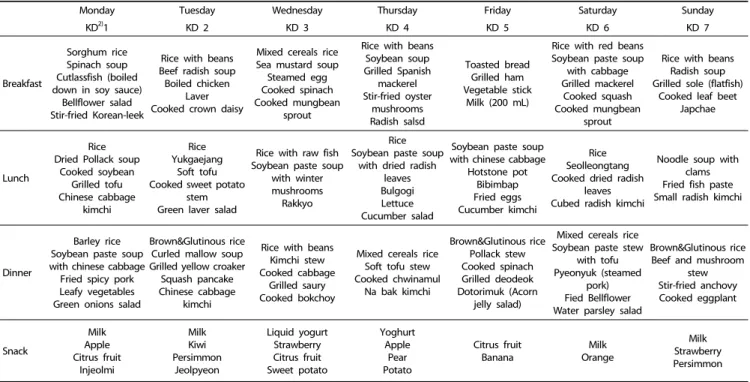
Monday Tuesday Wednesday Thursday Friday Saturday Sunday
KD2)1 KD 2 KD 3 KD 4 KD 5 KD 6 KD 7
Breakfast
Sorghum rice Spinach soup Cutlassfish (boiled down in soy sauce)
Bellflower salad Stir-fried Korean-leek
Rice with beans Beef radish soup Boiled chicken
Laver Cooked crown daisy
Mixed cereals rice Sea mustard soup Steamed egg Cooked spinach Cooked mungbean
sprout
Rice with beans Soybean soup Grilled Spanish
mackerel Stir-fried oyster
mushrooms Radish salsd
Toasted bread Grilled ham Vegetable stick
Milk (200 mL)
Rice with red beans Soybean paste soup
with cabbage Grilled mackerel
Cooked squash Cooked mungbean
sprout
Rice with beans Radish soup Grilled sole (flatfish)
Cooked leaf beet Japchae
Lunch
Rice Dried Pollack soup
Cooked soybean Grilled tofu Chinese cabbage
kimchi
Rice Yukgaejang
Soft tofu Cooked sweet potato
stem Green laver salad
Rice with raw fish Soybean paste soup
with winter mushrooms
Rakkyo
Rice Soybean paste soup
with dried radish leaves Bulgogi Lettuce Cucumber salad
Soybean paste soup with chinese cabbage
Hotstone pot Bibimbap Fried eggs Cucumber kimchi
Rice Seolleongtang Cooked dried radish
leaves Cubed radish kimchi
Noodle soup with clams Fried fish paste Small radish kimchi
Dinner
Barley rice Soybean paste soup with chinese cabbage
Fried spicy pork Leafy vegetables Green onions salad
Brown&Glutinous rice Curled mallow soup Grilled yellow croaker Squash pancake Chinese cabbage
kimchi
Rice with beans Kimchi stew Cooked cabbage
Grilled saury Cooked bokchoy
Mixed cereals rice Soft tofu stew Cooked chwinamul
Na bak kimchi
Brown&Glutinous rice Pollack stew Cooked spinach Grilled deodeok Dotorimuk (Acorn
jelly salad)
Mixed cereals rice Soybean paste stew
with tofu Pyeonyuk (steamed
pork) Fied Bellflower Water parsley salad
Brown&Glutinous rice Beef and mushroom
stew Stir-fried anchovy Cooked eggplant
Snack
Milk Apple Citrus fruit
Injeolmi
Milk Kiwi Persimmon
Jeolpyeon
Liquid yogurt Strawberry Citrus fruit Sweet potato
Yoghurt Apple
Pear Potato
Citrus fruit Banana
Milk Orange
Milk Strawberry Persimmon
1)Reference: 2010 Dietary Reference Intakes for Koreans first revision (The Korean Nutrition Society)
2)KD: Korean diet
Table 1. Normal dietary pattern of Korean diet (a week, 2,000 kcal/day)1)
Existing researches at home and abroad on antioxidant activity focus mainly on individual foods or specific components [19]. Antioxidants in food may lead to synergy or inhibitive activity depending on whether they are mixed harmoniously when taken in. In order to compare Korean and American diets in terms of antioxidant activity, therefore, it is of significance to examine a food group or a whole menu rather than individual foods. However, there have been few studies both at home and abroad on the antioxidant capacity of a whole diet or a dietary pattern rather than of individual foods. Yang et al. [20]
utilized the data of the National Health and Nutrition Examina- tion Survey (NHANES 2001-2002) in order to analyze the level of antioxidant capacity that is common in American diet. They estimated the total dietary antioxidant capacity of a whole diet in reference to the food data of this diet recall survey and existing measurements of each food's antioxidant capacity.
Russnes et al. [21] examined foods that the Spanish population would take in by means of the food frequency questionnaire (FFQ), and then they estimated the total dietary antioxidant capacity of a whole diet in reference to the existing FRAP value data of each food to analyze correlation with prostate cancer.
Recently, the result [16] of the in vitro measurement of the total dietary antioxidant capacity in the Spanish Mediterranean diet has come out. The author et al. have measured and reported the antioxidant activity and phenolic content in KD, not those of individual foods that are included in KD [22].
In general, foods that feature a high level of antioxidant activity or a high phenolic content have outstanding DNA damage reduction effects, and such foods contribute to controlling cancer cell reproduction or preventing chronic diseases [23-25]. There are a number of nutritional intervention
studies that specify the relation between dietary patterns and DNA damage reduction effects [26-28].
In an experiment, a healthy diet with vegetables and PUFA- rich plant oil was applied to patients with type 2 diabetes for 8 weeks and, as a result, DNA damage was reduced [26,28].
It was also reported that a menu with a wealth of whole grains, fruits, and vegetables in daily life can reduce DNA damage due to oxidative stress [27]. Such researches demonstrate that foods of high antioxidant capacity or diets with such foods can protect DNA from damage and control oxidative stress. However, there has been no research on the effect of KD on human DNA damage reduction.
Thus, this study aims to examine the in vitro antioxidant capacity and ex vivo lymphocyte DNA damage reduction effect of KD in comparison with those of American diet (AD) in order to clarify the excellence of KD in terms of antioxidant activity.
MATERIALS AND METHODS Diet
As for KD, this study applies the one-week standard diet menu
for Koreans as suggested in the 2010 Dietary Reference Intakes
for Korean (2010 KDRIs) [29] issued by the Korean Nutrition
Society. This menu was prepared in consideration of the
recommended number and amount of each food group per
day with 2,000 kcal as the standard for a day. In addition,
standards for nutrient intakes such as vitamin, minerals, and
fiber were taken into account in addition to the appropriate
amount of calories. A basic adult dietary pattern with a standard
amount of milk and dairy goods per meal was reflected (Table
1). Fresh ingredients for the KD menu were purchased at local
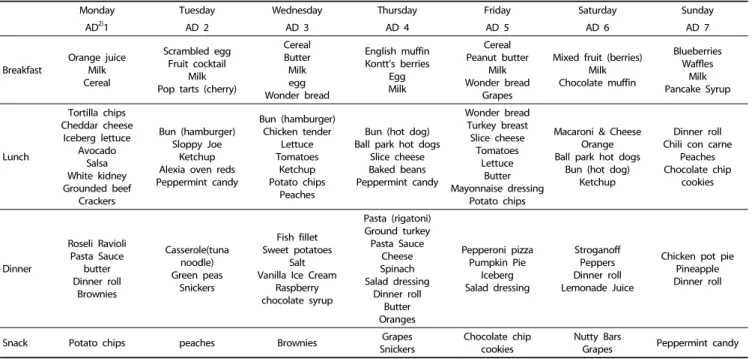
Monday Tuesday Wednesday Thursday Friday Saturday Sunday
AD2)1 AD 2 AD 3 AD 4 AD 5 AD 6 AD 7
Breakfast
Orange juice Milk Cereal
Scrambled egg Fruit cocktail
Milk Pop tarts (cherry)
Cereal Butter Milk egg Wonder bread
English muffin Kontt’s berries
Egg Milk
Cereal Peanut butter
Milk Wonder bread
Grapes
Mixed fruit (berries) Milk Chocolate muffin
Blueberries Waffles
Milk Pancake Syrup
Lunch
Tortilla chips Cheddar cheese
Iceberg lettuce Avocado
Salsa White kidney Grounded beef
Crackers
Bun (hamburger) Sloppy Joe
Ketchup Alexia oven reds Peppermint candy
Bun (hamburger) Chicken tender
Lettuce Tomatoes
Ketchup Potato chips
Peaches
Bun (hot dog) Ball park hot dogs
Slice cheese Baked beans Peppermint candy
Wonder bread Turkey breast
Slice cheese Tomatoes
Lettuce Butter Mayonnaise dressing
Potato chips
Macaroni & Cheese Orange Ball park hot dogs
Bun (hot dog) Ketchup
Dinner roll Chili con carne
Peaches Chocolate chip
cookies
Dinner
Roseli Ravioli Pasta Sauce
butter Dinner roll
Brownies
Casserole(tuna noodle) Green peas
Snickers
Fish fillet Sweet potatoes
Salt Vanilla Ice Cream
Raspberry chocolate syrup
Pasta (rigatoni) Ground turkey Pasta Sauce
Cheese Spinach Salad dressing
Dinner roll Butter Oranges
Pepperoni pizza Pumpkin Pie
Iceberg Salad dressing
Stroganoff Peppers Dinner roll Lemonade Juice
Chicken pot pie Pineapple Dinner roll
Snack Potato chips peaches Brownies Grapes
Snickers Chocolate chip
cookies Nutty Bars
Grapes Peppermint candy
1)Reference: the National Institute of Agricultural Sciences of the Korea Rural Development Administration (KRDA)
2)AD: American diet
Table 2. Normal dietary pattern of American diet (a week, 2,000 kcal/day)1)
stores in Daejeon. Kinds and quantities of various ingredients used in each menu met the standard of CAN-pro 4.0, and the standard amounts of the main ingredients specified in the sample menu were applied.
The applied AD menu is a typical American dietary menu that was used in the assignment entitled “The Effect of KD on the Health and Nutritional Condition and a Development of a Simplified Safety Test Technology,” which was conducted to compare the nutritional excellence of the recommended KD and AD by the National Institute of Agricultural Sciences, the Rural Development Administration [13]. The applied AD menu is 2,000 kcal per day. This is a menu that consists of foods that are commonly prepared for Americans according to the data of NHANES-2001-2004 (Table 2). To purchase foods that Americans would actually eat, products of the specific brands specified in the menu were purchased, and vegetables and fruits were purchased at local stores in Daejeon. Since the AD menu consisted mostly of processed foodstuffs, fruits, salads, and bread that could be taken in without additional cooking, no further ingredients except those indicated in the menu were required. The ‘daily meals’ sample menus were made by combining various foods that were prepared for each meal in a day. The ‘one-week meals’ sample menus were made by combining various foods that were prepared for each meal in one-week.
Freeze-drying of Korean and American dietary foods and production of extract samples
Freeze-drying is a way of drying foods as they are with no physical or chemical change. Since there is no protein denaturation in this process, it is possible to preserve the unique savor of foods and to store them for a long period of time
[30]. Prepared Korean and American dietary foods went through the freeze-drying process, were pulverized, analyzed, and stored in a freezer at -20°C. Extracts of the Korean and American dietary foods were used to produce methanol-acetone extract samples by means of 50% methanol and 70% acetone.
Antioxidant activity assay (in vitro) Total soluble phenolic content assay
Total soluble phenolic content was determined according to the method of Randhir et al. [31]. The test sample dissolved in distilled water (1 mL) was mixed with 1 mL of ethanol (95%, v/v). To each sample, 0.5 mL of Folin-Ciocalteu reagent (50%, v/v) and 1 mL of 5% Na
2CO
3were added. The reaction mixture was left in the dark for 1 h. Its absorbance was then read at 725 nm with 99% ethanol as the blank using a spectropho- tometer (Shimadzu Inc. Kyoto, Japan). A standard curve was established using various concentrations of gallic acid in 99%
ethanol. Finally, the absorbance values were converted to the mg of total soluble phenolics per g of test sample.
2,2-diphenyl-1-picrylhydrazyl (DPPH) radical scavenging capacity
In accordance with the method of Chen et al. [32], the test
sample (10 μL) was mixed with 190 μL of 120 μM DPPH in
ethanol and transferred to a microplate well. After incubation
at 37°C for 30 min, the absorbance of the resulting solution
was measured at 517 nm using an ELISA reader (Tecan Austria,
Salzburg, Austria). The DPPH scavenging capacity of the extract
was expressed as IC
50(the half maximal inhibitory concentration)
representing the concentration of the sample that removes the
50% DPPH radical.
Trolox equivalent antioxidant capacity (TEAC) assay
To the test tube containing 990 μL of 7 mM ABTS solution with 2.45 mM K
2S
2O
8, 10 μL of test sample was added, and the solution was mixed. The ABTS solution was kept in the dark until use. Its absorbance was read at 734 nm using a spectrophotometer (Shimadzu Inc., Kyoto, Japan) for 6 min at 25°C. Antioxidant activity of the TEAC was represented in IC
50(the half maximal inhibitory concentration) [33].
Oxygen radical absorbance capacity (ORAC
ROOㆍ ) assay The ORAC assay was carried out on a Tecan GENios multi-functional plate reader (Tecan Austria, Salzburg, Austria) with fluorescent filters (excitation wavelength: 485 nm; emission filter: 535 nm). In the final assay mixture, 40 μM fluorescein was used as the target of free radical attack with either 20 mM 2,2’-azobis(2-amidinopropane) dihydrochloride (AAPH) as the peroxyl radical generator in a peroxyl radical scavenging capacity (ORACROOㆍ) assay [34]. Trolox (1 μM) was used as the standard control and prepared fresh daily. The analyzer was programmed to record fluorescence every 2 min after AAPH was added. All fluorescence measurements were expressed relative to the initial reading. The final results were calculated using the difference of the area under the fluorescence decay curve between the blank and the sample. ORAC
ROOㆍ was expressed as μM of Trolox equivalents (TE). One ORAC unit is equivalent to the net protection area provided by 1 μM Trolox.
Ex vivo DNA damage determination by the alkaline comet assay Selection of blood-gathering subjects and blood-collecting Blood-gathering subjects included 5 healthy female adults in their 20 s, each of whom voluntarily agreed with the blood collecting process. Subjects were selected among those who had no history of chronic diseases that might cause DNA damage such as hypertension, diabetes, and cardiovascular disease, had not smoked, and had taken no vitamin or health functional food at all. The collected blood was carried in a 10 mL heparinated sterile tube (Vacutainer Becton Dickinson Co.) to the laboratory, and then the lymphocytes were separated within 3 hours. Since this was an experiment on a human body which involved the process of collecting blood, separating lymphocytes from it, processing KD and AD extracts, and comparing DNA damage reduction effects, an approval from the Institutional Review Board at Hannam University (South Korea) was gained (2013-07k) before the experiment was conducted.
Comet assay
The alkaline Comet assay was conducted as described by Singh et al. [35] with little modifications. Lymphocytes were separated by using 200 μL of Histopaque 1077 after mixing 100 μL fresh whole blood in 1 mL RPMI (10% FBS). The isolated lymphocytes were incubated for 30 min at 4°C with 250 μg/mL of sample extracts that showed the maximum DNA damage protective effect. The pre-treated lymphocytes were then subjected to oxidative stress by suspending in phosphate- buffered saline with 100 μmol/l H
2O
2for 5 min at 4°C. The lymphocytes were mixed with 75 μL of 0.85% low-melting agarose and added to the slides pre-coated with 0.75% normal
melting agarose. The slides were then immersed in lysis solution and were then placed into an electrophoresis tank containing 300 mmol/L NaOH and 10 mmol/L Na
2-EDTA (pH 13.0) for 40 min. The slides were electrophoresed for 20 min, washed three times with a neutralizing buffer and then treated with ethanol for another 5 min before staining with ethidium bromide to view under fluorescent microscope (Leica, Wetzlar, Germany).
The image of each nucleus received through the CCD camera (Nikon, Tokyo, Japan) was analyzed by the computer-equipped comet image analyzing system (Kinetic Imaging, Liverpool, UK) [36]. The DNA damage of lymphocyte was observed by tail moment (TM), which is the multiplied value of TL (or “tail length,” the distance of the DNA fragment moved from the nucleus) and % DNA in tail. The DNA damage degree was measured by a total of 150 lymphocytes or 50 cells from each of the three replicate slides.
Statistical analysis
Data were analyzed using the Statistical Package for the Social Sciences (SPSS-PC+ v22.0, Inc., an IBM Company, Chicago, Illinois, USA) software for Windows. The significance of the mean comparison between the Korean and AD was tested by independent paired t-test. Also, a comparison of the means in 7 days was performed by one-way analysis of variance with a post-hoc comparison using the least significant difference test.
Values were expressed as mean values ± SD or SE, and all the statistical significance was evaluated at the level of α = 0.05.
RESULT
Antioxidant capacity of daily meals in Korean and American diet The total phenolic content and in vitro antioxidant activity of daily meals in the one-week KD and AD menus were measured, and the results are presented in Table 3. In the one-week KD menu, the highest total phenolic content (KD6) was 63.67 ± 1.77 mg/100 g, and the lowest content (KD2) was 47.51 ± 0.62 mg/100 g respectively. In the one-week AD menu, the highest total phenolic content (AD6) was 62.89 ± 0.70 mg/100 g, and the lowest content (KD5) was 46.50 ± 0.67 mg/100 g respectively. The average phenolic content of the one-week meals was a bit higher than that of the AD (53.79
± 6.35 mg/100 g) although the difference was insignificant. The
DPPH radical scavenging capacity of a daily KD/AD menu was
indicated with IC
50: As this value is low, it indicates that the
level of antioxidant activity is high. In the KD menu, IC
50of
KD4 was the lowest (2.65 ± 0.05 mg/mL), which indicates that
its level of antioxidant activity was the highest. IC
50of KD6 was
the highest (4.69 ± 0.16 mg/mL), indicating that its level of
antioxidant activity was the lowest. In the AD menu, IC
50of
AD3 was the lowest (3.04 ± 0.03 mg/mL), indicating that its level
of antioxidant activity was the highest. IC
50of AD1 was the
highest (4.74 ± 0.17 mg/mL), indicating that its level of antioxidant
activity was the lowest. As for the average DPPH radical
scavenging capacity of one-week meals of KD/AD, the IC
50value
of the Korean meals was lower than the other, which indicates
that the DPPH radical scavenging capacity of the KD was
generally higher than that of the AD although the difference
was statistically insignificant. As ABTS values as well were
(A) Total phenolic assay (B) DPPH radical scavenging assay
(C) TEAC assay (D) ORACROOㆍ assay
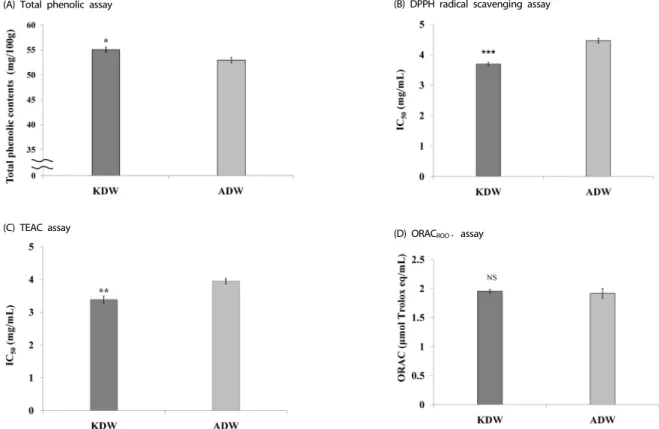
Fig. 1. Comparison of antioxidant capacity in one-week meal of Korean diet and American diet from (A) total phenolic content assay, (B) DPPH, (C) TEAC, (D) ORACROOㆍ
assay.
KDW, one-week Korean diet; ADW, one-week American diet. Mean ± SD, *
P< 0.05, **
P< 0.01, ***
P< 0.001, NS: Not Significant (t-test)
Diet Total phenolics(mg/100 g)
DPPH IC50 (mg/mL)
TEAC IC50 (mg/mL)
ORACROOㆍ
(TE, μM) Korean Diet (KD)
KD1 61.03 ± 2.031)b2) 2.81 ± 0.14ab 3.33 ± 0.07abc 2.29 ± 0.01c KD2 47.51 ± 0.62d 4.62 ± 0.12e 3.65 ± 0.24d 1.74 ± 0.07d KD3 60.71 ± 1.08b 2.97 ± 0.04b 3.03 ± 0.11a 2.18 ± 0.16c KD4 61.65 ± 2.30ab 2.65 ± 0.05a 3.27 ± 0.25abc 3.21 ± 0.12a KD5 55.90 ± 0.00c 3.67 ± 0.04c 3.13 ± 0.09ab 1.44 ± 0.10e KD6 63.67 ± 1.77a 4.69 ± 0.16e 3.37 ± 0.12bcd 1.87 ± 0.10d KD7 49.84 ± 0.62d 4.17 ± 0.03d 3.50 ± 0.16cd 2.66 ± 0.20b Total mean 57.19 ± 6.10 3.65 ± 0.82 3.33 ± 0.24 2.20 ± 0.57 American Diet (AD)
AD1 56.13 ± 0.62c 4.74 ± 0.17d 4.14 ± 0.12b 1.61 ± 0.01c AD2 47.89 ± 0.13d 3.55 ± 0.06b 4.04 ± 0.18b 1.71 ± 0.06c AD3 60.87 ± 1.65b 3.04 ± 0.03a 3.31 ± 0.11a 2.02 ± 0.15b AD4 54.58 ± 0.49c 4.08 ± 0.17c 4.75 ± 0.02c 2.01 ± 0.12b AD5 46.50 ± 0.67d 4.55 ± 0.20d 3.94 ± 0.18b 1.72 ± 0.10c AD6 62.89 ± 0.70a 3.24 ± 0.06a 3.19 ± 0.08a 2.53 ± 0.11a AD7 47.66 ± 1.28d 4.57 ± 0.12d 3.34 ± 0.04a 1.91 ± 0.11b Total mean 53.79 ± 6.35NS3) 3.97 ± 0.66NS 3.81 ± 0.55* 1.93 ± 0.31NS
1)All values are expressed as Mean ± SD.
2)Means with different superscripts in the same column are significantly different by the least significant difference test.
3)Comparison of the means between Korean and American diet was performed by t-test, NS: Not Significant, *P< 0.05
DPPH, 2,2-diphenyl-1-picrylhydrazyl; TEAC, trolox equivalent antioxidant capacity;
ORACROOㆍ, Oxygen radical absorbance capacity.
Table 3. Total phenol content and in vitro antioxidant capacity of 1 day meals
in Korean diet and American diet
indicated with IC
50, a low value indicates a high level of
antioxidant activity. As in the case of KD, there was no difference in different days of the week for the AD too. As for the average ABTS IC
50of the one-week meals of the KD and AD, however, that of the Korean menu was 3.33 ± 0.24 mg/mL while that of the American menu was 3.81 ± 0.55 mg/mL, which indicates that the level of antioxidant activity of the Korean menu was significantly high (P = 0.01). The ORAC
ROOㆍassay result shows that the average values of the one-week KD and AD menus showed no significant difference (Table 3).
Comparison of antioxidant capacity in one-week meals of Korean and American diet
For the total phenolic content and in vitro antioxidant
capacity of the one-week meals of KD and AD, each meal
containing the amount of food for one individual was measured
and compared. The result is presented in Fig. 1. The total
phenolic content in the KD is 55.04 ± 0.48 mg/100 g, which is
significantly higher than that of the AD (52.94 ± 0.55 mg/100
g) (Fig. 1A). According to the result of the DPPH radical
scavenging capacity assay that examined the antioxidant
capacity of the one-week meals of KD and AD, the value of
IC
50of the KD was 3.7 ± 0.05 mg/mL while that of the AD was
4.47 ± 0.08 mg/mL. Thus, the antioxidant capacity of KD meals,
whose value of IC
50was relatively low, was significantly higher
than that of AD meals (P < 0.001) (Fig. 1B). In the ABTS assay
as well, the value of IC
50of KD meals was 3.39 ± 0.11 mg/mL
while that of AD meals was 3.94 ± 0.08 mg/mL, which indicates
Diet Tail moment Tail length % DNA in tail Korean Diet (KD)
KD1 23.7 ± 1.341)bc2) 31.63 ± 2.05bc 36.08 ± 2.04cd KD2 30.78 ± 1.98d 41.10 ± 2.51e 38.90 ± 2.11d KD3 19.98 ± 0.94b 30.26 ± 0.98b 28.79 ± 1.18b KD4 15.02 ± 1.01a 23.42 ± 0.85a 23.53 ± 1.06a KD5 25.70 ± 1.09c 37.47 ± 1.81de 33.42 ± 2.15bc KD6 25.99 ± 1.50c 38.84 ± 1.70de 33.55 ± 1.57bc KD7 23.34 ± 1.38bc 35.68 ± 1.42cd 29.91 ± 1.40b Total mean 23.50 ± 0.67 34.07 ± 0.83 32.03 ± 0.78 American Diet (AD)
AD2)1 27.85 ± 0.81ab 38.69 ± 1.61bc 34.64 ± 1.90a AD2 27.15 ± 1.54ab 31.88 ± 1.14a 45.07 ± 2.59c AD3 26.68 ± 1.40ab 35.14 ± 1.55ab 36.71 ± 2.16ab AD4 29.36 ± 1.79ab 39.09 ± 2.09bc 39.45 ± 1.74abc AD5 38.40 ± 1.19c 42.62 ± 2.02c 52.49 ± 1.77d AD6 25.51 ± 1.60a 31.50 ± 1.59a 36.98 ± 0.83ab AD7 31.43 ± 2.83b 35.71 ± 1.11ab 42.96 ± 4.41bc Total mean 29.48 ± 0.74***3) 36.38 ± 0.70* 41.18 ± 1.05***
1)Mean ± SE; all values are relative score (%) for the positive control (H2O2), the maximum amount of DNA damage.
2)Means with different superscripts in the same column are significantly different by the least significant difference test.
3)Comparison of the means between Korean and American diet was performed by t-test, *P< 0.05, ***P< 0.001
Table 4. Levels of lymphocyte DNA damage as TM, TL, TD of 1 day meals in
Korean and American diet (A) (B)
(C) (D)
Fig. 2. Images of comets obtained by alkaline comet assay representing different degrees of DNA damage in Korean diet and American diet.
(A) No damage, (B) Positive control (by H
2O
2), (C) one-week Korean diet, (D) one-week American diet
Fig. 3. Comparison of protective effect on lymphocyte DNA damage in one-week meal of Korean and American diet by tail moment.
KDW, one-week Korean diet; ADW, one-week American diet. Mean ± SE, **
P< 0.01, t-test.
that the level of antioxidant activity of the KD menu was significantly higher than that of the AD menu (P < 0.01) (Fig.
1C). As the antioxidant capacity of one-week meals of KD and AD was compared by means of the ORAC
ROOㆍassay, it turned out that there was no significant difference between the KD (1.95 ± 0.03 TE, μM) and the AD (1.91 ± 0.09 TE, μM) (Fig. 1D).
Lymphocyte DNA damage in daily meals in Korean and American diet
Table 4 shows the result of comparing the daily ex vivo DNA damage reduction effect of the one-week KD and AD menus.
All the three indicators of DNA damage measured by means of the Comet assay showed significant difference among days of the week. As for the Korean menu, the value of TM was 15.02 ± 1.01 (KD4) to 30.78 ± 1.98 (KD2), the value of TL was 23.42 ± 0.85 (KD4) to 41.10 ± 2.51 (KD2), and the value of TD was 23.53 ± 1.06 (KD4) to 38.90 ± 2.11 (KD2). In contrast, the value of TM in the American menu was 25.51 ± 1.60 (AD6) to 38.40 ± 1.19 (AD5), the value of TL was 31.50 ± 1.59 (AD6) to 42.62 ± 2.02 (AD5), and the value of TD was 34.64 ± 1.90 (AD1) to 52.49 ± 1.77 (AD5), indicating that both KD and AD menus showed difference in the extent of DNA damage among days of the week. Thus, it turned out that the extent of DNA damage could be varied significantly depending on the foods and their combinations in a menu. The average extent of DNA damage per day in the one-week meals of KD (TM, 23.50 ± 0.67; TL, 34.07
± 0.83; TD, 32.03 ± 0.78) was significantly lower than that of the one-week meals of AD (TM, P < 0.001; TD, P < 0.001; TL, P
< 0.05).
DNA damage reduction effect in one-week meals of Korean and American diet
For the DNA damage reduction effect of one-week meals of KD and AD, each meal containing the amount of food for one individual was measured and compared. The result is presented in Fig. 2 and 3. The level of DNA damage was reduced in the one-week meals of KD (Fig. 2C) and AD (Fig. 2D) compared to that of DNA damage (Fig. 2B) by H
2O
2.In particular, the extent of reduction in the KD was significantly higher than that in the AD. The reduction rate of DNA damage in one-week meals of KD was 80.7 ± 1.84% while that in one-week meals of AD was 72.5 ± 4.84, which indicates that the DNA damage reduction effect of the KD was significantly higher than that of the AD (P < 0.01) (Fig. 3).
DISCUSSION
A traditional Korean menu consists mainly of boiled rice, soup,
and side dishes. Rice is boiled with mixed grains such as barley and millet, while soup is made of various ingredients such as meat, fish, vegetables, etc. Side dishes include kimchi, which is a major fermented food, vegetables, meat, shellfish, etc. [37].
As the Korean society is industralized, however, the dietary composition of Koreans changes gradually: The traditional dietary pattern of carbohydrate and plant foods is changing with healthy Korean dietary patterns of grains, vegetables, fruits, eggs, fish, and dairy goods in the proper ratio. In fact, there is no specific concept of what is a typical Korean dietary pattern.
Recently, many researches on the relation between Korean dietary patterns and the risk of chronic diseases have been released [11,14,15]. In addition to such observation studies that classify dietary patterns and observe risk factors of chronic disease, intervention studies that observe changes in risk factors of chronic diseases after letting subjects have KD meals for a certain period of time were also conducted recently [12,13].
Jung et al. [12] observed changes in risk factors of cardiovascular diseases after letting a group of patients with hypertension and diabetes maintain KD for a certain period of time. This study applied the “Korean traditional diet” (total content of fat: 19%) that was common in the 1970s. The meal includes boiled rice and at least three side dishes of soup, kimchi, and fermented foods (made from fermented beans). It may include raw or cooked vegetables, steamed or roasted fish or meat, dried and preserved foods, etc. The menu of the control group included American dietary items such as bread, milk, and dairy goods and was prepared according to the basic principles of diet suggested by the Korean Diabetes Association. These two different menus were served to patients with hypertension and diabetes for 12 weeks. As a result, the group to which the KD menu was applied showed positive changes in risk factors of cardiovascular diseases such as blood pressure, BMI, waist measurement, heart rate, LDL cholesterol, etc. Schroeder et al.
[13] provided adults who were overweight and obese (risk factors of cardiovascular diseases) with the KD menu, Dietary Guidelines for Americans (DGA), and the typical American diet (TA) for 4 weeks in order to examine the effect of Korean dietary patterns. The KD menu included five food groups: grains (whole grains and refined grains)/meat, fish, eggs, beans/vegetables/
fruits/milk, and dairy goods in consideration of the dietary composition recommendation of 2010 KDRIs. The menu of the 2010 DGA is recommended by the U.S. Department of Agriculture. It presents various dietary patterns with vegetables, fruits, whole grains, fiber, seaweeds, lean meat, beans, nuts, low-fat dairy goods, and so forth. The TA consists of foods that Americans commonly take in. This menu was prepared based on the result of the NHANES. The percentage of vegetables, fruits, whole grains, fiber, and dairy goods is relatively low while the percentage of sodium, saturated fat, and refined grains is high. One nutritional intervention study [13] included a 4-week experiment, where the total cholesterol level and LDL decreased in the KD and DGA groups.
According to one case-control study on the relation between Koreans' dietary patterns and colorectal cancer, the Traditional pattern incorporating vegetables, mushrooms, seaweeds, beans, and fish and the Prudent pattern using fruits, milk, dairy goods, whole grains, nuts, and kimchi decreased the risk of colorectal
cancer because of the intake of many fruits and dairy goods [17]. It may be difficult to summarize such existing research findings in a few words, but in general, traditional KD menus that present carbohydrate, protein, and fat in the proper composition ratio or the Acceptable Macronutrient Distribution Range (AMDR) and include a large amount of grains, vegetables, fruits, kimchi, seaweeds, fish, beans, and fermented foods have positive effects in preventing risk factors of chronic diseases, compared to Western diet menus that center on fat and protein.
The above-mentioned studies all show the relation between the risk of chronic diseases and Korean dietary patterns while there are few researches on the antioxidant activity of KD. It is well-known that when the antioxidant status is improved, oxidative stress decreases and then the risk of chronic diseases decreases accordingly. Thus, if the antioxidant activity of subjects had been analyzed in the studies mentioned above, there would have been positive results. In addition, although the Korean dietary patterns in nutritional intervention studies above were different, most of them were a type of Korean healthy diet. Accordingly, this study, which compares the antioxidant activity and DNA damage reduction effect of KD with those of AD, applies the KD menu suggested by the 2010 KDRIs as a Korean healthy dietary pattern. This menu was prepared with six food groups: grains, meat/fish/eggs/beans, vegetables, fruits, milk/dairy goods, and oil/sugars. Each meal contains an amount of food recommended for one individual each day.
In this study, the average value of in vitro antioxidant activity of the KD daily meals measured by means of the ABTS assay was higher than that of AD. As for the one-week meals that combined all the daily meals as well, those of KD showed a significantly higher level of antioxidant activity than those of AD when measured by means of the phenolic content analysis method (P < 0.05), DPPH radical scavenging capacity (assay) (P
< 0.001), and the TEAC assay (P < 0.01). This result indicates that the antioxidant capacity of KD is superior to that of AD.
However, one-week meals of both KD and AD consisted of different foods each day, and their levels of antioxidant activity were also different accordingly. Further, it may be difficult to affirm that the one-week meals used in this study are typical menus of KD and AD. Thus, it is necessary to compare the antioxidant activity of KD and AD in a broader range for a longer period of time. Still, this study is of significance in that it attempts to measure the level of antioxidant activity of combination diets in comparison of KD and AD while existing domestic and foreign researches on food antioxidant activity focused on individual foods or specific ingredients of individual foods while there have been few attempts to measure the antioxidant activity of one meal with various kinds of foods, one-day diets with three meals and one snack, or one-week diets that combine menus for each day. Studies on the antioxidant capacity of one meal and one-day, one-week, or one-month diets need to be conducted continually in a broader range.
The ratio of plant foods in the KD is higher than that of AD.
In particular, plant foods in KD such as fruits, vegetables,
mushrooms, seaweeds, nuts, potato, grains, beans, kimchi, and
oils contribute a lot to its relatively high level of antioxidant
capacity [22]. As for the quantity of vegetables and fruits in
the KD and AD used in this study, the average amount of vegetables and fruits (including fruit juice) per day in the case of KD was 586 g while that of AD was 339 g, which indicates that KD includes more vegetables and fruits in each meal compared to the AD. It is thought that such differences in dietary patterns result in a different level of antioxidant capacity.
Other dietary patterns that present a sufficient amount of fruits, vegetables, and whole grains and thus feature a high level of antioxidant capacity are those of the Mediterranean diet. To examine the effect of Mediterranean dietary patterns on the state of antioxidant capacity, Zamora et al. [38]
conducted a nutritional intervention study among subjects in their 50 to 80 s with risk factors of cardiovascular diseases (smoking, hypertension, use of hyperlipidemia drug, obesity, etc.) for one year. As they measured the antioxidant capacity of plasma thereafter, the level of plasma Non-enzymatic Antioxidant Capacity increased. This result indicates that the Mediterranean diet consists mainly of plant foods of great antioxidant capacity such as fruits, vegetables, nuts, and whole grains unlike other diets [16]. KD is similar to the Mediterranean diet in that both are in a high level of antioxidant activity [22], but a deeper study needs to be conducted on other aspects that show the excellence of the KD.
There have been a number of studies on measuring the effect of DNA damage reduction of food extracts by means of the comet assay where lymphocytes were separated, food extracts went through the pre-treatment, and DNAs were intentionally damaged by means of H
2O
2[23]. Many view that this kind of ex vivo experimental method is advantageous, compared to other common in vitro experimental methods, in applying it to human bodies [39]. Hence, this study adopts the ex vivo method using lymphocytes to examine the DNA damage reduction effect of one-day meals and one-week meals of KD and AD in the way of comet assay. The comet assay experiment produced two interesting results: First, there was difference in DNA damage reduction effects among the days of the week in both KD and AD, and this difference was more significant than that among in vitro experimental methods. This indicates that ex vivo DNA damage protective effect may be far more sensitive than the in vitro antioxidant activity depending on the daily diet in this study. In general, it is also viewed that ex vivo DNA damage reduction effect is a more sensitive parameter than in vitro antioxidant activity. Thus, the comet assay that utilizes lymphocytes is better than common in vitro assay methods in measuring food’s antioxidant capacity.
Second, in both daily meals (P < 0.001) and one-week meals of diet (P < 0.01), the DNA damage protective effect of KD was significantly higher than that of AD. This result can be a basis for future study to demonstrate the excellence of KD in terms of antioxidant activity. It has been reported that foods of outstanding antioxidant activity show a relatively high level of DNA damage protective effect [23,24]. According to Park et al.
[23], flavonoid compounds and antioxidant vitamins show a high level of DNA damage protective effect, and foods of a high level of DNA damage protective effect play an important role in preventing cancer or chronic diseases. Gafrikova et al.
[24] measured the protective effect on DNAs damaged by H
2O
2after the pre-treatment with flavonoid elements (kaempferol or
quercetin) of horseradish and Armoracia rusticana extract (AE).
As a result, it turned out that as for AE, DNA damage was reduced from 78% to 35.75% while as for kaempferal and quercetin, DNA damage was reduced from 83.3% to 19.4% and 16.2% respectively. A number of existing researches demonstrated that there is a high correlation between phenolic content and antioxidant capacity [16,22]. In addition, Jayakumar and Kanthimathi [25] reported that as the phenolic content of various spices was high, the DNA damage protective effect, as well as cancer cell reproduction control effect, were high accordingly. Such studies correspond to the finding of this study that the phenolic content, antioxidant activity, and DNA damage protective effect of KD are all better than those of AD.
Switzeny et al. [28] conducted an experiment among patients with type II diabetes where they maintained the diet with 300 g of vegetables and 25 mL of vegetable oil at each meal for 8 weeks, and the extent of DNA repair was analyzed. As a result, it turned out that the rich antioxidant substances in the meals removed free-radicals and increased the level of DNA restoration compared to the baseline. In addition, this study demonstrated a high level of correlation between DNA strand breaks and the methylation level as well. These findings verify that foods and dietary patterns of high antioxidant capacity can protect DNAs from damage and control oxidative stress. These studies correspond to the finding of this study that KD can enhance antioxidant activity compared to AD, and that the former can protect DNAs from damage by H
2O
2, having many health benefits.
However, this study has limitations in that it uses the one-week menus as samples of KD and AD to show the antioxidant activity and DNA damage reduction effect, but one week is insufficient to represent the typical dietary patterns of KD and AD. Since we eat different foods every day, either in KD or AD, it is difficult to compare KD and AD only based on one-week menus. Thus, a future study needs to prepare menus of KD and AD for a longer period to measure the antioxidant activity and DNA damage reduction effect.
This study aims to measure the in vitro antioxidant capacity
of KD and AD, compare the DNA damage reduction effect, and
clarify the excellence of KD. The findings of this study are of
significance in that the excellence of KD is proven not only
in terms of antioxidant activity but also DNA damage reduction
effect on lymphocytes, which is methodologically more
sensitive. However, more study needs to be conducted to verify
if in vitro and ex vivo experiments would produce the same
results in in vivo or nutritional intervention studies [23]. Thus,
in vivo study needs to be conducted to demonstrate if KD
substantially increases the level of plasma antioxidant capacity
or decreases DNA damage in lymphocytes. Nonetheless, the
findings of this study can be used as a basis to further prove
the chronic disease preventive and curative effects of KD
demonstrated in a number of former researches. In addition,
this study measures the dietary antioxidant capacity and DNA
damage reduction effect of KD not for individual foods but for
one-day or one-week meals of diet. Thus, this attempt will be
an important turning point for future studies on the antioxidant
functions of the KD.
CONFLICT OF INTEREST
The authors declare no potential conflicts of interests.
REFERENCES
1. Psaltopoulou T, Panagiotakos DB, Pitsavos C, Chrysochoou C, Detopoulou P, Skoumas J, Stefanadis C. Dietary antioxidant capacity is inversely associated with diabetes biomarkers: the ATTICA study.
Nutr Metab Cardiovasc Dis 2011;21:561-7.
2. Suhail N, Bilal N, Khan HY, Hasan S, Sharma S, Khan F, Mansoor T, Banu N. Effect of vitamins C and E on antioxidant status of breast-cancer patients undergoing chemotherapy. J Clin Pharm Ther 2012;37:22-6.
3. Cocate PG, Natali AJ, Alfenas RC, de Oliveira A, dos Santos EC, Hermsdorff HH. Carotenoid consumption is related to lower lipid oxidation and DNA damage in middle-aged men. Br J Nutr 2015;
114:257-64.
4. Strain JJ, Elwood PC, Davis A, Kennedy O, Coulter J, Fehily A, Mulholland CW, Robson PJ, Thurnham DI. Frequency of fruit and vegetable consumption and blood antioxidants in the Caerphilly cohort of older men. Eur J Clin Nutr 2000;54:828-33.
5. Liu S, Lee IM, Ajani U, Cole SR, Buring JE, Manson JE; Physicians’
Health Study. Intake of vegetables rich in carotenoids and risk of coronary heart disease in men: the Physicians’ Health Study. Int J Epidemiol 2001;30:130-5.
6. Hung HC, Joshipura KJ, Jiang R, Hu FB, Hunter D, Smith-Warner SA, Colditz GA, Rosner B, Spiegelman D, Willett WC. Fruit and vegetable intake and risk of major chronic disease. J Natl Cancer Inst 2004;96:1577-84.
7. Gaziano JM, Hennekens CH. The role of beta-carotene in the prevention of cardiovascular disease. Ann N Y Acad Sci 1993;691:
148-55.
8. Kim SH, Kim MS, Lee MS, Park YS, Lee HJ, Kang SA, Lee HS, Lee KE, Yang HJ, Kim MJ, Lee YE, Kwon DY. Korean diet: characteristics and historical background. J Ethn Food 2016;3:26-31.
9. Kim S, Moon S, Popkin BM. The nutrition transition in South Korea.
Am J Clin Nutr 2000;71:44-53.
10. Lee MJ, Popkin BM, Kim S. The unique aspects of the nutrition transition in South Korea: the retention of healthful elements in their traditional diet. Public Health Nutr 2002;5:197-203.
11. Song Y, Joung H. A traditional Korean dietary pattern and metabolic syndrome abnormalities. Nutr Metab Cardiovasc Dis 2012;22:456-62.
12. Jung SJ, Park SH, Choi EK, Cha YS, Cho BH, Kim YG, Kim MG, Song WO, Park TS, Ko JK, So BO, Chae SW. Beneficial effects of Korean traditional diets in hypertensive and type 2 diabetic patients. J Med Food 2014;17:161-71.
13. Schroeder N, Park YH, Kang MS, Kim Y, Ha GK, Kim HR, Yates AA, Caballero B. A randomized trial on the effects of 2010 Dietary Guidelines for Americans and Korean diet patterns on cardiovascular risk factors in overweight and obese adults. J Acad Nutr Diet 2015;115:1083-92.
14. Shin JY, Kim JM, Kim Y. Associations between dietary patterns and hypertension among Korean adults: the Korean National Health and Nutrition Examination Survey (2008-2010). Nutr Res Pract 2013;7:
224-32.
15. Choi JH, Woo HD, Lee JH, Kim J. Dietary patterns and risk for metabolic syndrome in Korean women: a cross-sectional study.
Medicine (Baltimore) 2015;94:e1424.
16. Saura-Calixto F, Goñi I. Antioxidant capacity of the Spanish Mediterranean diet. Food Chem 2006;94:442-7.
17. Park Y, Lee J, Oh JH, Shin A, Kim J. Dietary patterns and colorectal cancer risk in a Korean population: a case-control study. Medicine (Baltimore) 2016;95:e3759.
18. Serafini M, Del Rio D. Understanding the association between dietary antioxidants, redox status and disease: is the total antioxidant capacity the right tool? Redox Rep 2004;9:145-52.
19. Suh JH, Paek OJ, Kang YW, Ahn JE, Yun JS, Oh KS, An YS, Park SH, Lee SJ. Study on the antioxidant activity in the various vegetables.
J Food Hyg Saf 2013;28:337-41.
20. Yang M, Chung SJ, Chung CE, Kim DO, Song WO, Koo SI, Chun OK. Estimation of total antioxidant capacity from diet and supplements in US adults. Br J Nutr 2011;106:254-63.
21. Russnes KM, Möller E, Wilson KM, Carlsen M, Blomhoff R, Smeland S, Adami HO, Grönberg H, Mucci LA, Bälter K. Total antioxidant intake and prostate cancer in the Cancer of the Prostate in Sweden (CAPS) study. A case control study. BMC Cancer 2016;16:438.
22. Han JH, Lee HJ, Cho MR, Chang N, Kim Y, Oh SY, Kang MH. Total antioxidant capacity of the Korean diet. Nutr Res Pract 2014;8:
183-91.
23. Park YK, Jeon EJ, Kang MH. Protective effect of flavonoids on lymphocyte DNA damage using comet assay. Korean J Nutr 2003;36:125-32.
24. Gafrikova M, Galova E, Sevcovicova A, Imreova P, Mucaji P, Miadokova E. Extract from Armoracia rusticana and its flavonoid components protect human lymphocytes against oxidative damage induced by hydrogen peroxide. Molecules 2014;19:3160-72.
25. Jayakumar R, Kanthimathi MS. Dietary spices protect against hydrogen peroxide-induced DNA damage and inhibit nicotine- induced cancer cell migration. Food Chem 2012;134:1580-4.
26. Müllner E, Brath H, Pleifer S, Schiermayr C, Baierl A, Wallner M, Fastian T, Millner Y, Paller K, Henriksen T, Poulsen HE, Forster E, Wagner KH. Vegetables and PUFA-rich plant oil reduce DNA strand breaks in individuals with type 2 diabetes. Mol Nutr Food Res 2013;57:328-38.
27. Prado RP, dos Santos BF, Pinto CL, de Assis KR, Salvadori DM, Ladeira MS. Influence of diet on oxidative DNA damage, uracil misincorpo- ration and DNA repair capability. Mutagenesis 2010;25:483-7.
28. Switzeny OJ, Müllner E, Wagner KH, Brath H, Aumüller E, Haslberger AG. Vitamin and antioxidant rich diet increases MLH1 promoter DNA methylation in DMT2 subjects. Clin Epigenetics 2012;4:19.
29. The Korean Nutrition Society. Dietary Referece Intakes for Koreans.
1st rev. ed. Seoul: The Korean Nutrition Society; 2010. p.614.
30. Korean Society of Food Science and Technology. Encyclopedia of Food Science and Technology. Seoul: Kwangil Publishing Co.; 2004.
31. Randhir R, Shetty P, Shetty K. L-DOPA and total phenolic stimulation in dark germinated fava bean in response to peptide and phytochemical elicitors. Process Biochem 2002;37:1247-56.
32. Chen HM, Muramoto K, Yamauchi F, Fujimoto K, Nokihara K.
Antioxidative properties of histidine-containing peptides designed from peptide fragments found in the digests of a soybean protein.
J Agric Food Chem 1998;46:49-53.
33. Shon MY. Synergistic effect of methanol extract from kalopanax pictus and ascorbic acid on antioxidant, anticancer and immunomo- dulatory activities. J Life Sci 2007;17:1634-40.
34. Kurihara H, Fukami H, Asami S, Toyoda Y, Nakai M, Shibata H, Yao
XS. Effects of oolong tea on plasma antioxidative capacity in mice loaded with restraint stress assessed using the oxygen radical absorbance capacity (ORAC) assay. Biol Pharm Bull 2004;27:1093-8.
35. Singh NP, McCoy MT, Tice RR, Schneider EL. A simple technique for quantitation of low levels of DNA damage in individual cells.
Exp Cell Res 1988;175:184-91.
36. Park YK, Kim JS, Jeon EJ, Kang MH. The improvement of chaga mushroom (Inonotus Obliquus) extract supplementation on the blood glucose and cellular DNA damage in streptozotocin-induced diabetic rats. Korean J Nutr 2009;42:5-13.
37. Lee KW, Cho MS. The development and validation of the Korean dietary pattern score (KDPS). Korean J Food Cult 2010;25:652-60.
38. Zamora-Ros R, Serafini M, Estruch R, Lamuela-Raventós RM, Martínez-González MA, Salas-Salvadó J, Fiol M, Lapetra J, Arós F, Covas MI, Andres-Lacueva C; PREDIMED Study Investigators.
Mediterranean diet and non enzymatic antioxidant capacity in the PREDIMED study: evidence for a mechanism of antioxidant tuning.
Nutr Metab Cardiovasc Dis 2013;23:1167-74.
39. Rockett JC, Burczynski ME, Fornace AJ Jr, Herrmann PC, Krawetz SA, Dix DJ. Surrogate tissue analysis: monitoring toxicant exposure and health status of inaccessible tissues through the analysis of accessible tissues and cells. Toxicol Appl Pharmacol 2004;194:
189-99.