Jak1/Stat3 Is an Upstream Signaling of NF-κB Activation in Helicobacter pylori-Induced IL-8 Production
in Gastric Epithelial AGS Cells
Boram Cha, 1 Joo Weon Lim, 2 and Hyeyoung Kim 1,2
1
Department of Pharmacology, Yonsei University College of Medicine, Seoul;
2
Department of Food and Nutrition, Brain Korea 21 PLUS Project, College of Human Ecology, Yonsei University, Seoul, Korea.
Received: March 28, 2014 Revised: May 10, 2014 Accepted: May 23, 2014
Corresponding author: Dr. Hyeyoung Kim, Department of Food and Nutrition, Yonsei University,
50 Yonsei-ro, Seodaemun-gu, Seoul 120-749, Korea.
Tel: 82-2-2123-3125, Fax: 82-2-364-5781 E-mail: [email protected]
∙ The authors have no financial conflicts of interest.
© Copyright:
Yonsei University College of Medicine 2015 This is an Open Access article distributed under the terms of the Creative Commons Attribution Non- Commercial License (http://creativecommons.org/
licenses/by-nc/3.0) which permits unrestricted non- commercial use, distribution, and reproduction in any medium, provided the original work is properly cited.
Helicobacter pylori (H. pylori) induces the activation of nuclear factor-kB (NF-κB) and cytokine expression in gastric epithelial cells. The Janus kinase/signal transduc- ers and activators of transcription (Jak/Stat) cascade is the inflammatory signaling in various cells. The purpose of the present study is to determine whether H. pylori- induced activation of NF-κB and the expression of interleukin-8 (IL-8) are mediat- ed by the activation of Jak1/Stat3 in gastric epithelial (AGS) cells. Thus, gastric ep- ithelial AGS cells were infected with H. pylori in Korean isolates (HP99) at bacterium/cell ratio of 300:1, and the level of IL-8 in the medium was determined by enzyme-linked immonosorbent assay. Phospho-specific and total forms of Jak1/Stat3 and IκBα were assessed by Western blot analysis, and NF-κB activation was determined by electrophoretic mobility shift assay. The results showed that H.
pylori induced the activation of Jak1/Stat3 and IL-8 production, which was inhibit- ed by a Jak/Stat3 specific inhibitor AG490 in AGS cells in a dose-dependent man- ner. H. pylori-induced activation of NF-κB, determined by phosphorylation of IκBα and NF-κB-DNA binding activity, were inhibited by AG490. In conclusion, Jak1/Stat3 activation may mediate the activation of NF-κB and the expression of IL-8 in H. pylori-infected AGS cells. Inhibition of Jak1/Stat3 may be beneficial for the treatment of H. pylori-induced gastric inflammation, since the activation of NF-κB is inhibited and inflammatory cytokine expression is suppressed.
Key Words: Helicobacter pylori, Jak1/Stat3, IL-8, NF-κB, gastric epithelial cells
Helicobacter pylori (H. pylori) is involved in the pathogenesis of gastric diseases including gastritis, peptic ulcer, and gastric adenocarcinoma.
1-5Interleukin-8 (IL-8) is an activator of neutrophils which migrate into the infected gastric mucosa.
6,7Up- regulation of IL-8 was found in gastric mucosa isolated from the patients infected with H. pylori,
6and the expression of IL-8 was mediated with the activation of transcription factor NF-κB in gastric epithelial cells.
8-10Furthermore, signal trans- ducers and activators of transcription (Stat) regulates IL-8 transcription.
11,12Janus kinase (Jak)/Stat signaling is one of the important immune and cytokine
enhanced chemiluminescence (Santa Cruz Biotechnology).
19Actin served as a loading control. Electrophoretic mobility shift assay (EMSA) was performed for NF-κB-DNA binding activity using nuclear extracts as described previously.
19The statistical differences were determined using one-way ANO- VA, followed by a Newman-Keul’s test. All values are ex- pressed as mean±S.E. of four different experiments. A value of p<0.05 was considered statistically significant.
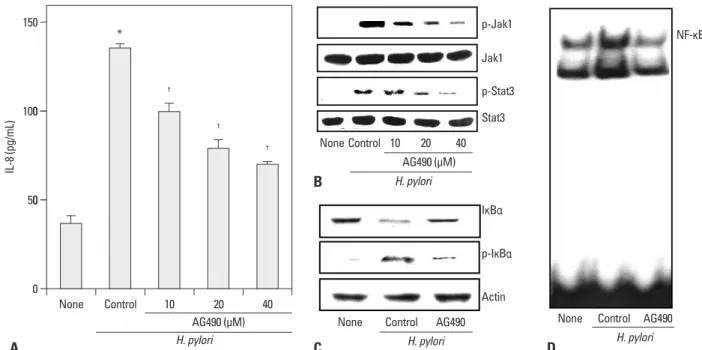
Fig. 1A shows that H. pylori-induced increase in IL-8 level in the medium was inhibited by AG490 in AGS cells dose- dependently. Phospho-specific forms of Jak1 and Stat3 were increased by H. pylori which was inhibited by AG490 treat- ment (Fig. 1B). Total forms of Jak1 and Stat3 were not changed by H. pylori infection and AG490 treatment. These results show that AG490 efficiently inhibits Jak1/Stat3 acti- vation in H. pylori-infected gastric epithelial AGS cells. NF- κB activation was determined by NF-κB-DNA binding ac- tivity and phophorylation of IκB by EMSA and Western blot analysis (Fig. 1C and D). AG490 suppressed phosphoryla- tion of IκBα and NF-κB-DNA binding activity in H. pylori- infected AGS cells. Since IκBα is phosphorylated to p-IκBα by H. pylori, total IκBα was decreased in the infected cells, which was inhibited by AG490.
H. pylori-induced inflammatory signaling has been known to focuse on the activation of NF-κB with IL-8 expres- sion.
8,9,19In the present study, we found that Jak1/Stat3 acti- vation mediated the production of IL-8 in H. pylori-infect- ed cells. Even though Jak/Stat signaling has been widely studied on inflammatory response in brain,
20,21relatively lit- tle studies on Jak/Stat activation in relation to gastric dis- eases have been reported. Lee, et al.
22reported that the phosphorylation status of H. pylori protein CagA affects the signal switch between the SHP2 (Src homology 2 domain- containing Src homology tyrosine phosphatase 2)/ERK and Jak2/Stat3 pathways through glycoprotein 130 in gastric epithelial cells. Stat3 activation mediated by non-phosphor- ylated CagA is dependent on Jak2 activation in AGS cells.
In the present study, AG490, an inhibitor of Jak/Stat3, sup- pressed H. pylori-induced activation of NF-κB and IL-8 ex- pression in AGS cells, and our recent study showed that HP99-induced activation of Jak2/Stat3 mediates the expres- sion of monocyte chemoattractant protein-1 (MCP-1) and inducible nitric oxide synthase (iNOS) in AGS cells.
23Since we did not determine phosphorylation status of H. pylori CagA in the present study, further study should be per- formed to investigate the involvement of phosphorylated or non-phosphorylated CagA in Jak/Stat3-mediated NF-κB signals. Various subtypes of Jak and Stat molecules are acti-
vated by specific inflammatory stimuli.
13,14The binding of inflammatory ligand such as cytokine to its receptor induces the assembly of an active receptor associated Jak. Phosphor- ylated Jak leads to the activation of neighboring Jak, which provides the docking sites for Stat. Stat is phosphorylated on tyrosine and serine residues which is required for full Stat activity. Phosphorylated Stat forms dimmers and trans- locate to the nucleus where they bind directly to the promot- er region of specific target genes involved in immune re- sponses.
15-18In the present study, we determined whether H.
pylori-induced activation of NF-κB and IL-8 production are mediated by the activation of Jak1/Stat3 in gastric epithelial AGS cells using a Jak/Stat3 specific inhibitor AG490.
A gastric epithelial cell line AGS (gastric adenocarcino- ma, ATCC CRL 1739, American Type Culture Collection, Manassas, VA, USA) and H. pylori strain HP99 in Korean isolates were cultured as previously described.
19HP99 was identified as cagA+, vacA s1b, m2, iceA1 H. pylori strain.
19Tyrphostin AG490 (a Jak/Stat3 specific inhibitor) was pur- chased from Calbiochem (La Jolla, CA, USA). AG490 was dissolved in dimethysulfoxide (DMSO). The cells were pre-treated with AG490 (10, 20, or 40 µM final concentra- tion) for 2 h and cultured in the presence of H. pylori for 30 min (for Jak1/Stat3 activation) and 24 h (for IL-8 levels in the medium). The control group received DMSO instead of AG490. The concentration of DMSO did not exceed 1%. In other set of experiment, AGS cells were pretreated at a final concentration of 40 μM AG490 2 h prior to H. pylori infec- tion. The cells were cultured in the presence of H. pylori for 1 h (for NF-κB-DNA binding activity and protein levels of IκBα). IL-8 level in the medium was determined by en- zyme-linked immunosorbent assay kits (Invitrogen Corpo- ration, Carlsbad, CA, USA). For determination of protein levels of Jak1, p-Jak1, Stat, p-Stat3, IκBα, and p-IκBα, whole cell extracts (50 µg protein) were subjected to 6%
SDS-PAGE and the proteins were detected with polyclonal
antibodies against Jak1 (1:500, Cat. No. 3332, Cell Signal-
ing, Beverly, MA, USA), Stat3 (1:500, Cat. No. 06-596, Up-
state Biotechnology, Lake Placid, NY, USA), phospho-Jak1
(1:500, Cat. sc-16773, Santa Cruz Biotechnology, Dallas,
TX, USA), phospho-Stat3 (1:500, Cat. No. 9131, Cell Sig-
naling), pan-IκB (1:500, Cat. sc-371, Santa Cruz Biotech-
nology) and phospho-IκBα (1:500, Cat. No. 9241, Cell Sig-
naling), followed by goat anti-rabbit secondary antibodies
(1:2000, Cat. No. sc-2004, Santa Cruz Biotechnology) con-
jugated to horseradish peroxidase, which was followed by
hibited phosphorylation of IκBα thus suppressing NF-κB activation in H. pylori-infected AGS cells. Novel finding of the present study is that the Jak1/Stat3 activation mediates the activation of NF-κB and the expression of IL-8 in H. py- lori-infected AGS cells. Recently, we showed that AG490 inhibited the activation of Jak2 which is activated in HP99- infected cells.
23Therefore, Jak2 may regulate NF-κB acti- vation in HP99-infected AGS cells. Further study should be performed to elucidate the involvement of Jak2 on H. pylo- ri-induced NF-κB activation in gastric epithelial cells.
We earlier showed that H. pylori induced translocation of heat shock protein 90β (Hsp 90β) from cytosol to membrane in H. pylori-infected gastric epithelial cells.
28In the mem- brane, Hsp 90β interacts with Rac1, which activates nicotin- amide adenine dinucleotide phosphate oxidase (NADPH oxidase) to produce reactive oxygen species (ROS). An NADPH oxidase inhibitor diphenyleneiodonium (DPI) sup- pressed H. pylori-induced activation of Jak1/Stat3 in AGS cells, suggesting that ROS may activate Jak1/Stat3, deter- mined by phosphorylation of Jak1/Stat3.
24ROS are known activators for NF-κB by inducing phosphorylation of inhibi- tory subunit IκBα through activation of IκB kinase,
29result- ing in NF-κB binding to the promoter region of IL-8 gene.
30Taken together, H. pylori induces activation of NADPH oxi- activation in gastric epithelial cells. The present results
demonstrate that Jak1/Stat3 activation is an upstream sig- naling for NF-κB activation to induce IL-8 expression in H.
pylori-infected gastric epithelial cells.
In the present study, AGS cells were infected with HP99 at bacterium/cell ratio of 300:1. Our previous study showed that Jak1/Sat3 and Jak2/Sat3 were activated at multiplicity of infection (MOI) of 300 bacteria per AGS cells,
23,24and Ritter, et al.
25demonstrated that IL-8 expression is differen- tially regulated by MOI of H. pylori per gastric epithelial cells; IL-8 mRNA level is elevated in response to high MOI independent of cagA and vacA gene characteristics, and only cagA+ strains significantly induce IL-8 expression by lower MOI,
25Previously, we found that both 100 and 300 MOI induced COX-2 expression
26,27whereas 300 MOI showed the activation of NF-κB and Jak1/Stat3 in HP99- infected AGS cells.
24Therefore, 100 MOI may activate Jak/
Stat3 in HP99-infected cells. Further study with lower MOI is needed to determine whether Jak/Stat3 is differentially activated by MOI of H. pylori per gastric epithelial cells.
Since NF-κB activation is followed by phosphorylation and proteosomal degradation of IκBα, we determined the effect of AG490 on phosphorylation of IκBα in H. pylori- infected AGS cells. Inhibition of Jak1/Stat3 by AG490 in-
Fig. 1. Effect of AG490 on H. pylori-induced increase of IL-8 levels in the medium, activation of Jak1/Stat3, phosphorylation of I κBα, and NF-κB-DNA binding activity in AGS cells. The cells were pre-treated with AG490 for 2 h and cultured in the presence of H. pylori for 24 h (for IL-8 levels in the medium, A), 30 min (for Jak1/Stat3 activation, B), and 1 h [for protein levels of IκBα and p-IκBα (C) and NF-κB-DNA binding activity (D)]. IL-8 level in the medium was determined by enzyme-linked immunosorbent assay. Protein levels of Jak1, p-Jak1, Stat3, p-Stat3, IκBα, and p-IκBα were determined by Western blot analysis. Actin was used for protein loading control. Electrophoretic mobility shift assay was performed for NF- κB-DNA binding activity. All values are expressed as mean±S.E. of four different experiments. A value of p<0.05 was considered statistically significant. *p<0.05 vs. none (the cells cultured in the absence of H.
pylori without treatment of AG490),
†p<0.05 vs. H. pylori control (the cells cultured in the presence of H. pylori without treatment of AG490). H. pylori, Helicobacter pylori; IL-8, interleukin-8; Stat, signal transducers and activa tors of transcription; Jak, Janus kinase; AGS, gastric adenocarcino ma.
NF-κB
I κBα p-Jak1
Jak1
p-Stat3 Stat3
p-IκBα
Actin
None None
None
Control Control
Control
H. pylori H. pylori
H. pylori AG490 (µM)
AG490 AG490
10 20 40
None Control
H. pylori AG490 (µM)
10 20 40
0 0 0
50 100 150
IL-8 (pg/mL)
*
†
†
†