Extended-Spectrum β-Lactamase 생성
Citrobacter freundii, Enterobacter
spp.,Proteus
spp. 및Serratia
marcescens
의 검출과 빈도송원근․이태재․김택경․김재석․박민정․이규만
한림대학교 의과대학 진단검사의학교실
Detection and Occurrence of Extended-Spectrum β-Lactamase-Producing Citrobacter freundii, Enterobacter spp., Proteus spp., and Serratia marcescens Isolates
Wonkeun Song, Tae Jae Lee, Taek-Kyung Kim, Jae-Seok Kim, Min-Jeong Park and Kyu Man Lee Department of Laboratory Medicine, Hallym University College of Medicine, Seoul, Korea
Background:The occurrence of extended-spectrum β-lactamases (ESBLs) in enterobacteria that possess inducible Bush group 1 chromosomal β-lactamases is being increasingly reported worldwide. The current National Committee for Clinical Laboratory Standards documents do not indicate the tests that should be used for the detection of ESBLs in Enterobacteriaceae except Klebsiella spp. and Escherichia coli. We determined the occurrence and detection of ESBL- producing Enterobacteriaceae isolates.
Methods:One hundred fifty-six consecutive, non-repeated isolates of Citrobacter freundii, Enterobacter spp., Proteus spp., and Serratia marcescens were collected. These isolates were performed broth microdilution antimicrobial susceptibility test, Vitek ESBL detection test, and double disk synergy (DDS) test. All the DDS-positive strains were tested PCR amplification of the blaTEM and blaSHV alleles.
Results:S. marcescens (27.3%) was the most frequently isolated ESBL producers followed by E. cloacae (23.8%), E. aerogenes (18.2%), C. freundii (13.3%), and P. mirabilis (8.3%). Among the total of 30 isolates that were considered ESBL producers, the Vitek ESBL detection test was positive for 26 (86.7%) strains. The genotypes of ESBLs were predominently SHV type (10 isolates) followed by others (8 isolates), SHV and TEM (7 isolates), and TEM type (5 isolates).
Conclusions:Our findings indicate that 19.2% of all Enterobacteriaceae except E. coli and Klebsiella spp. tested produced ESBLs. The Vitek ESBL detection test seems to be a useful test to identify ESBL-producing strains of C. freundii, Enterobacter spp., Proteus spp., and S. marce- scens isolates.
Key Words:Extended-spectrum β-lactamases, Citrobacter freundii, Enterobacter spp., Proteus spp., Serratia marcescens, Vitek ESBL detection test
교신저자:송원근
우) 150-071 서울시 영등포구 대림동 948-1 한림의대 강남성심병원 진단검사의학과 전화:02-829-5259, FAX:02-847-2403 E-mail:[email protected]
서 론
Plasmid성 extended-spectrum β-lactamase (ESBL)
가 1980년대 중반에 처음으로 보고[1]된 이후, 주로 Klebsiella pneumoniae와 Escherichia coli에서 ESBL 이 보고되고 있고 대부분이 TEM-1과 SHV-1에서 유래된 β-lactamase이었다[2]. ESBL은 유도성 AmpC β-lacta- mase를 생성하는 Enterobacter spp., Citrobacter freun- dii, Morganella morganii, Serratia marcescens 등에 서는 낮은 빈도로 보고되고 있으나 이 균종들에서도 ESBL
생성균주가 점차 증가하고 있으며 주로 TEM과 SHV에서 유래된 β-lactamase인 것으로 알려져 있다[3-7]. 이 균 종들은 clavulanic acid의 억제효과를 이용한 검사법으로 ESBL을 검출하기가 어렵고 염색체성 효소 생산의 정도에 따라 다양한 결과를 보이는 것으로 알려져 있다[8]. 임상적 인 측면에서 보면 ESBL과 class C β-lactamase의 과잉 생성 여부를 판별하는 것이 이들 세균 감염에 대한 치료 약 제가 비슷하기 때문에 중요하지 않을 수도 있겠으나 이러한 숨겨진 ESBL 생성균주를 검출하는 것이 병원의 역학적인 측면에서는 매우 중요하다고 할 수 있다[9].
한국의 경우 현재 Klebsiella spp.와 E. coli 이외의 장 내세균들에 대한 ESBL 연구는 아직 드문 편이다. 한편 Klebsiella spp.나 E. coli에 대해서는 ESBL 생성균주의 검출법이 National Committee for Clinical Laboratory Standards (NCCLS)에 기준이 설정되어 있고[10], E test[11]나 Vitek[12] 등의 상품화된 다양한 방법들이 개 발되어 있으나 이외의 장내세균들에 대해서는 ESBL 생성 균주 검출에 대한 표준화된 기준이나 상품화된 방법이 아직 없다. 따라서 저자들은 임상 검체에서 분리된 C. freundii, Enterobacter spp., Proteus spp. 및 S. marcescens를 대상으로 ESBL 생성균주의 빈도와 Vitek system을 이용 한 ESBL 생성균주 검출의 유용성을 알아보고자 하였다.
대상 및 방법
1. 대상균주
E. cloacae 63주, E. aerogenes 33주, S. marces- cens 22주, C. freundii 15주, P. mirabilis 12주, P.
vulgaris 11주를 포함한 총 156주를 대상으로 하였다. 이 균주들은 2002년 2월부터 6월 사이에 한림대학교 강남성 심병원의 임상검체에서 분리된 반복되지 않은 연속 분리주 이었다. 균주의 동정은 전통적인 생화적검사법 또는 Vitek 자동화 동정장비(bioMerieux Vitek, Hazelwood, MO., USA)를 이용하였다.
2. 항균제감수성시험과 ESBL 검출시험
항균제감수성시험은 ESBL 검출시험이 포함되어 있는 Vitek GNS-433 card (bioMerieux)를 이용하여 사용설 명서에 따라 미량액체배지 희석법으로 시행하였다. 원래 Vitek ESBL 검출시험은 Klebsiella spp.와 E. coli에 대 해서만 cefotaxime과 ceftazidime (각각 0.5 μg/ml), 그리고 각각의 이 항균제와 clavulanic acid (4 μg/ml) 가 혼합된 것 중 한가지 조합 이상에서 양성을 보이면 ESBL 생성균주로 판독하도록 되어 있으나 이번 연구에서 는 그 대상을 모든 Enterobacteriaceae로 프로그램을 변 경하여 검사하였다.
ESBL 확인시험으로는 double disk synergy (DDS)
시험을 이용하였다. DDS 시험은 NCCLS 디스크확산법 [13]에 따라 균액을 바른 Mueller-Hinton 배지(BBL, Cockeysville, MI, USA)의 중앙에 amoxicillin-clavu- lanate 디스크(20/10μg)를 놓고 각각의 cefotaxime, ceftazidime, aztreonam, cefepime 디스크(각각 30μg) 중앙간의 거리가 20mm이 되도록 놓은 후 하룻밤 배양하여 이 중 한가지 이상의 경우에서 억제대가 상승작용을 보이면 ESBL 생성균주로 판독하였다[14].
DDS 양성균주에 대하여 blaTEM과 blaSHV유전자 검출을 위한 PCR시험을 시행하였다. 혈액한천배지에 계대배양된 대상균주의 집락 4-5개를 Brain Heart Infusion 액체배 지(BBL)에 풀어서 15분간 10,000 xg로 원심분리하여 상 층액을 버리고 500μL 멸균증류수로 재 부유시킨 다음 9 5℃에서 10분간 가열하여 세포를 파괴시키고 15분간 10,000 xg로 원심분리하여 상층액 2μL를 PCR에 이용하 였다. PCR은 최종 부피가 20μL가 되게 하였다. blaTEM
은 primer A (5'-TAA-AAT-TCT-TGA-AGA-CG-3')와 B (5'-TTA-CCA-ATG-CTT-AAT-CA-3'), blaSHV는 pri- mer OS5 (5'-TTA-TCT-CCC-TGT-TAG-CCA- 3')와 OS6 (5'-GAT-TTG-CTG-ATT-TCG-CTC-3')를 사용하 였다[3]. 각각의 반응에는 20 mM Tris-HCl (pH 8.4) ;50 mM KCl:각각의 0.2 mM dNTP;16 mM (NH4)2SO4; 1.5 mM MgCl2; 각각의 10 pM primer; 1 U Taq DNA polymerase (Bioline, Luckenwalde, Germany) 가 포함되었다. 각각의 DNA (2μL)에 18μL의 반응액을 넣었다. PCR 프로그램은 처음 denaturation이 94℃, 5분, 그 다음 cycle은 denaturation 94℃, 30초; annealing 64℃, 30초; extension 72℃, 1분간 25 cycle 시행하고 마지막 extension은 72℃, 7분간으로 하였다. PCR 산물 은 2% agarose (Qbiogene Inc., Carlsbad, CA, USA)에 전기영동하여 분석하였다. Gel은 10μg/mL의 ethidium bromide로 염색하였고 자외선 투사기로 판독하였다. 100-bp DNA ladder (Bioneer, Daejun, Korea)를 marker로 사용하였다.
결 과
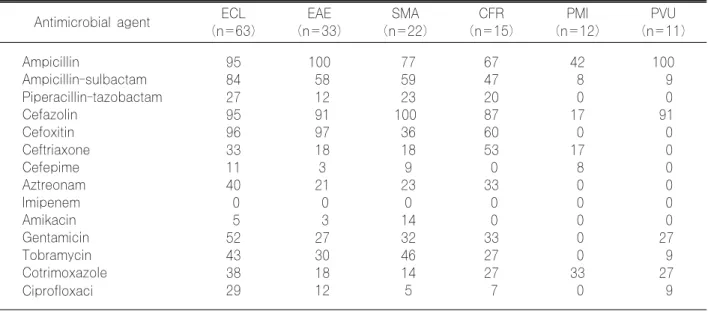
2002년 2월에서 6월 사이에 한림대학교 강남성심병원에 서 분리된 주요 장내세균 156주의 항균제 내성율은 Table 1과 같다. 그 중 ceftriaxone, cefepime 및 aztreonam의 내성율은 E. cloacae가 33%, 11%, 40%, E. aerogenes가 18%, 3%, 21%, S. marcescens가 18%, 9%, 23%, C. freundii가 53%, 0%, 33%, P. mirabilis가 17%, 8%, 0%이었고, P. vulgaris는 내성이 없었다. 대상 균주 중 imipenem에 내성인 경우는 없었다(Table 1).
156주 중 30주(19.2%)가 DDS시험에 양성인 ESBL 생성균주이었다. Cefotaxime, ceftazidime, cefepime 및
Table 1. Antimicrobial resistance (%) of Enterobacteriaceae isolated Antimicrobial agent ECL
(n=63)
EAE (n=33)
SMA (n=22)
CFR (n=15)
PMI (n=12)
PVU (n=11) Ampicillin
Ampicillin-sulbactam Piperacillin-tazobactam Cefazolin
Cefoxitin Ceftriaxone Cefepime Aztreonam Imipenem Amikacin Gentamicin Tobramycin Cotrimoxazole Ciprofloxaci
95 84 27 95 96 33 11 40 0 5 52 43 38 29
100 58 12 91 97 18 3 21 0 3 27 30 18 12
77 59 23 100 36 18 9 23
0 14 32 46 14 5
67 47 20 87 60 53 0 33 0 0 33 27 27 7
42 8 0 17 0 17 8 0 0 0 0 0 33 0
100 9 0 91 0 0 0 0 0 0 27 9 27 9 Abbreviations:ECL, Enterobacter cloacae; EAE, E. aerogenes; SMA, Serratia marcescens; CFR, Citrobacter freundii; PMI, Proteus mirabilis; PVU, P. vulgaris
Table 2. Comparative evaluation of the Vitek ESBL detection test and double disk synergy test applied for screening of ESBL among Enterobacteriaceae isolates
Test No. (%) of positive result
ESBL producer (n=30) Non-ESBL producer (n=126) Double disk synergy
Cefepime Ceftazidime Cefotaxime Aztreonam Vitek ESBL
30 (100) 23 (76.7) 25 (83.3) 28 (93.3) 26 (86.7)
0 0 0 0 2 (1.6)
Table 3. Distributions of extended-spectrum β-lactamase in Enterobacteriaceae isolates
Organism (n) No. (%) of isolates with ESBL
SHV TEM SHV+TEM Others Total
E. cloacae (n=63) E. aerogenes (n=33) S. marcescens (n=22) C. freundii (n=15) P. mirabilis (n=12) P. vulgaris (n=11)
6 4 0 0 0 0
1 1 3 0 0 0
7 0 0 0 0 0
1 1 3 2 1 0
15 (23.8) 6 (18.2) 6 (27.3) 2 (13.3) 1 (8.3) 0 (0)
Total (n=156) 10 (6.4) 5 (3.2) 7 (4.5) 8 (5.1) 30 (19.2)
aztreonam 중 cefepime의 ESBL 검출율이 가장 높았다.
30주의 ESBL 생성균주 중 26주(86.7%)가 Vitek ESBL 검출시험에 양성을 보였고 126주의 ESBL 비생성균주 중 2주(1.6%)가 Vitek ESBL 검출시험에 양성을 보였다 (Table 2). 이 두 균주는 디스크확산법에 의한 감수성시험 결과 cefotaxime, ceftazidime, cefepime 및 aztreonam
에 모두 감수성이었다.
15주(23.8%)의 E. cloacae, 6주(18.2%)의 E. aero- genes, 6주(27.3%)의 S. marcescens, 2주(13.3%)의 C. freundii 및 1주(8.3%)의 P. mirabilis를 포함하여 총 30주(19.2%)가 ESBL 생성균주이었다. 유전자형은 SHV형, TEM형, SHV와 TEM 혼합형 및 기타형이 각각
10주, 5주, 7주 및 8주이었다(Table 3).
고 찰
Enterobacter spp., Citrobacter spp., Serratia spp., M. morganii 등과 같이 선천적으로 유도성 AmpC β -lactamase를 생성하는 Enterobacteriaceae는 주로 dere- pressed mutant로 인한 염색체성 β-lactamase의 구조 적 과잉생성(constitutive overexpression)에 의해 광범 위 cephalosporin제에 내성을 보인다[15]. 그러나 이 균 종들에서도 plasmid에 의해 내성이 다른 균종에 전파되는 ESBL 생성균주들이 보고되고 있으며, 이 균종들은 β -lactam제 뿐만 아니라 aminoglycoside제 등에 대한 내 성 유전자도 함께 전파되는 것으로 알려져 있다[5, 16].
한국의 경우는 E. coli와 Klebsiella spp. 이외의 Entero- bacteriaceae에 대한 ESBL 생성균주의 빈도나 검출에 관 한 연구는 매우 드물다.
현재까지 NCCLS 지침[10]에는 E. coli와 Klebsiella spp.만을 대상으로 한 ESBL 검출기준이 정해져 있을 뿐 이다. Tzelepi 등[14]은 ESBL 생성 Enterobacter spp.
의 검출시험으로 DDS시험을 시행해본 결과 cefotaxime, ceftriaxone, ceftazidime, cefpodoxime, cefepime 및 aztreonam 중 cefepime을 이용하여 amoxicillin-clavu- lanate 디스크간의 거리를 20mm로 하여 검사하였을 때 ESBL의 검출율이 약 90%로 가장 높았다고 하였다. Vitek 을 이용한 ESBL 검출시험은 E. coli나 Klebsiella spp.
에 대해서는 유용하나 Enterobacter spp.와 Serratia spp.에 대해서는 좋지 않은 것으로 보고된 바 있다[12].
저자들의 경우도 각각의 cefotaxime, ceftazidime, cefe- pime 및 aztreonam과 amoxicillin-clavulanate의 디스 크 간격을 20 mm로 시행한 DDS 시험 결과 cefepime의 양성율이 가장 높았다. 그러나 Vitek ESBL 검출시험은 ESBL 생성균주의 86.7%가 양성을 보여 위의 연구와는 달리 높은 검출율을 보였다. 정확한 원인을 알 수는 없으나 이는 이번 연구에 사용된 키트(Vitek GNS-433 card)가 위의 연구와는 다른 것이었다는 것이 한 이유가 될 수 있을 것이라고 생각된다.
프랑스의 경우 Klebsiella spp.와 E. coli를 제외한 Enterobacteriaceae의 ESBL 생성균주의 빈도는 8.1%이 었고, 이중 E. aerogenes가 53.5%로 가장 높았다. 그리 고 ESBL 생성균주의 94%가 TEM형이었다[3]. 이탈리아 는 Klebsiella spp.와 E. coli를 제외한 Enterobacte- riaceae의 ESBL 생성균주의 빈도가 11.6%이었고, 이중 Providencia stuartii와 E. aerogenes가 각각 28.1%와 20.5%로 높았다. 유전자형은 SHV, TEM, SHV와 TEM 혼합형 및 기타형이 각각 42.3%, 30.1%, 15.6%, 12%
이었다[17]. 본 연구에서는 Klebsiella spp.와 E. coli를
제외한 Enterobacteriaceae의 ESBL 빈도가 19.2%로 위의 연구들 보다 높았다. 프랑스나 이탈리아의 경우는 E.
cloacae나 S. marcescens보다 E. aerogenes의 ESBL 빈도가 높은 것이 특징이었으나 저자들의 경우는 E. cloacae 와 S. marcescens의 ESBL 빈도가 각각 23.8%와 27.3%로 E. aerogenes보다 높았다. 프랑스와 이탈리아는 TEM형이 가장 흔하였으나 저자들의 경우는 SHV형이 33.3%로 가장 많았고 기타형도 26.7%로 많은 비율을 차 지하였다.
한국은 Klebsiella spp.와 E. coli 뿐만 아니라 다른 장 내세균에서도 ESBL 생성균주의 빈도가 선진국보다 높다는 것을 알 수 있었다. 따라서 이 균종들에 대해서도 ESBL 검출에 관심을 기울여야 할 것이다. 또한 Vitek ESBL 검 출시험은 모든 장내세균을 대상으로 범위를 확대하여 실시 할 수 있을 것으로 생각되었다.
요 약
배경:유도성 Bush group 1 염색체성 β-lactamase를 갖고있는 장내세균에서도 extended-spectrum β-lacta- mase (ESBL)를 생성하는 균주들이 전세계적으로 보고되 고 있다. 현재까지 Klebsiella pneumoniae와 Escherichia coli에 대해서는 National Committee for Clinical Labo- ratory Standards에 ESBL 기준이 설정되어 있고 상품화 된 다양한 방법들이 개발되어 있으나 이외의 장내세균들에 대해서는 이에 대한 표준화된 기준이 아직 없다. 따라서 저 자들은 임상 검체에서 분리된 주요 장내세균들에 대한 ESBL 생성균주의 검출과 빈도를 알아보고자 하였다.
방법:C. freundii, Enterobacter cloacae, E. aero- genes, Proteus mirabilis, P. vulgaris, S. marce- scens를 포함한 총 156주를 대상으로 항균제감수성시험, Vitek ESBL 검출시험 및 double disk synergy (DDS) 시험을 실시하였다. DDS 시험에 양성인 균주를 대상으로 blaTEM과 blaSHV PCR을 시행하였다.
결과:ESBL 생성균주는 S. marcescens (27.3%)가 가장 흔하였고 E. cloacae (23.8%), E. aerogenes (18.2%), C. freundii (13.3%) 및 P. mirabilis (8.3%)의 순이었다. 30주의 ESBL 생성균주 중 26주 (86.7%)가 Vitek ESBL 검출시험에 양성을 보였다. 유전 자형은 SHV형(10주)이 가장 많았고, 기타형(8주), SHV 와 TEM 혼합형(7주) 및 TEM형(5주)의 순이었다.
결론:K. pneumoniae와 E. coli 이외의 장내세균의 19.2%가 ESBL 생성균주이었다. Vitek ESBL 검출시험 은 C. freundii, Enterobacter spp., Proteus spp. 및 S. marcescens의 ESBL 검출에도 유용한 검사라고 생각 되었다.
참 고 문 헌
1. Knothe H, Shah P, Krcmery V, Antal M, Mitsuhashi S.
Transferable resistance to cefotaxime, cefoxitin, cefamandole and cefuroxime in clinical isolates in Klebsiella pneumoniae and Serratia marcescens. Infections 1983;11:315-7.
2. Bush K, Jacoby GA, Medeiros AA. A functional classifi- cation scheme for β-lactamases and its correlation with mole- cular structures. Antimicrob Agents Chemother 1995;39:1211- 33.
3. de Champs C, Sirot D, Chanal C, Bonnet R, Sirot J, the French Study Group. A 1998 survey of extended-spectrum β-lactamases in Enterobacteriaceae in France. Antimicrob Agents Chemother 2000;44:3177-9.
4. Luzzaro F, Perilli M, Migliavacca R, Lombardi G, Micheletti P, Agodi A, et al. Repeated epidemics caused by extended-spectrum beta-lactamase-producing Serratia marcescens strains. Eur J Clin Microbiol Infect Dis 1998;17:629-36.
5. Pitout JD, Thomson KS, Hanson ND, Ehrhardt AF, Coudron P, Sanders CC. Plasmid-mediated resistance to extended-spec- trum cephalosporins among Enterobacter strains. Antimicrob Agents Chemother 1998;42:596-600.
6. Power P, Radice M, Barberis C, de Mier C, Mellerach M, Maltagliatti M, et al. Cefotaxime-hydrolysing β-lactamases in Morganella morganii. Eur J Clin Microbiol Infect Dis 1999;18:743-7.
7. Varela C, Oliver A, Coque TM, Baquero F, Canton R. Pre- valence of extended-spectrum β-lactamases in group-1 β -lactamase-producing isolates. Clin Microbiol Infect 2001;7:
278-82.
8. Tzouvelekis LS, Vatopoulos AC, Katsanis G, Tzelepi E.
Rare case of failure by an automated system to detect ex- tended-spectrum β-lactamase in a cephalosporin-resistant Kle- bsiella pneumoniae. J Clin Microbiol 1999;37:2388.
9. Bush K. Is it important to identify extended-spectrum beta-
lactamase-producing isolates? Eur J Clin Microbiol Infect Dis 1996;15:361-4.
10. National Committee for Clinical Laboratory Standards.
Performance standards for antimicrobial susceptibility testing.
Twelfth informational supplement, M100-S12, Wayne, Pa.:
National Committee for Clinical Laboratory Standards, 2002.
11. Nuesch-Inderbinen MT, Haechler H, Kayser FH. Detections of genes coding for extended-spectrum SHV beta-lactamases in clinical isolates by a molecular genetic method and comparison with E test. Eur J Clin Microbiol Infect Dis 1996;15:398-401.
12. Sanders CC, Barry AL, Washington JA, Shubert C, Moland ES, Traczewski MM, et al. Detection of extended-spectrum β-lactamase-producing members of the Enterobacteriaceae with the Vitek ESBL test. J Clin Microbiol 1996;34:2997- 3001.
13. National Committee for Clinical Laboratory Standards.
Performance standards for antimicrobial disk susceptibility tests. 7th ed., Approved stadards, M2-A7. Wayne, Pa.: Nati- onal Committee for Clinical Laboratory Standards, 2000.
14. Tzelepi E, Giakkoupi P, Sofianou D, Loukova V, Kemero- glou A, Tsakris A. Detection of extended-spectrum β-lacta- mases in clinical isolates of Enterobacter cloacae and Enterobacter aerogenes. J Clin Microbiol 2000;38:542-6.
15. Ehrhardt AF and Sanders CC. Beta-lactam resistance amongst Enterobacter species. J Antimicrob Chemother 1993;32(Suppl B):1-11.
16. Neuwirth C, Siebor E, Lopez J, Pechinot A, Kazmierczak A. Outbreak of TEM-24-producing Enterobacter aerogenes in an intensive care unit and dissemination of the extended- spectrum β-lactamase to other members of the family Entero- bacteriaceae. J Clin Microbiol 1996;34:76-9.
17. Bonfiglio G, Perilli M, Stefani S, Amicosante G, Nicoletti G. Prevalence of extended spectrum β-lactamases among Enterobacteriaceae:an Italian survey. Int J Antimicrob Agents.
2002;19:213-7.