• 검색 결과가 없습니다.

Outcomes of Sleeve Lobectomy versus Pneumonectomy for Lung Cancer

N/A
N/A
Protected

Academic year: 2021

Share "Outcomes of Sleeve Lobectomy versus Pneumonectomy for Lung Cancer"

Copied!
5
0
0

로드 중.... (전체 텍스트 보기)

전체 글

(1)

http://dx.doi.org/10.5090/kjtcs.2011.44.6.413 ISSN: 2233-601X (Print) ISSN: 2093-6516 (Online)

*Department of Thoracic and Cardiovascular Surgery, Hallym University Sacred Heart Hospital, Hallym University College of Medicine

**Department of Thoracic and Cardiovascular Surgery, Kangnam Sacred Heart Hospital, Hallym University College of Medicine

***Department of Thoracic and Cardiovascular Surgery, Hangang Sacred Heart Hospital, Hallym University College of Medicine

****Department of Thoracic and Cardiovascular Surgery, Chuncheon Sacred Heart Hospital, Hallym University College of Medicine

*****Department of Thoracic and Cardiovascular Surgery, Kangdong Sacred Heart Hospital, Hallym University College of Medicine Received: July 11, 2011, Revised: October 20, 2011, Accepted: October 22, 2011

Corresponding author: Hee-Sung Lee, Department of Thoracic and Cardiovascular Surgery, Kangnam Sacred Heart Hospital, Hallym University College of Medicine, 948-1, Daerim-dong, Yeongdeungpo-gu, Seoul 150-950, Korea

(Tel) 82-2-829-5138 (Fax) 82-2-849-4469 (E-mail) [email protected]

C

The Korean Society for Thoracic and Cardiovascular Surgery. 2011. All right reserved.

CC
This is an open access article distributed under the terms of the Creative Commons Attribution Non-Commercial License (http://creative- commons.org/licenses/by-nc/3.0) which permits unrestricted non-commercial use, distribution, and reproduction in any medium, provided the original work is properly cited.

Outcomes of Sleeve Lobectomy versus Pneumonectomy for Lung Cancer

Hong-Kyu Lee, M.D.*, Hee-Sung Lee, M.D.**, Kun-Il Kim, M.D.*, Ho-Seung Shin, M.D.***, Jae-Woong Lee, M.D.*, Hyoung-Soo Kim, M.D.****, Sung-Woo Cho, M.D.*****

Background: Sleeve lobectomy for lung cancer in close proximity to or involving the carina is widely accepted.

Operative morbidity and mortality rates, recurrence, and survival rates have varied considerably across studies.

Materials and Methods: From March of 2005 to July of 2010, sleeve lobectomy was performed in 19 patients and pneumonectomy was performed in 20 patients. In this paper, the results of sleeve lobectomy and pneumo- nectomy for patients with lung cancer will be compared and evaluated. Results: There were no postoperative com- plications in either group, but there was one mortality in the pneumonectomy group. There was better preservation of pulmonary function in the sleeve lobectomy group than the pneumonectomy group (p=0.066 in FVC, p=0.019 in FEV1). The 3-year survival rates were 46.7% in the sleeve lobectomy group and 54.5% in the pneumonectomy group (p=0.505). The 3-year disease-free survival rates were 38% in the sleeve lobectomy group and 45.8% in the pneumonectomy group (p=0.200). Conclusion: Sleeve lobectomy for lung cancer showed low mortality, low bronchial anastomotic complication rates, and good preservation of pulmonary function.

Key words: 1. Lobectomy 2. Lung 3. Cancer

INTRODUCTION

Sleeve lobectomy is removal of the part of the main stem bronchus in continuity with the adjacent lobe or bilobe fol- lowed by end-to-end bronchial anastomosis [1]. Since the first report by Price-Thomas [2], sleeve lobectomy has been wide- ly used to treat patients with lung cancer in close proximity to or involving the carina [3-6]. Since sleeve lobectomy yielded survival results at least equal to those of pneumo-

nectomy, as well as better functional results, it became an ac- cepted procedure for patients with lung cancer who have ana- tomically suitable tumors, regardless of lung function [7-9].

Functional lung parenchyma can be preserved, and the re-

implanted lobes contribute to postoperative quality of life. If

a second case of primary lung cancer develops, subsequent

resection may be offered to selected patients [10,11]. Howev-

er, bronchial anastomotic complications and operative mortal-

ity rates show considerable variation across studies [12,13].

(2)

Table 1. Type of resection

Sleeve lobectomy Pneumonectomy Right

RUL RLL RML+RLL Left

LUL LLL Total

7 1 3

2 6 19

7

13

20 RUL=Right upper lobe; RLL=Right lower lobe; RML=Right middle lobe; LUL=Left upper lobe; LLL=Left lower lobe.

We performed this study to determine the outcomes of our use of sleeve lobectomy for primary lung cancer.

MATERIALS AND METHODS

Between March 2005 and July 2010, 19 patients underwent sleeve lobectomy and 20 patients underwent pneumonectomy for primary lung cancer. In the sleeve lobectomy group, there were 14 men and 5 women, with a mean age of 62.1±8.9 years (range, 41 to 75 years). In the pneumonectomy group, there were 16 men and 4 women, with a mean age of 64.3±8.8 years (range, 46 to 81 years). The decision to per- form sleeve lobectomy was based on the preoperative bron- choscopic evaluation in 18 patients and was made during the operation in 1 patient who had bronchial margin involvement determined by frozen-section examination.

Tumor spread and functional status were evaluated preoperatively. Physical examination, chest X-ray, chest com- puted tomography (CT), 18F-Fluorodeoxyglucose positron emission tomography (FDG-PET), spirometry, arterial blood gases, and quantitative ventilation and perfusion scans were performed routinely to evaluate functional status. Patients at high risk for heart disease were screened by echocardio- graphy. Tumor spread to the airway was evaluated by fiber- optic bronchoscopy, which plays a key role in selecting pa- tients for sleeve lobectomy; patients who have submucosal in- vasion or extrinsic compression of a lobar orifice with a pos- itive elective biopsy are good candidates for sleeve lobec- tomy.

Single-lung ventilation was established through a double-lu- men endotracheal tube. A posterolateral thoracotomy was per- formed in the fifth intercostal space. The hilar, carinal, para- tracheal, esophageal, and inferior pulmonary ligament lymph nodes were routinely dissected. In sleeve resection, circum- ferential bronchial resection was performed with a knife to obtain a straight margin distance from the tumor. Specimens of the resection margins were taken for frozen-section exami- nation to ensure complete resection and provide that ex- tension to sleeve lobectomy was feasible. Most patients were extubated in the operating room after the procedure. When postoperative mechanical ventilation was necessary, a standard endotracheal tube was substituted for the double-lumen tube.

Patients were followed up by routine chest X-ray and chest CT scans. Fiberoptic bronchoscopy was performed routinely in all patients before discharge between day 7 and 10, and when atelectasis indicated. 1 month after surgery, a pulmo- nary function test was performed. Operative mortality was de- fined as death within 30 days of the operation or death di- rectly related to the surgical procedure.

Findings from follow-up investigations were used to cate- gorize recurrences as in the anastomosed area, regional, or distant.

The data were compared with the independent t-test.

Survival data were calculated according to the Kaplan-Meier method from the date of operation and included postoperative deaths. Any value of p less than 0.05 was considered statisti- cally significant.

RESULTS

In the sleeve lobectomy group, there were 7 right upper lo-

bectomies, 1 right lower lobectomy, 3 bilobectomies, 2 left

upper lobectomies, and 6 left lower lobectomies. In the pneu-

monectomy group, there were 13 left pneumonectomies and 7

right pneumonectomies (Table 1). The permanent sections

showed squamous cell cancer in 13 patients (68.4%), ad-

enocarcinoma 4 in patients (21%), and other types of cancer

in 2 patients (10.5%) in the sleeve lobectomy group, and squ-

amous cell cancer in 14 patients (70%), adenocarcinoma in 4

patients (20%), and other types in 2 patients (10%) in the

pneumonectomy group. According to the TNM classification,

in the sleeve lobectomy group, 5 patients (26.3%) were in

(3)

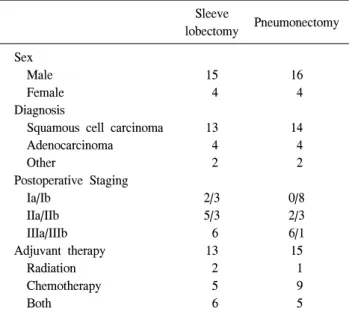
Table 2. Comparison of clinical variables of the sleeve lobectomy and pneumonectomy groups

Sleeve

lobectomy Pneumonectomy Sex

Male Female Diagnosis

Squamous cell carcinoma Adenocarcinoma Other

Postoperative Staging Ia/Ib

IIa/IIb IIIa/IIIb Adjuvant therapy Radiation Chemotherapy Both

15 4

13 4 2

2/3 5/3 6 13 2 5 6

16 4

14 4 2

0/8 2/3 6/1 15 1 9 5

Table 3. Pulmonary function test Sleeve lobectomy

Pneumonec- tomy p-value Mean FVC (postoperative/

preoperative)

Mean FEV1 (postoperative/

preoperative)

2.87/3.22 (89.1%) 1.99/2.13

(93.4%)

2.36/3.32 (71.0%) 1.74/2.40

(72.5%)

0.066

0.019

FVC=Forced vital capacity; FEV1=Forced expiratory volume in one second.

Table 4. Patterns of recurrence

Sleeve lobectomy Pneumonectomy Anastomosis site

Regional Distant

Locoregional+distant Total

0 2 2 1 5

0 2 5 2 9

stage I (2 IA and 3 IB), 8 (42.1%) were in stage II (5 IIA and 3 IIB), and 6 (31.5%) were in stage III (6 IIIA). 4 pa- tients (21%) had T1, 11 (57.8%) T2, 3 (15.7%) T3, and 1 (5.2%) T4 disease. 10 (52.6%) had N0, 5 (26.3%) N1, and 4 (21%) N2 disease. In the pneumonectomy group, 8 patients (40%) were in stage I (8 IB), 5 (25%) in stage II (2 IIA and 3 IIB), and 7 (35%) in stage III (6 IIIA and 1 IIIB). 1 pa- tient (5%) had T1, 14 (70%) T2, 4 (20%) T3, and 1 (5%) T4 disease. 10 (50%) had N0, 4 (20%) N1, and 6 (30%) N2 dis- ease (Table 2).

In the sleeve lobectomy group, 1 patient had incomplete resection in which frozen sections of the bronchial margin were positive but pneumonectomy was contraindicated by the results of preoperative investigations. In the pneumonectomy group, all patients underwent complete resection. In the sleeve lobectomy group, postoperative radiation therapies were used in 2 patients and postoperative chemotherapies were used in 5 patients. 6 patients received both chemo- therapy and radiation therapy after the operations. In the pneumonectomy group, postoperative radiation therapy was used in 1 patient and postoperative chemotherapy was used in 9 patients. 5 patients received both chemotherapy and radia- tion therapy after the operation (Table 2). There were no postoperative complications in either group, but there was one

mortality associated with the operation, repiratory failure in the pneumonectomy group. In the sleeve lobectomy group, a preoperative pulmonary function test showed mean values of forced expiratory volume in 1 second (FEV1) and forced vi- tal capacity (FVC), of 2.13 L and 3.22 L, repectively. The mean values of FEV1 and FVC showed 1.99 L and 2.87 L 1 month after surgery, with no significant difference (p=0.605 and p=0.377, respectively). In the pneumonectomy group, the mean values of FEV1 and FVC decreased from 2.40 L to 1.74 L and 3.32 L to 2.36 L 1 month after surgery, with sig- nificant changes both p=0.002. There was better preservation of pulmonary function in the sleeve lobectomy group than the pneumonectomy group (89.1% of mean FVC and 93.4% of mean FEV1 in the sleeve lobectomy group, 71% of mean FVC and 72.5% of mean FEV1 in the pneumonectomy group) (Table 3).

In the sleeve lobectomy group, the site of recurrence was

the anastomosis site in 0, regional in 2, distant in 2, and lo-

coregional and distant in 1. In the pneumonectomy group, the

site of recurrence was regional in 2, distant in 5, and locore-

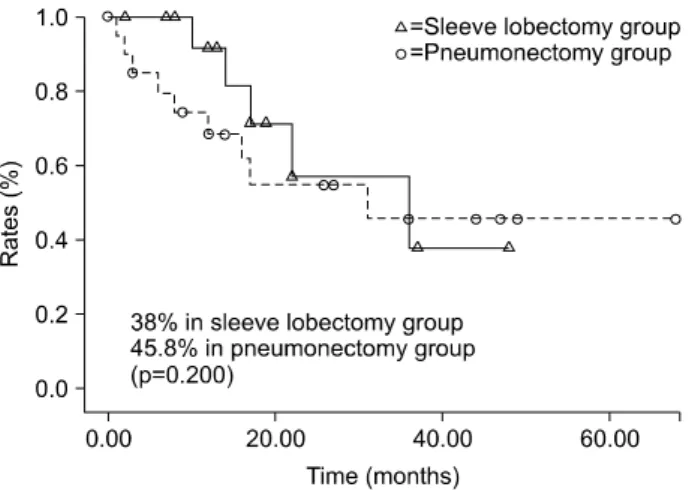
gional and distant in 2 (Table 4). The 3-year survival rates

were 46.7% in the sleeve lobectomy group and 54.5% in the

pneumonectomy group (p=0.505) (Fig. 1). The 3-year dis-

ease-free survival rates were 38% in the sleeve lobectomy

(4)

Fig. 1. Three-year overall survival. Fig. 2. Three-year recurrence-free survival.

group and 45.8% in the pneumonectomy group (p=0.200) (Fig. 2).

DISCUSSION

Since the first report by Price-Thomas [2], sleeve lobec- tomy has been generally used to treat patients with central bronchogenic cancer [3-6]. However, bronchial anastomotic complications and operative mortality rates show significant variation across studies [12,13]. Furthermore, the long-term results of sleeve resection in comparison with conventional lung cancer resections remain controversial, especially regard- ing nodal involvement and functional status [14].

The major complications after performing sleeve resection were the narrowing of the bronchoplasty site and atelectasis, whereas the pneumonectomy group suffered primarily from postpneumonectomy empyema and respiratory failure.

A 1992 collective review of 1,915 bronchoplastic proce- dures performed during a 12-year period in patients with bronchogenic tumors found that sleeve lobectomy was fol- lowed by morbidity and mortality similar to pneumonectomy but allowed for better lung function preservation [3]. In re- cent studies, operative mortality has ranged from 0% to 5.2%

[4,6], which is comparable to the range after standard lobec- tomy [15] and lower than after standard pneumonectomy [13,16]. In our study, there was no operative mortality after sleeve lobectomy.

Specific procedure-related complications of bronchoplasty

include impaired anastomotic healing and retention of bron- chial secretions. The incidence of anastomotic dehiscence is estimated at approximately 3.5% [3] and reoperative manage- ment is rarely required. Bronchial ischemia is obvious follow- ing sleeve bronchoplasty. Reports of the overall incidence of stenosis range from 3 to 9% [3]. Retention of secretions may be associated with bronchial denervation, which has been shown to decrease mucociliary clearance and viscoelasticity of bronchial secretions [17]. The reported incidence varies from 4 to 12% [18]. We did not perform repetitive broncho- scopy for bronchial clearing, and there were no postoperative complications.

The risk of local recurrence is the main concern caused by the use of sleeve lobectomy to treat bronchogenic malignancy. Suture line recurrence may be related to lung preservation at the expense of adequate bronchial margins [3].

Therefore, Paulson and colleagues [19] recommended that the bronchial resection margins be at least 1.5 cm away from the tumor. The incidence of local recurrence has ranged from 5%

to 51% [7]. In a recent study comparing sleeve lobectomy with pneumonectomy for NSCLC, Okada and colleagues [13]

found that the local recurrence rate was lower after broncho- plastic procedures. In our study, there was 1 (5.2%) locore- gional with distant recurrence after sleeve lobectomy.

Van Schil [14] reported that nodal status was the most sig-

nificant determinant of long-term survival after sleeve lobec-

tomy, with significantly shorter survival in patients with N2

disease than in those with N1 or N0 disease. It has been

(5)

shown that N2 disease is highly predictive of distant recur- rences [20].

CONCLUSION

Sleeve lobectomy is accepted as appropriate for selected patients with resectable malignant tumors and presents an al- ternative to the otherwise unavoidable pneumonectomy, owing to low mortality and good preservation of pulmonary function.

REFERENCES

1. Wain JC. Bronchoplastic resections. Philadelphia: Lippincott- Raven. 1998.

2. Thomas CP. Conservative resection of the bronchial tree. J R Coll Surg Edinb 1956;1:169-86.

3. Tedder M, Anstadt MP, Tedder SD, Lowe JE. Current mor- bidity, mortality, and survival after bronchoplastic proce- dures for malignancy. Ann Thorac Surg 1992;54:387-91.

4. Suen HC, Meyers BF, Guthrie T, et al. Favorable results af- ter sleeve lobectomy or bronchoplasty for bronchial malig- nancies. Ann Thorac Surg 1999;67:1557-62.

5. Faber LP. Sleeve lobectomy. Chest Surg Clin N Am 1995;5:

233-51.

6. Gaissert HA, Mathisen DJ, Moncure AC, Hilgenberg AD, Grillo HC, Wain JC. Survival and function after sleeve lo- bectomy for lung cancer. J Thorac Cardiovasc Surg 1996;

111:948-53.

7. Weisel RD, Cooper JD, Delarue NC, Theman TE, Todd TR, Pearson FG. Sleeve lobectomy for carcinoma of the lung. J Thorac Cardiovasc Surg 1979;78:839-49.

8. Van Schil PE, Brutel de la Rivière A, Knaepen PJ, van Swieten HA, Defauw JJ, van den Bosch JM. TNM staging and long-term follow-up after sleeve resection for broncho- genic tumors. Ann Thorac Surg 1991;52:1096-101.

9. Tsubota N, Yoshimura M, Murotani A, Miyamoto Y, Matoba Y. One hundred and one cases of bronchoplasty for primary lung cancer. Surg Today 1994;24:978-81.

10. Okada M, Tsubota N, Yoshimura M, Miyamoto Y. Opera- tive approach for multiple primary lung carcinomas. J Tho- rac Cardiovasc Surg 1998;115:836-40.

11. Van Schil PE, Brutel de la Rivière A, Knaepen PJ, van Swieten HA, Defauw JJ, van den Bosch JM. Second primary lung cancer after bronchial sleeve resection. Treatment and results in eleven patients. J Thorac Cardiovasc Surg 1992;

104:1451-5.

12. Faber LP, Jensik RJ, Kittle CF. Results of sleeve lobectomy for bronchogenic carcinoma in 101 patients. Ann Thorac Surg 1984;37:279-85.

13. Okada M, Yamagishi H, Satake S, et al. Survival related to lymph node involvement in lung cancer after sleeve lobec- tomy compared with pneumonectomy. J Thorac Cardiovasc Surg 2000;119:814-9.

14. Van Schil PE. Survival analysis after bronchoplastic resec- tion. Eur J Cardiothorac Surg 1999;16:395-6.

15. Ferguson MK, Karrison T. Does pneumonectomy for lung cancer adversely influence long-term survival? J Thorac Car- diovasc Surg 2000;119:440-8.

16. Ginsberg RJ, Hill LD, Eagan RT, et al. Modern thirty-day operative mortality for surgical resections in lung cancer. J Thorac Cardiovasc Surg 1983;86:654-8.

17. Paul A, Marelli D, Shennib H, et al. Mucociliary function in autotransplanted, allotransplanted and sleeve resected lungs.

J Thorac Cardiovasc Surg 1989;98:523-8.

18. Deslauriers J, Gaulin P, Beaulieu M, Piraux M, Bernier R, Cormier Y. Long-term clinical and functional results of sleeve lobectomy for primary lung cancer. J Thorac Cardio- vasc Surg 1986;92:871-9.

19. Paulson DL, Urschel HC Jr, McNamara JJ, Shaw RR.

Bronchoplastic procedures for bronchogenic carcinoma. J Thorac Cardiovasc Surg 1970;59:38-48.

20. Tronc F, Grégoire J, Rouleau J, Deslauriers J. Long-term re-

sults of sleeve lobectomy for lung cancer. Eur J Cardiothorac

Surg 2000;17:550-6.

수치

Table 3. Pulmonary function test  Sleeve  lobectomy Pneumonec-tomy p-value Mean  FVC  (postoperative/  preoperative)
Fig. 1. Three-year overall survival. Fig. 2. Three-year recurrence-free survival.

참조

관련 문서

Most submerged lamp system have a fundamental fouling problem and due to the absorption of UV light by fouling materials on the quartz sleeve, germicidal power of UV

In this study, we found that Pin1 plays a pivotal role in insulin- induced AP-1 activation through its interaction with p70S6K and prolongs activity of

Conclusion: No evidence of a substantial increase in all-cause mortality was found during the 2020 pandemic period in South Korea, as a result of a large decrease in deaths

Definition of patients presenting a high risk of developing peritoneal carcino- matosis after curative surgery for colorectal cancer: a systematic review..

a prospective analysis of 50 cases. Preoperative staging of non-small-cell lung cancer with positron-emission tomography. Staging of non- small-cell lung cancer

remarks at Prosecuting Attorneys Association of Michigan annual conference, Michigan Alliance Against Hate Crimes training, Michigan Human Trafficking conference, Kentwood

Tenofovir alafenamide versus tenofovir disoproxil fumarate for the treatment of patients with HBeAg-negative chronic hepatitis B virus infection: a randomised, double-blind,

Method We obtained blood samples from 49 patients who underwent surgical treatment for esophageal squamous cell cancer (ESCC) We performed ctDNA analysis with