• 검색 결과가 없습니다.

The Effects of Microwave Thermotherapy for Chronic Prostatitis/Chronic Pelvic Pain Syndrome: A Prospective, Randomized Study

N/A
N/A
Protected

Academic year: 2021

Share "The Effects of Microwave Thermotherapy for Chronic Prostatitis/Chronic Pelvic Pain Syndrome: A Prospective, Randomized Study"

Copied!
7
0
0

로드 중.... (전체 텍스트 보기)

전체 글

(1)

Original Article Urogenit Tract Infect 2017;12(1):35-41

http://crossmark.crossref.org/dialog/?doi=10.14777/uti.2017.12.1.&domain=pdf&date_stamp=2017-04-25

The Effects of Microwave Thermotherapy for Chronic Prostatitis/Chronic Pelvic Pain Syndrome: A Prospective, Randomized Study

Hong Chung, Hoon Choi

1

, Tag Keun Yoo

2

, Jeong Man Cho

2

, Hong Sup Kim

Department of Urology, Konkuk University School of Medicine, Chungju,

1

Department of Urology, Korea University Ansan Hospital, Korea University College of Medicine, Ansan,

2

Department of Urology, Nowon Eulji Hospital, Eulji University School of Medicine, Seoul, Korea

Purpose: Chronic prostatitis/chronic pelvic pain syndrome (CP/CPPS) causes pain and urinary symptoms that involve the prostate and/or other parts of the male. We analyzed the clinical outcomes of medication and microwave thermotherapy.

Materials and Methods: A total of 132 patients with CP/CPPS for at least 3 months were assigned to one of the three study groups (group A: medication; group B:

thermotherapy; group C: combination therapy). The NIH-CPSI was recorded at baseline, and at weeks 2, 4, 8, and 12 post-therapy. EPS was evaluated, and semen analysis was performed to assess the changes in prostatic inflammation. Moreover, patient satisfaction questionnaire was completed.

Results: Comparisons between groups A and B, as well as between groups B and C showed no significant changes in pain, quality of life, and total scores. At week 12, group C, when compared with group A, had a significantly improved voiding score (4.19±3.02 vs. 2.71±2.30, p=0.019) and EPS (12.47±15.91 vs.

3.73±4.82, p=0.003). At week 4, the patient satisfaction score in group C was significantly different from that in other groups (p=0.043), but there was no difference at week 12 (p>0.05). There was no statistically significant difference in laboratory test results, PSA, and prostate volume between the three groups at baseline and week 12. Complications of thermotherapy resolved with conservative management.

Conclusions: Our results showed that a combination of medication and thermotherapy improved NIH-CPSI and patient satisfaction in CP/CPPS more than medication alone. We suggested that thermotherapy could be another treatment option for CP/CPPS.

Keywords: Drug therapy; Microwaves; Prostate; Prostatitis

Copyright 2017, Korean Association of Urogenital Tract Infection and Inflammation. All rights reserved.

This is an open access article distributed under the terms of the Creative Commons Attribution Non-Commercial License (http://creativecommons.org/licenses/by-nc/4.0) which permits unrestricted non-commercial use, distribution, and reproduction in any medium, provided the original work is properly cited.

Received: 9 November, 2016 Revised: 4 December, 2016 Accepted: 12 December, 2016

Correspondence to: Hong Sup Kim http://orcid.org/0000-0001-7820-5303 Department of Urology, Konkuk University Chungju Hospital, 82 Gugwon-daero, Chungju 27376, Korea Tel: +82-43-840-8270, Fax: +82-43-848-4722 E-mail: [email protected]

INTRODUCTION

Chronic prostatitis/chronic pelvic pain syndrome (CP/CPPS) manifests as pain in the perineum, rectum, prostate, penis, testicles, and/or abdomen for more than 3 of the previous 6 months, or urinary symptoms and painful ejaculation

without documented urinary tract infection by any patho-

gen. CP/CPPS is the most common urological diagnosis

in men over the age of 50 years, and is the third most

common urological diagnosis in men younger than 50 years

[1]. Prostatitis accounts for 25% of all visits to the urologists

and up to 15% to 25% of visits to urologic clinics in Korea

(2)

Fig. 1. URO-DR

TM

(Somang Medical, Gangneung, Korea).

[2]. Cases of CP/CPPS are subdivided by the presence of inflammatory components in expressed prostatic secretions (EPSs) or semen (category IIIA) or its absence (category IIIB). Prostatitis remains to be a significantly underreported and poorly understood disease. Currently, there is much discourse regarding the pathophysiology and optimal therapeutic approach for patients with CP/CPPS. However, there has not been a consensus on the optimal treatment modality. Hence, a multimodal approach has been pre- sumed to demonstrate benefit. Various pharmacologic and nonpharmacological treatments have been proposed and used [3-5]. Moreover, multiple interventional techniques, including microwave thermotherapy, injection of botulinum toxin, transurethral needle ablation of the prostate, neuro- modulation, and extracorporeal shockwave therapy, have been utilized, with each offering varying degrees of benefit.

Transrectal microwave hyperthermia of the prostate was developed as a treatment for prostate cancer [6-8], and its application was subsequently extended to benign prostatic hyperplasia and CP [9,10]. Transrectal prostatic hyper- thermia has shown efficacy in selected patients with CP who did not respond to conventional therapies [11,12].

This study evaluated the effect of transrectal microwave thermotherapy (TRMT).

MATERIALS AND METHODS

1. Patients

This prospective study was carried out on 132 CP/CPPS patients, who were recruited among men visiting the urology clinics of Konkuk University Chungju Hospital and Eulji University Hospital in Korea between January 2005 and December 2010. This study was performed in accordance with the institutional guidelines and was approved by the Konkuk University Chungju Hospital Institutional Review Board (KU2010-003); all participants provided written informed consent. Patients had symptoms for more than 3 months, and all fulfilled the National Institutes of Health (NIH) diagnostic criteria for CP/CPPS. The NIH Chronic Prostatitis Symptom Index (NIH-CPSI) score was determined in each patient via a questionnaire. Patients with a history of urethritis, epididymitis, varicocele, perianal and rectal disorders, any neurological disease, presence of neurogenic bladder, urethral stricture, and previous urological surgery were excluded. The serum prostate specific antigen (PSA)

level was tested to exclude prostate cancer. None of the patients had received antibiotics or anti-inflammatory agents before enrollment in this study.

2. Study Design and Interventions

Men were randomly assigned in equal proportions to three groups: group A, receiving ciprofloxacin 500 mg twice daily and nonsteroidal anti-inflammatory drugs (NSAIDs);

group B, receiving TRMT alone; and group C, receiving a combined therapy of ciprofloxacin 500 mg twice daily, NSAIDs, and TRMT (group C). Patients were treated for 12 weeks, at which time the primary endpoint was assessed.

Symptoms were assessed to evaluate a longer-term treatment response at weeks 4, 8, and 12. The NIH-CPSI scores were recorded at baseline, and at weeks 2, 4, 8, and 12. EPS, semen analysis, and cytokine levels were used to evaluate inflammation. A patient satisfaction questionnaire, which consisted of 5 scales, was completed. A single TRMT treatment was performed with a URO-DR

TM

device (Somang Medical, Gangneung, Korea), at an intrarectal temperature of 43

o

C for 30 minutes, at a medium heating rate (Fig. 1).

This system included a 6-ring electrode mounted on a

silicone-coated 16-Fr latex Foley catheter, and incorporated

a computer-controlled radiofrequency generator that enabled

bipolar treatment. The treatment area was chosen according

to the prostatic urethral length, measured by transrectal

ultrasound (TRUS); localized treatment was performed by

applying an energy to the different catheter electrodes.

(3)

Fig. 2. Study flow diagram. Group A:

medical therapy, group B: microwave thermotherapy, group C: medication and microwave thermotherapy.

We also measured the prostate volume by TRUS and the PSA level before treatment. Patient follow-up at week 12 included TRUS and PSA level.

3. EPS and Semen Collection

Expressed prostatic secretion (EPS) and semen samples were collected after 3-5 days of abstinence. The penis and meatus were cleaned and disinfected. Urine was collected before and after prostate massage for routine examination and bacterial culture. Digital rectal examination and EPS collection were carried out with the subject in the knee-chest position. Semen was collected in a 1.5-ml cryotube after centrifugation at 3,000 g for 10 minutes and stored at −20

o

C for approximately 2 hours, which was then transferred for storage at −70

o

C until thawed for analysis. The EPS was smeared on a glass slide and examined promptly with a high-power microscope (×400) for cells and lecithin bodies.

4. Efficacy Calculation and Patient Satisfaction Questionnaire

We used a self-reported patient satisfaction questionnaire at baseline, and at weeks 4 and 12. Patient satisfaction after treatment was determined using a visual analogue scale (category IIIA: 0 to 15, category IIIB: 0 to 30). Efficacy was calculated with a formula, including questionnaire results. Patients in category IIIA showed a decrease in EPS white blood cell (WBC) counts.

5. Data Analysis

Data were analyzed using SPSS ver. 14.0 for Windows (SPSS Inc., Chicago, IL, USA). Single-factor analysis of variance was used to compare age, WBC counts, NIH-CPSI scores, and patient satisfaction between the three groups.

Pearson’s correlation was used to analyze the relationship between WBC counts and NIH-CPSI scores. A p-value of less than 0.05 was considered statistically significant.

RESULTS

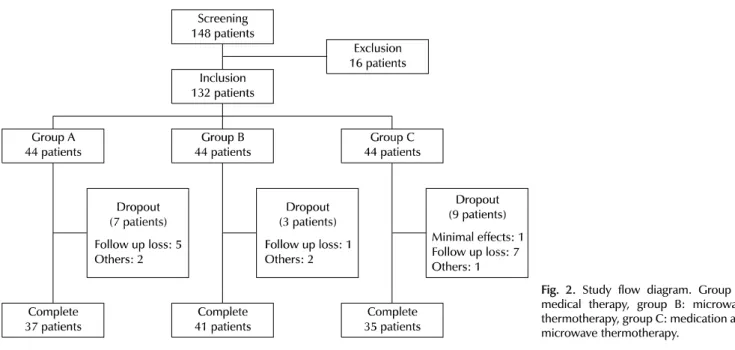
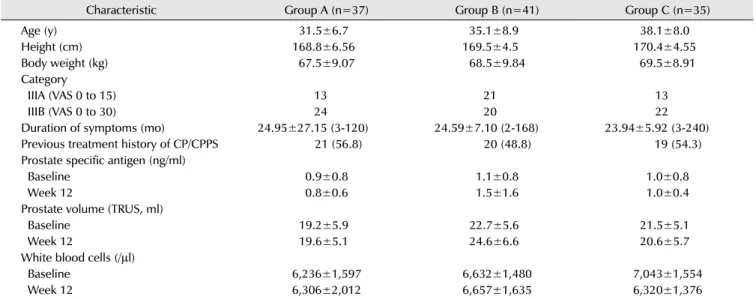
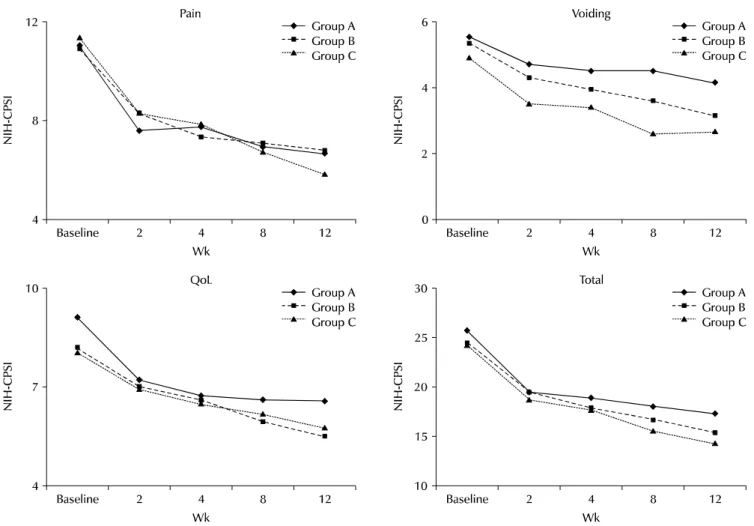
We screened 148 patients in 2 hospitals, and 16 were excluded due to urethritis, urethral stricture, or other rele- vant medical history. A total of 132 patients with CP/CPPS for at least 3 months were randomly assigned to one of the three groups (Fig. 2). There was no statistically signi- ficant difference in routine laboratory tests, PSA, or prostate volume between the three groups at baseline and at week 12 (Table 1). After 12 weeks of treatment, all groups showed signs of improvement compared with the baseline (Fig. 3;

p<0.05). Comparisons between groups A and B, as well as between groups B and C showed no significant changes in pain, quality of life (QoL), and total scores. At week 12, group C, when compared with group A, had a signifi- cantly improved voiding score (4.19±3.02 vs. 2.71±2.30, p=0.019; Table 2) and EPS findings (category IIIA, 12.47±

15.91/high-power field [HPF] vs. 3.73±4.82/HPF, p=0.003).

At week 4, the patient satisfaction score in group C was

significantly different from that in other groups (p=0.043);

(4)

Table 1. Patient characteristics

Characteristic Group A (n=37) Group B (n=41) Group C (n=35)

Age (y) 31.5±6.7 35.1±8.9 38.1±8.0

Height (cm) 168.8±6.56 169.5±4.5 170.4±4.55

Body weight (kg) 67.5±9.07 68.5±9.84 69.5±8.91

Category

IIIA (VAS 0 to 15) 13 21 13

IIIB (VAS 0 to 30) 24 20 22

Duration of symptoms (mo) 24.95±27.15 (3-120) 24.59±7.10 (2-168) 23.94±5.92 (3-240)

Previous treatment history of CP/CPPS 21 (56.8) 20 (48.8) 19 (54.3)

Prostate specific antigen (ng/ml)

Baseline 0.9±0.8 1.1±0.8 1.0±0.8

Week 12 0.8±0.6 1.5±1.6 1.0±0.4

Prostate volume (TRUS, ml)

Baseline 19.2±5.9 22.7±5.6 21.5±5.1

Week 12 19.6±5.1 24.6±6.6 20.6±5.7

White blood cells (/l)

Baseline 6,236±1,597 6,632±1,480 7,043±1,554

Week 12 6,306±2,012 6,657±1,635 6,320±1,376

Values are presented as mean±standard deviation, number only, or number (%).

Group A: medical therapy, group B: microwave thermotherapy, group C: medication and microwave thermotherapy, VAS: visual analogue scale, CP/CPPS: chronic prostatitis/chronic pelvic pain syndrome, TRUS: transrectal ultrasound.

All parameters were no statistically significant difference compared with each groups.

however, there was no difference at week 12 (p>0.05).

Group C had improved NIH-CPSI and patient satisfaction scores compared with group A (Tables 2, 3, Fig. 3). Nineteen patients dropped out due to minimal effect, loss to follow- up, or other reasons. One patient in group C was dissatisfied because of minimal effect. Minor complications were noted with URO-DR

TM

, such as anal itching and tenesmus, but these improved with conservative management.

DISCUSSION

Many treatments have been investigated and tested in patients with CP/CPPS, but none have shown significant long-term benefit [13]. Recently, a combination treatment for CP/CPPS has been suggested as a preferred method due to its synergistic effect, showing superiority over monotherapy [14,15]. Combination therapy was based on the UPOINT system of domains (urinary, psychosocial, organ-specific, infection, neurologic/systemic, and tender- ness) [16]. Many patients are involvement with more than one UPOINT domain and require multimodal therapy. There has recently been an increase in the use of hyperthermia to treat prostatic diseases, although with controversial results [9,17,18]. In 1996, Nickel and Sorensen [19] reported that transurethral microwave thermotherapy showed greater benefit than those receiving therapy. They suggested that

transurethral microwave thermotherapy was effective and safe to treat patients with CP/CPPS. However, transurethral treatments have been associated with increased risk of urinary tract infection. The aim of this study was to validate TRMT with URO-DR

TM

in a prospective randomized trial.

The transrectal approach has minimal complications, such as anal itching and tenesmus. This improve with conservative management. Our results showed that a combination therapy with TRMT, using URO-DR

TM

and medication, im- proved NIH-CPSI and patient satisfaction scores for CP/CPPS compared with medical therapy alone (Table 2, Fig. 3).

Additionally, the patient satisfaction scores in group C were significantly different from scores in other groups at week 4 (p=0.043), but not at week 12 (p>0.05). Thakkinstian et al. [20] reported significant improvement in voiding symptoms with antibiotics and/or NSAIDs compared with the placebo. At week 12, voiding symptoms significantly improved in group C compared with group A (p=0.019).

Additionally, voiding symptoms, pain, and QoL were

significantly improved in all groups (Fig. 3). There were

no significant differences in PSA, WBC counts, and prostate

volume following TRMT with URO-DR

TM

, compared with

the results with medical therapy (Table 1). In this study,

19 patients dropped out due to minimal effect, loss to

follow-up, and other reasons (Fig. 2). One patient in group

C was dissatisfied due to minimal effect.

(5)

Fig. 3. Changes of pain, voiding, quality of life (QoL), and total score. Group A: medical therapy, group B: microwave thermotherapy, group C:

medication and microwave thermotherapy, NIH-CPSI: The National Institutes of Health Chronic Prostatitis Symptom Index.

Table 3. Changes of patient satisfaction questionnaire Patient

satisfaction

Group A (n=37) Group B (n=41) Group C (n=35)

IIIA (n=13) IIIB (n=24) IIIA (n=21) IIIB (n=20) IIIA (n=13) IIIB (n=22) Week 4 Week 12 Week 4 Week 12 Week 4 Week 12 Week 4 Week 12 Week 4 Week 12 Week 4 Week 12

Very satisfied - 3 - 1 - 3 2 - 1 2 3 4

Satisfied 5 3 7 8 8 5 8 10 6 8 8 8

Neutral 7 5 15 12 10 12 9 9 5 3 10 10

Dissatisfied 2 2 1 2 3 - 1 1 - - 1 -

Very dissatisfied - - 1 1 - 1 - - - - - -

Group A: medical therapy, group B: microwave thermotherapy, group C: medication and microwave thermotherapy. Visual analogue scale: category IIIA, 0 to 15; category IIIB, 0 to 30.

Table 2. NIH-CPSI score at the baseline and at week 12

NIH-CPSI Group A (n=37) Group B (n=41) Group C (n=35)

Baseline Week 12 Baseline Week 12 Baseline Week 12

Pain 11.24±3.92 6.51±4.23 11.02±3.06 6.76±3.55 11.49±3.30 5.91±4.05

Voiding 6.11±2.58 4.19±3.02 5.29±3.03 3.17±2.52 4.66±3.10 2.71±2.30

QoL 8.97±2.92 6.49±2.67 8.27±2.66 5.46±2.25 7.80±2.17 5.83±2.62

Total 26.27±5.45 17.19±8.23 24.59±7.10 15.39±6.51 23.94±5.92 14.46±7.34

Values are presented as mean±standard deviation.

Group A: medical therapy, group B: microwave thermotherapy, group C: medication and microwave thermotherapy, NIH-CPSI: The National

Institutes of Health Chronic Prostatitis Symptom Index, QoL: quality of life.

(6)

CP/CPPS is the most common urological diagnosis in men younger than 50 years, accounting for 8% of all office visits to urologists. CP/CPPS is characterized by pelvic or perineal pain, with or without detectable inflammatory changes in the prostate tissue and secretions. Men with CP/CPPS also have urinary symptoms and sexual dysfunc- tion, both of which have a negative effect on QoL. Most prostatitis cases are classified as CPPS (NIH category III).

Traditionally, inflammation in CPPS cases has been considered synonymous with leukocytes in EPS. However, there is no correlation between leukocytes and CPPS symptoms in men or leukocytes in EPS and histological inflammation. As shown in a Reduction by Dutasteride of Prostate Cancer Events study, histological inflammation in CPPS cases showed a slight correlation with the overall NIH-CPSI score, but no correlation with pain [21,22]. In contrast, numerous studies showed increased proinflam- matory cytokines and chemokines, which in some instances correlate with NIH-CPSI [23-25].

Although the etiology of CP/CPPS is uncertain, it may include inflammatory or non-inflammatory etiologies. An inciting agent may cause inflammation or neurological damage in or around the prostate, leading to pelvic floor neuromuscular and/or neuropathic pain. Predisposing factors for CP/CPPS may include heredity, infection, voiding abnormalities, hormone imbalance, intraprostatic reflux, immunological or allergic triggers, or psychological traits.

A wide variety of therapies, including -blockers, antibiotics, anti-inflammatory medications, and other agents (e.g., finasteride, gabapentinoids), are routinely used. The findings of several placebo-controlled trials suggest that a treatment with -blockers may be effective for reducing symptoms in men with CP/CPPS, in those who have not previously been treated with these drugs, and in those who have had symptoms for a relatively short time. Alternative treat- ments for CP/CPPS, such as phytotherapy, physical therapy, biofeedback, and thermotherapy, have shown some success in ameliorating the symptoms of CP/CPPS. Evidence is increasing for a role of cytokines as inflammation mediators in CP/CPPS. Different cytokines, such as interleukin (IL)-2, IL-8, IL-10, and tumor necrosis factor alpha (TNF-), have been found in prostate secretion fluids of CP/CPPS patients and presumably play an important role in the process of CP/CPPS [23-26]. Pro-inflammatory, anti-inflammatory, and regulatory cytokines have been tested for their diagnostic

usefulness. IL-6 and IL-8 are representative pro-inflam- matory cytokines with greater levels in seminal plasma [27].

According to our results, IL-1b, IL-6, IL-8, IL-10, and TNF-

in the seminal fluid did not change after treatment (all groups, data not shown). Further studies of prostate cytokines may help to characterize the different types of CP/CPPS, and improve our understanding of prostate immune responses in patients with CP/CPPS.

Our study has some limitations to consider when interpreting the results. First, we used self-reported “patient satisfaction questionnaires” without validation. Indeed, patient satisfaction in group C was significantly different from that in other groups after 4 weeks (p=0.043), but not at week 12 (p>0.05). Second, other reports showed that changes in cytokines were useful as diagnostic tools.

Although we examined seminal fluid after centrifugation, cytokine levels did not change in all groups. We surmise that seminal fluid samples could have been contaminated.

CONCLUSIONS

A combined therapy of medical therapy and thermo- therapy using URO-DR

TM

, compared with medical therapy along, resulted in an improvement of NIH-CPSI and patient satisfaction scores for CP/CPPS. Thermotherapy using URO- DR

TM

resulted in no significant differences in laboratory findings compared with other treatments, and had minimal complica- tions. Thermotherapy using URO-DR

TM

can be another treat- ment option for CP/CPPS. However, further clinical trials are necessary to clarify the role of thermotherapy for CP/CPPS.

CONFLICT OF INTEREST

No potential conflict of interest relevant to this article was reported.

REFERENCES

1. Nickel JC, Krieger JN, McNaughton-Collins M, Anderson RU, Pontari M, Shoskes DA, et al. Alfuzosin and symptoms of chronic prostatitis-chronic pelvic pain syndrome. N Engl J Med 2008;359:2663-73.

2. Woo YN. Prostatitis. Korean J Urol 1994;35:575-85.

3. Lee KC, Jung PB, Park HS, Whang JH, Lee JG. Transurethral

needle ablation for chronic nonbacterial prostatitis. BJU Int

2002;89:226-9.

(7)

4. Gottsch HP, Yang CC, Berger RE. A pilot study of botulinum toxin A for male chronic pelvic pain syndrome. Scand J Urol Nephrol 2011;45:72-6.

5. Zimmermann R, Cumpanas A, Miclea F, Janetschek G.

Extracorporeal shock wave therapy for the treatment of chronic pelvic pain syndrome in males: a randomised, double-blind, placebo-controlled study. Eur Urol 2009;56:418-24.

6. Hurwitz MD, Kaplan ID, Svensson GK, Hynynen K, Hansen MS. Feasibility and patient tolerance of a novel transrectal ultrasound hyperthermia system for treatment of prostate cancer. Int J Hyperthermia 2001;17:31-7.

7. Stawarz B, Zielinski H, Szmigielski S, Rappaport E, Debicki P, Petrovich Z. Transrectal hyperthermia as palliative treatment for advanced adenocarcinoma of prostate and studies of cell-mediated immunity. Urology 1993;41:548-53.

8. Montorsi F, Guazzoni G, Colombo R, Galli L, Bergamaschi F, Rigatti P. Transrectal microwave hyperthermia for advanced prostate cancer: long-term clinical results. J Urol 1992;148:

342-5.

9. Apolikhin OI, Voronovitskii VD, Gonsales EN. Experience with application of ALMGP-01 device for local transrectal micro- wave hyperthermia of the prostate in the treatment of chronic prostatitis. Urologiia 2010;(5):39-41.

10. Kehinde EO, Abul F. Transurethral microwave thermotherapy for treatment of benign prostatic hyperplasia: a preliminary assessment of the Prostalund feedback treatment machine.

Med Princ Pract 2005;14:272-6.

11. Montorsi F, Guazzoni G, Rigatti P, Pizzini G, Miani A. Is there a role for transrectal microwave hyperthermia in the treatment of benign prostatic hyperplasia? A critical review of a six-year experience. J Endourol 1995;9:333-7.

12. Montorsi F, Galli L, Guazzoni G, Colombo R, Bulfamante G, Barbieri L, et al. Transrectal microwave hyperthermia for benign prostatic hyperplasia: long-term clinical, pathological and ultrastructural patterns. J Urol 1992;148:321-5.

13. Giubilei G, Mondaini N, Minervini A, Saieva C, Lapini A, Serni S, et al. Physical activity of men with chronic prostatitis/chronic pelvic pain syndrome not satisfied with conventional treat- ments--could it represent a valid option? The physical activity and male pelvic pain trial: a double-blind, randomized study. J Urol 2007;177:159-65.

14. Shoskes DA, Hakim L, Ghoniem G, Jackson CL. Long-term results of multimodal therapy for chronic prostatitis/chronic pelvic pain syndrome. J Urol 2003;169:1406-10.

15. Tuğcu V, Tasci AI, Fazlioglu A, Gurbuz G, Ozbek E, Sahin S, et al.

A placebo-controlled comparison of the efficiency of triple- and monotherapy in category III B chronic pelvic pain syndrome

(CPPS). Eur Urol 2007;51:1113-7; discussion 1118.

16. Lee KS, Choi JD. Chronic prostatitis: approaches for best management. Korean J Urol 2012;53:69-77.

17. Kastner C, Hochreiter W, Huidobro C, Cabezas J, Miller P.

Cooled transurethral microwave thermotherapy for intractable chronic prostatitis--results of a pilot study after 1 year. Urology 2004;64:1149-54.

18. Choi NG, Soh SH, Yoon TH, Song MH. Clinical experience with transurethral microwave thermotherapy for chronic nonbac- terial prostatitis and prostatodynia. J Endourol 1994;8:61-4.

19. Nickel JC, Sorensen R. Transurethral microwave thermothe- rapy for nonbacterial prostatitis: a randomized double-blind sham controlled study using new prostatitis specific assessment questionnaires. J Urol 1996;155:1950-5.

20. Thakkinstian A, Attia J, Anothaisintawee T, Nickel JC. - Blockers, antibiotics and anti-inflammatories have a role in the management of chronic prostatitis/chronic pelvic pain syn- drome. BJU Int 2012;110:1014-22.

21. Nickel JC, Roehrborn CG, O'Leary MP, Bostwick DG, Somerville MC, Rittmaster RS. The relationship between prostate inflammation and lower urinary tract symptoms:

examination of baseline data from the REDUCE trial. Eur Urol 2008;54:1379-84.

22. Nickel JC, Roehrborn CG, O'leary MP, Bostwick DG, Somerville MC, Rittmaster RS. Examination of the relationship between symptoms of prostatitis and histological inflammation:

baseline data from the REDUCE chemoprevention trial. J Urol 2007;178:896-900; discussion 900-1.

23. Stancik I, Plas E, Juza J, Pfluger H. Effect of antibiotic therapy on interleukin-6 in fresh semen and postmasturbation urine samples of patients with chronic prostatitis/chronic pelvic pain syndrome. Urology 2008;72:336-9.

24. Liu L, Li Q, Han P, Li X, Zeng H, Zhu Y, et al. Evaluation of interleukin-8 in expressed prostatic secretion as a reliable biomarker of inflammation in benign prostatic hyperplasia.

Urology 2009;74:340-4.

25. Lotti F, Corona G, Mancini M, Filimberti E, Degli Innocenti S, Colpi GM, et al. Ultrasonographic and clinical correlates of seminal plasma interleukin-8 levels in patients attending an andrology clinic for infertility. Int J Androl 2011;34:600-13.

26. He L, Wang Y, Long Z, Jiang C. Clinical significance of IL-2, IL-10, and TNF-alpha in prostatic secretion of patients with chronic prostatitis. Urology 2010;75:654-7.

27. Paulis G, Conti E, Voliani S, Bertozzi MA, Sarteschi ML,

Menchini Fabris F. Evaluation of the cytokines in genital

secretions of patients with chronic prostatitis. Arch Ital Urol

Androl 2003;75:179-86.

수치

Fig. 1. URO-DR TM  (Somang Medical, Gangneung, Korea).
Fig. 2. Study flow diagram. Group A:
Table 1. Patient characteristics
Fig. 3. Changes of pain, voiding, quality of life (QoL), and total score. Group A: medical therapy, group B: microwave thermotherapy, group C:

참조

관련 문서

The new NIH classification for category III further defined these men as either category IIIA (inflammatory) or IIIB (noninflammatory) on the basis of the presence of

Methods: The patient received Korean medicine therapies such as herbal medication, acupuncture, moxibustion, cupping therapy, and Korean medicine steam therapy (about

Group A: received pollen extract with vitamins (Deprox 500 Ⓡ ); treatment group, Group B: received bromelain; control group, CP/CPPS: chronic prostatitis/chronic pelvic pain

National Institutes of Health Chronic Prostatitis Symptom Index (NIH-CPSI) symptom evaluation in multinational cohorts of patients with chronic prostatitis/chronic pelvic

Materials and Methods: Thirty five males with CPPS (category IIIa 25, IIIb 10) and the National Institutes of Health Chronic Prostatitis Symptom Index (NIH-CPSI) total pain score

0 Tabl e1.Thecont ent sof