• 검색 결과가 없습니다.

Fournier 괴저 최근 10례의 특성

N/A
N/A
Protected

Academic year: 2021

Share "Fournier 괴저 최근 10례의 특성"

Copied!
6
0
0

로드 중.... (전체 텍스트 보기)

전체 글

(1)

203

•교신저자:문두건, 고려대학교 의과대학 비뇨기과학교실 서울시 구로구 구로동 80번지

Tel: 02-2626-3201, Fax: 02-2626-1321 E-mail: [email protected]

Fournier 괴저 최근 10례의 특성

고려대학교 의과대학 비뇨기과학교실

진명헌 오미미 배재현 박홍석 윤덕기 문두건 [Abstract]

Characteristics of Recent 10 Cases of Fournier's Gangrene

Myeong Heon Jin, Mi Mi Oh, Jae Hyun Bae, Hong Soek Park, Duck Ki Yoon, Du Geon Moon

From the Department of Urology, Korea University College of Medicine, Seoul, Korea

Purpose: Fournier’s gangrene is a rare and potentially fatal infectious disease characterized by necrotic fasciitis of the perineum and abdominal wall, along with the scrotum and penis in men and the vulva in women. The aim of this study is to share our recent experience with the management of this difficult infectious disease.

Materials and Methods: The authors reviewed retrospectively the clinical records of a series of 10 patients with Fournier’s gangrene between the years 2004 and 2007 who, after initial treatment. The patient’s age, predisposing etiological factors, interval between onset of symptoms and diagnosis, lesion site, results of bacteriologic cultures, treatment and reconstructive procedures, length of hospital stay, treatment and outcome were analyzed.

Results: The patients' ages ranged between 46 and 84 years (mean 59 years). Of the 10 patients, 1 (10%) died and 9 (90%) survived. The predisposing factors included diabetes mellitus (10 cases, 100%), hypertention (3 cases, 30%), liver cirrhosis (2 cases, 20%), CVA (1 case, 10%). All 10 patients had positive culture results, with 9 (90%) of these being polymicrobial. The most common organisms isolated were Escherichia coli (n=6), Staphylococcus aureus (n=4) and Streptococcus agalactiae (n=2). The important finding wass the fact that quinolone-resistant extended spectrum beta-lactamase (ESBL) Escherichia coli (E.

coli) was detected in two cases (20%). The mean length of hospital stay was 41.1 days (7-70).

Conclusions: There is no differences between current study and previous, butit is important that ESBL producing E. coli was appeared. It may have influence on length of hospital stay and wound healing.

However, more studies are required to conclusively prove the effect of ESBL on prognosis of Fournier’s gangrene. (Korean J UTII 2007;2:203-208)

Key Words: Fournier's gangrene, Management, Extended spectrum beta-lactamase (ESBL)

(2)

서 론

Fournier 괴저는 회음부와 생식기관 부위의 괴사 성 근막염으로 특징 지워지는 질환으로 작은 피하 혈관의 혈전증을 일으켜 피부괴사를 가져오게 된 다.

1

Fournier 괴저는 1764년 Baurienne에 의해 질환 에 대하여 처음으로 기술되었지만, 성병 전문 의사 였던 Jean Alfred Fournier

2

에 의해 1883년에 현재 병명을 가지는 이름의 시조가 되었다.

3

당시에는

‘건강한 젊은 남성의 회음부에 갑작스럽게 발생하 여 빠른 진행을 보이는 특발성의 괴사’라고 정의하 였으나, 그 이후 질환의 역학과 병인 등에 대한 이 해는 전 연령대의 남녀에서 발생하고 음낭뿐만 아 니라 회음부와 항문주위로도 파급되는 괴사성 근 막염이라는 것을 알게 하였다. 또한 질환의 이해와 함께 치료의 발전도 계속되었다. 치료원칙은 적극 적 혈역학적 안정, 광범위 항균제요법과 적극적 외 과적 시술이며, 최근 고압산소치료, 벌꿀, 과산화수 소수 등을 이용한 시험적 치료도 시행하고 있다.

4-6

그러나 Fournier 괴저는 여전히 15-50%의 높은 사 망률을 보이며 비뇨기과 영역의 응급질환이다.

7

국 내에서도 몇 편의 논문이 발표되었고 최근 두 논문 은 1990년부터 10년간, 1992년부터 10년간 치료와 예후에 대해 조사한 논문이었다.

8,9

저자들은 최근 3년간 본원에 내원한 Fournier 괴저 환자 10례를 대 상으로 그 특성을 파악하였고 지금까지 보고된 과 거의 Fournier 괴저의 특성에 비추어 최근 질환의 경향을 파악하고자 본 연구를 계획하였다.

대상 및 방법

2004년 1월부터 2007년 6월까지 본원 비뇨기과 에서 Fournier 괴저로 진단 및 치료를 받았던 10례 를 대상으로 의무기록지를 통하여 후향적으로 분 석하였다. 진단은 환자의 병력, 신체검사와 필요한 경우 방사선학적 영상을 통하여 시행하였다. 괴사 성 감염이 없는 단순 음낭 또는 회음부의 농양은 연구에서 제외하였다. 환자의 나이, 기저질환, 증상 발현에서 내원까지의 기간, 병소부위, 요로/대장전

환술 유무, 세균배양검사결과, 괴사조직제거술의 시행 횟수, 음낭재건술의 시행여부, 재원일수, 치료 결과 등을 조사하였다.

모든 환자에서 내원시 3세대 cephalosporin, ami- noglycoside, clindamycin 등을 이용한 3종 항균제 치 료를 시행하였으며, 괴사조직의 광범위 외과적 제 거를 시행하였다. 필요시 국소 또는 전신마취하에 추가적인 괴사조직제거를 시행하였다. 배뇨에 장애 가 있거나 음경 또는 항문주위로 괴저가 침범한 경 우에는 요로 또는 대장전환술을 시행하였고, 지속 적으로 베타딘을 이용한 소독 및 괴사부위의 반복 적 제거를 시행하였다. 조직에서 세균배양 검사가 음성으로 전환되고 육아조직이 생성시 음낭재건술 을 실시하였다.

결 과

환자들의 평균연령은 59세 (46-84)였으며, 여성에

서도 발생한다는 보고도 있지만 10명 모두 남자환

자였다. 치료결과 전체 10례 중 9명 모두 생존 하

였고 사망한 환자는 1례에서 있었다. 기저질환으로

모든 환자에서 당뇨병 (10례, 100%)를 가지고 있었

고, 동반질환으로 고혈압 3례, 간경화 2례, 뇌졸중

1례 등이 있었다. 증상발현에서 내원까지의 평균기

간은 5.9일 (3-14)이었고, 임상증상으로 음낭 부종,

동통, 홍반, 피부괴사 등은 모든 환자에서 있었으며

38℃ 이상의 발열은 7례 (70%), 패혈증 2례 (20%)

등이 있었다. 병소부위는 10례 모두에서 음낭부위의

병소를 가지고 있었으며 항문주위 5례, 서혜부 4례,

음경 2례, 후복막강 1례에서 있었다 (Table 1). 내원

시 5례에서 치골상부요로전환술을 시행하였고, 1례

에서 요로전환술 및 대장전환술을 시행하였다. 세균

배양검사 결과에서는 전체 10례 중 10례에서 균이

동정되었으며, 그 중 복합감염은 9례에서 관찰되었

다. 동정된 균으로는 Escherichia coli 6례였으며 그

중 2례에서 quinolone 내성인 Extended spectrum

beta-lactamase (ESBL)가 검출되었다. Staphylococcus

aureus는 4례, Streptococcus agalactiae 2례 등의 순

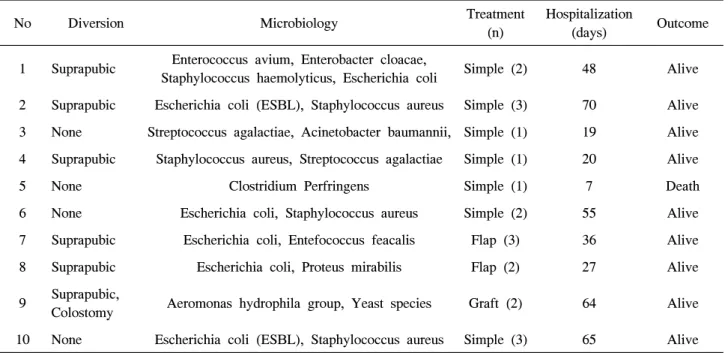
이었다 (Table 2). 음낭재건의 방법으로 단순봉합은

7례에서 시행하였고, 근피판이나 부분식피술을 이

(3)

Table 1. Pre-administrative features of each patient

No Age

(years) Predisposing factors Duration of symptoms

(days) Symptoms Location of infection

1 52 DM 4 None Scrotum, Perianal

2 52 DM 7 None Scrotum, Perianal, Inguinal

3 63 DM, HTN 7 Fever Scrotum, Inguinal, Retroperitoneum

4 46 DM 3 None Scrotum

5 84 DM 7 Fever, Shock Scrotum

6 77 DM, HTN, CVA 7 Fever Scrotum, Inguinal

7 49 DM, LC 3 Fever, Sepsis Scrotum, Perianal, Penis

8 54 DM, HTN 3 Fever Scrotum, Perianal, Inguinal

9 66 DM, LC 14 Fever Scrotum, Perianal, Penis

10 50 DM 4 Fever Scrotum

DM: diabetes mellitus, HTN: hypertension, CVA: cardiovascular accident, LC: liver cirrhosis

Table 2. Bacteriology of patients with Fournier’s gangrene (n=10)

Organism No. %

Escherichia coli (ESBL) 6 (2) 60 (20)

Staphylococcus aureus 4 40

Streptococcus agalactiae 2 20

Enterococcus 2 20

Acinetobacter baumannii 1 10

Enterobacter cloacae 1 10

Clostridium Perfringens 1 10

Aeromonas hydrophila group 1 10

Proteus mirabilis 1 10

ESBL: extended spectrum beta-lactamase

용한 경우가 3례에서 있었다. 평균재원 기간은 41.1 (7-70)일 이었으며 ESBL 양성인 환자군에서 평균재 원기간이 더 높게 나타났다 (Table 3).

고 찰

Fournier 괴저는 처음 증례가 보고된 이후 지금까

지 전체 비뇨기과 입원 환자의 0.2% 정도로 드물게

발행하는 질환이다.

10,11

Bejanga

12

는 환자 7,500명당

1명에서 발생하지만 사망자의 경우 이 질환명 보다

는 패혈증 쇼크로 진단, 처리되기 쉽기 때문에 실

제로는 더 흔할 것이라고 보고하였다. 최근에는

Fournier 괴저가 의사들에게 널리 인식되면서 그 발

생 빈도도 증가하는 추세에 있다. 본 연구는 최근

(4)

Table 3. Post-administrative features of each patient

No Diversion Microbiology Treatment

(n)

Hospitalization

(days) Outcome

1 Suprapubic Enterococcus avium, Enterobacter cloacae,

Staphylococcus haemolyticus, Escherichia coli Simple (2) 48 Alive 2 Suprapubic Escherichia coli (ESBL), Staphylococcus aureus Simple (3) 70 Alive 3 None Streptococcus agalactiae, Acinetobacter baumannii, Simple (1) 19 Alive 4 Suprapubic Staphylococcus aureus, Streptococcus agalactiae Simple (1) 20 Alive

5 None Clostridium Perfringens Simple (1) 7 Death

6 None Escherichia coli, Staphylococcus aureus Simple (2) 55 Alive

7 Suprapubic Escherichia coli, Entefococcus feacalis Flap (3) 36 Alive

8 Suprapubic Escherichia coli, Proteus mirabilis Flap (2) 27 Alive

9 Suprapubic,

Colostomy Aeromonas hydrophila group, Yeast species Graft (2) 64 Alive 10 None Escherichia coli (ESBL), Staphylococcus aureus Simple (3) 65 Alive Simple: simple closure, ESBL: extended spectrum beta-lactamase

3년간의 본원에 내원한 환자 기록을 대상으로 하였 는데 본원에서도 과거보다 Fournier 괴저의 빈도가 증가하는 추세였다. 다른 연구들에 비해 대상 례의 수가 적다는 문제점이 있을 수는 있지만, 최근 발 생하는 Fournier 괴저의 경향을 파악할 수 있을 것 이라 생각된다.

과거의 Fournier 괴저에 관한 보고를 살펴보면 치 료와 예후에 관한 것이 많았으나, 본 연구에서는 9 례에서 생존을 하였고, 1례에서만 사망을 하여 각 인자 별로 예후인자를 예측하는 것은 어려울 것으 로 생각한다. Fournier 괴저는 남성에서 주로 발생하 며 평균연령은 50세 이상으로 알려져 있으며,

10,11

본 연구에서도 59세로 큰 차이는 없었다. 또한 기저질 환은 Fournier 괴저를 유발하는 선행요인이 되는 것 으로 당뇨, 알코올성 간질환, 악성종양, 자가면역감 소 등의 질환에서 흔히 나타나는 것으로 보고되고 있고, 이 중 당뇨가 가장 중요한 요인으로 알려져

있다.

13-15

저자들의 경우에도 10례 모두에서 당뇨병

을 가지고 있었으며 다른 연구에서 보다는 당뇨병 의 비율이 높게 나타났다. 10례 중 2명을 제외하고 는 당 조절을 하지 않은 환자에서 발생하였다. 최근

대사성증후군이 증가됨에 따라 향후 Fournier 괴저 의 유병률에도 영향을 줄 수 있을 것으로 생각한다.

임상증상의 시작에서 내원까지의 시간은 5.9일로 다른 연구와 큰 차이를 보이지는 않았다. 가장 흔 한 임상증상으로는 동통과 부종으로 종종 발열과 동반되기도 한다. 동통은 보통초기에 뚜렷하게 나 타나다가 피부 신경의 압박 및 파괴로 인해 점차로 무감각해진다.

16

본원에 내원한 10례 중 7례에서 발 열이 동반된 동통 및 부종이 있었으며 내원 즉시 임상증상으로 진단 가능하였다. Fournier 괴저의 급 격한 진행은 신속한 진단을 필요로 하며, 패혈성 쇼크로의 진행을 막을 수 있을 것으로 생각한다.

10례 중 사망한 1례에서 유일하게 내원 시 패혈성 쇼크 증상을 보이고 있었다.

일반적으로 Fournier 괴저의 원인균은 호기성균과 혐기성균의 혼합감염이 흔한 것으로 알려져 있다.

각각의 균주들의 독성은 약하고 항생제치료에 효

과적으로 반응하나, 혼합감염으로 인한 상승작용으

로 더욱 심한 감염을 일으키는 것이 특징이다. 그

리고 이로 인한 환자의 면역력 저하는 감염상태를

더욱 악화시키는 요인이 된다.

17

병리조직학적 기전

(5)

은 작은 혈관들이 혈전에 의해 막혀서 발생하는 폐 색성 말초혈관염과 이로 인해 발생하는 피부의 괴 저이다. Fournier 괴저의 원인균들은 이 말초혈관염 의 발생에 영향을 주는데, E. coli, Proteus, Klebsiela 등 그람음성균은 모세혈관의 혈전형성과 관련되는 lipopolysaccharide endotoxin을 만들며,

17

Staphylo- coccus는 hyaluronidases를 만들어 탐식작용을 억제 하고 결합조직을 파괴한다. Beta-streptococci는 coa- gulase를 만들어 모세혈관의 혈전형성을 유발하며, hyaluronidase도 생성한다. 혐기성균인 Bacteroides는 collagenase 와 hyaluronidase, heparinases를 생성하여 혈전의 생성을 유발하며, 탐식작용도 억제하여 환 자의 면역력을 저하시킨다. 호기성균은 혈소판응집 과 보체의 고정을 일으키는 것으로 알려져 있다.

대부분의 연구에서 E. coli, Proteus, Klebsiella, Bacteroides, Streptococcus, Staphylococcus 등이 가장 흔히 동정되는 균으로 알려져 있다.

18

본 연구에서 도 다른 연구들과 마찬가지로 E. coli가 6례에서 가 장 많았으며 다음으로 Staphylococcus 순으로 나타 났다. 한편 균의 배양검사 결과 혐기성균이 나오지 않아도 항생제치료는 반드시 3종 항균제 치료를 시 행해야 한다. 왜냐하면 혐기성균은 배양검사에 잘 나타나지 않는 경우가 많으며, 이것의 존재가 병의 악화에 관여하기 때문이다.

18

그러나 한 가지 주목해 야 할 점은 E. coli가 10례 중 6례에서 발생을 하였 는데, 그 중 2례 (20%)에서 quinolone-저항성 ESBL E.coli가 동정되었다는 것이다. 최근 항생제 내성균 이 병원성 감염에 흔하며 질환의 치유를 방해하는 주된 요인으로 주목을 받고 있다. ESBL 양성을 보 인 2례의 환자에서 사망례가 없어서 예후에 영향을 주는지는 알 수 없으나 다른 8명의 환자군에 비해 유의하게 재원일수 및 음낭 재건시 봉합에 영향을 주는 것으로 나타났다. 향후 ESBL 양성 E. coli는 methicillin-resistant Staphylococcus aureus (MRSA) 등 과 마찬가지로 증가될 것이며 이는 Fournier 괴저의 예후에도 영향을 줄 수 있을 것으로 생각한다.

결 론

Fournier 괴저 10례의 환자에서 나이, 기저질환,

임상증상, 내원까지의 기간, 배양 균주의 종류에 따 른 빈도 등에서는 기존의 연구들과 큰 차이가 없었 으나, 세균배양검사 결과 최근 병원감염에서 문제 가 되는 ESBL 양성 E. coli가 출현하였다. 이 균주 는 환자의 재원기간 및 음낭재건에 영향을 줄 수 있을 것으로 생각하며 향후 예후인자로서의 영향 에 대한 연구도 필요할 것으로 생각한다.

REFERENCES

1. Eke N. Fournier’s gangrene: a review of 1726 cases.

Br J Surg 2000;87:718-28

2. Fournier JR. Gangrene foudroyante de la verge.

Medicin Pratique 1883;4:597-8

3. Quatan N, Kirby RS. Improving outcomes in Fournier’s gangrene. BJU Int 2004;93:691-2

4. Pizzorno R, Bonini F, Donelli A, Stubinski R, Medica M, Carmignani G. Hyperbaric oxygen therapy in the treatment of Fournier's disease in 11 male patients. J Urol 1997;158:837-40

5. Hejase MJ, Simonin JE, Bihrle R, Coogan CL. Genital Fournier's gangrene. Urology 1996;47:734-9

6. Horita Y, Miyazaki M, Noguchi M, Tadokoro M, Taura K, Ozono Y, et al. Healing of Fournier's gangrene of the scrotum in a haemodialysis patient after conservative therapy alone. Nephrol Dial Transplant 2000;15:419-21 7. Palmer LS, Winter HI, Tolia BM, Reid RE, Laor E.

The limited impact of involved surface area and surgical debridement on survival in Fournier’s gangrene. Br J Urol 1995;76:208-12

8. Lim SD, Lee SJ, Jeong HJ. The study of prognostic factor in Fournier's gangrenes. Korean J Urol 2002;

43:412-7

9. Kim BH, Chang HS, Park CH, Kim CI, Kim KS.

Necessity of aggressive management in Fournier's gangrene. Korean J Urol 2004;45:793-9

10. Saenz EV, Hernandez-Margo P, Ovalle MV, Vega JM, Alverez-Tostado FJF. Experience in management of Fournier’s gangrene. Tech Coloproctol 2002;6:5-13 11. Rotondo N. Fournier’s gangrene: an unusual presentation

of sepsis. J Emerg Med 2002;23:413-4

12. Bejanga BI. Fournier’s gangrene. Br J Urol 1979;51:312-6

13. Tan RE. Fournier's gangrene of the scrotum and the

(6)

penis. J Urol 1964;92:508-10

14. Lamb RC, Juler GL. Fournier's gangrene of the scrotum.

Arch Surg 1983;118:38-40

15. Paty R, Smith AD. Gangrene and Fournier's gangrene.

Urol Clin North Am 1992;19:149-62

16. Brown GS, Jones RB, Hirschmann JV. Fournier’s gan- grene: necrotizing subcutaneous infection of the male

genitalia. J Urol 1979;122:279-82

17. Smith GL, Bunker CB, Dinneen MD. Fournier's gan- grene. Br J Urol 199881:347-55

18. Kathryn SN, Lester WJ, Travis P, Katina HP, James

KS, Gazi BZ. Management of Fournier's gangrene: an

eleven year retrospective analysis of early recognition,

diagnosis, and treatment. Am Surg 2002;68:709-13

수치

Table  2.  Bacteriology  of  patients  with  Fournier’s  gangrene  (n=10)
Table  3.  Post-administrative  features  of  each  patient

참조

관련 문서

The extracts of isolated from Coptis Radix conducted an antimicrobial activity against Staphylococcus aureus, Staphylococcus epidermidis, Escherichia coli, Candida

These compounds were tested for the antimicrobial activities using Staphylococcus aureus and Escherichia coli by way of tube dilution method. aureus at

A ll compounds showed fair bacteriostatic activity against Staphylococcus aureus 6538p, Bac­.. illus subtilist Escherichia coli, and

양성 환자에서 CNS (Coagulase-Negative Staphylococcus)균을 제외하고, Type1 환자 5명에서 Staphylococcus aureus, Escherichia coli, Acinetobacter Baumannii,

paper disc FDV-3 Staphylococcus aureus, Escherichia coli, Listeria monocytogenes, Pseudomonas aeruginosa, Salmonella typhimurium, Yersinia enterocolitica 와 Lodderomyces

Major foodborne pathogens, specifically Escherichia coli, Salmonella spp., Listeria monocytogenes, Campylobacter jejuni, Staphylococcus aureus, Vibrio

6종의 Gram 양성균(Clostridium botulinum, Bacillus subtilis, B. cereus, Staphylococcus aureus, Micrococcus luteus, Listeria monocyto- gens), 3 종의 Gram 음성균(Escherichia

There were no significant differences between the 2 groups in bacterial species (Staphylococcus aureus, Escherichia coli, Klebsiella pneumoniae, Pseudomonas aerugi- nosa) and