• 검색 결과가 없습니다.

Non-Anastomotic Rupture of a Woven Dacron Graft in the Descending Thoracic Aorta Treated with Endovascular Stent Grafting

N/A
N/A
Protected

Academic year: 2021

Share "Non-Anastomotic Rupture of a Woven Dacron Graft in the Descending Thoracic Aorta Treated with Endovascular Stent Grafting"

Copied!
3
0
0

로드 중.... (전체 텍스트 보기)

전체 글

(1)

ISSN: 2233-601X (Print) ISSN: 2093-6516 (Online)

− 465 −

Received: June 24, 2016, Revised: August 8, 2016, Accepted: August 12, 2016, Published online: December 5, 2016

Corresponding author: Jong Tae Lee, Department of Thoracic and Cardiovascular Surgery, Kyungpook National University Hospital, Kyungpook National University School of Medicine, 130 Dongdeok-ro, Jung-gu, Daegu 41944, Korea

(Tel) 82-53-420-5665 (Fax) 82-53-426-4765 (E-mail) [email protected]

© The Korean Society for Thoracic and Cardiovascular Surgery. 2016. All right reserved.

This is an open access article distributed under the terms of the Creative Commons Attribution Non-Commercial License (http://creativecommons.org/

licenses/by-nc/4.0) which permits unrestricted non-commercial use, distribution, and reproduction in any medium, provided the original work is properly cited.

Non-Anastomotic Rupture of a Woven Dacron Graft in the Descending Thoracic Aorta Treated with

Endovascular Stent Grafting

Youngok Lee, M.D., Ph.D. 1 , Gun-Jik Kim, M.D. 1 , Young Eun Kim, M.D. 1 , Seong Wook Hong, M.D., Ph.D. 2 , Jong Tae Lee, M.D., Ph.D. 1

Departments of

1

Thoracic and Cardiovascular Surgery and

2
Anesthesiology and Pain Medicine, Kyungpook National University School of Medicine

The intrinsic structural failure of a Dacron graft resulting from the loss of structural integrity of the graft fabric can cause late graft complications. Late non-anastomotic rupture has traditionally been treated surgi- cally via open thoracotomy. We report a case of the successful use of thoracic endovascular repair to treat a Dacron graft rupture in the descending aorta. The rupture occurred 20 years after the graft had been placed.

Two stent grafts were placed at the proximal portion of the surgical graft, covering almost its entire length.

Key words: 1. Thoracoabdominal aortic aneurysm 2. Dacron

3. Rupture

4. Endovascular procedures

Case report

Dacron arterial grafts are widely used in thoracic aortic replacement, but few cases of non-anastomotic aneurysmal dilatation or rupture have been reported.

In most cases that have been reported, knitted, rath- er than woven, Dacron grafts were used. We report the clinically successful result of thoracic endovas- cular repair (TEVAR) of the late rupture of a woven Dacron graft. The Dacron graft had been implanted in the patient’s descending thoracic and upper abdo- minal aorta 20 years previously.

A 56-year-old man with a descending thoracoa- bdominal aortic aneurysm underwent descending th- oracic and upper abdominal aorta replacement with a Hemashield 20-mm woven Dacron graft (Meadox

Medicals Inc., Oakland, NJ, USA) in 1992. He was fol- lowed up as an outpatient, and no adverse events were noted until 2009, when he presented with sud- den-onset chest pain and severe dyspnea.

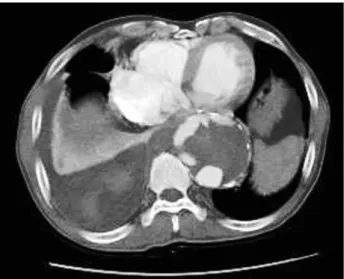
At that time, chest computed tomography (CT) re- vealed a massive right hemothorax, a large pseudoa- neurysm around the implanted graft just above the diaphragm level, and marked contrast medium ex- travasation from the graft (Fig. 1). The patient un- derwent an emergency open thoracotomy, in which a disruption was found at the site of the anastomosis between the Dacron graft and lumbar intercostal arteries. The disrupted site was repaired with 2 lay- ers of running sutures, and the graft was wrapped with the calcified aneurysmal sac.

In 2012, the patient presented with back pain, ab-

Korean J Thorac Cardiovasc Surg 2016;49:465-467 □ CASE REPORT □

https://doi.org/10.5090/kjtcs.2016.49.6.465

(2)

Youngok Lee, et al

− 466 −

Fig. 1. A chest computed tomographic scan from 2009 showing a massive right hemothorax and large pseudoaneurysm around the implanted graft and marked contrast medium extravasation from the graft.

Fig. 3. The arrow indicates multiple endoleaks from the graft, which were suspected to be due to a late Dacron graft rupture.

Fig. 2. A chest computed tomographic scan from 2012 showing a type III endoleak from the Dacron graft (arrow).

Fig. 4. A postoperative computed tomography scan showing the successful treatment of the suspected Dacron graft rupture.

dominal pain, and indigestion. A follow-up chest CT revealed that the size of the aneurysm in the de- scending aorta had increased in comparison with the findings of the previous CT examination. Dye collec- tion in the space between the graft and native aneur- ysmal sac was also observed, and was suspected to be indicative of a late rupture of the Dacron graft it- self (Fig. 2). The rupture was unrelated to the pre- vious anastomosis or disrupted site.

Due to the high morbidity and mortality associated

with reoperation, we decided to perform thoracic en- dovascular stent therapy as an alternative to open thoracotomy for the late graft failure. The primary goal of using TEVAR was to cover the entire length of the Dacron graft in the descending aorta with a stent graft. The right common femoral artery was ex- posed under general anesthesia, and a guidewire and angiographic catheter were introduced through it.

Aortic angiography revealed multiple dye leakages

from the graft that were caused by late failure of the

(3)

Successful Thoracic Endovascular Repair for Late Graft Failure

− 467 − Dacron graft (Fig. 3).

After obtaining an aortogram, two stent grafts (30×30×150 mm and 36×36×100 mm; S&G Biotech Inc., Seongnam, Korea) were also introduced through the right femoral artery and placed in the Dacron graft. The proximal end of the stent graft was de- ployed distally to the left subclavian artery, and the distal end was placed just above the celiac trunk.

The total length of the thoracoabdominal aorta cov- ered by the stent graft was approximately 220 mm.

A postoperative CT scan showed that the disruption of the Dacron graft had been successfully treated (Fig. 4).

The patient was discharged with no procedure-re- lated complications and, during the 1-year follow-up period, was free of any symptoms. However, he died of hepatocellular carcinoma 2 years later.

Discussion

Dacron vascular grafts are known to be durable and effective as aortic vascular prostheses. However, a few cases of non-anastomotic aneurysmal dilatation or rupture of these grafts after implantation in the descending thoracic aorta have been reported. The probable cause was degeneration over time of the graft fibers or the round black yarn used as the guideline [1]. Intrinsic graft failure of Dacron grafts is a rare complication (0.5%–3%); and in most re- ported cases, knitted, not woven, Dacron grafts had been used [2,3].

In our case, woven Dacron graft rupture occurred 20 years after the initial operation, probably caused by the degeneration of graft fibers over a long time.

Although woven Dacron graft rupture is extremely rare, reoperation is inevitable when it does occur.

Traditionally, late graft failure has been treated sur- gically through open thoracotomy. However, the hos- pital mortality after aortic reoperation remains high (8%–15% in many reports), and is even higher (25%–

50%) among patients receiving urgent or emergency

care [4,5].

TEVAR is increasingly being used for descending aortic diseases as a safe and feasible alternative to open graft repair. In light of the high morbidity and mortality associated with reoperation, we decided to perform endovascular therapy as an alternative man- agement strategy for late graft failure in our patient.

To the best of our k nowledge, the endovascular re- pair of primary graft rupture in a woven Dacron graft has not been reported. The case presented here dem- onstrates the effectiveness and feasibility of TEVAR implantation to treat the non-anastomotic rupture of a Dacron graft after descending aortic replacement.

Conflict of interest

No potential conflict of interest relevant to this ar- ticle was reported.

Acknowledgments

This research was sponsored by Kyungpook National University Research Fund, 2015.

References

1. Kawata M, Morota T, Takamoto S, Kubota H, Kitahori K.

Non-anastomotic rupture in the guideline of a Dacron thoracic aortic graft. J Vasc Surg 2005;42:573.

2. Shingu Y, Aoki H, Ebuoka N, Eya K, Takigami K, Oba J. Late rupture of knitted Dacron graft. Ann Thorac Cardiovasc Surg 2005;11:343-5.

3. Okabe T, Ishikawa S, Otaki A, Takahashi T, Koyano T, Morishita Y. A case of late non-anastomotic rupture of a Dacron prosthesis. Jpn J Vasc Surg 1998;7:759-63.

4. Fattori R, Tsai TT, Myrmel T, et al. Complicated acute type B dissection: is surgery still the best option?: a report from the International Registry of Acute Aortic Dissection.

JACC Cardiovasc Interv 2008;1:395-402.

5. Di Bartolomeo R, Berretta P, Petridis FD, et al. Reoperative

surgery on the thoracic aorta. J Thorac Cardiovasc Surg

2013;145(3 Suppl):S78-84.

수치

Fig. 3. The arrow indicates multiple endoleaks from the graft,  which were suspected to be due to a late Dacron graft rupture.

참조

관련 문서

We report a case of successful stent graft deployment for iatrogenic ruptured subclavian artery after attempted right subclavian vein catheterization in a 31 year-old

formation after thoracic endovascular aortic repair is probably as- sociated with the erosion of the esophageal wall by an infected stent-graft, pressure necrosis caused by the

The Modified Chimney Technique With a Thoracic Aortic Stent Graft to Preserve the Blood Flow of the Left Common Carotid Artery for Treating Descending Thoracic Aortic Aneurysm

The indications for endovascular repair were abdominal aortic aneurysm in 5 patients, descending thoracic aortic aneurysm in 6 patients and acute type B aortic dissection in

After stent graft implantation became a standard procedure for infra-renal abdominal aortic aneurysm, the number of cas- es of thoracic endovascular aortic repair

We report a case where the bypass graft used in the thoracic endovascular aortic repair procedure com- pressed the left internal jugular vein, causing acute thrombotic occlusion..

We report a case of successful endovascular treatment of a pseudoaneurysm and the obstruction of an aorto-aortic bypass graft, which had been performed to treat Takayasu’s

To the best of our knowledge, this is the first re- ported case of the late migration of an occluder de- vice to the descending thoracic aorta, and the only