• 검색 결과가 없습니다.

Descending Thoracic Aorta to Bilateral Femoral Artery Bypass in a Hostile Abdomen

N/A
N/A
Protected

Academic year: 2021

Share "Descending Thoracic Aorta to Bilateral Femoral Artery Bypass in a Hostile Abdomen"

Copied!
3
0
0

로드 중.... (전체 텍스트 보기)

전체 글

(1)

Korean J Thorac Cardiovasc Surg 2012;45:257-259 □ Case Report □ http://dx.doi.org/10.5090/kjtcs.2012.45.4.257 ISSN: 2233-601X (Print) ISSN: 2093-6516 (Online)

− 257 −

Department of Thoracic and Cardiovascular Surgery,

1

Hallym University Sacred Heart Hospital, Hallym University College of Medicine,

2

Chuncheon Sacred Heart Hospital, Hallym University College of Medicine,

3

Kangnam Sacred Heart Hospital, Hallym University College of Medicine,

4

Kangdong Sacred Heart Hospital, Hallym University College of Medicine

Received: October 21, 2011, Revised: November 11, 2011, Accepted: November 11, 2011

Corresponding author: Kun Il Kim, Department of Thoracic and Cardiovascular Surgery, Hallym University Sacred Heart Hospital, Hallym University College of Medicine, 22 Gwanpyeong-ro 170beon-gil, Dongan-gu, Anyang 431-796, Korea

(Tel) 82-31-380-3815 (Fax) 82-31-380-4118 (E-mail) [email protected]

C

The Korean Society for Thoracic and Cardiovascular Surgery. 2012. All right reserved.

CC
This is an open access article distributed under the terms of the Creative Commons Attribution Non-Commercial License (http://creative- commons.org/licenses/by-nc/3.0) which permits unrestricted non-commercial use, distribution, and reproduction in any medium, provided the original work is properly cited.

Descending Thoracic Aorta to Bilateral Femoral Artery Bypass in a Hostile Abdomen

Hong Kyu Lee, M.D.

1

, Kun Il Kim, M.D.

1

, Won Yong Lee, M.D.

1

, Hyoung Soo Kim, M.D.

2

, Hee Sung Lee, M.D.

3

, Sung Woo Cho, M.D.

4

Descending thoracic aorta to femoral artery bypass has been used as a remedial operation after aortic or axillofe- moral graft failure or graft infection and other intra-abdominal pathologies not amenable to standard aortofemoral revascularization. It can avoid abdomen approach and has been known as a durable procedure with excellent long-term patency. We reported descending thoracic aorta to femoral artery bypass grafting for primary revasculari- zation in a 55-year-old male with hostile abdominal conditions.

Key words: 1. Aorta, surgery 2. Bypass

CASE REPORT

A 55-year-old male was referred to our department for to- tal abdominal aorta obstruction with intermittent claudication.

At first, he visited the emergency room with epigastric pain.

He had a history of hemigastrectomy and gastrojejunostomy for acute gastric ulcer with perforation 4 years ago. He also had a history of diabetes mellitus and 30 pack-years smoking.

Abdominal sonography showed the pancreas of diffuse en- larged parenchyme with normal common bile duct. Abdomin- al computed tomography (CT) showed the swelling of pan- creas and small amount of fluid retention around pancreas with no demonstrable bile duct stone and total occlusion of infrarenal aorta to both common iliac arteries. After he com- pleted antibiotics therapy for acute pancreatitis and chol- angitis, he was transferred to our department for treatment of

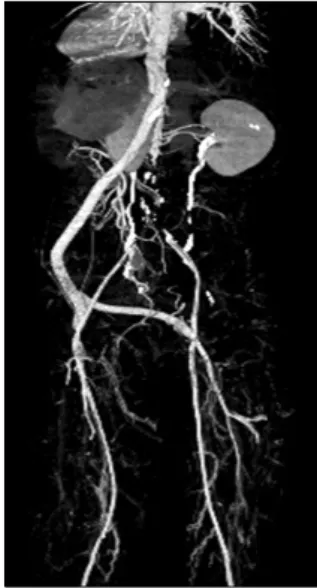
total occlusion of abdominal aorta (Fig. 1).

CT angiography showed total occlusion of infrarenal aorta, both common iliac arteries and left external iliac artery with collateral arterial flow into both femoral arteries. CT angiog- raphy also showed focal short segmental stenosis in superior mesenteric artery origin area with abundant collateral flow.

Preoperative ankle-brachial indices were 0.49 and 0.42 (right and left). Considering relatively young age of the patient, du- rable bypass procedure like aortobifemoral artery was needed.

However, the patient has previous abdominal surgery for gas- tric ulcer perforation and recent inflammatory conditions, pan- creatitis and cholangitis. After discussing various surgical al- ternatives, we decided to perform descending thoracic aorta to both femoral artery bypass surgery to avoid operation in a hostile abdomen.

With double-lumen endo-tracheal intubation to allow de-

(2)

Hong Kyu Lee, et al

− 258 −

Fig. 1. Preoperative computed tomography angiography. Fig. 2. Postoperative computed tomography angiography.

flation of the left lung, the patient was positioned with the right semi-lateral position. The pelvis was placed flat to allow access to both groins. Left posterolateral thoracotomy was performed through the eighth intercostal space, then, the dis- tal descending thoracic aorta just above diaphragm and both femoral arteries were exposed simultaneously. The distal de- scending thoracic aorta was mobilized from the parietal pleura to allow placement of a partially occluding clamp and a stab wound was made for graft. Leaving the inguinal liga- ment intact, the oblique and transverse muscles of left side were split and the left retroperitoneal space was entered.

Using blunt finger dissection, retroperitoneal tunneling was performed between the left hemithorax and the left supra- inguinal preperitoneal space and cross over tunnel between both groin incisions was created similarly. After partial clamping on thoracic descending aorta with systemic heparin- ization, a 10 mm polytetrafluoroethylene (PTFE) graft (Gore- Tex; Flagstaff, AZ, USA) with externally supported rings was anastomosed to the aorta proximally in an end-to-side fashion. And then distal anastomosis (left groin) was per- formed to left common femoral artery. After that, right com- mon femoral artery and 10 mm graft were connected with 8 mm PTFE graft with rings. A chest tube (28Fr) was placed in the left pleural space and all incisions were closed.

Postoperative course was uneventful and postoperative an- kle-brachial indices were improved from 0.49 and 0.42 to

0.95 and 0.94 (right and left). All bypass grafts were patent in postoperative CT angiography (Fig. 2). The patient was discharged without any complication and claudication 7 days after surgery. He is doing well without symptom at 30 months postoperatively.

DISCUSSION

Bypass from the descending thoracic aorta (DTA) to the

iliac or femoral arteries has been used mostly as an alter-

native procedure for aortic reconstruction in patients with un-

usually difficult conditions contraindicating the trans-

abdominal approach. More than half of the reported bypasses

from the DTA have been remedial aortic reconstructions in

patients with one or more previous abdominal aortic graft

failures because of thrombosis or infection, in many instances

with additional failure of extra-anatomic subcutaneous bypass

[1]. Despite use as a remedial operation and small number of

patients, published results have been satisfactory, with low

perioperative mortality, morbidity, and good long-term pa-

tency rates [1-3]. These have supported its continued use as

an alternative procedure for aortic graft failure or infection

and a more liberal use for primary revascularization for pa-

tients with severe atherosclerotic disease or complete occlu-

sion of the infrarenal aorta, especially when a direct trans-

abdominal aortic approach is not feasible [3].

(3)

Descending Thoracic Aorta to Femoral Artery Bypass

− 259 − Although DTA-to-femoral bypass grafting as the primary choice of treatment for infrarenal aortic occlusion is con- troversial, there are several reasonable advantages for using the DTA as an inflow source. The DTA is less prone to atherosclerotic disease than the infrarenal aorta [4]. And dis- section of the aorta in the chest cavity is simple because few surrounding structures are present. Although the aortic ex- posure can be limited by the presence of pleural adhesions, the potential complications and morbidity associated with trauma of the small and large intestine, ureters, and iliac veins during the exposure of the aorta are completely avoided [5]. Moreover, the use of a partial occlusion clamp on the aorta during proximal anastomosis maintains spinal cord, mesenteric, and renal blood flow.

This procedure has better durability compared to the axil- lary artery, commonly chosen as sites of inflow source except abdominal aorta. In 1999, Passman et al. [3], in the largest series published so far (50 patients), assessed the role of this procedure as a first-line treatment modality in infrarenal aort- ic occlusion; the primary patency rate at 5 years was 81%, comparable to the 83% to 92% patency rates for standard aortofemoral bypass grafting in most series.

There are few contraindications for this operation, however, and it should not be carried on in the presence of aneurysmal dilatation or severe occlusive disease in the thoracic aorta.

Prior left thoracotomy or preexisting left lung or pleural dis- ease is relative contraindications [6].

Because the patient in this case was relatively young and expected to have a hostile abdomen, we decided to use DTA as inflow for primary revascularization to avoid entering ab- domen and renal injury. Some authors have recommended su- praceliac aorta bypass surgery within the retroperitoneal space for juxtarenal aortic occlusive disease [7]. We also decided to use DTA for avoiding retroperitoneal adhesion and graft in- fection, because the patient had completed antibiotics therapy for acute pancreatitis and cholangitis. He had no pleural ad- hesion and thoracic descending aortic pathology and the thoracic procedure was performed comfortably.

The major limitation to this technique is the morbidity rate

associated with thoracotomy in a relatively high-risk vascular surgery population. The minimally invasive videoendoscopy procedure has been shown to improve the postoperative course and comfort of patients in general and thoracic surgery. The same benefits could be expected from a video- endoscopy procedure on the descending aorta. Also, tunnel- ling in conventional DTA-to-femoral artery bypass is usually a “blind” procedure. If tunneling is performed with video- endoscopy, it would provide visual control of retroperitoneal tunnelling, preventing any wrong directions which could cause iatrogenic trauma [8].

For the cardiothoracic surgeon with experience, the use of descending thoracic aorta could be a very good alternative for infrarenal aortic occlusion or extra-anatomic aortoiliac bypass.

REFERENCES

1. Criado E, Keagy BA. Use of the descending thoracic aorta as an inflow source in aortoiliac reconstruction: indications and long-term results. Ann Vasc Surg 1994;8:38-47.

2. Kalman PG, Johnston KW, Walker PM. Descending thoracic aortofemoral bypass as an alternative for aortoiliac revas- cularization. J Cardiovasc Surg (Torino) 1991;32:443-6.

3. Passman MA, Farber MA, Criado E, Marston WA, Burnham SJ, Keagy BA. Descending thoracic aorta to iliofemoral ar- tery bypass grafting: a role for primary revascularization for aortoiliac occlusive disease? J Vasc Surg 1999;29:249- 58.

4. Frazier OH, Oalmann MC, Strong JP, Cooley DA. Clinical applications of the supraceliac aorta: anatomical and patho- logic observations. J Thorac Cardiovasc Surg 1987;93:631-3.

5. Kolvenbach R. Regarding “Descending thoracic aorta to iliofemoral artery bypass grafting: a role for primary re- vascularization for aortoiliac occlusive disease?”. J Vasc Surg 2000;31:410.

6. Criado E. Descending thoracic aorta to femoral artery by- pass: surgical technique. Ann Vasc Surg 1997;11:206-15.

7. Oh JH, Choo SJ, Kim EK, Lee CK, Park KS. Supraceliac aorta bypass surgery for juxtarenal aortic occlussive dis- ease: 2 cases. Korean J Thorac Cardiovasc Surg 1992;25:

105-11.

8. Fukui S, Paraskevas N, Soury P, Gigou F. Totally videoen- doscopic descending thoracic aorta-to-femoral artery bypass.

J Vasc Surg 2010;51:1560-3.

수치

Fig. 1. Preoperative computed tomography angiography. Fig. 2. Postoperative computed tomography angiography.

참조

관련 문서

 Figuring out the dynamics involved in highway operations including tradeoffs among toll charges, service level,. volume of traffic,

* When a symmetry operation has a locus, that is a point, or a line, or a plane that is left unchanged by the operation, this locus is referred to as the symmetry element..

– A system or plant equipment list or P&ID, knowledge of equipment function and failure modes, knowledge of system or plant function and response to equipment

• Longest processing time (LPT) – a rule that sequences jobs to be processed on a resource in descending order of their processing times.. •

• Accumulated microscopic damage develops into a crack or other  macroscopic damage

State or other Participating States, are increasing in such a manner as to cause, or threaten to cause, serious injury to domestic industry that produces like or

Bone transplants, autogenous bones, allogenic bones, xenogenic bones, and synthetic bone substitutes have all been used as bone graft materials.. However,

Likewise, public art education has been considered as a future-oriented concept in that it focuses on friendliness as our surrounding space or aesthetics