257
©The Korean Society of Food Science and Technology
올리브 잎 분획물의 항산화기능과 아질산염 소거능력 평가
최남영·이재환·신한승∗
동국대학교 식품공학과 및 Lotus기능성식품소재연구소
Antioxidant Activity and Nitrite Scavenging Ability of Olive Leaf
(Olea europaea L.) Fractions
Namyoung Choi, Jaehwan Lee, and Han-Seung Shin∗ Department of Food Science and Technology and Institute of Lotus
Functional Food Ingredient, Dongguk University
Abstract In this study, the antioxidant activities and nitrite scavenging abilities of olive leaf fractions acquired from plants cultivated in Australia (Olea europaea L. var. Picual) and Spain (Olea europaea L. var. Hojiblanca) were evaluated. Oleuropein was found to be the major phenolic compound in the leaves, with the butanol fractions presenting the highest contents. Antioxidant activity was evaluated in terms of superoxide dismutase (SOD)-like activity, 1,1-diphenyl-2-picryl hydroxyl (DPPH) radical scavenging activity, and the inhibitory effect on the auto-oxidation rate of linoleic acid. The SOD-like activities of the olive leaf extracts ranged from 0 to 36.8%. DPPH radical scavenging activity was highest in the ethanol extract of the Australian cultivated olive leaves. Finally, the chloroform fractions of the extracts showed inhibitory effects on the auto-oxidation rate of linoleic acid as well as nitrite scavenging ability.
Key words: olive leaf, oleuropein, antioxidant activity, nitrite scavenging ability
서
론
올리브란 하나의 식물계와 그에 대한 대표적인 속에 대해서뿐 만 아니라, 올리브 나무에 열리는 열매에도 공통적으로 사용하는 명칭으로 24개의 속에 약 900여 종이 존재하며 스페인, 이태리, 그리스 등이 주요 올리브 생산 국가이다. 현재 올리브가 미치는 건강상의 이점에 대한 관심이 높아짐으로 인해 세계의 여러 국 가 및 지역(미국, 캐나다, 일본 등)에서도 재배하고 있으며 열매 는 생과 그대로 사용하거나 올리브유의 원료로, 잎은 이태리 요 리의 향신료나 약용식품으로 현재까지 이용되어 왔다(1-3). 약용 식품으로서 올리브 잎은 말라리아 고열 등을 치료하는 목적으로 민간 의약품으로 사용되었고 또한 고혈압, 아테롬성 동맥경화증, 결장암, 염증, 식중독 등의 증상에 효능이 있고 특히 올리브 잎 추출물은 혈압을 낮추거나 관상동맥의 혈류 속도를 증가, 부정맥 을 완화, 소장 근육의 경련을 예방하는 등의 능력이 있는 것으로 알려져 있으며 최근에는 AIDS(acquired immune deficiencysyn-drome)에도 효능이 있는 것으로 알려져 있다(4-7).
올리브 잎의 주요 생리활성 물질은 페놀성 화합물들로
hydrox-ytyrosol, tyrosol, catechin, caffeic acid, vanillic acid, p-coumaric acid, diosmetin, vanillin, rutin(8-11), oleuropein, demethyloleu-ropein, oleuroside, verbascoside, ligstroside, flavonoid glycosides (luteolin 7-rutinoside, luteolin 4-glucoside, apigenin 7-glucoside,
apigenin 7-rutinoside)(12-14)등이 있다. 특히 이들 성분 중 oleu-ropein은 올리브 잎에 가장 많이 함유되어 있는 페놀성 물질로 최근에는 oleuropein의 생리활성에 대한 연구가 활발하게 이루어 지고 있는데생리활성물질은 매우 적은 양으로도 인체 내에서 현 저한 활성을 나타내는 고부가가치 물질로 많은 종류가 유용하게 쓰이고 있다(8,9,12,13). Oleuropein은 올리브 열매와 잎에 함유된 주요 페놀화합물로서 세균, 바이러스, 진균 등과 같이 인체에 해로운 미생물에 대한 저 항력을 향상(14-17)시켜 고혈압 완화(18-22), 산화 방지 효과(19, 20,23), 혈당 조절 기능(23,24) 등 다양한 질병의 치료·보조 기 능이 있는 물질로 밝혀지고 있어 올리브 잎으로부터 추출한 페 놀성 성분들로부터 이러한 질병에 대한 연구로 이어지고 있으며 Fig. 1에 oleuropein의 구조를 나타냈다(23). 여러 연구에서 보여 지듯이 기능성 물질로서의 올리브 잎과 그 추출물에 대한 연구 가 활발하게 이루어지고 있고 인체에 미치는 그들의 영향이 밝 혀지고 있으나 국내에서는 아직 그 연구가 활발하게 이루어지지 않고 있다. 또한 그 동안은 주로 올리브의 열매에서 짜낸 기름만 이용하였지만 최근에는 올리브 잎에서 추출한 기능성 물질에 포 커스가 맞춰지고 있다.
*Corresponding author: Han-Seung Shin, Department of Food Sci-ence and Technology, Dongguk University, Seoul 100-715, Korea Tel: 82-2-2260-8590
Fax: 82-2-2260-8740
Received March 4, 2008; revised March 17, 2008;
따라서 본 연구에서는 기능성 식품의 소재로서 올리브 잎의 항산화기능과 아질산염 소거능력을 평가해 올리브 잎이 식품가 공과 건강기능식품 제조 시 활용될 수 있는 기초자료를 제공 하고자 한다.
재료
및
방법
재 료본 실험에서는 호주(Olea europaea L. var. Picual), 스페인(Olea
europaea L. var Hojiblanca)산 올리브 잎을 구입하여 잘 씻어 이
물질을 제거하고 자연건조시킨 후 30 mesh 전후로 조분쇄하여 시료로 사용하였다. 80% 에탄올 올리브 잎 추출물과 유기용매별 분획물의 제조 30 mesh 전후로 조분쇄 된 올리브 잎 25 g에 10배의 80% 에 탄올을 첨가하고 soxhlet 장치를 이용하여 환류냉각하며 3시간 동 안 80o C 수욕상에서 3회 반복 추출하였다. 이를 여과한 후 24시 간 동안 4o C에서 정치시키고 재여과하였다. 이 용액을 70o C에서 rotary vacuum evaporator(R-124, Buchi Co., Zurich, Switzerland)
를 이용하여 감압농축한 후 동결 건조(Freeze dryer 3, Labconco,
Kansas City, MO, USA)하여 올리브 잎 에탄올 추출물을 제조하
였고 이 올리브 잎 에탄올 추출물을 극성의 차이를 이용해 서로 다른 용매를 첨가하여 단계적으로 분획하였다. 올리브 잎 에탄올 추출물을 물에 녹여 분획깔때기에 놓고 헥산(Dae Jung Chemicals
& Metals Co., Siheung, Korea)을 첨가하여 헥산층과 물층을 분획
하였고 이를 다시 감압 농축하여 헥산 분획물을 얻었다. 동일한 과정을 통해 클로로포름, 부탄올(Dae Jung Chemicals & Metals
Co.)를 순차적으로 가하여 각 분획물을 얻었고 최종 남은 용액은 물분획물이라 칭하였다. 이들 분획물들을 감압농축하였고 동결 건조하여 용매를 제거한 후 실험에 사용하였다(25). 총 플라보이드와 총 페놀 함량 분석 총 flavonoid 함량은 80% 에탄올 올리브 잎 추출물 및 용매 분 획물을 일정량 취해 50% 메탄올 용액 5 mL로 mass-up한 후 이 시료 용액 1 mL와 diethylene glycol 10 mL, 1 N NaOH 용액
1 mL 가하여 혼합시켰다. 이 용액을 37o
C에서 1시간 반응시킨
후 UV/VIS spectrophotometer(Optizen 2120UV, Mecasys, Seoul,
Korea)를 사용하여 420 nm에서 흡광도를 측정하였는데 이때 표
준검량곡선은 naringin(Sigma Chemical Co., St. Louis, Mo, USA) 을 이용하여 작성하였다(26).
시료의 페놀 함량은 페놀성 물질이 phosphomolybdic acid와 반 응하여 청색을 나타내는 것을 이용한 Folin-Dennis법(27)을 이용 하여 측정하였다.
일정량의 DMSO(dimethylsulfoxide)(Junsei Chemical Co., Tokyo,
Japan)에 녹인 시료 1 mL, 증류수 7 mL, Folin-Dennis 시약 0.5 mL를 첨가하고 정확히 3분 후에 sodium carbonate anhydrous 포
화용액(Samchum Pure Chemical Co., Seoul, Korea) 1 mL, 증류 수 0.5 mL를 넣은 후 725 nm에서 UV/VIS spectrophotometer를 사용하여 흡광도를 측정하였다. 이때 표준검량곡선은 tannic acid
(Sigma, Chemical Co.)를 이용하여 작성하였다. Folin-Dennis시약
은 sodium tungstate(Shinyo Pure Chemical Co., Osaka, Japan)
10 g, phosphomolybdic acid 2 g, phosphoric acid 5 mL에 증류
수를 가한 후(시료가 녹을 만큼 충분히) 80o
C 수욕상에서 환류냉
각하여 사용하였다.
HPLC에 의한 페놀성 화합물분석
페놀성 화합물 분석은 HPLC(Dionex Co., Sunnyvale, CA,
USA)를 이용한 기기분석을 통하였는데 80% 에탄올 올리브 잎
추출물과 각각의 용매 분획물을 메탄올에 녹인 후 0.45 µL
mem-brane filter(Omnipore memmem-brane filter, Millipore, Tullagreen Ire-land)로 여과하여 사용하였다.
컬럼은 µ-Bondapak C18(300×3.9 mm, Waters Co., Milford, MA,
USA), 용매는 0.2% KH2PO4 (pH 3.0)/acetonitrile (85:15)를 사용
하였고, 이동 속도는 1.5 mL/min, 검출기는 UV detector(검출파장
280 nm), 시료 주입량은 20 µL이었다.
표준 시료는 catechin(Tokyo Chemical Industry, Tokyo, Japan),
caffeic acid(Sigma Chemical Co.), vanillin(Junsei Co.), Rutin (Acros, New Jersey, USA), oleuropein(Chromadex Inc., Irvine, CA, USA)을 사용하였다. 단, oleuropein의 분석 조건은 위와 다
르게 하였는데 용매는 water(pH 2.5, H3PO4)/acetonitrile(77.5:22.5),
검출기는 UV detector(검출파장 240 nm), 이동속도와 시료 주입 량은 위의 조건과 동일하였다.
SOD 유사활성(superoxide dismutase-like activity) 측정
Marklund와 Marklund의 방법(28)에 따라 다음과 같이 측정
하였다. 일정농도의 시료 0.2 mL, Tris-HCl buffer(50 mM Tris
(hydroxymethyl) aminomethane + 10 mM EDTA, pH 8.5로 보정) 3 mL, 7.2 mM pyrogallol(Yakuri Pure Chemicals Co., Kyoto, Japan) 0.2 mL을 첨가하여 25o C에서 10분간 반응시키고 1 N HCl 1 mL를 가하여 반응을 정지시켰다. 반응액 중 산화된 pyrogallol 의 양은 420 nm에서 UV/VIS spectrophotometer를 사용하여 흡광 도를 측정하였으며 SOD 유사활성은 시료 용액의 첨가구와 무첨 가구 사이의 흡광도의 차이를 백분율로 나타내었다. SOD 유사활성능 (%) = (1−(시료 첨가구의 흡광도/무첨가구 흡광도))×100 DPPH (1,1-diphenyl-2-picrylhydrazyl) radical 제거능 Chu 등의 방법(29)에 따라 일정농도의 추출물 0.2 mL에 4×10⁻⁴
M DPPH용액(Wako Pure Chemical Co., Tokyo, Japan) 0.8 mL
가하고 10초간 혼합한 뒤 상온에서 10분간 방치 후 525 nm에서
UV/VIS spectrophotometer를 사용하여 흡광도를 측정하였다. DPPH radical 제거능은 시료 용액의 첨가구와 무첨가구 사이의 흡광도
의 차이를 백분율로 나타내었다.
DPPH radicals scavenging activity (%) =
(1−(시료 첨가구의 흡광도/무첨가구 흡광도))×100
Linoleic acid 자동산화 억제활성
Kiharu 등의 방법(30)을 변형하여 다음과 같이 실험하였다.
처리 농도별로 일정량의 시료에 99.5% 에탄올 2 mL, 에탄올 로 희석한 2.5% linoleic acid(Kanto Chemical Co, Tokyo, Japan)
2.05 mL, 1시간 이상 aeration시킨 0.05 M phosphate buffer(pH 7.0) 4 mL를 가한 후 증류수를 첨가하여 총량이 10 mL가 되도 록 조정하였다. 이 용액을 70oC 암소에서 24시간 동안 반응시키 면서 3시간 간격으로 반응액 0.1 mL를 취하여 75% 에탄올 9.7 mL, 30% ammonium thiocyanate 0.1 mL, 3.5% HCl과 0.02 M ferrous chloride의 혼합용액 0.1 mL를 차례로 첨가하여 상온에서 3분간 반응시킨 후 UV/VIS spectrophotometer를 사용해서 500 nm 에서 흡광도를 측정하여 흡광도의 추이를 살펴보았다.
Nitrite 분해능 Gray와 Dugan의 방법(31)에 따라 일정 농도의 시료 1 mL에 1 mM NaNO2 용액 1 mL를 가한 뒤 0.1 N HCl로 반응 용액의 pH가 1.2가 되게 조절한 후 총량이 10 mL가 되도록 하였다. 1 시간동안 37o C에서 반응시킨 이 용액을 1 mL 취해 2% acetic acid 5 mL, Griess 시약(30% acetic acid 로 조제한 1% sulfanilic acid와 1% naphtylamine의 1:1 비율 혼합액으로 사용 직전에 조 제함.) 0.4 mL를 가하여 잘 혼합하였다. 이 혼합액을 상온에서 15분간 반응시키고 UV/VIS spectrophotometer를 사용해서 520 nm 에서 흡광도를 측정하여 남아있는 아질산량을 구하였다. 대조구 는 Griess 시약대신 동량의 증류수를 가하여 위와 동일한 방법으 로 측정하였다. N (%) = (1−(A-C)/B)×100
N: nitrite scavenging ability, A: 시료첨가구 흡광도 B: 1 mM NaNO2 의 흡광도, C: 대조구의 흡광도
통계처리
모든 측정값은 평균값±표준편차(Mean±SD)로 표시하였고 각 실 험군 간의 통계학적 분석은 Windows용 Sigma-Stat 2.0(Jandel Co.,
San Rafael, CA, USA)를 이용하였다. 각 군간의 측정치 비교는 one-way analysis of variance(ANOVA)를 시행하였으며 유의성은
신뢰구간 p<0.05에서 의미를 부여하였다.
결과
및
고찰
총 플라보노이드와 총 페놀 함량 분석 총 플라보노이드 함량(Fig. 2, Fig. 3)은 호주산과 스페인산 모 두 올리브 잎 80% 에탄올 추출물에서 각각 22.7, 23.9%으로 가 장 높았으며 전체적으로 물 분획물이 상대적으로 낮은 함량을 보 였다. 총 페놀 함량(Fig. 4, 5)은 산지별로 부탄올 분획물(18% 내 외)이 가장 높았으며 올리브 잎 80% 에탄올 추출물과 물 분획물 순으로 유의적으로 높은 페놀함량을 나타냈고 헥산, 클로로포름 분획물은 상대적으로 페놀함량이 낮았다. 동일 조건에서 올리브 잎 분획물의 플라보이드와 페놀 함량을 분석한 Lee 등의 결과 (25)에서는 플라보노이드의 함량은 1.5-7.13%, 페놀함량은 3.4-17.5%의 수준으로 나타나 본 실험에서 보다 낮은 함량을 보였다. 하지만 부탄올 분획물, 올리브 잎 80% 에탄올 추출물의 플라보 노이드와 페놀 함량이 상대적으로 높은 값을 나타내며 물, 헥산 분획물의 함량이 상대적으로 낮은 값을 나타냈다는 점에서는 유 사한 결과를 나타냈다. HPLC에 의한 용매별 분획물의 페놀성 화합물함량 올리브 잎 80% 에탄올 추출물과 분획물에 대한 페놀성 화합 물의 함량을 비교한 결과를 Table 1, 2에 나타내었다. 전반적인Fig. 2. Total flavonoid contents of olive leaf fractions raised in Australia. 80% EtOH, 80% ethanol extract; C, Chloroform fraction; H, Hexane fraction; B, Butanol fraction; W, Water fraction. a-c
Bars with different letters are significantly different (p<0.05). All values are expressed as Mean±SD of triplicate determinations.
Fig. 3. Total flavonoid contents of olive leaf fractions raised in Spain. 80% EtOH, 80% ethanol extract; C, Chloroform fraction; H, Hexane fraction; B, Butanol fraction; W, Water fraction. a-f
Bars with different letters are significantly different (p<0.05). All values are expressed as Mean±SD of triplicate determinations.
Fig. 4. Total phenol contents of olive leaf fractions raised in Australia. 80% EtOH, 80% ethanol extract; C, Chloroform fraction; H, Hexane fraction; B, Butanol fraction; W, Water fraction. a-d
Bars with different letters are significantly different (p<0.05). All values are expressed as Mean±SD of triplicate determinations.
Fig. 5. Total phenol contents of olive leaf fractions raised in Spain. 80% EtOH, 80% ethanol extract; C, Chloroform fraction; H, Hexane fraction; B, Butanol fraction; W, Water fraction. a-d
Bars with different letters are significantly different (p<0.05). All values are expressed as Mean±SD of triplicate determinations.
올리브 잎의 주요 페놀성 물질은 oleuropein이었고 부탄올 분획물 에서 가장 높은 함량을 나타냈으며 분획물에 따라 catechin, caffeic
acid, vanillin, rutin도 미량 존재하는 것으로 나타났다.
호주산 올리브 잎의 헥산 분획물과 클로로포름 분획물은 caffeic acid가 주요 페놀성 화합물인 것으로 확인되었고, 스페인산 올리 브 잎은 부탄올 분획물과 헥산 분획물에서 catechin 함량이 높았 다. 전반적으로 물 분획물에서는 페놀성 화합물이 검출되지 않거 나 혹은 그 함량이 낮았고 vanillin도 거의 모든 분획물에서 그 함량이 매우 적은 것으로 나타났다. 올리브 잎의 페놀성 화합물 을 측정한 논문(8-10)의 결과에 따르면 올리브 잎의 주요 페놀성 물질은 oleuropein이었다. 폴리페놀의 일종으로 동맥경화, 항바이 러스, 해독작용, 항균작용 등이 있다고 알려진 녹차의 떫은 맛 성 분인 catechin(32), 국소빈혈 억제효과, 발암억제의 효과, 산화적 스트레스를 억제해 항산화 효과를 나타내는 caffeic acid(33), 병 원성 미생물이나 부패 미생물의 성장을 저해하는 항미생물적 요 소로 알려진 vanillin(34), 항바이러스, 항산화효과 및 모세혈관을 강화시켜 출혈성 질병, 고혈압 등을 예방하는 데 효과가 있는 rutin(35) 등도 미량 존재하는 것으로 보고하여 본 실험의 결과와 비슷한 경향을 나타냈다. 올리브 잎 분획물의 SOD 유사활성 산지별 SOD 유사활성능은 0-36%의 범위이었으며 모든 추출 물 및 분획물에서 농도가 높아짐에 따라 활성도가 증가하였다 (Table 3, 4). 호주산 올리브 잎의 1,000 ppm 농도의 80% 에탄올 올리브 잎 추출물에서 36.08%의 가장 높은 활성을 나타냈으며 분획물에 따 라 고른 활성을 나타냈다 전반적으로 올리브 잎 80% 에탄올 추 출물에서 높은 SOD 유사활성을 나타냈지만 스페인산 올리브 잎 의 경우 호주산보다 낮은 활성을 나타냈다. 비록 실험방법은 다 르지만 Francisco 등(38)이 발표한 올리브 잎 추출물의 SOD 유 사활성 결과를 보면 15-52% 정도 수준의 활성을 보였으며 또한 본 실험 결과를 오가피(13.5%), 구기자(21.27%), 천문동(11.7%), 복 분자(13.2%), 갈근(17.13%), 생강(9.03%), 싸리추출물(20-44.08%) 등 한국산 약용식물 82종의 SOD 유사활성을 알아본 연구(36,37)
Table 1. Phenolic compound contents of olive leaf fractions raised in Australia (mg/100 g)2),3)
Samples Catechin Caffeic acid Vanillin Rutin Oleuropein
80% EtOH ND1) 0.0036±0.0001a ND 0.03±0.02a 4.82±0.28e Hexane fraction ND 4.27±0.38c 0.00335±0.0004a 0.05±0.06a 0.36±0.03b Chloroform fraction ND 4.25±1.02c ND 0.09±0.09a 0.93±0.05c Butanol fraction ND ND 1.02±0.01b 0.59±0.01c 22.43±1.58f Water fraction ND 0.33±0.09b 0.02±0.01a 0.28±0.03b 0.12±0.09a 1)ND=Not detected
2)All values are expressed as Mean±SD of triplicate determinations.
3)Means in the same column not sharing a common letter are significantly different (p<0.05) by Student-Newman-Keuls Method.
Table 2. Phenolic compound contents of olive leaf fractions raised in Spain (mg/100 g)2),3)
Samples Catechin Caffeic acid Vanillin Rutin Oleuropein
80% EtOH 0.86±0.27b ND 0.01±0.005a 0.16±0.01b 2.89±0.03c Hexane fraction 0.22±0.02a 1.29±0.18a ND 0.02±0.01a 1.08±0.03b Chloroform fraction 0.04±0.006a ND 0.002±0.001a 0.05±0.03a 0.34±0.03a Butanol fraction ND1) 1.91±0.52a 0.03±0.02a,b ND 7.41±0.40d Water fraction ND ND 0.002±0.0001 0.02±0.0006a ND 1)ND=Not detected
2)All values are expressed as Mean±SD of triplicate determinations.
3)Means in the same column not sharing a common letter are significantly different (p<0.05) by Student-Newman-Keuls Method.
Table 3. Superoxide dismutase-like activity (SOD-like activity) of olive leaf fractions raised in Australia
SOD-like activity (%)1),2) Samples 100 ppm 500 ppm 1,000 ppm 80% EtOH 19.31±0.17e 23.63±0.74e 36.08±0.61e Hexane fraction 1.96±0.17a 15.59±1.18d 23.53±0.51d Chloroform fraction 10.39±0.61d 15.69±0.74d 23.73±0.45d Butanol fraction 10.59±0.78d 13.04±0.45c 17.84±0.61c Water fraction 3.04±0.74b 6.18±1.02a 11.49±0.59a
1)All values are expressed as Mean±SD of triplicate determinations. 2)Means in the same column not sharing a common letter are
significantly different (p<0.05) by Student-Newman-Keuls Method.
Table 4. Superoxide dismutase-like activity (SOD-like activity) of olive leaf fractions raised in Spain
SOD-like activity (%)2),3) Samples 100 ppm 500 ppm 1,000 ppm 80% EtOH ND 0.4±0.17a 6.67±0.61d Hexane fraction ND ND 1.37±0.17a Chloroform fraction ND1) ND ND Butanol fraction 2.25±0.68a 3.73±0.17b 6.85±0.45d Water fraction 2.45±0.74a 3.33±0.17b 3.73±0.34b 1)ND=Not detected
2)All values are expressed as Mean±SD of triplicate determinations. 3)Means in the same column not sharing a common letter are significantly
의 결과와 비교해보면 3-4종의 약용식물을 제외하고는 1,000 ppm 농도에서 호주산 올리브 잎의 올리브 잎 80% 에탄올 추출물의
SOD 유사활성이 더 높거나 비슷한 결과를 나타냈다. 또한 천연
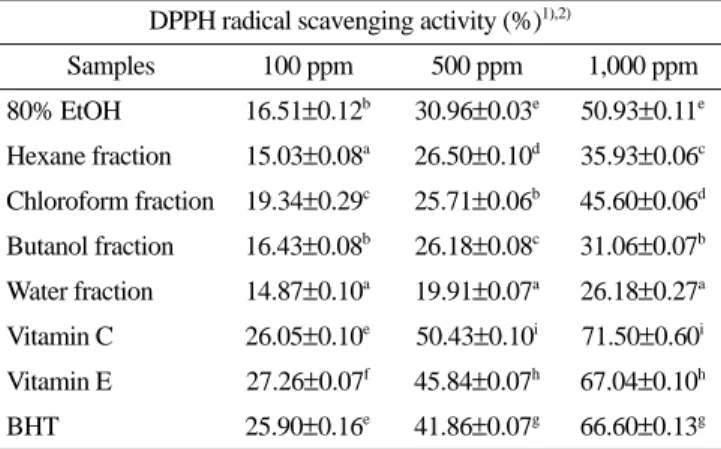
항산화제로써 ascorbic acid의 함량이 높은 과일, 채소류의 SOD 유사활성을 나타낸 연구(39)에서는 사과(14.6%), 브로콜리(41.7 %), 키위(27.6%), 딸기(30.2%) 등의 결과를 나타내어 올리브 잎 에탄올 추출물이 여러 종류의 천연산물과 유사하거나 더 높은 활 성도를 보여 항산화효과를 가진 천연물질로서의 이용이 가능하 다고 생각된다. SOD는 사람과 동물의 장기와 혈액 내에 존재하는 생리활성 효소로 유해 산소를 제거하는 역할을 하게 되며 SOD 유사활성 물질은 phytochemical에 속하는 물질이 SOD와 유사한 역할을 하 여 superoxide radical의 반응성을 억제하여 생체를 보호한다고 보 고되어 있다(40). 올리브 잎 분획물에서 페놀성 화합물에 의한 phyto-chemical 성분들의 영향으로 SOD 유사활성이 있음이 확인되었고 이러한 SOD 유사활성을 갖는 물질을 섭취하는 것은 생체내의 superoxide를 제거시킴으로써 노화억제와 산화를 예방할 수 있는 방법이라 할 수 있겠다(41). 올리브 잎 분획물의 DPPH radical 제거능 처리농도가 증가함에 따라 산지별 올리브 잎 분획물의 DPPH radical 제거활성이 3.25-63.32%로 증가함을 확인할 수 있었다(Table 5, Table 6). 스페인, 호주산 모두 비슷한 활성을 나타냈으며 이중 1,000 ppm 기준 호주산 80% 에탄올 올리브 잎의 추출물이 63.32% 로 가장 높은 활성을 나타냈으며 스페인산 역시 올리브 잎 80% 에탄올 추출물이 비교적 높은 활성(50.93%)을 나타냈다. 클로로포 름 분획물은 산지별로 41.93-45.60%의 radical 제거활성을 보여 올 리브 잎 80%에탄올 추출물 다음으로 높은 활성을 나타냈다. 식품에 항산화제로 사용하고 있는 비타민 C, 비타민 E, BHT의 DPPH radical 제거활성을 동일 조건에서 측정한 결과 올리브 잎 분획물보다 더 높은 활성을 나타냈지만 그 차이가 크지 않았다. Joaquin 등(42)이 발표한 결과에서는 올리브의 에탄올 추출물에서 의 DPPH radical 제거능력이 72.4% 수준이라고 보고하였으며 Ferrira은 87.1% 수준의 높은 DPPH radical 제거능력이 있다고 보고하였다. 비록 선행연구결과(42,43)보다 낮은 DPPH radical 제 거능력을 보였지만 본 실험의 올리브 잎 분획물의 DPPH radical 제거활성은 약용식물인 국내산 참당귀 43%(44), 연명초 60.0%(45) 의 radical 제거활성보다 유사하거나 더 높은 활성을 나타냈다. 항 암작용, 항산화작용 등 다양한 기능성이 있다고 보고된 10종의 식용버섯 및 약용버섯의 DPPH radical 제거활성을 나타낸 Kim 등 (46)의 연구에서는 표고버섯 19.9%, 차가버섯 44%, 꽃송이버섯 37.2%, 영지버섯 69.9%의 DPPH radical 제거활성을 나타냈다. 또 한 catechin 류에 의해 대표적인 항산화 물질로 알려진 녹차의 DPPH radical 제거활성이 50.56%로 보고되어(47) 올리브 잎 분획 물이 우리에게 잘 알려진 약용식물이나 항산화 효과로 알려진 녹 차에 비하여 뒤지지 않는다는 것을 확인 할 수 있었다. 세포가 성장하고 자라면서 발생되는 free radical에 의해 세포 가 산화되어 손상되는데 페놀성 화합물은 환원성이 강해서 free radical에 전자를 공여하여 산화를 억제하는 항산화 능력이 있다 고 알려져 있다(48,49). DPPH는 자체가 안정한 free radical을 지 니고 있는 화합물로 항산화물질에 의해 환원되어 항산화 능력을 확인하는데 널리 사용되는 물질이다. 위와 같은 결과로 올리브 잎 분획물에서도 free radical에 전자를 공여하여 산화를 억제하 는 능력이 있음이 확인되었으며 이는 올리브 잎의 페놀성 화합 물로 알려진 oleuropein, catechin, caffeic acid, vanillin, rutin,
hydroxytyrosol 등의 작용으로 판단된다.
Linoleic acid 자동산화억제활성
Linoleic acid는 동물체 내에서 인지질을 구성하거나 식물성 기
름에 존재하는 불포화지방산의 하나로 free radical에 의해 하이 드로퍼옥사이드(hydroperoxide)로 산화된다. Free radical은 DNA를 직접 손상시키기도 하지만 linoleic acid를 산화시켜 더욱 강력한 DNA 손상물질을 만들기도 하고 체내의 지방질과 쉽게 결합하여 제2의 산화를 유발하여 산화생성물들과 free radical을 연쇄적으로 생성 한다(50). 자동산화 과정은 두 개의 radical이 안정한 화합물 을 생성함으로써 반응이 종결되는 것인데 이 과정에서 free radical 에 전자를 공여하여 산화를 억제하게 하는 환원성이 강한 물질 을 필요로 하게 된다. 항산화제는 이러한 free radical을 제거하는 역할을 하게 되는데 주로 페놀성 화합물이 이러한 기능을 갖고 있으며(48,49) 올리브 잎의 주요 페놀성 화합물인 oleuropein과
hydroxytyrosol이 linoleic acid 자동산화를 억제 능력이 있다는 보
고가 있다(49).
Linoleic acid와 함께 시료를 처리하여 지질과산화를 억제하는
정도는 Fig. 6, 7과 같다. 호주산 올리브 잎 분획물은 시간 경과
Table 5. DPPH radical scavenging activity of olive leaf fractions raised in Australia
DPPH radical scavenging activity (%)1),2)
Samples 100 ppm 500 ppm 1,000 ppm 80% EtOH 26.34±0.10e 45.48±0.11f 63.32±0.07f Hexane fraction 12.15±0.03c 21.7±0.60b 45.21±0.06e Chloroform fraction 16.45±0.07d 27.61±0.44d 41.93±0.17d Butanol fraction 11.67±0.12b 26.19±0.06c 32.3 ±0.10a Water fraction 16.51±0.39d 26.21±0.03c 35.76±0.17c Vitamin C 26.05±0.10f 50.43±0.10h 71.50±0.60i Vitamin E 27.26±0.07g 45.84±0.07g 67.04±0.10h BHT 25.90±0.16f 41.86±0.07e 66.60±0.13g
1)All values are expressed as Mean±SD of triplicate determinations. 2)Means in the same column not sharing a common letter are significantly
different (p<0.05) by Student-Newman-Keuls Method.
Table 6. DPPH radical scavenging activity of olive leaf fractions raised in Spain
DPPH radical scavenging activity (%)1),2)
Samples 100 ppm 500 ppm 1,000 ppm 80% EtOH 16.51±0.12b 30.96±0.03e 50.93±0.11e Hexane fraction 15.03±0.08a 26.50±0.10d 35.93±0.06c Chloroform fraction 19.34±0.29c 25.71±0.06b 45.60±0.06d Butanol fraction 16.43±0.08b 26.18±0.08c 31.06±0.07b Water fraction 14.87±0.10a 19.91±0.07a 26.18±0.27a Vitamin C 26.05±0.10e 50.43±0.10i 71.50±0.60i Vitamin E 27.26±0.07f 45.84±0.07h 67.04±0.10h BHT 25.90±0.16e 41.86±0.07g 66.60±0.13g
1)All values are expressed as Mean±SD of triplicate determinations. 2)Means in the same column not sharing a common letter are significantly
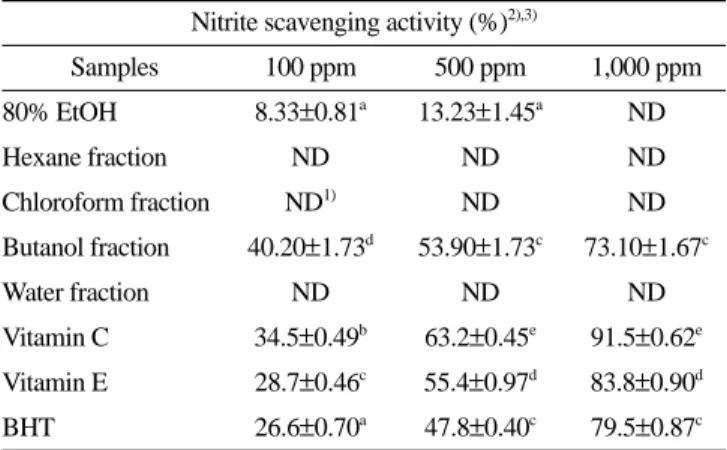
에 따라 농도 의존적으로 비교적 일정하게 산화억제활성이 나타 난 반면 스페인산 올리브 잎의 경우 몇몇 분획물에서 약하게 나 타냈을 뿐 산화억제활성은 거의 나타내지 않았다. 호주산 80% 에탄올 올리브 잎 추출물의 경우 시간 경과에 따 라 비타민 C, 비타민 E, BHT와 유사한 수준으로 항산화력을 나 타냈으며 클로로포름 분획물, 물 분획물의 순으로 산화억제활성 을 확인할 수 있었으며, 이는 역시 추출물 내에 존재하는 phenol 류의 작용으로 linoleic acid의 자동산화 억제활성을 보인 것이라 생각된다. 스페인산 올리브 잎의 올리브 잎 80% 에탄올 추출물 에서는 15시간 이후에 산화가 일어나기 시작하여 반응을 마친 24 시간되는 시점에서는 항산화력을 거의 나타내지 않았다. 아질산염 소거능력 평가 발암물질인 nitrosamine 생성의 원인물질인 nitrite 제거활성 결 과는 Table 7, 8과 같다. 올리브 잎 분획물의 아질산염 소거능력 은 농도 의존적으로 증가하는 경향을 보였다. 부탄올 분획물에서 nitrite 제거활성이 65.70, 73.10%로 높은 소거능을 나타났으며 헥 산과 물 분획물은 제거능력이 없거나 낮은 것으로 확인되었다. 가장 높은 활성을 보인 분획물은 88.20%로 호주산 올리브 잎의 클로로포름 분획물이었다. 스페인산 올리브 잎의 경우 부탄올 분 획물을 제외하고는 nitrite 제거능이 없거나 낮은 것으로 나타났 다. Lee 등(25)의 연구에서도 각 분획물의 농도가 증가할수록 nitrite 제거활성이 72.8%까지 뚜렷히 증가하는 경향을 보였으며 그 중 부탄올 분획물이 76.0% 수준의 높은 제거활성을 보였다. 또한 한약재로 쓰이는 약용식물 추출물의 아질산염 소거능을 살 펴본 연구(51, 52)에서는 동일 조건에서 당귀 35%, 목통 42%, 골 담초 33%, 찔레영지버섯 64%의 제거능을 나타냈다. 또한 노화질 환을 예방하고 항산화 능력이 있다고 알려진 솔잎 추출물(53)과 쑥 추출물(54)은 각각 77.85%, 37%의 아질산염 소거능을 나타냈 고, 항균효과와 항암효과가 있다고 알려진 대나무 에탄올 추출물 의 아질산염 소거능은 43.02%(55)로 본 실험에서 사용한 올리브 잎 분획물의 제거활성은 높은 수준의 활성을 보인 것이라 생각 된다. 식품 중에 함유되어 있는 nitrate 자체는 해롭지 않지만 nitrate reductase에 의해 아질산염으로 환원되면 독성을 가지게 된다. 아 질산염은 주로 육가공품에 사용되어 발색제나 보존제로 사용되
Fig. 6. Antioxidant effects of olive leaf fractions (concentration of 1,000 ppm) raised in Australia on the autoxidation rate of the linoleic acid store at 70o
C. O.E.f, olive extract fraction; H.f, hexane fraction; B.f, butanol fraction; C.f, chloroform fraction; W.f, water fraction; Vit.C, vitamin C; Vit.E, vitamin E; BHT, butylated hydroxytoluene. All values are expressed as Mean±SD of triplicate determinations.
Fig. 7. Antioxidant effects of olive leaf fractions (concentration of 1,000 ppm) raised in Spain on the autoxidation rate of the linoleic acid store at 70oC. O.E.f, olive extract fraction; H.f, hexane fraction; B.f, butanol fraction; C.f, chloroform fraction; W.f, water fraction; Vit.C, vitamin C; Vit.E, vitamin E; BHT, butylated hydroxytoluene. All values are expressed as Mean±SD of triplicate determinations.
Table 7. Nitrite scavenging activity of olive leaf fractions raised in Australia
Nitrite scavenging activity (%)2),3)
Samples 100 ppm 500 ppm 1,000 ppm 80% EtOH ND1) 15.20±0.87c 36.27±1.67a Hexane fraction ND 10.80±0.87b ND Chloroform fraction 15.20±0.87b 72.57±0.81h 88.20±0.00e Butanol fraction 3.90±1.73a 50.00±0.00e 65.70±0.87b Water fraction ND ND 37.73±2.24a Vitamin C 34.5±0.49b 63.2±0.45e 91.5±0.62e Vitamin E 28.7±0.46c 55.4±0.97d 83.8±0.90d BHT 26.6±0.70a 47.8±0.40c 79.5±0.87c 1)ND=Not detected
2)All values are expressed as Mean±SD of triplicate determinations. 3)Means in the same column not sharing a common letter are significantly
different (p<0.05) by Student-Newman-Keuls Method.
Table 8. Nitrite scavenging activity of olive leaf fractions raised in Spain
Nitrite scavenging activity (%)2),3)
Samples 100 ppm 500 ppm 1,000 ppm 80% EtOH 8.33±0.81a 13.23±1.45a ND Hexane fraction ND ND ND Chloroform fraction ND1) ND ND Butanol fraction 40.20±1.73d 53.90±1.73c 73.10±1.67c Water fraction ND ND ND Vitamin C 34.5±0.49b 63.2±0.45e 91.5±0.62e Vitamin E 28.7±0.46c 55.4±0.97d 83.8±0.90d BHT 26.6±0.70a 47.8±0.40c 79.5±0.87c 1)ND=Not detected
2)All values are expressed as Mean±SD of triplicate determinations. 3)Means in the same column not sharing a common letter are significantly
고 있으며 이것을 일정농도 이상 섭취 할 경우 식품 내에 존재 하는 amine류와 반응하여 발암물질인 nitrosamine을 생성하게 되 며(56) 이러한 반응을 억제(nitrite scavenger)하기 위해서는 전자 를 제공해주는 환원제가 필요하다(57). 식물의 뿌리나 잎에서 만 들어지는 모든 화학물질을 통틀어 일컫는 개념으로 식물 중에 존 재하는 성분들 중 인체에 유익한 생리활성을 가진 성분들을 phytochemical이라 한다. 이러한 phytochemical 중 플라보노이드나
페놀성 화합물은 radical acceptor로서 좋은 conjugated double
bond 구조로 환원성이 강해 free radical에 전자를 공여하여(58) nitrite scavenger 역할을 하게 된다(59). 발암 전단계의 억제작용을 측정할 수 있는 척도로서 아질산염 소거능력을 측정하였으며 올리브 잎 분획물은 free radical에 전 자를 공여하여 발암물질인 nitrosamine을 억제할 수 있는 가능성 이 있는 것으로 여겨진다. 본 실험에서는 사람 위 속의 pH와 유 사한 조건인 pH 1.2에서 실행하여 아질산염 소거능력이 높은 것 으로 나타나 올리브 잎 분획물이 생체 내에서 nitrosamine의 생 성을 효과적으로 억제할 수 있을 것이라 생각된다.
요
약
본 연구에서는 호주산과 스페인산 올리브 잎의 이화학적 특성 중 총 플라보노이드 함량, 총 페놀 함량, 항산화기능과 아질산염 소거능력을 측정하였다. 총 플라보노이드 함량은 호주산과 스페 인산 모두 올리브 잎 80% 에탄올 추출물에서 각각 22.7, 23.9% 으로 가장 높았으며 전체적으로는 물 분획물(1.5% 내외)이 상대 적으로 낮았다. 총 페놀 함량의 경우도 부탄올 분획물(18% 내외) 이 가장 높았으며 올리브 잎 80% 에탄올 추출물과 물 분획물 순 으로 유의적으로 높은 페놀함량을 나타냈다. SOD 유사활성능은 0-36.08%의 범위이었으며 모든 추출물 및 분획물에서 농도가 높 아짐에 따라 활성도가 증가하였고 올리브 잎 80% 에탄올 추출 물이 36.08%로 활성이 가장 높았다. DPPH radical 제거활성은 호 주산 올리브 잎의 80% 에탄올 추출물이 63.32%로 가장 높은 활 성을 나타냈다. Linoleic acid와 함께 시료를 처리하여 지질과산 화를 억제하는 정도는 호주산 올리브 잎 분획물은 시간 경과에 따라 농도 의존적으로 비교적 일정하게 산화억제활성이 나타난 반면 스페인산 올리브 잎의 경우 몇몇 분획물에서 약한 산화억 제활성을 나타냈을 뿐 산화억제활성을 거의 나타내지 않았다. 발 암물질인 nitrosamine 생성의 원인물질인 nitrite 제거활성을 확인 한 결과 농도 의존적으로 증가하는 경향을 나타냈다. 부탄올 분 획물은 nitrite 제거활성이 65.70, 73.10%로 높은 소거능을 보였으 며 헥산과 물 분획물은 제거능력이 없거나 낮은 것으로 나타났다.문
헌
1. Gucci R, Lombardini L, Tattini M. Analysis of leaf water rela-tions in leaves of two olive (Olea europea) cultivars differing in tolerance to salinity. Tree Physiol. 17: 13-21 (1997)
2. Pertinez MD, Cabrera AG, Garrido A. Predicting the nutritive value of the olive leaf (Olea europaea): Digestibility and chemi-cal composition and in vitro studies. Anim. Feed Sci. Technol. 87: 187-201 (2000)
3. Fernandez-Escobar R, Moreno R, Garcia-Creus M. Seasonal changes of mineral nutrients in olive leaves during the alternate-bearing cycle. Sci. Hortic-Amsterdam 82: 25-45 (1999)
4. Ryan D, Prenzler PD, Lavee S, Antolovich M, Robards K. Quan-titative changes in phenolic content during physiological develop-ment of the olive (Olea europea) cultivar Hardy's Mammonth. J. Agr. Food Chem. 51: 2532-2538 (2003)
5. Campeol E, Flamini G, Cioni PL, Morelli I, Cremonini R, Cec-carni L. Volatile fractions from three cultivars of Olea europea L. collected in two different seasons. J. Agr. Food Chem. 51: 1994-1999 (2003)
6. Flamini G, Cioni PL, Morelli I. Volatiles from leaves, fruit, and virgin oil from Olea europea. J. Agr. Food Chem. 51: 1382-1386 (2003)
7. Garcia-Gomez A, Roig A, Bernal MP. Composting of the solid fraction of olive mill wastewater with olive leaves: Organic mat-ter degradation and biological activity. Bioresource Technol. 86: 59-64 (2003)
8. Ryan D, Antolovich M, Prenzler P, Robards K, Lavee S. Biotransfomations of phenolic compounds in Olea europaea L. Sci. Hortic-Amsterdam 92: 147-176 (2002)
9. Bianco A, Uccella N. Biophenolic components of olives. Food Res. Int. 33: 475-485 (2000)
10. Tasioula-Margari M, Ologeri O. Isolation and characterization of virgin olive oil phenolic components by HPLC/UV and GC/ MS. J. Food Sci. 66: 530-534 (2001)
11. Silva S, Gomes L, Leitao F, Coelho AV, Vilas Boas L. Phenolic compounds and Antioxidant Activity of Olea europaea L. Fruits and Leaves. Food Sci. Technol. Int. 12: 385-395 (2006)
12. Nino AD, Lombardo N, Perri E, Procopio A, Sindora G. Direct identification of phenolic glucosides from olive leaf extracts by atmospheric pressure ionization tandemmass spectrometry. J. Mass Spectrom. 32: 533-541 (1997)
13. Visioli F, Poli A, Galli C. Antioxidant and other biological activi-ties of phenols from olives and olive oil. Med. Res. Rev. 22: 65-75 (2002)
14. Del-Rio JA, Baidez AG, Botia JM, Ortuno A. Enhancement of phenolic compounds in olive plants and their influence on resis-tance against Phytophthora sp. Food Chem. 83: 75-78 (2003) 15. Furneri PM, Marino A, Saija A, Uccella N, Bisignano G. In vitro
antimycoplasmal activity of oleuropein. Int. J. Antimicrob. Ag. 20: 293-296 (2002)
16. Raffaella B, Patumi M. Olea europea L. Leaf Extract and Deriva-tives: Antioxidant Properties. J. Agr. Food Chem. 50: 4934-4940 (2002)
17. Micol V, Caturla N, Pérez-Fons L, Más V, Pérez L, Nucci R. Estepa A. The olive leaf extract exhibits antiviral activity against viral haemorrhagic septicaemia rhabdovirus (VHSV). Antivir. Res. 66: 129-136 (2005)
18. Briante R, Cara FL, Tonziello MP, Febbraio F. Antioxidant activ-ity of the main bioactive derivatives from oleuropein hydrolysis by hyperthermophilic - glycosidase. J. Agr. Food Chem. 49: 3198-3203 (2001)
19. Hamdi HK, Castellon R. Oleuropein, a non-toxic olive iridoid, is an anti-tumor agent and cytoskelecton disruptor. Biochem. Bioph. Res. co. 334: 769-778 (2005)
20. Fitó M, Cladellas M, Torre R, Martí J, Alcántara M, Bastardes MP, Marrugat J, Bruguera J, López-Sabater MC, Vila J. Covas MI. Antioxidant effect of virgin olive oil in patients with stable coronary heart disease: A randomized, crossover, controlled, clini-cal trial. Atherosclerosis 181: 149-158 (2005)
21. Perona JS, Gutierrez VR. Triacylglycerol molecular species are depleted to different extents in the myocardium of spontaneously hypertensive rats fed two oleic acidrich oils. Am. J. Hypertens. 18: 72-80 (2005)
22. Medeiros FJ, Mothé CG, Aguila MB, Lacerda CAM. Long-term intake of edible oils benefits blood pressure and myocardial struc-ture in spontaneously hypertensive rat (SHR) and streptozotocin diabetic SHR. Prostag. Oth. Lipid M. 78: 231-248 (2005)
23. Al-Azzawie HF, Alhamdani MSS. Hypoglycemic and antioxidant effect of oleuropein in alloxan-diabetic rabbits. Life Sci. 78: 1371-1377 (2006)
24. Bennani-Kabchi N, Chraibi A, Benaich S, Marquie G. The effect of consumption of olive oil on a group of moroccan dislipidemic non insulino-dependent diabetics. Pharmacol. Res. 31: 228 (1995) 25. Lee OH, Lee HB, Son JY. Antimicrobial Activities and
Nitrite-scavenging Ability of Olive Leaf Fracrions. Korean J. Soc. Food Cook. Sci. 20: 204-210 (2004)
donating ability of phenolic compounds. Korean J. Food Sci. Technol. 28: 232-239 (1996)
27. Teresa-Sartue M, Huang SW, Frankel EN. Effect of natural anti-oxidants in virgin olive oil on oxidative stability of refined, bleached and deodorizied olive oil. J. Am. Oil Chem. Soc. 72: 1131-1137 (1995)
28. Marklund S, Marklund G. Involvement of superoxide anion radi-cal in the oxidation of pyrogallol and a convenient assay for superoxide dismutase. Eur. J. Biochem. 47: 468-474 (1975) 29. Chu YH, Chang CL, Hsu HF. Flavonoid content of several
vege-tables and their antioxidant activity. J. Sci. Food Agr. 80: 561-566 (2000)
30. Kiharu I, Miho I, Toshimi H. Major antioxidative substances in leaves of Satsumi-kabu. Agric. Biol. Chem. 54: 1053-1055 (1990) 31. Gray JI, Dugan JRL. Inhibition of N-nitrosamine formation in
model food system. J. Food Sci. 40: 981-985 (1975)
32. Tang FY, Chiang EPI, Shih CJ. Green tea catechin inhibits eph-rin-A1-mediated cell migration and angiogenesis of human umbil-ical vein endothelial cells. J. Nutr. Biochem. 18: 391-399 (2007) 33. Ozyurt H, Ozyurt B, Koca K. Caffeic acid phenethyl ester
pro-tects rat skeletal muscle against ischemia reperfusion induced oxi-dative stress. Vasc. Pharmacol. 10: 1016-1035 (2007)
34. Rupasinghe HPV, Bitzer JB, Ahn T, Odumeru JA. Vanillin inhib-its pathogenic and spolage microorganisms in vitro and aerobic microbial growth in fresh-cut apples. Food Res. Int. 39: 575-580 (2006)
35. Guo R, Wei P, Liu W. Combined antioxidant effects of rutin and Vitamin C in Triton X-100 micelles. J. Pharmaceut. Biomed. 43: 1580-1586 (2007)
36. Lim JD, Yu CY, Kim MJ, Yun SJ, Lee SJ, Kim N, Chung IM. Comparison of SOD activity and phenolic compound contents in various Korean medicinal plant. Korean J. Med. Crop Sci. 12: 191-202 (2004)
37. Lee YS, Joo EY, Kim NW. Antioxidant activity of extracts from the Lespedeza bicolor. Korean J. Food Preserv. 12: 75-79 (2005) 38. Corpas Fr, Fernández-Ocaña A, Carreras A, Valderrama R,
Fran-cisco Luque, FranFran-cisco J. Esteban, María Rodriquez-Serrano, Mounira Chaki, Pedrajas JR, Sandalio LM, del Río LA, Barroso JB. The expression of different superoxide dismutase forms is cell-type dependent in olive (Olea europaea L.) leaves. Plant Cell Physiol. 47: 984-994 (2006)
39. Hong HD, Kang NK, Kim SS. Superoxide dismutase-like activity of apple juice mixed with some fruits and vegetables. Korean J. Food Sci. Technol. 30: 1484-1487 (1998)
40. Murakami A, Takahashi D, Koshimizu K, Ohigashi H. Synergis-tic suppression of superoxide and nitric oxide generation from inflammatory cells by combined food factors. Mutat. Res. 523-524: 151-161 (2003)
41. Kitani K, Minami C, Yamamoto T, Kanai S, Ivy GO, Carrillo MC. Pharmacological interventions in aging and age-associated disorders: potentials of Propargylamines for human use. Ann. NY. Acad. Sci. 959: 259-307 (2002)
42. Altarejos J, Salido S, Pérez-Bonilla M, Linares-Palomino PJ, Teris A. van Beek, Manuel N, Adolfo S. Preliminary assay on the radical scavenging activity of olive wood extracts. Fitoterapia 76: 348-351 (2005)
43. Ferrira ICER, Barros L, Soares HE, Bastos HL, Pereira JA. Anti-oxidant activity and phenolic contents of Olea europaea L.
Leaves sprayed with different copper formulations. Food Chem. 103: 188-195 (2007)
44. Kang SA, Oh MS, Kim DR, Kang JU, Kim WN, Chang MS, Park SK. Compositions of Astragali radix and Angelicae radix by DPPH radical scavenging activity. Korean. J. Herbol. 21: 17-24 (2006)
45. An BJ, Park JM, Bae HJ, Pyun JR, Song MA. Antioxidant and antibacterial effect of Korean Isodon japonicus H. J. Korean Soc. Appl. Biol. Chem. 49: 129-134 (2006)
46. Kim MY, Ahn JK, Jung WS, Chung IM. Comparision of the SOD and DPPH activity, L-amino acid contents on edible mush-rooms and medicinal mushmush-rooms. Korean J. Med. Crop Sci. 51: 330-331 (2006)
47. Hassan O, Fan LS. The anti-oxidation potential of polyphenol extract from cocoa leaves on mechenically deboned chicken meat (MDCM). LWT-Food Sci. Technol. 38: 315-321 (2005)
48. Sanchez CS, Gonzalez AMT, Garcia-Parrilla MC, Granados JJQ, Serrana HLG, Martinez MCL. Different radical scavenging tests in virgin olive oil and their relation to the total phenol content. Anal. Chim. Acta. 593: 103-107 (2007)
49. Saija A, Trombetta D, Tomaino A, Cascio RL, Princi P, Uccella N, Bonina F, Castelli F. 'In vitro' evaluation of the antioxidant activity and biomembrane interaction of the plant phenols oleu-ropein and hydroxytyrosol. Int. J. Pharm. 166: 123-133 (1998) 50. Kok TMCM, Zwingman I, Moonen EJ, Schilderman PAEL,
Rhijnsburger E, Haenen GRMM, Kleinjans JCS. Analysis of oxi-dative DNA damage after human dietary supplementation with linoleic acid. Food Chem. Toxicol. 41: 351-358 (2003)
51. Park CS. Antioxidative and nitrite scavenging abilities of medicinal plant extracts. Korean J. Food Preserv. 12: 631-636 (2005) 52. Song JH, Lee HS, Hwang JK, Chung TY, Honh SR, Park KM.
Physiological activities of Phellinus ribis extracts. Korean J. Food Sci. Technol. 35: 690-695 (2003)
53. Hong TG, Lee YR, Hyun CN, Yim MH. Physiological function-ality and nitrite scavenging ability of fermentation extracts from pine neddles. Korean J. Food Preserv. 11: 94-99 (2004)
54. Park CS, Kwon CJ, Choi MA, Park GS, Choi KH. Antioxidative activity and nitrite scavenging ability of mugwort and pine neddle extracts. Korean J. Food Preserv. 9: 248-252 (2002)
55. Lim JA, Na YS, Baek SH. Antioxidative activity and nitrite scav-enging ability of ethanol extract from phyllostachys bambusoides. Korean J. Food Sci. Technol. 36: 306-310 (2004)
56. Jakszyn P, Gonzalez CA. Nitrosamine and related food intake and gastric and oesophageal cancer risk: A systematic review of the epidemiological evidence. World J. Gastroentero. 12: 4296-4303 (2006) 57. Choi SY, Chung MJ, Lee SJ, Shin JH, Sung NJ. N-nitrosamine
inhibition by strawberry, garlic, kale, and the effects of nitrite-scavenging and N-nitrosamine formation by functional compounds in strawberry and garlic. Food Control 18: 485-491 (2007)
58. Issa AY, Volate SR, Wargovich MJ. The role of phytochemicals in inhibition of cancer and inflammation new directions and per-spectives. J. Food Compos. Anal. 19: 405-419 (2006)
59. Andreadou I, Sigala F, Iliodromitis EK, Papaefthimiou M, Sigala C, Aligiannis N, Savvari P, Gorgoulis V, Papalabros E, Kremasti-nos D. Acute doxorubicin cardiotoxicity is successfully treated with the phytochemical oleuropein through suppression of oxida-tive and nitrosaoxida-tive stress. J. Mol. Cell. Cardiol. 42: 549-558 (2007)