© 2017 The Korean Academy of Medical Sciences.
This is an Open Access article distributed under the terms of the Creative Commons Attribution Non-Commercial License (http://creativecommons.org/licenses/by-nc/4.0) which permits unrestricted non-commercial use, distribution, and reproduction in any medium, provided the original work is properly cited.
pISSN 1011-8934 eISSN 1598-6357
Chronological Trends in Clinical and Urinary Metabolic Features over 20 Years in Korean Urolithiasis Patients
Urolithiasis is common and is becoming more prevalent worldwide. This study assessed the chronological trends in clinical and urinary metabolic features over 20 years in Korean urolithiasis patients. We performed a retrospective analysis of 4,076 patients treated at our clinic from 1996 to 2015. Urinary metabolic data and stone analysis data were available for 1,421 and 723 patients (34.9% and 17.7%), respectively. Patients were categorized into 4 groups according to the date of initial diagnosis: group 1 (1996–2000, n = 897), group 2 (2001–2005, n = 1,018), group 3 (2006–2010, n = 1,043), and group 4 (2011–2015, n = 1,118). Incidental detection of uric acid renal stones has become more prevalent in the past 10 years, accompanied by an increase in body mass index and age at diagnosis.
Similarly, the prevalence of diabetes mellitus and of hypertension increased from one group to the next throughout the study period. Levels of 24-hour urinary excretion of sodium, calcium, uric acid, and oxalate have decreased significantly over the study period.
The incidence of urinary metabolic abnormalities also showed an identical tendency. The proportion of stones composed of uric acid increased over the study period. In conclusion, incidental detection of uric acid renal stones has become more prevalent in Korea in the past 20 years. Urinary excretion of lithogenic constituents and the incidence of urinary metabolic abnormalities have decreased significantly over this period.
Keywords: Urolithiasis; Risk Factor; Stone Analysis; Uric Acid Ho Won Kang,1,2 Sung Pil Seo,1,2
Yun-Sok Ha,3 Won Tae Kim,1,2 Yong-June Kim,1,2 Seok Joong Yun,1,2 Wun-Jae Kim,1,2 and Sang-Cheol Lee1,2
1Department of Urology, College of Medicine, Chungbuk National University, Cheongju, Korea;
2Department of Urology, Chungbuk National University Hospital, Cheongju, Korea; 3Department of Urology, School of Medicine, Kyungpook National University, Daegu, Korea
Received: 27 March 2017 Accepted: 28 May 2017 Address for Correspondence:
Sang-Cheol Lee, MD, PhD
Department of Urology, College of Medicine, Chungbuk National University, 1 Chungdae-ro, Seowon-gu, Cheongju 28644, Republic of Korea
E-mail: [email protected]
Funding: This research was supported by Basic Science Research Program through the National Research Foundation of Korea(NRF) funded by the Ministry of Science, ICT & Future Planning (No. NRF-2015R1A2A2A03004100) and by the International Science and Business Belt Program through the Ministry of Science, ICT and Future Planning (2016K000297).
https://doi.org/10.3346/jkms.2017.32.9.1496 • J Korean Med Sci 2017; 32: 1496-1501
INTRODUCTION
The prevalence of urolithiasis varies between 2% and 20% world- wide, and seems to depend on the geographic location and so- cioeconomic characteristics of different populations (1,2). The incidence of urolithiasis in Korea has progressively increased, as has the incidence in other developed countries (3-5). De- spite the complexity of the etiology of urolithiasis, intrinsic and environmental factors contribute to increased urolithiasis, and improvements in diagnostic procedures increase observation of these stones. ‘Westernization’ of diets and sedentary lifestyles are factors that contribute to obesity and the metabolic syndrome (6-8). Obesity increases urinary excretion of metabolites that promote crystallization and urine acidity, and it contributes to an increase in calcium oxalate lithogenesis (9). Both hyperten- sion and diabetes mellitus are also associated with significant changes in urinary chemistry, which affect the crystallization of various stone-forming salts (10). Epidemiological data suggest that a link exists between hyperlipidemia and urine metabolic profiles and stone composition (11). Thus, we hypothesized that urinary composition and lithogenic risk in patients with uroli- thiasis might have changed over time along with these clinico-
pathological variables. Understanding these chronological trends is important to enable the development of appropriate public- health strategies for stone prevention. We therefore determined the levels of urinary lithogenic risk in patients attending our clinic over the past 20 years. To our knowledge, only one previ- ous study has evaluated the long-term trends of urinary litho- genic risk in patients with urolithiasis in Korea; this study by Kim et al. (12) involved a retrospective analysis of metabolic as- sessments in 619 patients with calcium stone former over a pe- riod of 14 years.
The present study was designed to assess the chronological trends of clinical and metabolic features over 20 years in Korean patients with urolithiasis. Patients were categorized into 4 groups according to the date of the initial diagnosis, and measurements of clinicometabolic characteristics and stone composition were compared.
MATERIALS AND METHODS Study population
The study involved a retrospective analysis of 4,076 consecutive patients with a first-time stone episode, who were diagnosed ORIGINAL ARTICLE
Urology
1 / 1 CROSSMARK_logo_3_Test
2017-03-16 https://crossmark-cdn.crossref.org/widget/v2.0/logos/CROSSMARK_Color_square.svg
http://jkms.org 1497
https://doi.org/10.3346/jkms.2017.32.9.1496
and treated between 1996 and 2015 at our institution. Data were collected on stone history, body mass index (BMI), metabolic evaluation (including serum and 24-hour urine chemistry), and radiographic imaging of the urinary tract. Urinary stone forma- tion was diagnosed by radiological modalities such as abdomi- nal radiography, ultrasonography, and noncontrast computer- ized tomography. Exclusion criteria consisted of any of the fol- lowing factors: urinary bladder stone, urethral stone, or stag- horn calculi; pediatric patients (younger than 16 years); incom- plete 24-hour urine collection (creatinine < 17 mg/kg per 24 hours in men and < 13 mg/kg per 24 hours in women); impaired renal function or the presence of a single kidney; urological mal- formation; urinary tract obstruction; or metabolic disease that could affect calcium and bone metabolism.
Measurement and definition of parameters
Urinary metabolic data were available in 1,421 patients (34.9%
of the total cohort), and stone analysis data were available in 723 patients (17.7% of the total cohort). Medications that could affect serum and 24-hour urine chemistry results were discon- tinued at least 2 weeks before complete metabolic evaluation.
The metabolic evaluation was performed at least 4 weeks after completion of stone management. Urinary metabolic abnor- malities were classified by using the definitions of Lifshitz et al.
(13) and Norman (14). Specific metabolic evaluation was indi- cated in high-risk stone formers including early onset of uroli- thiasis, familial stone formation, uric acid or brushite-contain- ing stones, solitary kidney, anatomical abnormalities, and met- abolic disease that could affect calcium and bone metabolism according to guidelines (1,14). In addition, metabolic evalua- tion was also performed even first stone formers without above stone forming risk. In this cases, the decision to perform the metabolic evaluation was made entirely by the patients. Stone
samples were sent for analysis of composition by Fourier-trans- form infrared spectrometry (Green Cross, Yongin, Korea).
Statistical analysis
Patients were categorized into 4 groups according to the date of initial diagnosis, as shown in Table 1. Differences in urine vari- ables between groups were assessed by the Kruskal-Wallis test.
Categorical variables were compared by χ2 test or Fisher’s exact test if appropriate. All statistical analyses were performed using SPSS ver. 21.0 software (IBM, Armonk, NY, USA). All tests were performed with 2-tailed analyses and P < 0.05 was considered statistically significant.
Ethics statement
The study was carried out in agreement with the applicable laws and regulations, good clinical practices, and ethical principles as described in the Declaration of Helsinki. The Institutional Review Board of Chungbuk National University approved this study protocol (Approval number: 2011-04-004). Informed con- sent was waived by the board.
RESULTS
Chronological trends in clinical features over the study period of 20 years
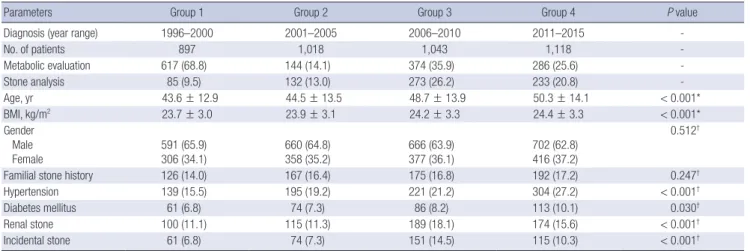
Patient demographics of the study population (n = 4,076) are detailed in Table 1. Statistical analysis indicated significant dif- ferences between the means of BMI and age in the different groups, and both sets of values increased as time progressed.
Similarly, the prevalence of diabetes mellitus and of hyperten- sion increased from one group to the next throughout the study period. The male:female ratio and prevalence of family history of urolithiasis did not differ between the groups. The prevalence
Table 1. Chronological trends of clinical features of patients with urolithiasis diagnosed over 20 years
Parameters Group 1 Group 2 Group 3 Group 4 P value
Diagnosis (year range) 1996–2000 2001–2005 2006–2010 2011–2015 -
No. of patients 897 1,018 1,043 1,118 -
Metabolic evaluation 617 (68.8) 144 (14.1) 374 (35.9) 286 (25.6) -
Stone analysis 85 (9.5) 132 (13.0) 273 (26.2) 233 (20.8) -
Age, yr 43.6 ± 12.9 44.5 ± 13.5 48.7 ± 13.9 50.3 ± 14.1 < 0.001*
BMI, kg/m2 23.7 ± 3.0 23.9 ± 3.1 24.2 ± 3.3 24.4 ± 3.3 < 0.001*
Gender Male Female
591 (65.9) 306 (34.1)
660 (64.8) 358 (35.2)
666 (63.9) 377 (36.1)
702 (62.8) 416 (37.2)
0.512†
Familial stone history 126 (14.0) 167 (16.4) 175 (16.8) 192 (17.2) 0.247†
Hypertension 139 (15.5) 195 (19.2) 221 (21.2) 304 (27.2) < 0.001†
Diabetes mellitus 61 (6.8) 74 (7.3) 86 (8.2) 113 (10.1) 0.030†
Renal stone 100 (11.1) 115 (11.3) 189 (18.1) 174 (15.6) < 0.001†
Incidental stone 61 (6.8) 74 (7.3) 151 (14.5) 115 (10.3) < 0.001†
Continuous data are shown as the mean ± SD or number (%) of patients.
BMI = body mass index, SD = standard deviation.
*P values were obtained from Kruskal-Wallis tests; †P values were obtained from Fisher’s exact tests.
Kang HW, et al. • Chronological Trends in Korean Urolithiasis Patients
1498 http://jkms.org https://doi.org/10.3346/jkms.2017.32.9.1496 Fig. 1. Annual levels of urinary stone-forming constituents in patients with urolithiasis over 20 years. Mean 24-hour urinary excretion of calcium (A), sodium (B), uric acid (C), oxalate (D), and citrate (E) (error bars represent 95% CIs) and the incidence of urinary metabolic abnormalities, hypercaliuria (F), hypernatriuria (G), hyperuricosuria (H), hyper- oxaluria (I), and hypocitraturia (J).
CI = confidence interval. (Continued to the next page)
(A)
(B)
(C)
(D)
(E)
(F)
(G)
(H)
(I)
(J)
24 hr urinary Calcium (mg/day)
Initial diagnosis (year)
19961997199819992000200120022003200420052006200720082009201020112012201320142015 400
350
300
250
200
150
100
(A)
(B)
(C)
(D)
(E)
(F)
(G)
(H)
(I)
(J)
Hypercaliuria (%)
Initial diagnosis (year)
19961997199819992000200120022003200420052006200720082009201020112012201320142015 50
40
30
20
10
0
(A)
(B)
(C)
(D)
(F)
(G)
(H)
(I)
Hyperuricosuria (%)
Initial diagnosis (year)
19961997199819992000200120022003200420052006200720082009201020112012201320142015 60
50
40
30
20
10
0
(A)
(B)
(C)
(D)
(F)
(G)
(H)
(I)
Hypernatriuria (%)
Initial diagnosis (year)
19961997199819992000200120022003200420052006200720082009201020112012201320142015 70
60
50
40
30
20
10
0
(A)
(B)
(C)
(D)
(F)
(G)
(H)
(I)
24 hr urinary Oxalate (mg/day)
Initial diagnosis (year)
19961997199819992000200120022003200420052006200720082009201020112012201320142015 100
90 80 70 60 50 40 30 20 10
(A)
(B)
(C)
(D)
(F)
(G)
(H)
(I)
24 hr urinary Sodium (mg/day)
Initial diagnosis (year)
19961997199819992000200120022003200420052006200720082009201020112012201320142015 300
280 260 240 220 200 180 160 140 120
(A)
(B)
(C)
(D)
(F)
(G)
(H)
(I)
24 hr urinary Uric acid (mg/day)
Initial diagnosis (year)
19961997199819992000200120022003200420052006200720082009201020112012201320142015 850
800 750 700 650 600 550 500 450 400
(A)
(B)
(C)
(D)
(F)
(G)
(H)
(I)
Hyperoxaluria (%)
Initial diagnosis (year)
19961997199819992000200120022003200420052006200720082009201020112012201320142015 70
60 50 40 30
20 10 0
A F
B G
H
I C
D
Kang HW, et al. • Chronological Trends in Korean Urolithiasis Patients
http://jkms.org 1499
https://doi.org/10.3346/jkms.2017.32.9.1496
of renal stones and incidental stones showed overall increases from the first to the last time period.
Chronological trends in urinary metabolic features over the study period of 20 years
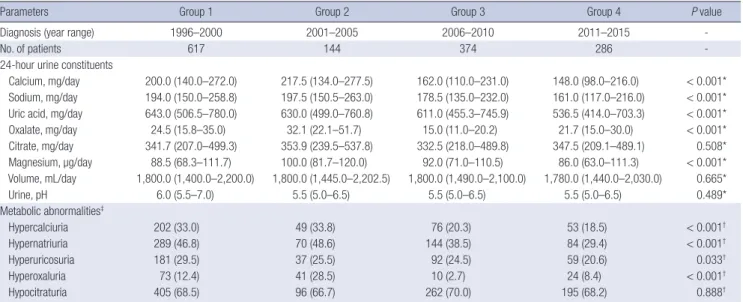
Urinary metabolic profile data and the prevalence of urinary metabolic abnormalities for patients in each year of the study period are shown in Fig. 1, and for patients in each 5-year peri- od are shown in Table 2. Differences between mean values of 24-hour urine constituents, or between proportions of patients with metabolic abnormalities, across the 4 groups were deter- mined by statistical analyses. Significant differences were seen in 24-hour urinary excretion of sodium, calcium, uric acid, mag- nesium, and oxalate between the groups, which corresponded
to observations of reduced excretion across the study period.
Similar patterns of decreased prevalence of the urinary meta- bolic abnormalities hypernatriuria, hyperuricosuria, hypercal- ciuria, and hyperoxaluria were also observed. By contrast, 24- hour urinary citrate excretion, urine volume and pH did not differ between the groups (all P > 0.05).
Chronological trends in stone composition over the study period of 20 years
Analysis of stone composition was available for 723 patients (17.7% of the total cohort). The proportions of calcium oxalate and calcium phosphate stones decreased, whereas the propor- tion of uric acid stones increased with time (P = 0.015) (Table 3).
Fig. 1. Continued.
(B)
(C)
(D)
(E)
(G)
(H)
(I)
(J) (B)
(C)
(D)
(E)
(G)
(H)
(I)
(J)
24 hr urinary Citrate (mg/day)
Initial diagnosis (year)
19961997199819992000200120022003200420052006200720082009201020112012201320142015 900
800 700
600 500 400
300 200
Hypocitraturia (%)
Initial diagnosis (year)
19961997199819992000200120022003200420052006200720082009201020112012201320142015 100
80
60
40
20
0
E J
Table 2. Chronological trends in urinary metabolic features (24-hour urine constituents and 24-hour urine metabolic abnormalities) of urolithiasis patients diagnosed over 20 years
Parameters Group 1 Group 2 Group 3 Group 4 P value
Diagnosis (year range) 1996–2000 2001–2005 2006–2010 2011–2015 -
No. of patients 617 144 374 286 -
24-hour urine constituents
Calcium, mg/day 200.0 (140.0–272.0) 217.5 (134.0–277.5) 162.0 (110.0–231.0) 148.0 (98.0–216.0) < 0.001*
Sodium, mg/day 194.0 (150.0–258.8) 197.5 (150.5–263.0) 178.5 (135.0–232.0) 161.0 (117.0–216.0) < 0.001*
Uric acid, mg/day 643.0 (506.5–780.0) 630.0 (499.0–760.8) 611.0 (455.3–745.9) 536.5 (414.0–703.3) < 0.001*
Oxalate, mg/day 24.5 (15.8–35.0) 32.1 (22.1–51.7) 15.0 (11.0–20.2) 21.7 (15.0–30.0) < 0.001*
Citrate, mg/day 341.7 (207.0–499.3) 353.9 (239.5–537.8) 332.5 (218.0–489.8) 347.5 (209.1–489.1) 0.508*
Magnesium, µg/day 88.5 (68.3–111.7) 100.0 (81.7–120.0) 92.0 (71.0–110.5) 86.0 (63.0–111.3) < 0.001*
Volume, mL/day 1,800.0 (1,400.0–2,200.0) 1,800.0 (1,445.0–2,202.5) 1,800.0 (1,490.0–2,100.0) 1,780.0 (1,440.0–2,030.0) 0.665*
Urine, pH 6.0 (5.5–7.0) 5.5 (5.0–6.5) 5.5 (5.0–6.5) 5.5 (5.0–6.5) 0.489*
Metabolic abnormalities‡
Hypercalciuria 202 (33.0) 49 (33.8) 76 (20.3) 53 (18.5) < 0.001†
Hypernatriuria 289 (46.8) 70 (48.6) 144 (38.5) 84 (29.4) < 0.001†
Hyperuricosuria 181 (29.5) 37 (25.5) 92 (24.5) 59 (20.6) 0.033†
Hyperoxaluria 73 (12.4) 41 (28.5) 10 (2.7) 24 (8.4) < 0.001†
Hypocitraturia 405 (68.5) 96 (66.7) 262 (70.0) 195 (68.2) 0.888†
The data are shown as median (IQR) or number (%) of patients.
IQR = interquartile range.
*P values were obtained from Kruskal-Wallis tests; †P values were obtained from Fisher’s exact tests; ‡Hypercalciuria was defined as excretion of ≥ 300 mg/day in men and
≥ 250 mg/day in women, hypernatriuria was defined as excretion of ≥ 200 mg/day, hyperuricosuria was defined as excretion of ≥ 800 mg in men and ≥ 750 mg in women, hyperoxaluria was defined as excretion of ≥ 45 mg/day, hypocitraturia was defined as excretion of < 450 mg/day. Analysis of 24-hour urine constituents was available for 1,421 patients (34.9% of the total cohort).
Kang HW, et al. • Chronological Trends in Korean Urolithiasis Patients
1500 http://jkms.org https://doi.org/10.3346/jkms.2017.32.9.1496 Table 3. Chronological trends of stone composition in patients with urolithiasis diag-
nosed over 20 years
Parameters Group 1 Group 2 Group 3 Group 4
Diagnosis (year range) 1996–2000 2001–2005 2006–2010 2011–2015
No. of patients 85 132 273 233
Stone composition
Calcium oxalate 75 (87.2) 102 (76.7) 210 (76.9) 161 (69.4) Uric acid 4 (4.7) 17 (12.8) 47 (17.2) 51 (22.0) Calcium phosphate 7 (8.1) 12 (9.0) 12 (4.4) 16 (6.9) Mixed stone or etc. 0 (0.0) 2 (1.5) 4 (1.5) 4 (1.7) Values are presented as number (%) of patients. P values were obtained from Fisher’s exact tests (P = 0.015), Analysis of stone composition was available for 723 patients (17.7% of the total cohort).
DISCUSSION
The present study assessed the chronological trends in clinical and metabolic features in Korean urolithiasis patients over a pe- riod of 20 years. In summary, BMI and age at diagnosis increas- ed, whereas urinary excretion of lithogenic constituents and the incidence of urinary metabolic abnormalities decreased over the study period.
The prevalence and incidence of urolithiasis has been report- ed to depend on the geographic locations and socioeconomic characteristics of different populations (15). The incidence of urolithiasis in Korea has progressively increased, in a manner similar to that seen in other developed countries (3,16,17). A nationwide population-based study reported that the annual incidence of urolithiasis in Korea was 457 per 100,000 popula- tion in 2009, which was higher than that of Iran (145.1 per 100,000 population) and Japan (134.0 per 100,000 population), but low- er than a range of values (from 0.5% to 1.5%) in western coun- tries (3,4,18). Possible explanations for rise in the prevalence of urolithiasis in Korea include improvements in diagnostic pro- cedures in the past 20 years, thereby increasing the detection of urolithiasis so that stones are now diagnosed earlier, often at the stage of asymptomatic calculi (19). In addition, Korea has a mandatory National Health Insurance system that includes bi- annual health checkups, free of charge. Because this healthcare plan covers almost everyone in the country (accounting for 97%
of the population), nephrolithiasis is frequently detected (20).
Increasing industrialization and Westernization of lifestyles in Korea contributes to the prevalence and incidence of urinary stones. Westernization of diets and increasingly sedentary life- styles have coincided with a rise in obesity and components of the metabolic syndrome, such as hypertension, dyslipidemia, and diabetes mellitus (7,21). The epidemiological link between obesity and urolithiasis has been confirmed (22). Obesity affects urinary homeostasis through changes that promote stone for- mation, such as reduction in urinary pH, and increases in uri- nary excretion of calcium and uric acid (23). The metabolic syn- drome, commonly associated with obesity, results in altered re-
nal acid-base metabolism, leading to low urine pH and a risk of uric acid stone disease (24). The age-adjusted prevalence of the metabolic syndrome in Korea has increased significantly, from 24.9% in 1998, to 29.2% in 2001, 30.4% in 2005, and 31.3% in 2007 (6). In agreement with the findings of an epidemiological study, our results showed increasing BMI and prevalence of the meta- bolic syndrome (indicated by hypertension and diabetes melli- tus) in the past 2 decades. As a result of increasing levels of risk factors for urolithiasis, such as old age, high BMI, and the meta- bolic syndrome, urinary lithogenic constituents are also expect- ed to rise. Surprisingly, our results showed the opposite trend;
urinary excretion of lithogenic constituents and the incidence of urinary metabolic abnormalities decreased significantly in the past decade. Our observation that incidentally detected uric acid renal stones have become more prevalent in recent years suggests that the increasing incidence of urolithiasis in Korea might be the result of frequent health-checkup imaging rather than increasing urinary lithogenic risk. The lack of similar re- ports of chronological trends of urinary metabolic features in urolithiasis patients makes it difficult to definitively interpret our results. Notably, over the past 2 decades, public-health mass- media campaigns have promoted a wide variety of health be- haviors, including changes in dietary habits (such as the adop- tion of low-salt diets, increasing consumption of fruit and vege- tables, and reducing dietary fat, animal protein, and cholester- ol-rich food) and lifestyle modification (including the promo- tion of physical activity and weight control) (7,25-27). Dietary modification and weight control might lead to correction of ab- normal urine-metabolite levels. Another factor to consider is that stone composition seems to have changed during the study period. In our groups, the proportions of calcium oxalate and calcium phosphate stones decreased, whereas the proportion of uric acid stones increased with time. Further research is now needed to confirm our observations and to determine the causes of these changes.
Limitations of this study include its retrospective design, which may have introduced sampling bias. Another concern is that metabolic analysis and stone analysis were performed only in selected patients who were considered likely to benefit from a metabolic evaluation, and this sample would not, therefore, rep- resent the general population. However, despite these limita- tions, this is one of the first studies reporting the chronological trends of urinary lithogenic risk in Korean patients with uroli- thiasis. Our results provide important information that can be used to establish appropriate public-health strategies for stone prevention.
In conclusion, incidentally detected uric acid renal stones have become increasingly prevalent in the past 20 years, where- as urinary excretion of lithogenic constituents and the incidence of urinary metabolic abnormalities have undergone significant reductions. Better understanding of the chronological trends of
http://jkms.org 1501
https://doi.org/10.3346/jkms.2017.32.9.1496
clinical and metabolic features is critical to establish appropri- ate public-health strategies for stone prevention.
DISCLOSURE
The authors have no potential conflicts of interest to disclose.
AUTHOR CONTRIBUTION
Conceptualization: Kang HW, Yun SJ. Data curation: Seo SP, Ha YS, Kim WT. Investigation: Kim YJ, Lee SC. Writing - original draft:
Kang HW. Writing - review & editing: Kim WJ, Lee SC.
ORCID
Ho Won Kang https://orcid.org/0000-0002-8164-4427 Sung Pil Seo https://orcid.org/0000-0001-6179-7031 Yun-Sok Ha https://orcid.org/0000-0003-3732-9814 Won Tae Kim https://orcid.org/0000-0002-7482-4550 Yong-June Kim https://orcid.org/0000-0001-7638-7174 Seok Joong Yun https://orcid.org/0000-0001-7737-4746 Wun-Jae Kim https://orcid.org/0000-0002-8060-8926 Sang-Cheol Lee https://orcid.org/0000-0002-4163-2210 REFERENCES
1. Skolarikos A, Straub M, Knoll T, Sarica K, Seitz C, Petřík A, Türk C. Meta- bolic evaluation and recurrence prevention for urinary stone patients:
EAU guidelines. Eur Urol 2015; 67: 750-63.
2. Ramello A, Vitale C, Marangella M. Epidemiology of nephrolithiasis. J Ne
phrol 2000; 13 Suppl 3: S45-50.
3. Bae SR, Seong JM, Kim LY, Paick SH, Kim HG, Lho YS, Park HK. The epi- demiology of reno-ureteral stone disease in Koreans: a nationwide popu- lation-based study. Urolithiasis 2014; 42: 109-14.
4. Yasui T, Iguchi M, Suzuki S, Kohri K. Prevalence and epidemiological char- acteristics of urolithiasis in Japan: national trends between 1965 and 2005.
Urology 2008; 71: 209-13.
5. Huang WY, Chen YF, Carter S, Chang HC, Lan CF, Huang KH. Epidemiol- ogy of upper urinary tract stone disease in a Taiwanese population: a na- tionwide, population based study. J Urol 2013; 189: 2158-63.
6. Lim S, Shin H, Song JH, Kwak SH, Kang SM, Won Yoon J, Choi SH, Cho SI, Park KS, Lee HK, et al. Increasing prevalence of metabolic syndrome in Korea: the Korean national health and nutrition examination survey for 1998–2007. Diabetes Care 2011; 34: 1323-8.
7. Park HS, Oh SW, Cho SI, Choi WH, Kim YS. The metabolic syndrome and associated lifestyle factors among South Korean adults. Int J Epidemiol 2004; 33: 328-36.
8. Park J, Suh B, Lee MS, Woo SH, Shin DW. National practice pattern and time trends in treatment of upper urinary tract calculi in Korea: a nation- wide population-based study. J Korean Med Sci 2016; 31: 1989-95.
9. Lee SC, Kim YJ, Kim TH, Yun SJ, Lee NK, Kim WJ. Impact of obesity in pa- tients with urolithiasis and its prognostic usefulness in stone recurrence.
J Urol 2008; 179: 570-4.
10. Kohjimoto Y, Sasaki Y, Iguchi M, Matsumura N, Inagaki T, Hara I. Associa- tion of metabolic syndrome traits and severity of kidney stones: results from a nationwide survey on urolithiasis in Japan. Am J Kidney Dis 2013;
61: 923-9.
11. Torricelli FC, De SK, Gebreselassie S, Li I, Sarkissian C, Monga M. Dyslip- idemia and kidney stone risk. J Urol 2014; 191: 667-72.
12. Kim YJ, Ha YS, Jo SW, Yun SJ, Chu IS, Kim WJ, Lee SC. Changes in urinary lithogenic features over time in patients with urolithiasis. Urology 2009;
74: 51-5.
13. Lifshitz DA, Shalhav AL, Lingeman JE, Evan AP. Metabolic evaluation of stone disease patients: a practical approach. J Endourol 1999; 13: 669-78.
14. Norman RW. Metabolic evaluation of stone disease patients: a practical approach. Curr Opin Urol 2001; 11: 347-51.
15. Trinchieri A. Epidemiology of urolithiasis. Arch Ital Urol Androl 1996; 68:
203-49.
16. Lee S, Kim MS, Kim JH, Kwon JK, Chi BH, Kim JW, Chang IH. Daily mean temperature affects urolithiasis presentation in Seoul: a time-series anal- ysis. J Korean Med Sci 2016; 31: 750-6.
17. Kang DH, Cho KS, Ham WS, Chung DY, Kwon JK, Choi YD, Lee JY. Ure- teral stenting can be a negative predictor for successful outcome follow- ing shock wave lithotripsy in patients with ureteral stones. Investig Clin Urol 2016; 57: 408-16.
18. Safarinejad MR. Adult urolithiasis in a population-based study in Iran:
prevalence, incidence, and associated risk factors. Urol Res 2007; 35: 73- 82.
19. Kim SC, Moon YT, Hong YP, Hwang TK, Choi SH, Kim KJ, Sul CK, Park TC, Kim YG, Park KS. Prevalence and risk factors of urinary stones in Ko- reans. J Korean Med Sci 1998; 13: 138-46.
20. Kwon S. Thirty years of national health insurance in South Korea: lessons for achieving universal health care coverage. Health Policy Plan 2009; 24:
63-71.
21. Park HS, Park CY, Oh SW, Yoo HJ. Prevalence of obesity and metabolic syndrome in Korean adults. Obes Rev 2008; 9: 104-7.
22. Calvert RC, Burgess NA. Urolithiasis and obesity: metabolic and techni- cal considerations. Curr Opin Urol 2005; 15: 113-7.
23. Kim SS, Luan X, Canning DA, Landis JR, Keren R. Association between body mass index and urolithiasis in children. J Urol 2011; 186: 1734-9.
24. Asplin JR. Obesity and urolithiasis. Adv Chronic Kidney Dis 2009; 16: 11- 20.
25. Lee MJ, Popkin BM, Kim S. The unique aspects of the nutrition transition in South Korea: the retention of healthful elements in their traditional diet.
Public Health Nutr 2002; 5: 197-203.
26. Heath GW, Parra DC, Sarmiento OL, Andersen LB, Owen N, Goenka S, Montes F, Brownson RC; Lancet Physical Activity Series Working Group.
Evidence-based intervention in physical activity: lessons from around the world. Lancet 2012; 380: 272-81.
27. Song Y, Joung H. A traditional Korean dietary pattern and metabolic syn- drome abnormalities. Nutr Metab Cardiovasc Dis 2012; 22: 456-62.