ABSTRACT
Background: The left internal thoracic artery (LITA) has been used as the first conduit of choice in coronary artery bypass grafting (CABG) because of excellent long-term patency and outcomes. However, no studies have examined substances other than nitric oxide that could be beneficial for the bypass conduit, native coronary artery or ischemic myocardium.
This study was conducted to evaluate differences in metabolic profiles between the LITA and ascending aorta using gas chromatography-time of flight-mass spectrometry (GC-TOF-MS).
Methods: Twenty patients who underwent CABG using the LITA were prospectively enrolled.
Plasma samples were collected simultaneously from the LITA and ascending aorta. GC- TOF-MS based untargeted metabolomic analyses were performed and a 2-step volcano plot analysis was used to identify distinguishable markers from two plasma metabolome profiles.
Semi-quantitative and quantitative analyses were performed using GC-TOF-MS and enzyme- linked immunosorbent assay, respectively, after selecting target metabolites based on the metabolite set enrichment analysis.
Results: Initial volcano plot analysis demonstrated 5 possible markers among 851 peaks detected. The final analysis demonstrated that the L-cysteine peak was significantly higher in the LITA than in the ascending aorta (fold change = 1.86). The concentrations of intermediate metabolites such as L-cysteine, L-methionine and L-cystine in the ‘cysteine and methionine metabolism pathway' were significantly higher in the LITA than in the ascending aorta (2.0-, 1.4- and 1.2-fold, respectively). Quantitative analysis showed that the concentration of hydrogen sulfide (H2S) was significantly higher in the LITA.
Conclusion: The plasma metabolome profiles of the LITA and ascending aorta were different, particularly higher plasma concentrations of L-cysteine and H2S in the LITA.
Original Article
Ji Seong Kim ,1* Andrew HyoungJin Kim ,2* Cholsoon Jang ,3 In-Jin Jang ,2 Ki-Bong Kim 1, Joo-Youn Cho ,2 and Ho Young Hwang 1
1Department of Thoracic and Cardiovascular Surgery, Seoul National University Hospital, Seoul National University College of Medicine, Seoul, Korea
2Department of Clinical Pharmacology and Therapeutics, Seoul National University Hospital, Seoul National University College of Medicine, Seoul, Korea
3Lewis Sigler Institute for Integrative Genomics and Department of Chemistry, Princeton University, Princeton, NJ, USA
Comparison of the Plasma Metabolome Profiles Between the Internal Thoracic Artery and Ascending Aorta in
Patients Undergoing Coronary Artery Bypass Graft Surgery Using Gas
Chromatography Time-of-Flight Mass Spectrometry
Received: Jan 19, 2019 Accepted: Mar 15, 2019 Address for Correspondence:
Ho Young Hwang, MD, PhD
Department of Thoracic and Cardiovascular Surgery, Seoul National University Hospital, Seoul National University College of Medicine, 101 Daehak-ro, Jongno-gu, Seoul 03080, Korea.
E-mail: [email protected] Joo-Youn Cho, PhD
Department of Clinical Pharmacology and Therapeutics, Seoul National University Hospital, Seoul National University College of Medicine, 101 Daehak-ro, Jongno-gu, Seoul 03080, Korea.
E-mail: [email protected]
*Ji Seong Kim and Andrew HyoungJin Kim contributed equally to this work.
© 2019 The Korean Academy of Medical Sciences.
This is an Open Access article distributed under the terms of the Creative Commons Attribution Non-Commercial License (https://
creativecommons.org/licenses/by-nc/4.0/) which permits unrestricted non-commercial use, distribution, and reproduction in any medium, provided the original work is properly cited.
ORCID iDs Ji Seong Kim
https://orcid.org/0000-0003-2908-7130 Andrew HyoungJin Kim
https://orcid.org/0000-0003-0971-6024
Cardiovascular Disorders
Keywords: Internal Thoracic Artery; Metabolomics; Coronary Artery Bypass; Cysteine;
Hydrogen Sulfide
INTRODUCTION
The left internal thoracic artery (LITA) has been used as the first conduit of choice in coronary artery bypass graft surgery (CABG) because of its excellent long-term patency and favorable clinical outcomes.1,2 The theoretical advantages of using the LITA as a CABG conduit include 1) its wall characteristics as an elastic artery, 2) its comparable size with the native coronary artery, and 3) the anti-atherosclerotic effects of affluent nitric oxide (NO) released from the endothelial layer.3-5
In addition, a composite grafting strategy based on the in situ LITA enables an-aortic off- pump CABG in which the risk of stroke could be minimized.6 A previous study showed that the patency of the grafts, even that of the internal thoracic artery (ITA), decreased when they were used as an aorto-coronary fashion.7 A recent randomized controlled trial showed that the patency of the saphenous vein (SV) improved and was non-inferior to that of the right ITA when it was used as a composite graft based on the in situ LITA.8 Theoretical advantages using bypass conduits as composite grafts compared to aorto-coronary grafts have been suggested as 1) conduits anastomosed to the side of the LITA are exposed to less circulatory stress than those anastomosed to the ascending aorta and 2) the composite conduits are exposed continuously to endothelial protective substances such as NO released from the LITA.9,10 However, there has been no study evaluating whether there are substances other than NO that could be beneficial for the bypass conduit, native coronary artery or ischemic myocardium.
Metabolomics is a systemic study detecting and analyzing small molecules which are associated with cellular metabolism, biological phenotypes and dynamic physiological states present in certain specimens at certain time point using two main techniques, mass spectrometry (MS) and nuclear magnetic resonance (NMR). MS is useful instrument for the determination and identification of the exact mass of metabolites with high sensitivity and specificity, while NMR is suitable for the structural elucidation of metabolites.11,12 Analyzing of samples using metabolomics approach may lead to discovery of novel biomarkers which can explain the long-term patency of ITA. However, such study was not conducted using metabolomics approach.
Thus, in this study, we aimed to clarify whether there are any differences in metabolic profiles between the LITA and ascending aorta using gas chromatography-time of flight-MS (GC- TOF-MS).
METHODS
Study design
The present study was conducted as a prospective observational study and patients in whom CABG was planned using the LITA through median sternotomy were screened for study eligibility. With an estimated number of patient enrollment as 10 per month based on our institutional clinical volume, the study was designed to enroll patients either until 20 study Ho Young Hwang
https://orcid.org/0000-0002-8935-8118 Joo-Youn Cho
https://orcid.org/0000-0001-9270-8273 Cholsoon Jang
https://orcid.org/0000-0001-6651-4213 In-Jin Jang
https://orcid.org/0000-0002-8384-3139 Ki-Bong Kim
https://orcid.org/0000-0002-4918-7262 Disclosure
The authors have no potential conflicts of interest to disclose.
Author Contributions
Conceptualization: Hwang HY, Cho JY, Jang C, Kim KB. Data curation: Kim JS, Kim AH, Hwang HY, Cho JY. Formal analysis: Kim JS, Kim AH. Investigation: Kim JS, Kim AH, Cho JY. Methodology: Hwang HY, Cho JY, Jang C, Kim KB. Software: Kim AH, Cho JY, Jang IJ.
Validation: Cho JY, Jang IJ.
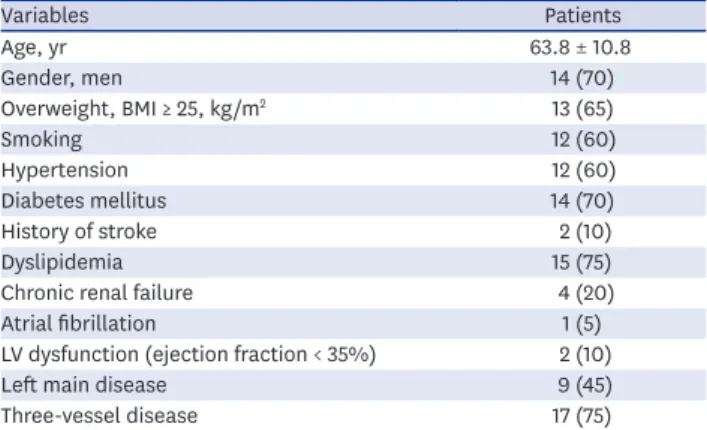
patients were included or until 3 months of enrollment period was completed to minimize any bias from a prolonged storage period of blood samples. Patient enrollment was started on August 31, 2017 and enrollment of 20 patients was completed on November 15, 2017. During the study period, 24 patients were screened and 4 of these patients were excluded because there was a substantial risk of manipulating the heavily calcified ascending aorta. Mean age of the study patients was 63.8 ± 10.8 years and 14 patients were men (Table 1). Nineteen patients underwent isolated CABG and the other patient underwent combined CABG and aortic valve replacement.
Sample collection and preparation
Under general anesthesia and hemodynamic monitoring, the LITA was harvested after median sternotomy and intravenous heparin (300 IU/kg) was injected before cutting the distal end of the LITA to maintain an activated clotting time greater than 300 seconds. After pericardiotomy, 2 mL of whole blood was simultaneously drawn from the ascending aorta and the LITA. Aorta sample was drawn by direct puncture using 2 mL syringe with 21 gauge needle, and LITA sample was collected by shedding to opened 2 mL syringe. Both samples were injected to ethylenediaminetetraacetic acid-coated vacutainers (Becton, Dickinson and Company, Franklin Lakes, NJ, USA) through 21 gauge syringe needles. All sample procedures were carefully performed to avoid any hemolysis. Immediately after sampling, plasma was separated by centrifugation at 3,000 rpm for 10 minutes at 4°C and stored in a −72°C liquefied nitrogen (N2) freezer until sample preparation for MS.
Chemicals
Extraction solvents, including high-performance liquid chromatography grade of isopropanol, acetonitrile, and water were purchased from J.T. Baker Chemical Co.
(Phillipsburg, NJ, USA). The chemicals used for derivatization including fatty acid methyl ester (FAME) mixtures, pyridine, methoxamine (MeOX) hydrochloride, and N-Methyl-N- (trimethylsilyl)trifluoroacetamide (MSTFA) were purchased from Sigma-Aldrich (St. Louis, MO, USA). Reference standards and internal standards used for identification and semi- quantification of selected markers were also obtained from Sigma-Aldrich.
Untargeted metabolomics
Untargeted metabolomic analysis was performed using a high-resolution mass analyzer GC- TOF-MS (LECO Corporation, St. Joseph, MI, USA). The samples were prepared as described previously.11 Briefly, 50 µL of plasma samples was extracted using 1 mL of degassed extraction
Table 1. Baseline characteristics of the 20 study patients
Variables Patients
Age, yr 63.8 ± 10.8
Gender, men 14 (70)
Overweight, BMI ≥ 25, kg/m2 13 (65)
Smoking 12 (60)
Hypertension 12 (60)
Diabetes mellitus 14 (70)
History of stroke 2 (10)
Dyslipidemia 15 (75)
Chronic renal failure 4 (20)
Atrial fibrillation 1 (5)
LV dysfunction (ejection fraction < 35%) 2 (10)
Left main disease 9 (45)
Three-vessel disease 17 (75)
Data are presented as mean ± standard deviation or number (%).
BMI = body mass index, LV = left ventricle.
solution (acetonitrile:isopropanol:H2O = 3:3:2). For the quality control (QC) samples, 100 µL of each sample was pooled after the first extraction. The extracted samples were evaporated under a N2 evaporator and subjected to a second extraction with 400 µL of extraction solution (acetonitrile:H2O = 1:1). Completely dried samples were then derivatized with 10 µL of methoximation solution (20 mg/mL MeOX hydrochloride in pyridine) at 30°C for 90 minutes in a shaking incubator and cooled at room temperature. The samples were further derivatized with 90 µL of mixture solution (5% FAME in MSTFA) at 70°C for 45 minutes and cooled again. The prepared samples were then transferred into GC injection vials.
For the GC analysis, a 1 µL aliquot of each prepared sample was injected with a front inlet split ratio of 20. The QC samples were injected after every ten samples to ensure the quality of the analysis. The metabolites from the samples were separated through Rtx-5MS columns (Restek Corporation, Bellefonte, PA, USA). The GC oven temperature was increased from 50°C at a rate of 20°C per minutes until the oven temperature reached 350°C to separate the metabolites. The mass spectrometer was set to detect metabolites ranging from 50 to 800 m/z (mass per charge ratio) with an acquisition voltage and a rate of 1,750 and 20 spectra/
second, respectively. The transfer line and ion source temperatures were set to 280°C and 250°C, respectively.
Metabolomics data analysis
Metabolomics data analysis was performed using Metaboanalyst 4.0, a web-based software.13 Metabolites with over 50% missing values were excluded in the following analyses.
Interquartile range was applied for the data filtering and Pareto scaling was applied as a data pretreatment method for normalization.14,15 Statistical analyses, such as principal component analysis (PCA) and the volcano plot,16-18 were performed to discover metabolic markers showing significant differences between the ITA and ascending aorta. Briefly, the PCA is an unsupervised multivariate analytical method using an unpaired data set of samples method to visualize subtle similarities or differences among complex datasets.16 The volcano plot is a combination analysis of fold change (FC) and t-test which visualizes the difference between datasets by the Y-axis with log10 (P value) and the X-axis with number of significant pairs which meet the FC cutoff criteria defined below. For the volcano plot analysis, false discovery rate (FDR)-adjusted P values from paired t-tests were used to control FDR in multiple tests.19 For selection of marker candidates the mean initial cutoff values of FC were set to be higher than 1.1 or lower than 0.9 with a significant threshold count percent set to be greater than 60%. The final markers were selected based on cutoff values of the volcano plot with a mean FC > 1.2 or < 0.8 and a significant threshold count percent > 75%.20,21
ChromaTOF 4.6 (LECO Corporation) was used for the identification of metabolites. Three commercially available libraries, including the NIST/EPA/NIH Mass Spectral Library (Version 2.2), LECO-Fiehn Rtx5 and Wiley (9th edition), were used22 with a cut-off value of 70% to match the minimum similarity of the detected spectrum. After possible name assignment, both retention time and mass spectra were compared with commercially available standardization agents to identify the metabolites.
Metabolite set enrichment analysis (MSEA)
Identified metabolites were reviewed through the literature and their main metabolic pathways were determined using the Kyoto Encyclopedia of Genes and Genomes pathway database (http://www.genome.jp/kegg/pathway.html) to select other potential metabolic markers.16
Quantitative analysis
Prior to the marker quantification, confirmation on assigned name of the markers was conducted by comparing mass spectrum with commercially available reference standards.
For the quantification, GC-TOF-MS based semi-quantification was performed using the commercially available reference standards of identified metabolites. Dodecanoic acid methyl ester, eicosanoic acid methyl ester, and octadecanoic acid methyl ester from the FAME mixtures were used as the internal standards. The peak area was used for the quantification.
For quantification of the hypothetical markers, the concentration was determined using an enzyme-linked immunosorbent assay (ELISA) kit (NOVATEINBIO, Woburn, MA, USA) analyzed through a VersaMaxPLUS microplate reader (Molecular Device, San Jose, CA, USA). The quality of the ELISA was treated as accurate if the quantification of the metabolite was duplicated, including a standard curve, and the coefficient of variation was less than 15% in all samples.
All statistical analyses were conducted using the GraphPad Prism 7.0 software package (GraphPad Software, San Diego, CA, USA). A paired t-test was used for statistical comparison between the concentrations from the ITA and ascending aorta. The P values of less than 0.05 were considered statistically significant in the paired t-test.
Ethics statement
The study protocol was reviewed and approved by the Institutional Review Board (IRB) at Seoul National University Hospital (approval No. 1708-058-877). Individual consent under IRB-approved protocols was obtained from all study patients.
RESULTS
GC-TOF-MS based untargeted metabolomics
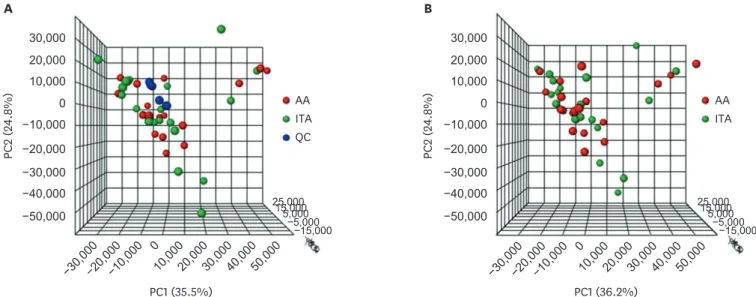
A total of 851 peaks were detected by GC-TOF-MS. Tightly clustered QC samples in the PCA plot showed that GC-TOF-MS analysis was conducted properly. No obvious separation was observed between the ITA and ascending aorta groups in the paired PCA plot (Fig. 1). In
B
30,000
−30,000 20,000
−20,000
−50,000
−40,000 10,000
−10,000 0
0
PC2 (24.8%)
PC1 (36.2%)
−30,000−20,000−10,000 10,00020,00030,00040,00050,000 25,000
−5,000
−15,000 15,0005,000
AA ITA A
30,000
−30,000 20,000
−20,000
−50,000
−40,000 10,000
−10,000 0
0
PC2 (24.8%)
PC1 (35.5%)
−30,000−20,000−10,000 10,00020,00030,00040,00050,000 25,000
−5,000
−15,000 15,0005,000
AA ITA QC
Fig. 1. The PC analysis plot. (A) QC samples were tightly clustered in the principal component plot. (B) There is no obvious separation between the ITA and ascending aorta samples.
PC = principal component; AA = ascending aorta, ITA = internal thoracic artery, QC = quality control.
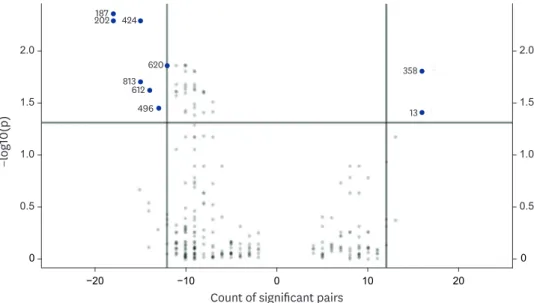
volcano plot analysis, a total of nine peaks met the initial criteria (Fig. 2). Among the nine selected peaks, the peak shape and mass spectrum comparison with the commercial library excluded four markers that were considered as derivatization reagents or artifacts. L-cysteine, propanoic acid, cholesterol, picolinic acid and L-glutamine were selected as possible markers (Table 2). In the subsequent volcano plot analysis with the final cut-off criteria, the L-cysteine showed a statistically higher peak intensity in the ITA than the ascending aorta (mean FC = 1.86, P = 0.02) (Fig. 3).
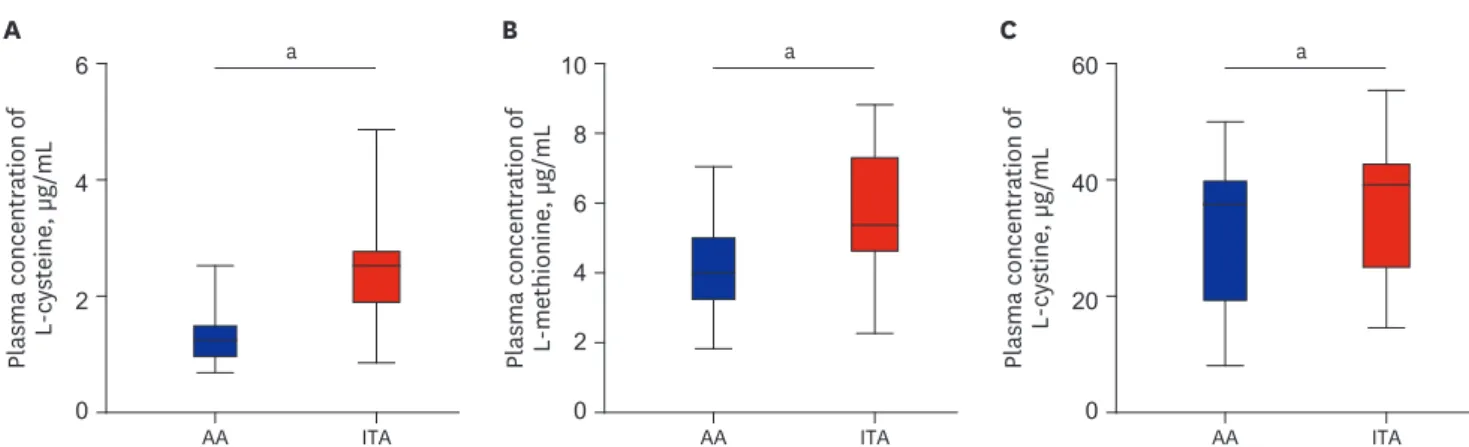
Based on the MSEA, three intermediate metabolites in the ‘cysteine and methionine metabolism pathway' linked with L-cysteine, such as L-methionine, L-homocysteine and L-cystine, were selected for the subsequent analyses. Hydrogen sulfide (H2S), one of the final products, was also selected as one of the hypothetical markers. The GC-TOF-MS based semi- quantification demonstrated that plasma concentrations of L-cysteine, L-methionine, and L-cystine were 2.0-, 1.4- and 1.2-fold higher, respectively, in the ITA than in the ascending aorta (P < 0.001 in each, Table 3 and Fig. 4). L-homocysteine was not detected in the samples.
ELISA showed that the plasma concentrations of H2S were significantly higher in the ITA than in the ascending aorta (P = 0.001) (Table 3).
Count of significant pairs
202187 424
620 813612
496
358 13
−log10(p)
0 2.0
0.5 1.0 1.5
0 2.0
0.5 1.0 1.5
−20 −10 0 10 20
Fig. 2. Results of initial volcano plot analysis. Nine peaks from gas chromatography-time of flight-mass spectrometry results met the initial volcano plot analysis criteria (cut-off values = mean fold change > 1.1 or < 0.9, significant count threshold 60%, false discovery rate-adjusted P value < 0.05).
Table 2. Possible markers selected by initial volcano plot analysis based on the cut-offs of mean fold change > 1.1 or < 0.9, significant count threshold 60% and FDR-adjusted P value < 0.05
No. Compound ID CAS No. R.T, sec Unique mass Similarity Probability FDR-adjusted P
value Peak intensity in the ITA
13 Propanoic acid 55493-92-0 267 174 > 800 > 9,000 0.04 High
187 Tridecanea 629-50-5 379 181 > 800 < 2,000 0.004 Low
202 Picolinic acid 17881-49-1 390.4 180 > 900 > 8,000 0.005 Low
358 L-cysteine 56272-69-6 480.6 220 > 800 > 9,000 0.02 High
424 Cyclohexanea 696-29-7 515.4 268 > 700 > 3,000 0.005 Low
496 L-glutamine 56145-13-2 554.4 156 > 800 > 9,000 0.04 Low
612 Unknowna - 639 335 - - 0.02 Low
620 Linoleic acida 2566-97-4 648.85 80 > 900 < 4,000 0.01 Low
813 Cholesterol 16134-40-0 900.8 368 > 800 > 9,000 0.02 Low
CAS = Chemical Abstracts Service, FDR = false discovery rated, R.T = retention time, ITA = internal thoracic artery.
aFour of these were estimated to be derivatization agents or artifacts.
DISCUSSION
This study demonstrated 2 main findings. First, there were differences in the plasma metabolome profiles of the 2 common blood sources for CABG, the LITA and the ascending aorta. Second, the plasma concentration of L-cysteine was 2-fold higher in the LITA than in the ascending aorta.
AA
B
ITA 1.5×10⁶
1×10⁶
5×10⁵
0
Peak intensity of L-cysteine
AA
A
ITA 1.5×10⁶
1×10⁶
5×10⁵
0
Peak intensity of L-cysteine
a a
Fig. 3. Results of GC-TOF-MS based metabolomics data analysis. GC-TOF-MS based metabolomics data analysis showed a significantly higher peak intensity of L-cysteine in the ITA than in the ascending aorta.
AA = ascending aorta, GC-TOF-MS = gas chromatography-time of flight-mass spectrometry, ITA = internal thoracic artery.
aP = 0.02.
Table 3. The gas chromatography-time of flight-mass spectrometry based semi-quantified concentrations of intermediate metabolites from ‘cysteine and methionine metabolism pathway' and H2S
Variables Internal thoracic artery Ascending aorta P value Mean FCa
L-methionine, µg/mL 5.67 ± 1.91 (2.28–8.80) 4.2 ± 1.43 (1.83–7.04) < 0.001 1.36
L-homocysteine, µg/mL NQ NQ - -
L-cysteine, µg/mL 2.51 ± 1.0 (0.84–4.89) 1.28 ± 0.45 (0.70–2.54) < 0.001 2.04 L-cystine, µg/mL 35.19 ± 11.71 (14.63–55.63) 31.3 ± 12.32 (8.20–50.05) < 0.001 1.18 H2S, nmol/mL 23.5 ± 17.14 (7.27–86.67) 22.71 ± 17.03 (6.76–85.54) 0.001 - All parameters are presented as means ± standard deviations (min–max).
FC = fold change, H2S = hydrogen sulfide, NQ = not quantifiable.
aMean FC was calculated as the average of FCs in each pair.
AA
C
ITA 60
40
20
0 Plasma concentration of L-cystine, µg/mL
a
AA
A
ITA 6
4
2
0 Plasma concentration of L-cysteine, µg/mL
a
AA
B
ITA 10
6
2 0 Plasma concentration of L-methionine, µg/mL
8
4
a
Fig. 4. Results of semi-quantification analysis of intermediate metabolites. The plasma concentrations of (A) L-cysteine, (B) L-methionine, and (C) L-cystine were 2.0-, 1.4- and 1.2- fold higher, respectively, in the ITA than in the ascending aorta.
AA = ascending aorta, ITA = internal thoracic artery.
aP < 0.001.
Previous studies demonstrated that patency rates of bypass grafts might be lower when the bypass conduit was used as an aorto-coronary fashion than when it was used as a composite graft based on the LITA.7,8 Contradictory results also existed that the patency of the radial artery (RA) was lower when it was used as a composite graft based on the LITA compared to aorto-coronary grafts.23,24 However, a previous systematic review demonstrated that the best evidence suggests that the site of proximal anastomosis has little or no effect on RA graft patency following CABG.25
One of the theoretical reasons for this difference may be that the composite conduits could be exposed continuously to endothelial protective substances such as NO released from the LITA.9 Another study showed that arterial grafts including the LITA had a protective effect on disease progression of the native coronary artery distal to the anastomosis compared to the SV which was used as an aorto-coronary fashion.26 Therefore, the authors speculated that metabolically active arterial grafts might produce vasoactive and endothelial progenitor substances that defend the native vessels from the progression of atherosclerosis. The present study was conducted to clarify whether there is any difference in metabolome profiles beyond NO that affect the long-term fates of the composite grafts and native coronary vessels with untargeted metabolomics approach using GC-TOF-MS.
In the present study, the concentration of L-cysteine was proven to be higher in the LITA than in the ascending aorta. The semi-quantification of major intermediates correlated with L-cysteine based on MSEA confirmed that the higher peak of L-cysteine in the LITA was not an erroneous finding. In addition, we quantified the plasma concentration of H2S in the ITA and ascending aorta because L-cysteine is capable of interconversion to types of sulfide containing amino acids, and it is the most important donor for biosynthesis of H2S.27,28 L-cysteine is a non-essential amino acid and a precursor for protein synthesis and various essential metabolites. Moreover, H2S is regarded as the third endogenous gaseous signaling molecules affecting the cardiovascular system, a so-called “gasotransmitter” following NO and carbon monoxide.27-32
Previous studies demonstrated the anti-atherosclerotic and antioxidant effects of L-cysteine
33-36; one study showed cardioprotective mechanisms of L-cysteine through an antioxidant effect that directly scavenges reactive free radicals and a mechanism that increases anaerobic energy production in a rat heart model.33 Another study revealed that exogenous L-cysteine in the rat heart model attenuates ischemia-reperfusion injury by stimulating the synthesis of H2S by cystathionine-γ-lyase in the myocardium.34 The protective effects of H2S on the myocardium and vascular endothelium include antioxidative action, suppression of beta-adrenergic function, reduction of apoptosis, preservation of mitochondrial function and high energy phosphate, promotion of angiogenesis, vasodilation and inhibition of atherosclerosis.30,31 These favorable effects of L-cysteine and H2S in addition to NO could be the reasons for the high long-term patency rates and cardioprotective effects of the LITA and composite grafting strategies in CABG. Also, with further investigations, these metabolomic approach and results could be applied to pharmacological modulation therapy for post myocardial revascularization patients.
There are several limitations to the current study that must be noted. First, the number of study patients could not be determined based on statistical methods because this study was designed to perform untargeted metabolomics in which no primary end-point could be assumed and
to compare the concentrations of metabolites between the two different sites in the same patient. Second, the number of patients enrolled was relatively small. Although all confounding variables could be eliminated by comparing the samples from the same patients, further studies with large numbers of patients using targeted metabolomics might be needed to draw definite conclusions about the metabolome profiles in the LITA and ascending aorta and to validate and confirm findings of the present study. Third, further analyses by including tissue or cells might be needed to clarify the mechanism of the high concentration of L-cysteine in the LITA. Finally, analyses of blood samples from other grafts such as RA, gastroepiploic artery and SV were not performed because the aim of the present study was to compare metabolomics profiles of bloods from 2 arteries that are used as blood flow sources in CABG.
In conclusion, there were distinguishable plasma metabolome profiles between the LITA and the ascending aorta, particularly a significantly higher plasma concentration of L-cysteine in the LITA and a higher concentration of H2S.
ACKNOWLEDGMENTS
The authors wish to thank the Medical Research Collaborating Center, Seoul National University Hospital for statistical consultation.
REFERENCES
1. Sabik JF 3rd, Lytle BW, Blackstone EH, Houghtaling PL, Cosgrove DM. Comparison of saphenous vein and internal thoracic artery graft patency by coronary system. Ann Thorac Surg 2005;79(2):544-51.
PUBMED | CROSSREF
2. Hwang HY, Kim JS, Kim KB. Angiographic equivalency of off-pump saphenous vein and arterial composite grafts at one year. Ann Thorac Surg 2010;90(2):516-21.
PUBMED | CROSSREF
3. Lüscher TF, Diederich D, Siebenmann R, Lehmann K, Stulz P, von Segesser L, et al. Difference between endothelium-dependent relaxation in arterial and in venous coronary bypass grafts. N Engl J Med 1988;319(8):462-7.
PUBMED | CROSSREF
4. Pearson PJ, Evora PR, Schaff HV. Bioassay of EDRF from internal mammary arteries: implications for early and late bypass graft patency. Ann Thorac Surg 1992;54(6):1078-84.
PUBMED | CROSSREF
5. van Son JA, Smedts F, Vincent JG, van Lier HJ, Kubat K. Comparative anatomic studies of various arterial conduits for myocardial revascularization. J Thorac Cardiovasc Surg 1990;99(4):703-7.
PUBMED
6. Kim KB, Kang CH, Chang WI, Lim C, Kim JH, Ham BM, et al. Off-pump coronary artery bypass with complete avoidance of aortic manipulation. Ann Thorac Surg 2002;74(4):S1377-82.
PUBMED | CROSSREF
7. Dion R. Complete arterial revascularization with the internal thoracic arteries. Oper Tech Thorac Cardiovasc Surg 1996;1(2):84-107.
CROSSREF
8. Kim KB, Hwang HY, Hahn S, Kim JS, Oh SJ. A randomized comparison of the saphenous vein versus right internal thoracic artery as a Y-composite graft (SAVE RITA) trial: one-year angiographic results and mid- term clinical outcomes. J Thorac Cardiovasc Surg 2014;148(3):901-7.
PUBMED | CROSSREF
9. Hwang HY, Kim JS, Oh SJ, Kim KB. A randomized comparison of the saphenous vein versus right internal thoracic artery as a Y-composite graft (SAVE RITA) trial: early results. J Thorac Cardiovasc Surg 2012;144(5):1027-33.
PUBMED | CROSSREF
10. Tedoriya T, Kawasuji M, Sakakibara N, Ueyama K, Watanabe Y. Pressure characteristics in arterial grafts for coronary bypass surgery. Cardiovasc Surg 1995;3(4):381-5.
PUBMED | CROSSREF
11. Fiehn O. Metabolomics by gas chromatography-mass spectrometry: combined targeted and untargeted profiling. Curr Protoc Mol Biol 2016;114(1):30.4.1-32.
PUBMED | CROSSREF
12. Lei Z, Huhman DV, Sumner LW. Mass spectrometry strategies in metabolomics. J Biol Chem 2011;286(29):25435-42.
PUBMED | CROSSREF
13. Xia J, Wishart DS. Using metaboanalyst 3.0 for comprehensive metabolomics data analysis. Curr Protoc Bioinformatics 2016;55(1):14.10.1-91.
PUBMED | CROSSREF
14. Hackstadt AJ, Hess AM. Filtering for increased power for microarray data analysis. BMC Bioinformatics 2009;10(1):11.
PUBMED | CROSSREF
15. van den Berg RA, Hoefsloot HC, Westerhuis JA, Smilde AK, van der Werf MJ. Centering, scaling, and transformations: improving the biological information content of metabolomics data. BMC Genomics 2006;7(1):142.
PUBMED | CROSSREF
16. Alonso A, Marsal S, Julià A. Analytical methods in untargeted metabolomics: state of the art in 2015. Front Bioeng Biotechnol 2015;3:23.
PUBMED | CROSSREF
17. De Hertogh B, De Meulder B, Berger F, Pierre M, Bareke E, Gaigneaux A, et al. A benchmark for statistical microarray data analysis that preserves actual biological and technical variance. BMC Bioinformatics 2010;11(1):17.
PUBMED | CROSSREF
18. Hur M, Campbell AA, Almeida-de-Macedo M, Li L, Ransom N, Jose A, et al. A global approach to analysis and interpretation of metabolic data for plant natural product discovery. Nat Prod Rep 2013;30(4):565-83.
PUBMED | CROSSREF
19. Storey JD. A direct approach to false discovery rates. J R Stat Soc Series B Stat Methodol 2002;64(3):479-98.
CROSSREF
20. Vinaixa M, Samino S, Saez I, Duran J, Guinovart JJ, Yanes O. A guideline to univariate statistical analysis for LC/MS-based untargeted metabolomics-derived data. Metabolites 2012;2(4):775-95.
PUBMED | CROSSREF
21. Chen L, Cheng CY, Choi H, Ikram MK, Sabanayagam C, Tan GS, et al. Plasma metabonomic profiling of diabetic retinopathy. Diabetes 2016;65(4):1099-108.
PUBMED | CROSSREF
22. Kind T, Wohlgemuth G, Lee DY, Lu Y, Palazoglu M, Shahbaz S, et al. FiehnLib: mass spectral and retention index libraries for metabolomics based on quadrupole and time-of-flight gas chromatography/
mass spectrometry. Anal Chem 2009;81(24):10038-48.
PUBMED | CROSSREF
23. Al-Ruzzeh S, Modine T, Athanasiou T, Mazrani W, Azeem F, Nakamura K, et al. Can the use of the radial artery be expanded to all patients with different surgical grafting techniques? Early clinical and angiographic results in 600 patients. J Card Surg 2005;20(1):1-7.
PUBMED | CROSSREF
24. Jung SH, Song H, Choo SJ, Je HG, Chung CH, Kang JW, et al. Comparison of radial artery patency according to proximal anastomosis site: direct aorta to radial artery anastomosis is superior to radial artery composite grafting. J Thorac Cardiovasc Surg 2009;138(1):76-83.
PUBMED | CROSSREF
25. Watson RA, Hamza M, Tsakok TM, Tsakok MT. Radial artery for coronary artery bypass grafting: does proximal anastomosis to the aorta or left internal mammary artery achieve better patency? Interact Cardiovasc Thorac Surg 2013;17(6):1020-4.
PUBMED | CROSSREF
26. Dimitrova KR, Hoffman DM, Geller CM, Dincheva G, Ko W, Tranbaugh RF. Arterial grafts protect the native coronary vessels from atherosclerotic disease progression. Ann Thorac Surg 2012;94(2):475-81.
PUBMED | CROSSREF
27. Shen Y, Shen Z, Luo S, Guo W, Zhu YZ. The cardioprotective effects of hydrogen sulfide in heart diseases:
from molecular mechanisms to therapeutic potential. Oxid Med Cell Longev 2015;2015:925167.
PUBMED | CROSSREF
28. Stipanuk MH. Sulfur amino acid metabolism: pathways for production and removal of homocysteine and cysteine. Annu Rev Nutr 2004;24(1):539-77.
PUBMED | CROSSREF
29. Zhao W, Zhang J, Lu Y, Wang R. The vasorelaxant effect of H(2)S as a novel endogenous gaseous K(ATP) channel opener. EMBO J 2001;20(21):6008-16.
PUBMED | CROSSREF
30. Szabó G, Veres G, Radovits T, Gero D, Módis K, Miesel-Gröschel C, et al. Cardioprotective effects of hydrogen sulfide. Nitric Oxide 2011;25(2):201-10.
PUBMED | CROSSREF
31. Liu YH, Lu M, Hu LF, Wong PT, Webb GD, Bian JS. Hydrogen sulfide in the mammalian cardiovascular system. Antioxid Redox Signal 2012;17(1):141-85.
PUBMED | CROSSREF
32. Wang Q, Wang XL, Liu HR, Rose P, Zhu YZ. Protective effects of cysteine analogues on acute myocardial ischemia: novel modulators of endogenous H(2)S production. Antioxid Redox Signal 2010;12(10):1155-65.
PUBMED | CROSSREF
33. Shackebaei D, King N, Shukla B, Suleiman MS. Mechanisms underlying the cardioprotective effect of L-cysteine. Mol Cell Biochem 2005;277(1-2):27-31.
PUBMED | CROSSREF
34. Elsey DJ, Fowkes RC, Baxter GF. L-cysteine stimulates hydrogen sulfide synthesis in myocardium associated with attenuation of ischemia-reperfusion injury. J Cardiovasc Pharmacol Ther 2010;15(1):53-9.
PUBMED | CROSSREF
35. Hamza RZ, El-Shenawy NS. The beneficial effects of l-cysteine on brain antioxidants of rats affected by sodium valproate. Hum Exp Toxicol 2017;36(11):1212-21.
PUBMED | CROSSREF
36. Dröge W. Oxidative stress and ageing: is ageing a cysteine deficiency syndrome? Philos Trans R Soc Lond B Biol Sci 2005;360(1464):2355-72.
PUBMED | CROSSREF