INTRODUCTION
Single-stage reconstruction of long, obliterative urethral strictures is a challenge. Since the introduction of the inner preputial and distal penile circular fasciocutaneous flap
Technique for single-stage reconstruction of obliterative or near-obliterative long urethral strictures in circumcised patients
Sher Singh Yadav, Vivek Kumar Singh, Vinay Tomar, Neeraj Agarwal, Anil Gulani
Department of Urology and Renal Transplantation, SMS Medical College, Jaipur, India
Purpose: To report our initial experience with urethral reconstruction using a combined dorsal lingual mucosal graft (LMG) and ventral onlay preputial flap for long obliterative or near-obliterative strictures in circumcised patients.
Materials and Methods: This was a retrospective study of 10 patients from January 2015 to June 2017 with long obliterative or near-obliterative anterior urethral strictures and circumcised prepuces. All patients underwent a combined approach using a dorsally LMG and a narrow preputial onlay flap ventrally to create a 26-30 Fr. neourethra over a 14-Fr Foley catheter. Success was defined as no requirement for additional urethral instrumentation. The follow-up period ranged from 6 to 32 months.
Results: The patients ranged in age from 17 to 44 years (mean, 32.3±9.59 years) and stricture length ranged from 9 to 12.5 cm (mean, 10.77±1.15 cm). Four strictures were obliterative and six were near-obliterative. Two patients had a history of prior urethroplasty.
The length of the LMGs harvested ranged from 11 to 14 cm (mean, 12.8±1.03 cm). The preputial flaps available were from 1 to 1.5 cm in width (1.29±0.16 cm) and the desired length. Maximum urinary flow rate (Qmax) achieved ranged from 12 to 26 mL/s (mean, 20.46±3.71 mL/s) after 3 months. One patient needed a single direct visualized internal urethrotomy and another patient develop temporary superficial penile necrosis. The success rate was 90%.
Conclusions: Long obliterative and near-obliterative penile and penobulbar urethral strictures can still be treated in circumcised patients using available preputial skin along with lingual mucosa with good outcomes.
Keywords: Foreskin; Mouth mucosa; Reconstructive surgical procedures; Urethral stricture
This is an Open Access article distributed under the terms of the Creative Commons Attribution Non-Commercial License (http://creativecommons.org/licenses/by-nc/4.0) which permits unrestricted non-commercial use, distribution, and reproduction in any medium, provided the original work is properly cited.
Received: 31 August, 2017 • Accepted: 12 February, 2018 Corresponding Author: Vivek Kumar Singh
Department of Urology and Renal Transplantation, SMS Medical College, 302004 Jaipur, Rajasthan, India TEL: +91-9549338213, FAX: +91-0141-5110496, E-mail: [email protected]
ORCID: http://orcid.org/0000-0003-1804-7395
ⓒ The Korean Urological Association
by Quartey [1] and McAninch [2], this hairless, adequately sized flap has been used for the treatment of urethral strictures even in circumcised patients [3]. Although the preputial flap is tubularized to substitute for the urethra, its surgical outcome is poor. Humby and Higgins in 1941 [4]
www.icurology.org
Investig Clin Urol 2018;59:213-219.
https://doi.org/10.4111/icu.2018.59.3.213 pISSN 2466-0493 • eISSN 2466-054X
214 www.icurology.org https://doi.org/10.4111/icu.2018.59.3.213 introduced the buccal mucosal graft (BMG) for hypospadias,
which was later rediscovered and popularized by Burger et al. in 1992 and is now being used for augmentation of the urethra with good outcomes [5-9]. The management of long obliterative and near-obliterative urethral strictures remains challenging, however, with either staged urethroplasty or excision and substitution urethroplasty in a single-stage procedure as available options. Using an oral mucosal graft (OMG) alone for single-stage reconstruction of a long urethral segment is not possible, especially in the penile region. However, staged procedures are associated with increased morbidity, financial burden, and difficulty in psychosocial adjustment [10]. In addition, there is no surety of better outcome than with a single-stage procedure [11].
Therefore, staged procedures should be reserved for complex strictures after failed hypospadias repair, lichen sclerosus, and strictures complicated by fistula or abscess [9]. The principle of augmentation urethroplasty using an OMG and penile skin was first introduced by Morey [12] and later by Erickson et al. [13]. Here we report our initial experience with this technique.
MATERIALS AND METHODS
This was a retrospective study of 10 patients who underwent this technique between January 2015 and June 2017. Ethical approval was obtained from the institutional ethics committee (approval number: IRB 2425/EC/MC/2016).
All patients included in the study had narrow preputial skin owing to a previous history of circumcision and had long obliterative or near-obliterative anterior urethral strictures.
Patients having lichen sclerosus et atrophicus, urethral abscess and fistula, short stricture and other comorbidities were excluded. Patients with buccal mucosa showing submucosal fibrosis or otherwise not suitable for grafting were also excluded.
Preoperative evaluation included clinical history, physical examination, urine culture, uroflowmetry (UFM), retrograde urethrogram (RGU), and voiding cystourethrogram (VCUG).
Urethroscopy was done at the time of surgery. Urethras with a caliber <5 Fr but a patent lumen were labeled as near-obliterative urethral strictures.
The procedure was performed on patients in the lithotomy position under general anesthesia. All cases were performed by a single experienced surgeon. A midline perineal and proximal scrotal incision was made depending on the location of the stricture. The incision was extended according to stricture length. Another circumferential, subcoronal incision was made and was deepened to the
superficial layer of Buck’s fascia. Subsequently, the urethra was dissected and the penis was pulled out from the perineal incision site (Fig. 1). In cases of obliterative strictures, the entire fibrosed segment was excised. Excision of urethral tissue was extended proximally and distally until approximately 1 cm of healthy urethra was exposed at both ends. In cases of a narrowed urethra, the urethra was dissected dorsolaterally from the corporal body and incised.
This incision was extended in healthy proximal and distal urethra for 1 cm. After the urethral mucosa of the stricture segment was incised, if it was found to have a normal appearance, it was saved for augmentation. Otherwise, it was excised.
The lingual mucosal graft (LMG) and inner preputial flap were harvested simultaneously by two teams. For the LMG, harvesting was done by use of a standard technique [14]. The width was kept to about 1.5 to 2 cm and the length to about 2 cm longer than the stricture length. In cases in which graft length on one side was inadequate, another graft was taken from the opposite side of the tongue.
Bleeding in the donor site bed was controlled with bipolar cautery and left open. The oral wound side was packed with adrenaline-soaked ribbon gauze for 3 to 5 hours. Graft defatting was done until all underlying fibrofatty tissue was completely removed and the glistening surface visualized.
Multiple small incisions were made to make fenestrations in the graft to prevent collection between the graft and the bed. Subsequently, the graft was spread and quilted over the ventral surface of the corporal bodies (Fig. 2).
The preputial fasciocutaneous flap was developed by the McAninch technique. A circumcoronal incision was marked about 4 to 5 mm proximal to the glanular margin, followed by a second incision marked about 1 to 1.5 cm proximal to
Fig. 1. Technique of delivering through perineal wound.
the first. A distal incision was deepened to the superficial layer of Buck’s fascia. Once the proper plane of dissection was achieved, dissection was carried out circumferentially.
This dissection was carried up to the root of the penis.
Subsequently, a proximal circumferential incision was deepened through the thin superficial layer of dartos and then the dissection was done to create a space between the deeper and superficial layers of the dartos fascia. This maneuver helps to protect the subdermal vascular plexus of penile skin, thus avoiding necrosis. The second plane of dissection was also extended to the base of the penis. The preputial flap with its pedicle was divided ventrally in the
midline (6 o’clock) down to the penoscrotal junction, thereby converting its circular configuration into a longitudinal strip (Fig. 3). After proper mobilization, the preputial flap was brought to the area of repair by the side of the penis in a tension-free manner. In cases of obliterative urethral strictures, the lateral edges of the LMG and preputial skin were sutured together, incorporating the tunica albuginea (Fig. 4) [5]. In cases of near-obliterative urethral strictures, the medial margin of the lingual mucosa was sutured to the medial margin of the laid-open urethra incorporating the tunica albuginea, so as to create the roof of neourethra (Fig. 5) [6]. By this we were able to achieve 26 to 30 mm (26 to 30 Fr) total breath of neourethral plate. Following this, Fig. 3. Harvested preputial island flap.
Fig. 2. Combined substitution urethroplasty. Lingual mucosal graft (LMG) quilted over ventral surface of corporal bodies and one side edge of longitudinally oriented preputial flap sutured to the right side margin of LMG incorporating tunica albuginea.
Fig. 4. Dorsal lingual mucosal graft and ventral preputial flap substitu- tion urethroplasty.
Fig. 5. Dorsal lingual mucosal graft, residual urethral plate, and prepu- tial flap.
216 www.icurology.org https://doi.org/10.4111/icu.2018.59.3.213 one margin of vertically oriented preputial flap was sutured
with the free edge of the laid-open urethra and another to the lateral margin of LMG so as to construct a urethral tube over a 14-Fr Foley catheter using 5-0 absorbable su- tu res. Then the degloved penile skin was retracted and the circumcoronal penile skin incision was closed. Bulbos- pongiosus muscle was approximated and the perineal wound was closed in layers after a negative-pressure suction drain was placed, which was removed after 48 hours or longer, once drainage was insignificant. The urethral catheter was removed at the end of 3 weeks.
The patients were followed up at 1, 3, and 6 months and then annually. UFM was done at every follow-up visit. If the patients had a maximum urinary flow rate (Qmax) <15 mL/s on UFM with evidence of stricture reappearance in RGU and VCUG or in endoscopy, then the procedure was labeled as a failure. Success was defined as no additional need for urethral instrumentation. Any direct visualized internal urethrotomy (DVIU) or repetitive dilatation or further surgical management for restricture was deemed a failure.
RESULTS
Table 1 shows the demographic data of the 10 patients who underwent neourethral reconstruction by the described technique. Most of the patients had a history of multiple endoscopic procedures. Seven patients had a history of ritual circumcision, whereas three had undergone circumcision in childhood for unknown reasons. In all patients, bilateral LMGs were harvested. The length of the harvested LMGs was matched to the stricture length. The preputial flaps raised were narrow in width and were of lengths matching the dorsal graft.
Table 2 shows the complications and morbidities asso- ciated with the procedures. OMG donor site morbidities were pain and slurring of speech, which subsided within 3 weeks without any treatment. One patient developed difficulty in protrusion of the tongue, which also resolved after proper exercise and speech therapy. One patient developed blackening and denudation of distal superficial penile skin that reepithelized completely within 3 weeks without any treatment.
Follow-up time ranged from 6 to 32 months (mean, 21.7±7.44 months). The Qmax at 3 months after surgery varied from 12 to 26 mL/s. One patient developed narrowing of the distal bulbar anastomotic site for which DVIU was done. Subsequently, he voided well with a good stream.
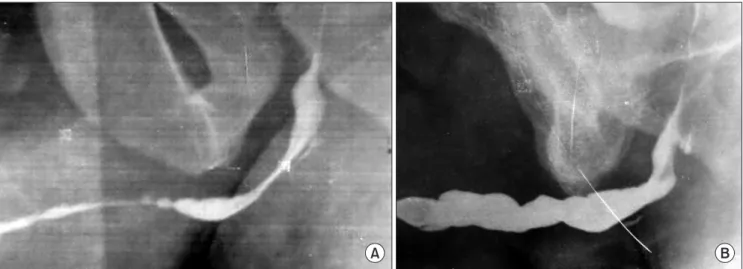
The preoperative urethrogram (Fig. 6A) shows the near- obliterative urethra and the postoperative RGU (Fig. 6B) af-
ter 2 years shows the good-caliber urethra.
DISCUSSION
Reconstruction of long urethral strictures is a challen- ging task, and the most favorable technique for repairing these strictures has not yet been adequately established. No study has clearly defined a preference for one tissue transfer technique over another for single-stage reconstruction of extensive anterior urethral strictures.
Before the use of OMGs for augmentation urethroplasty, preputial and penoscrotal flaps were being used for augmen- tation as well as substitution urethroplasty in cases of long obliterative or near-obliterative urethral strictures [1,2,15- 21]. A local penile skin flap has the advantage of quicker harvesting but lacks a definitive blood supply and has the disadvantage of hair-bearing skin [17].
On the other hand, the hairless, preputial-based pedicled flap has a good vascularized, long pedicle; therefore, it can be transported to nearly any part of the urethra [1,3,16,21].
Developing a preputial island flap requires not only a long operative time but also expertise. Besides these individual advantages and disadvantages of local flaps, all skin-based flaps have the disadvantages of excoriation of skin on exposure to urine, restenosis, dribbling of urine, diverticula, and fistula formation [2,3,22]. These can be reduced by incorporating a smaller area of skin in the urethral reconstruction and by closing the wound in multiple layers [2,21]. The technique is not without complications, however.
The results of the initial two studies with tubularized penile or preputial-based flaps had success rates of about 58% [20,23].
BMGs alone are not very helpful for single-stage repair of long obliterative and near-obliterative anterior urethras.
Tubularization of BMGs has been shown to have a nearly 50% short-term restricture rate, the cause of which is hypothesized to be the unreliable blood supply the healing graft receives at its lateral edges [12]. However, a BMG can be used for short obliterative strictures by the augmented anastomotic technique [24,25] or by use of a double-patched mucosal graft [7,26]. Here we used a LMG because it has less postoperative morbidity and more ease of harvesting compared with a BMG [27].
Only a few studies are available where long obliterative or near-obliterative urethral strictures were treated by using combined BMG and penile flaps. In these studies, the BMG was used for proximal and the penile skin flap for distal urethral plate augmentation with variable results (success rate, 38% to 88%) [24,28,29]. Some authors constructed a neourethral tube using a dorsal BMG and a ventral penile
Table 1. Patient and stricture characteristics Patient no.Age (y)Stricture etiologyPreoperative Qmax (mL/s)Prior intervention Stricture length (cm), strictured urethra lumen nature
Stricture regionLMG length (cm) Preputial width (cm)Postoperative Qmax at 3 mo (mL/s)Follow-up (mo) Mean±SD 32.3±9.59 10.77±1.1512.8±1.031.29±0.1620.46±3.7121.7±7.44 117Idiopathic 52-staged urethroplasty12.5, near- obliterativePenobulbar141.32632 240Catheterization (for retention of urine following orthopedic surgery)3.5DVIU×511, near- obliterativePenobulbar131.21228 335Catheterization (retention of urine following head injury)Retention of urineDVIU×49, obliterativePenile121.21928 430 Catheterization (for retention of urine perineal abscess drain)2.8 Augmented anasto- motic urethroplasty10.5, near- obliterativePenobulbar131.52124 541Catheterization for retention of urine (recurrent endoscopic instrumen- tation for urolithiasis)
Retention of urineDVIU×2 and h/o dilata- tion10, obliterativePenile12120.523 644 Catheterization (following hernioplasty)3.3DVIU×3 and h/o dilata- tion9.5, near- obliterativePenobulbar121.22222 725IdiopathicRetention of urineNone9, obliterativePenile111.418.621 839Idiopathic4.8DVIU×2 and h/o dilata- tion11.5, near- obliterativePenobulbar141.52018 918Idiopathic4DVIU×3 and h/o dilata- tion12, near- obliterativePenobulbar141.42415 1034IdiopathicRetention of urineDVIU×4 11, obliterativePenobulbar131.221.5 6 Qmax, maximum urinary flow rate; LMG, lingual mucosal graft; SD, standard deviation; DVIU, direct visualized internal urethrotomy.
218 www.icurology.org https://doi.org/10.4111/icu.2018.59.3.213 flap in failed hypospadias and complex urethral strictures
[12,13]. Erickson et al. [13] used a combined tissue transfer technique in the treatment of urethral strictures. They excised the portion of the urethra with a width of <0.5 cm and significant fibrosis. The excised part was substituted by a BMG and this was augmented by a ventral penile flap.
Where the plate was >0.5 cm wide, augmentation of the urethra was performed with a fasciocutaneous flap only.
Their initial success rate was 64.3% [13].
In a particular situation, where preputial skin is deficient because of circumcision, a preputial skin tube cannot help in a single-stage correction of a long anterior urethral stricture.
In these situations, the combination of preputial skin and oral mucosa can help in single-stage reconstruction of the urethra.
These may not only help in reducing skin flap–based complications but also allow the construction of neourethral tubes of adequate size. In the present study, we were able to treat long obliterative and near-obliterative urethral strictures in circumcised patients by using both LMGs and available inner preputial skin with good outcomes (90%
success rate). In our technique, except for the circumcoronal incision, no other incision was made in the penile skin. The urethra was dissected and pulled out through the perineal
or midscrotal incision, thus avoiding an overlap of suture lines. In the present study, the preputial flaps were narrow but with broad and long pedicles. Besides these maneuvers, suturing of both the LMG and the flap to the corporal bodies also helped in to prevent contracture as well as the formation of fistulas and diverticula [13,20,21]. Necrosis of the penile skin proximal to the flap can result when the vascular supply of the subdermal plexus is compromised [20], and its incidence varies between 2% and 23% [3,23,24]. The incidence in the present study was 10%. This can be reduced if the flap is raised in a proper plane with good hemostasis.
Recurrence of stricture can be reduced by good hemostasis and meticulous anastomosis, keeping an adequate sized urethral lumen.
To the best of our knowledge, no other studies are available in which the neourethra was constructed by using dorsal LMG and ventral preputial skin flaps, particularly in circumcised patients. The limitations of the present study were the small number of cases and the limited period of follow-up.
CONCLUSIONS
Long obliterative and near-obliterative penile and penobulbar urethral strictures can still be treated in single- stage procedures in circumcised patients by using available preputial skin along with LMGs with good outcomes.
CONFLICTS OF INTEREST
The authors have nothing to disclose.
Table 2. Complications of the procedure
Complications Value
A-lingual graft-related complications
Pain at harvesting site 10
Temporary slurring of speech 2
Temporary difficulty in protrusion of tongue 1 B-penile site complications
Superficial skin (epidermal) necrosis 1
A B
Fig. 6. (A) Preoperative retrograde urethrogram (RGU). (B) Postoperative RGU after 2 years.
REFERENCES
1. Quartey JK. One-stage penile/preputial cutaneous island flap urethroplasty for urethral stricture: a preliminary report. J Urol 1983;129:284-7.
2. McAninch JW. Reconstruction of extensive urethral strictures:
circular fasciocutaneous penile flap. J Urol 1993;149:488-91.
3. Carney KJ, McAninch JW. Penile circular fasciocutaneous flaps to reconstruct complex anterior urethral strictures. Urol Clin North Am 2002;29:397-409.
4. Humby G, Higgins TT. A one-stage operation for hypospadias.
Br J Surg 1941;29:84.
5. Andrich DE, Mundy AR. Substitution urethroplasty with buccal mucosal free grafts. J Urol 2001;165:1131-3; discussion 1133-4.
6. Pansadoro V, Emiliozzi P, Gaffi M, Scarpone P, DePaula F, Piz- zo M. Buccal mucosa urethroplasty in the treatment of bulbar urethral strictures. Urology 2003;61:1008-10.
7. Sharma U, Yadav SS, Tomar V, Garg A. Single stage circumfer- ential lingual mucosal graft urethroplasty in near obliterative bulbar urethra stricture: a novel technique. Urol Ann 2016;8:
146-50.
8. Datta B, Rao MP, Acharya RL, Goel N, Saxena V, Trivedi S, et al. Dorsal onlay buccal mucosal graft urethroplasty in long an- terior urethral stricture. Int Braz J Urol 2007;33:181-6; discus- sion 186-7.
9. Kulkarni S, Barbagli G, Sansalone S, Lazzeri M. One-sided anterior urethroplasty: a new dorsal onlay graft technique. BJU Int 2009;104:1150-5.
10. Moradi M, Moradi A. Urethroplasty for long anterior urethral strictures: report of long-term results. Urol J 2006;3:160-4.
11. Andrich DE, Greenwell TJ, Mundy AR. The problems of penile urethroplasty with particular reference to 2-stage reconstruc- tions. J Urol 2003;170:87-9.
12. Morey AF. Urethral plate salvage with dorsal graft promotes successful penile flap onlay reconstruction of severe pendulous strictures. J Urol 2001;166:1376-8.
13. Erickson BA, Breyer BN, McAninch JW. Single-stage seg- mental urethral replacement using combined ventral onlay fasciocutaneous flap with dorsal onlay buccal grafting for long segment strictures. BJU Int 2012;109:1392-6.
14. Simonato A, Gregori A, Lissiani A, Galli S, Ottaviani F, Rossi R, et al. The tongue as an alternative donor site for graft urethro- plasty: a pilot study. J Urol 2006;175:589-92.
15. Orandi A. One-stage urethroplasty. Br J Urol 1968;40:717-9.
16. Duckett JW. The island flap technique for hypospadias repair.
Urol Clin North Am 1981;8:503-12.
17. Mitre AI, Arap S, Lucon AM. Preputial island flap in extensive urethral stricture repair. World J Urol 1992;10:94-9.
18. Mundy AR, Stephenson TP. Pedicled preputial patch urethro- plasty. Br J Urol 1988;61:48-52.
19. Buckley J, McAninch J. Distal penile circular fasciocutaneous flap for complex anterior urethral strictures. BJU Int 2007;100:
221-31.
20. McAninch JW, Morey AF. Penile circular fasciocutaneous skin flap in 1-stage reconstruction of complex anterior urethral strictures. J Urol 1998;159:1209-13.
21. Atan A, Tuncel A, Balcı M, Aslan Y, Köseoğlu E, Erkan A.
Penile fasciocutaneous flap urethroplasty in long segment ure- thral stricture. Ulus Travma Acil Cerrahi Derg 2014;20:427-31.
22. Olajide AO, Salako AA, Aremu AA, Eziyi AK, Olajide FO, Banjo OO. Complications of transverse distal penile island flap: urethroplasty of complex anterior urethral stricture. Urol J 2010;7:178-82.
23. Elbakry A. Complications of the preputial island flap-tube ure- throplasty. BJU Int 1999;84:89-94.
24. Dubey D, Srivastava A, Kapoor R, Kumar A, Bhandari M, Mandhani A. Single stage reconstruction of complex anterior urethral stricture. Indian J Urol 2001;17:145-51.
25. Guralnick ML, Webster GD. The augmented anastomotic urethroplasty: indications and outcome in 29 patients. J Urol 2001;165:1496-501.
26. Palminteri E, Manzoni G, Berdondini E, Fiore FD, Testa G, Poluzzi M, et al. Combined dorsal plus ventral double buc- cal mucosa graft in bulbar urethral reconstruction. Eur Urol 2008;53:81-9.
27. Chauhan S, Yadav SS, Tomar V. Outcome of buccal mucosa and lingual mucosa graft urethroplasty in the management of urethral strictures: a comparative study. Urol Ann 2016;8:36- 41.
28. Wessells H, Morey AF, McAninch JW. Single stage reconstruc- tion of complex anterior urethral strictures: combined tissue transfer techniques. J Urol 1997;157:1271-4.
29. Berglund RK, Angermeier KW. Combined buccal mucosa graft and genital skin flap for reconstruction of extensive anterior urethral strictures. Urology 2006;68:707-10; discussion 710.